Call for Papers | Water, Gods, and the Iconography of Power

Design for a Carriage Built by Andrea Cornely after a design by Ciro Ferri, engraving published in An Account of His Excellence, Roger Earl of Castelmaine’s Embassy from His Sacred Majesty James the II King of England, Scotland, France and Ireland &c. To His Holiness Innocent XI (London, ca. 1687). London: V&A 19393. Inscriptions read: “The Tritons behind support two Majestic figures of Neptune & Britannia who extend each / an Arm & rear up the Imperial Crown of England’ and in the lower center of the plate, “A Marine Lion with two Genii each curbing ye Lion & Unicorn, one next Neptune holds his Trident”
◊ ◊ ◊ ◊ ◊
A donde Neptuno reina: Water, Gods and the Iconography
of Early Modern Power (16th–18th Centuries)
CHAM Conference—Oceans and Shores: Heritage, People, and Environments
Lisbon, 12–15 July 2017
Proposals due by 1 February 2017
Since Antiquity, the personification of water—rivers or seas—has been a recurrent elements in the iconography related to power. From the Tigris to the Ganges, from the Mare Nostrum to the Atlantic Sea, water seems to have been an essential element in the visual display of powerful monarchies and empires. After the European discovery of the Americas, oceans started also to play an extraordinary role in allegorical representations, especially in Spain and Portugal, though elsewhere, too. This panel approaches water iconography, especially as related to oceans, as a mode of representation of power during the early modern period, addressing its role in politics and culture. We are interested in arts, music, and literature, and how they relate to the iconography of water and its relationship with power. Especially welcome are cross-disciplinary contributions, proposals that address different cases studies in a comparative way, and studies focused on ephemeral architecture and theatrical contexts. Topics may include, but are not limited to:
• Ephemeral art: Celebrations of victories, kings’ birthdays, or even religious events were the perfect context for the representation of water as the image of rulers.
• Prints, emblems, and propaganda: How does the topic relate to rulers’ propaganda?
• European powers and the new geography: How did sovereigns employ discoveries into their own images of power?
• Odes, poetry, and epic: How did literature use the image of oceans and rivers to glorify rulers, and what were the implications for the visual arts?
More information is available at the CHAM conference website, and please direct any questions to Dr. Pilar Diez del Corral Corredoira, diezdelcorralcorredoira@tu-berlin.de. Proposals are due by 1 February 2017.
Print Quarterly, December 2016
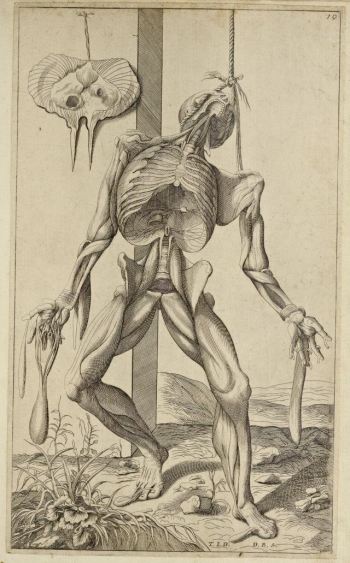
Domenico Bonaveri, Muscle Figure, pl. 10 from Notomie di Titiano (Bologna, ca, 1685–90), etching and engraving (Los Angeles: Getty Research Library).
The December 2016 issue of Print Quarterly includes several items relevant to the eighteenth century: articles concerning a redating of the Notomie di Titiano to c. 1685–90, a scrapbook in the Bibliotheca Thysiana in Leiden assembled in the late seventeenth or early eighteenth century, and a rediscovered drawing of 1669–80 by Jean Boulanger, as well as shorter pieces on the Dresden festivities of 1719 and prints and propaganda in the age of Napoleon.
Print Quarterly 33.4 (December 2016)
A R T I C L E S
• Monique Kornell, “A Dating for Domenico Bonaveri’s Notomie di Titiano,” pp. 379–91.
• Daphne E. Woutsa, “Exploring the Thysiana Scrapbook,” pp. 391–406.
• Angelamaria Aceto, “A Rediscovered Drawing by Jean Boulanger (1608–c.1680),” pp. 406–15,
N O T E S
• Madeleine Brook, “Constellatio Felix in 1719,” pp. 449–51.
• Philippe Bordes, “Prints and Propaganda in the Age of Napoleon,” pp. 453–55.
A full content list is available here»
Knole, Kent in the ‘NT Houses & Collections Annual, 2016’
Now available for free digitally, or as a hard copy through the National Trust:
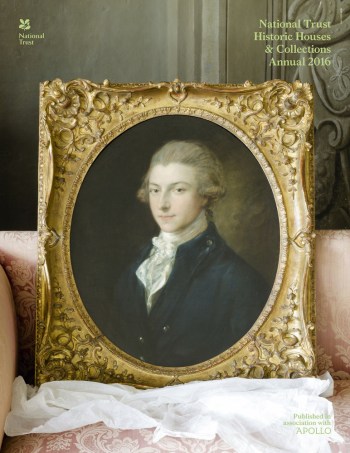 The National Trust Historic Houses & Collections Annual 2016, published in association with Apollo, is dedicated to Knole in Kent and includes these essays on eighteenth-century topics:
• Camilla Beresford, “The Bird House At Knole.” Considers a mid-18th-century gothic curiosity that once housed a remarkable collection of exotic birds.
• Christopher Rowell and Wolf Burchard, “The Third Duke of Dorset and the First Earl Whitworth as Diplomatic Patrons and Collectors.” Considers the many examples of furniture at Knole associated with the French court on the eve and aftermath of the French Revolution.
• John Chu, “Thomas Gainsborough’s Portrait of Louis-Pierre, Marquis de Champcenetz.” On how the Marquis, whose portrait by Gainsborough returns to Knole this year, found refuge and friendship in England (the portrait was at Knole by 1793 and remained there until 1930).
A full list is available here»
Call for Articles | French Porcelain, 1789–1918

Makers, Markets, and Museums: French Porcelain in the Long Nineteenth Century, 1789–1918
The French Porcelain Society Journal 7 (2018)
Proposals due by 7 April 2017
The French Porcelain Society Journal is the leading academic English-language journal on European ceramics and their histories, illustrated throughout in full colour. The society is pleased to announce the publication of Volume 6, Céramiques sans Frontières: The Transfer of Ceramic Designs and Technologies across Europe. Based on the society’s 2015 symposium, fourteen articles investigate the impact of French ceramic design on makers elsewhere in Europe and in Britain in the eighteenth and nineteenth centuries. These range from an analysis of the transfer of the Istoriato maiolica tradition from Italy to France in the late sixteenth century and an account by J.V.G. Mallet of the travels of Walther Ehrenfried von Tschirnhaus to an investigation of the links between Sèvres and Minton porcelain in the nineteenth century. For a full list of contents or to order, please consult the society’s website.
The editors now invite submissions for volume 7 of the journal, Makers, Markets, and Museums: French Porcelain in the Long Nineteenth Century, 1789–1918, to be published in 2018. From the dispersal of Sèvres porcelain from royal palaces and aristocratic collections after the French Revolution to the founding of outstanding collections of French porcelain in Britain and the United States and the establishment of new museums for the decorative arts, the nineteenth century was undoubtedly one of seismic change. It witnessed the growth of a flourishing London art market and new departures in collecting French eighteenth-century decorative art, all encouraged by the rise of the dealer. Innovation in design and manufacture was documented in a plethora of printed specialist publications, pattern books and popular journals. It is hoped that this volume will enlarge our understanding of this under-researched but important aspect of ceramic history.
The journal will include an article based on the 2016 Geoffrey de Bellaigue lecture given to the society by Dr Tom Stammers (Durham University) on “Baron Jean-Charles Davillier: A Paragon and Historian of Taste in Nineteenth-Century France.” Topics for consideration could include:
• Nineteenth-century French ceramics or those of other factories influenced by them
• Nineteenth-century collectors
• Methods of display in the nineteenth-century interior
• The role of new museums, exhibitions, and publications in advancing the study and collecting of French ceramics
• The dealer, the auction, and the art market
• New technical advances in ceramic production
• Connoisseurship
Submissions in the first instance should be a summary of no more than 750 words, with a brief description of the argument, a historiography and a note of the research tools and sources used. Please include a brief CV. The journal accepts articles in French as well as in English. The volume will comprise about 15 articles which will be peer reviewed by the editorial board and the FPS council of academic and museum specialists which includes: Dame Rosalind Savill, DBE, FBA, FSA (Curator Emeritus, The Wallace Collection, London); Oliver Fairclough, FSA, John Whitehead, FSA, Patricia Ferguson, Errol Manners, FSA, Diana Davis and Caroline McCaffrey-Howarth (University of Leeds). Articles should be no more than 6,000 words in length excluding endnotes. Up to 15 high-resolution images per article will be accepted. Please send abstracts as an e-mail attachment to: diana_davis@hotmail.co.uk by 7 April 2017. If your abstract is accepted, articles and images will be due by 29 September 2017.
Exhibition | Classicisms
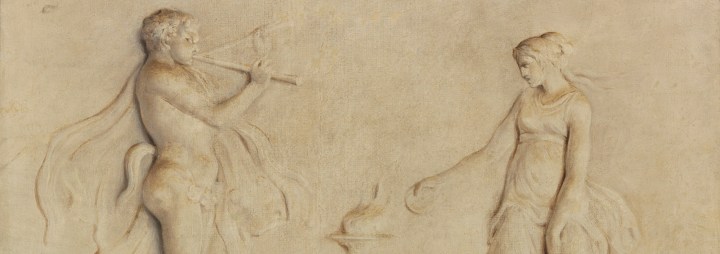
Tommaso Gherardini, Classical Relief (detail), 1765, oil on canvas (Chicago: Smart Museum of Art, Gift of the Collection of Edward A. and Inge Maser, 2008.23).
◊ ◊ ◊ ◊ ◊
From the Smart Museum of Art:
Classicisms
Smart Museum of Art, The University of Chicago, 16 February — 11 June 2017
Curated by Larry Norman and Anne Leonard
Classicism, as an aesthetic ideal, is often associated with a conventional set of rules founded on supposedly timeless notions such as order, reason, and decorum. As a result, it can be understood as rigid, outdated, or stodgy. But classicism is actually far from a stable concept—throughout history, it has given rise to more debate than consensus, and at times has been put to use for subversive ends.
Organized by the Smart Museum of Art and informed by an interdisciplinary planning process involving faculty members from across the University of Chicago, Classicisms explodes the idea of classicism as an unchanging ideal. The exhibition features 70 objects spanning diverse genres, eras, and media—paintings, ancient and modern sculpture, cast plaster replicas, and works on paper. Together with a scholarly catalogue, the exhibition traces classicism’s meanings across the centuries from varying artistic, cultural, and ideological perspectives to reveal a multifaceted concept with a complicated history.
◊ ◊ ◊ ◊ ◊
Distributed by The University of Chicago Press:
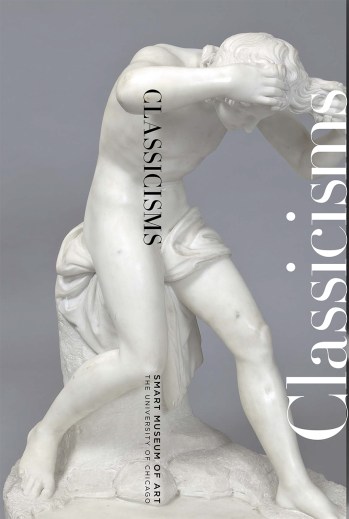 Larry F. Norman and Anne Leonard, ed., Classicisms (Chicago: Smart Museum of Art, The University of Chicago, 2017), 184 pages, ISBN: 978 0935 573572, $30. With essays by Richard T. Neer, Susanna Caviglia, Andrei Pop, Frederick A. de Armas, Benjamin Morgan, Jennifer Wild, Rebecca Zorach, and Glenn W. Most; and other contributions from Rainbow Porthé, Ji Gao, Esther Van Dyke, Caitlin Hoff, Rebecca Crisafulli, and James Nemiroff.
This volume explodes the idea of classicism as an unchanging ideal. Through essays and other contributions from an interdisciplinary group of scholars, it traces the shifting parameters of classicism from antiquity to the twentieth century, documenting an exhibition of seventy objects in various media from the collection of the Smart Museum of Art and other American and international institutions. With its impressive historical and conceptual reach—from ancient literature to contemporary race relations and beyond—this colorfully illustrated book is a dynamic exploration of classicism as a fluctuating stylistic and ideological category.
At Sotheby’s | Americana from the Caxambas Foundation
From Sotheby’s:
The Americana Collection of George S. Parker II from the Caxambas Foundation, Sale N09605
Sotheby’s New York, 19 January 2017
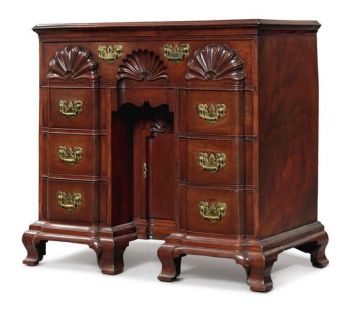
Lot 2089 — Queen Anne Carved and Figured Mahogany Block-and-Shell Kneehole Bureau Table, Providence, Rhode Island, ca. 1765 (estimate 300,000–500,000 USD).
The Collection of George S. Parker II from the Caxambas Foundation, previously on loan at the Chazen Museum of Art at the University of Wisconsin-Madison, will be offered on Thursday, 19 January 2017. The notable collection includes American and English furniture, silver, paintings and prints, with examples from some of the most distinguished artisans. Furniture highlights include a pair of Philadelphia side chairs attributed to Martin Jugiez; a rare Rhode Island Queen Anne shell-carved, block-front dressing table; an exceptional Philadelphia high chest of drawers attributed to John Pollard; and an important armchair by the same maker once owned by Charles Thomson. Great American portrait painters represented in the collection include John Singleton Copley, Gilbert Stuart, Thomas Sully, and John Trumbull among others. Finally, Mr. Parker’s silver collection comprises several examples from London silversmith Paul Storr and other English makers, including Ebenezer Coker and David Willaume.
New Book | Mediterranean Encounters
From Penn State UP:
Elisabeth Fraser, Mediterranean Encounters: Artists between Europe and the Ottoman Empire, 1774–1839 (University Park: The Pennsylvania State University Press, 2017), 320 pages, ISBN: 978 0271 073200, $90.
 In this volume, Elisabeth Fraser shows that artists and the works they created in the Mediterranean during the late eighteenth and early nineteenth centuries were informed by mutual dependence and reciprocity between European nations and the Ottoman Empire. Her rich exploration of this vibrant cross-cultural exchange challenges the dominant interpretation of European relations with the East during the period, revealing a shared world of fluid and long-sustained interactions.
Voyagers to and from the Ottoman Empire documented their journeys in prints, paintings, and lavishly illustrated travelogues; many of these helped define Europe’s self-identified role as heir to Ottoman civilizations and bolstered its presence in the Islamic Mediterranean and beyond. Fraser finds that these works illuminate not only how travelers’ experiences abroad were more nuanced than the expansionist ideology with which they became associated, but also how these narratives depicted the vitality of Ottoman culture and served as extensions of Ottoman diplomacy. Ottomans were aware of and responded to European representations, using them to defend Ottoman culture and sovereignty. In embracing the art of both cultures and setting these works in a broader context, Fraser challenges the dominant historiographical tradition that sees Ottoman artists adopting European modes of art in a one-sided process of ‘Europeanization’.
Theoretically informed and rigorously researched, this cross-cultural approach to European and Ottoman art sheds much-needed critical light on the widely disseminated travel images of the era—important cultural artifacts in their own right—and provides a fresh and inviting understanding of the relationships among cultures in the Mediterranean during an era of increasing European expansionism.
Elisabeth A. Fraser is Professor of Art History at the University of South Florida and the author of Delacroix, Art, and Patrimony in Post-Revolutionary France.
◊ ◊ ◊ ◊ ◊
C O N T E N T S
List of Illustrations
Acknowledgments
Introduction: Interpreting Travel in the Ottoman Mediterranean
Part I: Power in Question
1 Reading Choiseul in the Gaps of the Orientalist Archive
2 In the Shadow of les Grands: Cassas’s Orientalist Self-Fashioning
Part II: Ottoman Culture Abroad
3 The Translator’s Art: Mouradgea d’Ohsson, Ottoman Dragoman in Paris
4 Miniatures in Black and White: Melling’s Istanbul
Part III: Contradictory Contact
5 Skin of Nation, Body of Empire: Louis Dupré in Ottoman Greece
6 A Painter’s Renunciation: Delacroix in North Africa
Postscript
Notes
Bibliography
Index
Exhibition | Comforts, Cures, and Distractions

The farmhouse in which Bronson Alcott and family lived, now Fruitlands Museum, Harvard, Massachusetts (Photo: Wikimedia Commons, May 2009).
◊ ◊ ◊ ◊ ◊
Press release from Fruitlands Museum (via Art Daily). . .
Comforts, Cures, and Distractions: Winter at Fruitlands Museum
Fruitlands Museum, Harvard, Massachusetts, 29 November 2016 — 26 March 2017
Curated by Shana Dumont Garr and Rebecca Migdal
The Trustees of Reservations [a non-profit land conservation and historic preservation organization dedicated to preserving natural and historical places in Massachusetts] announced that Fruitlands Museum, its newest property, is presenting Comforts, Cures, and Distractions: Winter at Fruitlands Museum, running through March 26, 2017. The exhibition brings wintry New England into vivid focus with an assortment of art and artifacts from the museum’s diverse Transcendentalist, Shaker, Native American, and landscape painting collection.
“As daylight hours shorten and temperatures plummet, snow transforms the landscape, blanketing it with hushed beauty,” says Fruitlands Curator Shana Dumont Garr, who joined The Trustees in September. “During this season of winter wonder it becomes difficult to imagine how people made it through the cold weather in past centuries, before central heating and other modern conveniences. The objects assembled in Comforts, Cures, and Distractions will connect visitors to moments spent during winters past, and historical attempts to foster good health and good cheer, offering glimpses into wintertime daily life in 18th- and 19th-century New England when life was often so much more challenging day to day.”
The array of items also tells a unique story about Fruitlands’ collection, with Shaker scarves and mittens, a Woodlands Native American water warmer, or mokuk, and a 19th-century painting of ice skaters that captures the dramatic transformation of the landscape. There are skates, sleds, and snowshoes dating from the era when 11-year-old Louisa May Alcott described playing in the snow when she and her family lived in the Fruitlands Farmhouse in 1834, as well as a pair of pink and white mittens that are believed to have been used by the Alcott girls.
“Seeing items drawn from Fruitlands Museum’s varied collections provides an opportunity to see how different communities solve the same enduring problems of how to stay warm, fed, and entertained during the tough winter months,” adds Rebecca Migdal, who co-curated the exhibition with Dumont. Contemporary objects, such as dried herbs that follow Shaker healing traditions, a shovel, hat, and sled will help round out stories that follow themes of either survival or celebration and connect winters past with winters present.
Comforts, Cures, and Distractions is co-curated by Fruitlands Curator Shana Dumont Garr and Rebecca Migdal.
◊ ◊ ◊ ◊ ◊
Fruitlands Museum, founded in 1914 by Clara Endicott Sears, takes its name from an experimental utopian community led by Bronson Alcott and Charles Lane, which took place on the site in 1843. The campus includes
• The Fruitlands Farmhouse, the site of the experiment in communal living led by Alcott and Lane in 1843
• The Shaker Museum, the first Shaker museum in the country and home to the largest archive of Harvard Shaker documents in the world, housed in an historic building moved here from the Harvard Shaker community
• The Native American Museum, which houses a significant collection of artifacts that honor the spiritual presence and cultural history of the first Americans including New England Native culture and a survey of culture in the Plains, Southwest, and Northwest
• The Art Museum, including a collection of over 100 Hudson River School landscape paintings and over 230 nineteenth-century vernacular portraits, the second largest collection in the country along with a variety of rotating exhibits throughout the year
• The Wayside Visitor Center, exhibiting information on Fruitlands’ landscape and environment and providing classroom space for education programs and classes
Conference | CAA 2017, New York
105th Annual Conference of the College Art Association
New York Hilton Midtown, 15–18 February 2017
 The 2017 College Art Association conference takes place in New York, February 15–18, at the New York Hilton Midtown (1335 Avenue of the Americas). In introducing the eighteenth-century offerings for CAA 2016, I complained there were only four panels that seemed obviously relevant for the period. This year, again there are only a handful of sessions. Still, these look fabulous, and for anyone put off by the exorbitant registration fee (which can run as high as $495), bear in mind that there are other options ($20 per single time-slot session), which might be especially attractive for anyone in the New York area. We would love to have you join us!
Also, I’m glad to extend a warm invitation to HECAA members to join a group of HBA members on Saturday for a day trip to visit the recently re-opened Yale Center for British Art and to tour the exhibition Enlightened Princesses: Caroline, Augusta, Charlotte, and the Shaping of the Modern World with Lisa Ford, Assistant Director of Research. Space is limited. For more information or to reserve a spot, please email: CraigAshleyHanson@gmail.com. –CH
◊ ◊ ◊ ◊ ◊
Charting a New Course: Reorienting the Discourse of Early African American Art History
Wednesday, 15 February 2017, 3:30–5:00, Clinton Suite, 2nd Floor
Chairs: Mia L. Bagneris (Tulane University) and Anna Arabindan-Kesson (Princeton University)
• Jennifer Van Horn (George Mason University), Stealing a Glance: Enslaved Viewers in the Plantation South
• Key Jo Lee (Yale University), Face(ing) the Impossibility of Recovery: Tracing the Affective Terrain of the Anonymous in African American Photography
• Phillip Troutman (The George Washington University), Techniques of the Engraver: Patrick Henry Reason’s African American Portraits, 1830s–1860s
◊ ◊ ◊ ◊ ◊
Editing Journals in a Digital Age, Association of Research Institutes in Art History (ARIAH)
Thursday, 16 February 2017, 8:30–10:00am, East Ballroom, 3rd Floor
Chairs: Sarah Victoria Turner (The Paul Mellon Centre for Studies in British Art) and Martina Droth (Yale Center for British Art)
• Samuel Bibby, Reflections on Editing Art History
• Petra ten-Doesschate Chu, Reflections on Editing Nineteenth-Century Art Worldwide
• Kirk Ambrose, Reflection on Editing The Art Bulletin
• Alison M. Kettering, Reflections on Editing the Journal of Historians of Netherlandish Art
• Discussant: Gail Feigenbaum (Getty Research Institute)
◊ ◊ ◊ ◊ ◊
Transglobal Collecting: Co-Producing and Re-visioning British Art Abroad (HBA)
Thursday, 16 February 2017, 3:30–5:00, Gramercy B/East, 2nd Floor
Chair: Julie Codell (Arizona State University)
• Kathleen Stuart (Denver Art Museum), The Berger Collection at the Denver Art Museum: British Art in the Rocky Mountain West
• Elizabeth A. Pergam (Sotheby’s Institute of Art, New York), The British Model of Collecting: Importing British Art to America
• Andrew Stephenson (University of East London), ‘A Thing That Racially Belongs to Us More Than Any of the Latin Styles’: Collecting and Displaying English Art in Private Collections in the United States, c.1890–1926
• Nancy Scott (Brandeis University), Paintings across the Pond: Anchoring J. M. W. Turner in American Collections
◊ ◊ ◊ ◊ ◊
Studies in Eighteenth-Century Style
Friday, 17 February 2017, 8:30–10:00am, Gramercy B/East, 2nd Floor
• Josefine Baark (Lingnan University), ‘The King Stared at the Figure in Astonishment’: Chinese Nodding-Head Figures in Early Modern Denmark
• Andrea Bell (Parsons School of Design, The New School), The Geometrical Landscape: Architecture and the Severity of Style in Rome
• Tracy Ehrlich (The New School), Fashioning the Architectural Body in Eighteenth-Century Rome
• Kristin O’Rourke (Dartmouth College), The Toilette: Dressing in Public and Private
◊ ◊ ◊ ◊ ◊
Superpowers in the Global Eighteenth Century: Empire, Colonialism, and Cultural Contact
Friday, 17 February 2017, 10:30–12:00, Beekman Parlor, 2nd Floor
Chair: Tara Zanardi (The Metropolitan Museum of Art)
• Joanna Gohmann (Walters Art Museum), A Sign of Empire: The Pineapple in the Colonial British World
• Jocelyn Anderson (Independent Scholar), ‘The Most Remarkable Places’: Military Views of North America and the Caribbean in the Mid-Eighteenth Century”
• Amelia Rauser (Franklin and Marshall College), Satanic Mills, Indian Muslin, and the Materiality of Neoclassical Dress in the 1790s
• Discussant: Michael Yonan (University of Missouri)
The session is dedicated to the memory of Mary Sheriff (1950–2016).
◊ ◊ ◊ ◊ ◊
Yale Center for British Art and Paul Mellon Center Reception
Friday, 17 February 2017, 12:00–1:30, East Ballroom Foyer, 3rd Floor
◊ ◊ ◊ ◊ ◊
Art and Caricature
Friday, 17 February 2017, 5:30–7:00, Gramercy A/West, 2nd Floor
Chair: Phoebe Wolfskill (Indiana University)
• Anne L. Williams (Virginia Commonwealth University), Early Modern Multivalence: Caricature, Subversion, and Veneration in Sacred Art
• Richard Taws (University College London), The Smiling Face of Terror: Etienne Béricourt’s French Revolution
• Matthew Von Vogt (Indiana University), Pasolini’s Authorial Caricature: Reconsidering Authorship in the Intellettuale
• Corina L. Apostol (Rutgers University), Aggravating the Powerful: Political Caricature Now and Then
◊ ◊ ◊ ◊ ◊
The Netherlands and the Global Baroque, Historians of Netherlandish Art (HNA)
Saturday, 18 February 2017, 8:30–10:00am, Trianon Ballroom, 3rd Floor
Chair: Caroline Fowler (Yale University)
• Adam Eaker (The Metropolitan Museum of Art), Suriname on Display
• Christina An (Boston University), Art beyond Price or Place: Vermeer, Asia, and the Poetics of Painting
• Marsely Kehoe (Michigan State University), A Global Dutch Architecture?: Hybridity in Curaçao’s Eighteenth-Century Merchant Homes
◊ ◊ ◊ ◊ ◊
Key Conversation: Mary Sheriff (1950–2016): A Memorial Session
Saturday, 18 February 2017, 12:15–1:15, Madison Suite, 2nd Floor
Chair: Francesca Fiorani (University of Virginia)
Join this session to remember Mary Sheriff. Come together, share memories, and celebrate her achievements.
◊ ◊ ◊ ◊ ◊
Graphic Growth: Discovering, Drawing, and Understanding Nature in the Early Modern World
Saturday, 18 February 2017, 1:30–3:00, Madison Suite, 2nd Floor
Chairs: Catherine Girard (Williams College) and Jaya Remond (Max Planck Institute for the History of Science)
• Madeleine C. Viljoen (The New York Public Library), Ornament’s Science
• Katherine M. Reinhart (University of Cambridge), Graphic Practice and Natural Philosophy in the Early Paris Académie Royale des Sciences
• Elizabeth Athens (Worcester Art Museum), The Animating Mark: William Bartram’s Drawings from Life
◊ ◊ ◊ ◊ ◊
Day Trip to New Haven for the Yale Center for British Art
Saturday, 18 February 2017, 10:00am–5:00pm
Opportunity to visit the recently re-opened Yale Center for British Art and to tour the exhibition Enlightened Princesses: Caroline, Augusta, Charlotte, and the Shaping of the Modern World with Lisa Ford, Assistant Director of Research. Space is limited. For more information or to reserve a spot, please email: CraigAshleyHanson@gmail.com.
◊ ◊ ◊ ◊ ◊
Note (added 25 January 2017) — The original posting did not include the memorial session for Mary Sheriff.
Note (added 6 February 2017) — The original posting did not include the session on editing journals in a digital age.
New Website | Early Modern Typography

I imagine some Enfilade readers will find Early Modern Typography useful (it includes the eighteenth century); it’s also interesting to see a blog used as an index for a Flickr collection of images. As posted several days ago on the SHARP listserv (with permission from Paul Dijstelberge for resposting). –CH
◊ ◊ ◊ ◊ ◊
Dear Friends,
On the first day of the year I want to present a new website: earlymoderntypography.com. I have been adding images to a Flickr collection for 7 years, but the access became more and more difficult, due to the sheer amount of images. Early Modern Typography functions as an index to the Flickr website of 70,000 images of type, historiated initials, images, pages, bindings, and so on. The Flickr collection functions as a repository containing the ‘rough’ material for a book I am writing on the 16th-century European decorated initials (to be finished in 2017, with a separate website with advanced search possibilities).
The Flickr site contains material of 800+ printers and is growing on a daily basis. In time I hope to use ICONCLASS and advanced image search to create an instrument for the history of the book in the broadest sense. In 2017 I hope to digitize the archives of the late Paul Valkema Blouw that contains all 16th-century Dutch printers from 1540 to 1600 and to start on the Dutch late 17th and 18th centuries. Dutch books can be rather boring so I will add initials and images from other European printers too, mainly from the 16th and 18th centuries.
There is another page that might be of interest: illustrations from early modern books. I am working on Ovid’s Metamorphoses and on our great collections of topography and medicine at the Allard Pierson / Special Collections at the University of Amsterdam. Ovid is part of a project to write a thesis on the Dutch editions of the Metamorphoses.
I hope 2017 will be a good year. Like Candide I will spend it with cultivating my garden, but not without looking out for our civilization in general.
Best,
Paul Dijstelberge
University of Amsterdam / Allard Pierson – Special Collections










 Enfilade
leave a comment