Peter Kerber on Blasphemy, Irenicism, and Collecting
From the Mellon Centre:
Peter Björn Kerber | Blasphemy, Irenicism, and Collecting: The Improbable Friendship of Francis Dashwood and Antonio Niccolini
Paul Mellon Centre for Studies in British Art, London, 21 February 2018
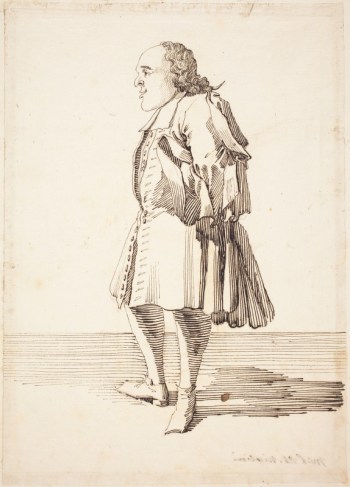
Pier Leone Ghezzi, Antonio Niccolini, ca. 1725, pen and ink over graphite on laid paper, 306 × 218 mm (Washington, D.C., National Gallery of Art, Joseph F. McCrindle Collection, 2009.70.126).
In February 1740, the cardinals convened in Rome to elect a successor to Pope Clement XII. In an open mockery of the ritual, Sir Francis Dashwood (1708–1781) and a group of fellow Grand Tourists staged a parody of the conclave. The irreverent young Englishman impersonated Pietro Ottoboni, Dean of the College of Cardinals and one of the greatest art collectors of his day. At the same time and in spite of the public scandal erupting over his blasphemous behaviour, Dashwood struck up a friendship with Antonio Niccolini (1701–1769), a Florentine nobleman closely connected to the family of the recently deceased pontiff and friend of the soon-to-be-elected Benedict XIV.
The two men were multifaceted characters: Dashwood was a notorious rake fond of satirising religious ceremonies, yet he compiled (together with Benjamin Franklin) and privately printed a simplified version of the Book of Common Prayer. Niccolini, a lawyer and theologian charged with a secret irenic mission to reconcile the Church of Utrecht with the Holy See, was an important behind-the-scenes contributor to the monumental Museum Florentinum, Anton Francesco Gori’s catalogue of Florentine antiquities and paintings. While spending almost two years in London in 1746–48, Niccolini frequented major collectors such as Henry Howard, 4th Earl of Carlisle, and Sir Hans Sloane in addition to Dashwood. This paper will retrace the intellectual, religious and artistic dimensions of the ill-matched pair’s twenty-year friendship and consider how Niccolini’s influence is reflected in the art collection Dashwood assembled at West Wycombe Park.
Wednesday, 21 February 2018, 18:00–20:00, at the Paul Mellon Centre for Studies in British Art, Bedford Square, London. Book here.
Peter Björn Kerber is a curator at Dulwich Picture Gallery and author of Eyewitness Views: Making History in Eighteenth-Century Europe. As a member of the Paul Mellon Centre’s research project Collecting and Display: The British Country House, his focus is the art collection at West Wycombe Park.
Christopher Ridgway on Picture Displays at Castle Howard

From the Mellon Centre:
Christopher Ridgway | The Lives and After-lives of Picture Displays at Castle Howard
Paul Mellon Centre for Studies in British Art, London, 28 February 2018
Whilst tracing the whereabouts of paintings in the Castle Howard collection at a given moment is a relatively straightforward matter, comprehending the changing relationships between individual pictures (and artists), and their neighbours on the walls gives rise to more complicated enquiries. Collections and their hangs are always in flux, but just what are the motives for, and consequences of, moving pictures?
Wednesday, 28 February 2018, 18:00–20:00, at the Paul Mellon Centre for Studies in British Art, Bedford Square, London. Book here.
Christopher Ridgway is curator at Castle Howard and has lectured and published on its architecture, collections, landscapes, and archives. He is Chair of the Yorkshire Country House Partnership, and Adjunct Professor at Maynooth University. His most recent publication, co-edited with Terence Dooley and Maeve O’Riordan, is Women and the Country House in Ireland and Britain (Four Courts Press, 2018).
Martin Postle on Portraits by Reynolds and Northcote
From the Mellon Centre:
Martin Postle | Patrons and Painters: Portraits by Joshua Reynolds and James Northcote at Trewithen, Cornwall
Paul Mellon Centre for Studies in British Art, London, 7 March 2018

James Watson, after Sir Joshua Reynolds, The Rev. Mr. Zachariah Mudge, Prebend of Exeter &c., mezzotint (New Haven: Yale Center for British Art, Paul Mellon Collection).
Among the pictures in the collection at Trewithen, Cornwall are two portraits by Sir Joshua Reynolds and four by his pupil James Northcote. The portraits feature for the most part members of the Mudge family and were painted in Plymouth—the home of the Mudges and the birthplace of both Reynolds and Northcote. The group comprises a portrait of the cleric Zachariah Mudge and his wife Kitty, by Joshua Reynolds; portraits by Northcote of the philosopher William Ferguson and Thomas Mudge; as well as Northcote’s self portrait and his copy of Reynolds’s portrait of John Mudge. These portraits remain virtually unknown beyond the confines of Trewithen and those acquainted with the house and its collection. Nor have they been subjected to any significant research in the modern period. The intention in this talk is to explain the context for their creation and the light they shed on an important source of local patronage, which had a profound impact on the careers of Reynolds and his pupil James Northcote.
Wednesday, 7 March 2018, 18:00–20:00, at the Paul Mellon Centre for Studies in British Art, Bedford Square, London. Book here.
New Book | Touring and Publicizing England’s Country Houses
From Bloomsbury Academic:
Jocelyn Anderson, Touring and Publicizing England’s Country Houses in the Long Eighteenth Century (London: Bloomsbury Academic, 2018) 256 pages, ISBN: 978 15013 34979, £86.
 Over the course of the long 18th century, many of England’s grandest country houses became known for displaying noteworthy architecture and design, large collections of sculptures and paintings, and expansive landscape gardens and parks. Although these houses continued to function as residences and spaces of elite retreat, they had powerful public identities: increasingly accessible to tourists and extensively described by travel writers, they began to be celebrated as sites of great importance to national culture. This book examines how these identities emerged, repositioning the importance of country houses in 18th-century Britain and exploring what it took to turn them into tourist attractions. Drawing on travel books, guidebooks, and dozens of tourists’ diaries and letters, it explores what it meant to tour country houses such as Blenheim Palace, Chatsworth, Wilton, Kedleston and Burghley in the tumultuous 1700s. It also questions the legacies of these early tourists: both as a critical cultural practice in the 18th century and an extraordinary and controversial influence in British culture today, country-house tourism is a phenomenon that demands investigation.
Jocelyn Anderson completed her PhD at the Courtauld Institute of Art in 2013. Subsequently, she held a postdoctoral fellowship at the Paul Mellon Centre for Studies in British Art (2014) and the post of Early Career Lecturer in Early Modern Art at the Courtauld (2015–16). She has recently received grants from the Marc Fitch Fund and the Society of Architectural Historians of Great Britain, and she is now an independent scholar based in Toronto, Canada.
C O N T E N T S
List of Plates
List of Figures
List of Tables
Acknowledgments
Introduction: ‘Come Here for Entertainment and Instruction’: Country Houses Exhibited to the Public
1 ‘For the Numerous Strangers Who Visit’: Tourists’ Itineraries and Practices
2 ‘A Sumptuous Pile of Building’: Remaking the Sights and Spaces of the House
3 ‘Eminent in Public Estimation’: The Transformation of Country Houses’ Paintings and Sculptures
4 ‘A Degree of Taste and Elegance’: Commenting on Country Houses’ Interiors
5 ‘The Beauties of Nature’: Descriptions of Country-House Gardens and Parks
Conclusion: ‘The Visitor of Today’: Legacies of 18th-Century Country-House Tourism
Appendix: Country-house Guidebooks
Bibliography
Index
New Book | Raynham Hall
From ACC Distribution:
Michael Ridgdill, Raynham Hall: An English Country House Revealed (Woodbridge: Antique Collectors Club, 2018), 224 pages, ISBN: 978 18514 98604, £30.
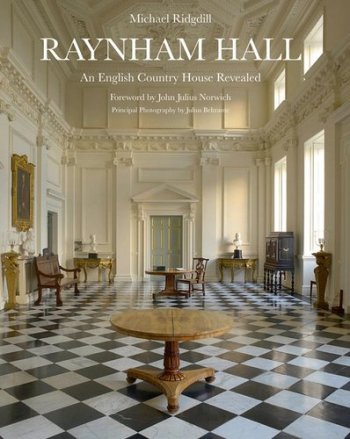 On the eve of its 400th anniversary, Raynham Hall is experiencing a renaissance. The present Marquess and Marchioness Townshend are breathing new life into this ancient family house, which has been passed down through generation after generation, and are sharing its treasures with the public for the first time.
As one of the earliest examples of neo-Palladian architecture in England, and with significant William Kent interiors, Raynham Hall is now the focal point of an entire book devoted to its evolution as a splendid country house and as the seat of one of England’s most important families.
This book serves as the first comprehensive survey of the house, its history, its evolution, and divulges the history of the Townshend family, whose impact on British politics has been felt since before the sixteen hundreds.
Michael Ridgdill founded the American Friends of British Art in 2003, with the mission to help restore and preserve historic art and architecture in Great Britain. Based in Florida, his summers are spent in England, exploring historic sites and meeting with key individuals in the heritage sector. As the charity’s head, Dr. Ridgdill works to promote American appreciation for Britain’s historic treasures, which is achieved by hosting guest lecturers from the UK to give talks in the US and by guiding Americans on country house tours across England. Dr Ridgdill is a native Floridian with a doctorate in Clinical Psychology. His lifelong passion for architecture and history has been the driving force behind the success of the American Friends of British Art, whose supporters are spread across the United States.
New Book | Women and the Country House in Ireland and Britain
From Four Courts Press:
Terence Dooley, Maeve O’Riordan, and Christopher Ridgway, eds., Women and the Country House in Ireland and Britain (Dublin: Four Courts Press, 2018), 320 pages, ISBN: 978 184682 6474, 30€.
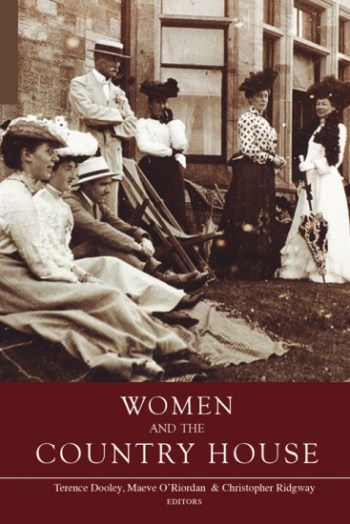 In recent years the role of women in country houses and estates across Ireland and the UK has been the focus of greater attention. Chatelaines, mothers, wives, daughters, widows, sisters, housekeepers and maids were ever-present figures in the microcosm of the country house. New research has begun to reveal the extent of their involvement in managing households and estates, influencing design, adopting public roles, championing good causes, as well as raising families, and committing their thoughts to paper in literary expression. This volume of essays, many of which draw on hitherto unseen family archives, will bring new perspectives to our understanding of the country house as a place where many women often held powerful roles.
Terence Dooley is director of the Centre for Historic Irish Houses and Estates, Maynooth University. Maeve O’Riordan is coordinator of Women’s Studies at University College Cork. Christopher Ridgway is curator at Castle Howard in Yorkshire.
C O N T E N T S
• Amy Boyington, The Architectural Endeavours of the Widowed Jemima Yorke, Marchioness Grey
• Kerry Bristol, Sisters and Sisters-in-law at Nostell Priory, West Yorkshire
• Philip Bull, Five Women of Monksgrange, Co. Wexford
• Anne Casement, The Social, Industrial and Land-owning Worlds of Frances Anne Vane-Tempest
• Jonathan Cherry and Arlene Crampsie, The Women of Ulster’s Country Houses and the Organization of Ulster Day
• Caroline Dakers, Madeline Wyndham of Clouds and Mabel Morrison of Fonthill: Two Victorian Ladies of Wiltshire
• William Fraher, An English Governess in Ireland during World War One
• Judith Hill, Catherine Maria Bury of Charleville Castle, Co. Offaly, 1800–12
• Edmund Joyce, Lady Harriet Kavanagh, 1800–1885: An Influential Chatelaine
• Ruth Larsen, Elite Women, Sorority and the Life Cycle, 1770–1860
• Anna Pilz, Lady Gregory, Forestry and the Domesticated Landscape
• Lowri Ann Rees, Patriarchal Perceptions of Welsh Rural Protest from the Letters of Miss Jane Walters, 1843–44
• Ciarán Reilly, The Country House and the Great Famine: Mildred Darby’s novel, The Hunger
• Regina Sexton, Elite Women and Their Recipe Books: The Case of Dorothy Parsons and her Booke of Choyce Receipts
• Brendan Twomey, Louisa Conolly’s Letters to Her Sister Sarah Bunbury
• Fiona White, Louisa Moore of Moorehall: A Life in Letters
Call for Papers | Architectural Patronage in an Age of Reform
From H-ArtHist:
Architectural Patronage in an Age of Reform, 1760–1840
Lambeth Palace Library, London, 6–7 September 2018
Proposals due by 11 March 2018
2018 marks the bicentenary of the passing of the Church Building Act, the first nation-wide non-military exercise of architectural patronage by central government in England and Wales. To commemorate and contextualise this event and place it in global comparative perspective, there will be an international conference to be held at Lambeth Palace Library on 6–7 September 2018.
Keynote speakers represent the international scope of the conference:
• Shirine Hamadeh (Koç University, Turkey), author of The City’s Pleasures: Istanbul in the Eighteenth Century (Seattle and London: The University of Washington Press, 2007)
• Freek Schmidt (Vrije Universiteit Amsterdam), author of Passion and Control: Dutch Architectural Culture of the Eighteenth Century (Farnham: Ashgate, 2016)
• Henriette Steiner (University of Copenhagen), author of The Emergence of a Modern City: Golden Age Copenhagen 1800–1850 (London and New York: Routledge, 2014)
• Richard Wittman (University of California at Santa Barbara), author of Architecture, Print Culture, and the Public Sphere in Eighteenth-Century France (London and New York: Routledge, 2007)
20-minute papers are invited on all aspects of architectural patronage in the period 1760–1840, in Great Britain and beyond. Priority may be given to papers addressing issues of State patronage at national or local level and/or papers that look beyond case studies of individual buildings/patrons. We are also very keen for speakers to represent a range of disciplines, including history, literature, music, performance studies etc.
Questions to be addressed include, but are not limited to
• Role of new and/or non-traditional groups as patrons (professional bodies, artisan organisations, gentlemanly societies, women etc)
• Patronage of new building types
• New models of patronage (subscriptions, tontines, new forms of taxation etc)
• The role of patronage in the emergence of general contracting
• The patron/architect relationship
• Communication and decision-making among corporate patrons
• Architectural patronage as discourse and the significance of architectural patronage to those involved
• Patronage networks
• Architectural patronage in colonial contexts and/or beyond the Anglophone world
Abstracts of 300 words plus CV should be sent to Alexandrina.Buchanan@liverpool.ac.uk by 11 March 2018. The conference is supported by an AHRC Networking Grant, Architecture and Society in an Age of Reform, 1760–1840. The University of Liverpool would also like to acknowledge the support of Lambeth Palace Library and the Georgian Group.
New Book | Interacting with Print
From The University of Chicago Press:
The Multigraph Collective, Interacting with Print: Elements of Reading in the Era of Print Saturation (Chicago: The University of Chicago Press, 2018), 416 pages, ISBN: 978 022646 9140, $45.
 A thorough rethinking of a field deserves to take a shape that is in itself new. Interacting with Print delivers on this premise, reworking the history of print through a unique effort in authorial collaboration. The book itself is not a typical monograph—rather, it is a ‘multigraph’, the collective work of twenty-two scholars who together have assembled an alphabetically arranged tour of key concepts for the study of print culture, from Anthologies and Binding to Publicity and Taste. Each entry builds on its term in order to resituate print and book history within a broader media ecology throughout the eighteenth and nineteenth centuries. The central theme is interactivity, in three senses: people interacting with print; print interacting with the non-print media that it has long been thought, erroneously, to have displaced; and people interacting with each other through print. The resulting book will introduce new energy to the field of print studies and lead to considerable new avenues of investigation.
The Multigraph Collective, emanating from the Montreal-based Interacting with Print research group, comprises: Mark Algee-Hewitt, Angela Borchert, David Brewer, Thora Brylowe, Julia Carlson, Brian Cowan, Susan Dalton, Marie-Claude Felton, Michael Gamer, Paul Keen, Michelle Levy, Michael Macovski, Nicholas Mason, Nikola von Merveldt, Tom Mole, Andrew Piper, Dahlia Porter, Jonathan Sachs, Diana Solomon, Andrew Stauffer, Richard Taws, and Chad Wellmon.
C O N T E N T S
List of Illustrations
Preface; or, What Is a Multigraph?
Introduction
1 Advertising
2 Anthologies
3 Binding
4 Catalogs
5 Conversations
6 Disruptions
7 Engraving
8 Ephemerality
9 Frontispieces
10 Index
11 Letters
12 Manuscript
13 Marking
14 Paper
15 Proliferation
16 Spacing
17 Stages
18 Thickening
Epilogue
Works Cited
About the Multigraph Collective
Index
Zeitschrift für Kunstgeschichte 80.4 (2017), Penser le rococo
The current issue of Zeitschrift für Kunstgeschichte focuses on the theme ‘Reconsidering the Rococo’, the subject of a November 2015 conference at the University of Lausanne. Abstracts (in English) are available as a PDF file here.
Zeitschrift für Kunstgeschichte 80.4 (2017), Penser le rococo
Guest edited by Carl Magnusson and Marie-Pauline Martin
A R T I C L E S
• Carl Magnusson, “Le rococo, une construction historiographique: introduction”
• Marie-Pauline Martin, “‹Rococo›: du jargon à la catégorie de style”
• Catherine Thomas-Ripault, “Evasion temporelle et fantaisie créatrice: usage des peintures du xviiie siècle dans les fictions romantiques”
• Etienne Tornier , “‹This new-born word is rococo›: Généalogie et fortune du rococo aux États-Unis”
• Jean-François Bédard, “La vitalité du décor : Fiske Kimball, du rococo au Colonial Revival”
• Carl Magnusson, “Le rococo est-il décoratif ?”
• David Pullins, “‹Quelques misérables places à remplir›: Locating Shaped Painting in Eighteenth-Century France
• Bérangère Poulain, “Rococo et fugacité du regard: émergence et modifications de la notion de ‹papillotage›”
R E V I E W S
• Paul Williamson, Review of Laurence Terrier Aliferis, L’imitation de l’Antiquité dans l’art médiéval, 1180–1230 (Répertoire iconographique de la littérature du Moyen Âge, Études du RILMA, vol. 7, 2016).
• Christoph Martin Vogtherr, Review of Jérôme Delaplanche, Un tableau n’est pas qu’une image: La reconnaissance de la matière de la peinture en France au XVIIIe siècle (2016).
• Martin Dönike, Review of Johann Joachim Winckelmann, Monumenti antichi inediti spiegati ed illustrati, Roma 1767, edited by Adolf H. Borbein and Max Kunze (2011) | Johann Joachim Winckelmann, Monumenti antichi inediti spiegati ed illustrati, Roma 1767, edited by Adolf H. Borbein, Max Kunze, and Axel Rügler (2015).
• Anna Degler, Review of Guillaume Cassegrain, La coulure: Histoire(s) de la peinture en mouvement, XIe–XXIe siècles (2015).
Call for Papers | Sequitur, Issue 4 (Spring 2018): Extra
Sequitur 4.2 (Spring 2018): Extra
Submissions and Proposals due by 12 February 2018
The editors of Sequitur, a graduate student journal published by the Department of History of Art & Architecture at Boston University, invite current graduate students in art history, architecture, fine arts, and related fields to submit content on the theme of Extra for the Spring 2018 issue.
The concept of Extra can positively or negatively imply an unexpected leftover surprise or the added necessary ingredient after a deadline, limit, quality, or quantity has been reached. In the context of art making, the extra, the extraneous, and the accessory can provide much-needed solutions, present unanticipated problems, or symbolize intentional gestures meant to charm, endear, appease, or potentially destroy. As a frame for art historical inquiry, lastly, the concept of ‘extra’ might shed light on the eccentricities of artists, architects, subjects, patrons, collectors, or institutions—whether reflected in the style and content of art and architecture or their display and reception.
Possible subjects may include (but are not limited to): architectural additions; eccentric subject matter or makers; modifications to structures or works of art; accessories in fashion and design; outsider art, the avant-garde; the cult of personality; the additive, the accumulative, augmentation, the overdone, and the sensational; the sequential and/ or its disruption; and temporality studies. We welcome submissions addressing art, architecture, visual culture, or material culture from all time periods (ancient to contemporary) and geographical areas (including Asia, the Americas, and Africa). We encourage submissions that take advantage of the online format of the journal. Previous issues can be found here.
Founded in 2014, SEQUITUR is an online biannual scholarly journal dedicated to addressing events, issues, and personalities in art and architectural history. SEQUITUR engages with and expands current conversations in the field by promoting the perspectives of graduate students from around the world. It seeks to contribute to existing scholarship by focusing on valuable but oft-overlooked parts of art and architectural history.
We invite full submissions for the following pieces:
• Featured essays (1500 words) — Essays must be submitted in full by the deadline below to be considered for publication. Content is open and at the discretion of the author, but should present original material that is suitable to the stipulated word limit. Please adhere to the formatting guidelines available here.
• Visual essays — An opportunity for M.Arch. or M.F.A. students to showcase a selection of original work. The work must be reproducible in a digital format. Submissions should include jpegs of up to ten works, and must be prefaced by an introduction or artist’s statement of 250 words or less. All images must be captioned and should be at least 500 DPI.
We invite proposals (200 words max) for the following pieces :
• Exhibition reviews (500 words) — Exhibitions currently on display or very recently closed are especially sought.
• Book or exhibition catalogue reviews (500 words) — Reviews of recently published books and catalogues are especially sought.
• Interviews (750 words) — Preference may be given to those who can provide audio or video recordings of the interview.
• Field reports/Research spotlights (500 words) — This is an opportunity for students conducting research to summarize and share their findings and experiences in a more casual format than a formal paper.
All submissions and proposals are due February 12.
• Please direct all materials to sequitur@bu.edu.
• Text must be in the form of a Word document, and images should be sent as jpeg files.
• Please provide a recent CV.
• Please include ‘SEQUITUR Spring 2018’ and type of submission/proposal in the subject line, and your name, institution and program, year in program, and contact information in the body of the email.
Authors will be notified of the acceptance of their submission or proposal no later than February 23 for May 1 publication. Please note that authors are responsible for obtaining all image copyright releases prior to publication. If you have any questions, please do not hesitate to contact the SEQUITUR editors at sequitur@bu.edu. We look forward to receiving your proposals.
The SEQUITUR Editorial Team
Joseph, Alison, Kimber, Lauren, & Kelsey










 Enfilade
leave a comment