Exhibition | Biting Wit and Brazen Folly: British Satirical Prints
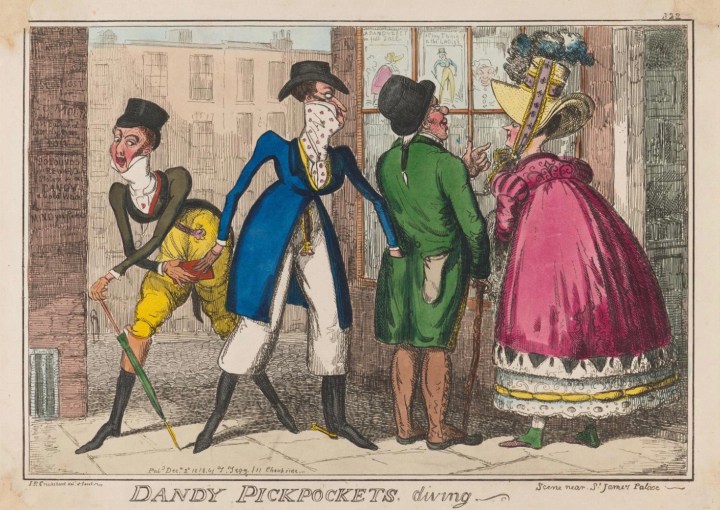
Isaac Robert Cruikshank, Dandy Pickpockets, Diving, 1818 hand-colored etching
(Philadelphia Museum of Art, 1974-179-250)
◊ ◊ ◊ ◊ ◊
Now on view in Philadelphia:
Biting Wit and Brazen Folly: British Satirical Prints, 1780s–1830s
Philadelphia Museum of Art, 4 May — 22 August 2018
Printed satirical caricatures were inescapable in London during the 1700s and 1800s. Often lighthearted and cheeky upon first glance, the images could also be mulled over and picked apart at leisure. A bawdy scene or grotesque facial expression instantly amused, while closer study revealed deeper literary or political references. Whether a fashionable dandy or a poor chimney sweep, no one escaped the scrutiny of caricaturists. This exhibition reveals the widespread appeal of caricature in Georgian England and demonstrates the ways in which such images teased and provoked audiences. Featuring over sixty brightly colored etchings from the Museum’s large collection of British satirical prints, it presents images of the everyday with a riot of color and a roar of laughter.
Browse all the works in the exhibition»
Life in London
London in the late 1700s and early 1800s was a chaotic place marked by social upheaval. People of every class—from the chimney sweep to the Duke of Wellington—witnessed dramatic changes all around them. Their struggles and triumphs did not escape the sharp eye of caricaturists, who were quick to distill their follies and successes into humorous yet arresting images.
Fashion Foibles
In the 1700s and 1800s, innovations in British textile production, along with increased travel between England and France, contributed to a boom in new fashions for both men and women. Caricaturists delighted in exaggerating trendy cinched waists, high collars, and big beards and lampooning the blind following of these fads. In their images, dresses become impossibly large, elaborate headpieces swallow the wearer, and common sense is thrown by the wayside in pursuit of youth and beauty.
Fiendish Ailments & Dubious Doctors
Health and hygiene in London in the late 1700s and early 1800s were dismal. In a city lacking effective medicine and an adequate sewage system, disease was rampant. Because illness was a devastating reality for all classes, it became a fitting subject for satirical artists. Caricatures confronted the corruption of quack doctors and the public’s obsession with cure-all potions. They also made light of common illnesses like gout and colic while showing the darker side of living under physical and mental distress.
Exhibition | Disappear Here: On Perspective
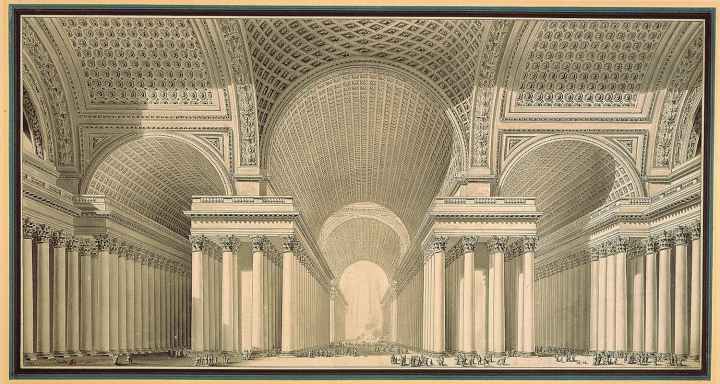
Étienne-Louis Boullée, Project for a Metropolitan Cathedral in the Form of a Greek Cross with a Domed Centre, 1782
(London: RIBA Collections)
◊ ◊ ◊ ◊ ◊
Now on view at RIBA:
Disappear Here
On Perspective and Other Kinds of Space: A Commission by Sam Jacob Studio
RIBA, London, 2 May – 7 October 2018
Proportion, distortion, geometry, distance, power, the infinite, the divine—perspective traverses truth and illusion, linking the disciplines of art, architecture, and mathematics. For this new exhibition, sponsored by Arper and Colt, RIBA has commissioned Sam Jacob Studio to explore how perspective drawing has been applied to the art of building for centuries and used as a tool to evoke illusory architectural spaces.
The Disappear Here installation will include original drawings and early writings by some of the most talented designers in history. Visitors will become active participants within the space where deceptive murals, playful architectural structures, and a newly commissioned film will trace the lineage of perspective from the Renaissance to present day. In a further twist, the system of perspective will dictate how everything in the gallery is arranged.

Unknown designer, Design for a Ceiling with Columns and Coffered Arches, Italy, ca. 1700 (London: RIBA Collections).
Speaking about the commission, Sam Jacob: “Since its invention in the 15th century perspective has been a fundamental tool in the way we imagine space and design architecture. But perspective is also a kind of tyranny too, forcing its own logic onto the worlds we create. This commission gave us the opportunity to explore how perspective has not only been used to illustrate the world but also how it creates and organises the world. This continues the studio’s longstanding interest in how ways of drawing shape the architecture we create. For this installation we wanted to create a space where visitors can experience the essentially illusory nature of perspective and question the making and breaking of rules.”
Sam Jacob Studio was invited by RIBA to draw on RIBA’s historic collections for inspiration to create a site-specific installation. The Studio has selected a diverse range of items, from rare books dating back to the Renaissance to contemporary works. Highlights vary from John Smythson’s early 17th-century Jacobean designs to a colourful modern interior by Max Clendinning and from Sebastiano Serlio’s architectural treatise Seven Books of Architecture to Étienne-Louis Boullée’s intricately drawn perspectives of neo-classical buildings. Other original drawings on display include works by Andrea Palladio, Edwin Lutyens, and William Talman. Additional material on loan from Drawing Matter include modern works from the radical Italian architecture firm Superstudio, French-born American industrial designer Raymond Loewy, and British architect James Gowan.
The material on display represents some of the most distinguished examples of perspectival drawing, depicting vast imaginary spaces and imposing mega structures on a single sheet of paper. Alongside these textbook examples, the show will reveal imperfect versions: drawings that more easily reveal their constructed nature and provide an insight into the strategies employed to achieve an illusory space.
The perspectival system plays an important role in how the collection objects are shown. Spanning two walls in the gallery, the drawings are displayed according to their vanishing points and perspective lines. Geometrical shapes drawn from 16th-century publications, and modern era drawings are used to design new furniture and a quarter of a structural shape will in part be completed by three-sided mirrored panels, referencing the work of Robert Smithson.
To end the exhibition, the specially commissioned film takes the theme of perspective into a contemporary reality. Sam Jacobs Studio has worked with game developer Shedworks to devise an algorithm that places 50 deconstructed architectural assemblies, taken from various architectural treatises, within an endless moving grid. The film, with no beginning or end, challenges ideas around perspectives in a digital age and interrogates notions of space, infinity and vanishing points.
Exhibition | William Birch, Ingenious Artist
From The Library Company of Philadelphia:
William Birch, Ingenious Artist: His Life, His Philadelphia Views, and His Legacy
The Library Company of Philadelphia, 1 May — 19 October 2018
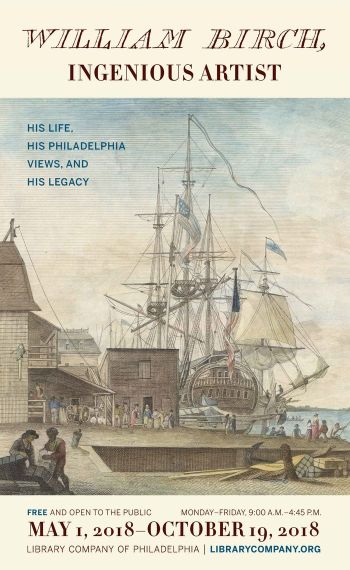 Through watercolors, enamels, manuscripts, books, and prints—some of which have never before been exhibited—we will explore the life and work of one of the most important artists of the Federal period, William Birch (1755–1834).
Birch established himself in London as a miniaturist and a graphic artist before immigrating to Philadelphia, where he published the first two American books of engraved views. The City of Philadelphia in the Year 1800 captures the spirit of the cultural and political capital of the new nation and remains a cornerstone of Philadelphia iconography. His second book, The Country Seats of the United States (1808), brought to America the ideal of the country house in a picturesque landscape, a vision that persists to this day. Join us as we explore Birch’s transatlantic career as an enamellist, landscape architect, and artist of the British and American scene.
◊ ◊ ◊ ◊ ◊
With a symposium scheduled for October:
William Birch and the Complexities of American Visual Culture
The Library Company of Philadelphia, 5 October 2018
“This country is new and flourishing. The mechanical arts are at their highest pitch, but the fine arts are of another complexion. They are the last polish of a refined nation… From an insignificant conceit of merit we have generally no knowledge of or feeling for, our imitations of nature, however beautiful, are mechanical altogether. But [these limitations] may be considered as the first lesson necessary for the fine arts… I do not profess myself a member of the fine arts; I am a copyist only, but from my knowledge of them [I] have been allowed judgment and taste, which is competent to give me a relish for them …” –William Birch
In celebration of the tenth anniversary of the establishment of the Visual Culture Program at the Library Company of Philadelphia (VCP), a one-day symposium on Friday, 5 October 2018 will explore the visual, cultural, and social themes elicited from the work of Philadelphia artist William Russell Birch (1755–1834). Inspired by the Library Company’s 2018 exhibition about Birch and his art, the symposium aims to promote discussions that reflect broadly on the continual resonance in American visual culture of the work of this premier enamel miniaturist, aspiring gentleman, and artist of the first American viewbooks.
While British-born Birch’s Views of Philadelphia (1798–1800) was enormously successful, his second, smaller plate book, The Country Seats of the United States (1808), in essence failed. Yet both—promoted through subscription—remain cornerstones of Philadelphia iconography and American visual culture and its complexities. Birch’s body of work includes some of the earliest American visual records of the new nation’s preeminent city as well as expressions of picturesque landscape crucial to 19th-century American makers of art. At the same time, his work evinces political and cultural propaganda, aesthetics of the ordinary and the everyday, and innovation in design.
Presentations are intended to foster broad and interdisciplinary discussions about the aesthetic, political, social, cultural, economic, material, and technological themes in Birch’s art, in his own time, and in the two centuries that followed. We will ask: What can be learned from works conceived and executed by a non-native artist parallel to constantly (and infinitely) evolving fields and definitions of art, and means of art production, distribution, and appreciation?
London History Day 2018 — 31 May 2018
From Historic England:
 London History Day 2018
31 May 2018
On Thursday 31 May 2018, more than 70 of London’s museums, galleries, and cultural spaces will open their doors to reveal special behind the scenes tours, rarely seen exhibits and one off events, celebrating the capital’s unique identity. 2018 is the year of courage, with many special events for London History Day touching on the pioneering spirit, heroism, initiative, and kindness layered in our history.
An example of programming as presented by the Mellon Centre:
Mark Hallett | The Suffering Soldier: Depictions of Courage in Eighteenth-Century British Art
Paul Mellon Centre, London, 31 May 2018, 12.30–14.00
The Paul Mellon Centre is taking part in London History Day by offering a special talk by the Director of the Centre, Mark Hallett. His lecture will focus on a few especially powerful examples of eighteenth-century British art to explore the ways in which artists dealt with, and depicted, the subject of courage. Mark Hallett, a leading authority on art in the Georgian period, will concentrate in particular on images of the heroic, tragic, and pitiful soldier, produced by artists as varied as John Singleton Copley, Benjamin West, and Joseph Wright of Derby. Doing so will reveal the very different ways in which courage could be conceptualised and represented during a century in which Britain was regularly at war. This talk is free and a light lunch is provided. Booking details are available here.
Call for Contributions | Printing Colour 1700–1830
This collection of essays will build and expand upon the research recently presented at the conference of the same name (Institute of English Studies, London, April 2018) to offer the first handbook of color printing techniques in the long eighteenth century.
Printing Colour 1700–1830: Histories, Techniques, Functions and Receptions
Edited by Elizabeth Savage and Margaret Morgan Grasselli
Proposals due by 8 June 2018; finished essays due by 15 February 2019
Following from the award-winning volume Printing Colour 1400–1700, Printing Colour 1700–1830 will be the first handbook of early modern colour printmaking in the long eighteenth century. It will contribute to a new, interdisciplinary paradigm for the history of printed material in the west. It aims to understand how new (and old) forms of colour printing changed communication during the late handpress period, from the invention of trichromatic printing until the Industrial Revolution and the introduction of chromolithography allowed the mass production of diverse colour-printed materials.
The discussion will encompass all media, techniques, and functions, from text to image, fashion to fine art, wallpaper to scientific communication. For this reason, submissions are sought from academics, curators, special collections librarians, printers, printmakers, cataloguers, conservators, art historians, book historians, digital humanities practitioners, scientists, and others who care for colour-printed material, seek to understand how it was produced and used, or engage with it in research.
Please submit 300-word abstracts online by 8 June 2018. Chapters of 4,000–6,000 words (including notes and captions) with up to 10 illustrations will be due 15 February 2019 for publication in mid-2020. The book will be peer-reviewed and published in full colour. Contributors will be responsible for sourcing images and copyright for their contributions, but they will qualify for fee waivers from many heritage collections because the publisher is a charitable academic press. This book is an output of the Printing Colour Project. For enquiries, please contact Gemma Cornetti at printingcolourproject@gmail.com.










 Enfilade
leave a comment