The Morgan Announces Restoration
From the press release (14 February 2019) from The Morgan:

Madison Avenue near East 36th Street, New York. J.P. Morgan Library, Wurts Bros., ca. 1905 (Museum of the City of New York, X2010.7.1.197).
The Morgan Library & Museum announced today the exterior restoration of J. Pierpont Morgan’s Library, designed by McKim, Mead & White. The four-year, $12.5 million project, which marks the first preservation of the landmark library’s exterior in its 112-year history, will restore and conserve one of the finest examples of Neoclassical architecture in the United States, enhance the surrounding grounds, improve the exterior lighting of the building, and increase public access to and appreciation of this historic architectural treasure.
J. Pierpont Morgan’s Library is the heart of the Morgan Library & Museum. Commissioned in 1902 by financier John Pierpont Morgan as his private library, the building was completed in 1906 and is considered one of McKim, Mead & White’s finest works, perfectly embodying the Renaissance ideal of the unity of the arts through the integration of architecture, sculpture, and painting with exceptional craftsmanship and materials. The structure reflects its contents: majestic in design, yet intimate in scale.
In 2010 the Morgan restored the interior rooms of J. Pierpont Morgan’s Library. In 2016 the Morgan began planning for the exterior restoration by engaging Integrated Conservation Resources (ICR), a firm specializing in the restoration of historic structures, to provide an initial needs assessment of the Library’s condition. Following the needs assessment, the Morgan engaged ICR to undertake a more detailed analysis of the building, which resulted in a fully articulated restoration approach. ICR, supported by the architecture firm Beyer Blinder Belle, carefully studied and documented existing conditions, installed data loggers to monitor the performance of the exterior envelope, tested proposed remediations, and finalized the restoration’s details.
The forthcoming restoration will be comprehensive and will address issues such as masonry deterioration, masonry joint failure, roof conditions, deterioration of the fence and other metalwork corrosion, and sculpture conservation.
In conjunction with the restoration, exterior lighting on J. Pierpont Morgan’s Library—currently minimal and ineffective—will be improved by enhancing existing light emanating from the interior, using historic fixtures coupled with new technologies. The scheme will create a painterly effect of layered light at dusk and dark. Developed by Tillett Lighting Design Associates, the new lighting design will give the Library a subtle, timeless, and inviting presence.
Restoring J. Pierpont Morgan’s Library presents a unique opportunity to reimagine the natural setting around it and to provide for visitor access to the site’s exterior for the first time in the institution’s history. The current landscaping—comprising a simple lawn and trees—does little to complement the architecture of the Library, nor does it provide accessible pathways or spaces to encourage visitor interaction with the landmark building’s exterior. By creating new spaces and opportunities for engagement, the project will help to reinvigorate this portion of the Morgan’s campus, which has been less visible to visitors since the Morgan’s entrance shifted from 36th Street to Madison Avenue as part of the 2006 Renzo Piano-designed expansion.
After an extensive search, the Morgan has engaged Todd Longstaffe-Gowan Landscape Design to develop designs to address these issues. An accomplished landscape architect, historian, teacher, and author, Todd Longstaffe-Gowan has led notable projects in the United Kingdom, including for Hampton Court Palace, Kensington Palace Gardens, and the Royal College of Art. This is his first appointment in the United States. Longstaffe-Gowan will collaborate with New York–based Future Green Studio to ensure the development of plantings that will flourish in New York City’s dense, challenging environment.
“Restoring the sublime exterior of J. Pierpont Morgan’s Library is far and away our most important capital project for the next decade,” said Director Colin B. Bailey. “This is our responsibility. And, in many respects, it is our privilege. Once the restoration of the Library is complete and the grounds are revitalized, the public will be able to engage more fully with one of McKim, Mead & White’s most important architectural achievements. The enhanced grounds will create a generous new space for outdoor programming and allow visitors to look closely at the exterior architectural and sculptural details of the Library.”
To date, 74 percent of the required $12.5 million is funded. On-site work will commence in February 2019, directed by Sciame and executed by Nicholson & Galloway, longtime partners in the architectural expansion and stewardship of the Morgan. Restoration of J. Pierpont Morgan’s Library will be completed by December 2019, at which point work will commence on the surrounding grounds. The library will still be open to visitors during the restoration process. The entire restoration and rehabilitation of the grounds will be unveiled to the public and accessible in fall 2020. The unveiling will be accompanied by an exhibition chronicling the history of the Library, as well as a scholarly publication.
Exhibition | Heaven and Earth in Chinese Art

Square curiosity box with multiple treasures, Qianlong 1736–95, Qing Dynasty (1644–1911); wood, jade, bronze, amber, agate, and ink on paper; 20 × 25 × 25 cm (Taipei: National Palace Museum).
◊ ◊ ◊ ◊ ◊
Press release (via Art Daily) for the exhibition:
Heaven and Earth in Chinese Art: Treasures from the National Palace Museum, Taipei
Art Gallery of New South Wales, Sydney, 2 February — 5 May 2019
Curated by Cao Yin
The Art Gallery of New South Wales presents Heaven and Earth in Chinese Art: Treasures from the National Palace Museum, Taipei. The exhibition is a rare opportunity to encounter some of the highest artistic achievements in Chinese history. Featuring 87 masterworks, the exhibition explores the extraordinary creativity of Chinese artists over the centuries, with objects dating from 5000 years ago in the Neolithic period to the nineteenth century.
 Director of the Art Gallery of NSW, Dr Michael Brand said the National Palace Museum holds one of the world’s finest collections of Chinese art with the majority of its holdings originating from the imperial collections of the Qing dynasty (1644–1911). “One of the most-visited museums in the world, the National Palace Museum in Taipei has a collection of outstanding beauty and historical importance.”
“Heaven and Earth in Chinese Art presents the ancient Chinese philosophical concept of tian ren he yi, the harmonious coexistence of nature and humans within the cosmos, which holds particular relevance today as we face the environmental challenges of contemporary life,” Dr Brand said. “The Art Gallery of NSW is the first cultural institution to host these extraordinary objects in Australia providing local audiences an exclusive opportunity to see how Chinese art speaks to the modern world,” Dr Brand added.
Dr Chen, Chi-nan, Director of the National Palace Museum, Taipei, said the museum has had a long-term commitment to international cultural exchange and has successfully curated a large number of exhibitions in Europe, America, and Asia from its collection. “Despite this impressive record, the National Palace Museum, Taipei, has not exhibited in the southern hemisphere, until now,” Dr Chen said. “Major highlights from the National Palace Museum collection travelling to Sydney include one of its most popular treasures: the Meat-shaped stone—a Qing dynasty masterpiece. This is only the third time it has been seen outside Taipei,” Dr Chen said.

Meat-shaped stone, Qing dynasty, 1644–1911 (Taipei: National Palace Museum).
The Meat-shaped stone, carved from jasper and set in a decorative gold stand, draws thousands of admirers a day. The stone most closely resembles the dish dongpo rou which is believed to have been invented by Su Dongpo (also known as Su Shi), an 11th-century Chinese poet and artist.
Art Gallery of NSW exhibition curator and curator of Chinese art, Yin Cao said Heaven and Earth in Chinese Art showcases the many ways in which Chinese artists have represented the trinity of heaven, earth, and humanity. “Since the earliest times, the Chinese have created imaginative stories and rich symbols to explain the unfathomable aspects of the world around them. Each work in Heaven and earth in Chinese art tells a unique story of the society in which it is created and bears a broader cultural and philosophical meaning,” Cao said.
“From the miniature carving of an olive pit to one of the longest paintings in Chinese history, this exhibition presents the highest level of artistic skill and advances in technology over the different eras, and shows the aspiration of Chinese artists as they try to capture the essence of nature and the world around them,” Cao added.
Heaven and Earth in Chinese Art presents paintings, calligraphy, illustrated books, bronzes, ceramics, jade, and wood carvings divided into five thematic sections: Heaven and Earth, Seasons, Places, Landscape, and Humanity.
The exhibition is accompanied by a book Heaven & Earth in Chinese Art: Treasures from the National Palace Museum, Taipei edited and written by exhibition curator Yin Cao with Dr Karyn Lai, associate professor of Philosophy in the School of Humanities and Languages at the University of NSW. It includes catalogue entries by National Palace Museum curators.
Cao Yin with Karyn Lai, Heaven & Earth in Chinese Art: Treasures from the National Palace Museum, Taipei (Sydney: Art Gallery of NSW, 2019), 236 pages, ISBN: 978-1741741438, $40.
The Wallace’s History of Collecting Seminars, 2019
From The Wallace Collection:
History of Collecting Seminars
The Wallace Collection, London, 2019
The History of Collecting seminar series was established as part of the Wallace Collection’s commitment to the research and study of the history of collections and collecting, especially in the eighteenth and nineteenth centuries in Paris and London. The seminars are free, no bookings required. To join the History of Collecting mailing list and receive updates on the future programme, please email your interest to collection@wallacecollection.org.
Monday, 25 February
Naomi Speakman (Curator of Late Medieval Europe, The British Museum), ‘Rich Treasures of Ivory Carvings’: Francis Douce’s Network, Medieval Ivories, and the Doucean Museum
Monday, 25 March
Esmée Quodbach (Assistant Director and Editor-in-Chief, Center for the History of Collecting), The Frick Collection), The Case of Leo Nardus (1868–1955): Reconstructing the Remarkable Career of a Major Yet Forgotten Dealer in Old Masters
Monday, 29 April
Giuseppe Rizzo (PhD candidate, Rupert-Karls-Universität Heidelberg, Germany), The Formation of Renaissance Taste in Early Victorian Britain: The Second Duke and Duchess of Sutherland as Collectors of Florentine Copies
Monday, 20 May
Emily Teo (PhD candidate, University of Kent and Free University of Berlin), Gotha’s Chinese Cabinet: Duke August’s Collection of East Asian Objects
Monday, 1 July (Please note the unusual date)
Frances Fowle (Professor of Nineteenth-Century Art, University of Edinburgh and Senior Curator of French Art, National Gallery of Scotland), A Woman of Taste: Mrs R. A. Workman’s Collection of Modern French Painting
Monday, 29 July
Kate Heard (Senior Curator of Prints and Drawings, Royal Collection Trust), ‘The Great Joss and His Playthings’: George IV as a Print Collector
Monday, 30 September
Isabelle Kent (Enriqueta Harris Frankfort Curatorial Assistant, The Wallace Collection), ‘The Aura of Popularity’: The Rise and Fall of Bartolomé Esteban Murillo in the Nineteenth-Century British Art Market
Monday, 28 October
Moya Carey (Curator of Islamic Collections, Chester Beatty Library, Dublin) and Mercedes Volait (research professor at CNRS, based at InVisu, INHA, Paris), Architectural Salvage from Cairo to London: The Pivotal Role of the Paris Exhibitions of 1867 and 1878
Monday, 25 November
Barbara Lasic (Lecturer in History of Art and Coordinator of Postgraduate Programmes, University of Buckingham), A ‘Fauve de la Curiosité’: The Hybrid Career of Edouard Jonas (1883–1961), Dealer and Curator
Display | Spotlight on Boilly

Louis-Léopold Boilly, Les Malheurs de l’amour (The Sorrows of Love), 1790
(London: The Wallace Collection)
◊ ◊ ◊ ◊ ◊
Opening this month at The Wallace:
Spotlight on Boilly
The Wallace Collection, London, 29 January — 19 May 2019
Curated by Yuriko Jackall
Over the course of his varied artistic career, Louis-Léopold Boilly (1761—1845) witnessed the overthrow of the French monarchy, the revolutionary period, and the rise of Napoleon. Of the fifteen paintings once owned by Sir Richard Wallace, three remain at the Wallace Collection, depicting detailed and humorous scenes of domestic life amongst the Parisian bourgeoisie. Thanks to the generosity of Étienne Bréton and Pascal Zuber, authors of the forthcoming catalogue raisonné of Boilly’s oeuvre, the three paintings have undergone extensive restoration and will be welcomed back to the museum with a special display showcasing the renewed vibrancy of their finely jewelled colours and celebrating Boilly’s genius as a chronicler of French society.
Francesca Whitlum-Cooper, From Boudoir to Boulevard: The Revolutionary Art of Boilly
The Wallace Collection, London, 22 February 2019, 18:30
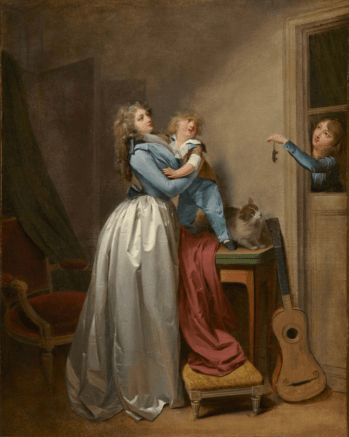
Louis-Léopold Boilly, The Dead Mouse, 1780s or 1790s (London: The Wallace Collection).
Louis-Leopold Boilly lived in extremely turbulent times. Yet, he did not merely survive this violent period: he thrived, painting the faces and places of modern Paris with humour, innovation, and startling modernity. On the eve of the UK’s first exhibition devoted to Boilly at the National Gallery—Boilly: Scenes of Parisian Life, curated Francesca Whitlum-Cooper— and to celebrate the recent conservation of the Wallace Collection’s three Boillys, this lecture by Dr Whitlum-Cooper will introduce Boilly to the public, suggesting that, half a century before the Impressionists, he was one of the first ‘painters of modern life’. The lecture will be prefaced by a brief conversation between Dr Whitlum-Cooper and the Wallace Collection’s Curator of French Paintings, Dr Yuriko Jackall, tracing Boilly’s critical fortunes in the present day. The talk will be followed by a wine reception and book signing with Dr Whitlum-Cooper of her new exhibition catalogue. Booking information is available here.
In addition, Yuriko Jackall will give a talk about the display on 21 February and 27 February, at 13:00.
The third painting by Boilly in the Wallace Collection is The Visit Returned, ca. 1789.
Exhibition | Boilly: Scenes of Parisian Life

Opening this month at the National Gallery:
Boilly: Scenes of Parisian Life
National Gallery, London, 28 February – 19 May 2019
Curated by Francesca Whitlum-Cooper
Working in a politically turbulent Paris, Louis-Léopold Boilly (1761–1845) witnessed the French Revolution, the rise and fall of Napoleon, and the Restoration of the French Monarchy. From controversially seductive interior scenes, which saw him get into trouble with the authorities, to ‘first-of-their-kind’ everyday street scenes and clever trompe l’oeils, this exhibition shows Boilly’s daring responses to the changing political environment and art market he encountered, and highlights his sharp powers of observation and wry sense of humour.
Focusing on 20 works from a British private collection never previously displayed or published, this exhibition—the first of its kind in the UK—celebrates an artist who is little known in Britain and provides unparalleled context for our Boilly, A Girl at a Window.
The catalogue is distributed by Yale UP:
Francesca Whitlum-Cooper, Boilly: Scenes of Parisian Life (London: National Gallery Company, 2019), 96 pages, ISBN: 978-1857096439, £17 / $25.
 Louis-Leopold Boilly lived a long life in the most turbulent times. From 1785 he spent half a century at the heart of the Parisian art world, throughout the turmoil of the Revolution, the rise and fall of Napoleon and the restoration of the monarchy. This first English-language publication on Boilly in over twenty years brings together portraiture, interiors on the theme of seduction, and vivid and groundbreaking scenes of raucous Parisian street life. The majority of these pictures have never been published before. The book introduces readers to Boilly’s richly detailed paintings and drawings, emphasising his technical brilliance, his acute powers of observation and his wry sense of humour, and illustrates Boilly’s daring responses to France’s changing political environment and burgeoning art market. It offers an alternative to the accepted view of Revolutionary French art as the purview of grand history painters such as Jacques-Louis David. Boilly popularised trompe l’oeil paintings—he invented the term—and by depicting daily life on the streets of Paris for the very first time, he turned the accepted hierarchies of art on their head.
Francesca Whitlum-Cooper is the Myojin-Nadar Associate Curator of Paintings, 1600–1800 at the National Gallery, London.
New Book | More Eighteenth-Century Neapolitan Staircases
Many Enfilade readers will already know this, but I’m sorry to report that Michael Shamansky’s Artbooks.com will soon close. Here’s an example of the discounts now available. –CH
Dirk De Meyer, with a preface by Marius Grootveld, More Eighteenth-Century Neapolitan Staircases: Showpiece and Utility (Ghent: A&S Books, 2018), 130 pages, ISBN: 978-9076714523, €29, reduced from $50 to $20.
 With particular attention to the work of Ferdinando Sanfelice (1675–1748), this book documents the development of the open staircase typology in Naples at the moment that it shifted from the traditional, monumental Baroque palace staircase towards the later palazzo or condominium staircase serving four, five, or more levels of apartments. These staircases are considered ‘the star(s) of the palace composition in Naples’. The book is the outcome of a master seminar in Architectural History at Ghent University. It continues an initial publication from 2017.
C O N T E N T S
• A Typological Make-over: Staircase Design in 18th-century Naples
• Palazzo Lauriano also called Capuano, c. 1730
• Palazzo Palmarice, 1719
• Double Palazzo in Via Salvator Rosa, c. 1730s
• Double Palazzo in Via Salvator Rosa, c. 1730s
• Palazzo Persico, mid 18th century
• Palazzo in Via Atri, mid or late 18th century
• Palazzo in Via Costantinopoli, mid or late 18th century
Art Markets: An Integrated Perspective
From the program’s website:
Art Markets: An Integrated Perspective
International Thematic School
Lyon, 24–28 June 2019
Registration due by 15 March 2019
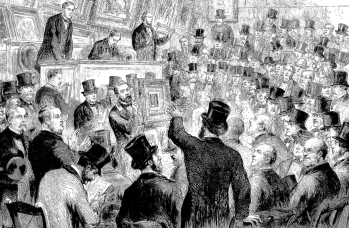 The thematic school is organized by the LARHRA and the Université Lumière Lyon 2 in collaboration with the Université Libre de Bruxelles and Erasmus University, Rotterdam. It aims to provide the research community interested in the study of art markets with an interdisciplinary theoretical approach and methodological tools in line with the most up-to-date analytical methods in order to bring out new research perspectives. About fifteen international specialists in art history, economics, law, sociology, finance, and digital humanities from all over Europe and the United States will animate it in a spirit of exchange and sharing of knowledge.
The art market is essentially a multidisciplinary object of study. While it is now a significant sector of the global economy, it has always it played a seminal role in the circulation and reception of art, and provided the context within which artists created their work. Researchers from disciplines as diverse as economics, finance, law, history, art history or sociology have contributed to a better understanding of the complexity and specificity of this market. Despite the advances made in each of these fields, research on the art market still too often suffers from a compartmentalization by disciplinary field.
The Art Markets thematic school aims to bring together the international community of researchers working on the art market and to offer participants the opportunity to better understand the scientific approaches of other disciplines. Sharing a common knowledge base and concepts is a necessary condition for developing transdisciplinary collaborations. To this end, this training offers an interdisciplinary theoretical approach and methodological tools in line with the most up-to-date analytical methods. The articulation between historical and contemporary analyses from the point of view of economics, finance, sociology, and law is particularly innovative.
Indeed, in the era of globalization and digital technology, art markets are undergoing profound changes that are leading to a reconfiguration of the modalities of interaction between actors and intermediaries. Issues related to artistic exchanges, the emergence or decline of markets, financial speculation, the concentration of actors and the role of agents in building the economic and social value of art, have accelerated the need to use robust analytical techniques to better understand these issues. But are they so new? These phenomena benefit from being re-examined in the light of their historical contexts in order to understand their logic and dynamics over time. At the same time, the analysis of contemporary art markets allows us to shed light with the advantage of hindsight on the practices, mechanisms and strategies put in place since the emergence of markets for visual arts and the first globalization from the 16th century onwards. In addition, quantitative analytical methods, data modelling and visualization have paved the way for important methodological and epistemological explorations
The training is aimed at the entire scientific community: professors-researchers, researchers, post-doctoral fellows, doctoral students, staff of research support (ITA). It should also be of interest for experts and professionals active in the art market. It is open to all participants from Master 2 level onwards, preferably in a discipline related to the study of art markets: economic history, art history, economics, finance, sociology, and law.
Contact: artmarkets2019@sciencesconf.org
This thematic school has received support from the CNRS, IDEX Lyon, Université Lumière Lyon 2, LARHRA, College académique Sciences Sociales de l’Université de Lyon.
Blanton Museum Acquires Major Spanish Colonial Art Collection

Unknown artist, Rest in the Flight into Egypt, Bolivia, 18th century, oil on canvas
(Blanton Museum of Art, The University of Texas at Austin)
◊ ◊ ◊ ◊ ◊
Press release from the Blanton Museum of Art:
The Blanton Museum of Art at The University of Texas at Austin announced that it has acquired the esteemed collection of Roberta and Richard Huber. This world-class collection of art from the Spanish and Portuguese Americas is composed of 119 objects ranging from paintings and sculpture to furniture and silverwork—deepening the Blanton’s extensive holdings of art and objects from Latin America. The Huber Collection is one of the most distinguished private collections of Spanish and Portuguese American art and includes works from countries across modern-day Latin America including Bolivia, Brazil, Ecuador, and Peru. Developed by Roberta and Richard Huber over the past 45 years, the collection showcases artistic practices and visual culture of the socially and ethnically diverse society in the Americas between the late 1600s and the early 1800s.
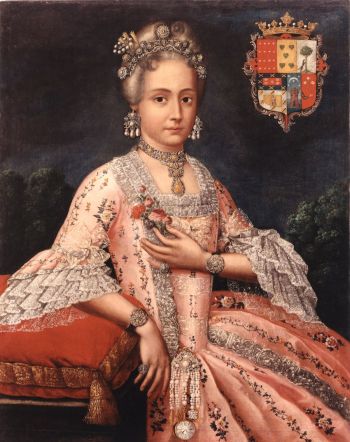
Attributed to Cristóbal Lozano (Lima, Peru 1705–1776), Portrait of Rosa de Salazar y Gabiño, Countess of Monteblanco and Montemar Peru, ca. 1763, oil on canvas (Blanton Museum of Art, The University of Texas at Austin).
“My wife, Roberta, and I couldn’t have hoped for a better steward for our collection than the Blanton, an institution with a long legacy of leadership in the field of Latin American art,” said Richard Huber. “We’re thrilled for the Blanton to present the works to audiences from Austin, the rest of the country, and abroad, and for them to be used in the museum’s robust teaching program on campus and in the community.”
“We are delighted that the Blanton will be the new home of the Huber collection, an incredibly beautiful group of works, which demonstrates the height of artistic achievement of this period,” said Blanton director Simone Wicha. “This acquisition cements our commitment to the study and exhibition of art from the Spanish and Portuguese Americas, which we proudly launched in partnership with the Carl & Marilynn Thoma Art Foundation in 2016. The Huber collection will open up new possibilities for scholarship on this dynamic era of cultural exchange, supported by the unparalleled strength of UT’s Latin American studies program and the Blanton’s renowned expertise and resources in the field of Latin American art,” Wicha continued.
The Blanton began collecting art from Latin America in 1963 and since then has amassed one of the country’s largest and finest collections of Latin American art. The museum’s Latin American collection now includes 2,500 works of modern and contemporary painting, prints, drawing, conceptual art, installation, video, and sculpture, alongside its growing holdings of art of the Spanish and Portuguese Americas. In 1988, the Blanton became the first museum in the United States to establish a curatorial position devoted to modern and contemporary Latin American art.

Unknown artist, Portable Desk, Bolivia, 1751, tempera, oil, and gold on wood (Blanton Museum of Art, The University of Texas at Austin).
“The acquisition of the Huber collection furthers our leadership in the field of Latin American art as a whole,” said Beverly Adams, Blanton curator of Latin American art. “The dialogues between modern and contemporary art with historical material that have emerged in our galleries and in our research over the past few years have been illuminating. We are thrilled to continue to be stewards for the artistic and scholarly value of the art of this significant period, alongside our partners on campus at UT.”
The museum’s expanded focus on art from the colonial period encompasses collecting, researching, and exhibiting. In 2016, the Carl & Marilynn Thoma Art Foundation announced a long-term loan of works from its distinguished collection and a major grant that established a curatorship in Spanish colonial art. In partnership with LLILAS Benson Latin American Studies and Collections at UT, the Blanton launched a cross-campus interdisciplinary program to facilitate object-based teaching, research, and scholarship on visual and material culture from this period. In 2017, the Colección Patricia Phelps de Cisneros gifted a group of 83 Venezuelan works of painting, sculpture, and furniture from the period to the Blanton.
“A unique strength of UT Austin is our commitment and leadership in Latin American scholarship and art. Through world-class collections, like this, the educational benefit to students, faculty, and our community cannot be understated. We are immensely grateful for the Hubers’ vision, and we are excited about the impact this collection will provide for generations to come,” said Maurie McInnis, executive vice president and provost.

Unknown artist, Coquera (coca box), Bolivian, ca. 1730, silver (Blanton Museum of Art, The University of Texas at Austin).
The museum acquisition was funded by the university, with additional support from Judy and David Beck, Leslie and Jack Blanton, Jr., Jeanne and Michael Klein, Judy and Charles Tate, and an anonymous donor. Highlights include an early 18th-century silver coquera box (for the storage of coca leaves) from Bolivia; a gorgeous bust-sized reliquary of St. Augustine from Mexico (ca. 1650); the impressive portrait of Rosa de Salazar y Gabiño, Countess of Monteblanco and Montemar (ca. 1764–71) attributed to Peruvian Cristobal Lozano; and a sculpture of the Virgin Mary attributed to Francisco Xavier de Brito, active in Minas Gerais, Brazil, in the mid 1700s. Among the furniture is a portable desk from the 18th century, which originated at one of the famed Jesuit missions of Chiquitos, in what is now Santa Cruz, Bolivia, and a UNESCO World Heritage Site.
This fall, a selection of objects from the Huber collection will make their debut in the Blanton exhibition Painted Cloth: Fashion and Ritual in Colonial America, which is made possible by lead funding and loans from the Thoma Foundation, as well as other loans from around the world. Painted Cloth examines the social role of textiles and their visual representations in different media produced in Bolivia, Mexico, Peru, and Venezuela during the 1600s and 1700s.
Lecture | Sally Jeffery on Nicholas Hawksmoor at Castle Howard
This talk by Sally Jeffery is part of The Gardens Trust’s Winter Lecture Season:
Sally Jeffery, Nicholas Hawksmoor and Castle Howard Gardens
The Gallery, 77 Cowcross Street, London, 6 March 2019
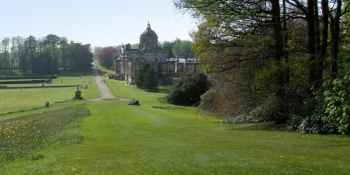 Architectural and garden historian Dr Sally Jeffery will discuss her recent research on Hawksmoor’s designs for Wray Wood, Castle Howard. Among documents formerly at Wilton House are four sketches for streams and rockwork attributed to Nicholas Hawksmoor (1661–1736) that have recently been identified as projects for the garden in Wray Wood, Castle Howard. This naturalistic woodland garden was much admired by early visitors, who commented on its innovative features, including a cave, an artificial stream with cascades and rockwork, and much classical sculpture inspired by Ovid. Little now survives, but using these drawings and other records, a picture of the garden can be constructed, and Hawksmoor’s role in the design can be better appreciated. Wednesday, 6 March 2019, 18:00.
New Book | Eighteenth-Century Art Worlds
Published this month by Bloomsbury:
Stacey Sloboda and Michael Yonan, eds., Eighteenth-Century Art Worlds: Global and Local Geographies of Art (London: Bloomsbury Visual Arts, 2019), 312 pages, ISBN: 978-1501335488, $117.
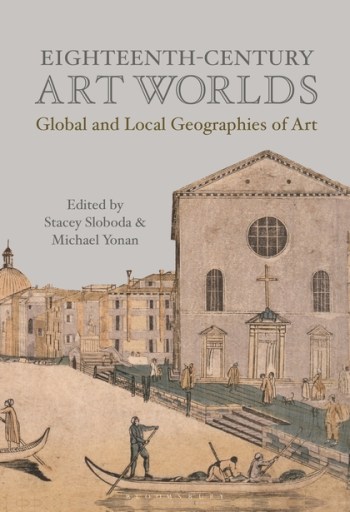 While the connected, international character of today’s art world is well known, the eighteenth century too had a global art world. Eighteenth-Century Art Worlds is the first book to attempt a map of the global art world of the eighteenth century. Fourteen essays from a distinguished group of scholars explore both cross-cultural connections and local specificities of art production and consumption in Africa, the Americas, Asia, and Europe. The result is an account of a series of interconnected and asymmetrical art worlds that were well developed in the eighteenth century.
Capturing the full material diversity of eighteenth-century art, this book considers painting and sculpture alongside far more numerous prints and decorative objects. Analyzing the role of place in the history of eighteenth-century art, it bridges the disciplines of art history and cultural geography, and draws attention away from any one place as a privileged art-historical site, while highlighting places such as Manila, Beijing, Mexico City, and London as significant points on globalized map of the eighteenth-century art world. Eighteenth-Century Art Worlds combines a broad global perspective on the history of art with careful attention to how global artistic concerns intersect with local ones, offering a framework for future studies in global art history.
Stacey Sloboda is Paul H. Tucker Professor of Art at the University of Massachusetts Boston. Michael Yonan is Associate Professor of Art History at the University of Missouri.
C O N T E N T S
List of Illustrations
Acknowledgements
1 Stacey Sloboda and Michael Yonan, Mapping Eighteenth-Century Art Worlds
2 Kristina Kleutghen, Flowering Stone: The Aesthetics and Politics of Islamic Jades at the Qing Court
3 Michele Matteini, The Market for ‘Western’ Paintings in Eighteenth-Century East Asia: A View from the Liulichang Market in Beijing
4 Timon Screech, Floating Pictures: The European Dimension to Japanese Art during the Eighteenth Century
5 Yeewan Koon, A Chinese Canton? Painting the Local in Export Art
6 J. M. Mancini, Pedro Cambón’s Asian Objects: A Transpacific Approach to Eighteenth-Century California
7 Kelly Donahue-Wallace, Making It Ours: Religious Art in Eighteenth-Century Colonial Spanish American Newspapers
8 Mari-Tere Álvarez and Charlene Villaseñor Black, Tortoiseshell and the Edge of Empire: Artistic Materials and Imperial Politics in Spain and France
9 Kristel Smentek, Other Antiquities: Ancients, Moderns, and the Challenge of China in Eighteenth-Century France
10 Hannah Williams, Drifting through the Louvre: A Local Guide to the French Academy
11 Carole Paul, The Art World of the European Grand Tour
12 Michael Yonan, The African Geographies of Angelo Soliman
13 Prita Meier, Toward an Itinerant Art History: The Swahili Coast of Eastern Africa
14 Stacey Sloboda, St. Martin’s Lane in London, Philadelphia, and Vizagapatam
List of Contributors
Bibliography
Index










 Enfilade
leave a comment