Call for Papers | New Directions in 18th- and 19th-Century Art, Season 3
From NDENCA:
New Directions in Eighteenth- and Nineteenth-Century, Art Season 3
Digital Seminar Series
Abstracts due by 30 November 2020
This digital seminar series seeks to showcase new and innovative research being undertaken on eighteenth- and nineteenth-century art and its histories. We invite contributions for papers investigating any aspect of the artistic, visual, and material cultures of this period, and produced across the globe. Sessions will be hosted via video conferencing software and will take the form of a 40-minute seminar, with time following for questions.
We welcome proposals from PhD researchers, early career academics and museum professionals, particularly those from underrepresented groups. Please send your abstracts to ndencaseminar@gmail.com.
Annibel Jenkins Prize in Performance and Theater Studies
Have you published an article on 18th-century performance studies or theater in the past two years? Consider submitting it for the Annibel Jenkins Prize in Performance and Theater Studies. From SEASECS:
Annibel Jenkins Prize in Performance and Theater Studies
Awarded under the auspices of SEASECS
Submissions due by 30 November 2020
In 2012, SEASECS established a prize in honor of its founding member, Annibel Jenkins. This biennial prize of $500 recognizes the best article in performance and theater studies published in a scholarly journal, annual, or collection. The Jenkins Prize will next be awarded at the 2021 SEASECS conference. Eligible publications for this award must have been published between 1 September 2018 and 31 August 2020. Authors must be members of SEASECS at the time of submission. Articles may be submitted by the author or by another member.
The deadline for submissions is 30 November 2020. Please send submissions as PDF files and address any queries about the prize to the Committee Chair, Diane Kelley, at dkelley@pugetsound.edu.
P A S T W I N N E R S
2019 Leah Benedict, “Impotence Made Public: Reading Sex on the Stage and in the Courtroom,” ELH 85 (Summer 2018): 441–69.
2018 Diana Solomon, “The Jolt of Jacobean Tragicomedy: Double Falsehood on the Eighteenth-Century English Stage,” in Revisiting Shakespeare’s Lost Play: Cardenio/Double Falsehood in the Eighteenth Century, edited by Deborah Payne (Palgrave, 2016).
2017 Terry F. Robinson, “Becoming Somebody: Refashioning the Body Politic in Mary Robinson’s Nobody,” Studies in Romanticism 55 (Summer 2016): 143–84.
2016 Heather McPherson, “Tragic Pallor and Siddons,” Eighteenth-Century Studies 48 (Summer 2015): 479–502.
2015 Daniel J. Ennis, “Christopher Smart, Mary Midnight and the Haymarket, 1755,” in Reading Christopher Smart in the 21st Century, edited by Min Wild and Noel Chevalier (Lewisburg: Bucknell University Press, 2013).
2014 Anne Greenfield, “D’Avenant’s Lady Macduff: Ideal Femininity and Subversive Politics,” Restoration 37 (Spring 2013): 39–60.
Online Conference | Décoration intérieure et plaisir des sens, 1700–1850

From the conference programme:
Décoration intérieure et plaisir des sens, 1700–1850
Online Colloquium, 3-4 December 2020
Organisé par l’Université de Genève (Unité d’histoire de l’art) et l’Université Paris 1 Panthéon-Sorbonne (Equipe de recherche HiCSA et Ecole doctorale d’histoire de l’art)
Lien pour l’inscription – jeudi 3 décembre :
https://unige.zoom.us/webinar/register/WN_6uqfcGYcTPKviyDc7H_sQA
Lien pour l’inscription – vendredi 4 décembre :
https://unige.zoom.us/webinar/register/WN_oe2wR8RUSAe1DNOS34S9EQ
Colloque organisé par Noémi Duperron (Université de Genève), Barbara Jouves-Hann (Université Paris 1 Panthéon-Sorbonne), Maxime Georges Métraux (Université Paris-Sorbonne/Galerie Hubert Duchemin), Bérangère Poulain (Université de Genève) et Marc-André Paulin (Université de Lille/Centre de Recherche et de Restauration des Musées de France).
Informations et contact : decoration.et.plaisir@gmail.com
◊ ◊ ◊ ◊ ◊
J E U D I , 3 D E C E M B R E 2 0 2 0
14.00 Introduction, Bérangère Poulain (Université de Genève) et Barbara Jouves-Hann (Université Paris 1 Panthéon-Sorbonne)
14.30 Session 1A: Mobilier
Modérée par Jean-Jacques Gautier (Mobilier national)
• Thibaut Wolvesperges (Université Paris-Sorbonne), Dessin d’ornemaniste et création du meuble
• Daniel Alcouffe (Musée du Louvre), La naissance du bureau et de la commode au XVIIe siècle
• Élisabeth Caude (Château de Versailles) et Frédéric Leblanc (C2RMF), Le cabinet particulier du roi Louis XIV à Versailles secrets autour des transformations d’un bureau
16.00 Pause
16.30 Session 1B: Mobilier
Modérée par Jean-Jacques Gautier (Mobilier national)
• Muriel Barbier (Mobilier national), « Une tente sous laquelle on dort » : l’alcôve et le lit d’alcôve dans la chambre au XVIIIe
• Ulrich Leben (Indépendant), Formes, matérialité et usages du mobilier
17.30 Conclusion, Marc-André Paulin (Université de Lille/C2RMF)
V E N D R E D I , 4 D E C E M B R E 2 0 2 0
9.00 Introduction, Noémi Duperron (Université de Genève) et Maxime Georges Métraux (Université Paris-Sorbonne/Galerie Hubert Duchemin)
9.30 Session 2A: Théorie
Modérée par Carl Magnusson (Université de Lausanne)
• Desmond-Bryan Kraege (Université de Lausanne), Fraîcheur, odeurs et procédés narratifs : Le génie de l’architecture de Le Camus de Mézières à la lumière de la théorie des jardins
• Aurélien Davrius (École nationale supérieure d’architecture Paris-Malaquais), Nouvelles typologies d’habitation au XVIIIe siècle
10.30 Pause
11.00 Session 2B: Théorie
Modérée par Carl Magnusson (Université de Lausanne)
• Joséphine Grimm (École nationale des Chartes), Construire le boudoir idéal : état de l’influence réciproque de la littérature sur les traités d’architecture au XVIIIe siècle
• Christina Contandriopoulos (Université du Québec à Montréal), Une spatialité intérieure, Madame de Maisonneuve et le Dôme des Invalides
14.30 Session 3A: Techniques
Modérée par Jan blanc (Université de Genève)
• Johanna Ilmakunnas (Åbo Akademi University), Thermal comfort, spatial order, and objects in country houses, Sweden c.1740–1800
• Olivier Jandot (Université Artois), Le feu caché. Introduction du confort thermique et métamorphoses de l’économie des sens, France, 1700–1850
15.30 Pause
16.30 Session 3B: Techniques
Modérée par Jan blanc (Université de Genève)
• Erika Wicky (Université Lumière Lyon 2), L’odeur des vernis ou la toxicité du confort au XVIIIe siècle
• Carine Desrondiers (Université Rennes 2), Les effets magnifiques ou les agréments de la serrurerie dans la décoration intérieure française de la fin du règne de Louis XIV à la Monarchie de Juillet
17.30 Conclusion générale et pistes de réflexion, Christian Michel (Université de Lausanne)
New Book | Merchants of Medicines
From The University of Chicago Press:
Zachary Dorner, Merchants of Medicines: The Commerce and Coercion of Health in Britain’s Long Eighteenth Century (Chicago: University of Chicago Press, 2020), 280 pages, ISBN: 978-0226706801, $50.
 The period from the late seventeenth to the early nineteenth century—the so-called long eighteenth century of English history—was a time of profound global change, marked by the expansion of intercontinental empires, long-distance trade, and human enslavement. It was also the moment when medicines, previously produced locally and in small batches, became global products. As greater numbers of British subjects struggled to survive overseas, more medicines than ever were manufactured and exported to help them. Most historical accounts, however, obscure the medicine trade’s dependence on slave labor, plantation agriculture, and colonial warfare.
In Merchants of Medicines, Zachary Dorner follows the earliest industrial pharmaceuticals from their manufacture in the United Kingdom, across trade routes, and to the edges of empire, telling a story of what medicines were, what they did, and what they meant. He brings to life business, medical, and government records to evoke a vibrant early modern world of London laboratories, Caribbean estates, South Asian factories, New England timber camps, and ships at sea. In these settings, medicines were produced, distributed, and consumed in new ways to help confront challenges of distance, labor, and authority in colonial territories. Merchants of Medicines offers a new history of economic and medical development across early America, Britain, and South Asia, revealing the unsettlingly close ties among medicine, finance, warfare, and slavery that changed people’s expectations of their health and their bodies.
Zachary Dorner is the Patrick Henry Postdoctoral Fellow in history at Johns Hopkins University.
C O N T E N T S
List of Figures and Tables
Introduction
1 Toward an Industry
2 Distance’s Remedies
3 The Possibility of Unfree Markets
4 Pine Trees and Profits
5 Self-Sufficiency in a Bottle
Conclusion
Acknowledgments
Notes
Bibliography
Index
British Library Makes 40K Maps and Views Available Online

Matthew Dixon. ‘A General Plan with a Project for the Defence of the Arsenals of Plymouth, / By Lieut: Colonel Dixon Chief Engineer of the Plymouth Division. Revised and corrected by Geo. Beck Jan. 1780.’ (London: British Library, Maps K.Top 11.79.2.TAB).
◊ ◊ ◊ ◊ ◊
From Art Daily (1 November 2020). . .
The British Library is nearing the end of a project to make 40,000 early maps and views freely available online for the first time. The material forms part of the Topographical Collection of King George III (K.Top) held by the British Library and captures four centuries of visual impressions of places throughout the world, from maps and atlases to architectural drawings, cartoons, and watercolours. Nearly half of the images are now available for anyone to view online via the British Library’s digital Flickr Commons Collection. This resource offers everyone the chance to virtually explore, the geography, art, science, and cultures of the past through the collection of one of history’s most avid armchair travellers.
Over seven years, a team of expert cataloguers, curators, conservators, and imaging specialists at the Library have worked to catalogue, conserve, and digitise the K.Top Collection. This project would not have been possible without significant philanthropic support and we are very grateful to the individuals and trusts whose generosity has enabled us to make this outstanding collection available to researchers across the world.
The collection is a distinct part of the larger King’s Library which was presented to the Nation by George IV in 1823. As a collection of maps and views that was built during the formative period of the British Empire, it is an important resource for the study of how Britain viewed and interacted with the wider world during this period. The collection consists of printed and hand-drawn works dating between 1500 and 1824 and covers a broad variety of compelling themes. Highlights include:
• The hand-drawn map of New York City, presented to the future James II in 1664
• Early 18th-century architectural drawings by Nicholas Hawksmoor for commissions including Castle Howard and London ‘Queen Anne’ churches
• The vast Kangxi Map of China of 1719 made by the Italian Jesuit Matteo Ripa
• A set of drawings of Lucca by the Italian artist Bernardo Bellotto, circa 1742
• James Cook’s large manuscript map of the islands of St. Pierre and Miquelon, 1763
• Watercolours by noted 18th-century artists such as Paul Sandby and Samuel Hieronymus Grimm
• Military maps of English south coast harbours including Plymouth from the 1780s, precursors of the Ordnance Survey
• Views of parts of modern-day Ontario, Canada, drawn by the artist Elizabeth Simcoe in around 1792
• The earliest comprehensive land-use map of London from 1800
A number of maps from the collection are accessible for the public to view in the British Library’s free, permanent exhibition Treasures of the British Library, including maps of forts in North America by Mary Anne Rocque (1765). The gallery has recently reopened to the public (booking essential).
The first batch of 18,000 images are now freely available to explore via the British Library’s page on Flickr Commons, alongside over 1 million copyright-free images from the Library’s collection of printed books. The images have been added to Flickr by British Library Labs (BL Labs). BL Labs supports the experimentation and reuse of the Library’s data and digital collections in exciting and creative new ways through competitions, events, exhibitions, collaborative projects and annual public awards (the deadline for entry this year is 30 November 2020.)
The maps will also be made available on the British Library’s ‘Georeferencer’, an interactive application that allows volunteers to turn maps into data by adding locations to digitised British Library collections, initiating innovative new forms of discovery and research. A selection of essays illustrated by images from the K. Top collection are available on the Library’s Picturing Places web space.
Tom Harper, Lead Curator of Antiquarian Mapping, said “This is a momentous and intriguing set of early maps and views which provides multiple windows into the world of previous centuries. We’re pleased to have been able to make this outstanding collection available through cataloguing and digitisation and to enable aspects of Britain’s past to be more fully understood.”
Dr Mia Ridge, Digital Curator for Western Heritage Collections, commented, “Providing online access to these images and metadata is an important milestone for digital research support at the British Library. The collection lends itself to digital scholarship methods such as computer vision, machine learning and AI, crowdsourcing, and georeferencing. We’re also excited to learn more about innovative applications for new and emerging computational methods as researchers explore the collection.”
Today | HECAA Emerging Scholars Showcase
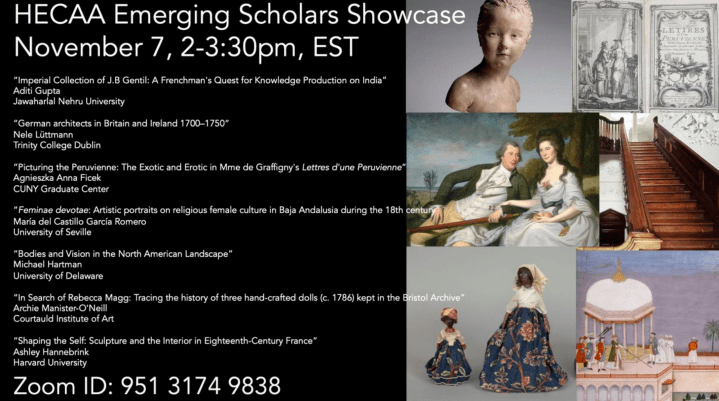
HECAA Emerging Scholars Showcase
Online, Saturday, 7 November 2020, 2:00–3:30pm (EST)
The first HECAA Emerging Scholars Showcase begins today at 2pm EST. Please join us via zoom to hear our first seven emerging scholars present their research. Each participant will present for 3–5 minutes, and after the presentations, we will host a question and answer session. The seven presenters and their presentation titles are listed below. If you have any questions or concerns, please contact Dani Ezor (dezor@smu.edu).
Best regards,
HECAA Board
◊ ◊ ◊ ◊ ◊
Zoom link: https://smu.zoom.us/j/95131749838
Meeting ID: 951 3174 9838
• Aditi Gupta, (Jawaharlal Nehru University), Imperial Collection of J.B Gentil: A Frenchman’s Quest for Knowledge Production on India
• Nele Lüttmann (Trinity College Dublin), German Architects in Britain and Ireland, 1700–1750
• Agnieszka Anna Ficek (CUNY Graduate Center), Picturing the Peruvienne: The Exotic and Erotic in Mme de Graffigny’s Lettres d’une Peruvienne
• María del Castillo García Romero (University of Seville), Feminae Devotae: Artistic Portraits on Religious Female Culture in Baja Andalusia during the Eighteenth Century
• Michael Hartman (University of Delaware), Bodies and Vision in the North American Landscape
• Archie Manister-O’Neill (Courtauld Institute of Art), In Search of Rebecca Magg: Tracing the History of Three Hand-Crafted Dolls (ca. 1786) Kept in the Bristol Archive
• Ashley Hannebrink (Harvard University), Shaping the Self: Sculpture and the Interior in Eighteenth-Century France
New Book | Hua Yan (1682–1756)
From Brill, this book by Kristen Chiem (now, incidentally, Kristen Brennan). . .
Kristen Loring Chiem, Hua Yan (1682–1756) and the Making of the Artist in Early Modern China (Leiden, Brill, 2020), 224 pages, ISBN: 978-9004427631, €110 / $132.
 Hua Yan (1682–1756) and the Making of the Artist in Early Modern China explores the relationships between the artist, local society, and artistic practice during the Qing dynasty (1644–1911). Arranged as an investigation of the artist Hua Yan’s work at a pivotal moment in eighteenth-century society, this book considers his paintings and poetry in early eighteenth-century Hangzhou, mid-eighteenth-century Yangzhou, and finally their nineteenth-century afterlife in Shanghai. By investigating Hua Yan’s struggle as a marginalized artist—both at his time and in the canon of Chinese art—this study draws attention to the implications of seeing and being seen as an artist in early modern China.
Kristen Loring Chiem, Ph.D. (2011), University of California, Los Angeles, is Associate Professor of Art History at Pepperdine University. Her work explores the intersections of gender, painting, and garden imagery in Chinese art.
C O N T E N T S
Acknowledgments
Introduction
The Mountain Man of Xinluo
Lyricism in Words and Images
Painting the Garden from Life
Picturing People, Past and Present
The Xinluo School
Epilogue: Lives of Jiangnan Artists, 1700–1900
Bibliography
Index
Online Conference | Hayley2020
From The Fitzwilliam:
Hayley2020: A Fitzwilliam Museum Conference
Online, 12–13 November 2020

George Romney, John Flaxman Modeling the Bust of William Hayley, 1795–96, oil on canvas, 89 × 57 inches (New Haven: Yale Center for British Art, Paul Mellon Collection, B1981.25.538).
Convened to mark the bicentenary of his death, Hayley2020 is the first ever conference dedicated to writer, scholar, and amateur doctor William Hayley (1745–1820). Hugely influential in his time, Hayley is now mostly remembered for persuading William Blake to move to the Sussex coast, commissioning illustrations and prints from him, and driving him to distraction. But there is much more to the man who wrote (in verse) a runaway bestseller advising young women on how to attract and keep a husband, refused the poet laureateship for political reasons, and was the first person to publish an English translation of a long extract from Dante’s Inferno. Join us online on November 12 and 13 for a series of presentations and discussions about Hayley and his world (listed times are GMT). All are welcome.
T H U R S D A Y , 1 2 N O V E M B E R 2 0 2 0
14.45 Welcome
Suzanne Reynolds, Lisa Gee, Naomi Billingsley, and Mark Crosby welcome you to virtual Eartham, but promise not to write you an adulatory sonnet.
15.00 On Romney, His Relationship with Hayley, and Works Arising
Alex Kidson talks about how Romney and Hayley’s relationship changed over the years, discussing works including the Cupid and Psyche cartoons, Flaxman Modelling the Bust of Hayley, and Romney’s illustrations for Hayley’s Essay on Old Maids (series of short videos). Parallel discussion in the chat with Alex present, followed by discussion. Video available for viewing beforehand and afterwards.
15.40 Coffee Break
You’ll have to bring your own hot beverage, but feel free to hang out, catch up with friends, and network like it’s 1795 in Hayley’s Library.
16.05 Hayley in His Contexts
Lisa Gee: Hayley – Essay on Sculpture, Mary Cockerell & the decline & death of Tom.; Alexandra Harris; Susan Matthews: Amina Wright: ‘Artist and Bard in Sweet Alliance: Joseph Wright of Derby and the Hermit of Eartham.’. Chaired by Mark Crosby.
16.45 Tea Break
17.00 Object-Oriented Session
Demo/test of the AMoR (A Museum of Relationships) pilot + discussion, with Lisa Gee and Suzanne Reynolds.
17.40 Plenary Discussions
F R I D A Y , 1 3 N O V E M B E R 2 0 2 0
13.00 Virtual Conference Picnic
Find us in the windswept (virtual) grounds of Eartham where, because it’s mid-November, we’re happy this is online rather than IRL.
15.00 On Hayley, Flaxman, and Blake
David Bindman discusses the memorials on which Flaxman and Hayley collaborated, one that Hayley tried to interfere in, and explains why Hayley’s relationship with Blake was so different to those with Flaxman and Romney.
15.40 Coffee Break
16.05 Hayley and Blake
Mark Crosby, Sarah Haggarty, Jason Whittaker: Hayley in Blake biographies. Chaired by Naomi Billingsley.
16.40 Tea Break
17.05 Future Scholarship
New collaborations, action planning. Chaired by Lisa Gee.
17.50 Concluding Remarks
New Book | Building America: The Life of Benjamin Henry Latrobe
From Oxford UP:
Jean Baker, Building America: The Life of Benjamin Henry Latrobe (Oxford: Oxford University Press, 2020), 304 pages, ISBN: 978-0190696450, $35.
 Building America: The Life of Benjamin Henry Latrobe is a biography of America’s first professionally trained architect and engineer. Born in 1764, Latrobe was raised in Moravian communities in England and Germany. His parents expected him to follow his father and brother into the ministry, but he rebelled against the church. Moved to London, he studied architecture and engineering. In 1795 he emigrated to the United States and became part of the period’s Transatlantic Exchange. Latrobe soon was famous for his neoclassical architecture, designing important buildings, including the US Capitol and Baltimore Basilica as well as private homes. Carpenters and millwrights who built structures more cheaply and less permanently than Latrobe challenged his efforts to establish architecture as a profession. Rarely during his twenty-five years in the United States was he financially secure, and when he was, he speculated on risky ventures that lost money. He declared bankruptcy in 1817 and moved to New Orleans, the sixth American city that he lived in, hoping to recoup his finances by installing a municipal water system. He died there of yellow fever in 1820. The themes that emerge in this biography are the critical role Latrobe played in the culture of the early republic through his buildings and his genius in neoclassical design. Like the nation’s political founders, Latrobe was committed to creating an exceptional nation, expressed in his case by buildings and internal improvements. Additionally, given the extensive primary sources available for this biography, an examination of his life reveals early American attitudes toward class, family, and religion.
Jean H. Baker is Bennett-Harwood Professor of History Emerita at Goucher College. An eminent political historian and biographer, she is the author of Margaret Sanger: A Life of Passion, Sisters: The Lives of America’s Suffragists, James Buchanan, and Mary Todd Lincoln: A Biography, among other titles.
C O N T E N T S
Acknowledgments
Introduction
1 Itching Ears
2 This New American
3 Capital Projects
4 Beloved Mary and the Little Folks
5 Breaking Points
6 Final Beginnings
Conclusion
Notes
Index
Fellowships | Tyson Scholars in American Art, 2021–22

From Crystal Bridges:
Tyson Scholars Program: Fellowships in American Art
Crystal Bridges Museum of American Art, Bentonville, Arkansas, 2021–22
Applications due by 15 January 2021
The Tyson Scholars of American Art Program supports full-time scholarship and an expansive approach to American art and visual and material culture from the colonial period to the present. The program was established in 2012 through a $5 million commitment from the Tyson family and Tyson Foods, Inc. Since its inception, the Tyson Scholars Program has supported the work of 46 scholars, attracting academic professionals in a variety of disciplines nationally and internationally.
Crystal Bridges and the Tyson Scholars Program invites PhD candidates (or equivalent), post-doctoral researchers and senior scholars from any field who are researching American art to apply. We encourage and support scholarship that seeks to expand boundaries and traditional categories of investigation into American art and visual culture. Applicants may be focusing on art history, architecture, visual and material culture, American studies, craft, Indigenous art, Latin American art, and contemporary art. Applications will be evaluated on the originality and quality of the proposed research project and its contribution to a more equitable and inclusive history of American art.
The Tyson Scholars Program looks for research projects that will intersect meaningfully with the Museum’s collections, library resources, architecture, grounds, curatorial expertise, programs and exhibitions; and/or the University of Arkansas faculty broadly; and applicants should speak to why residence in the Heartland will advance their work. The applicant’s academic standing, scholarly qualifications, and experience will be considered, as it informs the ability of the applicant to complete the proposed project. Letters of support are strongest when they demonstrate the applicant’s excellence, promise, originality, track record, and productivity as a scholar, not when the letter contains a commentary on the project.
Crystal Bridges is dedicated to an equitable, inclusive, and diverse cohort of fellows. We seek applicants who bring a critical perspective and understanding of the experiences of groups historically underrepresented in American art, and welcome applications from qualified persons of color; who are Indigenous; with disabilities; who are LGBTQ; first-generation college graduates; from low-income households; and who are veterans.
Fellowships are residential and support full-time writing and research for terms that range from six weeks to nine months. While in residence, Tyson Scholars have access to the art and library collections of Crystal Bridges as well as the library at the University of Arkansas in nearby Fayetteville. Stipends vary depending on the duration of residency, position as senior scholar, post-doctoral scholar or pre-doctoral scholar, and range from $15,000 to $30,000 per semester, plus provided housing. Additional funds of $1,500 for relocation are provided, and research funds are available during the residency upon application. Scholars are housed at one of the Crystal Bridges residences, within easy walking distance from the Museum via wooded trails and approximately 1.5 miles from downtown Bentonville. Scholars have private bed and bathrooms in the house, and share comfortable indoor and outdoor common spaces including an expansive yard and patio. Scholars are provided workspace in the curatorial wing of Crystal Bridges’ library. The workspace is an enclosed area shared with other Tyson Scholars. Scholars are provided with basic office supplies, desk space, an office chair, space on a bookshelf, and a locking cabinet with key for personal belongings and files.
Further information about the Tyson Scholars Program, application instructions, and application portal can be found here. Applications for the 2021-2022 academic year open October 19, 2020 and close January 15, 2021.










 Enfilade
leave a comment