Call for Papers | Art and Nature
From ArtHist.net:
Art and Nature: 6th Conference for Doctoral and Post-Doctoral Students in Humanities and Social Sciences
Online / Center for Iconographic Studes, Rijeka, 8 October 2021
Proposals due by 15 May 2021
This conference will address how the natural world has been presented, reflected or interacted by visual artists through centuries. Papers from PhD students and recent PhD graduates will debate on various topics from the pragmatic view of the natural world, existed simply to serve society, through the idea of natural phenomena, animals, plants etc. as allegories and symbols utilized to draw morality tales or aesthetic principles, which were viewed with as much importance as scientific information, to nature as a source of inspiration for new ideas and movements reflected in the fields of arts. Specific focus is put on the modern technologies and media, as well as the artists’ addressing social and political issues relating to the natural environment.
Topics of the conference include, but are not limited to:
• Art as mirror of nature: interpretation of nature in various historical periods, artistic contexts and individual artistic opuses
• Art and nature: allegoric and symbolic representations, illustrations in the books of nature (botanical and zoological studies), flora and fauna in emblems, design and applied arts;
• Art and natural context: landscape painting, Animalists, Wanderers Art Movement, Land Art, Earth Art, Environmental Art
• Art and new technologies: biotechnological arts (BioArt), Genetic art, Evolutionary art, ethical problems considering using modern technologies and bio materials in art etc.
• Art and contemporary aspects and dilemmas: climate changes, environmental problems, ecological awareness represented through visual arts (EcoArt, Crop art, Sustainable art)
Proposals should be sent to phd.conference2020.lj@gmail.com by 15 May 2021 and should include an abstract of maximum 400 words and a short CV. More information is available here.
New Book | Old Masters Worldwide
From Bloomsbury:
Susanna Avery-Quash and Barbara Pezzini, eds., Old Masters Worldwide: Markets, Movements and Museums, 1789–1939 (London: Bloomsbury, 2020), 320 pages, ISBN: 978-1501348143, $130.
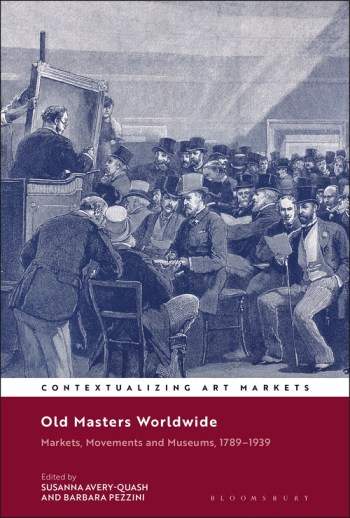 As a result of the Napoleonic wars, vast numbers of Old Master paintings were released on to the market from public and private collections across continental Europe. The knock-on effect was the growth of the market for Old Masters from the 1790s up to the early 1930s, when the Great Depression put an end to its expansion. This book explores the global movement of Old Master paintings and investigates some of the changes in the art market that took place as a result of this new interest. Arguably, the most important phenomenon was the diminishing of the traditional figure of the art agent and the rise of more visible, increasingly professional, dealerships; firms such as Colnaghi and Agnew’s in Britain, Goupil in France, and Knoedler in the USA, came into existence. Old Masters Worldwide explores the ways in which the pioneering practices of such businesses contributed to shape a changing market.
Susanna Avery-Quash is Senior Research Curator (History of Collecting) at The National Gallery London. Barbara Pezzini is a prolific writer on European Old Masters and British art of the period 1830–1970; she has previously worked in curatorial, research, and archival projects for The National Gallery, National Trust, and The Burlington Magazine.
C O N T E N T S
List of Figures
Series Editor’s Introduction, Kathryn Brown
Foreword, Gabriele Finaldi
Acknowledgements
List of Abbreviations
Introduction, Susanna Avery-Quash and Barbara Pezzini
Part I: Developing European Networks, 1780–1894
1 The European Market for Italian Old Masters after Napoleon — Robert Skwirblies (Technische Universität Berlin)
2 Old Masters from Rome to London: Alexander Day and Pietro Camuccini — Pier Ludovico Puddu (Palacký University, Czech Republic)
3 Selling Old Masters in Britain, France, and the Netherlands: The Networking Strategies of John Smith — Julia Armstrong-Totten (Independent Scholar, USA)
4 A Web of Agents: Buying Old Masters for the National Gallery, London — Susanna Avery-Quash (National Gallery, UK)
Part II: Gaining International Visibility and Expertise, 1850–1909
5 Old Masters versus Modern Art in Parisian Auctions — Léa Saint-Raymond (Université Paris Nanterre)
6 Agnew’s from Modern Art to the Old Masters — Barbara Pezzini (Independent Scholar, UK)
7 Taste or Opportunity? Durand-Ruel and Spanish Old Masters — Véronique Gerard Powell (Independent Scholar, France)
8 Authority and Expertise in the Old Master Market: Bode and Duveen — Catherine Scallen (Case Western Reserve University)
9 Scholar, Dealer, and Museum Man: Robert Langton Douglas in the International Old Master Market — Imogen Tedbury (Royal Holloway, University of London)
Part III: Casting a Wider Web, 1900–1939
10 A Missed Opportunity? Goupil and the Old Masters — Agnès Penot (Independent Scholar, USA)
11 Knoedler and Old Masters in America — Inge Reist (The Frick Collection)
12 Trust, Friendship, and Politics in the Old Master Market: Duveen and the State Art Collection of the Kingdom of Yugoslavia — Jelena Todorovic (Faculty of Fine Arts, Serbia)
13 Negotiating Old Masters for the Melbourne National Gallery — Monique Webber (The University of Melbourne and Monash University Art Design and Architecture)
14 The Distant Old Masters of South Africa — Jillian Carman (University of the Witwatersrand, South Africa)
Select Bibliography
Author Biographies
Index
Introducing Materia: Journal of Technical Art History
From Materia:
Introducing Materia: Journal of Technical Art History
We are pleased to announce the inauguration of an open-source, peer reviewed journal Materia: Journal of Technical Art History. This biannual publication, the first issue of which is set to launch in the spring of 2021, will provide an online, open-access platform devoted to the technical study of art objects. Bringing together the disciplines of conservation, conservation science, art history, and related disciplines, Materia will be among the first peer-reviewed publications dedicated solely to this steadily growing field of interdisciplinary research.
Editorial Team
Bianca Garcia, Balboa Art Conservation Center (San Diego, CA)
Courtney Books, St. Louis Art Museum (St. Louis, MO)
Cynthia Prieur, Queen’s University (Kingston, ON)
Emma Jansson, Stockholm University (Stockholm, Sweden)
Julie Ribits, Eskenazi Museum of Art at Indiana University (Bloomington, IN)
Lucia Bay, Philadelphia Museum of Art (Philadelphia, PA)
Morgan Wylder, Balboa Art Conservation Center (San Diego, CA)
Roxy Sperber, Indianapolis Museum of Art at Newfields (Indianapolis, IN)
New Book | The Purchase of the Past
From Cambridge UP:
Tom Stammers, The Purchase of the Past: Collecting Culture in Post-Revolutionary Paris c.1790–1890 (New York: Cambridge University Press, 2020), 370 pages, ISBN: 978-1108478847, $120.
 Offering a broad and vivid survey of the culture of collecting from the French Revolution to the Belle Époque, The Purchase of the Past explores how material things became a central means of accessing and imagining the past in nineteenth-century France. By subverting the monarchical establishment, the French Revolution not only heralded the dawn of the museum age, it also threw an unprecedented quantity of artworks into commercial circulation, allowing private individuals to pose as custodians and saviours of the endangered cultural inheritance. Through their common itineraries, erudition, and sociability, an early generation of scavengers established their own form of ‘private patrimony’, independent from state control. Over a century of Parisian history, Tom Stammers explores collectors’ investments—not just financial but also emotional and imaginative—in historical artefacts, as well as their uncomfortable relationship with public institutions. In so doing, he argues that private collections were a critical site for salvaging and interpreting the past in a post-revolutionary society, accelerating but also complicating the development of a shared national heritage.
Tom Stammers is Associate Professor in Modern European Cultural History at the University of Durham. He is a historian of modern France, specialising in visual and material culture; he works frequently with museums and heritage organisations, including collaborating on exhibitions, and is a regular contributor to arts reviews like Apollo.
C O N T E N T S
List of Illustrations
Acknowledgements
Introduction: Collection, Recollection, Revolution
1 Amateurs and the Art Market in Transition, c.1780–1830
2 Archiving and Envisioning the French Revolution, c.1780–1830
3 Book Hunting, Bibliophilia, and a Textual Restoration, c.1790–1840
4 Salvaging the Gothic in Private and Public Spaces, c.1820–1870
5 Royalists versus Vandals, and the Cult of the Old Regime, c.1860–1880
6 Allies of the Republic? Inside the Sale of the Century, c.1870–1895
Conclusion: The Resilience and Eclipse of Curiosité
Bibliography
Index
Call for Papers | Upcoming Issue of Perspective, On Inhabiting
From the Call for Papers (with the French version available here) . . .
Special Issue on Inhabiting / Habiter
Perspective: actualité en histoire de l’art (2021–22)
Proposals due by 10 January 2021; final articles due by 15 June 2021
For its coming issue, the journal Perspective asks the question of what it means to inhabit: to inhabit a space, a territory, one’s home or one’s body, whether we are dealing with far away frontiers, or the outlines of intimacy; to inhabit one’s life, one’s society/ies, one’s epoch, in what inhabiting means in terms of being present in one’s world, for and with one another, to face circumstances as they stand. In a time when, across the globe, entire populations are confined to their homes, Perspective issues an invitation to revisit the visual and imaginary plasticity of inhabiting: “to occupy a place of settled residence or habitat,” so states the dictionary, suggesting habit, repetition, regularity; but also occupying persons, inhabiting them, animating them, moving them.
Inhabiting is not only a question of space. When we speak of ‘the spirit of a place’, it opens the poetic question of being inhabited: to haunt, to be haunted, to possess a place or a being, to be possessed, as one may possess an idea, values or beliefs which, in turn, inhabit us. Thus, both time and intangibility find their way into the material world: inhabiting refers to what is built (masonry, roofs, buildings, frontiers), but it also refers to what we inherit, immaterial presences, intimate representations and mental spaces—finally, it refers to what holds us up, holds us back, or holds us together. In fine, inhabiting articulates the individual and the collective, what is shared and what is separated, what is movement and what is closure, places and non-places, and brings forth the question of the Commons: in our world, what do we share? This inevitably brings us to the question of ecology, in its original meaning; the science of the habitat (oikos, the ‘home’), to how our multiple forms of existence and coexistence interweave.
In this manner, Perspective endeavours to dedicate its coming issue to the ways in which artists, art historians, and their colleagues from various neighbouring disciplines, take on these interrogations and bring forth the multiple ways in which one can inhabit or be inhabited. This subject calls for a wide variety of approaches, both in terms of thematic and fields of study. All proposals will be studied as long as submissions remain in line with the journal’s editorial policy. Investigations into the fields of history of architecture, urbanism, landscaping, visual arts, but also museology, ethnology, anthropology, visual studies, and digital humanities, as well as decorative arts, design, fashion, performing arts and cinema shall all be welcome.
Published by the Institut national d’histoire de l’art (INHA) since 2006, Perspective is a biannual journal which aims to expose the diverse topicality of research in art history, while remaining constantly in movement, and explicitly aware of itself and of its own historicity and articulations. It bears witness to the historiographical debates within the field, while remaining in continuous relation with images and works of art themselves, updating their interpretations, and thus fostering global, intra- and interdisciplinary reflexions. The journal publishes scientific texts which offer novel perspectives on a given theme. These may be situated within a wide range, yet without ever losing site of the object of their focus ; to reach over and above any given case study, and interrogate the discipline, its methods, its history and limitations, while aligning these interrogations with topical issues from art history and neighbouring disciplines, which speak to each and every one of us as citizens.
Perspective invites contributors to update their historiographical material and the theoretical questionings from which they draw their work, to think from and around the starting point of a precise question, an assessment that will be considered an epistemological tool rather than a goal in itself. Thus, each article shall be written with a new approach, by creating links with the great societal and intellectual debates of our time.
Perspective is conceived as a disciplinary crossroad and aims to encourage dialogue between art history and other fields of research, human sciences in particular, and put into action the ‘law of the good neighbor’ developed by Aby Warburg. All geographical areas, periods, and mediums are welcome.
Please send your submissions (an abstract of 2,000 to 3,000 characters, a provisional title, a short bibliography on the subject, and a biography of a few lines) to the editorial office (revue-perspective@inha. fr) before 10 January 2021.
As Perspective will manage translations, projects will be examined by the issue’s editorial board regardless of language. The authors of selected proposals will be informed of the committee’s decision in February 2021, and articles must be submitted by 15 June 2021. Submitted articles, with a final length of 25,000 or 45,000 characters depending on the project, will be definitively accepted after the anonymous peer- review process.
At Sotheby’s | Sassoon: A Golden Legacy

Front and back views of a parcel-gilt silver and enamel Torah Shield, signed and dated In Hebrew, Elimelekh Tzoref Of Stanislav, 1782, 8 inches high. Estimate $600–900,000. More information is available here.
◊ ◊ ◊ ◊ ◊
Sotheby’s press release:
Sassoon: A Golden Legacy, N10399
Sotheby’s, New York, 17 December 2020
Sotheby’s announced that it will present a dedicated auction of important Judaica from the legendary Sassoon family on 17 December in New York. Assembled over the course of more than a century by the fabled ‘Rothschilds of the East’, Sassoon: A Golden Legacy will present a treasure trove of gilded silver objects, rare Hebrew manuscripts, textiles, and family artifacts, ranging geographically from Western Europe to the Far East, with rarities dating from the 11th to the 20th centuries. The nearly 70 lots in the collection are monumental in their significance as a primary source on the history of Jewish life and culture, and of the legendary Sassoon family.
With roots in Baghdad, the Sassoons relocated in the 1830s to India, led by their patriarch David Sassoon who established Bombay as the seat of his vast trade empire. He went on to open branches of his company in China, Hong Kong, Singapore, and Rangoon and played a key role in the industrialization of the Far East. In the late 19th and early 20th centuries, much of this fabled family moved to England, entering British high society and distinguishing themselves in the fields of journalism, philanthropy, poetry, politics, and the patronage of the arts. Several members, most notably Reuben David Sassoon, Flora Sassoon, David Solomon Sassoon, and Solomon David Sassoon, were particularly avid collectors of items of Jewish interest.
This sale offers treasures that have descended in the family since its earliest days, with items assembled during their residencies in Baghdad, Bombay, Hong Kong, and the United Kingdom. An important group of objects comes from Philip Salomons, brother of the first Jewish Lord Mayor of London and one of the earliest collectors of antique Judaica. That collection was bought by Reuben David Sassoon, who augmented it and subsequently lent many of these items—including several offered for sale here—to the groundbreaking 1887 Anglo-Jewish Historical Exhibition at the Royal Albert Hall in London, the first exhibition broadly dedicated to Judaica. Many were shown again in 1906, but have not been seen in public for over a century.
“We are incredibly privileged to present the Sassoon collection,” said John Ward, Head of Sotheby’s Silver Department in New York. “Sotheby’s history with the Sassoons goes back to the early 20th century, when David Solomon Sassoon bought Jewish books and manuscripts in Bond Street in the early 1900s. Beginning in 1970, we have been honored to host an extraordinary series of sales for the family in Zurich, New York, London, and Tel Aviv. The pieces in this sale are not just the personal holdings of one of the world’s great Jewish families, they are significant works of art, and tell an important story of Jewish patronage, collecting, and scholarship.”
Sharon Liberman Mintz, Senior Consultant of Books and Manuscripts at Sotheby’s, stated: “The distinguished pedigree, superior quality, and historical importance of this collection leaves me breathless. Not only are the Silver and Hebrew manuscripts some of the finest objects to ever come to market, they are further distinguished by their unparalleled provenance to generations of members from this legendary family. Working with this collection has been among the highlights of my professional career.”
The Sassoon Collection is led by two highly important parcel-gilt silver Torah shields from the 18th century, representing the most important pieces of Judaic metalwork to appear at auction in a generation. These superb jewel-like works of art, probably made in Lemberg (Lviv)—an important 18th-century Jewish center in modern-day Ukraine—are not only extraordinary in their craftsmanship, but are now attributable to the Jewish silversmith, Elimelekh Tzoref of Stanislav. As Jews of Western Europe were, for the most part, barred from joining the guilds. this is an extraordinary document from the era of the Enlightenment, and the date and signature of the artist represent a proud proclamation of Jewish artistry. Although the artist’s name appears only on one shield, their matching and highly distinctive decoration allows us to attribute both to him, in addition to a similar third shield (now in the Israel Museum) that was offered by the Sassoons through Sotheby’s Tel Aviv in 2000, and which achieved the then record-breaking price of almost $800,000.
The shields were in the collection of Reuben David Sassoon, who lent them to the aforementioned 1887 Anglo-Jewish Historical Exhibition at the Royal Albert Hall. However, the full story and historic significance of these three works could not be deduced until now, when the two companion shields have appeared—for the first time since the historic 1906 Whitechapel exhibition Jewish Art and Antiquities. The two shields evoke in miniature the towering carved wooden Torah Arks of Eastern European synagogues and are intricately engraved on the backs: on one scenes from the story of Isaac are displayed in an exuberant rococo setting (estimate $600–900,000), and on the other the artist has engraved a highly detailed plan of the Holy Temple in Jerusalem from a birds eye perspective (estimate $500,000–800,000).

Italian gold Esther Scroll Case, 18th century. Estimate: $60,000–90,000.
Most of the manuscripts derive from the collection of the famous bibliophile David Solomon Sassoon, with examples showcasing the reach of Jewish culture. Among the important books and manuscripts in the collection are a small group of items related to the great Rabbi Joseph Hayyim of Baghdad (1834–1909)—one of the most prominent halakhic authorities and kabbalists of Iraqi Jewry in the 19th and 20th century. Often described as ‘the preeminent kabbalist of Baghdad’, and referred to as the ‘Ben Ish Hai’—after his most popular literary work, Sefer ben ish hai—he played an important role in simplifying and popularizing kabbalistic concepts and practices among the masses throughout the Middle East.
The star highlight is a Siddur, or daily prayer book, owned by Rabbi Joseph Hayyim of Baghdad (estimate $100,000–200,000). Containing the prayers for much of the liturgical year, accompanied by an anthologized Kabbalistic commentary, it is distinguished not only by the high quality of its penmanship and condition, but by the presence of several notes and comments written by the rabbi himself.
The collection also includes two pairs of Tefillin (phylacteries) that belonged to Rabbi Joseph Hayyim of Baghdad (estimate $150,000–250,000). Following the rabbi’s death in 1909, David Solomon penned a letter to the rabbi’s son wishing him consolation and asking him if he could gift his father’s tefillin as a memento. No other examples of tefillin belonging to R. Joseph Hayyim of Baghdad are known to exist.
The collection also features several Yemenite manuscript copies of works by Rabbi Moses Maimonides (Rambam; 1138–1204), one of the most illustrious Jewish figures of all time. Born in Cordoba, Spain, he fled persecution at the hands of the Almohads in the late 1140s, eventually moving first to Fez, Morocco, and later settling in Cairo, where he remained until his death. His reputation rests upon his excellence in a wide variety of fields. Not only was he a halakhist and communal leader of the first rank, he also wrote highly important works of medicine and Jewish philosophy that, like the rest of his oeuvre, achieved wide circulation.
This group is led by a copy of Rabbi Moses Maimonides’ Judeo-Arabic commentary on Seder mo‘ed, the second Order of the Mishnah (estimate $25,000–35,000). It is one of only ten known copies of Maimonides’ original Judeo-Arabic commentary on Seder mo‘ed from before the fifteenth century, and the only one remaining in private hands.
The sale also includes an exceptionally well executed and preserved Miniature Torah Scroll from the 19th century, outfitted with elegant silver-gilt and silk accoutrements (estimate $80,000–120,000). While most communal scrolls used in synagogues for ritual purposes are large and heavy, ones for private devotion tend to be diminutive and portable, allowing their owners not only to store them more easily, but also to transport them from place to place. Naturally, the degree of proficiency required to produce a small scroll like the present one was beyond the ability of most skilled scribes—making such scrolls highly rare and greatly prized.
Additional objects in the sale reflect the personal tastes, luxurious lifestyles and the international range of this legendary family. One finds pieces of family artifacts such as the magnificent silk robe Ezekiel ben Joshua Gubbay (1824–1896) wore upon his marriage to Aziza Sassoon (1839–1897) (estimate $2,000–4,000); the ketubbah used at the wedding of Reuben David Sassoon and Catherine Ezekiel, members of two of the greatest Baghdadi merchant families in India (estimate $10,000–20,000); a silver memorial plaque for Lady Anne Sassoon, wife of Sir Albert (Abdullah) David Sassoon (estimate $2,000–3,000); a signet ring used by David Solomon Sassoon (estimate $2,000–3,000), and a golden medal presented to Lady Rachel Sassoon Ezra by the Governor of Bengal in 1947 (estimate $1,000–1,500).
New Book | Divine Images: The Life and Work of William Blake
From Reaktion Books:
Jason Whittaker, Divine Images: The Life and Work of William Blake (London: Reaktion Books, 2021), 392 pages, ISBN: 978-1789142877, £25 / $35.
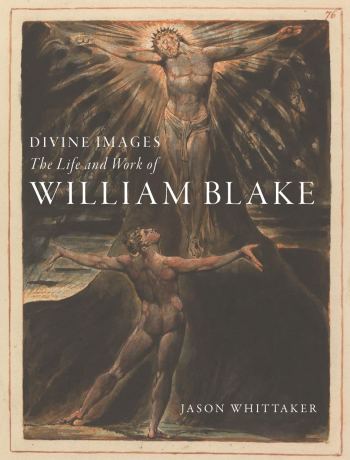 Although relatively obscure during his lifetime, William Blake has become one of the most popular English artists and writers, through poems such as ‘The Tyger’ and ‘Jerusalem’, and images including The Ancient of Days. Less well-known is Blake’s radical religious and political temperament, and that his visionary art was created to express a personal mythology that sought to recreate an entirely new approach to philosophy and art. This book examines both Blake’s visual and poetic work over his long career, from early engravings and poems to his final illustrations to Dante and the Book of Job. Divine Images further explores Blake’s immense popular appeal and influence after his death, offering an inspirational look at a pioneering figure.
Jason Whittaker is Head of the School of English and Journalism at the University of Lincoln. His books include William Blake and the Myths of Britain (1999) and Blake 2.0 (2012).
C O N T E N T S
Introduction: This World is a World of Imagination and Vision
1 Early Life and Work
2 Visions of Innocence
3 A New Heaven is Begun
4 Lambeth and Experience
5 A New System of Mythology
6 Night Thoughts and the Four Zoas
7 England’s Pleasant Land
8 Creating Systems
9 Final Visions
10 Death and Resurrection: The Legacy of William Blake
Bibliography
New Book | Metz royale et impériale: La cathédrale
From the École nationale supérieure d’architecture Paris-Malaquais:
Aurélien Davrius, Metz royale et impériale: La cathédrale, la mémoire et l’amnésie (Bordeaux: Éditions William Blake & Co, 2020), ISBN: 978-2841032303, 28€.
 Ville libre d’Empire, protectorat de facto du royaume France à partir de 1552, puis incorporée en 1648, Metz se voit annexée au Second Reich en 1871, avant de redevenir française en 1918. C’est l’histoire d’une ville de l’entre-deux qui se lit dans l’architecture messine. Le quartier de la Neue Stadt, bien sûr, rappelle ce passé germanique; la «gothisation» de la cathédrale à la fin du XIXe siècle aussi. Partant de l’exemple de l’entrée principale de la cathédrale Saint-Étienne remaniée par le Reich, cette étude vise à relever le caractère symbolique que Metz avait revêtu pour la monarchie française et qu’elle revêtit de nouveau, mais cette fois pour la monarchie impériale prussienne, au-delà du rôle purement stratégique qu’elle jouait pour les deux nations successives.
Louis XV, au milieu du Siècle des Lumières, chargea son architecte Jacques-François Blondel d’aménager les abords de la cathédrale, en créant trois places et en construisant un portique monumental, véritable ex-voto à la gloire du Prince, en style classique. Un siècle plus tard, Guillaume II fera démonter cette entrée, jugée trop française, pour effacer le souvenir de l’ancienne puissance dominante. C’est un portail néo-gothique qu’il fait édifier sur les dessins de son architecte Paul Tornow, digne de la haute culture du Second Reich. Le kaiser se fit représenter lui-même sous les traits du prophète Daniel, statue intégrée dans le décor du portail. Guillaume II tenta d’effacer et de remplacer Louis XV.
Afin de mieux comprendre les luttes de pouvoir entre France et Allemagne qui se nouèrent à Metz, à travers les œuvres d’architecture, cette étude se propose d’élargir la question à l’ensemble du contexte franco-allemand, de la fin du XVIIIe siècle au début du XXe. Les travaux de la cathédrale de Metz n’offrent qu’une pièce d’un puzzle beaucoup plus vaste, dont on peine à saisir tous les tenants et aboutissants. Il faut faire remonter cette rivalité à l’époque des armées napoléoniennes occupant et humiliant la Prusse, de la récupération de la figure de Vercingétorix par Napoléon III, de l’appropriation d’un certain style architectural par Guillaume II, mais aussi des chantiers d’achèvement des cathedrales de Cologne ou d’Ulm. Sur la base d’une riche iconographie, des articles de presse de l’époque ou encore de fonds archivistiques peu exploités, c’est un double portrait de la ville de Metz qui s’offre au lecteur: une ville à la fois royale et impériale.
S O M M A I R E
Partie I : Metz royale
• Metz et la politique royale d’embellissements
• Le portique de la cathédrale : un monument royal pour symboliser le Prince
• Un portique classique pour une cathédrale gothique
• Blondel théoricien et architecte d’un gothique des Lumières
Partie II : Metz impériale
• « Architecture allemande » (Goethe, 1772)
• Du gothique au classique, et retour : menaces sur l’œuvre de Blondel
• Paul Tornow, le « Viollet-le-Duc de Metz »
• Une gothisation du gothique
• Le Kaiser et l’équerre
• La fabrique d’un art national
• Gothique français contre gothique allemand : l’architecture comme enjeu national
The Rijksmuseum Fellowship Programme, 2021–22
The Rijksmuseum Fellowship Programme, 2021–22
Applications due by 17 January 2021
The Rijksmuseum welcomes international, independent research proposals that open new perspectives on the museum’s collection, its history, and activities. The purpose of the Rijksmuseum Fellowship Programme is to encourage and support scholarly investigation, and to contribute to academic discourses while strengthening bonds between the museum and universities. The programme enables highly talented candidates to base part of their research at the Rijksmuseum and offers access to the museum’s expertise, collections, library, and laboratories. Furthermore, the programme facilitates opportunities for Fellows to engage in workshops and excursions to encourage exchange of knowledge—both amongst themselves and the broader museum audience.
Please review the eligibility, funding, and application requirements by visiting the Rijksmuseum website. For the 2021–2022 academic year, candidates may apply for the following:
- Andrew W. Mellon Fellowship for research in art and cultural history. Apply here»
- Terra Foundation Fellowship for research in American Photography. Apply here»
- Johan Huizinga Fellowship for historical research. Apply here»
- Migelien Gerritzen Fellowship for conservation and scientific research. Apply here»
- Anton C.R. Dreesmann Fellowship for art historical research. Apply here»
The closing date for all applications is 17 January 2021, at 6:00pm (Amsterdam time/CET). No applications will be accepted after this deadline. All applications must be submitted online and in English. Applications or related materials delivered via email, postal mail, or in person will not be accepted. Selection will be made by an international committee in February 2021. The committee consists of eminent scholars in the relevant fields of study from European universities and institutions, and members of the curatorial and conservation staff of the Rijksmuseum. Applicants will be notified by 15 March 2021. All fellowships will start in September 2021.
For questions concerning the application procedure, contact the Coordinator of the Fellowship Programme (fellowships@rijksmuseum.nl).
New Book | The Marquis de Sade and the Avant-Garde
Sade died on this day, December 2, in 1814 at the Charenton Asylum; from Princeton UP:
Alyce Mahon, The Marquis de Sade and the Avant-Garde (Princeton: Princeton University Press, 2020), 296 pages, ISBN: 978-0691141619, £38 / $45.
 How the notorious author of The 120 Days of Sodom inspired the surrealists and other avant-garde artists, writers, and filmmakers
The writings of the Marquis de Sade (1740–1814) present a libertine philosophy of sexual excess and human suffering that refuses to make any concession to law, religion, or public decency. In this groundbreaking cultural history, Alyce Mahon traces how artists of the twentieth century turned to Sade to explore political, sexual, and psychological terror, adapting his imagery of the excessively sexual and terrorized body as a means of liberation from systems of power.
Mahon shows how avant-garde artists, writers, dramatists, and filmmakers drew on Sade’s ‘philosophy in the bedroom’ to challenge oppressive regimes and their restrictive codes and conventions of gender and sexuality. She provides close analyses of early illustrated editions of Sade’s works and looks at drawings, paintings, and photographs by leading surrealists such as André Masson, Leonor Fini, and Man Ray. She explains how Sade’s ideas were reflected in the writings of Guillaume Apollinaire and the fiction of Anne Desclos, who wrote her erotic novel, Story of O, as a love letter to critic Jean Paulhan, an admirer of Sade. Mahon explores how Sade influenced the happenings of Jean-Jacques Lebel, the theater of Peter Brook, the cinema of Pier Paolo Pasolini, and the multimedia art of Paul Chan. She also discusses responses to Sade by feminist theorists such as Simone de Beauvoir, Susan Sontag, and Angela Carter.
Beautifully illustrated, The Marquis de Sade and the Avant-Garde demonstrates that Sade inspired generations of artists to imagine new utopian visions of living, push the boundaries of the body and the body politic, and portray the unthinkable in their art.
Alyce Mahon is Reader in Modern and Contemporary Art History at the University of Cambridge. She is the author of Surrealism and the Politics of Eros, 1938–1968 and Eroticism and Art.










 Enfilade
leave a comment