New Book | How the Word Is Passed
From Little, Brown, and Company:
Clint Smith, How the Word Is Passed: A Reckoning with the History of Slavery Across America (New York: Little, Brown, and Company, 2021), 352 pages, ISBN: 978-0316492935, $30.
 Beginning in his hometown of New Orleans, Clint Smith leads the reader on an unforgettable tour of monuments and landmarks—those that are honest about the past and those that are not—that offer an intergenerational story of how slavery has been central in shaping our nation’s collective history, and ourselves.
It is the story of the Monticello Plantation in Virginia, the estate where Thomas Jefferson wrote letters espousing the urgent need for liberty while enslaving more than four hundred people. It is the story of the Whitney Plantation, one of the only former plantations devoted to preserving the experience of the enslaved people whose lives and work sustained it. It is the story of Angola, a former plantation–turned–maximum-security prison in Louisiana that is filled with Black men who work across the 18,000-acre land for virtually no pay. And it is the story of Blandford Cemetery, the final resting place of tens of thousands of Confederate soldiers.
A deeply researched and transporting exploration of the legacy of slavery and its imprint on centuries of American history, How the Word Is Passed illustrates how some of our country’s most essential stories are hidden in plain view—whether in places we might drive by on our way to work, holidays such as Juneteenth, or entire neighborhoods like downtown Manhattan, where the brutal history of the trade in enslaved men, women, and children has been deeply imprinted.
Informed by scholarship and brought to life by the story of people living today, Smith’s debut work of nonfiction is a landmark of reflection and insight that offers a new understanding of the hopeful role that memory and history can play in making sense of our country and how it has come to be.
Clint Smith is a staff writer at The Atlantic. He is the author of the poetry collection Counting Descent, which book won the 2017 Literary Award for Best Poetry Book from the Black Caucus of the American Library Association and was a finalist for an NAACP Image Award. He has received fellowships from New America, the Emerson Collective, the Art For Justice Fund, Cave Canem, and the National Science Foundation. His writing has been published in The New Yorker, The New York Times Magazine, Poetry Magazine, The Paris Review, and elsewhere. Born and raised in New Orleans, he received his B.A. in English from Davidson College and his Ph.D. in Education from Harvard University.
Online Conversation | Juneteenth

This CW Conversation is part of the Foundation’s Us: Past, Present, Future series (there are lots of terrific resources listed below; for course websites, I’m particularly excited about the timeline, which ranges from 1565 to 2020. –CH).
Juneteenth: A Conversation with Deirdre Jones Cardwell, Richard Josey, and Michael Twitty
Online, Colonial Willamsburg Foundation, 19 June 2021, 4pm (EDT)
General Order Number Three, which officially informed enslaved Texans of their legal freedom, stated that emancipation involved “an absolute equality of personal rights and rights of property.” Have we achieved the promises of Juneteenth, and how should it be observed? Join Deirdre Jones Cardwell, Programming Lead and Actor Interpreter with Colonial Williamsburg, Richard Josey, Founder and Principal Consultant for Collective Journeys LLC, and Michael Twitty, Culinary Historian, in a discussion about the story, significance, and meanings of Juneteenth.
Click here to join the livestream event on Saturday, 19 June 2021, at 4.00pm (EDT). You don’t have to have a Facebook Account to watch, but you will need to sign in to join the discussion.
◊ ◊ ◊ ◊ ◊
Whether you’re looking to read up on this topic before joining the conversation, or want some further reading afterward, here’s recommended reading from Colonial Williamsburg.
Colonial Williamsburg Juneteenth Resources
Colonial Williamsburg has created several related web resources, including an informational What is Juneteenth? page, a calendar of Juneteenth special events at Colonial Williamsburg, and a Juneteenth Historical Timeline that provides history and context for the commemoration.
The Colonial Williamsburg Resource Library provides access to numerous resources that explore relevant themes such as citizenship, civics, and government using video, lessons, and interactive web activities. The Resource Library features several relevant resources such as the When Freedom Came electronic field trip and Whose Emancipation?
Colonial Williamsburg’s YouTube Channel features 2020 productions “Juneteenth at Custis Square” and “Before Juneteenth.”
Juneteenth Resources from Other Cultural Institutions
• The Smithsonian National Museum of African American History & Culture offers “The Historical Legacy of Juneteenth.”
• The Library of Congress blog offers “The Birth of Juneteenth: Voices of the Enslaved” and “Emancipation Day in South Carolina . . .,” an 1863 illustration from Frank Leslie’s Illustrated Newspaper.
• The Library of Virginia’s The Uncommonwealth blog focuses on “Why Juneteenth?”
• PBS features “What is Juneteenth?” with Henry Louis Gates, Jr.
• The National Archives presents an online exhibit The Emancipation Proclamation, providing context on that document issued January 1, 1863.
Books
• Annette Gordon-Reed. On Juneteenth. New York: Liveright Publishing, 2021.
• Angela Johnson. All Different Now: Juneteenth, the First Day of Freedom. New York: Simon & Schuster Books for Young Readers, 2014.
Exhibition | A Gift to the Nation: The Hennage Collection

Tea and Coffee Service by Littleton Holland, Baltimore, ca.1800, silver and wood
(Colonial Williamsburg Foundation; bequest of Mr. and Mrs. Joseph H. Hennage)
◊ ◊ ◊ ◊ ◊
From the press release (15 June 2021) for the exhibition:
A Gift to the Nation: The Joseph and June Hennage Collection
DeWitt Wallace Decorative Arts Museum, Colonial Williamsburg, 26 June 2021 — 2023
Earlier this year, the Colonial Williamsburg Foundation announced the most significant single American decorative arts bequest in its 90-year history: The Joseph H. and June S. Hennage Collection with its more than 400 objects of various media including American furniture and miniature furniture, American silver, and Chinese porcelain that will transform Colonial Williamsburg’s already renowned collections. To celebrate this momentous bequest, an exhibition of approximately 50 highlighted objects, A Gift to the Nation: The Joseph and June Hennage Collection, will open in the Miodrag and Elizabeth Ridgely Blagojevich Gallery at the DeWitt Wallace Decorative Arts Museum, one of the newly expanded Art Museums of Colonial Williamsburg, on June 26, 2021 and remain on view through 2023. While only a fraction of the overall collection, the items selected for the exhibition will illustrate the Hennages’ exceptional taste and collecting style, the American origins and family histories of the objects and the couple’s passion for American decorative arts.
“Joe and June Hennage were remarkably generous and philanthropic,” said Ronald Hurst, the foundation’s Carlisle Humelsine chief curator and vice president for museums, preservation, and historic resources. “They wanted to ensure that these exceptional illustrations of the nation’s history and culture would be held in the public trust for everyone’s edification. Their gift to Colonial Williamsburg has done just that and we are forever in their debt.”
Collectors have many reasons for acquiring the objects they amass, but for the Hennages, who started collecting American decorative arts in the mid-1960s, the first step towards any antique purchase was ‘buying with your heart’, as June Hennage described it. The next step was studying the object for its authenticity, history and condition to determine if it was right for their collection. This method of consideration led to an assemblage of superlative examples of furniture and silver from important colonial centers including Boston, Philadelphia, New York, Baltimore, Charleston, and the Connecticut River Valley. Joe and June only acquired pieces on which they both agreed, and often the items were gifts to one another. Objects were selected both to fit within their home as well as to highlight various forms, such as tables, high chests, chairs, tea sets, and sauceboats, which represent the regional diversity in American furniture and silver. These pieces were complemented with an array of other materials, primarily Chinese export porcelain.
Colonial Williamsburg and its annual Antiques Forum played an important role in the Hennages’ collecting focus and philanthropy for more than 50 years; they received the highest honor for service to the foundation, the Churchill Bell award, in 1994. The couple’s patriotic generosity also extended to other institutions to whom they donated important American objects, including the U.S. State Department, the White House, the National Portrait Gallery, Mount Vernon, and Monticello.
Objects from the Hennage collection that were selected for this exhibition illustrate June and Joe’s collecting philosophy,” said Tara Chicirda, curator of furniture at the Colonial Williamsburg Foundation. “They specifically acquired representational objects from a variety of regions to highlight the local options in form or ornament, and they often sought out pieces with family histories or by well-known makers with signatures or labels. We have tried to show the breadth and depth of the furniture and silver collections in this exhibition as well as highlight their interest in miniature furniture and Chinese export porcelain.”
Although each object included in A Gift to the Nation is a highlight of the Hennage Collection, one exceptional piece of furniture is a high chest of drawers possibly made by Isaac Tryon in either Middletown or Glastonbury, Connecticut, located in the fertile Connecticut River Valley, between 1760 and 1790. Joe Hennage gave this piece to June as a gift, and many times over the years, the dealer who sold it to Joe offered to buy it back at a greater price. June declined to sell each time as she felt she would not be able to acquire another Connecticut high chest as nice as this example. Cabinetmakers, such as Isaac Tryon, crafted furniture for the wealthy inhabitants of the Connecticut River Valley, and the vertical, sleek lines and carved fans of this cherry high chest typify the work of makers in this region like Tryon.
Another highlight to the exhibition is a pair of French-inspired armchairs made in Philadelphia ca. 1790 and believed to have been originally owned by the wealthy Philadelphia merchant and signer of the Declaration of Independence, Robert Morris. French furniture and furniture inspired by French design became quite popular in America after the Revolution, especially in Philadelphia. Following this trend, George and Martha Washington purchased gold and white French chairs for the Presidential House there in 1790. The chairs survive with their original upholstery foundation covered in a reproduction silk of the same color as the show cloth first used.
Joe and June Hennage’s interests in American silver focused primarily on the period between 1730 and 1815 with emphasis in objects from Boston, Philadelphia, and Baltimore. Their collection of approximately 100 pieces includes tea and coffee sets, jugs, tankards, cans, goblets, porringers, sauceboats, casters, salvers, punch strainers, and ladles, many with known histories of ownership. As with the furniture and ceramics in the bequest of this collection, the silver from the Hennage collection is transforming the already important assemblage of silver in Colonial Williamsburg’s holdings.
“The Hennage silver bequest is game-changing, effectively doubling the number of American-made hollowware pieces owned by Colonial Williamsburg. It offers exciting new opportunities to interpret the diverse range of wares produced by silversmiths from New England to the South and includes important examples with distinguished pedigrees,” said Janine Skerry, Colonial Williamsburg’s senior curator of metals.
Among the highlights of the Hennage’s silver collection to be on view in A Gift to the Nation is a tea and coffee set by Littleton Holland made in Baltimore, Maryland, ca. 1800 (pictured above). Large en suite tea and coffee sets such as this example became popular by the earliest years of the nineteenth century. This set was made for the Krebs family of Baltimore and features two teapots—one for black tea and one for green—as well as a coffeepot, sugar urn, cream pot, and waste bowl. Fashioned in the late neo-classical style with broad fluted panels and bands of bright-cut engraving, this set exemplifies the end of the timeline for the silver that the Hennages collected; very few of their acquisitions date past 1810.

Pair of water bottles or guglets, Jingdezhen, China, ca. 1805 (Colonial Williamsburg Foundation; bequest of Mr. and Mrs. Joseph H. Hennage).
The Chinese export porcelain that Joe and June collected to complement their antique furniture and silver reflected their passion for American history and sense of design. The pieces to be on view in the exhibition include objects with rare American histories of ownership and those that reflect the couple’s love of vibrant color.
“The Chinese porcelain featured in the exhibition not only relays stories of the young United States, but also tells very personal stories of Joe’s and June’s love of collecting and their love of brilliant colors,” said Angelika Kuettner, associate curator of ceramics and glass at Colonial Williamsburg. “While the ceramics in this multimedia exhibit are only highlights from the collection, it’s important to note that, to date, the bequest marks the most significant addition to Colonial Williamsburg’s collection of Chinese porcelain destined for the post-Revolutionary American market.”
One such example of the Hennages’ love of vibrant color can be seen in A Gift to the Nation through their collection of a hot water dish and plates made in Jingdezhen, China, ca. 1800. These pieces made of hard-paste porcelain represent the variety of colors in which the so-called Fitzhugh pattern was available to eighteenth- and early nineteenth-century consumers. (Collectors have referred to this diaper and moth or butterfly-bordered four-paneled motif as ‘Fitzhugh’ since at least the late 19th century, and most likely the name derived from Thomas Fitzhugh who served as a British East India Company official from the 1780s until 1800.) The pattern often included a central medallion surrounding a floral sprig or a cypher. Instead of the central medallion, some pieces made specifically for export to the American market feature a splayed eagle holding within its beak a banner bearing the motto ‘E Pluribus Unum’, all representative of the Great Seal. Vibrant green, orange, yellow, and brown as well as the more common underglaze blue version were available and pieces decorated in yellow, such as the Hennages’, are among the rarest examples.
A Gift to the Nation: The Joseph and June Hennage Collection is generously funded by Cynthia Hardin and Robert S. Milligan and Mary Virginia E. and Charles F. Crone in honor of Ronald and Mary Jean Hurst.
Call for Papers | 18th-Century Dictionaries and Encyclopedias
While CAA isn’t scheduled to finalize decisions until August, we have, on the affiliate end, been selected to represent ASECS at the 2022 annual conference of the College Art Association in Chicago next February. With hopes of soliciting a wide range of papers and participants, we’re circulating this call for papers early. Please send a CV and an abstract (300 words) for 18-minute papers to jgermann@ithaca.edu and CraigAshleyHanson@gmail.com by Friday, 10 September 2021. Presenters will need to be members in good standing of both CAA and ASECS. We’re happy to answer questions. –Jennifer Germann and Craig Hanson
Constructing Art History in and through 18th-Century Dictionaries and Encyclopedias
ASECS Affiliate Session, College Art Association, Chicago, 16–19 February 2022 (format TBD)
Chaired by Jennifer Germann (Ithaca College) and Craig Hanson (Calvin University)
Proposals due by 10 September 2021

Frontispiece from J. Barrow, Dictionarium Polygraphicum: Or, The Whole Body of Arts Regularly Digested (London: Printed for C. Hitch and C. Davis in Pater-Noster Row, and S. Austen in St. Paul’s Church-Yard, 1735). Getty Research Institute.
Notwithstanding an impressive body of scholarship addressing eighteenth-century encyclopedias generally—particularly Ephraim Chambers’s Cyclopedia and the Encyclopédie of Diderot and d’Alembert—art history as a discipline has yet to produce anything like a comprehensive account of how various artistic discourses of the period were shaped by such reference works—either by ambitious universal dictionaries or by more focused, specialized volumes. In fact, however, the long eighteenth century saw the publication and often significant distribution of a wide range of art and architectural dictionaries, books like Filippo Baldinucci’s Vocabolario toscano dell’arte del disegno (1681), Neve’s The City and Country Purchaser’s and Builder’s Dictionary (1703), John Barrow’s Dictionarium Polygraphicum (1735), François Marie de Marsy’s Dictionnaire abrégé de peinture et d’architecture (1746), Joachim Christoph Gottsched’s Handlexicon, oder, kurzgefasstes Wörterbuch der schönen Wissenschaften und freyen Künste (1760), and Diego Antonio Rejon de Silva’s Diccionario de las nobles artes para instrucción de los aficionados, y uso de los profesores (1788).
This panel invites papers that explore how dictionaries and encyclopedias (broadly defined) mediated and shaped the emerging field of art history for both artistically sophisticated readers and a wider general audience. How were these texts used in the past (and by whom) and how might art historians engage them productively today? And what to make of how these texts have worked to legitimate some objects of art historical inquiry, even as the omissions have also profoundly shaped the field?
For all our twenty-first-century hopes of advancing a comprehensive, global scope, how effectively might any reference work, dependent upon existing scholarship, break from the biases and narratives that have dominated art history as an academic discipline? Should such works continue to be produced and, crucially, in what form? Narrowly focused papers are welcome so long as they also position their subjects within a larger framework. Contributions that reconsider well-known eighteenth-century publications (including universal dictionaries) as well as essays addressing underexplored reference books are encouraged.
Hôtel de la Marine Opens after €132m Restoration

Located in Paris on the Place de la Concorde, the Hôtel de la Marine was designed by Ange-Jacques Gabriel in the 1750s and completed in 1774. It opened to the public earlier this month. (Photo by Jean-Pierre Delagarde for Centre des monuments nationaux).
◊ ◊ ◊ ◊ ◊
From The Art Newspaper:
Sarah Belmont, “Paris’s Landmark Hôtel de la Marine Opens to Visitors—and Co-working Offices—after Four Years of Restoration,” The Art Newspaper (14 June 2021). The 550-room palace has undergone a €132m makeover by the Centre des Monuments Nationaux.
France’s Centre des Monuments Nationaux (CMN) has unveiled a new-look Hôtel de la Marine in Paris after a four-year restoration project costing €132m. The 18th-century state apartments, 19th-century reception rooms and a shop opened to the public on 12 June, with a gourmet restaurant and new displays dedicated to the private collection of Qatar’s Al-Thani dynasty to follow this autumn.
Located on the Place de la Concorde between the Champs-Élysées and the Tuileries gardens, the Hôtel de la Marine was designed in 1758 by Ange-Jacques Gabriel, the chief architect to King Louis XV. The 550-room palace served as the Crown’s furniture storage unit, the Garde-Meuble, before becoming the headquarters of the French navy for more than 200 years. It is where is where the Crown Jewels were stolen during the Revolution in 1792, where the decree that abolished slavery in France and its colonies was signed in 1848, and where sumptuous balls were held throughout the 19th century. . . .
The full article is available here»
Additional information and photos are available at a posting by Heather Clawson, for her blog Habitually Chic (6 June 2021).
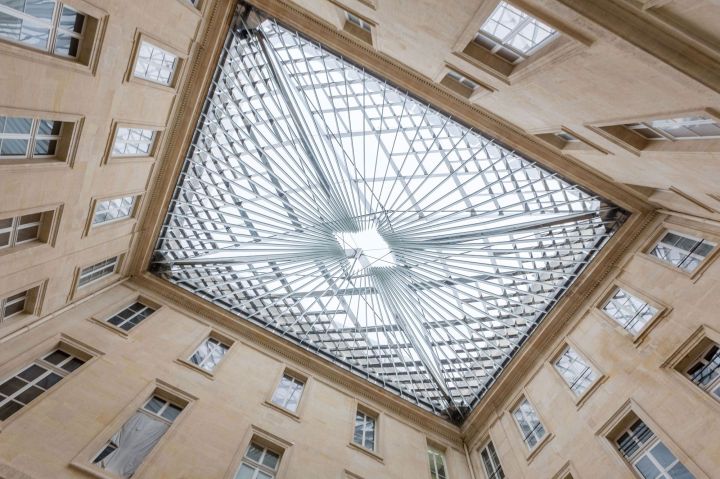
An courtyard of the Hôtel de la Marine has been covered with a new glass roof designed by Hugh Dutton in collaboration with Christophe Bottineau, the chief architect of French historic monument (Photo by Cedric Berieau for the Centre des monuments nationaux).
Online Symposium | Kaleidoscope Conversations, Color and Meaning
From the symposium programme:
Kaleidoscope Conversations
Online, Masterpiece London Symposium, 16–17 June 2021, 5.00–6.30pm (BST)
Organized with Thomas Marks
 Masterpiece is delighted to host a programme of digital debate and discussion co-organised by the Fair and Thomas Marks, editor of Apollo, to bring together preeminent museum curators and conservators with the leading figures in the art and antiques trade, with the aim of encouraging constructive discussion, networking, and the exchange of knowledge and practical advice.
Kaleidoscopic Conversations is the fifth in a series of events that Masterpiece launched in 2018—and which in the past twelve months have fully embraced the possibilities of digital discussion, with recent online events focusing on conservation and artistic materials. This June the spotlight is on the history of colour, and particularly how the colours and pigments of artistic materials—and how those have been harnessed in works of art—have borne specific meanings in different times and cultures.
Over two days, experts will discuss how the local significance of colours should be fundamental to how we interpret and appreciate a range of artistic fields and how best the history and science of colour can be communicated to as wide an audience as possible in museums and other contexts. How do we move beyond the aesthetic presentation of paintings or brightly coloured objects to discussion of what colours once meant? How can we perceive or reimagine colours that have changed or faded over time? How do museums allow us to see colours in the best possible light and provide an understanding of the role that colour plays in display? As ever at the Masterpiece Symposium, attendees will be invited to participate in the discussion during break-out sessions that will follow the panels—with the aim of stimulating vibrant debate.
“This event builds on our online programme, which has aimed to foster a better understanding of works of art through the exploration of materials,” says Philip Hewat-Jaboor, Chairman of Masterpiece London. “The fifth Masterpiece Symposium will continue this thread by looking at the often forgotten role that colour plays in works of art themselves, as well as in historical interiors, and how colour is reconceived and communicated in modern museum displays.”
Register for the Masterpiece Symposium here»
All times listed are BST
W E D N E S D A Y , 1 6 J U N E 2 0 2 1
5.00 Introduction by Philip Hewat-Jaboor and Thomas Marks
5.05. Panel Discussion: Vivid Histories
The inclusion of specific colours in paintings and works of art has rarely, if ever, been merely decorative. From the value historically associated with splendid raw materials, such as lapis lazuli or natural dyes for textiles, to the symbolic meanings that different hues have held in different times and places, colour contains and reflects meaning—even if that meaning may fade over time. From magnificent marbles to splendid stained glass, vibrant colours or their combinations have not only awed viewers but have historically also spoken to them of a wide spectrum of significance. This panel will explore: the fastness or fleeting nature of some of the meanings historically attached to colour; the relationship between colour and style; that between colour and power or status; the challenges of retrieving the historical significance of color; the role of heritage scientists in recovering the history of colour; and the role of art historians in telling its stories.
• Renée Dreyfus | Distinguished Curator and Curator in Charge, Ancient Art and Interpretation, Fine Arts Museums of San Francisco
• Alexandra Loske | Curator, Royal Pavilion, Brighton
• Georges Roque | Philosopher, art historian, and author of La cochenille, de la teinture à la peinture: Une histoire matérielle de la couleur
• Matthew Winterbottom | Curator of Sculpture and Decorative Arts, The Ashmolean Museum, Oxford
6.00 Break-out Session: Bright Ideas
All symposium participants will be split into small discussion groups. In this 25-minute session, they will be invited to continue the conversation of the preceding panel, drawing on their own knowledge and experience to explore how the history of colour can and should still be integral to how we think about art—and why this might be more urgent that ever as we strive to understand objects in global and local contexts.
T H U R S D A Y , 1 7 J U N E 2 0 2 1
5.00 Panel Discussion: The Chromatic Museum
In our memories, perhaps, museums sometimes exist in black and white—or in sepia tones. But working with colour—working in colour, even—is fundamental to museum installations and displays. And interpreting the historical meaning of colours is vital to how collections are communicated to the public. Richly coloured objects may be eye-catching, certainly, but how do curators and museum professionals translate that into significance for as broad an audience as possible? And how far do decisions made by curators and exhibition designers affect how we perceive and appreciate colour—or even reconstruct it—in the museum? This panel will explore: communicating the history of colour and its relationship to materials in the museum; lighting and colour; white cubes and wall colours; and how far new technologies can help in the understanding of colour.
• Emerson Bowyer | Searle Associate Curator of European Painting and Sculpture, Art Institute of Chicago
• Lisa O’Neill | Projects & Company Director, Centre Screen
• Philippa Simpson | Director of Design, Estate and Public Programme at the Victoria & Albert Museum, London
• Jennifer Sliwka | Deputy Director of the VCS project, Senior Research Fellow and Visiting Lecturer at King’s College London
5.55 Break-out Session: Widening the Spectrum
All symposium participants will be split into small discussion groups. In this 30-minute session, they will be invited to discuss how museums, academics, and the art market can work together to build a better understanding of displaying colour, and how such knowledge can be communicated to a wide public. What practical steps would further public engagement with the colourful history of art?
6.25 Closing Remarks by Philip Hewat-Jaboor
New Book | Nature’s Palette
From Princeton UP:
Patrick Baty, with contributions by Elaine Charwat, Peter Davidson, André Karliczek, and Giulia Simonini, Nature’s Palette: A Color Reference System from the Natural World (Princeton: Princeton University Press, 2021), 288 pages, ISBN: 978-0691217048 $40.
 A gorgeous expanded edition of Werner’s Nomenclature of Colours, a landmark reference book on color and its origins in nature.
First published in 1814, Werner’s Nomenclature of Colours is a taxonomically organized guide to color in the natural world. Compiled by German geologist Abraham Gottlob Werner, the book was expanded and enhanced in 1821 by Patrick Syme, who added color swatches and further color descriptions, bringing the total number of classified hues to 110. The resulting resource has been invaluable not only to artists and designers but also to zoologists, botanists, mineralogists, anatomists, and explorers, including Charles Darwin on the famous voyage of the Beagle.
Nature’s Palette makes this remarkable volume available to today’s readers, and is now fully enhanced with new illustrations of all the animals, plants, and minerals Werner referenced alongside each color swatch. Readers can see ’tile red’ in a piece of porcelain jasper, the breast of a cock bullfinch, or a Shrubby Pimpernel. They can admire ‘Berlin blue’ on a piece of sapphire, the Hepatica flower, or the wing feathers of a jay. Interspersed throughout the book are lavish feature pages displaying cases of taxidermy, eggs, shells, feathers, minerals, and butterflies, with individual specimens cross-referenced to the core catalog.
Featuring contributions by leading natural history experts along with more than 1,000 color illustrations and eight gatefolds, Nature’s Palette is the ideal illustrated reference volume for visual artists, naturalists, and anyone who is captivated by color.
Patrick Baty is the author of The Anatomy of Colour and the owner of Papers and Paints, a specialist paint business in London. Elaine Charwat is a doctoral researcher at the Oxford University Museum of Natural History. Peter Davidson is senior curator of minerals at National Museums Scotland. André Karliczek is a member of the German Optical Museum and part of cultur3D, a project that models cultural assets in 3D. Giulia Simonini is a conservator, paleographer, and art historian.
C O N T E N T S
A Colour Reference System From the Natural World
Introduction — Patrick Baty, The Origins, Development, and Influence of Werner’s Nomenclature of Colours
Whites, Greys, and Blacks
1 Peter Davidson, Werner’s Mineralogical System and How His Nomenclature of Colours Became Syme’s Colour Standard
Blues and Purples
2 Elaine Charwat, Colours in Zoology: Subjectivity or Systematic?
Greens
3 Giulia Simonini, Syme’s Colour Chart in Botany: Origin and Impact
Yellows and Oranges
4 André Karliczek, One for All? Werner’s Nomenclature of Colours as a General Standard of Colour and Its Particular Use in Medicine
Reds and Browns
Reference for the Contemporary Printer, Artist, and Decorator
Bibliography
Sources of Illustrations
Index
Acknowledgments
Online Talk | Sarah Coffin on Fêtes and Feasts
From The Royal Oak Foundation:
Sarah Coffin | Fêtes and Feasts: Diplomatic Dining and the Noble Table, 1660–1830
Online, The Royal Oak Foundation, Wednesday, 16 June 2021, 6.00pm (EDT)

Martin van Meytens, Banquet at the Wedding of Joseph II to Isabella of Parma, 10 October 1760, detail, 1763, oil on canvas (Vienna: Schönbrunn Palace).
What do Italian architects, English, French, and German diplomats and noblemen, and French chefs all have in common? Between the 17th century and 1830, they served up fantastical ‘table architecture’ to honor their noble and royal guests. These tables showcased lavish temples, beautiful arrangements of food, specially created sugar and porcelain sculptures, silver and gilded display pieces, and even table fireworks.
Marriages, diplomatic visits, and treaty signings turned these meals into theatrical extravaganzas, in which the chef played the role of master of ceremonies, organizing all the details including musical entertainment to accompany the cuisine. When James II of England acceded to the throne in 1685, he sent Lord Castlemayne to Rome as Ambassador to the Vatican where he arranged an elaborate banquet in honor of the Pope.
While Italy and France led the way in culinary fashion, English visitors and diplomats were often the beneficiaries and sometimes the hosts. Chef Antonin Câreme’s splendid dinner for the Treaty of Versailles attended by Alexander I of Russia, Tallyrand and others led to the chef briefly being lured to England by George IV for a State Dinner for Tsar Alexander in 1816, who tempted the chef to then travel to Russia.
Sarah Coffin, will recount some of these amazing meals and illustrate the elaborate table settings and accoutrements devised to impress guests from the top echelons of European society and royalty. She will provide first-hand accounts by observers, as well as show prints and paintings that show the masterpieces that were created for the pleasures of the table.
Sarah D. Coffin is an independent decorative arts and design historian, curator, consultant, and lecturer who has extensively researched and explored the interaction of culinary design and history. Previously she was Senior Curator and Head of the Product Design and Decorative Arts Department at Cooper Hewitt for over 14 years, retiring in 2018. Her tenure at Cooper Hewitt included her curation of the exhibition Feeding Desire: Design and Tools of the Table, 1500–2005. Other exhibitions for Cooper-Hewitt included the blockbuster exhibition Set in Style: The Jewelry of Van Cleef & Arpels (2011); Rococo: The Continuing Curve, 1730–2008; and The Jazz Age: American Style in the 1920s, which she co-curated and co-authored the exhibition catalog. Most recently she co-authored the exhibition catalogue for a show on Art Nouveau architect and designer Hector Guimard, opening in 2022 at Cooper Hewitt, Smithsonian Design Museum in New York, and then The Driehaus Museum, Chicago.
Watch live on Wednesday, June 16 at 6.00pm (EDT), or rent the recording for 4 days. $15 Royal Oak members; $20 non-members.
Exhibition | Health in the Press
Now on view at the Sainte-Geneviève Library; from the exhibition booklet:
La santé dans la presse: Livres, journaux et publics au 18e siècle
Bibliothèque Sainte-Geneviève, Paris, 20 April — 17 July 2021
Organized by Maria Conforti and Yasmine Marcil
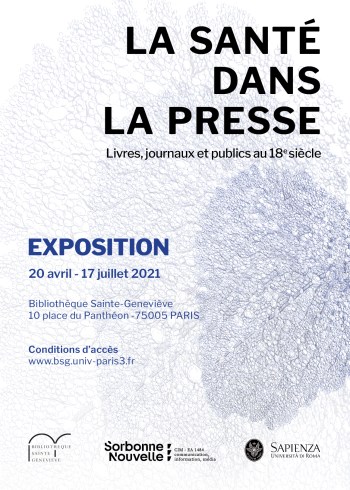 Cette exposition porte avant tout sur des questions de santé hors des milieux médicaux, auprès d’un public non spécialiste. En s’appuyant sur les fonds de la bibliothèque Sainte-Geneviève, il s’agit de montrer l’importance des périodiques et des livres imprimés dans la mise à disposition de savoirs et des nouvelles sur la santé, ainsi que de souligner la visibilité des ouvrages de médecine auprès du grand public.
83 documents sont présentés dans 7 parties thématiques:
• L’essor de la presse en Europe au 18e siècle
• Les débats sur l’inoculation
• Santé et voyage : le scorbut et la navigation
• La vogue du mesmérisme
• Les livres de médecine pour tous
• Les maladies des femmes, l’accouchement, l’allaitement
• Le succès de l’anatomie
Les journaux généralistes et spécialisés qui se multiplient en Europe durant le siècle des Lumières sont attentifs à l’actualité des publications et deviennent pour certains d’entre eux des lieux de débat, notamment par le biais du courrier de lecteurs. Certaines propositions thérapeutiques suscitent de larges débats tandis que l’on observe un intérêt nouveau pour les maladies des femmes ou le soin des enfants. Le goût pour l’anatomie, tout comme pour les sciences en général, se traduit par des propositions diversifiées, plus particulièrement à Paris, allant des cours aux démonstrations anatomiques et aux visites de cabinets de curiosité. Ces formations et ces activités attirent un public plus large que celui des seuls étudiants. Au-delà de ce public cultivé, des livres souvent rédigés par des médecins, comme Tissot et Buchan, apportant des conseils thérapeutiques, s’adressent à un vaste lectorat, comme en témoigne le succès de certains d’entre eux à l’échelle européenne. L’exposition place donc en regard périodiques et livres, ainsi que quelques gravures afin de montrer le rôle des imprimés dans l’élargissement du public et l’importance d’envisager ensemble livres et journaux.
Cette exposition a été conçue par Maria Conforti (Istituto e Museo di Storia della Medicina, Sapienza Università di Roma) et Yasmine Marcil (laboratoire CIM, Institut de la communication et des médias, Université Sorbonne Nouvelle).
Call for Papers | Napoleon’s Legacy
From ArtHist.net:
Imperial Material: Napoleon’s Legacy in Culture, Art, and Heritage, 1821–2021
Online, 3 September 2021
Organized by Matilda Greig and Nicole Cochrane
Proposals due by 12 July 2021
Napoleon Bonaparte died exactly two hundred years ago on a small island in the middle of the Atlantic Ocean. He had spent the last six years of his life in exile on St Helena, removed from political and military power, in the unusual situation of being able to try to shape and preserve his own posthumous legacy. He was, in a way, phenomenally successful. Napoleon is an instantly recognisable name to this day, and despite growing efforts in recent years to critically revise his reputation and highlight his role in issues such as the reinstatement of slavery, he has largely managed to escape the same level of historical censure as other infamous military dictators. This is perhaps partly because his name has become such an adaptable brand, standing for an entire era of people, places, and events, as well as a full two centuries’ worth of art, craft, and consumer commodities. While other events marking the bicentenary of Napoleon’s death have weighed his contributions to legislative, political, and military reform, less work has been done to confront his vast material, visual, and cultural legacy.
Napoleon’s death in 1821 prompted a frenzy of creation and circulation of materials relating to him, a whirling international trade in objects, images, texts and memorabilia which has essentially never since ceased. Death masks were made, shipped to Europe, waylaid, stolen, copied, and taken around Latin America by one of his doctors. Portraits were exchanged and exhibited, caricatures continued to abound, and actors took on the mantle of the Emperor from the stage to the film set. Personal items belonging to Napoleon were gifted to friends and family, collected by his admirers, and displayed at public exhibitions around the world: his horse, the key to his room, his toothbrush. These items make national headline news to this day when they are rediscovered, are sold for monumental sums to contemporary collectors and serve as key advertising strategies for museums. Napoleonic items can be official or personal, serious or comical, luxury or disposable: the former emperor can be equally thought of as a monumental Neoclassical marvel in white marble, as Joaquin Phoenix, or as a tiny cartoon figure astride a fat pony—yet little work has so far been done to bring together these diverse cultural histories in conversation.
We therefore invite researchers of all disciplines, and museum and heritage professionals, to reflect on the enduring material and visual legacy of Napoleon, what our interpretation and use of it means for the future as well as how it affects our understanding of the past.
Possible themes for papers include:
• Napoleon in theatre, TV and film; in music; in poetry; in art, sculpture and drawing; in books, ephemera, printing, paratext
• Napoleon in exhibitions and museums: museum histories, interpretations of collections, and how objects are presented to the public, including in past, present and future events; how Napoleon is used in marketing strategies or public engagement
• Private collecting and the choices and agency of collectors, including by historians; the memorabilia trade both in the 19th century and up to today; Napoleonic tourism and the creation, looting or buying of souvenirs from significant places
• Gender, sexuality, and Napoleonic memory; involvement of women as collectors, curators, consumers
• Race and empire: critical histories and commentaries on Napoleonic representations
• Medical histories of Napoleonic objects
• Dress, fashion, appearance
• Home décor
• Religion and the macabre
• Animals and Napoleonic symbolism
• The ‘golden’ or ‘rosy’ vs. ‘black’ legend of Napoleon and ongoing critical interpretations
• Comedy and ridicule
• Romanticisation, neoclassical heroism, masculinity
• Circulation and object histories
• Re-enactment
• Public commemoration; plaques, monuments, iconoclasm
• Napoleon and antiquity
Please submit abstracts for short 15-minute papers, along with a short bio, to ImpMatWorkshop@gmail.com by 12 July 2021. (Abstracts should be no longer than 300 words.) Following the workshop, we plan to pursue the publication of selected papers as a collected edition.
Convenors
Dr Matilda Greig (Cardiff University)
Dr Nicole Cochrane (University of Exeter)










 Enfilade
leave a comment