Call for Papers | (Dis-)Appropriation of Synagogue Architecture

Pałac Karnickich, Warsaw. Constructed in 1877 for a government official and rebuilt after World War II, the building now houses the Deutsches Historisches Institut Warschau.
◊ ◊ ◊ ◊ ◊
From ArtHist.net and the Deutsches Historisches Institut Warschau:
Jewish or Common Heritage? (Dis-)appropriation of Synagogue Architecture in East-Central Europe since 1945
POLIN Museum of the History of Polish Jews and the German Historical Institute, Warsaw, 12–14 September 2023
Proposals due by 31 January 2023
The synagogues that remained standing after World War II have faced an uncertain destiny. As abandoned buildings, they were susceptible to decay quickly and, as former buildings of worship—for legal, cultural, and architectural reasons—posed a great challenge in terms of their reuse. Consequently, many synagogues simply fell into ruins, some were turned into secular buildings of various purposes, and few could have been used as houses of prayer again.
In postwar Europe, synagogue architecture was culturally categorized as an element of Jewish heritage that appeared to be isolated from the common heritage of a city or town—wherever a synagogue stood. At first, synagogues were not considered a shared but a distinct patrimony of a place. A shift in such a state of affairs could have been observed in the last three decades that witnessed a ‘rediscovery’ of synagogues. Though one can still find abandoned synagogues in small towns, in most of the bigger municipalities, these buildings were ‘rediscovered’ as a part of local history and culture and thus became part of the common heritage. In many regions of Europe, the ‘rediscovery’ of the former synagogues led to their restoration and opening to the public, and in rare cases, to their reuse by Jewish communities.

“The Jewish Town / Muranów (1648–1772),” gallery of the Core Exhibition at the POLIN Museum of the History of Polish Jews, Warsaw (Photo by M. Starowieyska and D. Golik). More infromation»
These processes have already been quite well researched in western parts of Europe. A desideratum, however, is approach to the Jewish architectural heritage in those East-Central European territories, whose state affiliation changed after 1945 and whose population was exchanged. For example, in the former Eastern German territories, synagogues still standing at the end of the war became a foreign body in the urban space in a double sense. They neither belonged to the heritage of the new inhabitants, understood as ‘national’ or ‘own’, nor were they clearly attributable to the heritage of the pre-war German population. Synagogues were, therefore, not ‘hostile’ buildings, but in any case, they were irritating as characteristic objects of architecture. A contributing factor was that Jewish communities lasted only in a few cities in these areas.
The aim of the conference is a historicization of the processes of rediscovery in the recent past. We invite contributions linking the historical dimension in dealing with the Jewish architectural heritage with current developments in this field. The focus will be on the historical, political, and cultural preconditions and present processes having an impact on the handling of the Jewish built heritage. The key actors and decision-makers should also be taken into account. Therefore, the connection of the micro and macro levels is indispensable for the understanding of these developments because the impact of local actors and political decisions at the central level are closely interrelated. Global and memory culture trends have also contributed to the interest or disinterest in the respective religious buildings. In addition, transnational networks that influenced the preservation of synagogues will be considered, for example, in the context of the Polish-German dialogue.
The conference will not only discuss examples of a ‘successful rediscovery’ of Jewish architectural monuments. The aim is rather to draw conclusions about broader contexts based on concrete examples. It may be possible to identify patterns that indicate ‘success’ or ‘failure’ of the rediscovery. We also invite contributions that would pose the question of a model of a ‘successful’ or ‘failed’ rediscovery. If possible, however, the focus should be on those East- Central European cities or regions whose territorial affiliation changed in the wake of World War II.
The conference is a cooperation of Bet Tfila – Research Unit for Jewish Architecture in Europe at TU Braunschweig, GHI Warsaw and POLIN Museum of the History of Polish Jews. It takes place within the framework of the “DFG Priority Program 2357: Jewish Cultural Heritage,” which is funded by the German Research Foundation. The conference will take place 12–14 September 2023 at the POLIN Museum for the History of Polish Jews and at the German Historical Institute in Warsaw. Travel costs to and from the conference can be reimbursed within the usual limits.
Submissions will be accepted from any discipline as long as the topic relates to this broad theme. Scholars, experts, and practitioners are welcome. Abstracts should be 200–300 words. Although we welcome speakers from any country, the language of the conference will be English. For best consideration, please submit your abstract and a short CV by 31 January 2023 to Kamila Lenartowicz (k.lenartowicz@tu-braunschweig.de) and Christhardt Henschel (henschel@dhi.waw.pl). Applicants will be informed about their participation by 14 March 2023.
Organizers
• Kamila Lenartowicz and Zuzanna Światowy (Bet Tfila – Research Unit for Jewish Architecture in Europe, Technische Universität Braunschweig)
• Christhardt Henschel (German Historical Institute, Warsaw)
• Aleksandra Jakubczak-Gabay (POLIN Museum of the History of Polish Jews)
◊ ◊ ◊ ◊ ◊
For the American context, see Mark Gordon, “Rediscovering Jewish Infrastructure: 2022 Update on United States Eighteenth- and Nineteenth-Century Synagogues,” American Jewish Historical Society (4 November 2021), available here. –CH
◊ ◊ ◊ ◊ ◊
Note (added 18 January 2023) — More information on the polychrome ceiling, a life-sized wooden replica of the ceiling of the synagogue of Gwoździec at the POLIN Museum, is available here at Enfilade (now largely out-dated) and here with Ariel Fein’s essay for SmartHistory (4 April 2022).
Call for Papers | Listening In: Architectures, Cities, Landscapes

From the conference website:
Listening In: Conversations on Architectures, Cities, and Landscapes, 1700–1900
ETH Zurich, 14–15 September 2023
Proposals due by 10 March 2023
Who do we listen to when we write histories of architectures, cities, and landscapes? How many women authors can we find among our sources? How many of them are cited by those whose research we read? We argue that women and other marginalised groups have always been part of conversations on architectures, cities, and landscapes—but we have not had the space to listen to them. This conference is an invitation to reconstruct such conversations, real, imagined, and metaphorical ones, taking place in the 18th and 19th centuries, in any region, in order to diversify the ways we write histories. Taking the art of conversation, integral as both practice and form to the period in Western thought, and repurposing it to dismantle the exclusivity of historiography, this conference calls for contributions which bring women into dialogue with others.
Listening In proposes a new approach to the ‘canon’ and its protagonists. Rather than either fighting its existence or expanding it by means of ‘exceptions to the rule’, we call for the setting up of productive conversations. We acknowledge that the canon never exists on its own; instead, it is shaped by what Griselda Pollock has called “that which, while repressed, is always present as its structuring other” (1999, 8). This conference is envisaged as a listening exercise. We regard a conversation as both codified practice as well as a specific act of verbal exchange, spoken or written, on a particular subject—here architectures, cities, and landscapes—occurring in a specific site, from street to salon, kitchen to court, construction site to theatre, field to church, or book to newspaper, to name but a few.
We invite papers on conversations that grapple with hierarchies and inequalities, incorporating asymmetrical power relationships while taking care not to gloss over the struggle, pain, and conflict often occurring in these situations. Papers should highlight at least one protagonist identifying as a woman, and are encouraged to also listen to
• persons marginalised because of their race, class, religion, sexual orientation, or else,
• so-called ‘canonical’ figures, both architects and critics as well as those from other professions, disciplines, or domains,
• individuals from different geographical regions, including those affected by the violence of imperialism and colonialism.
Can a focus on conversations help to include in historiography new protagonists as well as sites which we have so far not seen? How about printed sites, in pamphlets, books, magazines, newspapers, or letter writing? And what are the critical notions around which these conversations occur, such as the sublime, character, or sensibility, but also those emerging from indigenous or non-western knowledges, on different sites and in different media? Further, what shifts, if we start from conversations, rather than, for instance, drawings and buildings? How will it affect histories of architectures, cities, and landscapes if these conversations are inclusive rather than exclusive?
This call invites contributions from and on all regions, particularly those that centre intersectional marginalisations. We are interested to hear about every-day experiences and sites so far less explored as well as new reflections on better-known events and structures. We hope to attract speakers from diverse regions, disciplines, backgrounds, and career stages, who are willing to engage with new materials in innovative ways, listening to each other and our sources. The conference is planned as a focused, single-strand event aimed at creating networks of scholars, facilitating exchanges, stimulating groundbreaking discussions, and producing new knowledges.
Listening In is organised in the context of two externally funded research projects based at gta, ETH Zurich: WoWA (Women Writing Architecture 1700–1900) is funded by the ERC, led by Anne Hultzsch, and studies female experiences of architecture and landscapes as recorded in women’s writings from South America and Europe. The SNSF-funded project Building Identity: Character in Architectural Discourse and Design 1750–1850, led by Sigrid de Jong and Maarten Delbeke, focuses on the uses and meaning of the notion of ‘character’ in architectural criticism and practice. Both projects share an interest in the experiences of marginalised groups, especially those who identified as women, and strive to have them heard not in a niche, but in the centre of our field. With this conference we wish to open up our approaches to a wider field of research, going beyond our respective geographical frameworks.
Please submit the following by 10 March 2023 to listening@arch.ethz.ch
• an abstract of no more than 300 words
• your name and professional affiliation if any
• a short curriculum vitae (ca 100 words)
Key Dates
1 December 2022 Launch call for papers
10 March 2023 Deadline to submit abstracts
April 2023 Paper selection and notification of authors
1 May 2023 Speakers confirm their participation
14–15 September 2023 Conference at ETH Zurich, Switzerland
Organisers
PD Dr Anne Hultzsch
Dr Sigrid de Jong
Prof Maarten Delbeke
Dr Sol Pérez Martínez
New Book | Portraits of Resistance
From Yale UP:
Jennifer Van Horn, Portraits of Resistance: Activating Art during Slavery (New Haven: Yale University Press, 2022), 344 pages, ISBN: 978-0300257632, $60.
 A highly original history of American portraiture that places the experiences of enslaved people at its center
This timely and eloquent book tells a new history of American art: how enslaved people mobilized portraiture for acts of defiance. Revisiting the origins of portrait painting in the United States, Jennifer Van Horn reveals how mythologies of whiteness and of nation building erased the aesthetic production of enslaved Americans of African descent and obscured the portrait’s importance as a site of resistance. Moving from the wharves of colonial Rhode Island to antebellum Louisiana plantations to South Carolina townhouses during the Civil War, the book illuminates how enslaved people’s relationships with portraits also shaped the trajectory of African American art post-emancipation. Van Horn asserts that Black creativity, subjecthood, viewership, and iconoclasm constituted instances of everyday rebellion against systemic oppression. Portraits of Resistance is not only a significant intervention in the fields of American art and history but also an important contribution to the reexamination of racial constructs on which American culture was built.
Jennifer Van Horn is associate professor of art history and history at the University of Delaware.
C O N T E N T S
Acknowledgments
Introduction: Neptune Thurston’s Portraits
1 Making Portraits
2 Fleeting Portraits
3 Haunted Portraits
4 Viewing Portraits
5 Destroying Portraits
Epilogue: Archibald Motley’s Portraits
Notes
Illustration Credit
Index
New Book | Adam Smith’s America
From Princeton UP:
Glory Liu, Adam Smith’s America: How a Scottish Philosopher Became an Icon of American Capitalism (Princeton: Princeton University Press, 2023), 384 pages, ISBN: 978-0691203812, £30 / $35.
 The unlikely story of how Americans canonized Adam Smith as the patron saint of free markets
Originally published in 1776, Adam Smith’s The Wealth of Nations was lauded by America’s founders as a landmark work of Enlightenment thinking about national wealth, statecraft, and moral virtue. Today, Smith is one of the most influential icons of economic thought in America. Glory Liu traces how generations of Americans have read, reinterpreted, and weaponized Smith’s ideas, revealing how his popular image as a champion of American-style capitalism and free markets is a historical invention.
Drawing on a trove of illuminating archival materials, Liu tells the story of how an unassuming Scottish philosopher captured the American imagination and played a leading role in shaping American economic and political ideas. She shows how Smith became known as the father of political economy in the nineteenth century and was firmly associated with free trade, and how, in the aftermath of the Great Depression, the Chicago School of Economics transformed him into the preeminent theorist of self-interest and the miracle of free markets. Liu explores how a new generation of political theorists and public intellectuals has sought to recover Smith’s original intentions and restore his reputation as a moral philosopher.
Charting the enduring fascination that this humble philosopher from Scotland has held for American readers over more than two centuries, Adam Smith’s America shows how Smith continues to be a vehicle for articulating perennial moral and political anxieties about modern capitalism.
Glory M. Liu is a college fellow in social studies at Harvard University. Her work has appeared in publications such as Modern Intellectual History, The Washington Post, and Aeon.
New Book | Adam Smith Reconsidered
From Princeton UP:
Paul Sagar, Adam Smith Reconsidered: History, Liberty, and the Foundations of Modern Politics (Princeton: Princeton University Press, 2022), 248 pages, ISBN: 978-0691210834, £28 / $35.
 Adam Smith has long been recognized as the father of modern economics. More recently, scholars have emphasized his standing as a moral philosopher—one who was prepared to critique markets as well as to praise them. But Smith’s contributions to political theory are still underappreciated and relatively neglected. In this bold, revisionary book, Paul Sagar argues that not only have the fundamentals of Smith’s political thought been widely misunderstood, but that once we understand them correctly, our estimations of Smith as economist and as moral philosopher must radically change.
Rather than seeing Smith either as the prophet of the free market, or as a moralist who thought the dangers of commerce lay primarily in the corrupting effects of trade, Sagar shows why Smith is more thoroughly a political thinker who made major contributions to the history of political thought. Smith, Sagar argues, saw war, not commerce, as the engine of political change and he was centrally concerned with the political, not moral, dimensions of—and threats to—commercial societies. In this light, the true contours and power of Smith’s foundational contributions to western political thought emerge as never before.
Offering major reinterpretations of Smith’s political, moral, and economic ideas, Adam Smith Reconsidered seeks to revolutionize how he is understood. In doing so, it recovers Smith’s original way of doing political theory, one rooted in the importance of history and the necessity of maintaining a realist sensibility, and from which we still have much to learn.
Paul Sagar is senior lecturer in political theory at King’s College London and the author of The Opinion of Mankind: Sociability and the Theory of the State from Hobbes to Smith (Princeton).
Adam Smith 300 in 2023
From the press release (23 November 2022) for Adam Smith 300 . . .
The University of Glasgow is marking the 300th anniversary of pioneering Scot Adam Smith (1723–1790) with a year-long celebration of his life, work, and influence.
The tercentenary commemoration of the ‘father of economics’ includes a host of events in Scotland and around the world, designed to inspire renewed discussion about Smith’s ideas. Smith’s work has had a lasting impact on the way the world considers economics, politics, and society more broadly. The planned programme of events aims to consider how his ideas from 300 years ago can help answer some of the biggest challenges we face today.
Throughout 2023 the University of Glasgow has a raft of programmes and events that will give academics, students, and the public new insights into his life and work. Highlights include:
• Tercentenary Week (5–10 June 2023)—a week-long series of activities, including talks and exhibitions at the University of Glasgow featuring scholars from the London School of Economics, the universities of Princeton and Harvard, and the University of Cambridge.
• An on-campus and virtual exhibition of significant and rare Smith-related artifacts—including letters, first edition books, and material from the University of Glasgow’s archives.
• The Adam Smith Tercentenary Global Lecture Series, featuring internationally renowned speakers from academia, business, and public policy.
• New research into Smith’s life and writings.
• The Royal Economic Society and Scottish Economic Society Joint Conference in April, featuring global academics reflecting upon Smith’s legacy.
Other activities involve a national student competition to re-design the front cover of The Wealth of Nations, online courses for adult learners, and new programmes to introduce high school to Adam Smith and his ideas. Universities from across the world, in North and South America, Asia, Africa, Europe, and Australia will be joining in the commemorations with their own events to mark the tercentenary.
Professor Sir Anton Muscatelli, Principal and Vice Chancellor of the University of Glasgow, said: “Adam Smith is one of our most famous alumni, and he left an indelible impact on the University of Glasgow, on the fields of economics and moral philosophy, and on the wider world. His studies and writings introduced new ideas, insights, and concepts that shaped our understanding of economics today but were revolutionary in their day. To mark the tercentenary of his birth we will see academics, students, and the public discuss his continued relevance at a series of events taking place in Glasgow and across the world. I look forward to taking part in the University’s commemoration of Adam Smith as we evaluate his legacy and consider how his thoughts and ideas from 300 years ago can still help us answer the greatest challenges of today.”
Adam Smith—born in Kirkcaldy, Fife, in June 1723—started his studies at the University of Glasgow aged 14. In 1740, he was awarded the Snell Scholarship, which is still in existence today, and left to study at Oxford. In 1751, Smith returned to Glasgow as a Professor of Logic, later becoming Professor of Moral Philosophy. While at Glasgow, Smith published the first edition of The Theory of Moral Sentiments in 1759, developing upon the principles and concepts explored in his lectures. Smith’s final connection with the University came in 1787 when he assumed the prominent position of Rector. He published arguably his most famous work The Wealth of Nations in 1776 and died in 1790.
Exhibition | The Sun King and the Prince of Orange

Adam Frans van der Meulen, Landscape with King Louis XIV at the Capture of Maastricht on 30 June 1673, 1673–1690, oil on canvas, 72 × 92 cm
(Venlo: Limburgs Museum, L24496)
◊ ◊ ◊ ◊ ◊
Opening this summer at the Limburg Museum in Venlo (65 km northeast of Maastricht). 2023 marks the 350th anniversary of the fall of Maastricht—which itself followed in the wake of the ‘Rampjaar’ (Disaster Year) of 1672. The museum was recently recognized with a 2022 International Design Award in graphic design for its campaign, “Limburgs Museum: Van ós / For Everybody,” by Total Design.
The Sun King and the Prince of Orange: Battle for the Meuse Valley
De Zonnekoning en Oranje: Slaags aan de Maas
Der Sonnenkönig und Oranien: Kämpfe an der Maas
Limburgs Museum, Venlo, 10 June 2023 — 7 January 2024
“I believe a spectacular event is going to unfold in front of our eyes.”
–King Louis XIV, shortly before the Siege of Maastricht
June 2023 will mark the 350th anniversary of the conquest of Maastricht by Louis XIV, the French Sun King. The city’s reputation as one of the best-fortified cities on the continent caused all of Europe to stand in disbelief at the end of the thirteen-day long military campaign. The victory was proudly showcased in the Hall of Mirrors in Versailles as well as on the Porte Saint-Denis in Paris. In 1676, the Prince of Orange’s attempt to reconquer the city for the Dutch Republic failed. As a result, French soldiers and administrators remained in Maastricht until 1679. What motives drove the actions of the two sovereigns? What did this region signify to them? And how did their actions affect the people? These questions lie at the heart of the grand exhibition The Sun King and the Prince of Orange: Battle for the Meuse Valley.
In collaboration with Service Historique de la Défense, Musée national des châteaux de Versailles et de Trianon, Rijksmuseum and Paleis het Loo.
Lecture | Matthew Keagle on Military Material Culture
From BGC:
Matthew Keagle, Military Material Culture
Bard Graduate Center, New York, 1 February 2023, 6.00pm

James Byers, Howitzer, Philadelphia, 1777 (Fort Ticonderoga Museum Collections; photo by Gavin Ashworth).
Military history and its related material culture elicit strong opinions. The objects of war shape the technologies, aesthetics, and ideologies of everyday life and reveal their own historiography. In this Alumni Spotlight Lecture, Fort Ticonderoga curator Matthew Keagle shares his experiences working in military material culture and the challenges and distinct opportunities this field offers for scholars and amateur historians.
Matthew Keagle has been involved in curation, exhibitions, research, and interpretation for historic sites and museums in Massachusetts, Rhode Island, Connecticut, New York, Delaware, Virginia, and North and South Carolina. He holds a BA from Cornell University, an MA in American material culture from the Winterthur Museum, and a PhD from Bard Graduate Center. Since joining Fort Ticonderoga in 2014, he has been developing exhibits, conducting research, and delivering programs that explore the eighteenth-century military experience. He has researched and lectured at collections and archives across the US, Canada, and Europe, with a particular focus on military dress in the eighteenth century.
Registration is available here»
Exhibition | A Japanese Bestiary
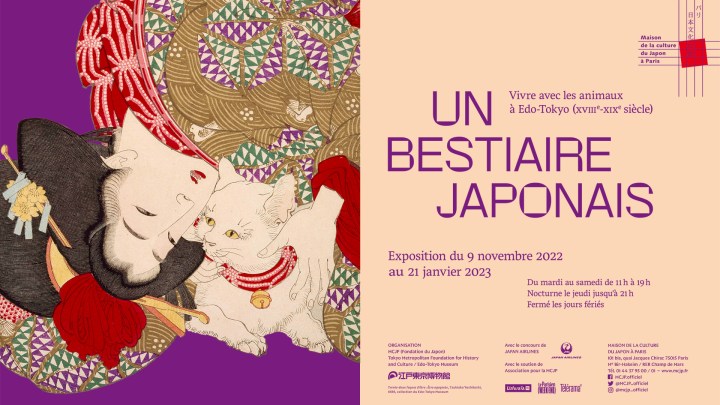
Co-organized with the Edo-Tokyo Museum, this exhibition brings together more than a hundred ukiyo-e prints, paintings, and everyday objects to explore the relationship between humans and animals in Japan during the eighteenth and nineteenth centuries.
Un bestiaire japonais: Vivre avec les animaux à Edo-Tokyo, XVIIIe–XIXe siècle
Maison de la culture du Japon, Paris, 9 November 2022 — 21 January 2023
La gentillesse avec laquelle les Japonais traitent les animaux surprend les premiers Occidentaux qui se rendent dans l’archipel. Les liens entre les humains et le monde animal sont cependant plus complexes comme en témoigne une remarquable réplique d’une paire de paravents de 1634 représentant un panorama détaillé d’Edo et de ses faubourgs. Outre des scènes avec le shogun poursuivant cerfs et sangliers, ou chassant au faucon, on y remarque des montreurs de singes, des chiens errants, des bœufs de labour, des chevaux sacrés…
Dans la section suivante sont présentés les différents rôles des animaux, en lien avec la vie de la noblesse guerrière, des paysans et des commerçants. L’établissement d’Edo comme capitale des guerriers explique une forte présence de chevaux militaires dans les premiers temps. Avec la paix durable, le nombre de chevaux de trait, soutien de la vie citadine, se met à croître. Les bœufs sont utilisés pour le transport des marchandises à Edo ainsi que pour le labour dans les zones rurales à l’extérieur de la ville. Les activités culturelles connaissent un essor important et on s’entoure volontiers d’animaux de compagnie : petits chiens et chats, rossignols et cailles, poissons rouges, ou encore grillons et criquets dont on apprécie le chant. Nombre d’estampes et d’ouvrages sur la façon de s’en occuper sont publiés.
Dans les zones périphériques d’Edo où vit une abondante faune sauvage, la noblesse guerrière pratique régulièrement la chasse. On chasse au faucon des grues, des oies et des canards. Organisées par le shogun, les grandes chasses au cerf visent les cervidés, sangliers, lièvres et faisans. Certains animaux sauvages sont associés à des croyances religieuses, tel le renard, connu pour être le messager d’Inari, dieu des moissons. Les habitants d’Edo, ville riche en collines, rivières, et ouverte sur la mer, vivent profondément en lien avec la nature.La vie des animaux sauvages est un élément familier, étroitement lié aux croyances religieuses et aux rites saisonniers.
À partir du début du XVIIe siècle, Edo s’urbanise rapidement et la population devient friande de nouvelles attractions. Des animaux rares, notamment les paons et perroquets provenant de Chine ou de Hollande, sont exposés dans des lieux spécifiques, ancêtres des zoos, avec des boutiques proposant nourriture et boissons. Très vite, la mode des animaux exotiques connaît un boom sans précédent. Avec l’entrée dans l’ère Meiji (1868–1912), période de modernisation et d’ouverture à l’Occident, le Japon construit des installations sur le modèle occidental, tels que zoos et hippodromes.
À l’époque Edo, la puissance financière nouvelle de la classe commerçante stimule la naissance d’une véritable culture citadine et le raffinement des objets du quotidien: les motifs décoratifs représentant des animaux évoluent vers une plus grande liberté de conception et des variations plus riches. Vers la fin du XIXe siècle, la symbolique des motifs animaliers commence à s’estomper et l’accent est mis de plus en plus sur le côté «kawaii» des animaux de compagnie.
Exhibition | Mr. Pergolesi’s Curious Things
Now on view at Cooper Hewitt–and please note the upcoming programming described below. . .
Mr. Pergolesi’s Curious Things: Ornament in 18th-Century Britain
Cooper Hewitt, Smithsonian Design Museum, New York City, 1 October 2022 — 29 January 2023
Curated by Julia Siemon

Michel Angelo Pergolesi, Ornament Design, Tripod and Roman Standards, 1776, pen and ink, brush and watercolor over graphite on laid paper; 48 × 34 cm (Cooper Hewitt, Smithsonian Design Museum; gift of an unknown donor, 1980-32-1443; photo by Matt Flynn).
Mr. Pergolesi’s Curious Things: Ornament in 18th-Century Britain showcases fanciful drawings and prints by Michel Angelo Pergolesi (died 1801), an Italian-born artist whose professional specialty, in his words, was “the ornaments of the ancients.” In the early 1760s, Pergolesi moved to London, where he helped popularize a neoclassical style that employed ornament inspired by artifacts from ancient Greece and Rome. Brilliantly hued watercolors from Cooper Hewitt’s collection highlight Pergolesi’s skill in transforming ancient relics—what he called “curious Things”—into lighthearted decorative motifs. Although his name is now largely forgotten, these rarely seen works call attention to Pergolesi’s legacy, to the Beaux-Arts neoclassical decoration of Cooper Hewitt’s historic mansion (built 1897–1902), and to the ways in which ornament of all kinds enlivens our built environment.
The exhibition is made possible with support from the Marks Family Foundation Endowment Fund. It was organized by Julia Siemon. Exhibition design is by Field Guide Architecture and Design with graphic design by Kelly Sung.
◊ ◊ ◊ ◊ ◊
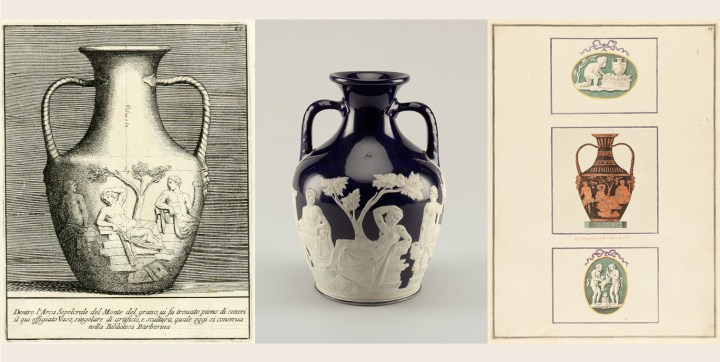
Left: Pietro Santi Bartoli, Gli antichi sepolcri, overo Mausolei Romani et Etruschi, trovati in Roma & in altri luoghi celebri…, Rome, 1697, plate 84 (Los Angeles: Getty Research Institute Library, 82-B2112). Middle: Copy of the Portland Vase, 1850–60, manufactured by Josiah Wedgwood and Sons, stoneware (Smithsonian Institution, Gift of Mrs. Frederick F. Thompson, 1915-30-1; photo by Matt Flynn). Right: Michel Angelo Pergolesi, Ornament Design with Portland Vase and Two Cameos, 1776, pen and ink, brush and watercolor over graphite on laid paper (Smithsonian Institution, Gift of Unknown Donor, 1980-32-1463; photo by Matt Flynn).
◊ ◊ ◊ ◊ ◊
The Antique in Print: The Classical Past and the Visual Arts in the Long 18th Century
Online, Wednesday, 18 January 2023, 1.00pm ET
Classical reliefs, sarcophagi, frescoes, coins, and gems were frequently copied and readapted by Renaissance artists from the 15th century onwards. Yet it was only in the age of the Enlightenment that a selection of them was canonized, illustrated, and diffused in Europe through antiquarian publications. Scholars and travelers on the Grand Tour viewed antiquity through the lens of these books. Their printed illustrations offered a range of images and symbolic references for artists, decorators, and architects whenever they wanted to quote the Antique in their creations. Join us as Dr. Adriano Aymonino explores how the print culture of the long 18th century shaped the visual and allegorical language of Neoclassicism. At the same time, he will contextualize Michel Angelo Pergolesi’s drawings and popular set of prints (Designs for Various Ornaments, 1777–1801). Dr. Julia Siemon, curator of Cooper Hewitt’s Mr. Pergolesi’s Curious Things: Ornament in 18th Century Britain will provide a brief overview of the exhibition at the start of the program.
The program will feature a lecture with a slideshow presentation followed by an audience Q&A hosted through Zoom, with the option to dial in as well. Details will be emailed upon registration. This program includes closed captioning. It will be recorded and available on Cooper Hewitt’s YouTube channel a week following the lecture. For general questions or if we can provide additional accessibility services or accommodations to support your participation in this program, please email CHEducation@si.edu or let us know when registering.
Adriano Aymonino is Director of Undergraduate Programmes in the Department of History of Art at the University of Buckingham and Programme Director for the MA in the Art Market and the History of Collecting. He has curated several exhibitions, such as Drawn from the Antique: Artists and the Classical Ideal, held at the Sir John Soane’s Museum in London in 2015. His book Enlightened Eclecticism was published by Yale University Press in June 2021 and has won the 2022 William MB Berger Prize for British Art History. He is currently working on a revised edition of Francis Haskell and Nicholas Penny’s Taste and the Antique (2023); and on a critical edition of Robert Adam’s Grand Tour correspondence, which will be hosted on the Sir John Soane’s Museum website (2024). He is also co-editor of the series Paper Worlds published by MIT Press and associate editor of the Journal of the History of Collections.
Julia Siemon is Assistant Curator of Paintings at the J. Paul Getty Museum. Prior to joining the Getty, she was Assistant Curator of Drawings, Prints, and Graphic Design at Cooper Hewitt, Smithsonian Design Museum, where she organized Mr. Pergolesi’s Curious Things: Ornament in 18th-Century Britain. Previously, as Assistant Research Curator in the Department of European Sculpture and Decorative Arts at The Metropolitan Museum of Art, she organized The Silver Caesars: A Renaissance Mystery (2017–18) and was editor and co-author of the related volume. Her other publications include contributions to The Medici: Portraits and Politics 1512–1570 (The Metropolitan Museum of Art, 2021) and A Royal Renaissance Treasure and its Afterlives: The Royal Clock Salt (British Museum Research Publications, 2021). She holds a PhD from Columbia University (2015), where she specialized in Italian Renaissance painting.
◊ ◊ ◊ ◊ ◊
Tour with Exhibition Curator Julia Siemon
Cooper Hewitt, New York, Friday, 20 January 2023, 1.30pm ET
In this guided tour with exhibition curator Julia Siemon, visitors will encounter fanciful drawings and prints by Michel Angelo Pergolesi, an Italian-born artist whose professional specialty, in his words, was “the ornaments of the ancients.” The tour is free with reserved museum admission; limited space is offered on a first-come basis.










 Enfilade
leave a comment