AHRC Studentship | Netherlandish Networks: Home-making, 1565–1799
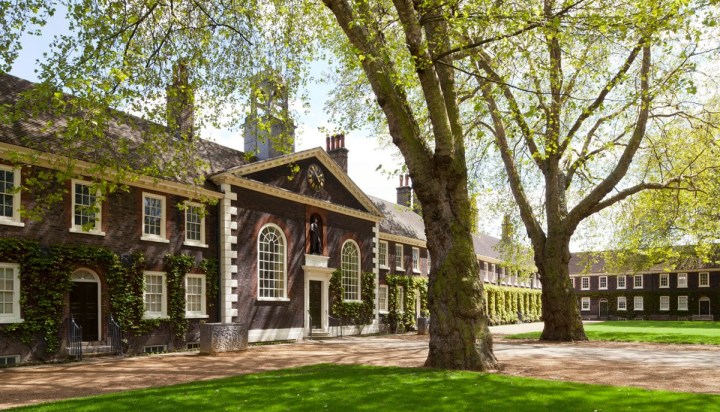
The Museum of the Home is located in almshouses, built in 1714, in Hoxton, East London.
◊ ◊ ◊ ◊ ◊
From the project description:
Netherlandish Networks:
Home-making in an Age of Emerging Global Capitalism, 1565–1799
AHRC Doctoral Studentship, Open University with the Museum of the Home and Queen Mary, University of London
Applications due by 7 April 2025
We are delighted to invite applications from students for a PhD Studentship in the Department of Art History at the Open University funded by the Arts and Humanities Research Council in partnership with the Museum of the Home (London) and the Centre for the Studies of Home at Queen Mary, University of London.
The project will explore the hidden histories behind a set of early modern objects belonging to the Museum of the Home, including a Flemish tapestry, Delftware, Chinese porcelain, japanned furniture, and items inlaid with rosewood. These diverse objects all share one quality: a relationship to the Netherlandish maritime trading networks (‘Netherlandish’ here refers to the profoundly entwined economies and cultures of what is roughly now Belgium and Holland). These Netherlandish networks spanned the globe but at their centre lay the cities of Amsterdam and Antwerp, not least because their Sephardic Jewish communities facilitated otherwise difficult trading connections between Northern Europe and the extensive Spanish and Portuguese Empires. London and the emerging British Empire relied heavily on these Netherlandish networks, especially across the sixteenth and seventeenth centuries. Crucially, these networks allowed for the circulation of religious and other refugees, merchants, skilled craftworkers, and enslaved people as well as materials like tropical hardwoods, objects like ceramics, clocks, and metalwork, and types of design that were then copied locally.
Key Research Questions
• What are the most efficient ways of mapping the many and complex journeys behind the interior fittings and furnishings that constituted home-making in early modern England as it became part of a global economy that, in turn, rested on colonialism and enslavement?
• How were early modern homes made in and through objects—so visually, spatially and materially—in relation to two overlapping immigrant communities (Sephardic Jews and Netherlanders)?
• To what extent were homes made in temporary lodgings such as boarding-houses or through public spaces such as churches or synagogues? In this process, how were objects mobilised in ritual and less formal behaviour?
• How can objects best be used to instantiate specific social histories about immigration, colonialism, and enslavement?
• What broader historical, curatorial, and art-historical methodologies may be developed from studying objects with hidden histories?
As part of the studentship, the successful candidate will be expected to spend significant periods of time with the collections at the Museum of the Home in east London. Research will also be undertaken at relevant archives across London, including the National Archives at Kew, which holds an extensive range of port books recording merchant shipping into most English ports from between 1565 and 1799.
The candidate will be co-supervised between the Open University and the Museum of the Home. Professor Clare Taylor and Dr Margit Thøfner, from the Department of Art History will supervise from the Open University, and Ailsa Hendry, Collections Manager and Lara Baclig, Community Producer, will supervise on behalf of the Museum of the Home.
Clare Taylor is a specialist in early modern interiors, material culture, and design. She has been lead supervisor for a number of Collaborative Doctoral Awards, including with the National Trust, the National Railway Museum, and the Sanderson archive. Margit Thøfner specialises in Netherlandish art, visual and material culture from the sixteenth and seventeenth centuries. Ailsa Hendry’s experience stretches across collections care and curation and she has worked on many projects exploring early modern European history. Lara Baclig specialises in community engagement and decolonial practice in collecting and displays.
More information is available here»
Call for Papers | ‘National’ Churches in Foreign Mediterranean Ports
This panel is part of the AISU conference in Palermo:
‘National’ Churches and Mediterranean Ports in the Early Modern Period
Foreign Communities Reshaping the Urban Fabric
Chiese ‘nazionali’ nei porti del Mediterraneo in età moderna (secoli XV–XVIII)
Il ruolo delle comunità forestiere nella riconfigurazione del tessuto urbano
Associazione Italiana di Storia Urbana Congress, Palermo, 10–13 September 2025
Organized by Nadia Rizzo and Carl Alexander Auf der Heyde
Proposals due by 3 May 2025
The establishment of ‘national’ mercantile groups in major Mediterranean port cities—key hubs for cross-cultural exchange—developed continuously from the Middle Ages into the early modern period (Colletta 2012). These ports became meeting places for foreign merchants who organised themselves into ‘nations’, structured associations based primarily on geographical origin, but also on shared language and religion (Petti Balbi 2001). These communities did not limit their activities to commercial spaces such as ‘fondaci’ and ‘logge’.
From at least the fifteenth century, they established meeting and worship places, often gaining patronage for chapels within existing churches. The most ambitious goal of the foreign communities, however, was the construction of a dedicated church, consecrated to their patron saint and intended primarily to meet the religious and liturgical needs of the group (Koller, Kubersky-Piredda 2015 [for national churches in Rome]). In addition to serving as a devotional landmark, the construction of a national church was a clear statement of the community’s presence, identity, and wealth, exerting a tangible and visible influence on the urban and architectural landscape of the host city.
From the mid-sixteenth century, coinciding with a wave of significant urban redevelopment, there was a marked increase in the construction of national churches independent of local religious communities. This phenomenon intensified during the seventeenth century, alongside the architectural fervour of the newly emerging Counter-Reformation orders, fostering a virtuous cycle of competition not only between nations, but also among religious congregations and national communities.
This panel seeks to explore the impact of foreign communities on the urban transformation of Mediterranean port cities between the sixteenth and eighteenth centuries, with a focus on the institution of the national church as a key reference point. We invite proposals in Italian, English, Spanish, and French that approach this topic from different perspectives and levels of analysis, including:
• Research on the settlement system of a single nation in multiple mercantile centers
• Specific studies on individual national churches
• Diachronic investigations on the settlement of a foreign group in a specific center (from chapels to national churches)
• Comparative overviews of multiple national churches in the same city
To apply, please fill out the form available at the bottom of each session presentation. The link for session 4.1 can be found here. Applicants are required to submit the paper abstract (maximum 5000 characters) and a brief biographical note. For any further information regarding the session, please contact the panel coordinators: Nadia Rizzo (Scuola Normale Superiore, nadia.rizzo@sns.it) and Carl Alexander Auf der Heyde (Università degli Studi di Palermo, carlalexander.aufderheyde@unipa.it).
The congress of the Associazione Italiana di Storia Urbana (Italian Association of Urban History / AISU International) will meet in Palermo, 10–13 September 2025. This year’s theme is The Crossroad City: Relations and Exchanges, Intersections and Crossing Points in Urban Realities.
Call for Papers | What Does Sculpture Do to a Garden? 17th–21st Century
From ArtHist.net, which includes the French version:
What Does a Sculpture Do to a Garden? What Does a Garden Do to a Sculpture?
Que fait une sculpture à un jardin? Que fait un jardin à une sculpture?, 17e–21e siècle
Musée Rodin, Paris, 6 June 2025
Proposals due by 31 March 2025

Edvard Munch, Le Penseur de Rodin dans le parc du Dr Max Linde à Lübeck, ca. 1907, oil on canvas, 143 × 98 cm (Paris: Musée Rodin).
Part of the 22nd edition of the Rendez-vous aux jardins taking place 6–8 June 2025 under the theme “Stone Gardens / Garden Stones,” the symposium is under the scientific direction of Emmanuelle Héran, Chief Curator and Head of Garden Collections at the Musée du Louvre. The event will be webcast live.
While closely linked since Antiquity, the relationship between sculpture and gardens was rekindled during the Renaissance. Rodin himself pondered this connection, as Paul Gsell recounts in Art: “Statues are usually placed in gardens to embellish them. For Rodin, gardens are here to adorn the statues. For him, Nature remains the supreme mistress, an infinite perfection.” And yet, works tracing the history of gardens often give little consideration to the statuary that inhabits them. Conversely, sculpture scholars rarely reflect on the unique setting of gardens, or on what a sculpture, in turn, can bring to a garden. In both fields, publications are frequently illustrated with tightly framed photographs of sculptures, isolating them as if displayed within a museum—or even entirely cut out from their surroundings. Yet, a garden is not a museum; it offers to three-dimensional works neither the neutrality of a ‘white cube’ nor even the illusion of a ‘green cube’ beneath an open sky.
Indeed, what could be more subject to change, more ephemeral, than a garden? As seasons pass, with the shifting hours of the day and the whims of the weather, the environment surrounding a sculpture is in constant flux. While there does exist a ‘museography’ for gardens—defined both as the art of displaying sculptures within them and as the composition of gardens incorporating sculpture—it has never been the subject of a comprehensive study. It is scarcely taught, neither to curators overseeing an ‘open-air sculpture museum’ nor to landscape architects and garden designers responsible for their creation and upkeep. In this regard, Louis Gevart’s dissertation broke new ground [1].
The question of meaning also arises. In royal and aristocratic parks and gardens, a sculptural ensemble may follow a coherent iconographic program, whose analysis reveals political intentions—such as the renowned Grande Commande of 1674 for Versailles. More often, however, groves and lawns host a disparate collection, whose coherence—if it ever existed—may have faded over time. The history of a collection displayed in a garden can mirror that of a museum. Yet it may also be entirely different, as the works placed in a garden are not necessarily commissioned pieces or first choices. Some may have arrived belatedly, by default, left outdoors for lack of a better option, or, when too damaged or vandalized, removed in haste.
It is thus possible that a restoration, conversion or ex nihilo creation project requires a landscape architect to address the difficult issue of sculptures. In the world of historical monuments, managing a set of statues does not always fall under the responsibility of the chief architect, but of a heritage curator. This separation of powers is worth examining: is it relevant or counterproductive? How can dialogue be established? The choice of materials, their adaptability and durability can all be considered. Site-specific works created in close collaboration with a garden can be cited, such as Giuseppe Penone and Pascal Cribier’s L’Arbre des voyelles in the Tuileries Gardens.
During the 20th century, sculpture parks and gardens—created with this intent—focused more on presenting a “living history of sculpture under construction” (Louis Gevart). Iconographic objectives may have been replaced by the production of a historical-stylistic narrative, without soliciting the help of a landscape architect. However, as the profound changes recently made to Middelheim Park in Antwerp and the recreation of entire programs at Stowe demonstrate, a return to iconographic coherence does seem to be taking place, in response to the public’s presumed expectations.
This symposium welcomes case studies of the same work in different sizes and materials, whose effect on a garden can be decisive for its composition or, on the contrary, become unremarkable. Think of copies of famous ancient sculptures—the Farnese Hercules, the Diana of Versailles—whose use, identified by Haskell and Penny in 1981 and recently revised, continues. Also welcome are examples of sculptures whose contribution to a garden does not appear to be essential, or of attempts that have proved inconclusive, or of bases that have been left empty or refilled. The crucial question remains that of the usefulness and relevance of a three-dimensional work within a garden environment. In other words, what does a sculpture do to a garden? And what does a garden do to a sculpture?
This call is addressed to art historians specializing in gardens or sculpture. It is also aimed at park and garden managers, heritage architects and landscape architects who have carried out preliminary studies or restoration work on historic gardens, so that they can share their thoughts and recent field practices, carried out in close collaboration with art historians and sculptors. It will focus on the following questions:
• What is the use of sculpture in a garden?
• Iconography: the search for coherence
• When the statue is missing / The empty base
• What materials are used in a garden?
• Landscape architects and sculptors / Site-specific works
Submissions—with a title, an abstract (1500–2000 characters), and a brief biographical note (500–1000 characters)—should be sent to colloques@musee-rodin.fr before 31 March 2025.
Research Committee
• Emmanuelle Héran, Chief Curator, Head of Garden Collections, musée du Louvre
• Amélie Simier, Chief Curator, Director, musée Rodin
• Véronique Mattiussi, Head of the Research Department, musée Rodin
• Franck Joubin, Researcher and Conference Coordinator, musée Rodin
[1] Louis Gevart, “La Sculpture et la terre. Histoire artistique et sociale du jardin de sculpture en Europe (1901–1968),” PhD thesis in art history, under the direction of Thierry Dufrêne, Université Paris Ouest La Défense, January 2017.
Exhibition | Designing the Future of The Nelson-Atkins
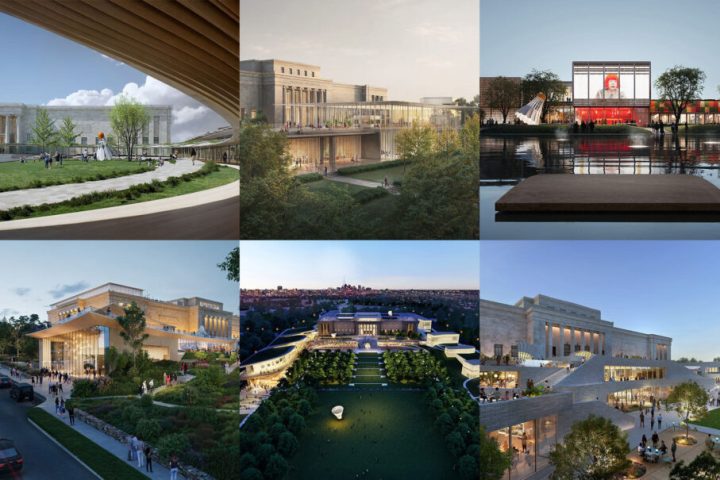
Proposals by the six finalists for The Nelson-Atkins Museum of Art, aimed at integrating the campus, the Donald J. Hall Sculpture Park, and the two existing buildings into a cohesive experience for new wider community engagement.
◊ ◊ ◊ ◊ ◊
It’s not an 18th-century story per se, but interesting to see a museum engage a strong classical facade and an iconic landscape in the 21st century. From the press release (13 March) for the exhibition, which includes an online component:
Building Belonging: Designing the Future of the Nelson-Atkins
The Nelson-Atkins Museum of Art, Kansas City, 15 March — 1 June 2025
The Nelson-Atkins Museum of Art this week revealed the concepts from six finalist teams in the competition to transform the museum with a dynamic, open, and inviting design. The expansion project’s goal is to attract new audiences by creating vibrant spaces for hosting more art, along with new immersive and interactive experiences for the community. The concepts—devised by some of the most respected designers working in museum architecture today—are now available to view in an online gallery here. They can also be seen in a free exhibition at The Nelson-Atkins Museum of Art, Building Belonging: Designing the Future of the Nelson-Atkins, until 1 June 2025. The public is invited to comment at the exhibition or through the portal available here.
The museum’s Architect Selection Committee (ASC) will meet in late spring to interview the finalists and make a recommendation to the Board of Trustees. Following ratification and the winning team’s appointment, the chosen design will be refined in close partnership with the museum and its stakeholders, including local communities. The Board of Trustees aims to broaden the conventions of the museum—which offers free general admission—so it continues evolving as a place where everyone feels they belong. The project will integrate the campus, the Donald J. Hall Sculpture Park, and the two existing buildings into a cohesive new experience. The first stage of the competition, which launched in October 2024, attracted 182 teams from 30 countries on six continents.
“These six concept designs articulate six unique visions of a new and even more dynamic Nelson-Atkins.” said Evelyn Craft Belger, Chair of the museum’s Board of Trustees and the Architect Selection Committee. “This is a thrilling moment for the museum and our community when we start to visualize an identity that will carry us through the coming decades. We encourage our community to visit the exhibition and share your thoughts—which proposal best realizes your aspirations?”
“We asked for bold, inspiring moves that also respected the existing museum campus and I’m so happy to say we’ve received them in these initial designs,’ said Julián Zugazagoitia, Director & CEO of the Nelson-Atkins, “Each is a fascinating response to a complex project brief, together they bring myriad perspectives. The teams have shone their beams of thought on our big questions: how do we synthesize our existing icons with a new proposition? How do we modernize and embrace the future but keep the best of our history? And, most of all, how do we create a museum that is transparent for all and instills a sense of belonging and well-being?”
In conjunction with this exhibition is the release of Director’s Highlights: Celebrating 90 Years of The Nelson-Atkins Museum of Art, which captures the richness and variety of the museum’s collection told through the eyes of the curators and Zugazagoitia himself. It includes about 200 works of art organized by the decade in which they entered the museum. Engaging stories, images, and colorful anecdotes accompany each work, along with historic photos and plans. The publication is available for purchase online and in the museum store.
More information about the six finalists can be found here»
• Kengo Kuma & Associates
• Renzo Piano Building Workshop
• Selldorf Architects
• Studio Gang
• Weiss/Manfredi Architecture/Landscape/Urbanism
• WHY Architecture

◊ ◊ ◊ ◊ ◊
Note (added 25 April 2025) — Weiss/Manfredi will lead the expansion, as announced in the press release:
The Nelson-Atkins Museum of Art has unanimously selected WEISS/MANFREDI Architecture/Landscape/Urbanism as the lead architect for the museum’s upcoming expansion and transformation project. Their guiding theme united the trilogy of architecture, landscape, and community as reciprocal elements that work together while maintaining the majestic south lawn view into the Donald J. Hall Sculpture Park. WEISS/MANFREDI’s concept is aligned with the museum’s goals for a dynamic, open, and inviting design that will create more spaces to present all forms of art, as well as new opportunities for immersive and creative experiences for audiences of every age. The museum’s Architect Selection Committee made the recommendation of WEISS/MANFREDI, describing the project as the best to fulfill the museum’s aspirations, and the team as sensitive to Kansas City while being engaging, smart, creative, and curious. The choice was ratified by the Board of Trustees shortly thereafter. Having selected the lead architect, the museum will now begin the months-long process of turning the concept into more specific and detailed plans to meet the long-term needs and goals of the community. . . .
The full press release is available here»
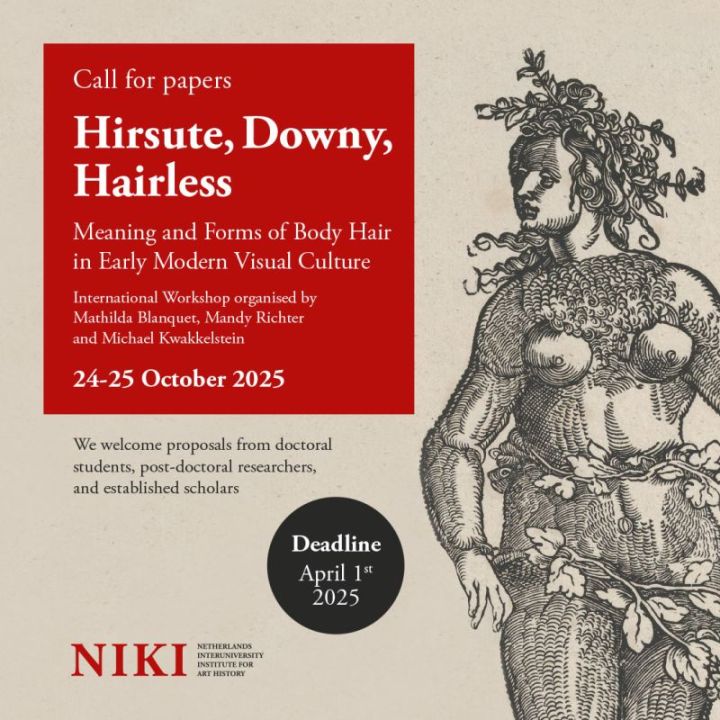
Call for Papers | Body Hair in Early Modern Visual Culture
From ArtHist.net and NIKI:
Hirsute, Downy, Hairless:
Meanings and Forms of Body Hair in Early Modern Visual Culture
Nederlands Interuniversitair Kunsthistorisch Instituut, Florence, 24–25 October 2025
Organized by Mathilda Blanquet, Michael Kwakkelstein, and Mandy Richter
Proposals due by 1 April 2025
 While long overlooked in art historical studies, over the past two decades body hair has emerged as a significant field of research, offering new perspectives on early modern visual culture. The presence or absence of body hair serves as an indicator of aesthetic (or artistic) preferences and prevailing social norms specific to certain periods and locations, revealing complex intersections between art and real life.
In profane art, the representation of male body hair tends to be quite common. It often points to idealized virility, strength, or even a natural state of being. However, its excess or misplacement might indicate mockery, degradation, or even alienation of the depicted subject. In comparison, female hirsuteness appears less frequently in artworks from the early modern period due to different canons of beauty associated with the female body. These rare instances of representation thus hold particular interest for this workshop.
In religious art, hair in general is of notable importance and this significance extends to body hair as well. Various iconographies of saints include these distinct features, raising questions not only about visual traditions in different cultural contexts but also querying particular hermeneutic meanings, such as notions of humanity, carnality, and spiritual transformation. In some cases, there could be a connection to preserved body hair relics of specific saints, which has never been part of a broader study thus far.
Technical challenges in representing hair are another point of interest. Artists and art theorists addressed these challenges across different media throughout the early modern period, as evidenced in theoretical treatises, anatomical studies, and workshop practices. Not only does this include the question of how to differentiate between human and animal hair but extends as well to artistic experiments in finding new and creative ways of treating or even avoiding body hair.
This two-day workshop aims to explore the multiple dimensions of body hair in visual culture through an interdisciplinary approach. Contributions may address, but are not limited to, the following themes:
1 Gender and Social Norms
• Male vs. female body hair in art
• Social and cultural implications of hair presence or absence
• Body hair as an indicator of social status and cultural norms
2 Religious and Symbolic Dimensions
• Hair in religious iconography
• Symbolic meanings in sacred versus profane contexts
• The role of body hair in representing humanity versus divinity
3 Artistic Theory and Practice
• Technical challenges in depicting body hair across different media
• Body hair in artistic treatises and anatomical studies
• Relationships between artistic theory and artistic practice
4 Cultural and Geographic Variations
• Comparative studies across European regions
• Cross-cultural perspectives on body hair representation
We welcome proposals from doctoral students, post-doctoral researchers, and established scholars. Papers may be presented in English or Italian. Please submit an abstract (300–500 words), a brief biographical note (150 words), your current institutional affiliation, and contact information to m.blanquet@udk-berlin.de and richter@khi.fi.it by 1 April 2025. Acceptance notifications should arrive by 15 April 2025.
Selected papers will be considered for publication in a peer-reviewed volume following the workshop. The workshop will be held at the Nederlands Interuniversitair Kunsthistorisch Instituut in Florence (NIKI). Accommodation and travel information will be provided to accepted participants. For any queries, please contact m.blanquet@hotmail.fr and richter@khi.fi.it.
Organizers
• Mathilda Blanquet, Universität der Künste in Berlin, Université Fédérale de Toulouse, Universität Hamburg
• Dr. Michael W. Kwakkelstein, Dutch University Institute for Art History in Florence (NIKI) – Utrecht University
• Dr. Mandy Richter, Kunsthistorisches Institut in Florenz – Max-Planck-Institut
New Book | Adventures in the Louvre
From Norton:
Elaine Sciolino, Adventures in the Louvre: How to Fall in Love with the World’s Greatest Museum (New York: W. W. Norton, 2025), 384 pages, ISBN: 978-1324021407, $30.
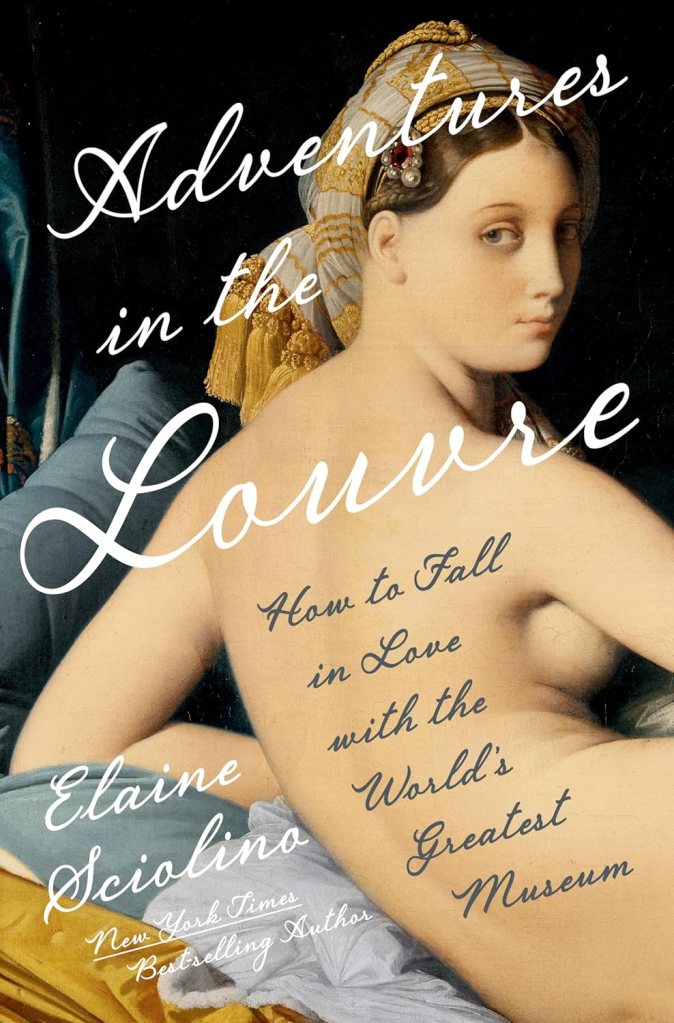 A former New York Times Paris bureau chief explores the Louvre, offering an intimate journey of discovery and revelation.
The Louvre is the most famous museum in the world, attracting millions of visitors every year with its masterpieces. In Adventures in the Louvre, Elaine Sciolino immerses herself in this magical space and helps us fall in love with what was once a forbidding fortress. Exploring galleries, basements, rooftops, and gardens, Sciolino demystifies the Louvre, introducing us to her favorite artworks, both legendary and overlooked, and to the people who are the museum’s lifeblood: the curators, the artisans producing frames and engravings, the builders overseeing restorations, the firefighters protecting the aging structure. Blending investigative journalism, travelogue, history, and memoir, Sciolino walks her readers through the museum’s front gates and immerses them in its irresistible, engrossing world of beauty and culture. Adventures in the Louvre reveals the secrets of this grand monument of Paris and basks in its timeless, seductive power.
Elaine Sciolino, contributing writer and former Paris bureau chief for The New York Times, is the author of The New York Times bestseller The Only Street in Paris, as well as The Seine and La Seduction. She lives in Paris.
Metropolitan Museum Journal 2024
The latest issue of The Met’s journal, with a reminder that digital copies are free! This year’s due date for submissions is 15 September; guidelines are available here.
Metropolitan Museum Journal 59 (2024)
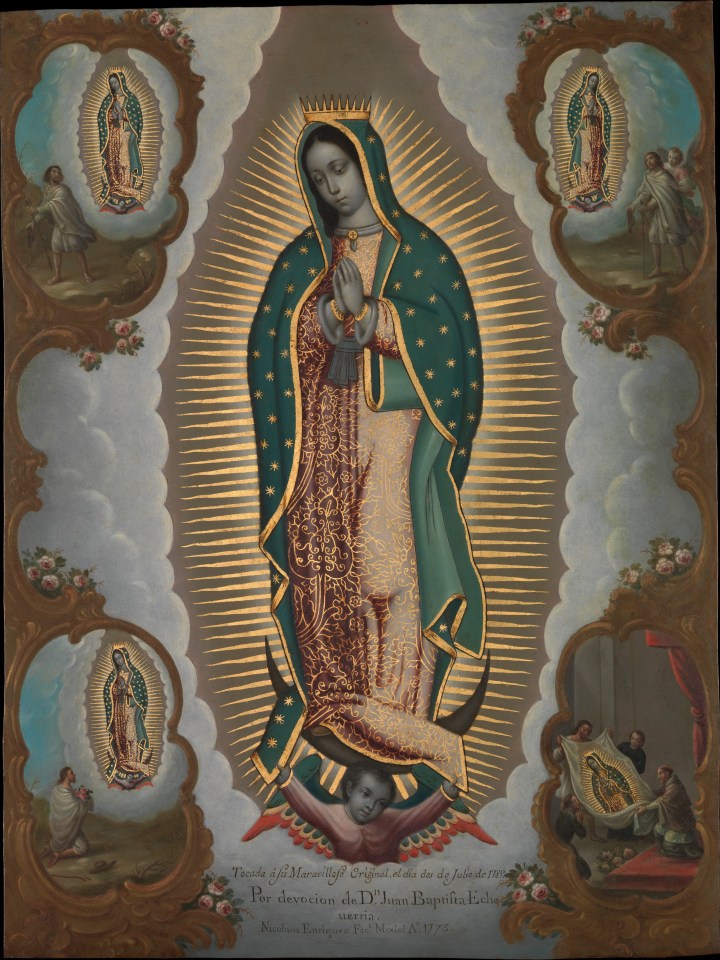
Nicolás Enríquez, The Virgin of Guadalupe with the Four Apparitions, 1773, oil on copper, 56.5 × 41.9 cm (New York: The Metropolitan Museum of Art, 2014.173).
a r t i c l e s
• Ally Kateusz, “Women at the Altar of Jesus’s Tomb in the Anastasis,” pp. 8–25.
• Melanie Holcomb, “The Architecture of ‘Playe’: Henry Hamlyn’s House in Tudor Exeter,” pp. 26–42.
• Ayşe AldemIr, “Ottoman Tastemaker Robert-Sadia Pardo and a Sixteenth-Century Prayer Rug in The Met,” pp. 43–57.
• Kelly Presutti, “Wood and Stone: Bernard Palissy’s Environmental Legacy,” pp. 58–72.
• Kristel Smentek and Christian Katschmanowski, “Oysters, Sauerkraut, and Pagods: Sibylla Augusta’s Chinese Banquet of 1729,” pp. 73–93.
• Ronda Kasl, “For the Devotion of Juan Bautista de Echeverría: Piety and Identity in Paintings by Nicolás Enríquez,” pp. 94–111.
• Nader Sayadi, “Imperial Threads: Kashmiri Shawls in Nineteenth-Century Iran,” pp. 113–29.
r e s e a r c h n o t e
• Rachel Lackner, Shirin Fozi, and Kisook Suh, “Julius Caesar from the Heroes Tapestries at The Met Cloisters: Dye Analysis and Molecular Insights,” 130–43.
Anna Jameson Lecture by Paris Spies-Gans
This evening at The National Gallery (the lecture is fully booked, but it will be live-streamed) . . .
Paris Spies-Gans | ‘The Spirit of a Particular Age’
Women Artists and the Challenges of an Integrated Art History
Online and in-person, The National Gallery, London, 13 March 2025, 6pm GMT

Elisabeth Louise Vigée Le Brun, Self Portrait in a Straw Hat, 1782 (London: The National Gallery).
Women artists are having a moment—featuring in exhibitions, headlines, and auctions. Art historians have, however, long known of their existence. Why do we continue to treat these creators as rare, exciting discoveries? This lecture will consider the complicated legacies surrounding women artists and notions of historical truth. Taking Anna Jameson’s concept of the ‘Spirit of a Particular Age’ as a jumping-off point, it will explore the tensions that often accompany studies of women in their own places and times and suggest a path towards a more integrated—and hopefully lasting—narrative of art: one that includes women as the prominent historical players they regularly were. Sometimes this entails uncomfortable work, such as questioning canonical narratives about women and art. However, embracing such complexities can ultimately lead to a deeper, fuller understanding of the cultural and gender dynamics that shaped the past—and continue to influence the present.
The lecture will also be live-streamed; please book tickets here»
Paris A. Spies-Gans holds a PhD in History from Princeton University, an MA in Art History from the Courtauld Institute of Art, and a BA from Harvard University. Her research has been supported by fellowships from the Harvard Society of Fellows and the J. Paul Getty Trust, among other institutions. Her first book, A Revolution on Canvas: The Rise of Women Artists in Britain and France, 1760–1830 (PMC/YUP 2022), has won several prizes in the fields of British art history and 18th-century studies and was named one of the top art books of 2022 by The Art Newspaper and The Conversation. She is currently working on her second book, A New Story of Art (US/Doubleday and UK/Viking).
Call for Applications | PhD Thesis on Spain and Ibero-America
From the Call for Expression of Interest, with the French version available here:
Doctoral Thesis on the History of Art and Visual Studies
Spain and Ibero-America, particularly New Spain, ca. 1650–1870
Directed by Tomas Macsotay and Émilie Roffidal
Applications due by 11 April 2025
This call is addressed to students wishing to prepare a doctoral thesis on aspects of the history of art and visual studies in Spain and Ibero-America, particularly New Spain, ca. 1650–1870. We will support the candidate in the preparation of a thesis proposal to be submitted in France. If the proposal is accepted, the candidate will benefit from the collaboration of two art history departments in Spain and France, enabling him or her to obtain a European doctorate.
p o s s i b l e t o p i c s
1 Artistic Academies in the Ibero-American Space
• Exchanges with Italy and France, artistic models
• Interpersonal and inter-institutional networks
• The relationship between the fine arts and the applied arts, in particular with the luxury and semi-luxury market; the role of the Juntaso de Commercio and Sociedades económicas de amigos del país
• The circulation of theoretical and archaeological knowledge
• Local heritage and the movement to create a Spanish artistic identity (casticismo, cultura andaluza)
2 Religious Art in Ibero-America
• Ecclesiastical interiors, furnishings, and religious sculpture as embodiments of the transformation of religious practice
• Text-image relationships, in particular through the study of printed sermons and panegyrics
• Relationships between ‘Baroque’ art and ‘neoclassicism’, between devotion in the private and public spheres
• The question of regional models and neoclassical reform (particularly neoclassicism in Madrid and Valencia)
• The place of antiquity in the vocabulary of forms
3 The Journey to Spain, published and unpublished
• Travelogues as an expression of the reception of Spanish art
• The reception of art (perception, intertextuality, and narrativity in commentaries on monuments and works of art)
• The journey as a search for a common artistic repertoire versus local identity
4 Engraving in the Ibero-American Space
• The use of engraving to show a diversity of images: landscapes, religious and/or political ceremonies, works of art, the population, everyday life, etc.
• Links between the real and the imaginary (compositions, recompositions, etc.)
• The question of violence, revolt, and upheaval
• Engravers and the image market
Candidates must have sufficient communication skills in French and Spanish (C1 or at least B2 levels). To apply, please send a cover letter, a thesis proposal on one of the proposed themes (3,000–6,000 characters), and a transcript of Master’s result list. Successful candidates will receive support in preparing their application for a doctoral contract (funded thesis) and in writing their final thesis proposal.
Directors
• Tomas Macsotay, associate professor, Pompeu Fabra University, tomas.macsotay@upf.edu
• Émilie Roffidal, senior researcher, Centre National de la Recherche Scientifique (FRAMESPA laboratory, UMR 5136, Toulouse), emilie.roffidal@univ-tlse2.fr
Exhibition | The Roman Drawings of José de Madrazo
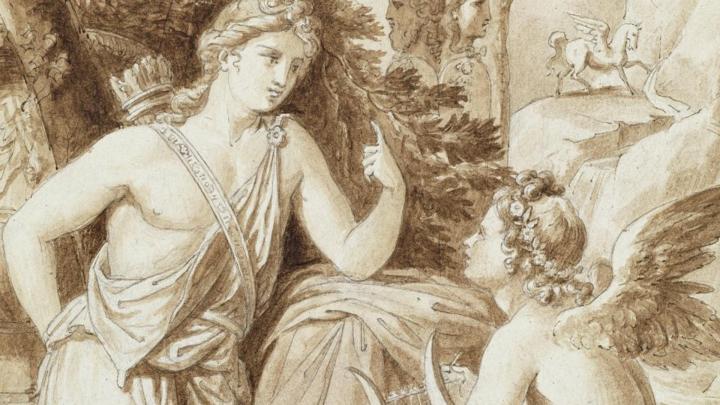
José de Madrazo y Agudo, The Dispute between Apollo and Cupid, detail, ca. 1812, pencil and grey-brown wash on wove paper, 29 × 22 cm
(Madrid: Prado, D006523)
◊ ◊ ◊ ◊ ◊
From press release for the exhibition:
Changing Forms: Myth & Metamorphosis in the Roman Drawings of José de Madrazo
Cambio de forma: Mito y metamorfosis en los dibujos romanos de José de Madrazo
Museo Nacional del Prado, Madrid, 10 March — 22 June 2025
Changing Forms: Myth and Metamorphosis in the Roman Drawings of José de Madrazo showcases the intriguing works of José de Madrazo y Agudo (1781–1859), the first artistic director of the Museo Nacional del Prado. The exhibition offers a unique glimpse into Madrazo’s fascination with classical mythology and its reflection of a turbulent era. During a time when Europe was reshaped by Napoleon and Goya captured the horrors of war, Madrazo, then in exile in Rome, explored the transformative power of myth.
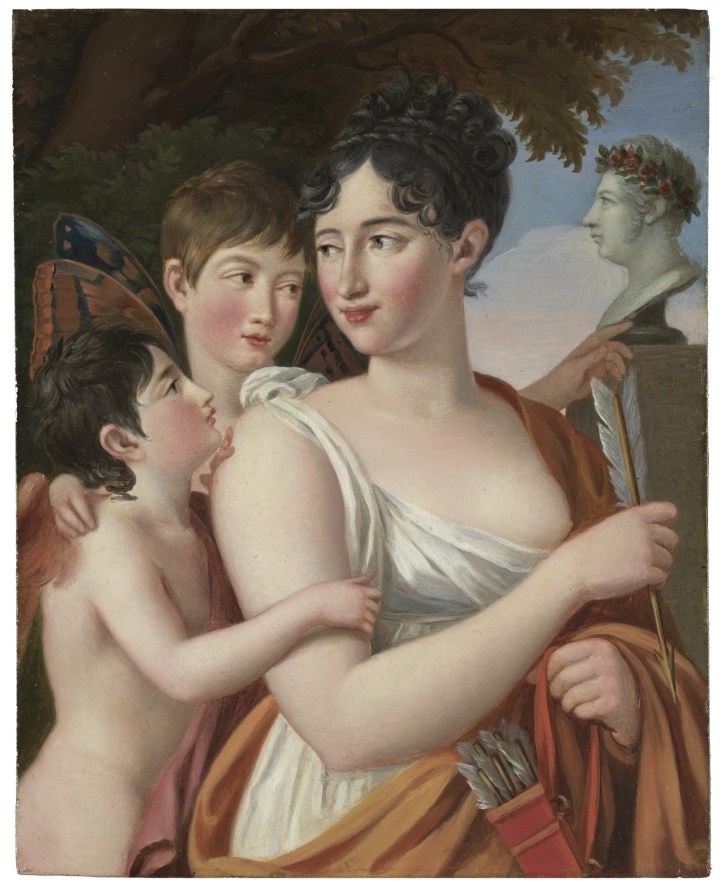
José de Madrazo y Agudo, Josefa Tudó with Her Sons Manuel and Luis Godoy, in a Garden, ca. 1812, oil on panel 20 × 16 cm (Madrid: Prado).
The exhibition features a collection of drawings and portraits from the Daza-Madrazo collection, acquired by the Prado in 2006, highlighting Madrazo’s ability to interpret ancient stories through a contemporary lens. The exhibition is structured around two distinct sets of works, prompting questions about their original purpose. One set appears to be preparatory sketches for engravings, while the other, semicircular compositions, suggests they were intended for decorative purposes, possibly for the exiled court of Charles IV in Rome. Themes like the contest between Apollo and Cupid are prominent, revealing Madrazo’s personal and scholarly approach to myth.
A notable inclusion is Madrazo’s Portrait of Josefa Tudó and Her Children, where they are depicted as mythological figures. This highlights how Madrazo incorporated mythological symbolism into his portraiture, adding layers of meaning to his works. The exhibition also delves into Madrazo’s self-representation, featuring his silhouette, a lithographic portrait, and a photograph, demonstrating his interest in evolving artistic technologies. These pieces span different periods of his life, showcasing his experimental nature.
Changing Forms goes beyond a simple display of technical skill, inviting visitors to consider the historical context in which Madrazo worked, a period marked by significant change. The exhibition emphasizes how Madrazo’s exploration of metamorphosis was not just a theme in his art, but a reflection of his own ability to adapt and reinvent himself. The Daza-Madrazo collection, a key resource for understanding Madrazo’s drawing practice, is central to the exhibition. It reveals his creative process, aesthetic choices, and the complexities of his Roman period.
Madrazo’s deep engagement with classical texts and art history is evident in his detailed drawings. He combined diverse sources to enrich his narratives, demonstrating a rigorous study of both past and present artistic trends. The exhibition aims to provide a deeper understanding of José de Madrazo’s artistic vision and his ability to navigate a time of significant historical and artistic change. Visitors are encouraged to explore the connection between myth, transformation, and the artist’s own journey.










 Enfilade
leave a comment