Call for Papers | New Research on Venetian Art
From ArtHist.net:
New Research on Venetian Art
A Study Day for Doctoral and Post-Doctoral Researchers
Online, 24 October 2026
Proposals due by 30 June 2026
The Venetian Art History Research Group (VAHRG) invites submissions for its second virtual conference, open to current PhD students and postdoctoral researchers working on any aspect of Venetian art history. The conference will take place online via Zoom on Saturday, 24 October 2026, and will be hosted by members of the VAHRG committee. We welcome proposals for short papers presenting current research on Venetian art. Presentations may be given in either English or Italian, be accompanied by a PowerPoint, and not exceed 20 minutes. Those interested in participating are invited to submit a proposal title and an abstract (maximum 200 words) to venetianahg@gmail.com by Tuesday, 30 June 2026. Please also include your current university affiliation and the contact details of your supervisor(s).
Prado Opens New 18th-C. Galleries, Highlighting Goya
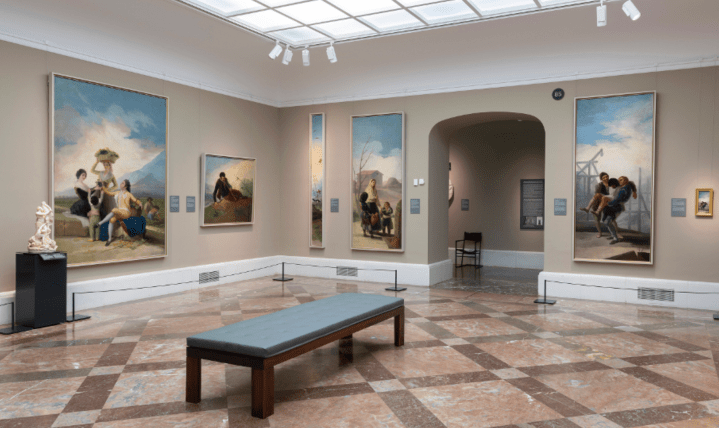
From the press release from the Prado:
The Museo Nacional del Prado has unveiled a fresh look at its 18th-century collections, placing Francisco de Goya at the heart of a thoughtful and immersive re-installation on the south side of its second floor. The highlight is a near-complete presentation of the artist’s celebrated tapestry cartoons, now brought together in rooms 85 and 90–94, offering visitors a rare chance to follow nearly two decades of Goya’s early career in a single, continuous narrative.
Painted between 1775 and the mid-1790s, these works were originally designed to decorate royal residences such as El Escorial and El Pardo for the Princes of Asturias, the future Charles IV and María Luisa of Parma. Now reunited in the museum, they reveal not only Goya’s technical brilliance but also the gradual emergence of a distinctive artistic voice—one that would later redefine Spanish painting. The Prado holds 50 of the 57 cartoons he created, making this installation an exceptional opportunity to grasp the full scope of the series, especially given that several others are either lost or dispersed in different collections.
The new layout guides visitors through Goya’s evolution with clarity and intention. Early works show the strong influence of court painters like Anton Raphael Mengs and Francisco Bayeu, under whom Goya began his career in Madrid. But as the rooms unfold, so too does his independence, with later pieces hinting at the originality and psychological depth that would come to define masterpieces such as Los Caprichos and the Black Paintings. A particularly striking moment comes in the final gallery, where a direct comparison between works by Bayeu and Goya underscores just how far the younger artist had pushed beyond his teacher’s shadow.
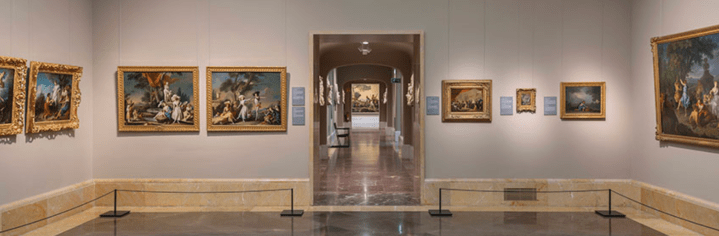
Beyond the Goya display, the re-installation expands into a broader exploration of 18th-century art. Nearby rooms present a rich mix of painting, sculpture, and decorative arts that evoke the refined interiors of royal palaces. Works by figures such as Corrado Giaquinto, Giambattista Tiepolo, and Louis-Michel Van Loo share space with British masters like Joshua Reynolds and Thomas Gainsborough, painting a vivid picture of a cosmopolitan Europe shaped by courtly taste, classical revival, and artistic exchange. Intricate marquetry and hardstone objects, including pieces from the Royal Laboratory of Buen Retiro, further deepen the sense of material culture from the period.
The museum has also taken the opportunity to open a window into its conservation work, highlighting ongoing restoration efforts supported by Fundación Iberdrola España. Visitors can explore technical insights into how these fragile works are preserved, including a rare glimpse at an X-ray of one of Goya’s cartoons alongside a reproduction of The Blind Guitarist, the only print he created based on this series. These elements bring the creative and physical processes behind the artworks into sharper focus.
In parallel with the physical redesign, the Prado is extending the experience online with a new microsite dedicated to a set of 31 marble reliefs from the royal collections. The digital platform offers updated research, attribution, and historical context, shedding light on an ambitious 18th-century sculptural program tied to Madrid’s Royal Palace. Several of these reliefs can now be seen in the newly arranged galleries, reinforcing the connection between scholarship, display, and public engagement. Altogether, the Prado’s latest re-installation is more than a simple reshuffling of works—it is a carefully crafted narrative that brings visitors closer to the artistic, cultural, and political currents of the 18th century, with Goya’s early genius shining at its center.
New Book | Turning Away: The Poetics of an Ancient Gesture
Saltzman’s wide range of sources include Rousseau and Goya. From The University of Chicago Press:
Benjamin Saltzman, Turning Away: The Poetics of an Ancient Gesture (Chicago: The University of Chicago Press, 2026), 304 pages, ISBN: 978-0226847214 (cloth), $115 / ISBN: 978-0226847221 (paper), $30.
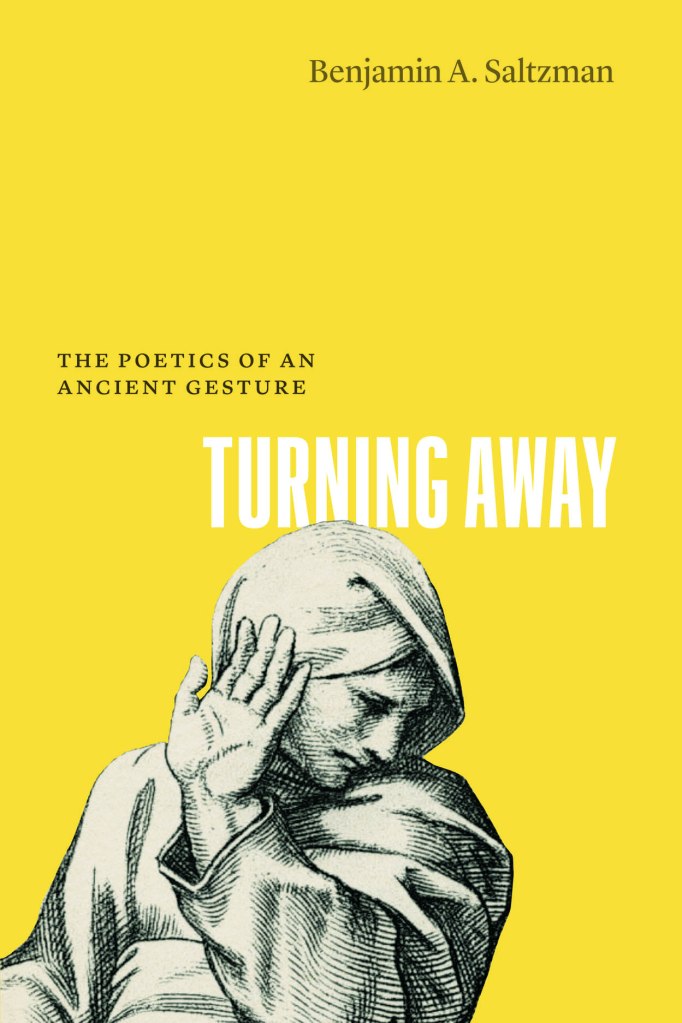 A sweeping account of how we are at our most human when we turn away from the pains of the world.
Why do we look away from the suffering of others? Why do we cover our faces in shame? Why do we lower our heads in grief? Few gestures are as universal as the averted gaze. Fewer still are as ambivalent and inscrutable. In this incisive study, Benjamin A. Saltzman reveals how the kaleidoscopic appearance of these gestures in art, poetry, and philosophy has turned them into an essential language for our uncomfortable engagements with the world, challenging us to reflect on the ways we fundamentally relate to others. Into the horizon of contemporary discourse, Turning Away sets out from five influential scenes in which figures avert their gaze: Timanthes’s Sacrifice of Iphigenia, Plato’s Republic, Augustine’s Confessions, Christ’s Crucifixion, and the Fall and Expulsion of Adam and Eve. The gestures of aversion in these scenes refract across visual media, through philosophy and politics, into modernity and the present day, having been reimagined along the way by thinkers like Hannah Arendt, artists like Marc Chagall and Salvador Dalí, poets like Langston Hughes, and many others. Saltzman offers a timely critique of the privilege of turning away and of the too-easy condemnation of our tendencies to do so.
Benjamin A. Saltzman is associate professor of English at the University of Chicago, where he coedits the journal Modern Philology. Saltzman is the author of Bonds of Secrecy: Law, Spirituality, and the Literature of Concealment in Early Medieval England and the coeditor of Thinking of the Medieval: Midcentury Intellectuals and the Middle Ages.
c o n t e n t s
Prologue
1 Parodos
2 Ambivalence
3 Sensation
4 Darkness
5 Retroversion
Exodos
Gratitude
Notes
Bibliography
List of Illustrations
Index
New Book | Anne Vallayer-Coster
From Lund Humphries and The Getty:
Kelsey Brosnan, Anne Vallayer-Coster (London: Lund Humphries Publishers, 2026), 152 pages, ISBN: 978-1848226852, £35 / $45.
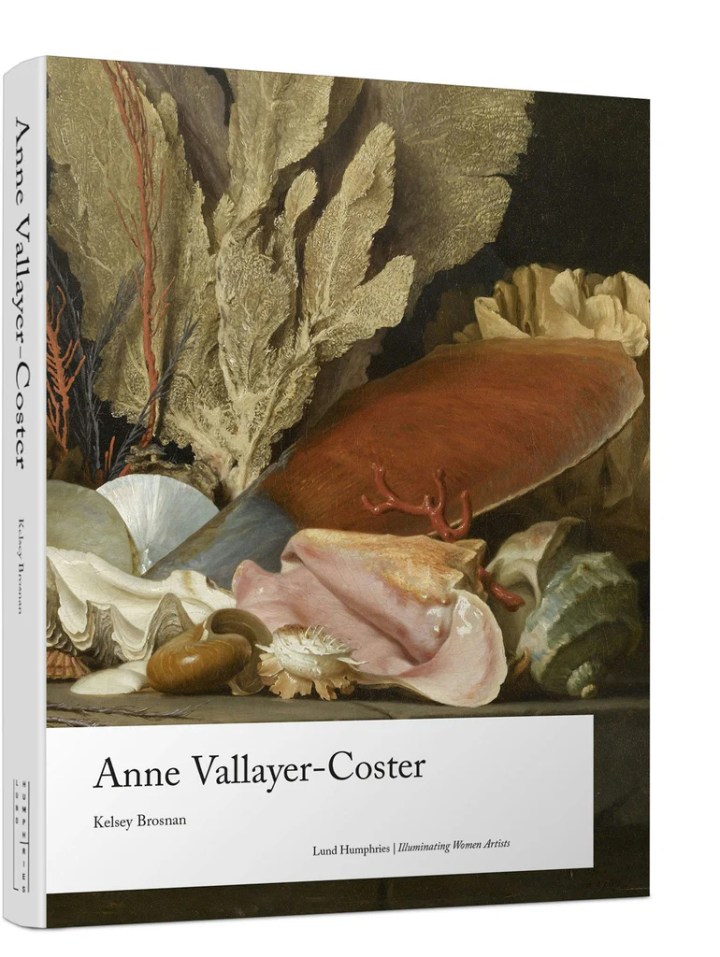 Anne Vallayer-Coster (1744–1818) was one of just four female academicians admitted to the French Royal Academy of Painting and Sculpture in the late 18th century. She made her debut at the Paris Salon only a year after joining the academy with her outstanding still-lifes. Later, she secured Queen Marie Antoinette as a patron. This book, the first English-language publication in over 20 years dedicated to this artist, provides a fresh, feminist re-evaluation of her biography and artistic context. Exploring the wide range of objects, materials and textures which the artist depicted—from food and flowers to guns and game—this study offers a new, synaesthetic framework for experiencing the visceral qualities of Vallayer-Coster’s still-life paintings as they were understood in her own time.
Kelsey Brosnan is a writer and art historian specialising in 18th- and 19th-century French paintings, works on paper, and decorative arts. She is Visiting Assistant Professor in the History of Art and Design Department at Pratt Institute, New York and also works as a writer and cataloguer for Christie’s, New York.
c o n t e n t s
Acknowledgements
Introduction
1 Vallayer-Coster, Académicienne / Citoyenne
2 Allegories
3 Food
4 The Hunt
5 Shells
6 Flowers
Conclusion
Appendix: Vallayer-Coster at the Salon, 1771–1817
Notes
Bibliography
Index
New Book | Diplomatic Reception Rooms at the U.S. Department of State
From: Rizzoli:
Virginia Hart, ed., Views of America: The Diplomatic Reception Rooms at the U.S. Department of State (New York: Rizzoli Electa, 2026), 240 pages, ISBN: 978-0847876532, $65. With contributions by Bri Brophy, Laaren Brown, and Mark Alan Hewitt. Principal photography by Durston Saylor and Bruce White.
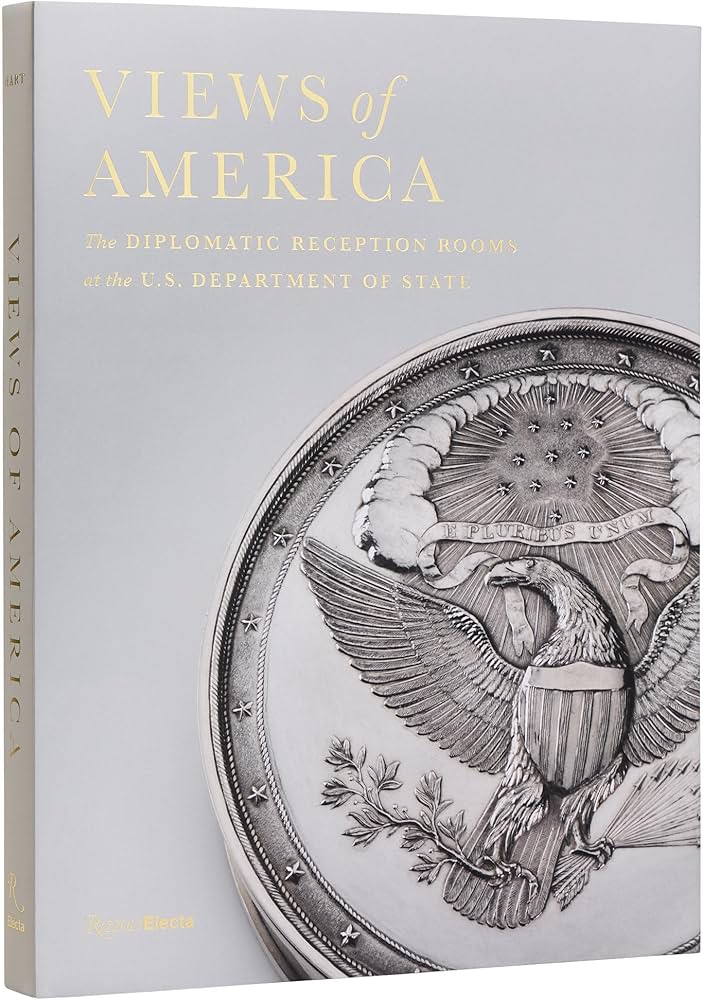 A book to honor the 250th anniversary of America, uncovering the history of the United States through works of art dating from America’s revolutionary period, from the collection of the Diplomatic Reception Rooms at the US Department of State.
Published as a follow-up to Rizzoli’s America’s Collection, with a new array of objects and original scholarship, this book celebrates the unparalleled collection of the Diplomatic Reception Rooms, one of America’s most astonishing yet little-known treasures, located in the US Department of State’s Harry S. Truman Building in Washington, DC, now in a more accessible price and format. The collection is home to more than 5,000 fine and decorative art objects, mostly from 1740 to 1840, which tell stories from the nation’s founding era and formative decades.
This survey of 100 key works brims with historical provenances: porcelain from the personal collection of George Washington, silverwork by Paul Revere, side chairs that descended through the family of Francis Scott Key, and the tambour writing table upon which the Treaty of Paris was signed and is still used for signing of diplomatic papers today. The book showcases the important paintings by John Singleton Copley, Gilbert Stuart, Thomas Moran, Childe Hassam, and others, as well as examples of fine furniture and porcelain. The collection reflects the craftsmanship and spirit of eighteenth- and early nineteenth-century America and forms a vital link between the past and today’s endeavors to represent the American character through the art of diplomacy.
Virginia B. Hart is director and curator of the Diplomatic Reception Rooms, and Bri Brophy is deputy chief curator. Laaren Brown is a writer and editor for art and natural history topics. Mark Alan Hewitt is an architect and architectural historian.
New Book | Arms and Armour from The Wallace Collection
From Bloomsbury:
Thom Richardson and Paula Turner, eds., with photographs by Cassandra Parsons, The Wallace Collection Catalogue of Arms and Armour from Asia, Africa, and the Ottoman World (London: Philip Wilson Publishers, 2026), 560 pages, ISBN: 978-1781301203, $195.
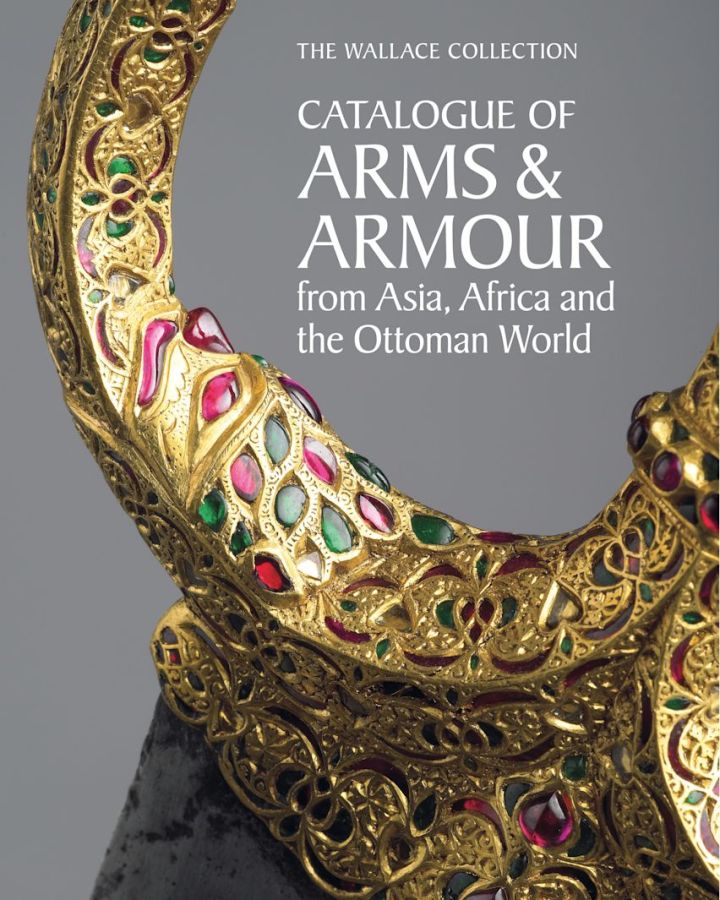 Brimming with bejewelled and enamelled dagger hilts, swords, and scabbards, and with delicately gilded spears, helmets, shields, and breastplates, the Wallace Collection is home to one of the finest assemblages of arms and armour in the world. The pieces within the collection provide an expansive view of three key areas—Asia, Africa, and the Ottoman world—and span the 17th, 18th, and 19th centuries, with star objects dating from as early as the 15th century. Being both functional weapons and prestigious luxury items, objects in this area of the collection are fascinating and awe-inspiring both for their technical achievements and artistic virtuosity.
This richly illustrated catalogue, compiled by leading specialists in the field, is a landmark achievement and shines a light on a previously overlooked part of the Wallace Collection. It provides detailed photographs of almost every object, each accompanied by a description of its provenance, materials, inscriptions, and construction. Also included is an introduction to the subject and a history of the collecting of non-European arms and armour by the 4th Marquess of Hertford and Sir Richard Wallace.
Call for Papers | The Public of the Monument, 1789–2026
From ArtHist.net:
The Public of the Monument, 1789–2026: Collective Celebration in Question
Le Public du monument, 1789–2026: La célébration collective en question
13th Symposium for Young Researchers in Sculpture
Online and in-person, Musée Rodin, Paris, 9 October 2026
Organized by Thierry Laugée
Proposals due by 31 May 2026
“This is how the Republic knew how to impress the masses, by involving them in these great national performances.” –Pierre-Jean David d’Angers, “Fêtes nationales,” Dictionnaire politique: Encyclopédie du langage et de la science politiques (Paris, Pagnerre, 1842), pp. 400–01.
Through these words, published by Pagnerre in 1842 in the Dictionnaire politique, Pierre-Jean David d’Angers elevated the revolutionary festivals of Year II of the Republic to the status of exemplary models, considering them to be authentically popular in nature. The Festival of the Supreme Being in particular—staging the participation of the people in the celebration of temporary statues—aroused an enthusiasm conducive to moral elevation and reminded the sculptor of the emancipatory function of the sculpted monument. David’s attentiveness to the collective dimension of the monument must be situated within the broader history of public statuary. For shared celebration—whether marking an inauguration or assuming a more symbolic form—constitutes one of the necessary conditions for a monument to be genuinely perceived as public, that is, as belonging to those who encounter it in their daily lives. Whether an association commemorates the anniversary of a great man before his statue, a spontaneous gathering assembles around an effigy in defense of a political cause, or supporters climb the statue of the Republic to celebrate a club’s victory, such gestures represent as many ways of celebrating a monument—or of celebrating with it.
Incidentally, the popular gatherings of 1899 around the sculpted monument Le Triomphe de la République by Jules Dalou are said to have inspired him with the idea of his Monument aux ouvriers, attesting to the political and artistic emulation generated by the public appropriation of the monument.
Public statuary, by inscribing itself within urban space, exists in daily proximity to pedestrians. Although the statue is intended to convey a message to them, to shape their memory, or to signal the values upheld by the locality, the role of the passerby cannot be confined to passive reception. Beyond potential financial participation through taxation or public subscription, it is the passerby who ultimately accepts—or rejects—the monument and integrates it into local social life.
To recount the history of a public monument entails reconstructing, through archival sources, the genealogy of debates and the administrative and financial decisions that led to its erection, followed by an examination of the artist’s successive projects culminating in its execution in its definitive material, and possibly its inauguration. Yet one of the fundamental stakes of public statuary lies in its inscription within the future of a locality. Every episode occurring on or around the monument, up to its potential dismantling, forms part of the long-term history of the public monument. This urban history generally escapes the artist’s control; it is composed of ceremonies and festivities that focus on the statue or incorporate it into a spatial framework defined either by deliberate choice or by necessity. This symposium therefore seeks to examine the modalities and paradoxes of celebrating statuary within the city, as well as the multiple actors involved in these collective forms of celebration. It aims to observe the statue’s “fellow citizens,” those for whom it is intended, in order to better understand their role, their practices, and the attachment they may gradually develop toward an effigy over time.
One of the proposed research perspectives concerns the study of the ways public monuments are inaugurated. As Bertrand Tillier notes, “these collective uses of the monument at the moment of its inauguration, as it enters the public sphere, generate a shared emotional experience” (La Disgrâce des statues, 2022). This emotion may surface in speeches, poems, concerts, or songs—forms whose study has, until now, remained largely peripheral. Yet a rich and varied corpus of artistic and literary works, whether published or unpublished, accompanies these ceremonies. Yet there exists a rich body of artistic and literary productions, published or unpublished, that mark the rhythm of the ceremonial proceedings and contribute to the staging of the collective.
The ways in which a monument is celebrated prove to be remarkably varied, and in some cases, they overlap significantly with religious ceremonial practices, particularly through processional forms. These points of permeability between civic and sacred spaces, far from being incidental, invite a deeper examination of the circulation of practices, symbols, and ritual registers through which individuals express attachment to—or acknowledgment of—a secular figure.
Beyond the moment of inauguration alone, it becomes clear that public statuary functions as a form of spectacle. Another research perspective during this study day will therefore be to examine the forms and uses of this spectacularization, understood as a mode of collective engagement within public space. Particular attention may be given to the most ephemeral expressions of statuary, a transitory character that appears at first glance to contradict the ideal of permanence. From the First Republic to the most recent Olympic Games, the display of temporary statues—in plaster, cardboard, paper, fabric, or resin—during civic celebrations attests to the structuring role of statuary in shaping urban discourse. Contributions addressing the use of pyrotechnics, illumination, or sound design in relation to monuments are especially encouraged, since these devices play a significant part in the festive appropriation of public monuments.
This study day is explicitly interdisciplinary in scope and is intended for scholars across all fields of the humanities and social sciences, with the aim of fostering dialogue, methodological exchange, and the enrichment of historical knowledge concerning sculpted monuments. Particular attention will be given to contributions that offer a fresh perspective on groups of monuments, civic celebrations, or related practices.
Proposals for papers may be submitted in French or English. They must include a title, an abstract (between 1500 and 2000 characters), and a brief biographical note (between 500 and 1000 characters). They should be sent before 31 May 2026 to colloques@musee-rodin.fr.
Research and Organizing Committee
Amélie Simier, Director of the Musée Rodin
Thierry Laugée, Professor of Contemporary Art History, Nantes Université, CReAAH-LARA
Emilia Philippot, Senior Curator, Head of Curatorial Affairs, Musée Rodin
Véronique Mattiussi, Head of the Research department, Musée Rodin
Franck Joubin, Researcher, Conference Coordinator, Musée Rodin
Call for Papers | Painting and Genre
From the Call for Papers:
Painting and Genre
St Edmund Hall, University of Oxford, 6 August 2026
Organized by Sofya Dmitrieva
Proposals due by 31 May 2026
Painting genres structure artistic practice, shape reception, and inform institutional frameworks. Yet as an analytical category, genre has long occupied a marginal position within art history.
This is not to suggest that the discipline has produced no genre theory. Influential studies, such as Wayne Franits’s Dutch Seventeenth-Century Genre Painting: Its Stylistic and Thematic Evolution (Yale University Press, 2004), have addressed genre explicitly, and scholarship on individual genres, particularly portraiture and landscape, is vast. Questions related to genre, most notably the academic hierarchy of genres, have received sustained scholarly attention, from Jean Locquin to Christian Michel, Mark Ledbury, and Paul Duro. Indeed, one of the discipline’s foundational texts—Alois Riegl’s The Group Portraiture of Holland (1902)—is a genre study.
Art-historical approaches to genre have likewise been varied and innovative. To cite just a small selection of recent examples, Amy Freund has examined the hunting portrait from a sociohistorical perspective, linking it to the changing status of the sword nobility in the early eighteenth century (Art History, 2019); Susanna Caviglia has revisited history painting under Louis XV, relating it to contemporary political and cultural discourses on pleasure (Oxford University Studies in the Enlightenment, 2020); and Stephanie O’Rourke has explored how late eighteenth- and early nineteenth-century landscape painting registered practices of resource extraction (University of Chicago Press, 2025).
Still, despite this substantial body of scholarship, the study of genre has remained largely overshadowed by iconographic and formalist approaches. In contrast to literary and film studies, where genre theory occupies a central methodological position, art history has yet to develop a comparably sustained theoretical framework for the analysis of genre.
This one-day conference invites contributions that place genre at the centre of the analysis of painting. It seeks to foreground genre not merely as a classificatory device but as a critical category through which artistic production, reception, and historiography can be re-examined. While certain periods, such as the Dutch Golden Age, readily lend themselves to genre-based analysis, the conference is not limited chronologically or geographically. Case studies of genres from all periods and regions are welcome, as are experimental theoretical contributions and historiographical papers that reflect on the role genre has played within art history, theory, and criticism.
Possible questions include, but are not limited to:
• What formally defines a painting genre?
• What mechanisms govern the formation, stabilisation, and transformation of genres?
• How do hybrid genres emerge and operate?
• How do generic expectations shape viewer perception and interpretation?
• How do genres reflect their historical contexts, including political ideologies, class relations, and gender roles?
• How do genres articulate sociocultural practices?
• What role have genres played within institutions (academies, museums, auction houses) and the art market?
• How has the notion of genre developed within the history, theory, and criticism of art?
Breakfast, lunch, and dinner will be provided at the venue. The organiser intends for the conference to result in a publication. Please submit a 300-word abstract for a 20-minute presentations and a 100-word biography to Sofya Dmitrieva (sofya.k.dmitrieva@gmail.com) by May 31.
Conference | Revolutions, Art, and the Market
From ArtHist.net and Eventbrite:
Revolutions, Art, and the Market
Sotheby’s Institute of Art, London, 4–5 June 2026
Art market trends and practices—whether historical or contemporary—are affected by networks of complex and often competing forces. As moments of political, economic, intellectual, or technological rupture, revolutions have significantly shaped art market systems and fortunes, refracting and redirecting collecting ambitions, displacing existing markets and creating new ones, and promoting novel modes of commercialisation of art. Embracing wide chronological and geographical spans, this conference considers how revolutions have inflected the circulation and consumption of art and facilitated the emergence of new art market practices and collecting paradigms.
Tickets range from £10 to £60—depending on whether attendance is online or in-person and whether there is a student rate. Registration is now open here.
t h u r s d a y , 4 j u n e
9.15 Coffee and Registration
9.45 Welcome
10.00 Session 1 | Revolutions in the Age of Enlightenment
Chair: Barbara Lasic
• Catherine Dossin (Associate Professor, Purdue University) — Franklinmania: The French Art Market and the Making of the American Revolution
• Gabriel Wick (Assistant Professor, American University in Paris) — Marketing Gardens: The Duc d’Orléans, Palais Royal, Le Raincy, and the Parisian Public, 1785–1793
• Jan Dirk Baetens (Assistant Professor, Radboud University) and Evelien De Visser (Curator, RKD – Netherlands Institute for Art History) — Art for All: The Emergence of a Mass Market for Cheap Paintings in the Age of Revolutions
12.30 Lunch Break
13.30 Session 2 | The 1917 Russian Revolutions and Their Aftermath</span
Chair: Lis Bogdan
• Natalia Murray (Lecturer, Courtauld Institute) — All the Empty Palaces: The Fate of Private Collections in Russia after the 1917 Revolutions
• Daniel Bulatov (PhD Candidate, University of Münster) — Beyond the Market: Soviet Patronage and the Economics of Western Revolutionary Art, 1920s–30s
14.45 Tea Break
15.15 Session 3 | Modernist Revolutions and Cross-border Networks
Chair: Bernard Vere
• Lara Virginie Pitteloud (PhD Candidate, University of Neuchâtel) — Exhibiting Modernism in Revolutionary Odesa: Izdebsky’s Salons and the Formation of Transnational Art Market Networks, 1909–1911
• Lucia Colombari (Assistant Professor, University of Oklahoma) — The Afterlife of Italian Futurism: Postwar Art Markets and Transatlantic Networks
• Annie Wong (Independent Art Historian) — After the Cultural Revolution: Wu Guanzhong and the Making of a Transregional Chinese Modernist Market
17.15 Keynote
• Adrian Locke (Curator Emeritus, The Royal Academy of Arts) — Frida Kahlo and the Mexican Revolution
18.15 Drinks Reception
f r i d a y , 5 j u n e
10.00 Session 4 | Revolutions, Representations, and Structural Transformations
Chair: David Bellingham
• Maxence Garde (Curator, Gulbenkian Museum) — Building on a Revolution: A Transformative Economical Approach of Egyptian Antiquities after 1952
• Iris Gilad (University of Tel-Aviv) — Revolution and Recognition: War, Canon Formation, and the Israeli-Palestinian Art Market
• Aurella Yussuf (PhD Candidate, University of Birmingham) — Revolutionary Rhetoric and Market Continuity: Black Political Rupture and the Art Market after 2020
12.30 Lunch Break
13.30 Session 5 | Cultural Revolutions and New Market Practices in Asia
Chair: Ivy Chan
• Vivian Tong (Lecturer, Hong Kong Baptist University) — Shaping Taste in an Evolving Market: Historical Chinese Works of Art and their Auction Market in Hong Kong, 1970s–2020s
• Katie Hill (Senior Lecturer, SIA London) — The Cultural Bond of Maoism: Political Memory and (Cultural) Value in Contemporary Art from China
14.45 Tea Break
15.15 Session 6 | Digital Revolutions
Chair: Melanie Fasche
• Georgia Gerson (PhD Candidate, University of York) — NFTs and the Art Market: Revolution or Continuity?
• Giulia Taurino (Getty Research Institute) — Beyond Network Centrality: Machine Intelligence and the Recovery of Invisible Markets
• Jonathan Adeyemi (Leverhulme Early Career Fellow, Loughborough University) — Political Revolution and Digital Mediation: A Sustainable Increasing Stake of African Art in the Global Market?
17.15 Concluding Remarks
On Tour in the UK | Mignard’s Portrait of Marquise de Seignelay
From the press release:
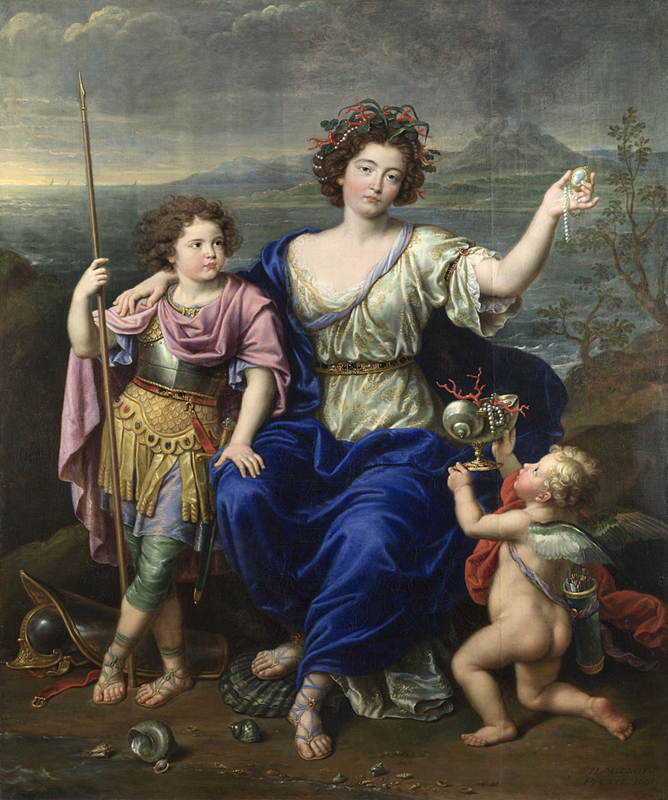
Pierre Mignard, The Marquise de Seignelay, 1691, oil on canvas, 195 × 154 cm (London: National Gallery).
The National Gallery announced the second painting for the National Gallery Masterpiece Tour, 2025–27. Pierre Mignard’s portrait of the Marquise de Seignelay (1691) will travel to our four partners between 2026 and 2027: South Shields Museum and Art Gallery (29 August 2026 – 8 November 2026); The Cooper Gallery, Barnsley (13 November 2026 – 20 February 2027); Grundy Art Gallery, Blackpool (27 February 2027 – 5 June 2027), and Ferens Art Gallery, Hull (11 June 2027 – 5 September 2027).
In this striking portrait, Mignard depicts the recently widowed Catherine-Thérèse de Goyon de Matignon-Thorigny, Marquise de Seignelay (1662–1699), as a woman of cultural and international importance. She is portrayed as the sea-goddess Thetis, while her eldest son Marie-Jean Baptiste (1683–1712) is dressed as the Greek hero Achilles, Thetis’s son by the mortal Peleus. Her sumptuous robe is painted using ultramarine, a highly expensive blue pigment, as a show of her wealth and status. The extensive marine imagery references her late husband, the Marquis de Seignelay’s position as head of the French Navy. The landscape in the background likely represents the shores of Martinique, an island in the West Indian ocean which was purchased for the French crown by the Marquise’s late father-in-law in 1664.
The exhibition programme plans to highlight the unique strengths of the partner venues, with three located on the coast—an ideal context for exploring the maritime themes of the painting and deepening its resonance with their surrounding landscapes and local collections.
At South Shields, the exhibition will be enriched through co-created elements developed with New Writing North’s Young Writers programme, students from South Tyneside College, and members of Our Voice Counts. The Cooper Gallery, Barnsley will co-produce its iteration of the exhibition with Next Big Thing, Barnsley Museums youth group, ensuring strong local engagement and creative collaboration. Grundy Art Gallery will shape its presentation by working for a 2nd year with Blackpool’s Young People’s charity The Magic Club. Grundy is working for all three years of The Masterpiece Touring Project with The Magic Club providing the opportunity for deep engagement over time. Ferens Art Gallery will further shape their presentation by working closely with community groups, drawing on local insights to inform and animate each exhibition, whilst providing a perspective which enriches our understanding of this painting.
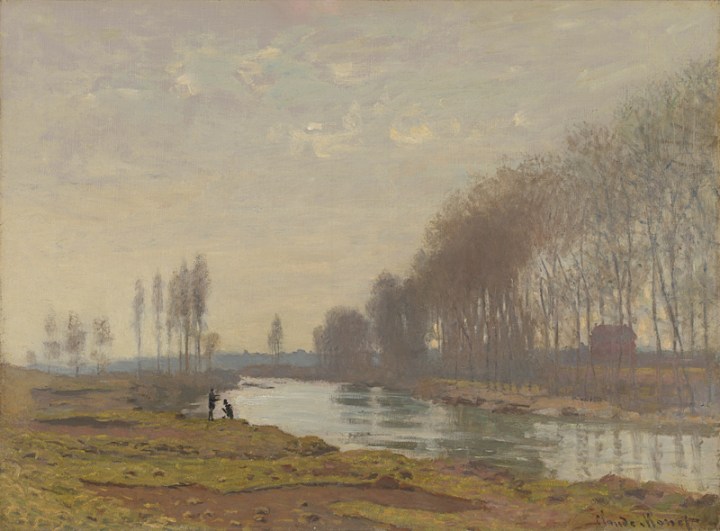
Claude Monet, The Petit Bras of the Seine at Argenteuil 1872, oil on canvas, 53 × 72 cm (London: National Gallery).
The National Gallery Masterpiece Tour: Monet was recently on display at South Shields Gallery (until 25 March). Monet’s The Petit Bras of the Seine at Argenteuil was presented with works from the South Shields, Laing and Shipley art collections, and artworks co-created by EBSA (Emotionally Based School Avoidant) young people, teachers, and local organisations. At Grundy Art Gallery (28 March – 13 June), the painting will be displayed alongside a new sonic art work produced by participants of Blackpool’s Young People’s charity, The Magic Club. Working with artist Kelly Jayne Jones, Blackpool’s young people have produced a sound-based response to their experience of Monet’s painting. The first round of the tour will then finish at Ferens Art Gallery (19 June – 13 September), where the picture will be part of an exhibition co-curated with Flourish, Ferens Art Gallery’s creative group for children and young people. Organised with and for disabled and neurodivergent visitors, the show will present select works from the Ferens’s vast collection alongside contemporary responses from Flourish.
Since its inception in 2014, The National Gallery Masterpiece Tour has reached 401,000 people across the UK. Our National Touring programme, including The National Gallery Masterpiece Tour and other travelling exhibitions, has now reached 1,467,618 people since 2014. As part of our ongoing commitment to sharing the collection, this exhibition partnership, made possible by the generous support from Hiscox, offers four UK museums and galleries outside of London the opportunity to work with the National Gallery for three years and display three major artworks from the collection.
For the second edition of the Masterpiece Tour, partners will each connect with a local community organisation to support the exhibition or public programme related to the selected painting each year. Each partner will develop their own display to explore and draw out themes most relevant to them and their communities.
National Gallery Director Sir Gabriele Finaldi said: “The National Gallery’s collection belongs to all of us. It is part of our duty and our honour to look after these paintings and to bring them to where people are, not just expect them to come to us. Partnering on touring exhibitions does so much more than bring beloved paintings from the collection to other places in the UK—it supports the whole country’s cultural ecosystem, connects people with paintings that belong to us all, and allows us to learn and expand our own practices and interpretations through the creativity of our partner organisations and their communities. That over one million people have visited these exhibitions in the last decade proves the desire to engage with our collection is growing, and we look forward to welcoming the next million visitors across the UK.”
North East Museums Director, Keith Merrin said: “We’re delighted to be part of the next chapter of the Masterpiece Tour and to welcome this extraordinary painting to South Shields Museum & Art Gallery. Bringing a work of this significance to our communities reflects the shared commitment between partners to making world-class art accessible, relevant and inspiring. Since the launch of the Masterpiece Tour on 17 January, when the museum welcomed Monet’s The Petit Bras of the Seine at Argenteuil (1872), footfall to the museum has increased by over 70%, highlighting the strong appetite for high-quality art experiences amongst our community.”










leave a comment