Exhibition | Juste-Aurèle Meissonnier: Rococo Goldsmith

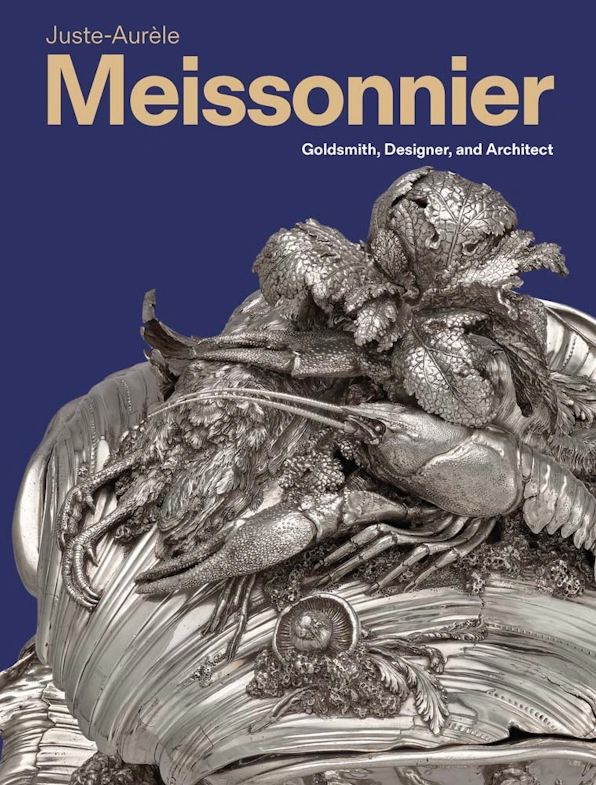
Covered Tureen on Stand (Pot-à-oille), 1735–38, designed by Juste-Aurèle Meissonnier and made by Pierre-François Bonnestrenne and Henry Adnet, silver (The Cleveland Museum of Art, 1977.182).
◊ ◊ ◊ ◊ ◊
Opening in October at The Cleveland Museum of Art:
Juste-Aurèle Meissonnier: Rococo Goldsmith in Focus
The Cleveland Museum of Art, 25 October 2026 — 14 March 2027
Curated by Ada de Wit
Juste-Aurèle Meissonnier (1695–1750) was the most revolutionary forerunner of the Rococo style in the decorative arts. Multitalented with entrepreneurial skills, he worked for the French court and European nobility. Considered a genius goldsmith by his contemporaries, he was also a prolific designer and aspiring architect, seamlessly maneuvering between media and disciplines.
 Born and trained in Turin, Italy, Meissonnier moved to Paris around 1715 to advance his career, although the conservative guild of Parisian goldsmiths made it practically impossible for newcomers to register as masters and open their own workshops. Meissonnier’s ambition, creativity, and determination in pursuing his desired career path are apparent from his work and limited biographical information and continue to resonate today.
Few of Meissonnier’s works survived political upheavals; the most celebrated is a silver tureen in the collection of the Cleveland Museum of Art, made for the Duke of Kingston. A striking sculpture rather than a functional object, the tureen epitomizes the Rococo style with its movement, asymmetrical design, fluid unity of form and ornament, and elements inspired by nature. The tureen has recently undergone scientific analysis, which has provided new insights into its sophisticated creation process.
The catalogue is distributed by Yale UP:
Ada de Wit, ed., with additional contributions by Michèle Bimbenet-Privat, Beth Edelstein, Peter Fuhring, Alexandre Gady, and Colleen Snyder, Juste-Aurèle Meissonnier: Goldsmith, Designer, and Architect (Cleveland: The Cleveland Museum of Art, 2026), 160 pages, ISBN: 978-0300282306, $50.
◊ ◊ ◊ ◊ ◊
From the press release for the recent acquisition of a snuffbox (7 May 2026) . . .

Juste-Aurèle Meissonnier, Gold Box, 1728–29, gold and lapis lazuli, 3 × 8.3 × 5.2 cm (The Cleveland Museum of Art, 2026.12).
The Cleveland Museum of Art has acquired an extraordinarily rare gold snuffbox made in Paris in 1728–29 by Juste-Aurèle Meissonnier. Of exceptional art historical importance, the box is one of only five known objects in precious metals firmly associated with Meissonnier to have survived the political upheavals of subsequent centuries, during which works in gold and silver were frequently melted down. For many years, it was the only known work bearing the maker’s mark of Meissonnier, until the 2019 discovery of his mark on a gold mount for a rock crystal ewer belonging to Marie Antoinette, now in the Louvre. The snuffbox is distinguished as a work executed by Meissonnier himself, without the involvement of other master goldsmiths.
This acquisition significantly strengthens the museum’s Meissonnier collection and will play a central role in Juste-Aurèle Meissonnier: Rococo Goldsmith in Focus, an exhibition of the artist’s work, which opens at the CMA in October 2026. Notably, the object has never before been displayed in a museum.
“This important acquisition reinforces the museum’s standing as one of the world’s leading collections of 18th-century French decorative arts,” said the CMA’s Sarah S. and Alexander M. Cutler Director William M. Griswold. “It also strengthens our position as a preeminent center for the study and appreciation of Meissonnier’s work.”
“Meissonnier’s box is one of the most sophisticated works of art in our collection, whose extraordinary qualities can be fully appreciated only through close, in-person looking,” said Ada de Wit, the Ellen S. and Bruce V. Mavec Curator of Decorative Arts at the Cleveland Museum of Art. “This remarkable acquisition further enhances the CMA as a destination for both scholars and the broader public.”
The snuffbox was acquired through a private sale facilitated by the auction house Christie’s. The deputy chairman of Christie’s Department of European Furniture and Works of Art, Will Strafford, said: “We have a long and proud history of private sales to storied institutions such as the Cleveland Museum of Art and we are thrilled that this sublime masterpiece of the decorative arts has gone to such a worthy home; I have no doubt that this work amazes and delights visitors to the museum for generations to come.”
This Meissonnier box has long been regarded as among the finest of its kind and described as “an object in a class of its own.” It stands out from others due to its superior design and execution, the strong sense of movement achieved by its dynamic contour, its extraordinary level of detail, and the dramatic contrast of its gold and lapis lazuli materials. Together, these qualities position the box at the pinnacle of Meissonnier’s artistic achievement.
Small, ornate boxes such as this were used to hold snuff tobacco and functioned as highly personal luxury objects that conveyed the owner’s wealth, refinement, and social standing. Often exchanged as prestigious gifts, they were among the most sophisticated expressions of craftsmanship and design in 18th-century Europe.
The snuffbox also carries an important royal and modern history. It was made for the dowager Queen of Spain, Maria Anna of Neuburg, and bears her coat of arms alongside that of her late husband, Charles II. During World War II, it was looted by the Nazis from the collection of Parisian collector David David-Weill. The object was restituted to him in 1946 after passing through the Munich Central Collecting Point, administered by the Allied Monuments, Fine Arts, and Archives program.










leave a comment