Conference | New Republic, New Worlds
From Colonial Williamsburg:
New Republic, New Worlds
Fifth and final meeting of the ‘For 2026’ Project
Williamsburg, 23–24 October 2026
 Hosted by The Colonial Williamsburg Foundation, the Omohundro Institute of Early American History & Culture, and William & Mary
The American Revolution forged a new nation out of thirteen British colonies, triggering a host of predictable and unexpected consequences. This conference will explore the novel circumstances, challenges, and opportunities of the transitional era that followed victory in the War for American Independence. What were the fresh constitutional and political structures fueled by the Revolution, and what were the possibilities in play then and after? How were families, communities, boundaries, and environments changed in the new era? What were the ambitions of this new nation, and what do we now know about how diverse communities assessed its prospects? How did the various peoples within its borders and beyond respond to this new moment?
New Republic, New Worlds, the final meeting of the five-year For 2026 project, brings into conversation scholarly and public-facing research exploring the far-reaching effects of the American Revolution. It will take place October 23–24, 2026, at the William & Mary School of Education and at Colonial Williamsburg in Williamsburg, Virginia. Daytime programs will take place on the campus of William & Mary and throughout the Historic Area of Colonial Williamsburg, with two evening plenaries open to the public with no pre-registration required. Full conference registration information will be available by September.
◊ ◊ ◊ ◊ ◊
e v e n i n g p l e n a r i e s
The Friday and Saturday evening plenaries are free and open to the public. Seating will be available on a first-come, first-served basis, and the recorded programs will be available online on both William & Mary and Colonial Williamsburg supported pages following the event.
Ronald Johnson | Entangled Alliances: Racialized Freedom and
Atlantic Diplomacy during the American Revolution
Art Museums of Colonial Williamsburg, 23 October 2026, 5pm (doors open at 4:30)
Dr. Ronald Angelo Johnson is the 2026–2027 Mellon Distinguished Scholar in Residence at the American Antiquarian Society and the Ralph and Bessie Mae Lynn Professor of History at Baylor University. He is the author two books: Entangled Alliances: Racialized Freedom and Atlantic Diplomacy during the American Revolution (Cornell University Press, 2025) and Diplomacy in Black and White: John Adams, Toussaint Louverture, and Their Atlantic World Alliance (UGA Press, 2014). He co-edited the volume In Search of Liberty: African American Internationalism in the Nineteenth-Century Atlantic World (UGA Press, 2021). His current book manuscript We Are All Equal: Turmoil and Triumph in the Early United States and Revolutionary Haiti is under contract with Princeton University Press.
Kathleen DuVal | The American Revolution and the Survival of Native Nations
Muscarelle Museum of Art, Williamsburg, 24 October 2026, 5pm (doors open at 4:30)
The American Revolution brought unprecedented challenges to Indigenous lives, land, and sovereignty in North America. Yet we can also tell the past 250 years of Native history as the story of surviving the creation of the United States. Focusing on Native history can help us put the American Revolution in the longer context of North America’s long past, present, and future.
Dr. Kathleen DuVal is the Carl W. Ernst Distinguished Professor of History at the University of North Carolina at Chapel Hill. She is a Guggenheim Fellow and the author of Native Nations: A Millennium in North America, which won the Pulitzer Prize, the Bancroft Prize, the Mark Lynton History Prize, and the Cundill History Prize. Her other books include Independence Lost: Lives on the Edge of the American Revolution, The Native Ground: Indians and Colonists in the Heart of the Continent, and the U.S. history textbook Give Me Liberty!, co-authored with Eric Foner and Lisa McGirr. DuVal has published in the William and Mary Quarterly, the Journal of the Early Republic, The Atlantic, Time Magazine, The New York Times, and The Wall Street Journal. She also appeared in the recent Ken Burns film, The American Revolution.
New at Williamsburg | Campbell Archaeology Center

The center opened earlier this year; from the press release (17 April 2026) . . . .
The Colin G. and Nancy N. Campbell Archaeology Center opened to the public on Saturday, April 25. The center boasts 40,000 square feet of collection, research, and education space dedicated to advancing archaeological research and deepening public engagement with Williamsburg’s rich history. Visiting the Campbell Archaeology Center is free and open to the public. Once the center is fully operational, visitors can immerse themselves in archaeologists’ daily work, including behind-the-scenes views of the laboratories and other facilities that help researchers uncover new aspects of Williamsburg’s—and America’s—history.
“We believe Colonial Williamsburg will be able to offer a one-of-a-kind experience,” said Jack Gary, associate vice president of Historic Resources and Kahler family director of Archaeology at The Colonial Williamsburg Foundation. “So much of what we do as archaeologists goes unseen by the public. With the opening of the Campbell Archaeology Center, visitors will have the opportunity to engage with our process after we discover artifacts in the field and bring them into the lab for further examination.”
In addition to experiencing Colonial Williamsburg’s ongoing archaeological projects, visitors can view a selection of the Foundation’s extensive collection of artifacts on display throughout the center.
“Archaeology has played a pivotal role in Colonial Williamsburg’s first 100 years, from the discovery of many of the buildings that were recreated to recent revelations that enable us to learn about our nation’s history,” said Ron Hurst, Colonial Williamsburg’s chief mission officer. “The Campbell Archaeology Center brings our archaeology right to our visitors, allowing us to showcase our community-engaged approach and educate in a way we’ve never been able to do before.”
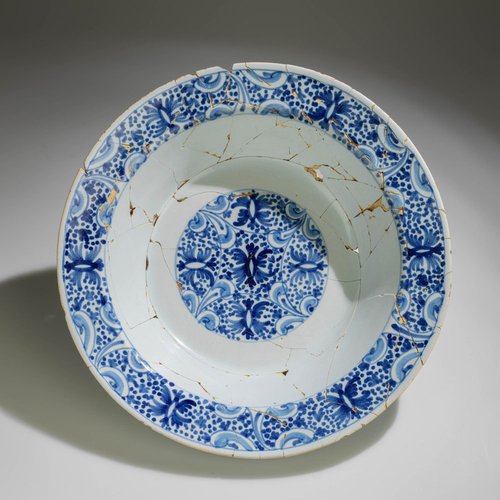
This tin-glazed earthenware basin, circa 1760, was excavated from the Thomas Everard House site. Virginia Royal Gov. Robert Dinwiddie was an investor in the Delftfield Pottery of Scotland where it was produced.
The Campbell Archaeology Center is unique in that it is dedicated solely to archaeology. Among the many highlights:
• An early 18th-century brick foundation viewed through a glass floor — The foundation of a building constructed around the time of the founding of Williamsburg was discovered by Colonial Williamsburg archaeologists and incorporated into the design of the new center.
• Wall of Wonder — A wide variety of more than 80 artifacts found in and around Williamsburg, including wine bottles, ceramics, and other items that show everyday life in 18th-century Williamsburg.
• Follow the ‘Squabbit’ — Is it a squirrel, is it a rabbit? It’s a ‘Squabbit’ (inspired by an artifact) that visitors can follow from lab to lab, helping them learn what happens as an artifact goes from the ground to washing to identification to analysis.
Colonial Williamsburg is the birthplace of historical archaeology, a subfield of archaeology that uses material culture to understand the development of the modern world. Decades of archaeological work in the Historic Area have resulted in one of the world’s largest archaeological collections of 17th-through-early-19th-century artifacts from colonial America. In addition to providing expanded storage facilities to properly steward this collection, the Campbell Archaeology Center includes classrooms, exhibition space, and a public archaeology teaching lab with room for visitors and community members to physically engage with artifacts.
 “Even though Colonial Williamsburg has 100 years of artifacts, nearly 70% of the Historic Area has not been excavated in a modern way, meaning we have so much more to uncover and learn from,” Gary said. “This center enables us to be good stewards of the materials we excavate. What we have here—and will continue to unearth—is a national treasure, and now, we can provide the community with an emotional connection to our shared history.”
The Campbell Archaeology Center is one of the Foundation’s signature projects commemorating America’s 250th anniversary in 2026. The building, designed by the architecture firm of Clark Nexsen, will join several new sites on Nassau Street to help create a major visitor corridor to the Historic Area. The site of the Williamsburg Bray School, one of the earliest institutions dedicated to Black education in North America, opened to the public in 2025, and the African Baptist Meeting House, one of the first Black church congregations in the nation, will be dedicated in October 2026. Nearby, the Custis Square excavation site offers a self-guided tour that explores the life and opulent gardens of plantation owner John Custis IV.
Funding for the Colin G. and Nancy N. Campbell Archaeology Center was provided in part by a lead gift from the late Forrest E. Mars. Jr., former Colonial Williamsburg trustee and longtime donor, who chose the name in honor of the Campbells’ service to the institution. Colin Campbell, a chairman emeritus of The Colonial Williamsburg Foundation who passed away in 2024, served as the organization’s president and CEO from 2000 to 2014, during which time he expanded the Foundation’s educational programs and increased its endowment. Nancy Campbell is chair emerita of the National Trust for Historic Preservation. Together, the couple received The Colonial Williamsburg Foundation’s prestigious Churchill Bell Award in 2014.










leave a comment