The BADA Antiques & Fine Art Fair, March 2015
Press release for this year’s BADA Fair:
The BADA Antiques & Fine Art Fair
Duke of York Square, off Sloane Square, London, 18–24 March 2015

George I period scarlet japanned bureau cabinet, attributed to John Belchier and Daniel Massey, English, ca. 1720.
Long-regarded as the premier national fair in the UK, The BADA Antiques & Fine Art Fair is the leading event for sourcing antiques and fine art of assured quality and authenticity. It is the only event on the international art calendar exclusive to members of the British Antique Dealers’ Association and will see the display of a diverse range of important furniture, objet d’art, and paintings. Before the BADA Fair opens to the public, all these items are subject to a rigorous vetting process. Encompassing both antique and contemporary items, the BADA Fair allows buyers of all tastes and experience to add to their collections. In recent years the BADA Fair has seen a steady growth in international visitors and an increase in sales above £100,000.
Ninety-eight of the most renowned art and antiques dealers from around the country, representing a variety of specialisms, have confirmed their attendance at the BADA Fair. Returning Exhibitors include leading dealers Godson & Coles, Harris Lindsay, Thomas Coulborn & Sons, Lennox Cato, Frank Partridge, Anthony Woodburn Ltd., Trinity House, The Taylor Gallery, Sandra Cronan Ltd., and Holly Johnson Antiques. The demand for stands at the BADA Fair has increased and amongst the new Exhibitors at the upcoming edition are: Beaux Arts London, Philip Mould & Company, Michael Hughes, Peter Lipitch Ltd. and Ted Few.
The exquisite range of jewellery brought by various dealers has always been a highlight at the BADA Fair, and this year is no exception. Amongst the offerings from Sandra Cronan Ltd. is an important pair of diamond ‘waterfall’ earrings dating from c. 1940, each featuring 8 pear cut diamonds, and smaller baguette cut diamonds. New Exhibitor John Joseph will bring a beautiful Art Deco coral and diamond brooch and Anthea A G Antiques will display a bold coral ring in 18 carat gold, made by Kutchinsky and dating from the 1970s.
There are several trends that have emerged amongst the items being submitted by the dealers for the upcoming BADA Fair. These include a rise of European furniture and objects designed in an Oriental style. Godson & Coles, specialist in 18th- and 19th-century furniture, as well as Modern British art, will bring a rare George I period, scarlet japanned bureau cabinet, signed by maker Daniel Massey (pictured). Frank Partridge will devote his entire stand to Chinoiserie items. Another prevalent style in furniture will be fine pieces in English Oak as seen on the stands of Wakelin & Linfield, Witney Antiques and Shaw Edwards Antiques.
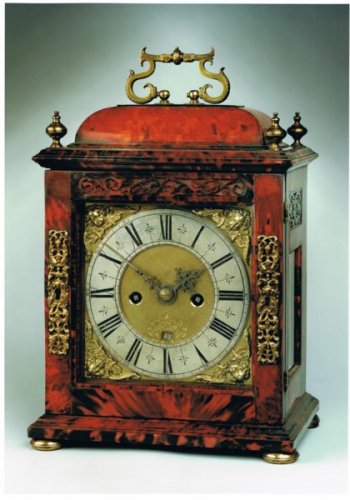
William and Mary turtle shell and gilt table clock, ca.1695
A further notable category is clocks, which are always well represented at the BADA Fair. Anthony Woodburn will bring a magnificent William and Mary turtle shell and gilt table clock dating from c.1695 as well as a remarkably preserved Charles II walnut and marquetry longcase clock. Yet again the fine art at the BADA Fair encompasses some wonderful British examples, ranging from 18th-century watercolours from John Spink and Guy Peppiatt Fine Art, to modern British sculpture including Elisabeth Frink’s Assassins II from Beaux Arts London, and contemporary works by artist Jonathan Pike, to whom Julian Simon Fine Art will devote their stand.
A new development that will benefit collectors is the introduction by the British Antique Dealers’ Association (BADA) of Certificates of Provenance, which members may now choose to include with the sale of an object. This is the first time Certificates of Provenance will have been available for objects sold at the BADA Fair. The Certificates will demonstrate that an object has been bought from a member of the BADA, which will be recorded as part of its permanent provenance.
In order to broaden the audience at the BADA Fair, there are several initiatives to attract new visitors and collectors. One of the most positive has been the Interior Designers’ Selection run by House & Garden. This year four acclaimed interior designers will each choose three highlights amongst the items displayed at the BADA Fair, and their exhibitors will receive a showcard to denote the selected object. Similarly the programme of talks and events will cover themes from cross collecting to Hollywood Style – Jewellery and Fashion from 1929 to 1959, appealing not just to antique aficionados but to a range of people from interior designers to jewellery enthusiasts.
The BADA Fair has a long tradition of supporting charitable causes, and has raised over £3 million for a variety of charities over the years. This year the BADA Fair is delighted to announce The Haven Trust as its beneficiary. The Haven Trust is an award- winning breast cancer charity, offering support and complimentary therapy to patients. The BADA Fair will host a Charity Gala Dinner for The Haven Trust on the evening of Thursday 19th March in the Cellini Restaurant, within the BADA Fair.
Following the success of the catering at last year’s BADA Fair, the upcoming edition will see the return of celebrated caterers Absolute Taste running both the Cellini restaurant and Duke of York Brasserie. World-renowned and family-owned champagne house Taittinger will once more be sponsoring the Champagne Bar.
The Architectural Drawing: From the Document to the Monument
From the press kit for the art fair:
Salon du Dessin 2015
Palais Brongniart, Paris, 25–30 March 2015 / Symposium, 25–26 March 2015
 Created in 1991 by a small group of art dealers, the Salon du dessin is now a leader in its field. A frontrunner for many reasons, the fair possesses all the ingredients of a success story: the exceptional quality of the works selected by the exhibitors, its undeniable commercial dynamism, its capacity to attract the most important collectors and curators from around the world, and its ability to gather together institutions to celebrate drawings. Thanks to its unprecedented position in the art world, the Salon du dessin resolutely pursues its mission, which is to ardently promote the art of drawing. In 2014, 13,000 visitors assembled in the magnificent Palais Brongniart around their shared passion for drawings.
A Showcase for the Drawings of the Bnf
Since its creation in the 17th century the Bibliothèque nationale de france has gathered numerous drawings by renowned architects such as Mansart, Brongniart and Viollet-le-Duc. Gradually enriched throughout the centuries and then inventoried, deciphered and classified, this collection is now ready to be unveiled. The department of Prints and Photographs has selected the most significant sheets, which will be given a preview at the Salon.
The Semaine du Dessin: Uniting Drawing Enthusiasts
From 23rd until 30th March, the most important museums from Paris and its surroundings will open the doors to their graphic art departments, presenting a special display or organising, in conjunction with the Salon, an exhibition on the theme of drawing. In partnership with the City of Paris, more than twenty prestigious institutions will participate in this celebration of drawing in all its forms and from all periods. Among the shows not to be missed is: drawings by the artist Jean Gorin, a native of Nantes and a proponent of neo-plasticism, at the drawings department of the Centre Pompidou; Italian masters from the renaissance from the Städel museum in frankfurt on show at the Custodia Foundation; drawings by the discreet yet prolific painter and decorator Charles Lameire at the musée d’orsay, and the homage given at the musée Carnavalet to “monsieur Barrée, architect and speculator in Enlightenment Paris.”
◊ ◊ ◊ ◊ ◊
International Symposium
The Architectural Drawing: From the Document to the Monument
Le Dessin d’architecture: document ou monument?
Palais Brongniart, Paris, 25–26 March 2015
The Salon has more than a solely commercial dimension. On 25th and 26th March a series of twelve lectures will present the work of a wide range of academics researching the field of architectural drawing. Inaugurated last year under the auspices of Claude Mignot, professor emeritus at the University of Paris Sorbonne, this series of lectures will focus on the topic with a new light: The Architectural Drawing: From the Document to the Monument. The proceedings of the symposium, now a reference, will be published in the fall.
The lectures begin at 2:30pm and conclude at 6:00pm (in the small auditorium). It is free for those visiting the fair, though please note that seating is limited. The fair entrance fee is 15€ and includes a copy of the catalogue.
W E D N E S D A Y , 2 5 M A R C H 2 01 5
Claude Mignot (Professor Emeritus, Paris-Sorbonne University), Introduction
Tim Benton (Professor Emeritus of Art History, the Open University, Milton Keynes), On the Difficult Birth of Le Corbusier’s Project
Guido Beltramini (Director of the Centro Internazionale di Studi di Architettura Andrea Palladio), Freedberg’s Question: On the Beauty of the Drawings by Andrea Palladio
Gordon Higgott (Independent Historian, London), Documenting the Design of St Paul’s Cathedral in Drawings and Engravings: The Contribution of Simon Gribelin (1661–1733)
Olivia Horsfall Turner (Curator, Victoria & Albert Museum), Documenting Monuments: Antiquaries and Architectural Drawing in 17th-Century England.
Jérôme de La Gorce (Senior Researcher at the CNRS), A Little-known Project by Servandoni: The Décor of Fireworks for the Birth of a New Heir to the Throne (1732)
Charles Hind (Chief Curator and H. J. Heinz Curator of Drawings, RIBA British Architectural Library), A Classical or Gothic Monument: Proposals for Reconstructing the Houses of Parliament, 1735–1835
T H U R S D A Y , 2 6 M A R C H 2 0 1 5
Emmanuelle Brugerolles (Chief Curator, ENSBA Paris), From Architecture to Document: The Example of Drawings by Jean-Michel Chevotet for l’Architecture Française by Jean Mariette
Basile Baudez (Associate Professor, History of Modern and Contemporary Heritage, University Paris-Sorbonne), On the Use of Tracing Paper in Late 18th-Century Architecture: A Tool for Conception or Memory of Representations
Jean-Philippe Garric (Professor of History of Contemporary Architecture, University Paris 1 Panthéon-Sorbonne), The Monument to La Pérouse: To Document Labrouste’s Drawing
Marc Le Cœur (Art Historian, Teacher at the Ecole spéciale d’Architecture), Architects’ Drawings in the Print Department of the BnF: An Exceptional Yet Little-known Collection
Magnus Olausson (Head of Collections and Director of the Swedish National Portrait Gallery, Nationalmuseum, Stockholm), The Architect’s Practice in the Nationalmuseum of Stockholm Collections: Between Dream and Reality
Simon Texier (Professor at the Université de Picardie Jules-Verne), The Technical Drawings of the Perret Brothers: A Way towards the Monument
At Sotheby’s | The Collection of Louis Grandchamp des Raux

François Desportes, Hunting Scene with Dogs, Partridges, and Pheasants, a royal commission for the antechamber of Louis XIV’s apartment at Marly in 1702.
◊ ◊ ◊ ◊ ◊
Press release (14 January 2015) from Artcurial:
Collection Louis Grandchamp des Raux: Le choix de l’élégance
Sotheby’s, Paris, 26 March 2015 (Sale #PF1539)
Exhibition Schedule
Sotheby’s, New York, 24–28 January 2015
Artcurial, Brussels, 11 February 2015
Artcurial, Paris, 20–23 March 2015
Sotheby’s, Paris, 24–25 March 2015
Sotheby’s, in association with Artcurial and the Cabinet Eric Turquin, is delighted to present the Louis Grandchamp des Raux collection—the most significant collection of French 17th- and 18th-century paintings to be offered at auction for the last twenty years. The sale will take place at Sotheby’s in Paris on 26 March 2015, after a travelling exhibition in New York and Brussels.
Built up over more than 25 years, this magnificent collection consists of around 50 paintings, mainly from the French and North European schools. It provides an overview of 17th- and 18th-century French painting that is both consistent and refined, with works from the greatest masters of the period, such as François Boucher, Jean-Honoré Fragonard, François Desportes, Louyse Moillon, Anne Vallayer-Coster, and Hubert Robert, together with lesser-known artists like Pierre-Antoine Lemoine and Nicolas-Bernard Lépicié. Louis Grandchamp des Raux poured his passion into the collection, following the advice of specialists in the field, particularly Eric Turquin.
Eric Turquin said: “I met Louis Grandchamp des Raux in the 1980 (…) It was the start of a project that lasted nearly 30 years. He was initially drawn to Dutch and Flemish painting from the first half of the 17th century. Then, as he explored painting with increasing passion, his taste naturally developed—firstly for 17th-century French painting and then for that of the 18th century, whose delicacy and refinement he relished. The great step forward came with the purchase of two major Desportes, some Boucher, and finally some Fragonard—the crowning achievement of his approach as an aesthete and collector. The sale of this collection of paintings is tremendously exciting. It illustrates the many stages of this journey, which is more or less the path I followed myself at the beginning of my career as a specialist.”

Anne Vallayer-Coster, Portrait of a Woman with Violin, 1773.
The collection contains numerous masterpieces, including a Portrait of a Woman with Violin executed in 1773 by Anne Vallayer-Coster, one of the very few women painters who managed to establish herself in a realm still dominated by men (estimate: €300,000–400,000 / $354,000–470,000)*. Singled out by Marie-Antoinette, Vallayer-Coster carved herself out a niche at court, and received numerous still life commissions from the royal family. This painting is a rare example of the few portraits we know by this artist. Clearly influenced by her predecessor, the genius Jean- Siméon Chardin, it evinces an approach to the portrait that is both poetic and psychological. She draws us into the intimate world of the model: a young violinist who has broken off her musical exercises to peruse her score, and seems lost in thought.
Another talented woman painter, and a veritable master in the art of the still life, was Louyse Moillon, who produced Still Life with Peaches on a Pewter Plate at the age of 24 in 1634 (estimate: €400,000–600,000 / $470,000–709,000). She goes right to the heart of the matter, inviting the viewer to contemplate peaches presented very simply, with striking realism. She gives the fruit a leading role, staging them in a subtle play of light and shade in a sober, refined composition. Another painting by the artist is a Still Life with Basket of Bitter Oranges and Pomegranates, which she painted in around 1650 (estimate: €350,000–450,000 / $413,000–530,000). Here she remains faithful to her artistic invention, opting for a simple composition where the treatment of colour is nonetheless very different from the previous work.
A royal commission for the antechamber of Louis XIV’s apartment at Marly in 1702, the triple portrait of the bitches Bonne, Nonne and Ponne (Hunting Scene with Dogs, Partridges, and Pheasants) is incontestably one of François Desportes’ masterpieces (estimate: €250,000–300,000 / $295,000–354,000). In this house where the king sought refuge from court etiquette, the iconographic theme was nature. A particularly accomplished preparatory sketch for the painting, now in the Musée de la Chasse et de la Nature in Paris, this oil on paper is highly appealing with its generous substance, subtle palette and harmonious colours.
The Northern European School
Louis Grandchamp des Raux’s collection really began with some masters of the Northern European school originally belonging to his family. The still life genre, which was extraordinarily popular in France during the 17th century, is illustrated in the collection with some marvellous examples by artists who have always been keenly admired. Still Life with Grapes, Cherries and Strawberry Plant by Isaac Soreau is a composition of considerable refinement (estimate: €150,000–200,000 / $177,000–236,000). Each fruit, treated separately with an acute sense of detail, reveals all the painter’s love for the Flemish tradition initiated by Jacob van Hulsdonck, his master and first source of inspiration. His mastery of the subject, shored up by an unrivalled technique, makes him one of the subtlest painters of still lifes.
Bouquet of Flowers in a Glass by Jan Frans van Dael (estimate: €100,000–150,000 / $119,000–177,000), is an excellent example of the artist’s virtuosity in line with the tradition of flower painting by Northern artists who were particularly esteemed for their precise brushwork and sense of harmony. The work rivals those of the greatest exponents of the genre active in Paris, like Jan van Huysum and Gérard van Spaendonck.
Jacob van Hulsdonck takes the line adopted by his French and Flemish predecessors with a highly classical staging of his Still Life with Peaches, Plums, and Grapes in a Basket on a Table. The colours are appealing, and the fruits have a beautifully appetising bloom. There is no question that the artist demonstrates considerable mastery of his art here (estimate: €250,000–300,000 / $295,000–354,000).
18th-Century Painting
François Boucher raised the genre of pastoral scene, which he reinvented by enlivening it with figures in modern costumes, to the rank of the most noble subjects in the 18th century, particularly through his fine, delicate and subtle brushwork, which can also be full, rich and generous. Pastoral Scene with Washerwomen and a Couple by the Water, which features in this collection, is a model of the artist’s abundant technical skill (estimate: €120,000– 180,000 / $142,000–213,000). His vigorous workmanship is imbued with thick strokes that enhance the poetry of his composition. This attractive pastoral scene reflects all the charm of François Boucher’s work.
During his first stay in Italy between 1756 and 1761, Jean-Honoré Fragonard discovered the scenery around Rome with its landscapes and inhabitants. The Italian countryside with its rocks and waterfalls, luxuriant vegetation and extraordinary light left an indelible impression on the young painter for the rest of his career. The poetry emanating from Italian Landscape with Staircase lies above all in the subtle treatment of light, making play with the rays of sunshine that illuminate the marble statues and white dress of the woman in the foreground, while the parasol pines provide shade to the carefree strollers wandering around in this leafy setting (estimate: €200,000–300,000 / $236,000–354.000).
Classified as a Historic Monument in the 20th century, like all the furniture in the Château de Ferney-Voltaire where it was kept, Joseph Vernet’s Fishermen Departing at Dawn of 1747 offers a picturesque vision of the Italian coast, instantly wafting the viewer to the idealised Italy of the 18th century. Thanks to his meticulous rendering of this atmosphere, Vernet was enormously successful among those who went on the Grand Tour. He earned a glowing reputation in both Italy and France, particularly as from 1746, when he began to participate in the Salon (estimate: €400,000–600,000 / $470,000–709,000).
While allegory was a subject little treated by Nicolas Lancret, the arts of the stage and music were recurring themes in the work of Antoine Watteau’s poetic follower. This exquisite little painting in grisaille is a preparatory version of the frontispiece for the Second Book of Pieces for Harpsichord by François Dandrieu, a brilliant harpsichordist and composer who was appointed organist of the Chapelle du Roi in 1721 (estimate: €100,000–150,000 / $119,000–177,000). This frontispiece was engraved by Charles-Nicolas Cochin in 1728. Lancret also produced the frontispiece for Dandrieu’s Third Book of Pieces for Harpsichord, published in 1734. There are few differences between the preparatory version and the engraving by Cochin, apart from the arms carried by the putto on the right, which are those of France in the composition here and those of the Conti in the engraving, reflecting the dedication of Dandrieu’s work.
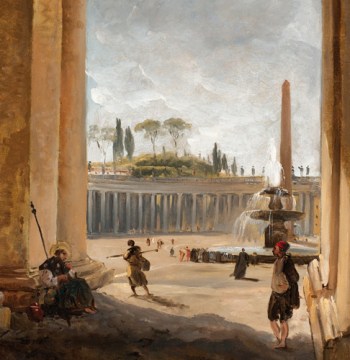
Hubert Robert, View of Saint Peter’s Square in Rome through Bernini’s Colonnade
When it was exhibited at the Salon of 1761, the painting The Village Bride by Jean-Baptiste Greuze, now in the Musée du Louvre, was a considerable success, and all the critics unanimously acclaimed the painter’s genius. The Portrait of a Young Woman in a White Headscarf from the Louis Grandchamp des Raux collection is similar to one of the figures in the centre of the composition (estimate: €80,000– 120,000 / $94,000–142,000). This painting is one of the most speaking examples of the artist’s talent for illustrating the domestic life of his times.
With his View of Saint Peter’s Square in Rome through Bernini’s Colonnade, Hubert Robert gives us a poetic interpretation of this grand esplanade, conveying all the splendour of Rome’s architecture (estimate: €80,000–120,000 / $94,000–142,000). The artist has composed a highly spontaneous view in the treatment of its composition, particularly the figures, depicted with lively, instinctive brush strokes. Nonetheless, the painter remains faithful to the exactness of the scene and shows us Saint Peter’s Square in a highly realistic manner. Combining simplicity with grandeur, the painter evinces a genuine mastery of perspective in this view, drawing the viewer into the scene.
Lesser Known Artists
Louis Grandchamp des Raux had a talent for spotting significant works by artists who were unjustly less well-known. This was the case with the exquisite little portrait of Madame Lagrenée, wife of the painter Louis-Jean- Francois Lagrenée the Elder (1725–1805), by Nicolas-Bernard Lépicié. This delicate picture shows his model immersed in her thoughts, heedless of her book. The refined composition combines a style influenced by Flemish painting with all the delicacy and poetic refinement of a Chardin (estimate: €20,000–30,000 / $24,000–35,000).
The appearance of a work by Pierre-Antoine Lemoine on the market is always a major event. Still Life with Grapes, Peaches and Chinese Vase (estimate: €150,000–200,000 / $177,000–236,000), magnificently succeeds in suggesting the flavours of the fruits shown in the painting, which have a fresh and voluptuous texture. Pierre Antoine Lemoine established himself incontestably as one of the key figures in the history of French still life, proving a worthy heir of Caravaggism, while revealing an individual style and providing a new perspective on this pictorial genre.
* Estimates do not include the buyer’s premium; prices include the hammer price and buyer’s premium.
◊ ◊ ◊ ◊ ◊
Note (added 17 June 2015) — As reported by Art Daily (17 June 2015), Anne Vallayer-Coster’s Portrait of a Woman with Violin was acquired by Sweden’s Nationalmuseum.
Master Drawings New York, 2015

Aert Schouman (Dordrecht 1710–1792 The Hague), A Cockerel Crowing, pencil, pen and ink and watercolour and gum arabic, heightened with white, signed ‘A. Schouman. ad.f’ in pen and brown ink, 171 x 191 mm, Provenance: Lord Fairhaven. Offered by Crispian Riley-Smith Fine Arts Ltd. and on view during Master Drawings New York 2015 at Shepherd / W & K Galleries.
◊ ◊ ◊ ◊ ◊
Press release (26 November 2014) as edited to highlight the eighteenth-century offerings:
Master Drawings New York, 2015
New York, 24–31 January 2015
The 2015 edition of Master Drawings in New York promises to be the best ever. More than thirty of the world’s leading dealers are coming to New York City to offer for sale master art works in pencil, pen and ink, chalk and charcoal, as well as oil on paper sketches and watercolours, created by iconic artists working in the 16th to 21st centuries. Each exhibition is hosted by an expert specialist and many works on offer are newly discovered or have not been seen on the market in decades, if at all.
In addition, Margot Gordon and Crispian Riley-Smith, co-founders of Master Drawings in New York, are delighted to announce that John Marciari, the new head of the Department of Drawings and Prints at the Morgan Library & Museum in New York, will provide the introduction for the 2015 brochure.
Highlights at the 2015 edition include ….
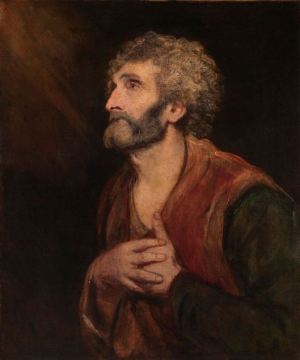
Joshua Reynolds, Dionysius Aeropagites. oil on canvas, 30 x 25 inches, ca. 1772
• A major rediscovered masterpiece by Sir Joshua Reynolds, listed as missing since 1905, and a star attraction at the exhibition of London gallery LOWELL LIBSON LTD. “Dionysius Aeropagites has only been known from an 18th-century engraving,” according to Libson. It depicts Reynolds’s favorite model, a street mender from York, George White. The painting perfectly communicates Reynolds’s ambitions as a history painter shortly after the founding of the Royal Academy.” Painted in emulation of an Italian old master, the powerful head was published shortly after its completion and given the title identifying the sitter as a follower of St. Paul. Libson is also featuring works by William Blake, John Singleton Copley, Thomas Jones, Samuel Palmer, Simeon Solomon and a fascinating group of British portrait drawings of the 1830s and 1840s depicting Queen Victoria, Talleyrand, Chopin and Paganini—plus Sir Thomas Lawrence’s portrait of the Duke of Wellington’s nieces and J.M.W. Turner’s Alpine tour watercolor, The Val d’Aosta.
• A small group of noteworthy David Cox watercolours MARTYN GREGORY is bringing to New York includes a very large one that is completely fresh to the market. Gregory says it is interesting as it is made on several sheets of the ‘Scotch’ paper Cox used later in his career, which he had carefully pieced together to make a much larger sheet. It is a fascinating watercolour which shows Cox working on grand scale, mastering one of his favourite subjects: Betwys-y-Coed in North Wales. Gregory is also showing 18th- and 19th-century British watercolours including Richard Parkes Bonington’s The Ruins of Chateau d’Harcourt near Lillebonne, a pencil and watercolour dating to 1821-22 when Bonington made his first tour of Normandy; a 1793 watercolour by British artist William Alexander showing Chinese Barges of the first British embassy preparing to pass under a bridge, led in 1792-4 by Lord Macartney; and a highly detailed wash drawing, John Hood’s The East Indiaman Essex in Three Positions.
• London specialist STEPHEN ONGPIN FINE ART always manages to acquire new-to-the-market works by the most iconic names in fine art including Edgar Degas, Thomas Gainsborough, Adolph Gottlieb, Paul Klee, Henri Matisse, Edvard Munch, Paul Signac, Alfred Sisley, Wayne Thiebaud, and Odilon Redon. This year’s exhibition won’t disappoint as Ongpin is showing Gainsborough’s Travellers Passing Through A Village, Klee’s Night impression of a Southern Town, Degas’s A Seated Young Woman Plaiting her Hair, Matisse’s Standing Female Nude, Munch’s Rocks on the Edge of a Sea, Paul Signac’s Still Life with a Bowl of Fruit, Wayne Thiebaud’s Ice Cream Cone, and Redon’s A Face in the Window.
• New exhibitor PRPH RARE BOOKS is offering an album of 70 uncensored 16th-century drawings after Michelangelo’s Last Judgment in the Sistine Chapel. The original figures depict genitalia and other ‘lewd’ elements which were later censored and painted over at the Church’s direction. These were generally unknown until the restoration of the work in 1980–84. They are bound in 18th-century calf and were in the collection of Count Leopold Cicognara (1767–1834), the leading Italian art historian of his time. PRPH is also showing a highly important complete set of 50 engraved fortune telling cards (Northern Italy 1465) by the Master of the ‘Mantegna’ Tarocchi—E-series, rebound in 18th-century cartonnato.
• London dealer GUY PEPPIATT brings over wonderful British works including artworks by one of the most important British topographical artists of the late 18th century, Edward Dayes, whose Carlsbrooke Castle Isle of Wight, dating to 1788, is featured at MDNY. Also featured is a William Callow R.W.S. watercolour A Spring Day at Florence from San Miniato, dating to 1882, and Thomas Rowlandson’s pen, ink and watercolour,The Mid-day Rest.
• PIA GALLO is offering a Salvator Rosa (1615–1673) Study for the Figure of Scylla in pen ink and wash that is a study for the painting Glaucus and Scylla at the Brussels Musee des Beaux Arts. The drawing was once owned by Queen Christina of Sweden. Also showing splendid, hand-painted, fan-shaped gouaches with views of the Gulf of Naples that were meant to be folding fans. Fans and hand screens—predominantly as a fashion accessory—became popular in Europe from the seventeenth century onwards. These two individual fans are made from natural vellum, hand-painted by an anonymous artist. The fans here are not folded nor are they mounted and date from probably around 1800. They show Romantic views of the most frequently visited sights in the Bay of Naples by travelers on the Grand Tour. Villa di Pompejo (Villa of Diomedes). Gouache on natural vellum. Veduta del Sepolcro della Sacerdotessa Mammia a Pompejano.
• CRISPIAN RILEY-SMITH of London has titled his exhibition, Flights of Fancy: Birds and Animals by Aert Schouman and his Contemporaries in 18th-century Holland. On view are six Aert Schouman watercolours, including five from the collection of the late Lord Fairhaven, and four watercolours by Abraham Meertens—plus master drawings by Bandini, Benso Hackert, Zuccarelli and Van Goyen.
• MARGOT GORDON FINE ARTS is staging a show titled Five Centuries of Faces and Figures.
• MIA WEINER is showing a selection of important works such as Gaetano Gandolfi’s Studies of Two Angels, preparatory for the flanking angels in the 1780 altarpiece Immaculate Conception in S.M. Lambarun Coeli, Bologna. She also offers a charming red chalk drawing by a student of the Carracci closest in technique to Annibale, drawing a fellow student or perhaps himself as he works from model sheets of facial features made by Agostino. Plus Filippo Lauri’s Allegorical Figures Frolicking in the Flowers in gouache, Jan Van Kessel’s watercolour of Butterfly, Moth, Rose and Spring of Gooseberries, Salvator Rosa’s Study of a River God for The Dream of Aeneas, a study for the same figure in a painting at the Metropolitan Museum. A number of 19th-century landscape oil sketches and watercolours by Northern European and Italian artists such as Carl Friedrich Heinrich Werner’s A Beautiful Water Carrier, which Weiner says is a stunning example of the artist’s work, and Daniel Israel’s large scale Portrait of a Bearded Man, as strong as any German sheet of the period.
• MIREILLE MOSLER is showing artworks spanning five centuries including works by Zacharias Blijhooft, Pieter Holsteyn II, Francois Bonvin, John Constable, Jules Bastien-Lepage, Willem van den Berg, Leo Gestel, Jan Sluyters, Jan Toorop and Jacobus van Looy. The earliest 17th-century drawings exhibited are a group of 15 small animals and insects that once belonged to a larger album in the possession of the Earl of Arundel (1585–1648) known as ‘The Collector Earl’. John Constable’s 1810 ‘En plein air’ East Bergholt depicts the surroundings where he grew up. A Francois Bonvin Study for Le Couvreur tombe dating to 1877 is a recently rediscovered study of a now lost important Salon painting of the same year.
Founded in 2006 as a way to draw upon and buttress the presence of collectors and museum officials during the important January art-buying events, including the Old Master auctions and The Winter Antiques Show, Master Drawings in New York has become an important part of the winter art scene in its own right, attracting the most influential dealers not only in New York but in England, France, Italy, Germany, and Spain who each stage a themed exhibition in more than two dozen Upper East Side galleries between East 63rd and 93rd Streets. Master Drawings in New York has received critical acclaim for orchestrating a showcase for fine art works that cut across the full range of styles, centuries, mediums and genres, and for providing greater accessibility to fine art at price points that range from several thousand dollars to several million.
◊ ◊ ◊ ◊ ◊
Note (added 4 February 2015) — A press release recapping the 2015 event is available here»
The Future of Flaxman’s Adoration of the Magi?

John Flaxman, The Adoration of the Magi,
marble, 9 x 17 inches (228 by 430 mm), ca. 1792–94
◊ ◊ ◊ ◊ ◊
Press release (6 November 2014) from the Arts Council of England:
Culture Minister Ed Vaizey has placed a temporary export bar on a marble relief by John Flaxman, the renowned sculptor who in his youth served as a modeller for Josiah Wedgwood. The sculpture depicts the Adoration of the Magi: the three kings kneeling before the seated Virgin and Child. It will be exported overseas unless money can be found to match the asking price of £800,000.
The rectangular marble slab, carved in low relief, depicts the Virgin seated on the ground holding the Christ child on her lap. Before them kneel the three Magi. The relief panel, of exceptional quality, has been attributed to the renowned British artist John Flaxman. The composition closely corresponds with a slightly larger plaster version by the artist at Sir John Soane’s Museum, as well as two pen, ink and wash drawings, one of which is currently at the British Museum. This remarkable sculpture seems extraordinarily modern, doubtless because of the relative lack of surface ornament, and the simplicity and purity of its composition. It also presents an unusual subject within Flaxman’s oeuvre, in that it is neither a portrait nor a mythological composition, but taken from the New Testament.
The Minister has deferred granting an export licence for the piece following a recommendation by the Reviewing Committee on the Export of Works of Art and Objects of Cultural Interest, (RCEWA) administered by Arts Council England. The Committee made their recommendation on the grounds that the marble relief is of outstanding significance for the study of neo-classical sculpture and Flaxman’s role within its development.
Culture Minister Ed Vaizey said: “John Flaxman was one of the most influential British artists of the early nineteenth century, who worked for Josiah Wedgwood and was held in esteem around the world. This piece is a wonderful example of English neo-classical sculpture and I sincerely hope that efforts can be made to raise funds for a matching offer to keep the painting in the UK.”
Chairman of the RCEWA Sir Hayden Phillips said: “I am sure that many people will find, as I do, that this superbly crafted relief is of such direct and simple beauty that it offers its viewer a scene of compelling charm.”
The decision on the export licence application for the marble relief will be deferred for a period ending at midnight on 5 February 2015. This period may be extended until 5 May 2015 if a serious intention to raise funds to purchase the piece is made at the recommended price of £800,000.
◊ ◊ ◊ ◊ ◊
Note: The relief was exhibited in connection with the display Gainsborough and the Landscape of Refinement (Lowell Libson at Mitchell-Innes & Nash, New York, 24 January — 1 February 2014).
At Auction | Sotheby’s Old Master Week
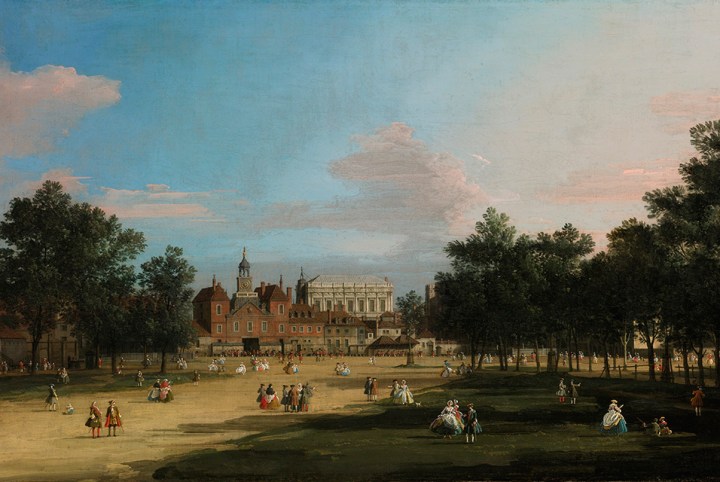
Giovanni Antonio Canal, called Canaletto, London, a View of the Old Horse Guards and Banqueting Hall, Whitehall Seen from St. James’ Park, ca. 1749. Estimate. $4–6 million. Photo: Sotheby’s.
◊ ◊ ◊ ◊ ◊
Press release (16 December 2014). . .
Sotheby’s Sale 9302 | Master Paintings: Part I
New York, 29 January 2015
Sotheby’s January 2015 Old Master Week in New York will feature a select group of highly important paintings assembled by noted collector J. E. Safra (included in Sale 9302). The choice offering of 17 paintings presents a wide range of styles and genres of the period including the Dutch Golden Age, as well as 18th-century Italian and French. The vast majority of the works have been off the market for at least 20 years and together the group is estimated to bring $22–34 million. The paintings will go on public exhibition, alongside Sotheby’s Old Master Week sales, beginning 24 January.
Leading a very strong group of Dutch works to be offered in Sotheby’s January 2015 sales is Frozen River at Sunset, painted by Aert van der Neer in or shortly after 1660, a period that was a high point for Dutch landscape painting and for the artist himself (est. $4–6 million). The work embodies the artist’s fascination with the people and the world around him and most notably the effect of light on a winter landscape and how it can transform the content and mood of a composition.
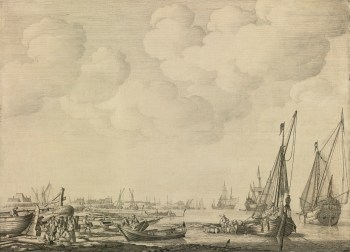
Willem van de Velde the Elder (1611–1693), Dutch Harbor in a Calm with Small Vessels. Lot 32, estimate $2–3 million.
Willem van de Velde the Elder’s Dutch Harbor in a Calm with small Vessels is one of the greatest examples of a penschilderij (pen and ink painting) remaining private hands (est. $2–3 million). Executed in a remarkable combination of pen, ink and brush over a thin layer of lead white, the use of quills of varying sizes and inks in different shades creates a remarkable sense of recession without the loss of any detail, even in the distant buildings of the town beyond.
A Roemer, an Overturned Pewter Jug, Olives and a Half- Peeled Lemon on Pewter Plates is a key work in Pieter Claesz.’s development as a painter of still-life, signaling a new approach to the genre (est. $2–3 million). In this modest ontbijtje (breakfast piece), he abandons the more luxurious displays of his early years in favor of compositions with fewer objects organized around a simple geometric structure and restricts his palette to suit this more muted style.
Among the wonderful Italian works to be offered from Mr. Safra’s collection is an exquisite example of views from Canaletto’s English period: London, A View of the Old Horse Guards and Banqueting Hall, Whitehall seen from St. James’ Park (est. $4–6 million). In May of 1746, Canaletto transferred his studio to London, perhaps in pursuit of fresh challenges. The outbreak of the War of the Austrian Succession in 1740 had discouraged English visitors from undertaking the Grand Tour, and these had made up the majority of Canaletto’s patrons. The painting is presumed to date to 1749, when the old, red brick Horse Guards had been condemned. This perhaps captured the imagination of the artist, compelling him to record the architecture in painted form for posterity.
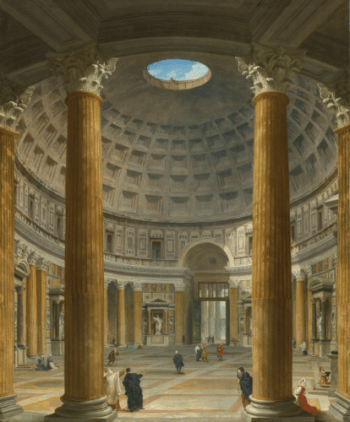
Giovanni Paolo Panini, Rome, The Pantheon, A View of the Interior towards the Piazza della Rotonda, 1732. Lot 91, estimate $3–5 million.
Giovanni Paolo Panini’s Rome, The Pantheon, A View of the Interior towards the Piazza della Rotonda is the earliest dated view of the interior of the Pantheon in Rome by the artist (est. $3–5 million). The work is in fantastic condition and a wonderful snapshot of figures marveling at the spectacular construction around them, in much the same way as they do today. Panini offers us a broad spectrum of the social tapestry of Rome in 1732; the spirited figures include soldiers, clergymen, beggars and other people at prayer, all dwarfed by the ancient Roman temple. As is typical of Panini’s great works, the meticulously observed architecture, particularly the Corinthian capitals, is bathed in the warm and inviting glow of Rome’s afternoon light
Stuart Miniatures by Liotard on Offer at TEFAF 2015
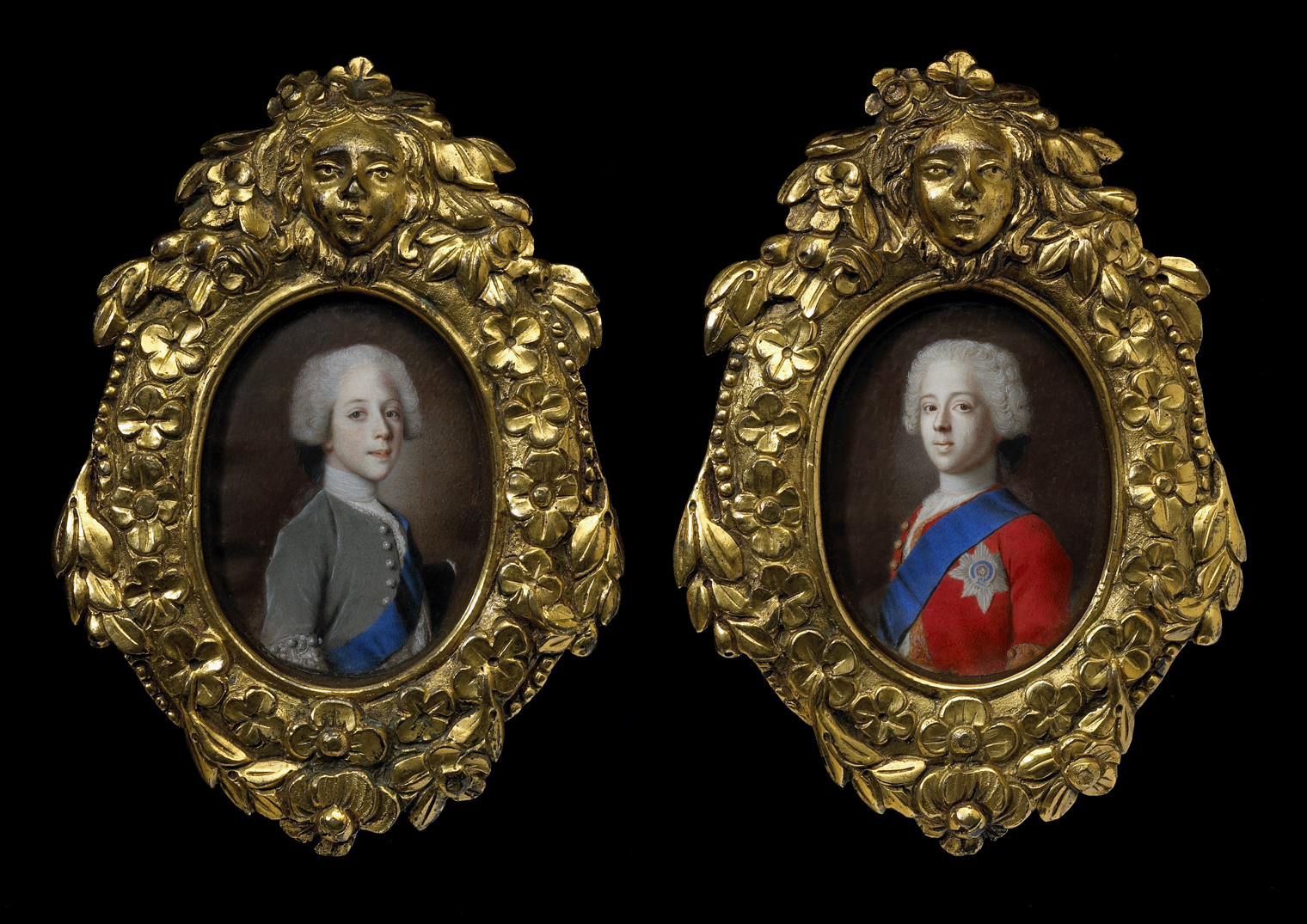
Jean-Étienne Liotard, Prince Henry Benedict Stuart (left) and Prince Charles Edward Stuart (right), ca. 1736–38, watercolour and gouache on vellum, 7.4cm high by 5.5cm wide (excluding frame), €275,000.
◊ ◊ ◊ ◊ ◊
From the press release:
Tomasso Brothers Fine Art at TEFAF
Maastricht, 13–22 March 2015
Recognised as leading dealers in the field of European sculpture, Tomasso Brothers Fine Art also specialises in Old Master paintings and objets d’art. At TEFAF 2015 the gallery unveils an exquisite pair of portrait miniatures by one of the most sought-after masters of the genre Jean-Étienne Liotard (1702–1789), which depict Princes Charles Edward Stuart (1720–1788) and Henry Benedict Stuart (1725–1807), last in the lineage of Stuart Kings in Scotland and England. The asking price for these miniature masterpieces is €275,000.
Born to French parents in Geneva, Jean-Étienne Liotard trained in Paris under the miniaturist and printmaker Jean-Baptiste Massé. While in Rome between 1736 and 1738, Liotard was commissioned by the exiled ‘Old Pretender’ James Edward Stuart (1688–1766) to paint portraits of his young sons Princes Charles and Henry. One of the most romantic figures in British history, celebrated in folklore as Bonnie Prince Charlie, Prince Charles Edward Stuart led the final Jacobite Rebellion of 1745 that was to end in defeat on the battlefield of Culloden.
Powerful and compelling imagery of the Stuart royal family—in the form of portrait miniatures, engravings and prints—was dispatched throughout Europe to garner loyalty and raise funds for the Jacobite cause to re-claim the throne of England. Evidence shows these particular miniatures may have been part of a group of three Stuart portraits sent to Vienna to be seen by Empress Elizabeth, wife of the Holy Roman Emperor Charles VI. A miniature of Prince Charles is also recorded as having been sent to Dorotea, Dowager Duchess of Parma and mother of the Queen of Spain. The attribution has been fully endorsed by Professor Marcel Roethlisberger, author of the definitive 2008 monograph on Jean-Étienne Liotard in which they are illustrated.
Dino Tomasso, one of the Directors of the gallery, comments: “We are delighted to be exhibiting two masterpieces by the highly esteemed Jean-Etienne Liotard. This exquisite pair of miniatures is unrivalled amongst Liotard’s Stuart portraits in terms of their quality, and the fact that they are executed on vellum strongly suggests that they were his primary portraits of the young princes.”
Based at Bardon Hall, Leeds, Tomasso Brothers Fine Art was established in 1993. A second gallery was opened in St. James’s, London in 2013. Dino and Raffaello are recognised internationally for specialising in important European sculpture from the early Renaissance to the Neoclassical periods, with particular expertise in European Renaissance bronzes, along with an in-depth knowledge of Old Master paintings and objets d’art. They have promoted and supported, through loans and exhibitions, major international institutions and were one of the sponsors of the landmark show Bronze at the Royal Academy of Arts, London, 2012. Significant sales have been made to some of the world’s most prestigious museums, including the Bode Museum, Berlin; The Liechtenstein Collection and the Kunsthistorisches Museum, Vienna; the Metropolitan Museum of Art, New York; the Yale Center for British Art, New Haven; and the Art Institute of Chicago.
Provenance
Possibly James Francis Edward Stuart, Palazzo Muti, Rome: whence Empress Elizabeth Christine of Brunswick-Wolfenbüttel, wife of the Holy Roman Emperor Charles VI, Vienna, by 1738.
Sir Alfred Chester Beatty, Clonmannon, Ashfrod, Co. Wicklow, Ireland, by 1968.
Private Collection, England.
Published
Marcel Roethlisberger and Renee Loché, Liotard: Catalogue Sources et Correspondance (Davaco 2008), Volume 1, pp. 257–58; Volume 2, cat. 46 & 49.
Related Literature
Edward Corp, The King over the Water: Portraits of the Stuarts in Exile after 1689 (National Galleries of Scotland, 2001), p.73
Additional information is available here»
At Auction | Un Moment de Perfection: Furniture & Paintings

One of a pair of Italian walnut commodes, ca. 1784–85, designed and mounted by Luigi Valadier. Estimate: £600,000–1 million (Lot 30; click here for additional images and audio description).
◊ ◊ ◊ ◊ ◊
Press release (26 November 2014) from Christie’s:
Un Moment de Perfection: An Important Private Collection of French
18th-Century Furniture and Old Master Paintings, Sale 10199
Christie’s, London, 3 December 2014
 Christie’s will present a superb collection of French paintings and decorative arts in Un Moment de Perfection: An Important Private Collection of French 18th-Century Furniture and Old Master Paintings on 3 December 2014 [Sale 10199]. Formed by an erudite and sophisticated collector of both French and Spanish origins, the quality and breadth of this collection demonstrate the distinguished gentleman’s deep understanding of art and history, which developed and matured through endless curiosity, extensive travels and friendships formed in the art world. Comprising 83 lots, the wide array of important treasures include a pair of Italian walnut commodes designed and mounted by Luigi Valadier (estimate: £600,000–1 million); a pair of impressive ormolu candelabra attributed to the ciseleur-doreur Pierre Gouthière (estimate: £350,000–500,000); and a pair of capricci of Rome by Hubert Robert depicting the Forum with the Temple of Antoninus and Faustina and the Temple of Saturn (estimate: £200,000–400,000). The sale offers new and established collectors the opportunity to acquire works of exceptional quality from this magnificent group. The collection will be available to view from Friday 28 November at Christie’s King Street.
European Furniture
The sale is led by an elegant pair of Italian walnut commodes, circa 1784–85, designed and mounted by Luigi Valadier (estimate: £600,000–1 million) which corresponds almost exactly to a pair of commodes in a drawing from the workshop of Luigi Valadier which, along with other papers, is now in the Pinacoteca Civica. Other notable pieces of European furniture include a late Louis XV ormolu-mounted tulipwood, amaranth and fruitwood marquetry commode by Pierre-Antoine Foullet, circa 1770–75, which belongs to a group of case furniture stamped or attributed to Pierre-Antoine Foullet, all of which share the distinctive neo-classical oval frame mounts and Transitional form of this commode (estimate: £70,000–100,000); a French pale-grey painted and parcel-gilt cast-iron centre table from the second quarter of the 19th century (estimate: £15,000–25,000); and a French ormolu and gilt-varnished metal gueridon, attributed to Maison Jansen, late 19th century, in the manner of Adam Weisweiler (estimate: £6,000–9,000). Regarded as one of the most prominent interior decorating companies of the 20th century, Maison Jansen, founded in 1880 also designed and made furnishings for the interiors they conceived, the designs for which ranged from a revival of Louis XV, XVI and Empire styles to modern taste, creating a dialogue between the historical and the contemporary. Some of the firm’s most important commissions were for the Duke and Duchess of Windsor’s residence in Paris, the White House for Jacqueline and John F. Kennedy and the March family residences in Spain.
European Objects
Formerly in the collection of Archibald Philip Primrose, 5th Earl of Rosebery (1847–1929) at Mentmore Towers, a magnificent pair of candelabra attributed to the celebrated ciseleur-doreur Pierre Gouthière, may be regarded as one of the most accomplished models executed in the ‘goût à l’Etrusque’ (estimate: £350,000–500,000). They are thought to be after a design by Jean-Demosthène Dugourc, made by Gouthière and supplied by the celebrated marchand-mercier Dominique Daguerre who collaborated closely with Gouthière on various important commissions. Further highlights range from a pair of Louis XVI ormolu-mounted Sèvres ‘beau bleu’ porcelain vases, the mounts attributed to Pierre-Philippe Thomire, circa 1785, which were also almost certainly supplied by Dominique Daguerre (estimate: £200,000–300,000); to a pair of restoration ormolu-mounted porphyry and blued-steel brûle parfums, circa 1820-30, after the model by Mathew Boulton (estimate: £30,000–50,000); a Louis XVI oval marble bas-relief of a vestal virgin, attributed to Louis-Simon Boizot, circa 1777, which is almost certainly the marble bas-relief depicting Une Vestale that Boizot exhibited in the Paris Salon of 1777 (estimate: £8,000–12,000).

Old Master Paintings
Leading the offering of Old Master paintings is one of the top lots of the sale, a pair of capricci of Rome by Hubert Robert depicting the Forum with the Temple of Antoninus and Faustina and the Temple of Saturn (estimate: £200,000–400,000, Lot 36). In the collection of HRH The Duchess of Kent at Derby House between 1940 and 1947, this pair of views are a vibrant demonstration of Robert’s fascination with the ancient world and of the palpable influence of Giovanni Paolo Panini. Other key works include a striking portrait of Don Lourenço José Xavier de Lima, 1st Count of Mafra by Louis Gauffier’s a beautifully preserved example of the artist’s small full-length portraiture, the genre that dominated his oeuvre until his death in 1801 and for which he would ultimately be most celebrated (estimate: £150,000–250,000).
19th-Century Paintings
A three-quarter length Portrait of Empress Alexandra Feodorovna of Russia, née Princess Charlotte of Prussia by Scottish born Christina Robertson is likely to be of particular Russian interest (estimate: £ 30,000–50,000). Robertson travelled to St Petersburg in 1839 to paint the Empress and the Imperial Court, and became her favoured court artist, painting a number of portraits of her. She returned again in 1849 where she remained until her death in 1854. The largest concentration of her work is in the collection of the Hermitage Museum. Amongst her distinguished patrons were the Duke and Duchess of Northumberland, Lord Powerscourt, and influential European families including the Rothschilds and Pototskis. Lady with a fan by Roberto Bompiani was exhibited at the Esposizione di Belle Arti in Turin in 1880 where it was highly praised (estimate: £30,000–50,000). Nicknamed ‘the Italian Bouguereau’, for his pictures of religious and mythological subjects which were evocative of the great French Academic artist, Bompiani was also known as a history and portrait painter who frequently represented members of the Italian aristocracy, such as the Borghese family.
Exhibition | Out of the Ordinary: Living with Chinese Export Porcelain
From Jorge Welsh:
Out of the Ordinary: Living with Chinese Export Porcelain
Jorge Welsh, London, 1–8 November 2014
Jorge Welsh, Lisbon, 14 November — 6 December 2014
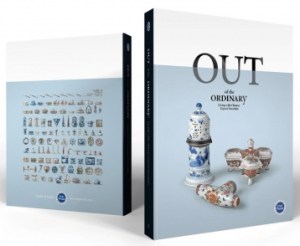 The exhibition Out of the Ordinary: Living with Chinese Export Porcelain will take place at the newly refurbished London gallery from the 1st of November, coinciding with the late night opening of Asian Art in London. The exhibition then travels to our Lisbon gallery, where it will be on view from the 14th of November until the 6th of December.
The exhibition and catalogue will focus on the most unusual forms of Chinese export porcelain produced in the late 17th and 18th centuries. Truly out of the ordinary, most of these items were copied from Western prototypes made in metal, wood, ceramics or glass. Jorge Welsh will present more than 100 objects including egg cups, strainers, cutlery handles, pudding moulds, custard pots, ladles, funnels, bulb pots, snuff boxes, cane handles, barber’s bowls and chamber pots, amongst others. Commissioned according to the latest fashions, they provide an insight into the scope of the European orders and the sophistication of contemporary consumer society in Europe at this time.
Out of the Ordinary: Living with Chinese Export Porcelain (London: Jorge Welsh Books, 2014), 344 pages, ISBN 978-0957354715, £100.
Exhibition | The Sparkling Soul of Terracotta
Press release (distributed by Cawdell Douglas), via Art Daily (the particularly handsome 124-page catalogue is available for free download as PDF file here).
The Sparkling Soul of Terracotta: 16th to 19th Centuries
Caiati & Gallo Gallery, Milan, 9 October – 8 November 2014
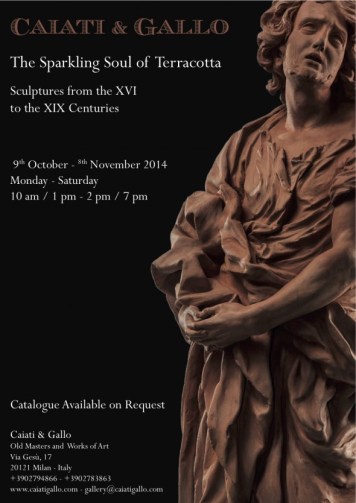 Caiati & Gallo Gallery is paying tribute to terracotta with an important exhibition entitled The Sparkling Soul of Terracotta: Exploring the Vibrant Intensity of Sculpture from the 16th to 19th Centuries. The exhibition centres around fifteen works of art which represent the peak of their particular era. These important works have been tracked down through extensive research and collaboration by a team of leading scholars. Each piece has been selected for its unique contribution to the history of art.
One of the most touching examples is the late-baroque Lombard group of Jupiter and Semele by the Milanese sculptor Carlo Francesco Mellone. It represents Jupiter meeting his lover Semele, who has a small cherub at her side. A second cherub who has since lost both arms completes the scene. The figures rest on a rectangular base, possibly alluding to the bed in which their adultery was committed. Mellone’s figures are light and full of movement. Semele’s facial features are typical of the sculptor’s work: the delicate oval shape, small mouth and large eyelids exemplify a style repeated in numerous
other works.
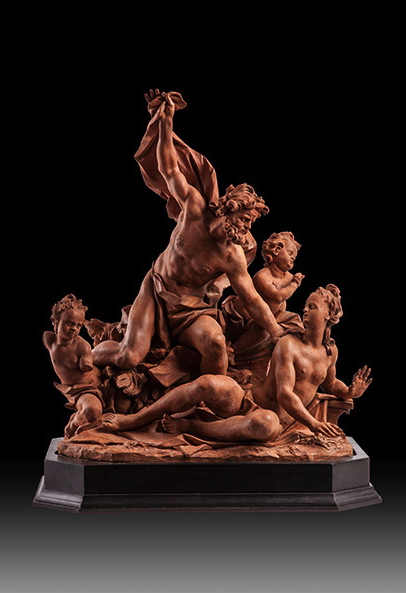
Carlo Francesco Mellone (1670–before 1756), Jupiter and Semele, terracotta, 12 x 16 x 8 inches.
René Frémin (1672–1744), Allegory of America. This statue is of a girl crowned by a full head of feathers in a long dress, her legs covered in a short irregularly-shaped tunic. The delicacy of her affected gestures, her flowing drapes and the square base bring to mind the gardens of the Royal Palace at La Granja of Sant’ Ildefonso, the summer residence of the King of Spain. This enables us to place the statue within the works of Frémin since he was responsible for the decoration of the palace from 1721 onwards. He was Louis XIV’s favourite sculptor and entered the French Academy in 1696.
Ignazio (1724–1793) and Filippo Collino (1737–1800), Pair of statues. Defence of Glory and Strength by the two brothers who were among the most important sculptors in Piedmont in the second half of the eighteenth century. Defence of Glory. This light, standing female figure is particularly refined. Her beautiful features are highlighted by her full head of hair gathered behind her neck. Great emphasis is given to her lithe body that is accentuated by a dress which mischievously clings to her body. A soft cloak with folds and pleats hangs down to her feet. The presence of a sword and a laurel branch with berries held between the woman’s fingers suggests the figure is an allegorical personification of the Defence of Glory. Strength. The figure in this work holds a baton in her hands with an oval shield bearing a relief of a lion attacking a wild boar. The woman’s features are drawn from the classical model of female beauty. Created as part of a pair with the Defence of Glory, the work is both refined and cultivated in terms of style, bearing considerable similarity to the French Rococo, late-baroque Roman and Tuscan classicism and the eclectic styles of mid eighteenth-century Venetian sculpture.
Jean Del Cour (1627–1707), Saint John. The most important Flemish sculptor of his time, Del Cour sculpted in marble, bronze, and wood. He was influenced by French and Flemish styles as well as by Bernini who he had met and visited in Rome during one of his long stays in the Eternal City. Del Cour’s Bernini-esque interpretations were both brilliant and original thanks to his ability to present the modernity of his epoch and thus translate passion, love, sensuality, and mysticism into dynamism, strength, and elegance.
Antonio Begarelli (Modena 1499–1565) Saint with Book (Saint Justine?). Little is known of the life of Begarelli before 1522, when, as a young man (in those days, under twenty-five was considered very young), he burst onto Modena’s artistic scene. Without receiving any commission, he undertook a large statue in terracotta, the Madonna di Piazza that he offered for free to the city. Today, it is kept at Modena’s Museo Civico. The statue was hugely popular and eventually earned him the position of Modena’s official artist.
Antonio Calegari (Brescia 1699–1777) Madonna with Child. Having trained with his father, Sante, Calegari drew from the seafaring traditions of Venice and exploited the dynamism, chiaroscuro, and vivacity that characterised his better works. In later years, his work enjoyed brilliant Rococo influences in perfect harmony with the latest styles in Venice and, above all, the work of Giambattista Tiepolo. It is to this last phase, from the mid-1750s to the early-1760s, that this work belongs.
Guido Reni, (Bologna 1575–1642) from a model of the Bust of Seneca. This dynamic terracotta sculpture of the ancient philosopher has been perfectly conserved, so that the exceptional modelling of the clay is still in evidence. It can be compared to at least seven versions in terracotta, bronze, plaster, and stone, all of which are replicas of Reni’s Seneca. According to Carlo Cesare Malvasia, the original was a terracotta relief head. In his thorough biography of Reni, contained in his celebrated work Felsina Pittrice (1678), Malvasia exalts Reni as the quintessential artist of seventeenth-century Bologna. Of the sculpted copies now known of the powerful head, only the two terracotta versions and this unseen work, could truly claim attribution to the master.
Lorenzo Sarti ( ?) (documented in Emilia and Veneto from 1722 to 1747) The Trinity with the Guardian Angel and Saints Filippo Benizzi, Francesco da Paola, Filippo Neri and Carlo Borromeo and The Blessed Virgin between Saint Caterina d’Alessandria and Christ carrying the Cross, with Saints Augustine, Domenic and Thomas Aquinas. Having undergone recent restoration, these two important terracotta high reliefs demonstrate all the depth and detail of their original modelling. Though the provenance and collection histories are unknown, examination suggests that they are from a school which originated within the walls of Bologna. This school was formed under the aegis of Giuseppe Maria Mazza and was then led by his pupil Angelo Gabriello Pi . Sarti was one of his best pupils. The two rectangular reliefs which should be regarded as pendants, are of very similar dimensions and format. The compositions both have a pyramidal form, with the holy groups placed at the apex. The lower part is an ordered and symmetrical arrangement of saints who appear in hierachical order.










 Enfilade
leave a comment