Exhibition | Samurai: Armor from the Barbier-Mueller Collection
Touring since 2011 when it opened in Paris, the exhibition opens this November in Bern—its twelfth venue. Writing about the collection in 2017 for Apollo, Susan Moore noted that it then had been seen by 1.3million visitors.
Samurai: Armor from The Ann and Gabriel Barbier-Mueller Collection
Musée du quai Branly – Jacques Chirac, Paris, 8 November 2011 — 29 January 2012
Musée de la civilisation, Québec City, 4 April 2012 — 17 February 2013
Museum of Fine Arts, Boston, 14 April — 4 August 2013
Portland Art Museum, 5 October 2013 — 12 January 2014
Kimbell Art Museum, Fort Worth, 16 February — 17 August 2014
Los Angeles County Museum of Art, 19 October 2014 — 1 February 2015
Centro Cultural La Moneda, Santiago, 13 October 2015 — 8 February 2016
Denver Art Museum, 6 March — 5 June 2016
Phoenix Art Museum, 1 March — 16 July 2017
Bellagio Gallery of Fine Arts, Las Vegas, 3 November 2017 — 29 April 2018
Kunsthalle München, Munich, 1 February — 30 June 2019
Bernisches Historisches Museum, Bern, 4 November 2021 — 5 June 2022
Visitors are immersed in the multifaceted history and culture of the Japanese samurai. The exhibition presents spectacular armour, helmets, and masks from the renowned private collection of Ann and Gabriel Barbier-Mueller, along with priceless weapons from the collection of the Bernisches Historisches Museum. In addition to the familiar figure of the mythical fighter, the samurai manifest themselves as civil servants and scholars whose aesthetics, philosophy, and values endure to the present day.
J. Gabriel-Mueller, ed., with essays by Morihiro Ogawa, John Stevenson, Sachiko Hori, Stephen Turnbull, John Anderson, Ian Bottomely, Thom Richardson, Gregory Irvine, and Eric Meulien, catalogue text by Bernard Fournier-Bourdier, Art of Armor: Samurai Armor from the Ann and Gabriel Barbier-Mueller Collection (New Haven: Yale University Press, 2011), 360 pages, ISBN: 978-0300176360, $65.
 This extraordinary publication presents, for the first time, the samurai armor collection of the Ann and Gabriel Barbier-Mueller Museum in Dallas. The Barbier-Mueller has selectively amassed these pieces of armor over the past twenty-five years, ultimately forming one of the largest and most important collections of its kind in the world. It is composed of nearly three hundred objects, several of which are considered masterpieces, including suits of armor, helmets, masks, horse armor, and weaponry. The objects date from the 12th to the 19th century, with a particularly strong focus on Edo-period armor. Offering an exciting look into the world of the samurai warrior, the book begins with an introduction by Morihiro Ogawa. Essays by prominent scholars in the field highlight topics such as the phenomenon of the warrior in Japan, the development of the samurai helmet, castle architecture, women in samurai culture, and Japanese horse armor. The book’s final section consists of an extensive catalogue of objects, concentrating on 120 significant works in the collection. Lavishly illustrated in full color, each object is accompanied by an entry written by a scholar of Japanese armor.
L. John Anderson is an independent scholar and collector of samurai armor. Sachiko Hori is vice president of Sotheby’s Japanese Works of Art department in New York. Morihiro Ogawa is special consultant for Japanese arms and armor in the Department of Arms and Armor at The Metropolitan Museum of Art. Thom Richardson is keeper of armour and Oriental collections at the Royal Armouries in Leeds. John Stevenson is lecturer on Japanese art and history at the University of Washington. Stephen Turnbull is visiting lecturer in South East Asian religious studies at the University of Leeds.
Exhibition | 1821: Before and After

Kozis Desyllas, Portrait of Athanasios Diakos, detail, ca. 1870
(Athens: Benaki Museum)
◊ ◊ ◊ ◊ ◊
Now on view at the Benaki Museum:
1821: Before and After
Benaki Museum, Athens, 3 March — 7 November 2021
Curated by Maria Dimitriadou and Tassos Sakellaropoulos
The Benaki Museum—in cooperation with the Bank of Greece, the National Bank of Greece, and Alpha Bank—presents a major anniversary exhibition to celebrate the bicentenary of the pivotal year in modern Greek history, 1821, the year when the revolution which resulted in the country’s independence was declared. 1200 objects unfold more than a century of history, from the 1770 ‘Orlov Revolt’ until the 1880s.

Map of Greece, late 17th or early 18th century, tempera on wood (Athens: Benaki Museum)
Paintings, sculpture, personal items belonging to key revolutionaries, historic documents, and heirlooms are arranged in three sections. The first part (1770–1821) brings to life the progress towards a national revolution. Section two (1821–1831) showcases the events of the War of Independence and its conclusion, and section three (1831–1870) addresses the creation of the modern Greek state and its development during its first half-century.
The show presents objects held in the collections of the three banks and the Benaki Museum, itself a rich repository created on bonds of trust with the families of those who held centre-stage in the Greek Revolution. Loans have also been secured from important museums and private collections in Greece, France, and the United Kingdom.
The exhibition is included in the National Program of Bicentennial Celebrations coordinated by the ‘Greece 2021’ Committee.
An online preview is available here»
Maria Dimitriadou and Tassos Sakellaropoulos, eds., 1821 Πριν και Μετά / 1821 Before and After (Athens: Benaki Museum, 2021), 1218 pages, ISBN: 978-9604762828 (Greek) / ISBN: 978-964762835 (English), 45€.
 More than 1200 objects gathered in the exhibition and spread across the 1218 pages of the accompanying catalogue showcase one hundred years of modern Greek history, between 1770 and 1870. The period begins with the moral and economic preparations for the liberation of the Greeks, reaches an apex with the 1821 Revolution, and concludes with the first decades of the operation and development of the new Greek state. The catalogue offer a fascinating journey of history and art, revealing why this adventurous century remains so deeply engaging, even now. These works create a meaningful assemblage that traces the enchanting story of modern Greeks and brings to the fore the reasons of their very existence, their perseverance, and how far they have travelled: all the positive elements that have shaped modern Hellenism.
Copies are available here»
New Book | Sculpture Collections in Europe and the United States
From Brill:
Malcolm Baker and Inge Reist, eds., Sculpture Collections in Europe and the United States, 1500–1930: Variety and Ambiguity (Leiden: Brill, 2021), ISBN: 978-9004458468, €62 / $75.
 Exploring the variety of forms taken by collections of sculpture, this volume presents new research by twelve internationally recognized scholars. The essays delve into the motivations of different collectors, the modes of display, and the aesthetics of viewing sculpture, bringing to light much new archival material. The book underscores the ambiguous nature of sculpture collections, variously understood as decorative components of interiors or gardens, as objects of desire in cabinets of curiosity, or as autonomous works of art in private and public collections. Emphasizing the collections and the ways in which these were viewed and described, this book addresses a significant but neglected aspect of art collecting and contributes to the literature on this branch of art and cultural history.
This book evolved from the symposium Sculpture Collecting and Display, 1600–2000, organized by the Center for the History of Collecting and held at The Frick Collection, 19–20 May 2017. The book and symposium were made possible through the generous support of the Robert H. Smith Family Foundation. The book is published in association with The Frick Collection.
Malcolm Baker is Distinguished Professor Emeritus of Art History, University of California, Riverside. As both a curator and a university teacher, he has written widely on the history of sculpture; his most recent book is The Marble Index: Roubiliac and Sculptural Portraiture in Eighteenth-Century Britain.
Inge Jackson Reist is Founding Director (now Emerita) of the Center for the History of Collecting, The Frick Collection. Reist’s edited and authored publications focus on Italian Renaissance and Baroque art and the history of art collecting.
C O N T E N T S
Foreword by Malcolm Baker and Inge Reist
Illustrations
Contributors
Malcolm Baker, Variety and Ambiguity: What Do We Mean by a ‘Sculpture Collection’?
Part 1. Sculpture in the Kunstkammer: Contexts, Formation, and Dispersal
1 Thomas DaCosta Kaufmann, Sculpture Collecting and the Kunstkammer
2 Jeremy Warren, The Collecting of Small Bronze Sculptures in Late Renaissance Italy: The Canonici Collection
3 Malcolm Baker, Shifting Perceptions and Changing Frameworks: The Case of Francis van Bossuit and the Place of Small-Scale Sculpture in Ivory in the Sculpture Collection
Part 2. Garden Sculptures as Collections
4 Julius Bryant, Gentlemen Prefer Bronze: Garden Sculpture and Sculpture Gardens in Britain, 1720–1860
5 Betsy Rosasco, The Sculpture Gardens of Versailles, Marly, and Dresden: Magnificence and Its Limits
Part 3. The Sculpture Gallery and Dedicated Spaces for Sculpture
6 Anne-Lise Desmas, The ‘Gallerie du S.r Girardon Sculpteur Ordinaire du Roy’
7 Michael Yonan, Porcelain as Sculpture: Medium, Materiality, and the Categories of Eighteenth-Century Collecting
8 Alison Yarrington, Art and Nature: The Country House Sculpture Gallery in the Post-Napoleonic Period
Part 4. The Changing Place of Sculpture in the Public Museum
9 Alex Potts, The Public Art Gallery as Arena for Modern Sculpture
10 Andrew McClellan and Marietta Cambareri, Displaying Deceit: Alceo Dossena’s Tomb of Maria Catharina Sabello at the Museum of Fine Arts, Boston
11 Alan Phipps Darr, The Legacy of William Valentiner in Shaping the Display and Collecting of European Sculpture in American Museums, 1900–Present: Case Studies
Bibliography
Index
New Book | Men on Horseback
From Macmillan:
David A. Bell, Men on Horseback: The Power of Charisma in the Age of Revolution (New York: Farrar, Straus and Giroux, 2020), 352 pages, ISBN: 978-0374207922, $30.
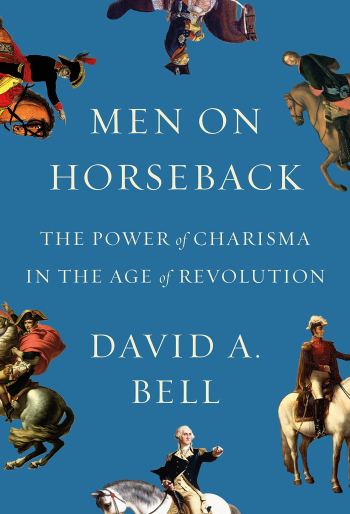 An immersive examination of why the age of democratic revolutions was also a time of hero worship and strongmen
In Men on Horseback, the Princeton University historian David A. Bell offers a dramatic new interpretation of modern politics, arguing that the history of democracy is inextricable from the history of charisma, its shadow self.
Bell begins with Corsica’s Pasquale Paoli, an icon of republican virtue whose exploits were once renowned throughout the Atlantic World. Paoli would become a signal influence in both George Washington’s America and Napoleon Bonaparte’s France. In turn, Bonaparte would exalt Washington even as he fashioned an entirely different form of leadership. In the same period, Toussaint Louverture sought to make French Revolutionary ideals of freedom and equality a reality for the formerly enslaved people of what would become Haiti, only to be betrayed by Napoleon himself. Simon Bolivar witnessed the coronation of Napoleon and later sought refuge in newly independent Haiti as he fought to liberate Latin America from Spanish rule. Tracing these stories and their interconnections, Bell weaves a spellbinding tale of power and its ability to mesmerize.
Ultimately, Bell tells the crucial and neglected story of how political leadership was reinvented for a revolutionary world that wanted to do without kings and queens. If leaders no longer rule by divine right, what underlies their authority? Military valor? The consent of the people? Their own Godlike qualities? Bell’s subjects all struggled with this question, learning from each other’s example as they did so. They were men on horseback who sought to be men of the people―as Bell shows, modern democracy, militarism, and the cult of the strongman all emerged together.
Today, with democracy’s appeal and durability under threat around the world, Bell’s account of its dark twin is timely and revelatory. For all its dangers, charisma cannot be dispensed with; in the end, Bell offers a stirring injunction to reimagine it as an animating force for good in the politics of our time.
David A. Bell is the Sidney and Ruth Lapidus Professor in the Era of North Atlantic Revolutions at Princeton University and the author of several previous books, among them The First Total War and Shadows of Revolution.
New Book | Letters to Camondo
From Macmillan:
Edmund de Waal, Letters to Camondo (New York: Farrar, Straus and Giroux, 2021), 192 pages, ISBN: 978-0374603489, $28.
 A tragic family history told in a collection of imaginary letters to a famed collector, Moise de Camondo
Letters to Camondo is a collection of imaginary letters from Edmund de Waal to Moise de Camondo (1860–1935), the banker and art collector who created a spectacular house in Paris, now the Musée Nissim de Camondo, and filled it with the greatest private collection of French eighteenth-century art.
The Camondos were a Jewish family from Constantinople, ‘the Rothschilds of the East’, who made their home in Paris in the 1870s and became philanthropists, art collectors, and fixtures of Belle Époque high society, as well as being targets of antisemitism—much like de Waal’s relations, the Ephrussi family, to whom they were connected. Moise de Camondo created a spectacular house and filled it with art for his son, Nissim; after Nissim was killed in the First World War, the house was bequeathed to the French state. Eventually, the Camondos were murdered by the Nazis.
After de Waal, one of the world’s great ceramic artists, was invited to make an exhibition in the Camondo house, he began to write letters to Moise de Camondo. These fifty letters are deeply personal reflections on assimilation, melancholy, family, art, the vicissitudes of history, and the value of memory.
Edmund de Waal is an artist who has exhibited in museums and galleries around the world. His bestselling memoir, The Hare with Amber Eyes, has won many prizes and has been translated into twenty-nine languages. The White Road, a journey into the history of porcelain, was published in 2015. He lives in London with his family.
New Book | The House of Fragile Things
From Yale UP:
James McAuley, The House of Fragile Things: Jewish Art Collectors and the Fall of France (New Haven: Yale University Press, 2021), 320 pages, ISBN: 978-0300233377, $30.
 In the dramatic years between 1870 and the end of World War II, a number of prominent French Jews—pillars of an embattled community—invested their fortunes in France’s cultural artifacts, sacrificed their sons to the country’s army, and were ultimately rewarded by seeing their collections plundered and their families deported to Nazi concentration camps.
In this rich, evocative account, James McAuley explores the central role that art and material culture played in the assimilation and identity of French Jews in the fin-de-siècle. Weaving together narratives of various figures, some familiar from the works of Marcel Proust and the diaries of Jules and Edmond Goncourt—the Camondos, the Rothschilds, the Ephrussis, the Cahens d’Anvers—McAuley shows how Jewish art collectors contended with a powerful strain of anti-Semitism: they were often accused of ‘invading’ France’s cultural patrimony. The collections these families left behind—many ultimately donated to the French state—were their response, tragic attempts to celebrate a nation that later betrayed them.
James McAuley is the Paris correspondent for The Washington Post and a contributor to The New York Review of Books. He recently received his doctorate in French history at Oxford.
Exhibition | Vivre à l’antique: From Marie-Antoinette to Napoléon
The catalogue for the exhibition is published by Éditions Monelle Hayot:
Vivre à l’antique: de Marie-Antoinette à Napoléon 1er
Château de Rambouillet, 19 June — 9 August 2021
Curated by Gabriel Wick
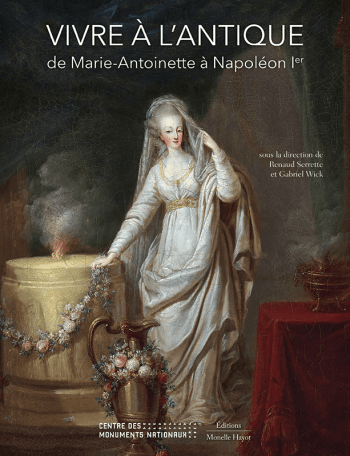 In the last three decades of the 18th century, the elites of Europe were enthralled by the constant flow of discoveries issuing forth from the excavations of buried cities, Etruscan tombs, and imperial villas in Italy. The distant past suddenly surged into the present, and architecture, furniture, and the accessories of daily life were re-imagined in its image. Nowhere in France could recount this aesthetic and cultural revolution more aptly than Rambouillet, the hunting estate and intimate retreat of the courts of Louis XVI and Napoléon I. Over the course of three months, the staterooms, intimate apartments, and dairy of Rambouillet will once again be filled with artifacts, models, and drawings from the Grand Tour and the Italian excavations, paintings by Hubert Robert, 18th– and 19th-century furnishings and decors by Jacob and Percier, and precious ceramics by Sèvres and Wedgwood. Through loans from the château of Versailles, the cité de la céramique de Sèvres, the École nationale supérieure des Beaux-Arts, the Bibliothèque des Arts décoratifs, and a number of private collections, the exhibition will explore how and why at the threshold of the modern era, distant antiquity so completely captured the imagination of the sovereigns and their courts.
Renaud Serrette and Gabriel Wick, eds., Vivre à l’antique, de Marie-Antoinette à Napoléon 1er (Saint-Remy-en-l’Eau: Éditions d’art Monelle Hayot, 2021), 200 pages, ISBN: 979-1096561315, 39€.
New Book | Monument’s of St Paul’s Cathedral, 1796–1916
From Scala:
Jason Edwards, Amy Harris, and Greg Sullivan, Monument’s of St Paul’s Cathedral, 1796–1916 (London: Scala, 2021), 48 pages, ISBN: 978-1785513602, £8 / $10.
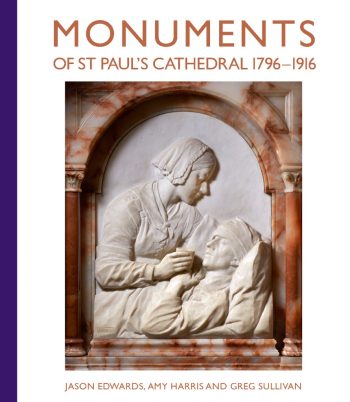 St Paul’s Cathedral is home to some of the finest sculptures by the foremost artists of the long nineteenth century. Memorials around the Cathedral represent giants of the arts, political and military figures and a range of other men and women of national importance, from Nelson to Florence Nightingale. Their memorials echo the tenor of their lives, some dramatic and impressive, others quieter and more reflective, but each story unique. The monuments of St Paul’s are also a record of 19th-century nationalist attitudes, giving this guide particular piquancy in light of current conversations about national identity and values.
Jason Edwards is a Professor of Art History at the University of York and a specialist in the global contexts of British sculpture from 1760 to 1914. Amy Harris is a sculptural historian who specialises in long-19th-century national collections of British sculpture. Greg Sullivan is a sculpture historian and co-author of the Biographical Dictionary of Sculptors in Britain 1660–1851.
Exhibition | Flags and Founding Documents

13-star flag featuring a ‘Great Star’ pattern, ca. 1800–25, one of the earliest American flags known to survive
(Jeff Bridgman, American Antiques)
◊ ◊ ◊ ◊ ◊
Now on view at the Museum of the American Revolution:
Flags and Founding Documents, 1776–Today
Museum of the American Revolution, Philadelphia, 11 June — 6 September 2021
The summer exhibition Flags and Founding Documents, 1776–Today showcases dozens of rare American flags alongside historic early state constitutions and the first printing of the proposed U.S. Constitution of 1787.
The flags—many of which have never been exhibited before—trace the evolution of the Stars and Stripes through the addition and subtraction of stars as new states joined the Union and the nation battled through the Civil War. The flags serve as a visual narrative of America’s national story. The flags are showcased alongside historic documents including early printings of more than 16 different state constitutions and the Choctaw Nation Constitution of 1838 to shed light on the triumphs and tensions that the United States faced as it expanded and worked toward creating a ‘more perfect Union’. By telling stories from the nation’s revolutionary roots to its continuing struggle over equal rights, Flags and Founding Documents, 1776–Today encourages visitors to consider their role in the ongoing effort to fulfill the promise of the American Revolution.
The collection of historic flags is on loan from Jeff R. Bridgman, a leading dealer of antique flags and political textiles. The documents are on loan from the Dorothy Tapper Goldman Foundation following their presentation at the New-York Historical Society in the exhibition Colonists, Citizens, Constitutions: Creating the American Republic (February 2020 — Mary 2021), curated by Dr. James F. Hrdlicka.
James Hrdlicka, with Robert McD. Parker and a foreword by Ruth Bader Ginsburg, Colonists, Citizens, Constitutions: Creating the American Republic (London: Scala Arts Publishers, 2020), 208 pages, ISBN: 978-1785512070, $45.
New Book | Colonial Complexions
First published in 2018, Colonial Complexions has just been released in paperback; from Penn Press:
Sharon Block, Colonial Complexions: Race and Bodies in Eighteenth-Century America (Philadelphia: University of Pennsylvania Press, 2018), 232 pages, ISBN 978-0812250060 (cloth), $45 / ISBN 978-0812224924 (paperback), $23.
 In Colonial Complexions, historian Sharon Block examines how Anglo-Americans built racial ideologies out of descriptions of physical appearance. By analyzing more than 4,000 advertisements for fugitive servants and slaves in colonial newspapers alongside scores of transatlantic sources, she reveals how colonists transformed observable characteristics into racist reality. Building on her expertise in digital humanities, Block repurposes these well-known historical sources to newly highlight how daily language called race and identity into being before the rise of scientific racism.
In the eighteenth century, a multitude of characteristics beyond skin color factored into racial assumptions, and complexion did not have a stable or singular meaning. Colonists justified a race-based slave labor system not by opposing black and white but by accumulating differences in the bodies they described: racism was made real by marking variation from a norm on some bodies, and variation as the norm on others. Such subtle systemizations of racism naturalized enslavement into bodily description, erased Native American heritage, and privileged life history as a crucial marker of free status only for people of European-based identities. Colonial Complexions suggests alternative possibilities to modern formulations of racial identities and offers a precise historical analysis of the beliefs behind evolving notions of race-based differences in North American history.
Sharon Block is Professor of History at the University of California, Irvine.
C O N T E N T S
Introduction
1 Complicating Humors and Rethinking Complexion
2 Shaping Bodies in Print: Labor and Health
3 Coloring Bodies: Naturalized Incompatibilities
4 Categorizing Bodies: Race, Place, and the Pursuit of Freedom
5 Written by and on the Body: Racialization of Affects and Effects
Epilogue
Appendices
1 Advertisements for Runaways: Sources and Methodology
2 Graphic Overview of Advertisements for Runaways
3 Newspapers with Advertisements for Runaways, 1750–75
Notes
Index
Acknowledgments










 Enfilade
leave a comment