Exhibition | Return Journey: Art of the Americas in Spain

Pueblo de Teotenango, en el valle de Matalcingo, en Nueva España / Town of Teotenango, in the Matalcingo Valley, in New Spain, detail
(Seville: Archivo General de Indias, MP-MEXICO,33). More information is available here.
◊ ◊ ◊ ◊ ◊
Opening this fall at the Prado (with the English description from Spain.info). . .
Tornaviaje: Arte Iberoamericano en España / Tornaviaje: Ibero-American Art in Spain
Museo Nacional del Prado, Madrid, 5 October 2021 — 13 February 2022
Curated by Rafael López Guzmán, with Jaime Cuadriello and Pablo F. Amador
This exhibition at the Prado Museum brings together around a hundred works of art that arrived in Europe from the Americas during the Modern Era. Most of them are housed in cultural and religious institutions, or are in private collections, mainly in Spain. Return Journey is divided into four sections. The first, ‘Geography, Conquest, and Society’, looks at the concept of cultural landscape within the geographical framework of the Americas, the Spanish conquest, and the peoples who lived there during the Modern Era. The second, ‘The Pantheon of the Americas: Religious Exchanges’, addresses religious beliefs, in both the Iberian Peninsula and in the Americas, how they have impacted each other, and the resulting fusions. Visitors will find oil paintings, sculptures, and drawings from important centres of production in Lima, Alto Perú, Puebla de los Ángeles and Ciudad de México, together with works by renowned Spanish painters such as Murillo. The third section, ‘Art Journeys’, presents a wide range of household and religious artefacts; and the fourth, ‘Impronta Indiana’, brings together a series of works that reflect the artistic materiality of Spanish America throughout the Modern Era.
◊ ◊ ◊ ◊ ◊
 El tornaviaje o viaje de regreso que da título a esta exposición nos permite valorar las obras de arte que llegaron desde América a España y, por extensión, a Europa durante la Edad Moderna.
La finalidad de esta muestra es visibilizar, a través de aproximadamente un centenar de obras, este rico patrimonio que, proveniente del Nuevo Mundo, se conserva en instituciones culturales, espacios religiosos o colecciones particulares, principalmente en España. Estos objetos, llegados en distintos momentos de la historia, forman parte de nuestro patrimonio histórico y cultural, sin que, a veces, reconozcamos las razones de su presencia.
La muestra se organiza en cuatro grandes secciones. La primera de ellas, ‘Geografía, Conquista y Sociedad’, gira en torno al concepto de paisaje cultural, dándose cita en el mismo la geografía de América, la conquista y las gentes que habitaron estos territorios durante la Edad Moderna. De esta forma, en esta sección, conviven obras de carácter religioso, aportes cristianos que justificaban la conquista, con valores estéticos indudables, a las que se unen vistas de ciudades en las que la traza urbana y el mercado con los productos de la tierra configuraron un paisaje sin igual. Espacios por donde deambulan y se desarrollan los distintos estamentos sociales, representados en cuadros de familias nobiliarias, eclesiásticos, virreyes y, claro está, indígenas, también con sus diferencias estamentales, que nos hablan de esa sociedad diversa.
Quizás el Biombo de la Conquista de México y La muy noble y leal ciudad de México resume con sus dos caras el concepto de esta sección, reproduciendo la conquista de Tenochtitlán, por un lado, y la ciudad de México, por el otro, habitada por más de doscientos personajes, representando el momento histórico constitutivo de América y la vitalidad de la capital novohispana y, por extensión, de las grandes ciudades capitales del nuevo continente.

Juan Patricio Morlete Ruiz (1713–1772), San José y el Niño / St Joseph with the Child Jesus (Church of Santa María la Real, or San Agustín of Badajoz, Spain).
La segunda sección, ‘El panteón americano. Devociones de ida y vuelta’, reúne una exquisita selección de óleos, esculturas y dibujos que tienen como objetivo analizar las devociones religiosas, tanto americanas como peninsulares, así como sus intercambios e hibridaciones. El visitante podrá entender el viaje y la transferencia de las imágenes de devoción, merced al patrocino de los indianos y de algunos virreyes, que reintegraron a sus lugares de origen parte de una memoria compartida; sobre todo, de sus experiencias de fe vividas desde ultramar. Quedará también patente en esta sección el constante envío de obras de pintura “fina” de los más afamados centros de producción de Lima, el Alto Perú, Puebla de los Ángeles o la Ciudad de México, así como obras realizadas en España, por importantes pintores como Murillo, que ejemplifican el impacto de los imaginarios americanos que formaron parte de la propaganda devocional y de los procesos de santificación.
La tercera sección, ‘Las travesías del arte’, se centra en uno de los intercambios comerciales con valores artísticos más fecundos como serían los objetos de ajuar que cruzaron el Atlántico con destino a los lugares más variopintos. Mobiliario diverso para el viaje o para las salas de las residencias dialogan con una nutrida selección de objetos de ajuar, domésticos y religiosos, que pretende cubrir un amplio abanico de tipologías, permitiendo mostrar físicamente el concepto de “tesoro” que asociamos con los objetos llegados de Indias. Los indianos, emigrantes enriquecidos en el nuevo mundo, son ese hilo que hilvana las lejanas tierras de donde proceden estos objetos con un crisol de pueblos y ciudades españolas.
La cuarta y última sección, ‘Impronta indiana’, reunirá un corpus de obras que, pese a su disparidad, se interrelacionan al ser referentes y reflejos de la materialidad artística hispanoamericana a lo largo de la Edad Moderna. Tendremos la ocasión de entender cómo la larga tradición artística prehispánica se adapta a las nuevas exigencias de los reinos hispánicos. Cómo leen los maestros artesanos indígenas las indicaciones y demandas de la nueva sociedad y cómo, a su vez, integran lenguajes y simbología de su propia cultura, permitiendo en su conjunto valorar la riqueza del patrimonio que llegado de América fue integrándose y moldeando, cambiando sin rupturas, la cultura de la península ibérica y, también, la europea; asumiendo América como parte de nuestra identidad.
Las investigaciones que han conducido a la concreción de este proyecto se reflejarán también en un catálogo que acompañará a la exposición.
El proyecto está comisariado por Rafael López Guzmán, Catedrático de Historia del Arte Iberoamericano en la Universidad de Granada, y cuenta con la colaboración de varios especialistas en cultura visual del periodo virreinal en América.
Rafael López Guzmán, Adrián Contreras-Guerrero, Gloria Espinosa, Jaime Cuadriello, and Pablo F. Amador, Return Journey: Art of the Americas in Spain (Madrid: Prado, 2021), 304 pages, ISBN: 978-8484805632, 32€. Also available in Spanish and Castellano editions.
◊ ◊ ◊ ◊ ◊
Note (added 4 October 2021) — The posting was updated to include a revised English title, identification of the exhibition’s curators, and details for the catalogue.
Note (added 14 October 2021) — The press release (in English) is available via Art Daily.
Exhibition | Slavery: Ten True Stories
Exhibition trailer by Boomerang Motion.
◊ ◊ ◊ ◊ ◊
From the press release for the exhibition now on view (an initial notice appeared here at Enfilade in September 2019, but here’s the full, updated information, including links for terrific online components). . .
Slavery: Ten True Stories
Rijksmuseum, Amsterdam, 5 June — 29 August 2021
United Nations Headquarters Visitors’ Lobby, New York, 26 February — 30 March 2023
Curated by Eveline Sint Nicolaas and Valika Smuelders
The Rijksmuseum, the national museum of arts and history of the Netherlands, presents its first ever major exhibition dedicated to the subject of slavery this summer. Slavery is inextricably bound up with Dutch history. This is the first time stories of slave trade across the Atlantic and the Indian Oceans are told together in one exhibition in the Netherlands. The exhibition presents ten true stories. Ten personal stories about enslaved people and slave owners, people who resisted, and people who were brought to the Netherlands in slavery. What were their lives like? What was their attitude to the system of slavery? Were they able to make their own decisions?
 The exhibition includes objects from national and international museums, archives, and private collections—including the Nationaal Museum voor Wereldculturen, British Museum, National Gallery of Denmark, Iziko Museums of South Africa, St Eustatius Historical Foundation, National Archeological Antropological Memory Management (NAAM) in Curaçao, the National Archives of South Africa, Indonesia and the Netherlands, and private collections in Sint Eustatius, Suriname, and the Netherlands.
Valika Smeulders, head of History Rijksmuseum: “By focusing on ten true personal stories, Slavery gives an insight into how individuals dealt with legalized injustice.”
Taco Dibbits, General Director Rijksmuseum: “The Rijksmuseum is the national museum of art and history. Slavery is an integral part of our history. By delving into it, we can form a more complete picture of our history and a better understanding of today’s society.”
Ten True Stories
During the 250-year colonial period, people were made into property and objects to be recorded in accounts. The exhibition highlights the lives of ten people who lived at the time. They each tell their own story: about living in slavery or taking advantage of it, about resistance, and—ultimately—freedom. They include enslaved people and slaveholders, as well as individuals who broke the shackles of slavery, an African servant in the Netherlands, and an Amsterdam sugar industrialist. An audio tour leads visitors through these widely differing lives. Among the narrators are Joy Delima, Remy Bonjasky and Anastacia Larmonie, who each have a connection with one of the ten people through their own background.
The exhibition includes objects, paintings, and unique archival documents. Visitors also will hear oral sources, poems, and music. To tell a more complete story, there will be exhibits that have never been shown in the Rijksmuseum before, such as objects that were cherished by people in slavery and tools that were used on plantations.
The Dutch Colonial Period on Four Continents

Alexander de Lavaux, Map of Suriname, 1737, silk, 187 × 216 cm (Amsterdam: Rijksmuseum).
The exhibition spans the Dutch colonial period from the 17th to the 19th century. It features the trans-Atlantic slavery in Suriname, Brazil, and the Caribbean, along with the part played by the Dutch West India Company (WIC) and Dutch colonial slavery in South Africa and Asia, where the Dutch East India Company (VOC) operated. The effects of the system in the Netherlands during the period are also highlighted. As a whole, it offers a geographically broad and at the same time specifically Dutch view that has never been seen before in a national museum.
Look at Me Now
The stories in the exhibition—about João, Wally, Oopjen, Paulus, Dirk, Lokhay, Van Bengalen, Surapati, Sapali and Tula—stand for millions of other stories about the slavery past of the Netherlands and its continued effects. At the end of the exhibition, the artists David Bade (Curacao, 1970) and Tirzo Martha (Curacao, 1965), both from Curacao’s Instituto Buena Bista, invite visitors to give expression to their own stories through the ten new artworks making up the Look at Me Now project. Visitors can follow the progress of this project via the website.
Online Exhibition
The Rijksmuseum is also presenting the ten stories in an online exhibition that features video and audio clips, animations, an overview of the exhibition galleries, and objects that can be viewed in exceptional detail. Visitors to the website will be able to see the Slavery exhibition in ten episodes, whenever and wherever it suits them.
Symposium
The Rijksmuseum partnered with the National Library of the Netherlands and the National Archive of the Netherlands to present an English-language online symposium on 23 April 2021, focusing on what it means to increase inclusivity in source usage by museums, archives, and libraries. What sources are available to people making presentations and conducting research on the subjects of slavery and the slave trade? Click here to view a recording of the symposium.
Rijksmuseum & Slavery
For the coming year, more than 70 objects in the permanent collection will have a second museum label that explores and highlights what has been, until now, an invisible relationship between the object and slavery. Subjects covered range from former rulers to the presence of people of colour and the way they are portrayed. Rijksmuseum & Slavery takes place concurrently with the Slavery exhibition, but it is not part of the exhibition.
Collaboration
The exhibition and accompanying events and activities are the result of collaboration with a wide variety of external experts, including historians, heritage experts, cultural entrepreneurs, artists, theatre practitioners, and performers.
Narrative advisor:
Jörgen Tjon A Fong
Think tank:
Reggie Baay, Raul Balai, Aspha Bijnaar, Mitchell Esajas, Karwan Fatah-Black, Martine Gosselink, Dienke Hondius, Wayne Modest, Ellen Neslo, Matthias van Rossum, Maurice San A Jong, Alex van Stipriaan, Jennifer Tosch, Urwin Vyent, Simone Zeefuik, and Suze Zijlstra
The exhibition design is by AFARAI, the agency led by architect Afaina de Jong. The graphic design of the exhibition and the book are by Irma Boom Office.
◊ ◊ ◊ ◊ ◊
Eveline Sint Nicolaas and Valika Smeulders, eds., Slavery: The Story of João, Wally, Oopjen, Paulus, Van Bengalen, Surapati, Sapali, Tula, Dirk, Lohkay (Amsterdam: Atlas Contact, 2021), 352 pages, ISBN: 978-9045044279, €28. (Also available in Dutch).
◊ ◊ ◊ ◊ ◊
Note (added 27 March 2023) — The posting has been updated to include the UN as a venue for a version of the exhibition.
New Book | Under Discussion: The Encyclopedic Museum
From The Getty:
Donatien Grau, ed., Under Discussion: The Encyclopedic Museum (Los Angeles: Getty Research Institute, 2021), 256 pages, ISBN: 978-1606067192, $35.
 In almost thirty interviews, Donatien Grau probes some of the world’s most prominent thinkers and preeminent arts leaders on the past, present, and future of the encyclopedic museum.
Over the last two decades, the encyclopedic museum has been criticized and praised, constantly discussed, and often in the news. Encyclopedic museums are a phenomenon of Europe and the United States, and their locations and mostly Eurocentric collections have in more recent years drawn attention to what many see as bias. Debates on provenance in general, cultural origins, and restitutions of African heritage have exerted pressure on encyclopedic museums, and indeed on all manner of museums. Is there still a place for an institution dedicated to gathering, preserving, and showcasing all the world’s cultures?
Donatien Grau’s conversations with international arts officials, museum leaders, artists, architects, and journalists go beyond the history of the encyclopedic format and the last decades’ issues that have burdened existing institutions. Are encyclopedic museums still relevant? What can they contribute when the Internet now seems to offer the greater encyclopedia? How important is it for us to have in-person access to objects from all over the world that can directly articulate something to us about humanity? The fresh ideas and nuances of new voices on the core principles important to museums in Dakar, Abu Dhabi, and Mumbai complement some of the world’s arts leaders from European and American institutions—resulting in some revealing and unexpected answers. Every interviewee offers differing views, making for exciting, stimulating reading.
Includes interviews with George Abungu, National Museums of Kenya; Kwame Anthony Appiah, New York University; Homi K. Bhabha, Harvard University; Hamady Bocoum, Musée des Civilisationes Noires, Dakar; Irina Bokova, UNESCO; Partha Chatterjee, Columbia University; Thomas Campbell, Fine Arts Museum of San Francisco; James Cuno, J. Paul Getty Trust; Philippe de Montebello, New York University; Bachir Souleymane Diagne, Columbia University; Kaywin Feldman, National Gallery of Art; Marc Fumaroli, Collège de France; Massimiliano Gioni, New Museum; Michael Govan, Los Angeles County Museum of Art; Camille Henrot, artist; Max Hollein, Metropolitan Museum of Art; Henri Loyrette, Musée du Louvre; Jean Nouvel, architect; Zaki Nusseibeh, United Arab Emirates; Mikhail Piotrovsky, State Hermitage Museum; Grayson Perry, artist; Krzysztof Pomian, École des Hautes Études en Sciences Sociales; Mari Carmen Ramírez, Museum of Fine Arts, Houston; Fiammetta Rocco, The Economist; Sabyasachi Mukherjee, CSMVS Mumbai; Bénédicte Savoy; Collège de France; Kavita Singh, Jawaharlal Nehru University, New Delhi; Amit Sood, Google Arts & Culture.
Donatien Grau is head of contemporary programs at the Musée d’Orsay, Paris. He is the author of Plato in L.A. (Getty, 2018).
Exhibition | By Her Hand, Women Artists in Italy, 1500–1800
From the press release (30 July 2021) for the exhibition:
By Her Hand: Artemisia Gentileschi and Women Artists in Italy, 1500–1800
Wadsworth Atheneum Museum of Art, Hartford, 30 September 2021 — 9 January 2022
Detroit Institute of Arts, 6 February — 29 May 2022
Curated by Eve Straussman-Pflanzer and Oliver Tostmann
 The first exhibition solely dedicated to Italian women artists at the Wadsworth Atheneum Museum of Art, By Her Hand: Artemisia Gentileschi and Women Artists in Italy, 1500–1800 explores how women succeeded in the male-dominated art world of the time. From the group of eighteen artists presented, Artemisia Gentileschi (1593–1654 or later), takes center stage with outstanding portraits and images of heroines. This exhibition recognizes and celebrates the vital contributions of women to the history of art in Italy through rarely seen works, recent scholarship, and introductions to virtually unknown artists.
“Sofonisba Anguissola, Artemisia Gentileschi, and Rosalba Carriera, among others, created pathbreaking works of art, simultaneously subverting expectations and challenging norms,” said Oliver Tostmann, Susan Morse Hilles Curator of European Art at the Wadsworth. “Their works and careers are often distinguished by alternative choices and idiosyncratic methods employed within the context of the male dominated art world of the time. By Her Hand brings together a wide spectrum of works by these artists—many on view for the first time—inviting visitors to explore, reassess, and celebrate the achievements of Italian women artists.”
The exhibition features a wide array of paintings, miniatures, and works on paper from institutional and private collections in the United States, Canada, and Europe. The artists take on a range of subjects from portraiture and still life, to historical and religious stories. Many works are being shown publicly for the first time or are making their U.S. debut such as Artemisia Gentileschi’s ravishing Mary Magdalene. By Her Hand reweaves history by examining women artists’ work and careers from the 1550s to the 1750s. Despite the fundamental differences and challenges women artists faced, some achieved notable success in their lifetime. The accomplishments of this diverse and dynamic group are introduced, discussed, and reassessed. Until recently, many of these Italian women artists were overlooked by critics, scholars, collectors, and institutions alike.
Artemisia Gentileschi is arguably the best-known artist included in the exhibition. Gentileschi’s talents were widely recognized by her contemporaries, many elite patrons of her day knew of and desired her work. Important works by Gentileschi highlight her innovative ideas, use of sensuous colors, and command of the brush. The Wadsworth’s Self-Portrait as a Lute Player is compared with the recently discovered Self-Portrait as Saint Catherine of Alexandria from the National Gallery, London, as well as Portrait of Saint Catherine from the Uffizi Galleries, Florence. This will be the first opportunity to see these three celebrated paintings side by side in the United States. Additional examples of Gentileschi’s pioneering depictions of strong women, such as Judith and Her Maidservant with the Head of Holofernes from the Detroit Institute of Arts, will also be on view.
The compelling works of art on view in By Her Hand coupled with stories of their pioneering makers reveals a nuanced picture of the role Italian women artists played from the Renaissance to the Rococo. By Her Hand celebrates their long-overlooked contributions, and aims to inspire continued reexaminations of the role women artists have played throughout the history of art.
“Never before in its long history has the Wadsworth devoted an exhibition to the work of professional women artists in sixteenth through eighteenth-century Italy, despite the fame of our Italian Baroque painting collection” said Jeffrey N. Brown, Interim Director & CEO of the Wadsworth Atheneum. “By Her Hand is the first exhibition in any encyclopedic museum in the United States to focus on this subject. This ground-breaking exhibition provides our audiences with a chance to encounter the outstanding art produced by these women artists in early modern Italy and to appreciate the far-reaching consequences of Artemisia Gentileschi’s illustrious career.”
By Her Hand is a collaboration between the Wadsworth and the Detroit Institute of Arts. Curated by Eve Straussman-Pflanzer former curator at the Detroit Institute of Arts now Curator and Head of Italian and Spanish paintings at The National Gallery of Art, Washington and Oliver Tostmann, Susan Morse Hilles Curator of European Art at the Wadsworth. After its debut at the Wadsworth, it will travel to Detroit where it will be on view February 6–May 29, 2022.
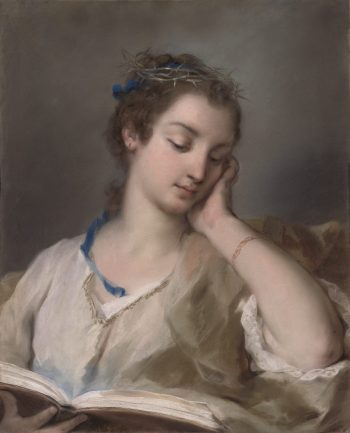
Rosalba Carriera, Allegory of Grammar, ca. 1715, pastel on paper (Private Collection).
Artists in the exhibition
Sofonisba Anguissola (c. 1535–1625)
Diana Scultori (c. 1547–1612)
Lavinia Fontana (1552–1614)
Fede Galizia (c. 1574–c. 1630)
Isabella Catanea Parasole (active 1585–1625)
Artemisia Gentileschi (1593–1654 or later)
Orsola Maddalena Caccia (1596–1676)
Giovanna Garzoni (1600–1670)
Virginia da Vezzo (1600–1638)*
Anna Maria Vaiani (1604–1655)
Elisabetta Sirani (1638–1665)
Ginevra Cantofoli (1618–1672)
Caterina de Julianis (c. 1670–c. 1742)
Rosalba Carriera (1673–1757)
Marianna Carlevarijs (1703–after 1750)
Maria Felice Tibaldi (1707–1770)*
Veronica Stern Telli (1717–1801)
Anna Bacherini Piattoli (1720–1788)
* Virginia da Vezzo and Maria Felice Tibaldi are represented in portraits painted by their husbands Simon Vouet (1590–1649) and Pierre Subleyras (1699–1749).
Eve Straussman-Pflanzer and Oliver Tostmann, with contributions by Sheila Barker, Babette Bohn, C. D. Dickerson, Jamie Gabbarelli, Hilliard T. Goldfarb, Joaneath Spicer, and Lara Roney, By Her Hand: Artemisia Gentileschi and Women Artists in Italy, 1500–1800 (New Haven: Yale University Press, 2021), 192 pages, ISBN: 978-0300256369, $40.
New Book | The Natural, Moral, and Political History of Jamaica
Today is Emancipation Day, a holiday celebrated in Jamaica and throughout the Caribbean. On 1 August 1834, slavery was legally abolished in British colonies, resulting in freedom for some 311,00 enslaved people in Jamaica. From the University of Virginia Press:
James Knight, The Natural, Moral, and Political History of Jamaica, and the Territories thereon Depending: From the First Discovery of the Island by Christopher Columbus to the Year 1746, edited by Jack Greene (Charlottesville: University of Virginia Press, 2021), 832 pages, ISBN 978-0813945576 (ebook), $49 / ISBN: 978-0813945569 (cloth), $65.
 Between 1737 and 1746, James Knight—a merchant, planter, and sometime Crown official and legislator in Jamaica—wrote a massive two-volume history of the island. The first volume provided a narrative of the colony’s development up to the mid-1740s, while the second offered a broad survey of most aspects of Jamaican life as it had developed by the third and fourth decades of the eighteenth century. Completed not long before his death in the winter of 1746–47 and held in the British Library, this work is now published for the first time. Well researched and intelligently critical, Knight’s work is not only the most comprehensive account of Jamaica’s ninety years as an English colony ever written; it is also one of the best representations of the provincial mentality as it had emerged in colonial British America between the founding of Virginia and 1750. Expertly edited and introduced by Jack Greene, this volume represents a colonial Caribbean history unique in its contemporary perspective, detail, and scope.
Jack P. Greene is Andrew W. Mellon Professor in the Humanities Emeritus at Johns Hopkins University and author of Settler Jamaica in the 1750s: A Social Portrait (Virginia).
Exhibition | Bellotto: The Königstein Views Reunited

The National Gallery acquired Bellotto’s The Fortress of Königstein from the North (1756–58) in 2017. This exhibition unites it with four other paintings of the site by the artist—paintings from the Manchester Art Gallery, Knowsley Hall, and The National Gallery of Art in Washington D.C.
◊ ◊ ◊ ◊ ◊
Now on view at the National Gallery:
Bellotto: The Königstein Views Reunited
National Gallery, London, 22 July — 31 October 2021
Bernardo Bellotto (1722–1780) painted this historic site—a stronghold located approximately 25 miles south-east of Dresden, in the picturesque Elbe valley—not just once, but five times. In this exhibition, we reunite these five monumental views, which includes our recently acquired view from the north, for the first time in more than 250 years.
 Painted at the height of Bellotto’s career, when he was court painter to August III, Elector of Saxony and King of Poland, these views were commissioned as part of a larger series of 30 views of Dresden and its surroundings. The five paintings of Königstein show the ancient fortress from outside its forbidding walls as well as from within. Bellotto succeeds in capturing both the drama and detail of this commanding site, on canvases measuring more than two metres wide. Stand back and you can see the sharp, angular forms of the fortress, but look closely and you can make out the crumbling stone walls, tiny soldiers on the ramparts and women hanging washing in the courtyard.
For many years Bellotto was overlooked, in favour of his more famous uncle and master, Canaletto, but today he is recognised as one of the most distinctive artistic personalities of the 18th century. Applying what he had learnt in Venice to his highly original panoramic depictions of northern Europe, Bellotto took the tradition of view painting in an entirely new direction.
Letizia Treves, with Lucy Chiswell, Stephen Lloyd, and Hannah Williamson, Bellotto: The Königstein Views Reunited (London: National Gallery, 2021), 88 pages, ISBN: 9781857096743, £15 / $20.
Exhibition | Table Delights: Historical Linen Damasks
Press release for the exhibition, via the European Textile Network (‘Tafelfreuden’ is my new favorite word! -CH).
Tafelfreuden: Historische Leinendamaste / The Delights of Dining: Historical Linen Damasks
Abegg-Stiftung, Riggisberg, 25 April — 7 November 2021

Linen Damask with Grapevines, United Provinces, 1660–80 (Abegg-Stiftung, inv. no. 3573; photograph by Christoph von Viràg). White-in-white patterned table linen was generally more expensive than fine glassware, exquisite porcelain, and cutlery in the seventeenth century.
Patterned table linen has adorned festive dining tables since the Late Middle Ages. These pure white tablecloths, napkins, and hand towels are patterned with discreet, artfully-drawn pictorial compositions and coats of arms. Used in conjunction with fine silverware, linen damasks served as a status symbol in both princely and bourgeois households. The textiles that have survived are valuable testimony to historical dining culture. Among the many pleasures of dining, besides indulging the palate, is the spectacle of fine glassware, exquisite porcelain, and silver. And since the early sixteenth century, table linen made of white linen damasks has also been a common part of festive banquets. Often it was the most expensive item on the table.
White-in-white patterned table linen? Is there anything to see at all? Most definitely. For concealed within these seemingly plain white cloths are hitherto unimagined visual worlds and experiences. Their subtlety prompts us to ponder our sense of sight and optical phenomena generally, since depending on the fall of light—and unlike on perfectly illuminated photographs—the woven designs are not always clearly visible. But anyone ready to engage with them will soon discover motifs drawn from seafaring or everyday life, mythological and Biblical scenes, portraits of rulers, historical events, and the patrons’ coats of arms. The Abegg-Stiftung in Riggisberg possesses one of the world’s most important collections of historical linen damasks. These monumental tablecloths, napkins, and hand towels are normally kept in storage. This year’s special exhibition, however, will feature a selection of exceptionally fine examples dating from the sixteenth to eighteenth century. These will be flanked by texts and short films explaining their manufacture, place of origin, and use.
Related publication from the museum:
Cornelis A. Burgers, White Linen Damasks: Heraldic Motifs from the Sixteenth Century to circa 1830 (Riggisberg: Abegg-Stiftung, 2014), 2 vols, 564 pages, ISBN: 978-3905014563, CHF 280.
The Abegg-Stiftung’s collection of white linen damasks ranks amongst the foremost in the world. With tablecloths, banquet napkins, handtowels, and napkins, it covers a wide range of patterns, including heraldic and historical motifs, biblical and mythological stories, flowers, hunting scenes, views of towns, etc. With emphasis on heraldic motifs all such patterns feature in this catalogue. Occasionally clients also had their names and a date woven in. Most of this napery originates from weaving centres in the Southern and Northern Netherlands, Germany, Scotland, Ireland, and Russia.
New Book | Cardiff Castle and the Marquesses of Bute
From Scala:
Matthew Williams, Cardiff Castle and the Marquesses of Bute (London: Scala, 2019), 208 pages, ISBN: 978-1785512346, £30 / $40.
 Cardiff Castle is a major Roman, Norman and medieval survival, but what sets it apart is its extraordinary redevelopment during the 18th and 19th centuries, culminating in the fairytale gothic revival extravagances we see today. In this sumptuous illustrated study of the past 250 years of its history, the Castle’s curator celebrates this reinvention that was led by several generations of the wealthy Bute family. 18th-century building and landscape work by the renowned landscape designer ‘Capability’ Brown and the architect Henry Holland was followed by William Burges’ fantastical transformations in the 19th century, together creating what is now one of the most iconic and popular buildings in Wales.
Matthew Williams has been the Historian and Curator of Cardiff Castle since 1990.
New Book | Old Buildings, New Architecture
From RIBA:
Richard Griffiths, Old Buildings, New Architecture (London: Richard Griffiths Architects, 2019), 176 pages, ISBN: 978-1527231627, £30.
 In this book, Richard Griffiths describes the creation of new architecture for old buildings, through the story of his practice, Richard Griffiths Architects, and of the projects that he has completed over 25 years. He writes of his belief that adding a new layer of architecture and use to old buildings is as interesting and rewarding as designing new buildings, since old buildings have a richness of memory, significance, and texture that new buildings can only acquire over time.
The book is richly illustrated with colour photographs and covers the following:
• The making of an architect
• The layering of history: Sutton House
• Old and new in context: Southwark Cathedral
• Old and new in contrast: Lambeth Palace and Burghley
• Historic houses for the public
• The care of churches
• The care of cathedrals: St Albans Abbey
• New design in an historic context
• The typology of barns
• The art of repair and the texture of age
• The art of construction and detailing
• Architecture and decoration
• New uses for old buildings
• The case for restoration
• Historic gardens and landscape
• The regeneration of historic areas
• Conservation cause celebre: St Pancras Hotel and Station
Exhibition | Iron Men: The Artistry of Iron in Samurai Armor

From the press release for the exhibition:
Iron Men: The Artistry of Iron in Samurai Armor
The Ann & Gabriel Barbier-Mueller Museum, The Samurai Collection, Dallas, 1 May — 3 October 2021
Curated by Jessica Liu Beasley
On May 1, The Ann & Gabriel Barbier-Mueller Museum: The Samurai Collection will unveil its newest exhibition, Iron Men: The Artistry of Iron in Samurai Armor. The exhibition will be on display through October 3. The show examines the vital role that iron played in Japanese warrior culture and technology from the third century, when the knowledge of ironworking arrived in Japan, to the end of the samurai era in the nineteenth century. Over eighty artworks, including several masterpieces and many objects that have never before been on display, will be showcased in Iron Men. An array of samurai ironworks—full suits of armor, helmets, accessories, weapons, and horse tack—have been assembled to highlight the ways in which this seemingly unyielding metal gave way to works of protective art.
“It’s interesting to think about the common uses of iron and how, with the samurai and our collection, iron is the medium the Japanese artisans used to create the amazing pieces on display,” said Niña Barbier-Mueller Tollett, Director of Cultural Affairs for The Samurai Collection. “In the new exhibition, I think Iron Men is really referring to the craftsmen, as well as the samurai. We are excited to be bringing this aspect of samurai history to light.”
Samurai were the warriors of premodern Japan who shaped the country’s history for centuries. Their culture was one of pageantry, violence, beauty, and honor, and their spectacular armor was worn during epic battles and glorious ceremonies. The exhibition is a testament to the peerless craftsmanship of the metalworkers and reveals how they mined, smelted, and ultimately forged iron into lifesaving armor. Transcending utility, components were often meticulously inlaid with gold and silver, adorning high-ranking samurai, the daimyo, in wearable art that skillfully merged artistic form and protective function. Suits of armor from the powerful Ikeda and Date families show how these expertly crafted iron suits gave the warriors a distinguished identity and prominent appearance.
“It is remarkable to see these masterworks of iron from the collection presented together,” said Jessica Liu Beasley, curator of Iron Men and curator of The Samurai Collection. “Samurai armor is often coated in layers of lacquer that conceal the quality of the iron beneath, hiding any flaws, mistakes, or carelessness. In Iron Men, the plates are exposed, revealing every texture and lustrous finish. The virtuosity of the armorers is clearly displayed for the visitors to experience.”
The sections of the exhibition follow the story of Japanese ironworking from its introduction throughout the age of the samurai. Armorers harnessed the protective powers of iron technology to formulate their own distinct type of armor. Examples of medieval samurai armor from the thirteenth to fifteenth centuries illustrate the innovative construction that used hundreds of tiny scales (sane), which enabled superior flexibility and range of motion. Schools of armorers emerged, and the exhibition presents the work of several master armorers, providing an opportunity for side-by-side comparisons of some of the finest ironwork produced for the samurai.
Following further evolution of Japanese armor, the exhibition looks at how the introduction of firearms in the sixteenth century influenced armor fabrication. The country was in the midst of large-scale civil warfare and, in response to the new weapons, larger, more solid plates of iron had to be incorporated into the armor to protect warriors from bullets. Several components in Iron Men were bullet tested (tameshi teppo) to prove that the iron structure was strong enough to take the impact. Later, during the Edo period (1615–1868), to accommodate the changing roles of the samurai, another innovative style of armor emerged that was created with chainmail and smaller plates of iron. In this section, visitors will learn how this streamlined armor was built for ease of wear, transport, and storage.
The final sections of the exhibition show additional works from the Edo period, a time of relative peace in Japan that occurred under the unification imposed by the Tokugawa family. No longer embroiled in constant warfare, the need for battle armor decreased, and armorers had the opportunity to elevate their craft to new heights. Sumptuous creations gleam with fine metal details and decorative fittings. Sculptural iron helmets and masks were molded into fantastic three-dimensional shapes of creatures and deities. Objects of this caliber were greatly important during the many ceremonies and processions where the daimyo used the armor to demonstrate their wealth and status. Though the armor grew in beauty and refinement, the armorers to the samurai were mindful that conflict could arise again at any time. Balance had to be maintained between the elegance of their craft and the responsibility they burdened to protect the fates of their clients.
◊ ◊ ◊ ◊ ◊
The Ann & Gabriel Barbier-Mueller Museum: The Samurai Collection presents armor that once protected and adorned these fierce warriors. Established in Dallas’s Harwood District in 2012, The Samurai Collection is the only museum of its kind in the U.S. and is now one of the largest in the world. Ann and Gabriel Barbier-Mueller began acquiring art of the samurai over thirty years ago. The family has selectively built the collection with an intense focus on artistic detail and sculptural quality. The objects, which range in date from the fifth to nineteenth century, are presented in a variety of rotating exhibitions—each exploring an intriguing aspect of Japanese warrior culture. Additionally, a large exhibition of the samurai armor is currently touring through the U.S., Canada, South America, and Europe. Its upcoming exhibition at Bernisches Historisches Museum will debut 4 November 2021. The Samurai Collection is housed in the historic St. Ann’s School building, originally constructed in 1927.










 Enfilade
leave a comment