Print Quarterly, September 2021

Gottfried August Gründler, Frontispiece Der Naturforscher (1774), engraving, 90 × 110 mm
(Cambridge University Library)
◊ ◊ ◊ ◊ ◊
The eighteenth century in the latest issue of Print Quarterly:
Print Quarterly 38.3 (September 2021)
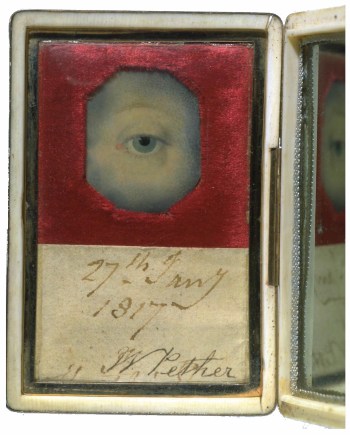
William Pether, Eye Miniature, 1817, watercolour on ivory, embedded in red velvet, 27 × 22 mm (London: Victoria & Albert Museum).
A R T I C L E S
Dominika Cora, “New Light on the Life and Work of the Mezzotint Engraver William Pether (1739–1821)”
William Pether (1739–1821) was one of the most distinguished English mezzotint engravers in the second half of the eighteenth century. Responding to scholarly confusion around his life, this article presents archival discoveries that illuminate his biography and personal life, as well as unpublished drawings and an overview of his artistic output.
N O T E S
Anna Gielas, “Gottfried A. Gründler’s Der Naturforscher (1773)”
During the second half of the eighteenth century, there was a peak in the usage of elaborate frontispiece engravings for European naturalist periodicals. Gielas introduces the frontispiece created by the renowned German engraver Gottfried August Gründler (1710–1775) for the naturalist journal Der Naturforscher and examines the useful information it displayed to the periodical’s (potential) audience. The engraving can be seen as an illustration of the cultural identity of naturalists as well as the Enlightened individual in the later decades of the eighteenth century.
Exhibition | Masterpieces from Buckingham Palace

Installation of the exhibition Masterpieces from Buckingham Palace, at The Queen’s Gallery In London.
◊ ◊ ◊ ◊ ◊
Now on view at The Queen’s Gallery:
Masterpieces from Buckingham Palace
The Queen’s Gallery, Buckingham Palace, London, 17 May 2021 — 13 February 2022
Curated by Desmond Shawe-Taylor and Isabella Manning
Masterpieces from the Royal Collection have been displayed in Buckingham Palace since the residence was acquired by George III and Queen Charlotte in 1762. The painting displays were reinvented during the reign of their son, George IV, who commissioned the architect John Nash to renovate the palace in the 1820s. A Picture Gallery was included to display the monarch’s exceptional collection of paintings. Since then, the Picture Gallery has remained the focus for some of the most treasured Italian, Dutch, and Flemish paintings from the Royal Collection.
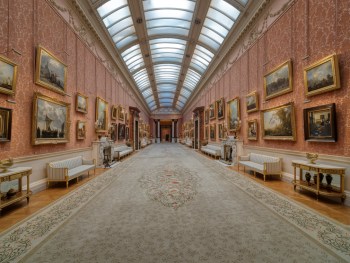
The Picture Gallery at Buckingham Palace (typically open to visitors only during the summer) is currently being renovated–creating an opportunity to display the paintings normally installed there in other contexts.
Palace displays are often imbued with dynastic meaning; the Picture Gallery was one of the few spaces intended for the enjoyment of art, pure and simple. It is in this same spirit that we have mounted this exhibition: for the first time the paintings are displayed together in modern gallery conditions, allowing us to look at them afresh.
In general these paintings are securely dated and attributed; mostly we know which monarch bought them. We are providing this information here, but we are also asking a different, more subjective question—what makes them important? What do they have to offer? In the exhibition catalogue we have suggested qualities that were valued by the makers of these works and can still be appreciated today: the imitation of nature; the sensuous use of materials; the creation of beautiful design; and the ability to express human emotion. But are we missing something? We hope that visitors will make up their own minds about what there is to enjoy in these paintings and find reasons to believe that they are still worth exploring.
Dou to Vermeer
The paintings in this room were all created in the Low Countries between 1630 and 1680, the heyday of the so-called Dutch Golden Age. They are modest in scale, the majority scenes of everyday life, with figures in landscapes or in homes, taverns and shops. These artists didn’t set up their easels in the market place; they worked from drawings, memory and imagination, but they depicted the familiar everyday world around them. The people they painted were of the same kind that bought their paintings: we can see examples in simple ebony frames on the walls of the interiors of de Hooch and Vermeer.
All but two of these paintings were acquired by George IV to hang in the sumptuous interiors of Carlton House, his London residence when Prince of Wales. Like their original purchasers, he admired them for their comedy, their brilliant technique and their truth to life. They continue to fascinate through their minute detail, tactile surfaces and ability to suggest spaces filled with light and air.

Canaletto, The Piazza Looking North-West with the Narthex of San Marco, ca. 1723–24, oil on canvas, 172 × 134 cm (London: Royal Collectin Trust, RCIN 401037). The painting is one of a set of six views of the Piazza San Marco and the Piazzetta.
Rubens, Rembrandt, and Van Dyck
The artists in this room all come from the Low Countries, as in the previous section. There are some comic scenes of everyday life, but the majority of works belong to the more prestigious branches of art—narrative painting, commissioned portraits, and ambitious landscapes with a symbolic or religious meaning.
This room is dominated by three artists of very different character: Rubens, a diplomat and land-owner; van Dyck, a courtier; and Rembrandt, a professional serving the merchants of Amsterdam. In other ways they are similar, especially in their enthusiasm for the type of Venetian painting that can be seen in the next section.
Painting in Italy, 1510–1740
The paintings in this room were created in Italy, in various artistic centres and over a period of two hundred years. Bringing together this great range of painting evokes something of the first displays at Buckingham Palace, during the reign of George III.
Several strands of Italian art are here on show. There are sober male portraits, often painted with a bare minimum of detail and colour range, but conveying great psychological intensity. There are ideal female figures, derived from the study of antique sculpture, their beauty impassive however dramatic the narrative. There are expressive landscapes, ranging from a cataclysmic storm to the unruffled stillness of a sunset. Then there are Canaletto’s boldly expressive views of Venice, where the imposing monuments of the city are spiced with a hint of picturesque shabbiness.
◊ ◊ ◊ ◊ ◊
In the United States, the catalogue is distributed by The University of Chicago Press:
Desmond Shawe-Taylor and Isabella Manning, Masterpieces from Buckingham Palace (London: Royal Collection Trust, 2021), 160 pages, ISBN: 978-1909741737, £20 / $25.
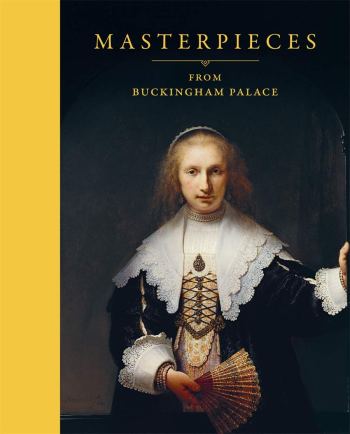 In this beautifully designed book, Desmond Shawe-Taylor, Surveyor of The Queen’s Pictures, and Assistant Curator of Paintings, Isabella Manning, examine 65 of the most celebrated paintings from the Picture Gallery, which sits at the heart of Buckingham Palace. With masterpieces by such artists as Vermeer, Rembrandt, Van Dyck, Rubens, Titian, Jan Steen, Claude, and Canaletto, this publication offers new insights into these world-famous works of art. The authors encourage readers to look at the works in a new way and to consider how Claude paints a sky; how Rubens models the landscape through his use of color; and how Titian uses contrast to add gravitas to a portrait. Rather than re-treading the old boards of provenance and attribution, the authors seek to engage with different, perhaps riskier and more subjective, questions: asking not when were they painted and by whom, but why should we concern ourselves with them? A short introduction gives an account of the creation of the Picture Gallery and tells the story of the monarchs who curated this extraordinary collection of paintings and how the works entered the Collection.
C O N T E N T S
A History of Old Master Paintings at Buckingham Palace
Looking at the Old Masters
The Pictures
Further Reading
Index
◊ ◊ ◊ ◊ ◊
Desmond Shawe-Taylor’s very productive fifteen-year tenure as Surveyor of the Queen’s Pictures came to an end in December 2020, as reported by the BBC, in response to £64m of lost income related to the pandemic. Indeed, the historic Surveyor position—first filled in 1625 during the reign of Charles I—is for now “lost and held in abeyance.” Royal Collection Director, Tim Knox, has taken on “overall responsibility for the curatorial sections, supported by the Deputy Surveyors of Pictures and Works of Art.”
New Book | Rubens in Repeat
From The Getty:
Aaron Hyman, Rubens in Repeat: The Logic of the Copy in Colonial Latin America (Los Angeles: Getty Research Institute, 2021), 320 pages, ISBN 978-1606066867, $70.
 This book examines the reception in Latin America of prints designed by the Flemish artist Peter Paul Rubens, showing how colonial artists used such designs to create all manner of artworks and, in the process, forged new frameworks for artistic creativity.
Peter Paul Rubens (1577–1640) never crossed the Atlantic himself, but his impact in colonial Latin America was profound. Prints made after the Flemish artist’s designs were routinely sent from Europe to the Spanish Americas, where artists used them to make all manner of objects.
Rubens in Repeat is the first comprehensive study of this transatlantic phenomenon, despite broad recognition that it was one of the most important forces to shape the artistic landscapes of the region. Copying, particularly in colonial contexts, has traditionally held negative implications that have discouraged its serious exploration. Yet analyzing the interpretation of printed sources and recontextualizing the resulting works within period discourse and their original spaces of display allow a new critical reassessment of this broad category of art produced in colonial Latin America—art that has all too easily been dismissed as derivative and thus unworthy of sustained interest and investigation. This book takes a new approach to the paradigms of artistic authorship that emerged alongside these complex creative responses, focusing on the viceroyalties of New Spain and Peru in the seventeenth and eighteenth centuries. It argues that the use of European prints was an essential component of the very framework in which colonial artists forged ideas about what it meant to be a creator.
Aaron M. Hyman is assistant professor in the Department of the History of Art at Johns Hopkins University.
Exhibition | Canvas & Silk: Historic Fashion
From the press release (10 June 2021) for the exhibition:
Canvas & Silk: Historic Fashion from Madrid’s Museo del Traje
The Meadows Museum, SMU, Dallas, 19 September 2021 — 9 January 2022
Curated by Amanda Dotseth and Elvira González
The Meadows Museum, SMU, has announced a major exhibition of Spanish dress and fashion that will pair paintings from the Meadows’s collection with historic dress and accessories from the Museo del Traje, Centro de Investigación del Patrimonio Etnológico in Madrid. Canvas & Silk: Historic Fashion from Madrid’s Museo del Traje marks the first major collaboration between this important Spanish institution and an American museum and will include approximately 40 works from the Meadows alongside examples of dress and accessories from the Museo del Traje (Spanish National Museum for Fashion). Displayed together, the works in the exhibition not only tell the story of how fashion trends in Spain changed over four hundred years, but also reveal how elements of a country’s history—such as its involvement with global trade or the formation of a national identity—are reflected in its dress.
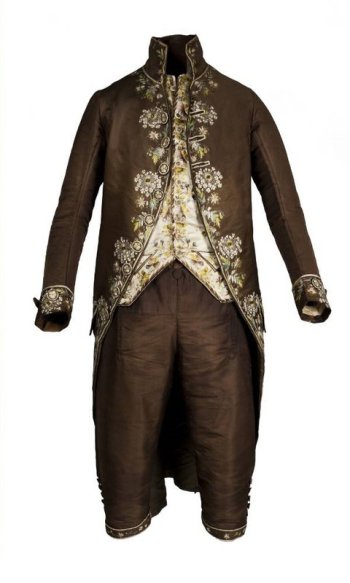
Traje a ‘la francesca’ (calzón, chupa, casaca) / French Costume (Breeches, Vest, Dress Coat), ca. 1795–1800; silk, linen, and cotton (Madrid: Museo del Traje, Centro de Investigación del Patrimonio Etnológico; Calzón, CE000663; chupa, CE000664; casaca, CE000665; photo by Gonzalo Cases Ortega).
Canvas & Silk will be on view at the Meadows from 19 September 2021 until 9 January 2022. Concurrently, the Meadows will also present Image & Identity: Mexican Fashion in the Modern Period, an investigation into Mexican dress spanning from Mexican Independence to modern times through photographs and prints from the collections of the Meadows Museum and SMU’s DeGolyer Library.
“We are thrilled to have the opportunity to gain further insight into the Meadows’s collection of Spanish art through its exhibition with loans from Spain’s premier collection of historic dress,” said Amanda W. Dotseth, curator at the Meadows Museum and co-curator of the exhibition in collaboration with Elvira González of the Museo del Traje. “This exhibition makes it possible to tell a more nuanced story about Spanish society through the presentation of historic paintings with contemporaneous examples of the garments depicted therein. We are as never before able to explore the complex relationships between representation and reality, between image and artifact. Spanish fashion has long been a point of interest for the Meadows Museum, whether in the form of past exhibitions—such Balenciaga and His Legacy: Haute Couture from the Texas Fashion Collection in 2007—or as portrayed in the collection’s prints, paintings, and sculptures. We look forward to continuing our study and display of Spanish fashion with this unprecedented collaboration with the Museo del Traje.”
Canvas & Silk will be divided into themes that elucidate various trends in the history of European fashion in general and Spanish dress in particular over the past five hundred years. These include ‘Precious Things’, featuring accessories like jewelry and combs made from precious metals and other rare materials such as coral; ‘Traditional Dress’ with examples of garments and ensembles that are typically identified with Spain, such as a traje de luces (the suit typically worn by bullfighters) and mantón de Manila (traditional embroidered silk shawls historically traded through Manila); and ‘Stepping Out’ demonstrating the importance of what one wore when presenting themselves in public. Highlights of pairings combining paintings from the Meadows’s collection and historic dress from the Museo del Traje include Ignacio Zuloaga’s The Bullfighter ‘El Segovianito’ (1912) accompanied by a traje de luces of the same color; Zuloaga’s Portrait of the Duchess of Arión, Marchioness of Bay (1918) displayed alongside a mantón de Manila similar to the one the duchess is holding; and Joan Miró’s Queen Louise of Prussia (1929) paired with a vibrantly hand-painted dress and shoes by twentieth-century fashion designer Manuel Piña.
“By pairing the Museo del Traje’s collection with that of the Meadows’s, we are bringing the dress, accessories, and other material objects to life, enabling viewers to see the contexts in which such articles were worn,” said Elvira González, curator of the historic apparel collection at the Museo del Traje. “Viewed together, the clothing allows for a deeper understanding of the painting; for example, the presence of the mantón de Manila (embroidered Manila silk shawl) in Ignacio Zuloaga y Zabaleta’s painting Portrait of the Duchess of Arión, Marchioness of Bay (1918) speaks to the social position of the woman depicted. Not only will our collection be seen by audiences in the U.S. for the first time, but it will also be displayed in a completely new light. We’re excited to see what kind of scholarship and new ideas might be generated by presenting these works in a new environment and alongside these paintings and drawings.”
The accompanying exhibition catalogue will contain an essay co-authored by Dotseth and González that illuminates themes linking the garments, accessories, and corresponding works in the Meadows collection. The publication will feature new photography of key objects by Jesús Madriñán.
Canvas & Silk will be accompanied by a focused exhibition in the museum’s first-floor galleries titled Image & Identity: Mexican Fashion in the Modern Period, curated by Akemi Luisa Herráez Vossbrink, the Center for Spain in America (CSA) Curatorial Fellow at the Meadows Museum. Featuring photographs, prints, books, and gouaches from the 19th and 20th centuries, this exhibition will explore Mexican fashion through images of everyday scenes, festivities, regional types, and occupations. Building on a theme developed in Canvas & Silk, Image & Identity will also show how national identity formation is reflected in fashion and is often accompanied by a resurgence in the popularity of indigenous dress. Works in Image & Identity are drawn from the collections of the Meadows Museum and SMU’s DeGolyer Library, named after Everette L. DeGolyer, Sr. who, with his son, collected maps, books, manuscripts, and photographs related to Mexican exploration and history. Artists featured in the exhibition include Alfred Briquet, Carlos Mérida, Diego Rivera, José Clemente Orozco, Jerry Bywaters, Paul Strand, and Manuel Álvarez Bravo.
Huntington Commissions Wiley to Paint New, ‘Blue-Boy’ Inspired Work

Thomas Kehinde Wiley, A Portrait of a Young Gentleman, 2021, oil on linen, 71 × 49 inches, © Kehinde Wiley (San Marino: Collection of The Huntington Library, Art Museum, and Botanical Gardens, commissioned through Roberts Projects, Los Angeles). Installation photo by Joshua White.
◊ ◊ ◊ ◊ ◊
Press release (9 September 2021) from The Huntington:
Kehinde Wiley, A Portrait of a Young Gentleman
San Marino, The Huntington Library, Art Museum, and Botanical Gardens, 2 October 2021 — 3 January 2022
The Huntington Library, Art Museum, and Botanical Gardens announced today that it has commissioned the renowned artist Kehinde Wiley to create a new work inspired by Thomas Gainsborough’s The Blue Boy (ca. 1770). Wiley’s A Portrait of a Young Gentleman (also the original title of the Gainsborough painting) will be a large-scale portrait in the Grand Manner style that will be added to The Huntington’s permanent collection. The new painting will be on view from 2 October 2021 through 3 January 2022, in The Huntington’s Thornton Portrait Gallery, opposite the institution’s iconic and recently restored Blue Boy. The acquisition of the Wiley portrait celebrates the 100th anniversary of the purchase of the Gainsborough painting by Henry and Arabella Huntington, the founders of the institution.
 “Just as scholars come to The Huntington to study and reinterpret our significant collections, with this commission we are delighted that Kehinde Wiley will reenvision our iconic work, The Blue Boy, and Grand Manner portraiture in a powerful way,” said Huntington President Karen R. Lawrence. “Across the breadth of our library, art, and botanical collections, we are inviting perspectives that alter the way we see tradition itself.”
Wiley has long talked about the role The Huntington played in his formative years as an artist growing up in Los Angeles. When he was young, his mother enrolled him in art classes at The Huntington, where he encountered a formidable collection of Grand Manner portraits—large-scale depictions of England’s 18th- and 19th-century noble class. The portraits made such an impression on Wiley that he would later incorporate their stylistic representations of wealth, glory, and power into his own artistic practice, focusing on the Black and brown bodies missing from the museums he visited.
“I loved The Huntington’s galleries; the paintings by Joshua Reynolds, Thomas Gainsborough, and John Constable were some of my favorites,” Wiley said. “I was taken by their imagery, their sheer spectacle, and, of course, their beauty. When I started painting, I started looking at their technical proficiency—the manipulation of paint, color, and composition. These portraits are hyperreal, with the detail on the face finely crafted, and the brushwork, the clothing, and the landscape fluid and playful. Since I felt somewhat removed from the imagery—personally and culturally—I took a scientific approach and had an aesthetic fascination with these paintings. That distance gave me a removed freedom. Later, I started thinking about issues of desire, objectification, and fantasy in portraiture and, of course, colonialism.”
For A Portrait of a Young Gentleman, Wiley has been painting in Senegal, where he has been living during the COVID-19 pandemic and where Black Rock Senegal, his artist-in-residence program, is headquartered.
Wiley, who earned a bachelor’s in fine arts from the San Francisco Art Institute in 1999 and a master’s in fine arts from Yale University in 2001, became famous for full-length depictions of everyday Black men and women in street clothes. The subjects are painted in classical poses against vibrant, patterned backgrounds, reminiscent of West African fabrics as well as wallpaper and textile designs by William Morris and Co. Wiley’s portraits have come to include depictions of a number of public figures, the most well known of which is the presidential portrait of Barack Obama, which coincidentally will be on view just a few miles from The Huntington at the Los Angeles County Museum of Art (LACMA) this fall, as part of a national tour.
“By adding a work by Kehinde Wiley to our collection, and offering it on view in our most lauded gallery of historic art, we are examining our shared history and beginning to curate our future,” said Christina Nielsen, Hannah and Russel Kully Director of the Art Museum at The Huntington. “I fully expect that Wiley’s portrait will speak to 21st-century audiences just as Thomas Gainsborough’s Blue Boy did to its original audience when it was first unveiled in 1770. We can’t wait to share this experience with visitors.”
In conjunction with the commission, The Huntington is developing plans for a related book.
In January 2022, The Blue Boy will travel to London for an exhibition at the National Gallery, opening 100 years to the day it departed from England for its new home in California.
◊ ◊ ◊ ◊ ◊
Note (added 2 October 2021) — The painting was unveiled on 2 October 2021. The posting has been updated to include the images.
New Book | Everyday Rococo
Scheduled for publication in October:
Rosalind Savill, Everyday Rococo: Madame de Pompadour and Sèvres Porcelain (London: Unicorn Press, 2021), 704 pages, ISBN: 978-1916495715, £200.
 Jeanne Antoinette Poisson (1721–1764), Marquise de Pompadour, the 300th anniversary of whose birth will be celebrated on 29 December 2021, became the official mistress of Louis XV of France in 1745, and for the rest of her life their patronage of Vincennes/Sèvres helped to make it one of the greatest porcelain factories in history. Everyday Rococo: Madame de Pompadour and Sèvres Porcelain is a year-on-year richly-illustrated chronology of her daily life and purchases. Although also partly a social history revealing Madame de Pompadour as a major player in the art and politics of eighteenth-century France, Rosalind Savill’s diligent research has concentrated on the everyday details of Madame de Pompadour’s life for which Vincennes/Sèvres catered so perfectly.
Rosalind Savill, DBE, FBA, FSA, was Director of the Wallace Collection in London from 1992 until 2011, and is a specialist in French decorative arts, especially Sèvres porcelain. Her major publication, The Wallace Collection: Catalogue of Sèvres Porcelain, 3 vols, 1988, was awarded the National Art-Collection Fund prize for Scholarship in 1990. She was appointed CBE for Services to the Study of Ceramics in 2000, won the European Woman of Achievement Award (Arts and Media) in 2005, was appointed DBE for Services to the Arts in 2009, and was appointed an Ocier dans L’Ordre des Arts et des Lettres, France, in 2014. She co-curated the exhibition The Art of Love: Madame de Pompadour at the Wallace Collection in 2002.
New Book | Invisible Enlighteners: The Jewish Merchants of Modena
From Penn Press:
Federica Francesconi, Invisible Enlighteners: The Jewish Merchants of Modena, from the Renaissance to the Emancipation (Philadeaphia: University of Pennsylvania Press, 2021), 400 pages, ISBN: 978-0812253146, $80 / £64.
 Federica Francesconi writes the history of the Jewish merchants who lived and prospered in the northern Italian city of Modena, capital city of the Este Duchy, during the seventeenth and eighteenth centuries. Her protagonists are men and women who stood out within their communities but who, despite their cultural and economic prominence, were ghettoized after 1638. Their sociocultural transformation and eventual legal and political integration evolved through a complex dialogue between their Italian and Jewish identities, and without the traumatic ruptures or dramatic divides that led to the assimilation and conversion of many Jews elsewhere in Europe.
In Modena, male and female Jewish identities were contoured by both cultural developments internal to the community and engagement with the broader society. The study of Lurianic and Cordoverian Kabbalah, liturgical and nondevotional Hebrew poetry, and Sabbateanism existed alongside interactions with Jesuits, converts, and inquisitors. If Modenese Jewish merchants were absent from the public discourse of the Estes, their businesses lives were nevertheless located at the very geographical and economic center of the city. They lived in an environment that gave rise to unique forms of Renaissance culture, early modern female agency, and Enlightenment practice. New Jewish ways of performing gender emerged in the seventeenth century, giving rise to what could be called an entrepreneurial female community devoted to assisting, employing, and socializing in the ghetto. Indeed, the ghetto leadership prepared both Jewish men and women for the political and legal emancipation they would eventually obtain under Napoleon. It was the cultured Modenese merchants who combined active participation in the political struggle for Italian Jewish emancipation with the creation of a special form of the Enlightenment embedded in scholarly and French-oriented lay culture that emerged within the European context.
Federica Francesconi is on the faculty of History and is the Director of the Judaic Studies Program at the University at Albany, State University of New York.
C O N T E N T S
Note on Spelling, Translations, and Currency
Introduction
1 A Network of Jewish Families in the Early Modern Period: The Road Toward Ghettoization
2 Jewish Leaders, Their Circles, and Their Books Before the Inquisition: A Parallel Story
3 The Jewish Household: Family Networks, Social Control, and Gendered Spaces
4 The ‘Invisible’ Wealth of Silver: The Journey of the Formigginis from the Ghetto to the Ducal Court
5 Jewish Female Agency in the Ghetto Mercantile Elite
6 The Jewish Urban Geography of the Ghetto and Beyond
7 Moisè Formiggini Before Napoleon: Two Steps Toward Emancipation and One Step Back
List of Abbreviations
Notes
Bibliography
Index
Acknowledgments
New Book | Places of Worship in Great Britain, 1689–1829
Published earlier this year by Shaun Tyas:
P. S. Barnwell and Mark Smith, eds., Places of Worship in Great Britain, 1689–1829 (Donington, Lincolnshire: Shaun Tyas, 2021), ISBN: 978-1907730887, £40.
 This book, the sixth in a series on places of worship in Britain and Ireland, contains eleven essays on a period of relative calm after the radical changes during the previous reformations and civil wars. The dates are set by the Act of Toleration from the new government of William and Mary and the Catholic Emancipation Act of 1829. The period saw a renewed emphasis on auditory worship, preaching, and a new social conscience marked by educational and welfare initiatives and a desire to build churches in every locality. The architecture of the period is marked by simplicity, some geometrical experiments, and an eclectic mix of styles for details—mostly classical or vernacular—though the first stirrings of the Gothic Revival also appeared.
Paul Barnwell (FSA) was Director of Studies in the Historic Environment at the University of Oxford from 2006 to 2020, having previously worked for the Royal Commission on the Historical Monuments of England and then for English Heritage. Mark Smith is Director of Studies in Local History at the University of Oxford.
C O N T E N T S
• Mark Smith provides a general overview
• John Harper on worship and music
• W. M. Jacobs on Anglican churches, 1689–1790
• Christopher Webster on Anglican churches, 1790–1840
• William Roulston on Irish places of worship
• Richard Fawcett on Scottish developments
• Christopher Wakeling on chapel building in the age of Methodism
• Ann-Marie Akehurst on Quaker meeting houses
• Roderick O’Donnell on new Catholic places of worship
• Sharman Kadish on the Georgian synagogue
• P. S. Barnwell provides a conclusion
New Book | The Thing about Religion
From The University of North Carolina Press:
David Morgan, The Thing about Religion: An Introduction to the Material Study of Religions (Chapel Hill: The University of North Carolina Press, 2021), 268 pages, ISBN: 978-1469662824, $95 / ISBN: 978-1469662831 (paperback), $25.
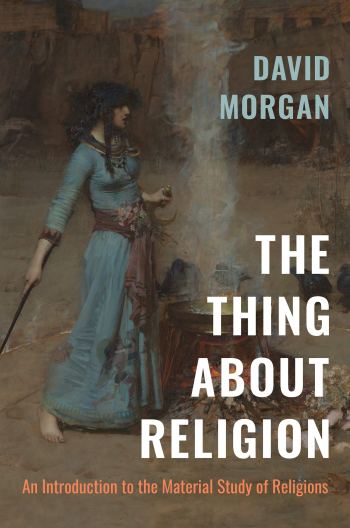 Common views of religion typically focus on the beliefs and meanings derived from revealed scriptures, ideas, and doctrines. David Morgan has led the way in broadening that framework to encompass the understanding that religions are fundamentally embodied, material forms of practice. This concise primer shows readers how to study what has come to be termed material religion—the ways religious meaning is enacted in the material world. Material religion includes the things people wear, eat, sing, touch, look at, create, and avoid. It also encompasses the places where religion and the social realities of everyday life, including gender, class, and race, intersect in physical ways. This interdisciplinary approach brings religious studies into conversation with art history, anthropology, and other fields. In the book, Morgan lays out a range of theories, terms, and concepts and shows how they work together to center materiality in the study of religion. Integrating visual evidence, he then applies these ideas and methods to case studies across a variety of religious traditions, modeling step-by-step analysis and emphasizing the importance of historical context.
David Morgan is professor of religious studies and art, art history, and visual studies at Duke University. His most recent book is Images at Work: The Material Culture of Enchantment.
C O N T E N T S
Acknowledgments
Introduction: How Materiality Matters to the Study of Religion
Part I. Theories and Definitions
1 How Some Theories of Religion Dematerialize It
2 What Is the Material Study of Religion?
3 How Religions Happen Materially
Part II. Studying Material Religion
4 The Power of Things: A History of Magic Wands
5 Notre-Dame de Paris: Religion and Time
6 Words and Things
Conclusion: Things, Networks, and Agents
Resources for Classroom Use
Primary Texts, Key Terms, and Online Resources
Writing Guide
Bibliography to Support Student Research
Notes
Index
New Book | A Companion to Viceregal Mexico City, 1519–1821
From Brill:
John López, ed., A Companion to Viceregal Mexico City, 1519–1821 (Leiden: Brill, 2021), 470 pages, ISBN: 978-9004335561, €233 / $280. Volume 3 in Brill’s Companions to the Americas series.
 This book presents a historical overview of colonial Mexico City and the important role it played in the creation of the early modern Hispanic world. Organized into five sections, an interdisciplinary and international team of twenty scholars scrutinize the nature and character of Mexico City through the study of its history and society, religious practices, institutions, arts, and scientific, cartographic, and environmental endeavors.
The Companion ultimately shows how viceregal Mexico City had a deep sense of history, drawing from all that the ancient Americas, Europe, Asia, and Africa offered but where history, culture, and identity twisted and turned in extraordinary fashion to forge a new society.
John F. López (Ph.D., Massachusetts Institute of Technology, 2013) is Assistant Professor of Early Modern European and Latin American art and architecture at the University of California, Davis. López has authored numerous articles and has edited special issues for Ethnohistory, Latin American Geography, and Monumentos históricos.
C O N T E N T S
List of Figures and Tables
Archival and Image Repositories
Notes on Contributors
Acknowledgements
John F. López — Introduction: Viceregal Mexico City, Colonial Cosmopolitanism, and the Hispanic World
Part 1. History and Society
1 Matthew Restall — Fear, Wonder, and Absence: Our Distorted View of Moctezuma’s Tenochtitlan
2 Luis Fernando Granados — The Weirdest of All? Indigenous Peoples and Polities of Colonial Mexico City
3 Joan C. Bristol — Blackness and Blurred Boundaries in Mexico City
4 Sonya Lipsett-Rivera — Of Pleasures and Proscriptions: Or How Residents of Mexico City Negotiated Gender and Family Norms
5 Frances L. Ramos — War, Legitimacy, and Ceremony in 18th-Century Mexico City: The Annual Funerary Honors for Fallen Soldiers
Part 2. Religious Life
6 Antonio Rubial García — City of Friars, City of Archbishops: The Church in Mexico City in the Age of the Hapsburgs
7 Alejandro Cañeque — The Cabildo of Mexico City, Patron Saints, and the Making of Local and Imperial Identities
8 Cristina Cruz González — Visualizing Corporate Piety: The Art of Religious Brotherhoods
Part 3. Institutions
9 Iván Escamilla González — Permanence and Change in Mexico City’s Viceregal Court, 1535–1821
10 María del Pilar and Martínez López-Cano — Finance and Credit in Viceregal Mexico City
11 Enrique González González — Uneven Chances: Education in Colonial Mexico City
12 Paula S. De Vos — Medicine and Municipal Rights in Viceregal Mexico City
Part 4. Special Themes
13 Barbara E. Mundy — The Urban Plans of Mexico City, 1520–1810
14 John F. Lopez — The Desagüe’s Watermark: Cartography and Environmental Crisis at Viceregal Mexico City
15 Miruna Achim — Urban Science in 18th-Century Mexico City
Part 5. The Arts
16 Kelly Donahue-Wallace — A Culture of Print in Viceregal Mexico City
17 Martha Lilia Tenorio — Novohispanic Baroque Poetry: A Lyric Chronicle of Mexico City
18 Jesús A. Ramos-Kittrell — Music and Literature in New Spain: The Politics of Buen Gusto in 18th-Century Mexico City
19 Amy C. Hamman and Stacie G. Widdifield — The Royal Academy of San Carlos, 1781–1800
Index










leave a comment