New Book | Dandy Style
The related exhibition is scheduled to open later at the Manchester Art Gallery, but the publication, from Yale UP, is available now:
Shaun Cole and Miles Lambert, Dandy Style: 250 Years of British Men’s Fashion (New Have: Yale University Press, 2021), 168 pages, ISBN: 978-0300254136, $35.
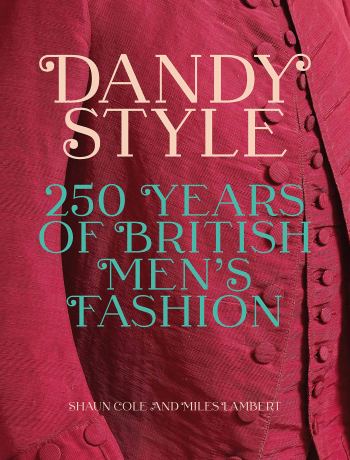 Celebrating 250 years of male self-expression, investigating the portraiture and wardrobe of the fashionable British man
The style of the dandy is elegant but bold—dedicated to the perfection of taste. This meticulously choreographed look has a vibrant history; the legacy of Beau Brummell, the original dandy of Regency England, can be traced in the clothing of urban dandies today. Dandy Style celebrates 250 years of male self-expression, investigating the portraiture and wardrobe of the fashionable British man. Combining fashion, art, and photography, the historic and the contemporary, the provocative and the respectable, it considers key themes in the development of male style and identity, including elegance, uniformity, and spectacle. Various types of dandy are represented by iconic figures such as Oscar Wilde, Edward VIII as Prince of Wales, and Gilbert & George. They appear alongside the seminal designs of Vivienne Westwood, Ozwald Boateng, and Alexander McQueen; and portraits by Thomas Gainsborough and David Hockney.
Shaun Cole is associate professor in fashion at Winchester School of Art, University of Southampton. Miles Lambert is curator of costume at Manchester Art Gallery.
C O N T E N T S
Christopher Breward — Foreword: Dandy Style
Alistair Hudson — Director’s Preface
Shaun Cole and Miles Lambert — Introduction
1 Miles Lambert — Creative Collecting: How Museums Acquire Men’s Fashion
2 Ben Whyman — The Life Stories of Men’s Clothes
3 Joshua M. Bluteau — The Devil Is in the Detail: Why Men Still Wear Suits
4 Shaun Cole, Miles Lambert, and Rebecca Milner — Painting Men’s Style: Portraying an Image
5 Kate Dorney — Performing the Dandy
6 Miles Lambert — Extravagance and Flamboyance: Decorated Men’s Fashion
7 Shaun Cole — Casual Subversion
8 Jay McCauley Bowstead — Contemporary British Menswear: Hybridity, Flux, and Globalisation
Notes
Select Bibliography
Index
Acknowledgments
List of Contributors
New Book | Material Lives: Women Makers and Consumer Culture
From Bloomsbury:
Serena Dyer, Material Lives: Women Makers and Consumer Culture in the 18th Century (London: Bloomsbury Visual Arts, 2021), 272 pages, ISBN: 978-1350126978 (hardcover), £80 / ISBN: 978-1350126961 (paperback), £27.
 Eighteenth-century women told their life stories through making. With its compelling stories of women’s material experiences and practices, Material Lives offers a new perspective on eighteenth-century production and consumption. Genteel women’s making has traditionally been seen as decorative, trivial and superficial. Yet their material archives, forged through fabric samples, watercolours, dressed prints and dolls’ garments, reveal how women used the material culture of making to record and navigate their lives.
Material Lives positions women as ‘makers’ in a consumer society. Through fragments of fabric and paper, Dyer explores an innovative way of accessing the lives of otherwise obscured women. For researchers and students of material culture, dress history, consumption, gender and women’s history, it offers a rich resource to illuminate the power of needles, paintbrushes and scissors.
Serena Dyer is Lecturer in History of Design and Material Culture at De Montfort University. She has taught at the University of Warwick and the University of Hertfordshire, and was Postdoctoral Fellow at the Paul Mellon Centre for Studies in British Art. She was previously Curator of the Museum of Domestic Design and Architecture. She has published on albums, wallpaper, consumer culture, and childhood in the eighteenth century.
C O N T E N T S
List of Illustrations
List of Charts and Tables
Acknowledgements
List of Abbreviations
1 Introduction: Making Material Lives
• Material Life Writing
• The Consumer Culture of Making
• Four Material Lives
2 Material Accounting: A Sartorial Account Book
• Barbara Johnson (1738–1825)
• Educating Barbara Johnson
• Accounting for Herself
• Material Literacy
• A Chronicle of Fashion
3 Dress of the Year: Watercolours
• Ann Frankland Lewis (1757–1842)
• Sartorial Timekeeping and the Fashion Plate
• Accomplishment and Creative Practice
• Society and Fashionable Display
• Selfhood, Emotion, and the Mourning Watercolours
4 Adorned in Silk: Dressed Prints
• Sabine Winn (1734–1798)
• Paper Textiles, Dress and the Dressed Print
• Sabine Winn’s Dressed Prints
• Print and Making at Nostell
5 Fashions in Miniature: Dolls
• Laetitia Powell (1741–1801)
• The Powell Dolls
• Mimetic Dolls and Miniature Selves
• Dolls as Sartorial Social Narrators
6 Conclusion: Material Afterlives
Glossary
Bibliography
Index
New Book | Dress Codes
From Simon & Schuster:
Richard Thompson Ford, Dress Codes: How the Laws of Fashion Made History (New York: Simon & Schuster, 2021), 464 pages, ISBN: 978-1501180064, $30.
 Dress codes are as old as clothing itself. For centuries, clothing has been a wearable status symbol; fashion, a weapon in struggles for social change; and dress codes, a way to maintain political control. Merchants who dressed like princes and butchers’ wives wearing gem-encrusted crowns were public enemies in medieval societies structured by social hierarchy and defined by spectacle. In Tudor England, silk, velvet, and fur were reserved for the nobility and ballooning pants called “trunk hose” could be considered a menace to good order. The Renaissance era Florentine patriarch Cosimo de Medici captured the power of fashion and dress codes when he remarked, “One can make a gentleman from two yards of red cloth.” Dress codes evolved along with the social and political ideals of the day, but they always reflected struggles for power and status. In the 1700s, South Carolina’s “Negro Act” made it illegal for Black people to dress “above their condition.” In the 1920s, the bobbed hair and form-fitting dresses worn by free-spirited flappers were banned in workplaces throughout the United States and in the 1940s the baggy zoot suits favored by Black and Latino men caused riots in cities from coast to coast.
Even in today’s more informal world, dress codes still determine what we wear, when we wear it—and what our clothing means. People lose their jobs for wearing braided hair, long fingernails, large earrings, beards, and tattoos or refusing to wear a suit and tie or make-up and high heels. In some cities, wearing sagging pants is a crime. And even when there are no written rules, implicit dress codes still influence opportunities and social mobility. Silicon Valley CEOs wear t-shirts and flip flops, setting the tone for an entire industry: women wearing fashionable dresses or high heels face ridicule in the tech world, and some venture capitalists refuse to invest in any company run by someone wearing a suit.
In Dress Codes, law professor and cultural critic Richard Thompson Ford presents an insightful and entertaining history of the laws of fashion from the middle ages to the present day, a walk down history’s red carpet to uncover and examine the canons, mores, and customs of clothing—rules that we often take for granted.
Richard Thompson Ford is a Professor at Stanford Law School. He has written about law, social and cultural issues, and race relations for The New York Times, The Washington Post, San Francisco Chronicle, and Slate, and has appeared on The Colbert Report and The Rachel Maddow Show. He is the author of The New York Times notable books The Race Card and Rights Gone Wrong: How Law Corrupts the Struggle for Equality. He lives in San Francisco.
New Book | Gainsborough in London
Distributed for Modern Art Press by Yale UP:
Susan Sloman, Gainsborough in London (London: Modern Art Press, 2021), 412 pages, ISBN: 978-0956800787, £35 / $45.
 Thomas Gainsborough’s (1727–1788) London years, from 1774 to 1788, were the pinnacle and conclusion of his career. They coincided with the establishment of the Royal Academy, of which Gainsborough was a founding member, and the city’s ascendance as a center for the arts. This is a meticulously researched and readable account of how Gainsborough designed his home and studio and maintained a growing schedule of influential patrons, making a place for himself in the art world of late-18th-century London. New material about Gainsborough’s technique is based on examinations of his pictures and firsthand accounts by studio visitors. His fractious relationship with the Royal Academy and its exhibition culture is reexamined through the works he sent to its annual shows. The full range of Gainsborough’s art, from fashionable portraits to landscapes and fancy pictures, is addressed in this major contribution, not just to the study of a great artist, but to 18th-century studies in general.
Susan Sloman is an independent scholar and curator specialising in eighteenth-century studies. Gainsborough in London is the follow-up to her previous book, Gainsborough in Bath.
For more information, see Dr. Sloman’s posting at the Yale Books Blog.
New Book | Dangerous to Show: Byron and His Portraits
Distributed in the US and Canada by The University of Chicago Press:
Geoffrey Bond and Christine Kenyon Jones, Dangerous to Show: Byron and His Portraits (London: Unicorn Publishing Group, 2020), 160 pages, ISBN: 978-1912690718, £25 / $38.
 “Don’t look at him. He is dangerous to look at,” said Lady Liddell to her daughter in 1817. Handsome, charismatic, aristocratic, and allegedly “mad, bad and dangerous to know,” Lord Byron (1788–1824) is one of the most captivating and recognizable figures of the Romantic Age. His face, figure, and appearance added to the appeal of his poetry, and the close association of the man with his poetic creations encouraged a wide range of artists to create portraits during his lifetime and to memorialize him after his heroic death in Greece.
The first work on the subjects of the portraits of the poet, and written by two authorities on the subject, Dangerous to Show explores Byron’s life through the intriguing stories behind one hundred of these images. Reproduced in color for the first time, we can explore the key paintings, miniatures, sculptures, drawings, and sketches, along with a selection of prints, cartoons, engravings, and other representations of the artist. The book uses Byron’s own wit with words to recount his attempts to manage his own image through the way he was presented in his portraits, as well as through fashion, weight control, and the disguise of his lameness.
Christine Kenyon Jones is a writer and lecturer, and an expert on Lord Byron and the Romantic period. She has been published widely on Byron’s image and his portraiture; on his politics and his pronunciation; on his disability and his dieting; on his relationship with his publisher John Murray, his religious background and his afterlife as a science-fiction character. Her book Kindred Brutes is a study of animals in the Romantic period, in which Byron figures largely. She has also written, lectured and broadcast widely about the Regency period and Jane Austen. She is a Research Fellow in the Department of English at King’s College London.
Geoffrey Bond is a polymath, having had careers as a solicitor, businessman, and broadcaster. His special interests now are the creation and promotion of education initiatives for young people in the heritage, law and engineering sectors. He has written and lectured on heritage matters and chaired a variety of heritage organisations at regional and national level. A collector and antiquarian, living in an historic house, he is a Fellow and former member of the council of the Antiquaries Society of London. He has one of the best collections of Byron first editions and Byron memorabilia in the country.
New Book | Minerva’s French Sisters
Professor Gelbart will be discussing her book this Thursday, 27 May, at 6pm (ET), in an online session hosted by The Athenaeum of Philadelphia. From Yale UP:
Nina Rattner Gelbart, Minerva’s French Sisters: Women of Science in Enlightenment France (New Haven: Yale University Press, 2021), 360 pages, ISBN: 978-0300252569, $40.
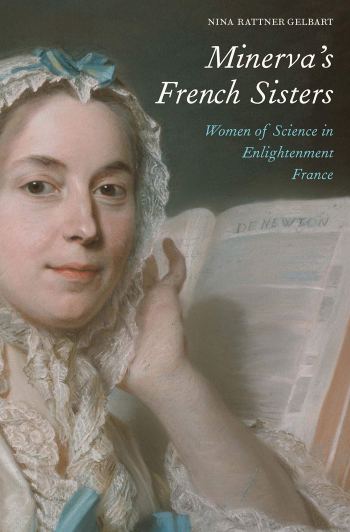 A fascinating collective biography of six female scientists in eighteenth-century France, whose stories were largely written out of history
This book presents the stories of six intrepid Frenchwomen of science in the Enlightenment whose accomplishments—though celebrated in their lifetimes—have been generally omitted from subsequent studies of their period: mathematician and philosopher Elisabeth Ferrand, astronomer Nicole Reine Lepaute, field naturalist Jeanne Barret, garden botanist and illustrator Madeleine Françoise Basseporte, anatomist and inventor Marie-Marguerite Biheron, and chemist Geneviève d’Arconville. By adjusting our lens, we can find them.
In a society where science was not yet an established profession for men, much less women, these six audacious and inspiring figures made their mark on their respective fields of science and on Enlightenment society, as they defied gender expectations and conventional norms. Their boldness and contributions to science were appreciated by such luminaries as Franklin, the philosophes, and many European monarchs. The book is written in an unorthodox style to match the women’s breaking of boundaries.
Nina Rattner Gelbart is professor of history and Anita Johnson Wand Professor of Women’s Studies at Occidental College. Her previous books include Feminine and Opposition Journalism in Old Regime France and The King’s Midwife: A History and Mystery of Madame du Coudray.
C O N T E N T S
Acknowledgments
Chronology
Actors in a Supporting Role
Introduction: A Sextet of Firsts, Variations on a Theme
Interlude: Letter to Elisabeth, Reine, Jeanne, Madeleine Françoise, Marie-Marguerite, and Geneviève
1 Mathematician and Philosopher: The ‘Celebrated Mlle Ferrand’ (1700–1752)
Interlude: Letter to Elisabeth
2 Astronomer and ‘Learned Calculator’: Nicole Reine Lepaute (1723–1788)
Interlude: Letter to Reine
3 Botany in the Field and in the Garden: Jeanne Baret (1740–1807) and Madeleine Françoise Basseporte (1701–1780)
Interlude: Letters to Jeanne and Madeleine Françoise
4 Anatomist and Inventor: Marie-Marguerite Biheron and Her Medical Museum (1719–1795)
Interlude: Letter to Marie-Marguerite
5 Chemist and Experimentalist: Marie Geneviève Charlotte Thiroux d’Arconville and Her Choice of Anonymity (1720–1805)
Interlude: Letter to Geneviève
Epilogue
Notes
Index
New Book | Copley and West in England, 1775–1815
Distributed by Paul Holberton Publishing and The University of Chicago Press:
Allen Staley, Copley and West in England, 1775–1815 (London: Burlington Press, 2021), 176 pages, ISBN: 978-1916237803, £35 / $45.
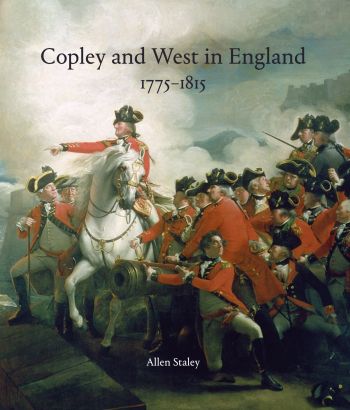 This beautifully and thoroughly illustrated book, which constitutes the first serious investigation of the relationship between Benjamin West and John Singleton Copley, will be of considerable interest to both British and American art historians, and appeal to art lovers from both countries.
West and Copley have always and properly been viewed as the two pre-eminent eighteenth-century American artists, despite the fact that, at the age of twenty-one, West left his native shores in 1760, never to return. He went on to become immensely successful in England, becoming, among other things, the second president of the Royal Academy of Arts. Copley spent half his working life also in England. However, before making the move across the Atlantic, he made his mark as an exceptionally talented artist, who, without any real training, painted likenesses of fellow Bostonians, including ones of figures such as John Hancock and Paul Revere, that have become icons of American history. While those portraits remain his most widely admired works, after 1775 and his resettling in England, he started painting distinctly different types of pictures, initially showing modern historical subjects in emulation of the model provided him by West, following, for example, West’s celebrated Death of General Wolfe, exhibited in 1771, with his own Death of the Earl of Chatham, begun in 1779. For a brief span of time, the two expatriate Americans had a close working relationship, that we can see substantially reflected in both the formal language and the subject matter of many of their best works, but it eventually and inevitably turned into rivalry.
The book begins with a brief prologue discussing the earliest of West’s depictions of recent historical events and of subjects set in America, painted prior to Copley’s arrival in England. It then follows the year-by-year evolution of Copley’s painting from 1775 to his death in 1815, with an underlying focus upon his ongoing give-and-take with West. It ends with examination of hitherto little-known and unstudied major late paintings, from after 1800, by both artists.
Allen Staley is Professor Emeritus of Art History at Columbia University, where he taught for more than thirty years. Prior to Columbia he worked at the Frick Collection in New York and as an assistant curator at the Philadelphia Museum of Art. His engagement with Benjamin West began in Philadelphia with an article about an oil sketch by West, published in the museum’s bulletin in 1965. In 1975 he took on the task of completing the monumental catalogue of West’s paintings begun by the late Helmut von Erff, which led him to think about the artist’s influence upon the work of his compatriot and exact contemporary Copley. The book, after a decade’s labor, saw publication in 1986. His other significant books are The Pre-Raphaelite Landscape, published in 1973 with a second edition in 2001, and The New Painting of the 1860s: Between the Pre-Raphaelites and the Aesthetic Movement, published in 2011, both products of long-standing love and study of English Victorian painting. In addition to writing countless reviews and articles—the first in The Burlington Magazine in 1963—he has organized or shared in organizing and writing the catalogues of numerous exhibitions.
New Book | Art and Industry
Distributed in the US and Canada by The University of Chicago Press:
David Stacey, Art and Industry: Seven Artists in Search of an Industrial Revolution in Britain (London: Unicorn Publishing Group, 2021), 176 pages, ISBN: 978-1913491291, £25 / $38.
 In seven linked essays, the author discusses paintings of industrial scenes by seven artists working in the period 1780–1830. Their unique and distinct responses to the subject-matter reveal a surprisingly coherent message. Joseph Wright of Derby invites us to consider the lives of the men, women and children working in Arkwright’s cotton mills at Cromford. John Opie, in his painting of a Cornish entrepreneur and a miner, acknowledges the value of new technology but leads us to reflect on class and the use of capital. Philippe-Jacques de Loutherbourg responds to the sublimity of the industrial landscape at Coalbrookdale but reveals the impact of an industry no longer subject to nature’s diurnal rhythms. Joseph Mallord William Turner presents an evolving response to the changes that Britain was undergoing. He observes with delight the opening up of pastoral scenery along the new canal routes but prompts the viewer to consider the environmental impact of industrial development. William Havell finds copper-mining employees in a place between heaven and hell in an industry subject to competition and the vagaries of demand. Penry Williams, in his paintings of ironworks at Merthyr Tydfil, raises the issue of the conditions that ironworkers and miners were facing as the gap widened between employer and employee. And the little-known and often-derided Henry Hawkins produces an image which lifts the lid on his slave-owning patron’s enterprise through an image of a slate quarry which suggests parallels with Dante’s Divine Comedy. Seven artists in search of an industrial revolution in Britain respond in their works with a coherent message on the impact of new technology, the use of capital and on conditions that saw the emergence of new social classes in Britain.
David Stacey is an independent art historian with a lifelong interest in British paintings of the eighteenth and nineteenth centuries. He has contributed articles to The British Art Journal, The Burlington Magazine, and other art history journals. He graduated with a degree in engineering science from the University of Oxford and has a postgraduate degree in the history of art from Birkbeck College, University of London. He has worked as an international water resources consultant in South and South-East Asia and the Middle East and is a Fellow of the Institution of Civil Engineers. He has two children and lives in London.
New Book and Podcast | 125 Treasures
Hubert Martinet, Elephant Automaton, ca. 1770
(National Trust / Waddesdon Manor)
◊ ◊ ◊ ◊ ◊
In addition to this book celebrating the 125th anniversary of the National Trust (in 2020), the project includes a podcast, hosted by Alison Steadman, the first episode of which addresses Waddesdon Manor’s Elephant Automaton, made by Hubert Martinet (ca. 1770). Tessa Murdoch writes about the elephant for Apollo Magazine (14 May 2021), noting that “an in-depth study of the automaton, written by Jonathan Betts and Roger Smith, is also forthcoming.”
◊ ◊ ◊ ◊ ◊
Tarnya Cooper, 125 Treasures from the Collections of the National Trust (Swindon: National Trust Books, 2021), 224 pages, ISBN: 978-0707804538, £10.
 This engaging, beautifully illustrated book brings together a selection of highlights from the National Trust’s vast collection. Arranged chronologically, starting with Roman sculpture and ending with 20th-century design, it focuses on museum-quality objects as well as important examples of decorative arts, furniture, textiles and objects with fascinating stories. The highlights—from Cardinal Wolsey’s purse to Rodin’s bust of George Bernard Shaw—are illustrated with exquisite photography and accompanied by illuminating captions. Based on the dedicated research of over 60 curators across the organisation, the book also includes a timeline of key moments in the Trust’s history.
Tarnya Cooper is the Curatorial and Collections Director at the National Trust.
New Book | William Blake’s Printed Paintings
Distributed by Yale University Press:
Joseph Viscomi, William Blake’s Printed Paintings: Methods, Origins, Meanings (London: Paul Mellon Centre for Studies in British Art, 2021), 256 pages, ISBN: 978-1913107208, £40 / $50.
 An in-depth examination of William Blake’s glorious and acclaimed series of twelve monoprints
Among William Blake’s (1757–1827) most widely recognized and highly regarded works as an artist are twelve color printed drawings, or monoprints, conceived and executed in 1795. This book investigates these masterworks, explaining Blake’s technique—one he essentially reinvented, unaware of 17th-century precursors—to show that these works were produced as paintings, and played a crucial role in Blake’s development as a painter. Using material and historical analyses, Joseph Viscomi argues that the monoprints were created as autonomous paintings rather than as illustrations for Blake’s books with an intended viewing order. Enlivened with bountiful illustrations, the text approaches the works within the context of their time, not divorced from ideas expressed in Blake’s writings but not illustrative of or determined by those writings.
Joseph Viscomi is James G. Kenan Distinguished Professor of English Literature at the University of North Carolina at Chapel Hill.










 Enfilade
leave a comment