Exhibition | British Stories

Johan Zoffany, The Triumph of Venus (Vénus sur les eaux), ca. 1760, oil on canvas
(Musée des Beaux-Arts de Bordeaux). More information is available here.
◊ ◊ ◊ ◊ ◊
This summer the Musée des Beaux-Arts in Bordeaux, as part of ‘A British Year at the Museum’, presents two exhibitions: British Stories and Absolutely Bizarre! Strange Tales from the Bristol School of Artists, 1800–1840.
British Stories
Musée des Beaux-Arts de Bordeaux, 19 May — 19 September 2021
Organized by Sophie Barthélémy, Sandra Buratti-Hasan, and Guillaume Faroult
The British art collections held by the Bordeaux Museum of Fine Arts form a coherent corpus of thirty paintings, drawings, prints, and sculptures. This exhibition is an occasion to admire them all and compare them with works loaned by the Louvre.
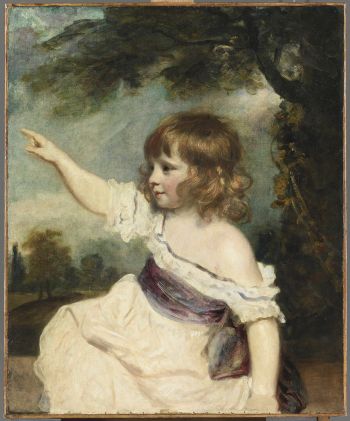
Joshua Reynolds, Portrait of Francis George Hare (1786–1842), ‘Master Hare’, ca. 1788–89, oil on canvas (Paris: Musée du Louvre, RF 1580).
A significant portion of the exhibition is dedicated to portraiture, a genre in which British painters excelled. In the 17th century, Flemish painter Anthony van Dyck was invited to stay at the Court of Charles I of England during the last decade of his career, a period that was a pivotal moment in the development of European portrait art whose conventions van Dyck reinvented (modello of the Double Portrait of the Palatinate Princes Charles Louis I and Prince Rupert, Museum of Fine Arts, Bordeaux). Among his most famous heirs we can mention Sir Joshua Reynolds, represented by his celebrated ‘Master Hare’ (Louvre) and his Portrait of Richard Robinson, Archbishop of Armagh (Museum of Fine Arts, Bordeaux). This survey of British portraiture culminates with the Portrait of John Hunter by Sir Thomas Lawrence (Museum of Fine Arts, Bordeaux).
In the history painting genre, the exhibition gives a special place to artists under-represented in French public collections, namely James Ward, with his superb Baptism of Christ (Louvre), Benjamin West (Phaeton Asking Apollo to Drive the Sun Chariot, Louvre), and Johan Zoffany (The Triumph of Venus and Venus and Adonis, Museum of Fine Arts, Bordeaux). The typically British genre, the conversation piece, is also represented, along with landscape, the latter dominated by the dramatic canvas by John Martin of Macbeth and the Three Witches (Museum of Fine Arts, Bordeaux).
The Museum of Fine Arts and its close partner the Louvre look forward to taking viewers on a fascinating journey of paintings from across the Channel, on an itinerary through the most significant works of art by generations of innovative, inquisitive, and daring artists.
Sandra Buratti-Hasan and Guillaume Faroult, British Stories: Conversations entre le musée du Louvre et des Beaux-Arts de Bordeaux (Paris: Snoeck Édition, 2021), 32 pages, ISBN: 978-9461616302, 10€.
New Book | Resounding the Sublime
From Penn Press:
Miranda Eva Stanyon, Resounding the Sublime: Music in English and German Literature and Aesthetic Theory, 1670–1850 (Philadelphia: University of Pennsylvania Press, 2020), 304 pages, ISBN: 978-0812253085, $75.
 What does the sublime sound like? Harmonious, discordant, noisy, rustling, silent? Miranda Eva Stanyon rereads and resounds this crucial aesthetic category in English and German literatures of the long eighteenth century from a musical perspective and shows how sonorous sublimes lay at the heart of a central and transformative discourse. For Enlightenment and Romantic era listeners, the musical sublime represented a sonic encounter of the most extreme kind, one that tested what humans were capable of feeling, imagining, thinking, and therefore becoming.
The sublime and music have not always sung from the same hymn sheet, Stanyon observes. She charts an antagonistic intimacy between the two, from the sublime’s rise to prominence in the later seventeenth century, through the upheavals associated with Kant in the late eighteenth century, and their reverberations in the nineteenth. Offering readings of canonical texts by Longinus, Dryden, Burke, Klopstock, Herder, Coleridge, De Quincey, and others alongside lesser-known figures, she shows how the literary sublime was inextricable from musical culture, from folksongs and ballads to psalmody, polychoral sacred music, and opera. Deeply interdisciplinary, Resounding the Sublime draws literature into dialogue with sound studies, musicology, and intellectual and cultural history to offer new perspectives on the sublime as a phenomenon which crossed media, disciplines, and cultures.
An interdisciplinary study of sound in history, the book recovers varieties of the sublime crucial for understanding both the period it covers and the genealogy of modern and postmodern aesthetic discourses. In resounding the sublime, Stanyon reveals a phenomenon which was always already resonant. The sublime emerges not only as the aesthetic of the violently powerful, a-rational, or unrepresentable, but as a variegated discourse with competing dissonant, harmonious, rustling, noisy, and silent strains, one in which music and sound illustrate deep divisions over issues of power, reason, and representation.
Miranda Eva Stanyon is Lecturer in Comparative Literature at King’s College London and Research Fellow in English Literature at the University of Melbourne.
C O N T E N T S
List of Abbreviations
Note on Translations and References
Introduction
Part I. He Rais’d a Mortal to the Skies; She Drew an Angel Down: English Literature, ca. 1670–1760
1 Music as a ‘Bastard Imitation of Persuasion’? Power and Legitimacy in Dryden and Dennis
2 ‘What Passion Cannot Musick Raise and Quell!’ Passionate and Dispassionate Sublimity with the Hillarians and Handelians
Part II. Hissing Snakes and Angelic Hosts: German Literature, ca. 1720–1770
3 Reforming Aesthetics: Bodmer and Breitinger’s Anti-Musical Sublime
4 Klopstock, Rustling, and the Antiphonal Sublime
Part III. Sublime Beauty and the Wrath of the Organ: English and German Literature, ca. 1770–1850
5 The Beauty of the Infinite: Herder’s Sublimely-Beautiful, Beautifully-Sublime Music
6 The Terror of the Infinite: Thomas De Quincy’s Reverberations
Conclusion
Notes
Bibliography
Index
Acknowledgements
New Book | The Sculpted Ear
From The Pennsylvania State UP:
Ryan McCormack, The Sculpted Ear: Aurality and Statuary in the West (University Park: Penn State University Press, 2020), 224 pages, ISBN: 978-0271086927 (hardcover), $90 / ISBN: 978-0271086934 (paperback), $33.
 Sound and statuary have had a complicated relationship in Western aesthetic thought since antiquity. Taking as its focus the sounding statue—a type of anthropocentric statue that invites the viewer to imagine sounds the statue might make—The Sculpted Ear rethinks this relationship in light of discourses on aurality emerging within the field of sound studies. Ryan McCormack argues that the sounding statue is best thought of not as an aesthetic object but as an event heard by people and subsequently conceptualized into being through acts of writing and performance.
Constructing a history in which hearing plays an integral role in ideas about anthropocentric statuary, McCormack begins with the ancient sculpture of Laocoön before moving to a discussion of the early modern automaton known as Tipu’s Tiger and the statue of the Commendatore in Mozart’s Don Giovanni. Finally, he examines statues of people from the present and the past, including the singer Josephine Baker, the violinist Aleksandar Nikolov, and the actor Bob Newhart—with each case touching on some of the issues that have historically plagued the aesthetic viability of the sounding statue. McCormack convincingly demonstrates how sounding statues have served as important precursors and continuing contributors to modern ideas about the ontology of sound, technologies of sound reproduction, and performance practices blurring traditional divides between music, sculpture, and the other arts.
A compelling narrative that illuminates the stories of individual sculptural objects and the audiences that hear them, this book will appeal to anyone interested in the connections between aurality and statues in the Western world, in particular scholars and students of sound studies and sensory history.
Ryan McCormack is a writer and independent scholar based in Knoxville, Tennessee.
C O N T E N T S
Acknowledgments
Introduction: Elvis Leaves the Building
1 Animation Introduces Animation
2 Breathing Voice into Laocoön’s Mouth
3 Imperial Possessions
4 Hearing a Stone Man
5 Aural Skins
6 Now You Have to Go, Comrade
7 Museums of Resonance
Conclusion: I Now Present Sergei Rachmaninoff
Notes
Bibliography
Index
New Book | A Sensory History Manifesto
From The Pennsylvania State UP:
Mark Smith, A Sensory History Manifesto (University Park: Penn State University Press, 2021), 128 pages, ISBN: 978-0271090177 (hardcover), $70 / ISBN: 978-0271090184 (paperback), $22.
 A Sensory History Manifesto is a brief and timely meditation on the state of the field. It invites historians who are unfamiliar with sensory history to adopt some of its insights and practices, and it urges current practitioners to think in new ways about writing histories of the senses.
Starting from the premise that the sensorium is a historical formation, Mark Smith traces the origins of historical work on the senses long before the emergence of the field now called ‘sensory history’, interrogating, exploring, and in some cases recovering pioneering work on the topic. Smith argues that we are at an important moment in the writing of the history of the senses, and he explains the potential that this field holds for the study of history generally. In addition to highlighting the strengths of current work in sensory history, Smith also identifies some of its shortcomings. If sensory history provides historians of all persuasions, times, and places a useful and incisive way to write about the past, it also challenges current practitioners to think more carefully about the historicity of the senses and the desirability—even the urgency—of engaged and sustained debate among themselves. In this way, A Sensory History Manifesto invites scholars to think about how their field needs to evolve if the real interpretive dividends of sensory history are to be realized.
Mark M. Smith is Carolina Distinguished Professor of History at the University of South Carolina. An award-winning author of more than a dozen books, his work has been translated into Chinese, Korean, German, Danish, and Spanish.
C O N T E N T S
Acknowledgments
Introduction
1 Past
2 Present
3 Future
Notes
Bibliography
Index
New Book | How the Word Is Passed
From Little, Brown, and Company:
Clint Smith, How the Word Is Passed: A Reckoning with the History of Slavery Across America (New York: Little, Brown, and Company, 2021), 352 pages, ISBN: 978-0316492935, $30.
 Beginning in his hometown of New Orleans, Clint Smith leads the reader on an unforgettable tour of monuments and landmarks—those that are honest about the past and those that are not—that offer an intergenerational story of how slavery has been central in shaping our nation’s collective history, and ourselves.
It is the story of the Monticello Plantation in Virginia, the estate where Thomas Jefferson wrote letters espousing the urgent need for liberty while enslaving more than four hundred people. It is the story of the Whitney Plantation, one of the only former plantations devoted to preserving the experience of the enslaved people whose lives and work sustained it. It is the story of Angola, a former plantation–turned–maximum-security prison in Louisiana that is filled with Black men who work across the 18,000-acre land for virtually no pay. And it is the story of Blandford Cemetery, the final resting place of tens of thousands of Confederate soldiers.
A deeply researched and transporting exploration of the legacy of slavery and its imprint on centuries of American history, How the Word Is Passed illustrates how some of our country’s most essential stories are hidden in plain view—whether in places we might drive by on our way to work, holidays such as Juneteenth, or entire neighborhoods like downtown Manhattan, where the brutal history of the trade in enslaved men, women, and children has been deeply imprinted.
Informed by scholarship and brought to life by the story of people living today, Smith’s debut work of nonfiction is a landmark of reflection and insight that offers a new understanding of the hopeful role that memory and history can play in making sense of our country and how it has come to be.
Clint Smith is a staff writer at The Atlantic. He is the author of the poetry collection Counting Descent, which book won the 2017 Literary Award for Best Poetry Book from the Black Caucus of the American Library Association and was a finalist for an NAACP Image Award. He has received fellowships from New America, the Emerson Collective, the Art For Justice Fund, Cave Canem, and the National Science Foundation. His writing has been published in The New Yorker, The New York Times Magazine, Poetry Magazine, The Paris Review, and elsewhere. Born and raised in New Orleans, he received his B.A. in English from Davidson College and his Ph.D. in Education from Harvard University.
New Book | Nature’s Palette
From Princeton UP:
Patrick Baty, with contributions by Elaine Charwat, Peter Davidson, André Karliczek, and Giulia Simonini, Nature’s Palette: A Color Reference System from the Natural World (Princeton: Princeton University Press, 2021), 288 pages, ISBN: 978-0691217048 $40.
 A gorgeous expanded edition of Werner’s Nomenclature of Colours, a landmark reference book on color and its origins in nature.
First published in 1814, Werner’s Nomenclature of Colours is a taxonomically organized guide to color in the natural world. Compiled by German geologist Abraham Gottlob Werner, the book was expanded and enhanced in 1821 by Patrick Syme, who added color swatches and further color descriptions, bringing the total number of classified hues to 110. The resulting resource has been invaluable not only to artists and designers but also to zoologists, botanists, mineralogists, anatomists, and explorers, including Charles Darwin on the famous voyage of the Beagle.
Nature’s Palette makes this remarkable volume available to today’s readers, and is now fully enhanced with new illustrations of all the animals, plants, and minerals Werner referenced alongside each color swatch. Readers can see ’tile red’ in a piece of porcelain jasper, the breast of a cock bullfinch, or a Shrubby Pimpernel. They can admire ‘Berlin blue’ on a piece of sapphire, the Hepatica flower, or the wing feathers of a jay. Interspersed throughout the book are lavish feature pages displaying cases of taxidermy, eggs, shells, feathers, minerals, and butterflies, with individual specimens cross-referenced to the core catalog.
Featuring contributions by leading natural history experts along with more than 1,000 color illustrations and eight gatefolds, Nature’s Palette is the ideal illustrated reference volume for visual artists, naturalists, and anyone who is captivated by color.
Patrick Baty is the author of The Anatomy of Colour and the owner of Papers and Paints, a specialist paint business in London. Elaine Charwat is a doctoral researcher at the Oxford University Museum of Natural History. Peter Davidson is senior curator of minerals at National Museums Scotland. André Karliczek is a member of the German Optical Museum and part of cultur3D, a project that models cultural assets in 3D. Giulia Simonini is a conservator, paleographer, and art historian.
C O N T E N T S
A Colour Reference System From the Natural World
Introduction — Patrick Baty, The Origins, Development, and Influence of Werner’s Nomenclature of Colours
Whites, Greys, and Blacks
1 Peter Davidson, Werner’s Mineralogical System and How His Nomenclature of Colours Became Syme’s Colour Standard
Blues and Purples
2 Elaine Charwat, Colours in Zoology: Subjectivity or Systematic?
Greens
3 Giulia Simonini, Syme’s Colour Chart in Botany: Origin and Impact
Yellows and Oranges
4 André Karliczek, One for All? Werner’s Nomenclature of Colours as a General Standard of Colour and Its Particular Use in Medicine
Reds and Browns
Reference for the Contemporary Printer, Artist, and Decorator
Bibliography
Sources of Illustrations
Index
Acknowledgments
Exhibition | Tables of Power: A History of Prestigious Meals

Jacques Roëttiers, Ornamental Centerpiece, Surtout de table, 1736 (Paris: Musée du Louvre). Additional information and exceptional details are available here.
◊ ◊ ◊ ◊ ◊
Comprised of five sections, the exhibition traces the history of elite dining conventions from ancient Mesopotamia and Egypt to the present. The fourth section focuses on eighteenth-century France.
Les tables du pouvoir: Une histoire des repas de prestige
Musée du Louvre-Lens, 19 May — 26 July 2021
Organized by Zeev Gourarier with Michèle Bimbenet-Privat, Hélène Bouillon, Alexandre Estaquet-Legrand, Christine Germain-Donnat, and Marie Lavandier
Chapitre 4 : du service à la française au service à la russe
 Le 18e inaugure de nouvelles manières d’envisager les plaisirs de la table. La forme trop protocolaire du Grand Couvert laisse si peu de place à la convivialité que, pour y échapper, on invente au sein des « petits appartements » à Versailles et dans les résidences privées du roi, la salle à manger puis la table à manger, de forme ronde. Dans le cadre des Soupers fins, on peut alors s’adonner en toute liberté et en bonne compagnie aux plaisirs d’une gastronomie en pleine effervescence. Le service offert par l’Impératrice Marie-Thérèse d’Autriche à Madame Geoffrin, qui tient l’un des plus célèbres salons artistiques et littéraires parisiens d’alors, rappelle l’atmosphère raffinée des repas consommés dans les toutes premières salles à manger au temps des Lumières.
À partir de 1740, la fabrique de Vincennes—transférée à Sèvres en 1756—met au point un procédé complexe de double cuisson qui permet d’obtenir une pâte onctueuse et translucide, la porcelaine tendre. L’exposition présente l’un des premiers services de table réalisés, à fond bleu céleste et décor de fleurs, offert à Louis XV. Ces pièces exceptionnelles font la renommée de la France dans toute l’Europe et créent une véritable diplomatie des services de Sèvres, abondamment offerts en cadeaux par le roi. Dès son instauration en 1804, le Premier Empire en devient un commanditaire majeur. Le Service Olympique fait partie des premiers services en porcelaine livrés à Napoléon. Il décore la table de fête au palais des Tuileries à l’occasion du mariage de son frère, Jérôme Bonaparte. La table du Cardinal Fesch, oncle de Napoléon, se déploie également au milieu du parcours. Sur un fond bleu lapis, imitant la pierre dure, le décor de portraits d’empereurs antiques à la manière des camées est un hommage subtil à Napoléon lui-même, qui lui offre ce service.
Au gré des régimes, la Manufacture de Sèvres habille les tables du pouvoir. À l’instar de la Présidence de la République, les ministères d’État disposent de leur propre vaisselle, passant commande aujourd’hui encore. Une table en miroir fait ainsi dialoguer le service des Départements (19e siècle) et son décor floral, au service Diane du ministère de la Culture, conçu vers 1960 et dont le décor est renouvelé en 2007 par l’artiste Fabrice Hyber.
 À sa création à la fin du 18e siècle, la manufacture royale du Danemark rejoint la prestigieuse compétition que se livrent les différentes manufactures de porcelaine d’Europe. Elle réalise l’un des plus surprenants et opulents services de table de cette époque, le Flora Danica. Composé de plus de 1800 pièces à l’origine, il aurait été initialement destiné à l’impératrice de Russie Catherine II, grande amatrice de porcelaine, mais n’est jamais livré. Les motifs s’inspirent directement des planches illustrées du Flora Danica (« Flore du Danemark »), et forment comme un grand atlas botanique, avec plantes, champignons et autres lichens. Le service est aujourd’hui encore utilisé à la cour du Danemark lors des grandes occasions.
Dans le cadre de la pièce désormais réservée aux repas, la salle à manger, l’ordonnance du repas continue d’évoluer pour aboutir en un siècle à notre service actuel, dit « service à la russe ». Ce nouveau dispositif témoigne des transformations des modes de vie et de la culture alimentaire au début du 19e siècle. Il implique un nouvel ordonnancement des mets. Les plats ne sont plus présentés de manière harmonieuse et foisonnante en services successifs, mais sont désormais servis individuellement, simultanément à tous les convives. Ces dispositions permettent notamment à tous de manger chaud et réduisent le nombre de domestiques autour de la table. Les verres se multiplient et ne sont plus disposés sur des dessertes mais sur la table, et les couverts individuels s’alignent autour de l’assiette—tels que nous les connaissons aujourd’hui.
Zeev Gourarier, ed., Les tables du pouvoir: Une histoire des repas de prestige (Paris: Réunion des musées nationaux, 2021), 320 pages, ISBN: 978-2711878635, 40€.
A list of contents is available here»
New Book | Visualising Protestant Monarchy
From Boydell and Brewer:
Julie Farguson, Visualising Protestant Monarchy: Ceremony, Art, and Politics after the Glorious Revolution, 1689–1714 (London: Boydell Press, 2021), 402 pages, ISBN: 978-1783275441 (hardcover), £75 / $99 and ISBN: 978-1787448179 (ebook) £20 / $25.
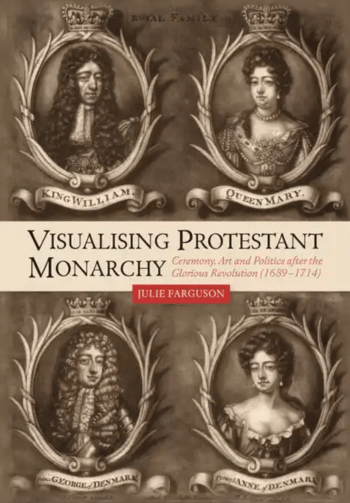 The first comprehensive, comparative study of the visual culture of monarchy in the reigns of William and Mary and Queen Anne
This book provides the first comprehensive, comparative study of the visual culture of monarchy in the reigns of William and Mary and Queen Anne. It makes innovative use of material evidence and new primary sources to re-evaluatethe practice of kingship and queenship to produce an original interpretation of the British monarchy during a period of vital transformation. The quarter century between the Glorious Revolution and the Georgian era witnessed prolonged military conflict with France and the birth of what we now call Great Britain. This book argues that a new style of monarchy likewise emerged in this period and that its survival largely depended on the efforts of the royal family: two English queens, a Dutch king, and a Danish prince.
Through a study of art and material culture (paintings, prints, the decorative arts, architecture, dress, and royal insignia) within the broader political context, the book explores how the English people were persuaded to transfer their loyalties from a traditional style of kingship, centred on ideas of divinely appointed rule and hereditary right, to one rooted in Protestantism and Parliament. The book argues that both ceremony and art played a vital role in the way the monarchy functioned after the Glorious Revolution. Crucially, it examines not only the production of images and use of ceremony but also the ways in which they were received by audiences, both in England and abroad. The book sets the on-going changes in the ideology of British monarchy within the wider context of royal politicking in Europe and pays close attention to gender and the practice of queenship as well as the ways in which military conflict shaped royal representational culture. Using a method that is centred on the visual—ceremonies and art—and on visuality, the study makes an original and important contribution to our understanding not only of the monarchy but also the political culture of the post-Glorious Revolution era.
Julie Farguson is College Lecturer in History at St Hilda’s College, Oxford.
C O N T E N T S
Introduction
• Establishing an Anglo-Dutch Royal Image, 1689–90: The Beginning of Stuart-Orange Kingship
• Anglo-Dutch Kingship and War, 1690–94: The Stuart-Orange Partnership in Action
• The Royal Image, 1695–1702: From Stuart Monarch to Orange King
• Transforming the Royal Image, 1702: Establishing Stuart-Oldenburg Kingship
• Military Affiliations, 1702–08: Stuart-Oldenburg Kingship and War
• The Royal Image, 1709–14: The Rise of Anna Augusta
Conclusion
Bibliography
New Book | Pots, Prints, and Politics
From Oxbow Books:
Patricia Ferguson, ed., Pots, Prints, and Politics: Ceramics with an Agenda, from the 14th to the 20th Century (London: The British Museum Press, 2021), 196 pages, ISBN: 978-0861592296, £40 / $80.
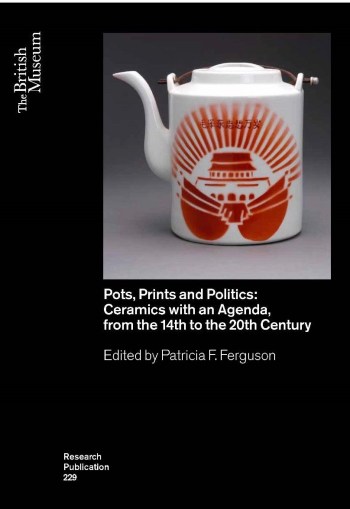 In this lavishly illustrated publication, 15 leading scholars challenge and interrogate a mixture of Asian and European ceramic objects—from teapots to chamber pots—bringing to light new meanings and agendas that are just as provocative now, as when they were made. The medium behind these messages are graphic sources. From Chinese woodblock prints to Japanese kyōka surimono (‘printed things’), and European copperplate engravings to chromolithographs, prints circulated ideas. Potters across time and cultures adapted these images into ceramic bodies or covered their surfaces with hand-painted or transfer-printed representations, giving expression to serious political and social issues: propaganda, self-promotion, piety, race, gender, national, and regional identities. Driven by commercial gain, altruism or imperial dictate, ceramic artists and manufacturers often risked their livelihoods, if not their lives, articulating their convictions.
The authors in this volume have explored these narratives on a variety of wares employing the British Museum’s world-renowned print collection as a base, as well as studying visual culture for material references. Pots, Prints and Politics invites us to look at ceramics as social objects, deciphering their many critical debates masquerading as mere ornament.
This publication has been generously supported by Ceramica-Stiftung Basel.
Patricia F. Ferguson was Project Curator in the Britain, Europe and Prehistory Department at the British Museum from 2017 until 2020, focusing on European ceramics and print sources. Between 2006 and 2017, she was a consulting curator in the Asian and Ceramics Departments of the Victoria and Albert Museum. As Honorary Adviser on Ceramics to the National Trust, she published Ceramics: 400 Years of British Collecting in 100 Masterpieces (2016) and Garnitures: Vase Sets from National Trust Houses (2016).
C O N T E N T S
Introduction, Patricia Ferguson
1 Luk Yu-ping (The British Museum), Pots, Prints, and Politics in China? Some Examples from the 14th to 17th Centuries
2 Elaine Buck (SOAS), A 14th-Century Longquan Pot with a Dual Purpose
3 Wenyuan Xin (The British Museum), Illustrated Hagiographies and Figure Production in Late Ming Fujian
4 Dora Thornton (Curator, Goldsmith’s Company), ‘Take Note’: The Construction of Political Allegories of the Sack of Rome (1527) on Italian Renaissance Maiolica in the British Museum
5 Elisa Paola Sani (The Courtauld Gallery), War on a Plate: The Battle of Mühlberg on a Maiolica Dish at the Wallace Collection, London
6 Claire Blakey (Burrell Collection) and Rachel King (British Museum), Prints and Post-Palissian Ceramics
7 Helen Glaister (Victoria and Albert Museum), Exotic Self-Reflections: Fashioning Chinese Porcelain for European Eyes
8 Catrin Jones (V&A Wedgwood Collection), ‘Aux plaisirs des dames’: Designing and Redesigning a Meissen Bourdalone
9 Patricia Ferguson (Hon. Adviser on Ceramics, The National Trust), Myth and Materiality: Admiral Anson’s Chinese Armorial Dinner Service at Shugborough Hall, Staffordshire
10 Alessandro Biancalana (Independent art historian and author), From stampa and riporto to giochi di bambini: Transfer Printing and Iconographic Sources at Carlo Ginori’s Porcelain Manufactory at Doccia
11 Sheila O’Connell (The British Museum), Jefferyes Hamett O’Neale (act. 1750–1801): Porcelain Painter and Print Designer
12 Caroline McCaffrey-Howarth (Victorian and Albert Museum), Propaganda on Pots: ‘King Louis’s Last Interview with his Family’ on a Creamware Mug, 1793–95
13 Mary Redfern (Chester Beatty Library), Pots for Poets: Ceramics Up-Close in Japanese Prints, Including Hokusai’s Everything Concerning Horses
14 Ronald W. Fuchs II (Reeves Center, Washington and Lee University) and Patricia Ferguson (Hon. Adviser on Ceramics, The National Trust), ‘Remember them that are in Bonds’: A Plate Made for the Abolition Movement
15 Mary Ginsberg (The British Museum), Appropriated Heroes: Prints, Pots, and Political Symbols in Revolutionary China
Bibliography
Print Quarterly, June 2021
The eighteenth century in the latest issue of Print Quarterly:
Print Quarterly 38.2 (June 2021)

Jeanne-Elisabeth Chaudet, Portrait of a Young Girl, traditionally Identified as Madame Villot, née Barbier, Carrying Her Father’s Sabre, oil on canvas, likely shown at the Salon in 1817 (Private Collection).
A R T I C L E S
Claire Brisby, “Orthodox Prints in the Samokov Painter’s Archive”
Addressing the distinctive category of religious prints produced for the Orthodox Christian market from 1698 to 1864, Brisby’s article focuses on prints that once formed the image archive of the painter Christo Dimitrov and his son and other family members in Samokov, Bulgaria—prints that have received limited scholarly attention. The article discusses various sites of print production and explores the use of prints in workshops as models for frescoes and paintings.
N O T E S
F. Carlo Schmid, “Prints after the Antique up to 1869”
The exhibition catalogue Phönix aus der Asche: Bildwerdung der Antike – Druckgrafiken bis 1869 / L’Araba Fenice: L’Antico Visualizzato nella Grafica a Stampa fino al 1869, reviewed here by F. Carlo Schmid, explores the development of printed images concerning architecture, sculpture, and objects of everyday life of classical antiquity. The prints date from the fifteenth to the second half of the nineteenth century and relate to works from, but not limited to, Egypt, Greece, and the Roman Empire. Of particular interest to eighteenth-century scholars, Schmid highlights that the original project out of which the exhibition and catalogue grew concerned Hadrian’s Villa at Tivoli as a “space of artistic interaction” in the eighteenth and nineteenth centuries.
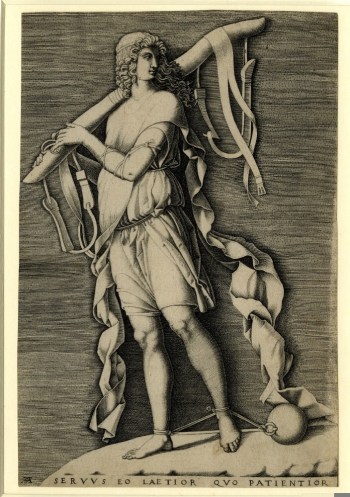
Adamo Scultori (Ghisi), Young Prisoner, 1566–80, engraving.
Francisco J. R. Chaparro, “Spanish Drawing Books”
A note on the exhibition catalogue El Maestro de Papel reviewed here by Francisco J. R. Chaparro, presents a comprehensive review of the scholarly attention directed towards Spanish drawing books. Chaparro makes reference to the Matías de Irala 1731 work and mentions the poor survival of the books. Chaparro tracks the appearance and reappearance of Jusepe Ribera’s etchings dated 1622 to highlight the further issue of cross-reference in these works. The note provides a critique of the exhibition while firmly situating it as a cornerstone for further research on the field of Spanish prints and drawings.
Ellis Tinios, “Surimono from the Virginia Shawan Drosten and Patrick Kenadjian Collection”
A laudatory note by Ellis Tinios on the catalogue The Private World of Surimino presents a brief analysis of surimono prints and notes, for instance, the importance of adequate lighting in revealing the complexities of blind printing and reflective inks.
David Ekserdijan, “A Portrait by Jeanne-Elisabeth Chaudet and Its Source”
David Ekserdijan presents the unusual artistic inspiration behind Jeanne-Elisabeth Chaudet’s painting A Portrait of a Young Girl of 1817, which sold in a 2006 Sotheby’s auction. The note features a side-by-side comparison with Adamo Scultori’s Young Prisoner or An Allegory of Servitude of 1566–80.










 Enfilade
leave a comment