New Book | Aristocratic Education
From UNC Press:
Mark Boonshoft, Aristocratic Education and the Making of the American Republic (Chapel Hill: The University of North Carolina Press, 2020), 296 pages, ISBN: 978-1-469659541 (ebook), $23 / ISBN: 978-1469661360 (paperback), $30 / ISBN: 978-1469659534 (hardcover), $95.
 Following the American Revolution, it was a cliché that the new republic’s future depended on widespread, informed citizenship. However, instead of immediately creating the common schools–accessible, elementary education—that seemed necessary to create such a citizenry, the Federalists in power founded one of the most ubiquitous but forgotten institutions of early American life: academies, privately run but state-chartered secondary schools that offered European-style education primarily for elites. By 1800, academies had become the most widely incorporated institutions besides churches and transportation projects in nearly every state.
In this book, Mark Boonshoft shows how many Americans saw the academy as a caricature of aristocratic European education and how their political reaction against the academy led to a first era of school reform in the United States, helping transform education from a tool of elite privilege into a key component of self-government. And yet the very anti-aristocratic critique that propelled democratic education was conspicuously silent on the persistence of racial and gender inequality in public schooling. By tracing the history of academies in the revolutionary era, Boonshoft offers a new understanding of political power and the origins of public education and segregation in the United States.
Mark Boonshoft is assistant professor of history at Duquesne University.
C O N T E N T S
List of Figure and Tables
Acknowledgments
Introduction: Why Academies?: Aristocratic Education in Revolutionary America
Part I. From Denominational Schools to Nationalist Institutions, 1730–1787
1 The Emergence of Academies: The Great Awakening and Colonial Elite Formation
2 The Academy Effect: Civic Education and the American Revolution
3 Rebuilding Academies: Education and Politics in the Confederation Era
Part II. The Culture of Academies, 1780–1800
4 Defining Merit: Academies and Inequality
5 Diplomacy and Dance: The Geopolitics of Ornamental Education
Part III. From Aristocratic Education to Reform, 1787–1830
6 Creating Consensus: The Politics of State Support for Academies
7 The First Era of School Reform: War, Panic, and Popular Education
Epilogue: The Legacy of Aristocratic Education
Appendix
Notes
Bibliography
Print Quarterly, September 2020

Johann Jakob Mettenleiter, Double Portrait of Johann Elias Haid and Johann Jakob Mettenleiter, ca. 1778–84, oil on copper, 31 × 38 cm (image courtesy Boris Wilnitsky Fine Arts, Vienna).
◊ ◊ ◊ ◊ ◊
The eighteenth-century in the latest issue of Print Quarterly (with apologies for being so slow! -Craig).
Print Quarterly 37.3 (September 2020)
A R T I C L E S
Julie Mellby, “Audubon’s Copperplates for Birds of America”, pp. 283–93.
After a brief introduction to John James Audubon’s (1785–1851) life and the publication history of his famous Birds of America, this article explores the afterlife of the copperplates. Partly damaged during a fire and later sold as used copper, some of these objects were eventually acquired and restored by William E. Dodge II (1832–1903). Their history interestingly overlaps with the history of important American institutions, such as the Metropolitan Museum of Art and the Princeton University Art Museum.
Marianne A. Yule, “A Friendship Portrait of J. J. Mettenleiter and J. E. Haid”, pp. 294–99.
This piece focuses on a newly discovered painting and its related mezzotint, the only known collaborative work between the printmaker John Elias Haid (1739–1809) and the painter Johann Jakob Mettenleiter (1750–1825). It explores the history of the image and identifies all the prints depicted therein.
N O T E S A N D R E V I E W S
Peter Van Der Coelen, Review of Henk van Nierop, The Life of Romeyn de Hooghe 1645–1708: Prints, Pamphlets, and Politics in the Dutch Golden Age (2018), pp. 314–16.
The note, as the book it reviews, sheds light on the lesser known, yet extremely prolific Romeyn de Hooghe (1645–1708), a printmaker operating between the Netherlands and Paris. His prints depict the political events of the day, such as the French invasion of Holland, as well as fashionable pastimes, as exemplified by his illustrations for a treatise on wrestling. De Hooghe’s life and work attest to the rising dominance of France all over Europe in the age of Louis XIV, both politically and artistically.
Domenico Pino, Review of Xavier F. Salomon, Andrea Tomezzoli and Denis Ton, Tiepolo in Milan: The Lost Frescoes of Palazzo Archinto (2019), pp. 319–21.
The catalogue under review reconstructs a cycle of frescoes commissioned for an aristocratic Milanese palace and destroyed during World War II. The note focuses on one chapter in particular, analysing Giambattista Tiepolo’s (1697–1770) early career as a book illustrator in Verona and Milan in the 1720s and ’30s, reading it in the context of the cultural fervour that spread all over Italy following the war of Spanish succession.
Domenico Pino, Review of Canaletto & Venezia (2019), pp. 321–22.
The note offers an overview of eighteenth-century Venice and the cultural fervour it hosted. The exhibition catalogue explores in detail the artistic career of Canaletto (1697–1768), Giambattista Tiepolo (1697–1770) and Giambattista Piazzetta (1682–1754), and discusses the developments of artistic trends in furniture, glass, porcelain and architecture in Venice throughout the century up to the fall of the Republic in 1797.
Elizabeth Rudy, Review of Aude Prigot, La Réception de Rembrandt à traversles estampes en France au XVIIIe siècle (2018), pp. 322–25.
The note explores the impact Rembrandt had on artists from the eighteenth through to the twenty-first century. In particular it focuses on the practice of collecting his prints in eighteenth-century France and that of copying his composition in the later part of the century. The main case studies are five French artists, among them Claude-Henri Watelet (1718–86) and Dominique Vivant-Denon (1747–1825).
New Book | Where Caciques and Mapmakers Met
From UNC Press:
Jeffrey Alan Erbig, Where Caciques and Mapmakers Met: Border Making in Eighteenth-Century South America (Chapel Hill: The University of North Carolina Press, 2020), 280 pages, ISBN: 978-1469655055 (ebook), $20 / ISBN: 978-1469655048 (paperback), $25 / ISBN: 978-1469655031 (hardcover), $90.
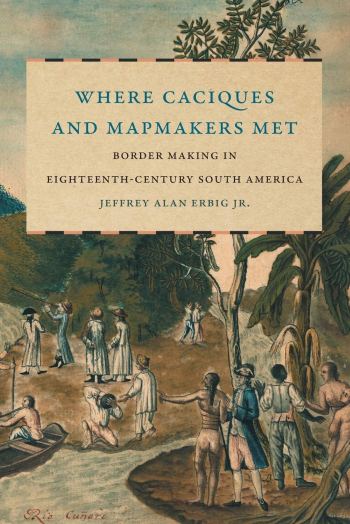 During the late eighteenth century, Portugal and Spain sent joint mapping expeditions to draw a nearly 10,000-mile border between Brazil and Spanish South America. These boundary commissions were the largest ever sent to the Americas and coincided with broader imperial reforms enacted throughout the hemisphere. Where Caciques and Mapmakers Met considers what these efforts meant to Indigenous peoples whose lands the border crossed. Moving beyond common frameworks that assess mapped borders strictly via colonial law or Native sovereignty, it examines the interplay between imperial and Indigenous spatial imaginaries. What results is an intricate spatial history of border making in southeastern South America (present-day Argentina, Brazil, and Uruguay) with global implications.
Drawing upon manuscripts from over two dozen archives in seven countries, Jeffrey Erbig traces on-the-ground interactions between Ibero-American colonists, Jesuit and Guaraní mission-dwellers, and autonomous Indigenous peoples as they responded to ever-changing notions of territorial possession. It reveals that Native agents shaped when and where the border was drawn, and fused it to their own territorial claims. While mapmakers’ assertions of Indigenous disappearance or subjugation shaped historiographical imaginations thereafter, Erbig reveals that the formation of a border was contingent upon Native engagement and authority.
Published with support provided by the William P. Clements Center for Southwest Studies at Southern Methodist University in Dallas, Texas.
Jeffrey Alan Erbig Jr. is assistant professor of Latin American and Latino studies at the University of California, Santa Cruz.
C O N T E N T S
List of Figures, Maps, and Tables
Acknowledgments
Abbreviations
Introduction
1 An Archipelago of Settlements and Tolderías
2 Projecting Possession
3 Mapping the Tolderías’ Mansion
4 Simultaneous Sovereignties
5 Where the Lines End
Conclusion
Notes
Bibliography
Exhibition | François Boucher: Rococo Artist

François Boucher, Shepherd and Shepherdess, 1760, oil on canvas, 81 × 65 cm
(Staatliche Kunsthalle Karlsruhe)
◊ ◊ ◊ ◊ ◊
Opening next month at the Staatliche Kunsthalle:
François Boucher: Künstler des Rokoko / Artiste Rococo
Staatliche Kunsthalle Karlsruhe, 14 November 2020 — 7 February 2021
François Boucher (1703–1770) est encore considéré de nos jours comme l’artiste rococo français par excellence. À l’occasion du 250e anniversaire de sa mort, la Kunsthalle de Karlsruhe présente la première exposition en Allemagne qui lui soit exclusivement consacrée.
 Bien que né dans un milieu modeste, Boucher s’est affirmé comme l’un des principaux artistes de son époque. Premier peintre du roi, il comptait parmi ses commanditaires la marquise de Pompadour ainsi que la margravine Caroline-Louise de Bade. Son style rayonna dans toute l’Europe et ses compositions furent reprises pour un grand nombre de tapisseries et de décors de théâtre, de meubles et de porcelaines.
La diversité des styles qu’il aborda et des sujets qu’il traita reste impressionnante jusqu’à l’heure actuelle. Ses élégantes scènes de genre ainsi que les représentations qu’il a données de paysages bucoliques et de sujets mythologiques se distinguent par leur inventivité, leur humour et l’ironie qui s’en dégage. Par leur exécution subtile et leur palette délicate, ses œuvres nous sensibilisent à la sensualité pouvant irradier d’une toile.
Ses dessins et ébauches à l’huile illustrent parfaitement sa manière de travailler. Tantôt puissantes et virtuoses, tantôt empreintes de retenue et témoins d’une introspection, ces esquisses s’affirment comme desœuvres d’art à part entière.
Artiste fascinant, Boucher, a ainsi développé un style très riche dont l’influence est perceptible jusque dans l’art moderne – Un style que l’exposition de la Kunsthalle permettra de redécouvrir.
L’exposition se complète par une installation sonore d’Elina Lukijanova qui reproduit des éléments stylistiques du Rococo à l’aide de bruits et de mots de notre époque.
Astrid Reuter, ed., François Boucher: Künstler des Rokoko (Cologne: Wienand, 2020), 336 pages, ISBN: 978-3868325812, 45€. With essays by Astrid Reuter, Barbara Bauer, Alexander Eiling, Peter Fuhring, Holger Jacob-Friesen, Melissa Hyde, Oliver Jehle, Françoise Joulie, Alastair Laing, Hans Plechinski, Aileen Ribeiro, Dorit Schäfer, Martin Schieder, Perrin Stein, Christoph Martin Vogtherr, and Kirsten Voigt.
New Book | Lectures on Art: Selected Conférences, 1667–1772
From Getty Publications:
Christian Michel and Jacqueline Lichtenstein, eds., Lectures on Art: Selected Conférences from the Académie Royale de Peinture et de Sculpture, 1667–1772, translated by Chris Miller (Los Angeles: Getty Publishing, 2020), 488 pages, ISBN 978-1606066461, $75.
 Between 1667 and 1792, the artists and amateurs of the Académie Royale de Peinture et de Sculpture in Paris lectured on the Académie’s conférences, foundational documents in the theory and practice of art. These texts and the principles they embody guided artistic practice and art theory in France and throughout Europe for two centuries.
In the 1800s, the Académie’s influence waned, and few of the 388 Académie lectures were translated into English. Eminent scholars Christian Michel and Jacqueline Lichtenstein have selected and annotated forty-two of the most representative lectures, creating the first authoritative collection of the conférences for readers of English. Essential to understanding French art of the seventeenth and eighteenth centuries, these lectures reveal what leading French artists looked for in a painting or sculpture, the problems they sought to resolve in their works, and how they viewed their own and others’ artistic practice.
Christian Michel is a professor of art history at the Université de Lausanne, a leading scholar of artistic production in seventeenth- and eighteenth-century Europe, and the author of many essays, articles, and books. Jacqueline Lichtenstein was a philosopher and art historian specializing in the history and criticism of art and aesthetics. She taught at the University of Paris-IV-Sorbonne, the University of Paris- X Nanterre, the École du Louvre, and the University of California, Berkeley. Lichtenstein died in 2019. Chris Miller is a widely published critic and translator, co-founder of the Oxford Amnesty Lectures, and author of Forms of Transcendence: The Art of Roger Wagner (2009).
New Book | Freemasonry and the Visual Arts
From Routledge:
Reva Wolf and Alisa Luxenberg, eds., Freemasonry and the Visual Arts from the Eighteenth Century Forward: Historical and Global Perspectives (London: Bloomsbury Visual Arts, 2020), 304 pages, ISBN: 978-1501337963 (hardback), $120 / ISBN: 978-1501366925 (paperback), $35.
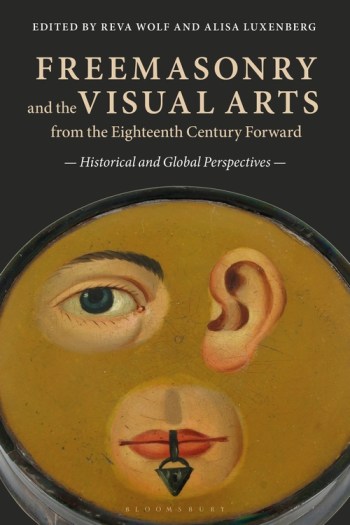 With the dramatic rise of Freemasonry in the eighteenth century, art played a fundamental role in its practice, rhetoric, and global dissemination, while Freemasonry, in turn, directly influenced developments in art. This mutually enhancing relationship has only recently begun to receive its due. The vilification of Masons, and their own secretive practices, have hampered critical study and interpretation. As perceptions change, and as masonic archives and institutions begin opening to the public, the time is ripe for a fresh consideration of the interconnections between Freemasonry and the visual arts. This volume offers diverse approaches, and explores the challenges inherent to the subject, through a series of eye-opening case studies that reveal new dimensions of well-known artists such as Francisco de Goya and John Singleton Copley, and important collectors and entrepreneurs, including Arturo Alfonso Schomburg and Baron Taylor. Individual essays take readers to various countries within Europe and to America, Iran, India, and Haiti. The kinds of art analyzed are remarkably wide-ranging-porcelain, architecture, posters, prints, photography, painting, sculpture, metalwork, and more-and offer a clear picture of the international scope of the relationships between Freemasonry and art and their significance for the history of modern social life, politics, and spiritual practices. In examining this topic broadly yet deeply, Freemasonry and the Visual Arts sets a standard for serious study of the subject and suggests new avenues of investigation in this fascinating emerging field.
Reva Wolf is Professor of Art History, State University of New York at New Paltz. Alisa Luxenberg is Professor of Art History, University of Georgia.
C O N T E N T S
Acknowledgments
List of illustrations
Reva Wolf and Alisa Luxenberg, Introduction: The Mystery of Masonry Brought to Light
1 David Martín López, Freemasonry in Eighteenth-Century Portugal and the Architectural Projects of the Marquis of Pombal
2 Cordula Bischoff, The Order of the Pug and Meissen Porcelain: Myth and History
3 Reva Wolf, Goya and Freemasonry: Travels, Letters, Friends
4 David Bjelajac, Freemasonry’s ‘Living Stones’ and the Boston Portraiture of John Singleton Copley
5 Nan Wolverton, The Visual Arts of Freemasonry as Practiced ‘Within the Compass of Good Citizens’ by Paul Revere
6 Alisa Luxenberg, Building Codes for Masonic Viewers in Baron Taylor’s Voyages pittoresques et romantiques dans l’ancienne France
7 Talinn Grigor, Freemasonry and the Architecture of the Persian Revival, 1843–1933
8 William D. Moore, Solomon’s Temple in America: Masonic Architecture, Biblical Imagery, and Popular Culture, 1865–1930
9 Martin Cherry, Freemasonry and the Art Workers’ Guild: The Arts Lodge No. 2751, 1899–1935
10 Cheryl Finley and Deborah Willis, Picturing Black Freemasons from Emancipation to the 1990s
11 Katherine Smith, Saint Jean Baptiste, Haitian Vodou, and the Masonic Imaginary
Selected Bibliography
Index
New Book | Humphry Repton: Landscape Design in an Age of Revolution
From Reaktion Books and the University of Chicago Press:
Tom Williamson, Humphry Repton: Landscape Design in an Age of Revolution (London: Reaktion Books, 2020), 352 pages, ISBN: 978-1789142990, £35 / $50.
 Humphry Repton (1752–1818) remains one of England’s most interesting and prolific garden and landscape designers. Renowned for his innovative design proposals and distinctive before-and-after images, captured in his famous ‘Red Books’, Repton’s astonishing career represents the link between the simple parklands of his predecessor Capability Brown and the more elaborate, structured, and formal landscapes of the Victorian age. This lavishly illustrated book, based on a wealth of new research, reinterprets Repton’s life, working methods, and designs, and examines why they proved so popular in a rapidly changing world.
Tom Williamson is professor of landscape history at the University of East Anglia.
C O N T E N T S
Introducing Humphry Repton
1 Before Repton
2 The Shape of a Career
3 Repton in Business: Working Methods
4 The Public Landscape: ‘Character’ and ‘Appropriation’
5 Domesticity and ‘Cheerfulness’
6 Shaping Style: Influences, Contemporaries, Social Change
Epilogue: Repton’s Legacy
References
Bibliography
Acknowledgements
Photo Acknowledgements
Index
New Book | Goya: A Portrait of the Artist
From Princeton UP:
Janis Tomlinson, Goya: A Portrait of the Artist (Princeton: Princeton University Press, 2020), 448 pages, ISBN: 978-0691192048, $35 / £30.
 The life of Francisco Goya (1746–1828) coincided with an age of transformation in Spanish history that brought upheavals in the country’s politics and at the court which Goya served, changes in society, the devastation of the Iberian Peninsula in the war against Napoleon, and an ensuing period of political instability. In this revelatory biography, Janis Tomlinson draws on a wide range of documents—including letters, court papers, and a sketchbook used by Goya in the early years of his career—to provide a nuanced portrait of a complex and multifaceted painter and printmaker, whose art is synonymous with compelling images of the people, events, and social revolution that defined his life and era.
Tomlinson challenges the popular image of the artist as an isolated figure obsessed with darkness and death, showing how Goya’s likeability and ambition contributed to his success at court, and offering new perspectives on his youth, rich family life, extensive travels, and lifelong friendships. She explores the full breadth of his imagery—from scenes inspired by life in Madrid to visions of worlds without reason, from royal portraits to the atrocities of war. She sheds light on the artist’s personal trials, including the deaths of six children and the onset of deafness in middle age, but also reconsiders the conventional interpretation of Goya’s late years as a period of disillusion, viewing them instead as years of liberated artistic invention, most famously in the murals on the walls of his country house, popularly known as the ‘black’ paintings.
A monumental achievement, Goya: A Portrait of the Artist is the definitive biography of an artist whose faith in his art and his genius inspired paintings, drawings, prints, and frescoes that continue to captivate, challenge, and surprise us two centuries later.
Janis A. Tomlinson has written and lectured extensively on the art of Goya. Her books include Goya: Order and Disorder, Goya: Images of Women, Goya in the Twilight of Enlightenment, and Francisco Goya: The Tapestry Cartoons and Early Career at the Court of Madrid.
Exhibition | The Torlonia Marbles
Notice of the exhibition appeared here at Enfilade last November; here’s the updated information; the catalogue is published by Electa.
The Torlonia Marbles: Collecting Masterpieces
I Marmi Torlonia: Collezionare Capolavori
Musei Capitolini at Palazzo Caffarelli, Rome, 14 October 2020 — 29 June 2021
Curated by Carlo Gasparri and Salvatore Settis
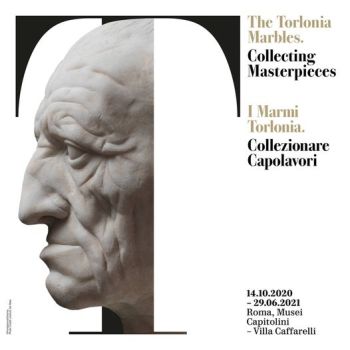 The Torlonia Marbles: Collecting Masterpieces presents 96 works selected from the 620 cataloged marbles belonging to the Torlonia Collection, the prestigious private collection of ancient sculptures, significant for the history of art, excavations, restoration, taste, museography, and archaeological studies. The exhibition is organized in five sections, telling the story of the collecting of ancient Greek and Roman marbles in reverse chronology beginning with the founding of the Torlonia Museum in 1875 by Prince Alexander Torlonia. The second section brings together the nineteenth-century finds of antiquity in the Torlonia properties. The next section addresses eighteenth-century collecting, with sculptures from the acquisitions of Villa Albani and the collection of the sculptor and restorer Bartolomeo Cavaceppi. A selection of sculptures owned by Vincenzo Giustiniani, one of the most sophisticated Roman collectors of the seventeenth century then follows, with the final section presenting pieces from collections of aristocratic families of the fifteenth and sixteenth centuries.
New Book | Fragonard: Painting Out of Time
From Reaktion Books and the University of Chicago Press:
Satish Padiyar, Fragonard: Painting Out of Time (London: Reaktion Books, 2020), 248 pages, ISBN: 978-1789142099, £35 / $55.
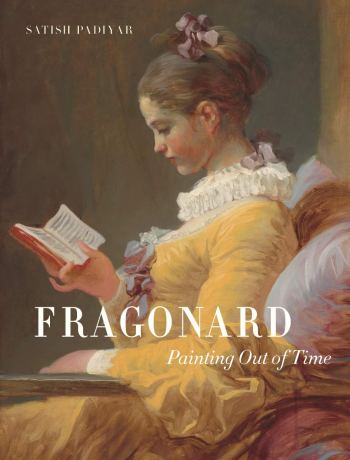 At the time of his death in 1806, the rococo artist Jean-Honoré Fragonard had not painted for two decades. Following a period of huge public success, the painter’s reputation fell. Fragonard: Painting Out of Time takes this prolonged artistic silence as a point of departure to investigate the maverick personality of Fragonard within the lively society of eighteenth-century France. Personally secretive, Fragonard nevertheless created revealing images that undermined a normal sense of space and time. Satish Padiyar investigates the life and work of the last of the libertine painters of the ancien regime, a contemporary of Denis Diderot and Jean-Jacques Rousseau, and presents dramatic new perspectives on works such as The Progress of Love, painted for Madame du Barry, the infamous The Bolt, and the ever-popular The Swing.
Satish Padiyar is Honorary Research Fellow at The Courtauld Institute of Art. His previous publications include Chains: David, Canova, and the Fall of the Public Hero in Postrevolutionary France (2007).
C O N T E N T S
Introduction
1 Secrets
2 Surprise
3 Dreams
References
Select Biography
Acknowledgements
Photo Acknowledgements
Index










 Enfilade
leave a comment