New Book | Art of the United States, 1750–2000
Distributed by The University of Chicago Press:
John Davis and Michael Leja and edited by Francesca Rose, Art of the United States, 1750–2000 (Chicago: Terra Foundation for American Art, 2020), 544 pages, ISBN: 978-0932171689, $39.
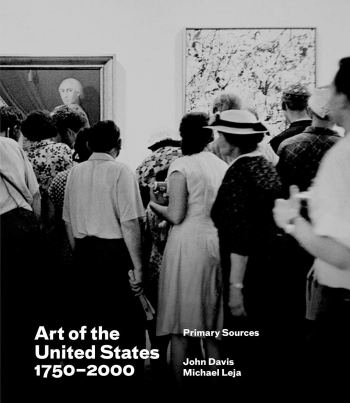 Art of the United States is a landmark volume that presents three centuries of US art through a broad array of historical texts, including writings by artists, critics, patrons, literary figures, and other commentators. Combining a wide-ranging selection of texts with high-quality reproductions of artworks, it offers a resource for the study and understanding of the visual arts of the United States. With contextual essays, explanatory headnotes, a chronology of US historical landmarks, maps, and full-color illustrations of key artworks, the volume will appeal to national and international audiences ranging from undergraduates and museum visitors to art historians and other scholars. Texts by a range of artists and cultural figures—including John Adams, Thomas Cole, Frederick Douglass, Mary Cassatt, Edward Hopper, Clement Greenberg, and Cindy Sherman—are grouped according to historical era alongside additional featured artists.
A sourcebook of unprecedented breadth and depth, Art of the United States brings together multiple voices throughout the ages to provide a framework for learning and critical thinking on US art.
John Davis is the provost and under secretary for museums, education, and research at the Smithsonian Institution and the author or coauthor of numerous catalogs and books, including, with Sarah Burns, the comprehensive volume American Art to 1900. Michael Leja is the James and Nan Wagner Farquhar Professor of History of Art at the University of Pennsylvania and the author of numerous catalogs and books, including Reframing Abstract Expressionism: Subjectivity and Painting in the 1940s and Looking Askance: Skepticism and American Art from Eakins to Duchamp. Francesca Rose is the program director for publications at the Terra Foundation for American Art.
New Book | The Edinburgh History of Reading
Spread across the volumes are essays addressing the long eighteenth century, including topics of illustrations and visual culture. From Edinburgh UP:
Mary Hammond and Jonathan Rose, eds., The Edinburgh History of Reading, 4 volumes (Edinburgh: Edinburgh University Press, 2020), 1512 pages, 978-1474478717, £350. [Each volume is also sold individually.]
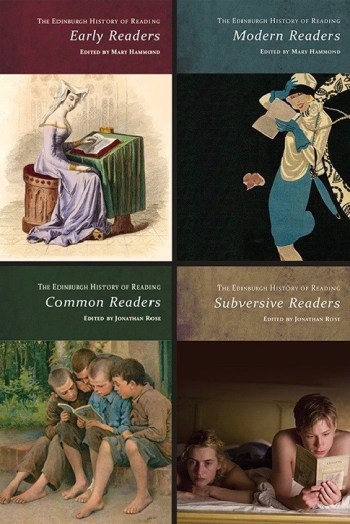 Bringing together the latest scholarship from all over the world on topics ranging from reading practices in ancient China to the workings of the twenty-first-century reading brain, the 4 volumes of The Edinburgh History of Reading demonstrate that reading is a deeply imbricated, socio-political practice, at once personal and public, defiant, and obedient. It is often materially ephemeral, but it can also be emotionally and intellectually enduring.
Volume Titles
Early Readers, edited by Mary Hammond, with contents listed here.
Early Readers presents a number of innovative ways through which we might capture or infer traces of readers in cultures where most evidence has been lost. It begins by investigating what a close analysis of extant texts from 6th-century BCE China can tell us about contemporary reading practices, explores the reading of medieval European women and their male medical practitioner counterparts, traces readers across New Spain, Peru, the Ottoman Empire and the Iberian world between 1500 and 1800, and ends with an analysis of the surprisingly enduring practice of reading aloud.
Modern Readers, edited by Mary Hammond, with contents listed here.
Modern Readers explores the myriad places and spaces in which reading has typically taken place since the eighteenth century, from the bedrooms of the English upper classes, through large parts of nineteenth-century Africa and on-board ships and trains travelling the world, to twenty-first-century reading groups. It encompasses a range of genres from to science fiction, music and self-help to Government propaganda.
Common Readers, edited by Jonathan Rose, with contents listed here.
Common Readers casts a fascinating light on the literary experiences of ordinary people: miners in Scotland, churchgoers in Victorian London, workers in Czarist Russia, schoolgirls in rural Australia, farmers in Republican China, and forward to today’s online book discussion groups. Chapters in this volume explore what they read, and how books changed their lives.
Subversive Readers, edited by Jonathan Rose, with contents listed here.
Subversive Readers explores the strategies used by readers to question authority, challenge convention, resist oppression, assert their independence and imagine a better world. This kind of insurgent reading may be found everywhere: in revolutionary France and Nazi Germany, in Eastern Europe under Communism and in Australian and Iranian prisons, among eighteenth-century women reading history and nineteenth-century men reading erotica, among postcolonial Africans, the blind, and pioneering transgender activists.
New Book | Tastemakers: British Dealers and the Anglo-Gallic Interior
Forthcoming from The Getty (in July) . . .
Diana Davis, The Tastemakers: British Dealers and the Anglo-Gallic Interior, 1785–1865 (Los Angeles: Getty Research Institute, 2020), 320 pages, ISBN: 978-1606066416, $65.
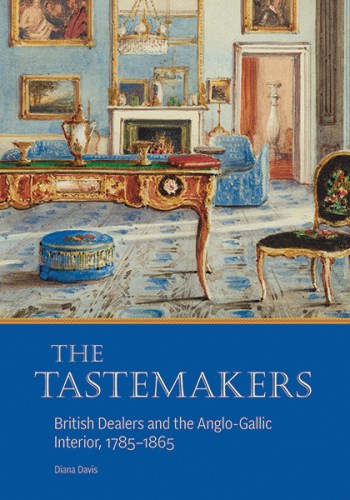 In this volume, Diana Davis demonstrates how London dealers invented a new and visually splendid decorative style that combined the contrasting tastes of two nations. Departing from the conventional narrative that depicts dealers as purveyors of antiquarianism, Davis repositions them as innovators who were key to transforming old art objects from ancien régime France into cherished ‘antiques’ and, equally, as creators of new and modified French-inspired furniture, bronze work, and porcelain. The resulting old, new, and reconfigured objects merged aristocratic French eighteenth-century taste with nineteenth-century British preference, and they were prized by collectors, who displayed them side by side in palatial interiors of the period.
The Tastemakers analyzes dealer-made furnishings from the nineteenth-century patron’s perspective and in the context of the interiors for which they were created, contending that early dealers deliberately formulated a new aesthetic with its own objects, language, and value. Davis examines a wide variety of documents to piece together the shadowy world of these dealers, who emerge center stage as traders, makers, and tastemakers.
Diana Davis specializes in the interface between collectors, dealers, and the art market in the late eighteenth and early nineteenth centuries.
C O N T E N T S
Acknowledgments
Note to the Reader
Introduction
Part 1 — Trade, Taste and Retail
1 ‘The Revised Taste of Louis the Fourteenth’
2 ‘Nos Amis, Les Enemies!: Britain and France
3 ‘The Wily Brocanteur‘
4 ‘The New Race of Connoisseurs’
Part 2 — The Dealer-Producer
5 Manufacturers of Antique Furniture
6 ‘Matt and Burnished Gold’
7 ‘China Painted and Gilt’
8 ‘A Burst of Splendour’: The Anglo-Gallic Interior
Conclusion
Appendix 1 Selected Dealer Biographies
Appendix 2 Sale Catalogs
Sources and Bibliography
About the Author
Illustration Credits
Index
New Book | Restoring Williamsburg
Distributed by Yale University Press:
George Humphrey Yetter and Carl Lounsbury, Restoring Williamsburg (The Colonial Williamsburg Foundation, 2019), 296 pages, ISBN: 978-0300248357, $50.
 Today best known as the world’s largest ‘living history’ museum, Williamsburg was the capital of the colony of Virginia in the 1700s and the setting for key debates leading to the American Revolution. Inspired by growing interest in America’s colonial heritage, W. A. R. Goodwin, supported by John D. Rockefeller, Jr., initiated a major restoration in the 1920s and 1930s that has allowed visitors to see how Williamsburg looked in the 18th century. Restoring Williamsburg expands on Williamsburg Before and After, a now-classic book with more than 200,000 copies in print, offering an updated and nuanced look at the continuing process of restoration. In addition to capturing moments throughout the site’s transformation, the book offers important considerations about modern curatorial practices and changing approaches to historic preservation.
Lavishly illustrated with more than 350 photographs, watercolors, sketches, maps, and other illustrations, Restoring Williamsburg features new images from both before and after the restoration. This is an important contribution not only to architectural history and restoration practices but also to our understanding of the town that continues to inspire Americans to think about their history.
George Humphrey Yetter, who wrote Williamsburg Before and After, is the former associate curator of architectural drawings at the Colonial Williamsburg Foundation. Carl R. Lounsbury is the former Shirley and Richard Roberts Architectural Historian at the Colonial Williamsburg Foundation and currently teaches history at the College of William and Mary.
New Book | Fancy in Eighteenth-Century European Visual Culture
From the Oxford University Studies in The Enlightenment series:
Melissa Percival and Muriel Adrien, eds., Fancy in Eighteenth-Century European Visual Culture (Liverpool: Voltaire Foundation in association with Liverpool University Press, 2020), 325 pages, ISBN: 978-1789620030, £65 / $100.
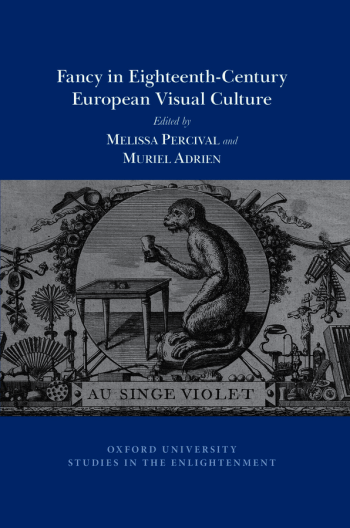 Fancy in the eighteenth century was part of a rich semantic network, connecting wit, whimsicality, erotic desire, spontaneity, deviation from norms and triviality. It was also a contentious term, signifying excess, oddness and irrationality, liable to offend taste, reason and morals. This collection of essays foregrounds fancy—and its close synonym, caprice—as a distinct strand of the imagination in the period. As a prevalent, coherent and enduring concept in aesthetics and visual culture, it deserves a more prominent place in scholarly understanding than it has hitherto occupied. Fancy is here understood as a type of creative output that deviated from rules and relished artistic freedom. It was also a mode of audience response, entailing a high degree of imaginative engagement with playful, quirky artworks, generating pleasure, desire, or anxiety. Emphasizing commonalities between visual productions in different media from diverse locations, the authors interrogate and celebrate the expressive freedom of fancy in European visual culture. Topics include: the seductive fictions of the fancy picture, Fragonard and galanterie, fancy in drawing manuals, pattern books and popular prints, fans and fancy goods, chinoiserie, excess and virtuality in garden design, Canaletto’s British capricci, urban design in Madrid, and Goya’s Caprichos.
Melissa Percival is Professor of French, Art History, and Visual Culture at the University of Exeter. She has published widely on theories of facial expression, fantasy figures, and portraits, with particular reference to eighteenth-century France; these include a monograph on Fragonard’s fantasy figures. Muriel Adrien is Associate Professor of art history and visual culture within the English Department at the University of Toulouse. She has published numerous articles on 18th- and 19th-century British and American art, especially as related to scientific contexts. She is chief editor of the online scholarly journal Miranda.
C O N T E N T S
List of figure
Acknowledgements
• Melissa Percival, Introduction
• Emmanuel Faure-Carricaburu, The Fantasy Figures of Jean-Baptiste Santerre and the Limits of Generic Frameworks of Interpretation
• Christophe Guillouet, The Parisian World of Printmaking at the Heart of the Invention of a Genre? Poilly, Courtin, and Bonnart’s Fantaisies, 1713–28
• John Chu, Windows of Opportunity: The French Fantasy Figure and the Spirit of Enterprise in Early-Eighteenth-Century Europe
• Martin Postle, Modelling for the Fancy Picture in Eighteenth-Century England
• Bénédicte Miyamoto, The Influence of Drawing Manuals on the British Practice and Reception of Fancy Pictures
• Guillaume Faroult, A Galant Fantasy: Fragonard’s Fantasy Figures and The Music Lesson in Relation to Van Dyck, Watteau, and Carle Vanloo
• Pierre-Henri Biger, Fans, Fantasy, and Fancy
• Melissa Percival, Fancy as a Mode of Consumption
• Vanessa Alayrac-Fielding, ‘A Butterfly Supporting an Elephant’: Chinoiserie, Fantaisie, and ‘the Luxuriance of Fancy’
• Laurent Châtel , The Garden as Capriccio: The Hortulan Pleasures of Imagination and Virtuality
• Béatrice Laurent, Grand Tour Capricci
• Xavier Cervantes, Venetian Reminiscences and Cultural Hybridity in Canaletto’s English-period Capricci and Vedute
• Adrián Fernández Almoguera, From the Private Cabinet to the Suburban Villa: Caprices and Fantasies in Eighteenth-Century Madrid
• Andrew Schulz, Satire and Fantasy in Goya’s Caprichos
• Alice Labourg, ‘Fancy Paints with Hues Unreal’: Pictorial Fantasy and Literary Creation in Ann Radcliffe’s Gothic Novels
Summaries
List of Contributors
Bibliography
Index
New Book | A Fistful of Shells
From The U of C Press:
Toby Green, A Fistful of Shells: West Africa from the Rise of the Slave Trade to the Age of Revolution (Chicago: The University of Chicago Press, 2019), 640 pages, ISBN: 978-0226644578, $40.
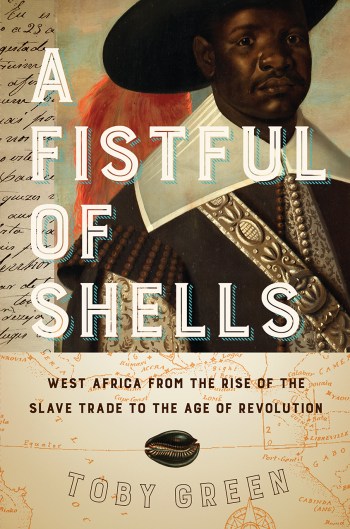 By the time the “Scramble for Africa” among European colonial powers began in the late nineteenth century, Africa had already been globally connected for centuries. Its gold had fueled the economies of Europe and the Islamic world for nearly a millennium, and the sophisticated kingdoms spanning its west coast had traded with Europeans since the fifteenth century. Until at least 1650, this was a trade of equals, using a variety of currencies—most importantly, cowrie shells imported from the Maldives and nzimbu shells imported from Brazil. But, as the slave trade grew, African kingdoms began to lose prominence in the growing global economy. We have been living with the effects of this shift ever since.
With A Fistful of Shells, Toby Green transforms our view of West and West-Central Africa by reconstructing the world of these kingdoms, which revolved around trade, diplomacy, complex religious beliefs, and the production of art. Green shows how the slave trade led to economic disparities that caused African kingdoms to lose relative political and economic power. The concentration of money in the hands of Atlantic elites in and outside these kingdoms brought about a revolutionary nineteenth century in Africa, parallel to the upheavals then taking place in Europe and America. Yet political fragmentation following the fall of African aristocracies produced radically different results as European colonization took hold.
Drawing not just on written histories, but on archival research in nine countries, art, oral history, archaeology, and letters, Green lays bare the transformations that have shaped world politics and the global economy since the fifteenth century and paints a new and masterful portrait of West Africa, past and present.
Toby Green is a senior lecturer in Lusophone African history and culture at King’s College London and is author of The Rise of the Trans-Atlantic Slave Trade in Western Africa, 1300-1589.
C O N T E N T S
List of Maps
Foreword
Note on Spellings/Names
Glossary
Introduction
Part One
Causes: Economic Divergence in West and West- Central Africa
Timelines for Part One
1 ‘Three Measures of Gold’: The Rise and Fall of the Great Empires of the Sahel
2 Causeways across the Savannah: From Senegambia to Sierra Leone
3 Ready Money: The Gold Coast and the Gold Trade
4 Rivers of Cloth, Masks of Bronze: The Bights of Benin and Biafra
5 The Kingdom of Kongo: From Majesty to Revolt
Coda to Part One
Part Two
Consequences: Politics, Belief and Revolutions from Below
Timeline for Part Two: West African Political History, c. 1680–1850
Prologue to Part Two
6 ‘With Boots Worth 3 Slaves’: Slavery and Value in the Eighteenth Century
7 On a War Footing: The ‘Fiscal- Military State’ in West African Politics
8 Feeding Power: New Societies, New Worldviews
9 Transnational Africas, Struggle and the Rising of Modernity
10 Warrior Aristocracies and Pushback from Below
11 Let them Drink Rum! Islam, Revolution and the Aristocracy
Conclusion
Bibliography
Notes
List of Illustrations
Index
New Book | John Reeves
From ACC Art Books:
Kate Bailey, John Reeves: Pioneering Collector of Chinese Plants and Botanical Art (New York: ACC Art Books, 2019), 176 pages, ISBN: 978-1788840316, £35 / $50.
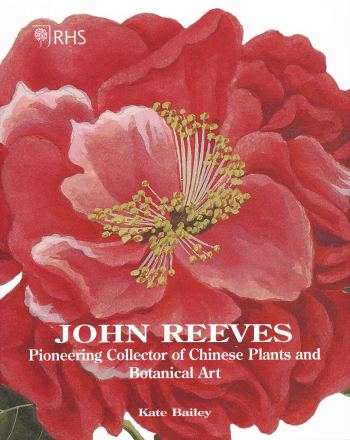 This is the story of John Reeves (1774–1856) and the Reeves Collection of botanical paintings, the result of one man’s single-minded dedication to commissioning pictures and gathering plants for the Horticultural Society of London.
Reeves went to China in 1812 and immediately on arrival started sending back snippets of information about manufactures, plants and poetry, goods, gods, and tea to Sir Joseph Banks. Slightly later, he also started collecting for the Society. But despite years of work collecting, labelling, and packing plants and organising a team of Chinese artists until he left China in 1831, Reeves never enjoyed the same degree of recognition as other naturalists in China. This was possibly because he had a demanding job as a tea inspector. Reeves himself never claimed to be a professional naturalist, and the plant collecting and painting supervision were undertaken in his own time. Furthermore, fan qui (foreign devils) were restricted to the port area of Canton and to Macau, so that plant-hunting expeditions further afield were impossible. Furthermore, Reeves never published an account of his life in the country, unlike Clarke Abel and Robert Fortune, but he left us some letters, notebooks, drawings, and maps.
The collection is held at the Royal Horticultural Society’s Lindley Library in Vincent Square, London. It is a magnificent achievement. Not only are the pictures accurate and richly coloured plant portraits of plants then unknown in the West, but they stand as a record of plants being cultivated in nineteenth-century Canton and Macau. In John Reeves: Pioneering Collector of Chinese Plants and Botanical Art, Kate Bailey reveals John Reeves’s life as an East India Company tea inspector in nineteenth-century China and shows how he managed to collect and document thousands of Chinese natural history drawings, far more than anyone else at the time.
Kate Bailey started working life as a reluctant solicitor. At the age of 54, on the strength of a magazine article about a paper conservator, she abandoned the law and enrolled at Camberwell College of Arts for a degree in paper conservation. After obtaining an M.A. and being accepted for a Ph.D., for three years Kate stalked Reeves in libraries, museums, and auction houses while at the same time drawing on her own childhood memories of Singapore and Hong Kong in the early 1950s. A post-doctoral year at the V&A followed, working on a collaborative project into the pigments found on Chinese export paintings using the Reeves pictures for comparison. Then came a request for a book to bring the work of a modest, dedicated East India Company tea inspector and his band of skilfull Chinese painters to a wider audience. Kate continues to research, write, and lecture on Reeves and related art-botanical subjects.
C O N T E N T S
Letter to the Reader
Acknowledgments
Introduction
1 Mr Reeves’ Drawings
2 Mr Reeves Sails to China
3 Mr Reeves Arrives in Canton
4 Mr Reeves Writes to Sir Joseph Banks
5 Mr Reeves Goes Plant Hunting in Macao
6 Mr Reeves Commissions Drawings
7 Mr Reeves Collects Plants
8 Mr Reeves Creates a Collection
Endnotes
Index of Plants
General Index
New Book | Jane Austen’s England
From ACC Art Books:
Karin Quint, Jane Austen’s England: A Travel Guide (New York: ACC Art Books, 2019), 320 pages, ISBN: 978-1788840354, $20.
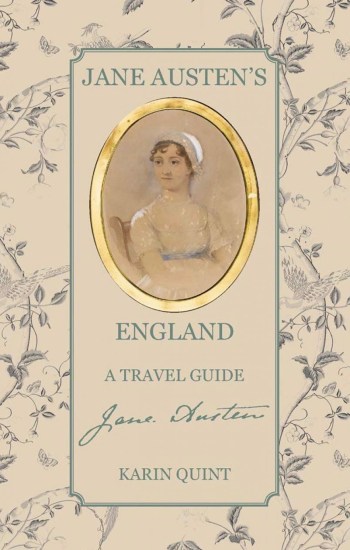 Walk in Jane Austen’s footsteps with this unique travel guide—the first book to explore England in relation to its most beloved Regency author. Rambling across the rolling fields of Hampshire, along the bustling streets of London, and around the golden crescents of Bath, Jane Austen’s England is the perfect companion for any Janeite planning a pilgrimage.
Functionally arranged by region, each chapter tracks down the most iconic scenes from both the big and little screen, as well as the key destinations where Jane lived, danced, and wrote. Descriptions of each location are interspersed with biographical anecdotes and local history. Subsections focus on various stately homes that have been featured in every adaptation of every novel, from the beloved Pride and Prejudice television series (1995, Jennifer Ehle and Colin Firth) to Pride and Prejudice and Zombies (2016). With a compilation of websites, seasonal opening hours, and tour details, this compact book contains everything you need to immerse yourself in Austen.
Karin Quint discovered Austen aged 20, when she picked up Pride and Prejudice at a flea market. She later realized that she was reading one of the best-loved novels in English literature, and her obsession only grew from there. As well as being a professional journalist and photographer, Quint is an ambassador for the Jane Austen Literacy Foundation. She has co-written two other travel guides about Wales and Scotland.
Exhibition | Hidden Valuables: Early-Period Meissen Porcelains
The catalogue is published by Arnoldsche and distributed by ACC Art Books:
Hidden Valuables: Early-Period Meissen Porcelains from Swiss Private Collections
Musée Ariana, Geneva, 7 February — 6 September 2020
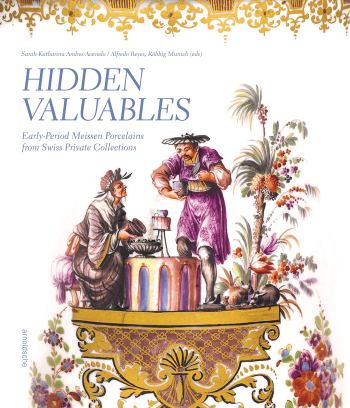 Switzerland is well-known for its host of remarkable collections of eighteenth-century European porcelain. Exemplary representatives of these are such extraordinary collector personalities as Albert Kocher or Dr Marcel Nyffeler. A number of these magnificent collections can be found today in Switzerland’s renowned institutions, and the ‘white gold’ from Saxony still fascinates Swiss connoisseurs. This exhibition is dedicated to their passionate collecting and exceptional treasures, while the catalogue is enriched with essays by renowned art historians and porcelain experts.
Sarah-Katharina Andres-Acevedo, Alfredo Reyes, and Röbbig München, eds., Hidden Valuables: Early-Period Meissen Porcelains from Swiss Private Collections (Stuttgart: Arnoldsche, 2020), 416 pages, ISBN 978-3897905863, £78 / $135.
New Book | A Passion for Porcelain
Published by the Gardiner Museum in association with Arnoldsche and distributed by ACC Art Books:
Karine Tsoumis and Vanessa Sigalas, eds., A Passion for Porcelain: Essays in Honour of Meredith Chilton (Stuttgart: Arnoldsche, 2020), 208 pages, ISBN: 978-3897905849, $50.
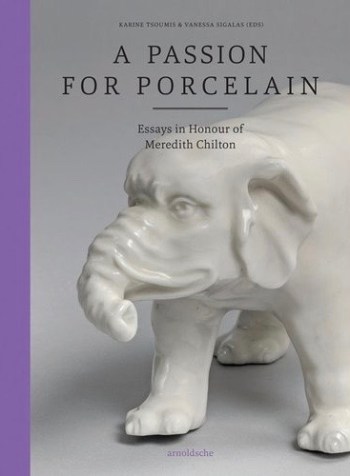 A Passion for Porcelain brings together papers delivered at an international symposium held in 2018 at Toronto’s Gardiner Museum in honour of Meredith Chilton, C.M., one of the foremost scholars and curators of eighteenth-century European porcelain. Authored by leading scholars in the field, the essays take us on a journey from France (Sèvres), to Japan via Boston, where we encounter both revered artists and anonymous makers, together with passionate collectors past and present. The contributions also explore the medium of porcelain in the context of artistic rivalry and gift exchange, as an object of fashion and scientific curiosity and as a symbol of status and power. Together, the essays reveal the versatility of the medium, changing perceptions, and endless possibilities for porcelain scholarship.
With contributions by Daniel Chen, Katharina Hantschmann, Peter Kaellgren, Sebastian Kuhn, Claudia Lehner-Jobst, Thomas Michie, Jeffrey Munger, Linda Roth, Rosalind Savill, Vanessa Sigalas, and Karine Tsoumis.










 Enfilade
leave a comment