Exhibition and Book | Mudlarking
As noted in Salon, the newsletter of the Society of Antiquaries of London, issue 432 (30 July 2019) . . .
Foragers of the Foreshore
Bargehouse on Bankside, London, 25–29 September 2019
Curated by Florence Evans
Mudlarking is gaining new attention. It is an old profession, a term applied especially to people who once lurked on the banks of the Thames in London searching for things they could sell, washed up on the tide or rising from the mud and sewage . . . The poor became less visible and scavengers faded away, but more recently detectorists and collectors have returned to the river, for the thrill and fascination of discovery and contact with people from the past.
Modern mudlarkers need a three-year permit, issued by the Port of London Authority (PLA) for £80, and must report all their finds to the Portable Antiquities Scheme’s Finds Liaison Officer at the Museum of London. . . .
Lara Maiklem is more communicative about mudlarking than many practitioners. She has tens of thousands of followers on social media, where she posts striking photos of her finds (often to be left where they are)—Instagram is made for determined mudlarkers—and has written a book, Mudlarking: Lost and Found on the River Thames. Though not be released until 22 August, on Amazon it is already at no 1 in ‘Urban & rural planning’ and no 7 in ‘Social science human geography’. It will be Radio 4 Book of the Week from 12 August. And now there is to be an exhibition.
For five days, writes Karen Hearn FSA, Foragers of the Foreshore will be at the Bargehouse on Bankside (25–29 September), part of a Totally Thames festival. Curated by Florence Evans, says the blurb, this will be “the most expansive exhibition on Mudlarking that has ever taken place.” It will feature new art, photographic portraits of mudlarkers taken by Hannah Smiles, and “a chance to meet Mudlarker in Residence Nicola White.” Museum of London Archaeology’s Thames Discovery Programme, Thames21, and Unruly Heritage will explain inter-tidal archaeology. Maiklem is among event speakers.
◊ ◊ ◊ ◊ ◊
From Bloomsbury:
Lara Maiklem, Mudlarking: Lost and Found on the River Thames (London: Bloomsbury Publishing, 2019), 320 pages, ISBN: 978-1408889213, £19.
 For thousands of years human beings have been losing their possessions and dumping their rubbish in the River Thames, making it the longest and most varied archaeological site in the world. For those in the know, the muddy stretches provide a tangible link with the past, a connection to the natural world, and an oasis of calm in a chaotic city.
Lara Maiklem left the countryside for London in her twenties. At first enticed by the city, she soon found herself cut adrift, yearning for the solace she had known growing up among nature. Down on the banks of the River Thames, she discovered mudlarking: the act of scavenging in the mud for items discarded by past generations of Londoners. For the next fifteen years her days would be dedicated to and dictated by the tides, in pursuit of the objects that the river unearthed: from Neolithic flints to Roman hair pins, medieval shoe buckles to Tudor buttons, Georgian clay pipes to discarded war medals. Moving from the river’s tidal origins in the west of the city to the point where it reaches the sea in the east, Mudlarking is the story of the Thames and its people as seen through these objects. A fascinating search for peace through solitude and history, it brings the voices of long-forgotten Londoners to life.
Lara Maiklem moved from her family’s farm to London in the 1990s and has been mudlarking along the River Thames for fifteen years. She now lives with her family on the Kent coast within easy reach of the river, which she visits as regularly as the tides permit. This is her first book.
New Book | The Place of the Viewer
From Brill:
Kerr Houston, The Place of the Viewer: The Embodied Beholder in the History of Art, 1764–1968 (Leiden: Brill, 2019), 270 pages, ISBN: 978-9004400238 , €112 / $135.
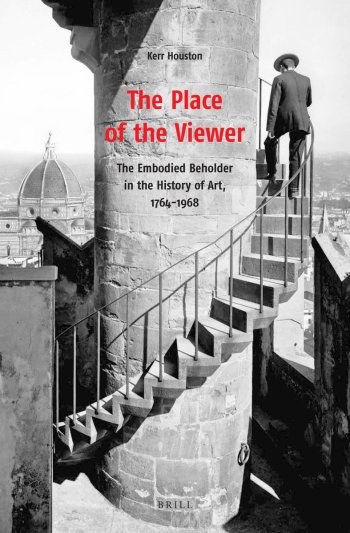 In recent decades, art historians and critics have occasionally emphasized a dynamic, embodied mode of looking, accenting the role of the viewer and the complex interplay between beholders and works of art. In The Place of the Viewer, Kerr Houston shows that an attention to the position and physical experiences of beholders has in fact long informed art historical analyses—and that close study of the theme can lead to a fuller understanding of the discipline, the act of viewership and individual works of art. Simultaneously attentive to historical ideas and contemporary scholarship, this book identifies a vein of thought that has been generally overlooked, and proposes new ways of seeing familiar works and traditions.
Kerr Houston (PhD, Yale, 2001) has taught art history and criticism at The Maryland Institute College of Art since 2002. He is the author of An Introduction to Art Criticism (2013) and numerous articles and reviews.
C O N T E N T S
Acknowledgements
Figures
Introduction
The Communicative Viewpoint: Photography, Frontality, and Multiplicity in the 1800s
The Beholder in Motion: Kinetic Viewership
The Body Physical, the Body Politic: Incorporated Viewership in the 1960s
Art History and the Place of the Viewer since 1968
Bibliography
Index
Exhibition | Antoine-Jean Gros: Drawings from the Louvre
Now on view at the Louvre:
Antoine-Jean Gros (1771–1835): Dessins du Louvre
Musée du Louvre, Paris, 27 June — 30 September 2019
Curated by Laura Angelucci
 One of Jacques-Louis David’s (1748–1825) most famous pupils, and known as the painter of the Napoleonic epic, Antoine-Jean Gros is rightly considered a forerunner of Romanticism. Early on, his drawings, more so than his paintings, began to reveal a gradual shift away from David’s teachings, leading to a definitive break with neoclassical aesthetics and a distinct style heralding the new artistic movement. In his most dramatic drawings, executed in pen and ink, Gros’s free, impetuous style and liberal use of wash accentuate the strength and originality of his art, which led Delacroix to single the artist out from David’s other pupils and consider him the first painter of the new school.
Organized to accompany the publication in June 2019 of the Inventaire général des dessins d’Antoine-Jean Gros (1771–1835) au Louvre, this exhibition features about forty drawings, as well as paintings from the museum’s collection and the Musée Delacroix. It offers an overview of Gros’s career, from his training to the peak of his artistic maturity, and highlights his draftsmanship, of which the public knows very little.
Organized by Laura Angelucci, documentary researcher, Department of Prints and Drawings, Musée du Louvre.
New Books | Mazes and Labyrinths
A fair number of examples are drawn from the eighteenth century:
Charlotte Higgins, Red Thread: On Mazes and Labyrinths (London: Jonathan Cape, 2018), 224 pages, ISBN: 978-1910702390, £25.
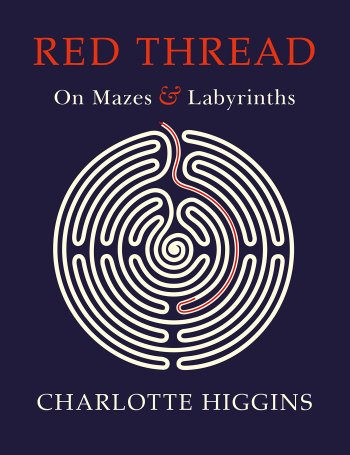 The tale of how the hero Theseus killed the Minotaur, finding his way out of the labyrinth using Ariadne’s ball of red thread, is one of the most intriguing, suggestive and persistent of all myths, and the labyrinth—the beautiful, confounding and terrifying building created for the half-man, half-bull monster—is one of the foundational symbols of human ingenuity and artistry.
Charlotte Higgins tracks the origins of the story of the labyrinth in the poems of Homer, Catullus, Virgil and Ovid, and with them builds an ingenious edifice of her own. She follows the idea of the labyrinth through the Cretan excavations of Sir Arthur Evans, the mysterious turf labyrinths of northern Europe, the church labyrinths of medieval French cathedrals and the hedge mazes of Renaissance gardens. Along the way, she traces the labyrinthine ideas of writers from Dante and Borges to George Eliot and Conan Doyle, and of artists from Titian and Velázquez to Picasso and Eva Hesse.
Her intricately constructed narrative asks what it is to be lost, what it is to find one’s way, and what it is to travel the confusing and circuitous path of a lived life. Red Thread is, above all, a winding and unpredictable route through the byways of the author’s imagination—one that leads the reader on a strange and intriguing journey, full of unexpected connections and surprising pleasures.
Charlotte Higgins’s previous books include the acclaimed Under Another Sky: Journeys in Roman Britain, which was shortlisted for awards including the Samuel Johnson (now Baillie Gifford) Prize for non-fiction. She is chief culture writer of The Guardian, a past winner of the Classical Association prize, and a fellow of the Society of Antiquaries. She lives in London.
From Laurence King:
Angus Hyland and Kendra Wilson, with illustrations by Thibaud Herem, The Maze: A Labyrinthine Compendium (London: Laurence King Publishing, 2018), 144 pages, $30.
 Mazes have been a part of civilization for at least 4,000 years, and there are more being built now than ever before. What is it about these magical life-size puzzles that continues to intrigue us? The idea of the maze taps into so many subconscious notions: the game, the quest, the spiritual journey. Perhaps this is the key to their enduring appeal. This beautifully illustrated book will delight lovers of mazes, acting as a guide, directory, and puzzle book combined. Specially commissioned illustrations by Thibaud Hérem represent 60 real and imagined mazes from around the world, with a bird’s eye view of each maze so that readers can make their own journey. Each maze is also accompanied by a fascinating and witty short history.
Thibaud Hérem is a French illustrator based in London. His published work includes Know Your Rodent (with Ziggy Hanaor, 2010), Draw me a House (2012) and London Deco (2013).
Angus Hyland is a graduate of the Royal College of Art and a partner at Pentagram Design London. His work for Laurence King includes (with Roanne Bell) Hand to Eye (2003), The Picture Book (2010), (with Steve Bateman) Symbol (2011), The Purple Book (2013) and The Book of the Dog (2015).
Kendra Wilson is a journalist, and author of My Garden is a Car Park and Other Design Dilemmas (2017), published by Laurence King. Collaborations with Angus Hyland include The Book of the Dog (2015) and The Book of the Bird (Laurence King, 2016).
From Penguin Random House:
Henry Eliot, Follow This Thread: A Maze Book to Get Lost In (New York: Three Rivers Press, 2019), 240 pages, ISBN: 978-1984824448, $18.
 Beautifully designed and gorgeously illustrated, this immersive, puzzle-like exploration of the history and psychology of mazes and labyrinths evokes the spirit of Choose Your Own Adventure, the textual inventiveness of Tom Stoppard, and the philosophical spirit of Jorge Luis Borges. Labyrinths are as old as humanity, the proving grounds of heroes, the paths of pilgrims, symbols of spiritual rebirth and pleasure gardens for pure entertainment. Henry Eliot leads us on a twisting journey through the world of mazes, real and imagined, unraveling our ancient, abiding relationship with them and exploring why they continue to fascinate us, from Kafka to Kubrick to the myth of the Minotaur and a quest to solve the disappearance of the legendary Maze King.
Henry Eliot is the creative editor of Penguin Classics. Having studied English Literature at Cambridge University, he has spent the past decade immersed in literature, creating a mass public pilgrimage for the National Trust inspired by William Morris, recreating Chaucer’s Canterbury Tales to raise money for the National Literacy Trust and leading a number of literary tours, including a Lake Poets tour of Cumbria and a quest for the Holy Grail based on Malory’s Morte Darthur. He was a Trustee of the William Blake literary society for three years. He is the author of Follow This Thread, a maze-like book about the history and psychology of mazes, and Curiocity, written with Matt Lloyd-Rose, an illustrated book of unexpected London journeys and experiences.
New Book | Iconoclasm in New York: Revolution to Reenactment
Scheduled for publication this fall from Penn State UP:
Wendy Bellion, Iconoclasm in New York: Revolution to Reenactment (University Park: The Pennsylvania State University Press, 2019), 280 pages, ISBN: 978-0271083643, $125.
 King George III will not stay on the ground. Ever since a crowd in New York City toppled his equestrian statue in 1776, burying some of the parts and melting the rest into bullets, the king has been riding back into American culture, raising his gilded head in visual representations and reappearing as fragments. In this book, Wendy Bellion asks why Americans destroyed the statue of George III—and why they keep bringing it back.
Locating the statue’s destruction in a transatlantic space of radical protest and material violence—and tracing its resurrection through pictures and performances—Bellion advances a history of American art that looks beyond familiar narratives of paintings and polite spectators to encompass a riotous cast of public sculptures and liberty poles, impassioned crowds and street protests, performative smashings and yearning re-creations. Bellion argues that iconoclasm mobilized a central paradox of the national imaginary: it was at once a destructive phenomenon through which Americans enacted their independence and a creative phenomenon through which they continued to enact British cultural identities. Persuasive and engaging, Iconoclasm in New York demonstrates how British monuments gave rise to an American creation story. This fascinating cultural history will captivate art historians, specialists in iconoclasm, and general readers interested in American history and New York City.
Wendy Bellion is Professor and Sewell C. Biggs Chair of American Art History at the University of Delaware. She is the author of the award-winning Citizen Spectator: Art, Illusion, and Visual Perception in Early National America.
New Book | Reconsidering Interpretation of Heritage Sites
From Routledge:
Anne Lindsay, Reconsidering Interpretation of Heritage Sites: America in the Eighteenth Century (New York: Routledge, 2019), 208 pages, ISBN: 978-1629582702 (hardback), $150 / ISBN: 978-1629582719 (paperback), $40.
 Reconsidering Interpretation of Heritage Sites chronicles and problematizes the representation of the eighteenth century in museums and heritage sites, whilst also challenging public historians to alter their perceptions of what might be possible when interpreting such sites.
Much of the history consumed at eighteenth-century historic sites is one-dimensional, white, male, heteronormative, and very focused on power and wealth. Anne Lindsay argues that this narrative may be challenged through an engagement with the everyday life of the past, creating thought-provoking and challenging experiences that will connect with the modern visitor on a deeper level. Unlike other work that has been done in the field, the book provides a constructive study that engages in a horizontal analysis of a century over a geographic region. As a result, Lindsay provides a unique opportunity for scholars and practitioners to reflect on the types and tone of messages usually conveyed about the eighteenth century.
Reconsidering Interpretation of Heritage Sites will be invaluable to scholars and practitioners working in the fields of museum and heritage studies and history. It will be particularly interesting to those who want to know more about how the lived experience of the past may be interpreted at historic sites and how this could be used to engage with contentious histories.
Anne Lindsay is an assistant professor of history and coordinator of the Capital Campus Public History Program at California State University, Sacramento. She holds a PhD in public history from the University of California, Riverside. Her research considers eighteenth-century heritage tourism for twenty-first century audiences. As a practitioner, she works in historic preservation and heritage tourism. She lives in northern California with her husband and three furry research assistants.
C O N T E N T S
Introduction
1 Interpreting the Lived Experience of Individuals and Families in the Eighteenth Century
2 Eighteenth-Century Interpretations of Environmental and Global Contexts at Historic Sites
3 Breathing Life into Historic House Museums
4 Interpreting Eighteenth-Century Streets and Gardens in the Urban Environment
5 Problematizing Eighteenth-Century Interpretation in the Homes of the Founders
Epilogue
Index
New Title | ‘The Only Unavoidable Subject of Regret’
From The University of Virginia Press:
Mary Thompson, ‘The Only Unavoidable Subject of Regret’: George Washington, Slavery, and the Enslaved Community at Mount Vernon (Charlottesville: The University of Virginia Press, 2019), 520 pages, ISBN: 978-0813941844, $30.
 George Washington’s life has been scrutinized by historians over the past three centuries, but the day-to-day lives of Mount Vernon’s enslaved workers, who left few written records but made up 90 percent of the estate’s population, have been largely left out of the story.
In “The Only Unavoidable Subject of Regret,” Mary Thompson offers the first comprehensive account of those who served in bondage at Mount Vernon. Drawing on years of research in a wide range of sources, Thompson brings to life the lives of Washington’s slaves while illuminating the radical change in his views on slavery and race wrought by the American Revolution.
Thompson begins with an examination of George and Martha Washington as slave owners. Culling from letters to financial ledgers, travel diaries kept by visitors and reminiscences of family members as well as of former slaves and neighbors, Thompson explores various facets of everyday life on the plantation ranging from work to domestic life, housing, foodways, private enterprise, and resistance. Along the way, she considers the relationship between Washington’s military career and his style of plantation management and relates the many ways slaves rebelled against their condition. The book closes with Washington’s attempts to reconcile being a slave owner with the changes in his thinking on slavery and race, ending in his decision to grant his slaves freedom in his will.
Mary V. Thompson, Research Historian at George Washington’s Mount Vernon, is the author of ‘In the Hands of a Good Providence’: Religion in the Life of George Washington (Virginia).
New Book | The American Duchess Guide to 18th-Century Beauty
This companion volume to The American Duchess Guide to 18th–Century Dressmaking is scheduled to be released in July, when it will be available at Amazon, Barnes & Noble, and other major booksellers.
Lauren Stowell and Abby Cox, with Cheyney McKnight, The American Duchess Guide to 18th-Century Beauty: 40 Projects for Period-Accurate Hairstyles, Makeup, and Accessories (Salem: MA, Page Street Publishing, 2019), 240 pages, ISBN: 978-1624147869, $25.
 Ever wondered how Marie Antoinette achieved her sky-high hairstyle or how women in the 1700s created their voluminous frizz hairdos? The American Duchess Guide to 18th-Century Beauty answers all your Georgian beauty questions―and teaches you all you need to know to recreate the styles yourself. Learn how to whip up your own pomatum and hair powder and correctly use them to take your dos to the next level. From there, dive into the world of buckles, hair cushions, and papillote papers with historically accurate hairstyles straight from the 1700s. And top all your hair masterpieces with millinery from the time period, from a French night cap to a silk bonnet to a simple, elegant chiffonet. With step-by-step instructions and insightful commentary, this must-have guide is sure to find a permanent place on the shelves of 18th-century beauty enthusiasts.
Lauren Stowell and Abby Cox are the authors of The American Duchess Guide to 18th-Century Dressmaking, and their company, American Duchess Inc., has been providing historically accurate lady’s shoes since 2011. Their shoes and accessories have been used in productions all over the world, including ABC’s Once Upon a Time, Starz’s Outlander and American Gods, Broadway’s Hamilton: An American Musical, Dangerous Liaisons, and Cinderella. Their shoes have also been used by the New York Metropolitan Opera and Ford’s Theater and have walked the red carpet at the Academy Awards. They live in Reno, Nevada.
As Stowell and Cox describe the project on their blog:
The recipes in the book come from primary sources like Toilet De Flora (1772) and Plocacosmos (1782), among others. These books have multiple recipes for various types of pomades, powders, rouges, paints, perfumes, and dyes, some of which contain ingredients that are not available today. We went with the simplest and most accessible recipes, all with natural and safe ingredients easily obtained.
Exhibition | Chic Emprise: Art and Culture of Tobacco
Now on view at the Museum of the New World in La Rochelle, from the press release:
Chic emprise: Culture, usages et sociabilités du tabac du XVIe au XVIIIe siècle
Musée du Nouveau Monde, La Rochelle, 22 June — 23 September 2019
Curated by Maxime Georges Métraux and Annick Notter
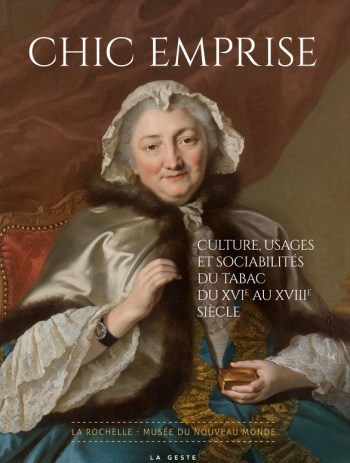 De l’Amérique du Nord en passant par les Caraïbes jusqu’au royaume du Kongo, le tabac est une plante incontournable de l’époque moderne (XVIe–XVIIIe siècle). À la fois produit de consommation, plaisir addictif et marqueur social, il s’est enraciné durablement dans l’ensemble des strates de la société en imprégnant aussi bien les mœurs aristocratiques et bourgeoises que populaires. Originaire d’Amérique, le tabac est rapidement importé avec succès en Europe où il a immédiatement entraîné de vifs débats entre ses défenseurs et ses opposants. Aujourd’hui discréditée et blâmée pour ses effets sur la santé, cette plante bénéficiait alors d’un statut différent, ses prétendues vertus curatives ont parfois été louées au point d’être l’objet de véritables discours de médicalisation. Le tabac véhicule un puissant imaginaire artistique et visuel comme en témoigne la vaste sélection d’œuvres présentées. Par ses multiples usages et son rôle éminemment social, la célèbre « herbe à Nicot » constitue un sujet idéal pour comprendre que l’époque moderne, et plus particulièrement le XVIIIe siècle, est l’un des moments de bascule d’une « civilisation de la rareté et de l’économie stationnaire à celle du développement et de l’abondance[1] ». Outre sa production et sa circulation, cette substance a engendré la fabrication de nombreux objets dédiés à ses diverses utilisations allant des pipes en pierre de Nouvelle-France jusqu’aux précieuses tabatières parisiennes. À l’instar du sucre et des boissons exotiques que sont le thé, le café et le chocolat, cette plante permet de saisir pleinement les processus coloniaux et leurs fonctionnements. L’essor de son commerce s’accompagne de la mise en place d’une imagerie promotionnelle massive dont les enseignes des marchands de tabacs constituent un précieux témoignage. À la croisée de l’histoire naturelle, de l’art et de la culture visuelle, cette exposition se propose d’étudier le tabac selon différentes approches afin d’en souligner son exceptionnelle richesse.
Cette exposition est l’occasion de présenter une grande sélection d’objets grâce à l’aide de plusieurs prêteurs publics (musée du Louvre, BnF, musée du Tabac de Bergerac, MAD Paris, Petit Palais, cité de la céramique de Sèvres, etc.) mais également du soutien de collectionneurs privés.
[1] Daniel Roche, Histoire des choses banales : naissance de la consommation dans les sociétés traditionnelles, XVIIe–XIXe siècle (Paris: Fayard, 1997), p. 14.
◊ ◊ ◊ ◊ ◊
Un catalogue a également été publié par les éditions La Geste:
Chic emprise: Culture, usages et sociabilités du tabac du XVIe au XVIIIe siècle (La Crèche: La Geste Editions, 2019), 256 pages, ISBN: 979-1035304669, €29.
L’ouvrage est richement illustré et composé d’une douzaine d’essais dont voici le sommaire :
1 La production de tabac en Amérique du Nord
• Elodie Peyrol-Kleiber, Les hommes aux pouces verts : cultiver le tabac dans la baie de Chesapeake
• Philippe Hrodej, Le cycle du tabac dans la partie française de Saint Domingue au XVIIe siècle
2 Les pratiques tabagiques
• Samir Boumediene, Du bon usage des choses. Les métamorphoses du tabac entre rites, savoir médicaux et pratiques de consommation
• Catherine Ferland, Usages du tabac au Canada, XVIe–XVIIIe siècle : la rencontre interculturelle
• Anton Serdeczny, De la fumée pour le mort : le tabac entre pratiques médicales et imaginaires culturels
3 Production et circulation des objets du fumeur
• Bernard Clist, Premières mondialisations de l’économie : témoignages par les pipes à fumer du royaume du Kongo de la fin du XVe siècle à la fin du XVIIIe siècle
• Marie-Hélène Daviau, Travailler la pierre pour faire naître la fumée : la pipe de pierre en Nouvelle-France
• Michèle Bimbenet-Privat, Les tabatières parisiennes : un luxe à la pointe de la mode
4 Le tabac et ses représentations
• Agnès Lugo-Ortiz, Des routes du démoniaque : tabac, commerce et culture visuelle aux Caraïbes et leurs axes transatlantiques
• Marianne Volle, La Nicotinia fait un tabac : du récit de voyage au livre botanique, XVIIe–XVIIIe siècles
• Pascale Cugy, ‘Agréable Tabac, charmant amuzement…’ Fumeurs, priseurs et râpeurs dans la gravure de mode sous Louis XIV
• Maxime Georges Métraux, Les enseignes des marchands de tabac au XVIIIe siècle : iconographie coloniale et culture visuelle de la consommation
Exhibition | Curieux Antiquaires: Les débuts de l’archéologie à Bavay
From the Forum Antique de Bavay:
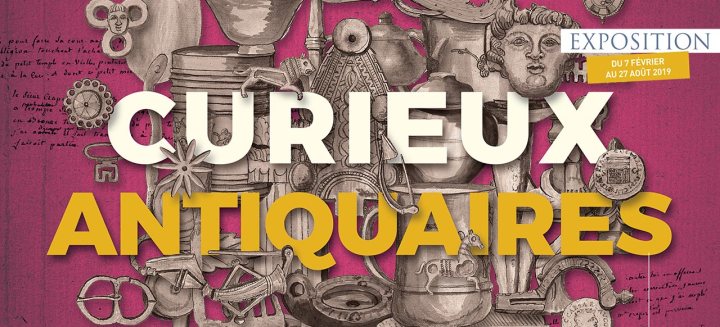
Curieux Antiquaires: The Origins of Archaeology in Bavay in the 18th and 19th Centuries
Forum Antique, Bavay (Nord), 7 February — 27 August 2019
L’antiquaire est par définition un grand collectionneur… Mais, celui que nous connaissons aujourd’hui et celui des XVIIIe et XIXe siècles sont bien différents. Un antiquaire dans les années 1700 et 1800 est en réalité un précurseur de l’archéologie, il se passionne pour la collection d’objets antiques et s’intéresse à leur passé pour raconter notre Histoire. Avec l’exposition Curieux antiquaires, les débuts de l’archéologie à Bavay aux XVIIle et XIXe siècles, pénétrez au coeur du passé antique de Bavay avec les yeux de ces amateurs éclairés. Découvrez des érudits hauts en couleurs à travers leurs méthodes de travail, réseaux, collections et dessins.
Cette exposition grand public a pour but de faire part aux visiteurs des avancées dans la connaissance de l’histoire de l’archéologie à Bavay en mettant d’une part en avant des portraits des acteurs de cette histoire (l’abbé Carlier, J.B. Lambiez, Antoine Niveleau, Parent) et d’autre part leurs publications (Recueil de dessins de Carlier, Histoire monumentaire du Nord des Gaules de Lambiez, Bavay ancien et nouveau de Niveleau …). Il est aussi question de faire prendre conscience au public du fait que la manière de construire l’image de l’Antiquité est conditionnée par l’époque.
Curieux Antiquaires: Les débuts de l’archéologie à Bavay aux XVIIIe et XIXe siècles (Paris: Snoeck, 2019), 200 pages, ISBN: 978-9461614711, 22€.
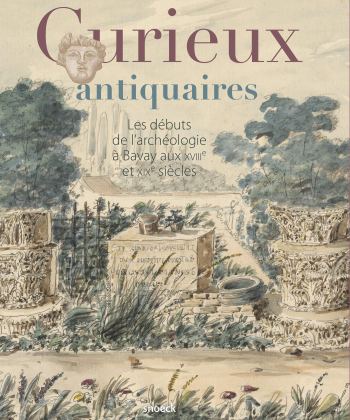 Si l’histoire de l’antique Bagacum est bien connue, la manière dont celle-ci s’est construite l’est moins. Curieux antiquaires, les débuts de l’archéologie à Bavay aux XVIIIe et XIXe siècles permet d’appréhender le patrimoine bavaisien sous un nouvel angle. Offrant une mise en perspective tant géographique que chronologique, ce catalogue apporte une vision nouvelle sur les premiers antiquaires bavaisiens. A travers les contributions d’Odile Parsis-Bazubé et d’Alain Schnapp, c’est la construction de l’antiquariate et de l’archéologie en France aux XVIIIe et XIXe siècles qui est mise en lumière. Plus loin, Véronique Beirnaert-Mary, Delphine Morana-Burlot et Véronique Krings détaillent l’exemple de Bavay. La première dresse le paysage bavaisien en présentant les acteurs locaux et leurs actions. Delphine Morana-Burlot propose ensuite une réflexion autour de la question du faux, Enfin, Véronique Krings ouvre une fenêtre sur la période du début du XXe siècle en s’attachant à relater la correspondance entre Franz Cumont et Raoul Warocqué autour des objets bavaisiens. Richement illustré, cet ouvrage rassemble toutes les pièces présentées à l’occasion de l’exposition. Des documents inédits sont ici publiés pour la première fois. La juxtaposition des objets archéologiques et de leur représentation dessinée est elle aussi inédite.










 Enfilade
leave a comment