New Book | Sodomites, Pederasts, and Tribades
From Penn State UP:
Jeffrey Merrick, ed., Sodomites, Pederasts, and Tribades in Eighteenth-Century France: A Documentary History (The Pennsylvania State University Press, 2019), 272 pages, ISBN: 978-0271083353, $90.
 In this book, Jeffrey Merrick brings together a rich array of primary-source documents—many of which are published or translated here for the first time—that depict in detail the policing of same-sex populations in eighteenth-century France and the ways in which Parisians regarded what they called sodomy or pederasty and tribadism. Taken together, these documents suggest that male and female same-sex relations played a more visible public role in Enlightenment-era society than was previously believed.
The translated and annotated sources included here show how robust the same-sex subculture was in eighteenth-century Paris, as well as how widespread the policing of sodomy was at the time. Part 1 includes archival police records from the 1720s to the 1780s that show how the police attempted to manage sodomitical activity through surveillance and repression; part 2 includes excerpts from treatises and encyclopedias, published nouvelles (collections of news) and libelles (libelous writings), fictive portrayals, and Enlightenment treatments of the topic that include calls for legal reform. Together these sources show how contemporaries understood same-sex relations in multiple contexts and cultures, including their own. The resulting volume is an unprecedented look at the role of same-sex relations in the culture and society of the era.
The product of years of archival research curated, translated, and annotated by a premier expert in the field, Sodomites, Pederasts, and Tribades in Eighteenth-Century France provides a foundational primary text for the study and teaching of the history of sexuality.
Jeffrey Merrick is Professor Emeritus of History at the University of Wisconsin–Milwaukee. He is the author of Order and Disorder Under the Ancien Régime and coeditor of Family, Gender, and Law in Early Modern France, the latter also published by Penn State University Press.
C O N T E N T S
Preface
List of Abbreviations
Glossary
Introduction
Part I. Surveillance of the Parisian Subculture
A Reports from the Archives of the Bastille
B Reports of the Watch/Guard and the Commissaires
C Reports of the Swiss Guard in the Champs-Élysées and the Commissaires
D Reports of Commissaires Foucault and Desormeaux
Part II. Representations of Same-Sex Relations
E Gossip and Slander
F Tradition
G Enlightenment
H Fictions
Notes
Recommended Reading
Index
Exhibition | William Blake
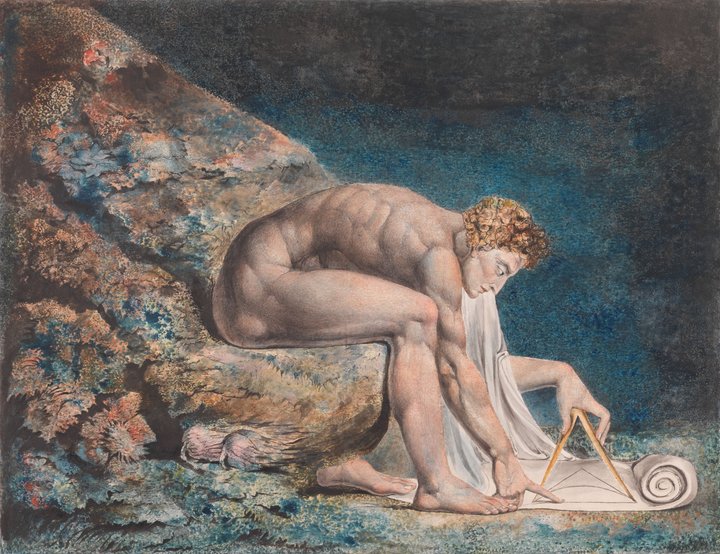
William Blake, Newton, 1795–c.1805, color print, ink and watercolour on paper
(London: Tate Britain)
◊ ◊ ◊ ◊ ◊
Press release (4 April 2019) for the exhibition:
William Blake
Tate Britain, London, 11 September 2019 — 2 February 2020
Curated by Martin Myrone and Amy Concannon
This autumn, Tate Britain will present the largest survey of work by William Blake (1757–1827) in the UK for a generation. A visionary painter, printmaker, and poet, Blake created some of the most iconic images in the history of British art and has remained an inspiration to artists, musicians, writers, and performers worldwide for over two centuries. This ambitious exhibition will bring together over 300 remarkable and rarely seen works and rediscover Blake as a visual artist for the 21st century.
 Tate Britain will reimagine the artist’s work as he intended it to be experienced. Blake’s art was a product of his tumultuous times, with revolution, war and progressive politics acting as the crucible of his unique imagination; yet he struggled to be understood and appreciated during his life. Now renowned as a poet, Blake also had grand ambitions as a visual artist and envisioned vast frescos that were never realised. For the first time, The Spiritual Form of Nelson Guiding Leviathan (c.1805–09) and The Spiritual Form of Pitt Guiding Behemoth (c.1805) will be digitally enlarged and projected onto the gallery wall on the huge scale that Blake imagined. The original artworks will be displayed nearby in a restaging of Blake’s ill-fated exhibition of 1809, the artist’s only significant attempt to create a public reputation for himself as a painter. Tate will recreate the domestic room above his family hosiery shop in which the show was held, allowing visitors to encounter the paintings exactly as people did in 1809.
The exhibition will provide a vivid biographical framework in which to consider Blake’s life and work. There will be a focus on London, the city in which he was born and lived for most of his life. The burgeoning metropolis was a constant inspiration for the artist, offering an environment in which harsh realities and pure imagination were woven together. His creative freedom was also dependent on the unwavering support of those closest to him, his friends, family, and patrons. Tate will highlight the vital presence of his wife Catherine who offered both practical assistance and became an unacknowledged hand in the production of his engravings and illuminated books. The exhibition will showcase a series of illustrations to Pilgrim’s Progress (1824–27) and a copy of the book The complaint, and the consolation Night Thoughts (1797), now thought to be coloured by Catherine.
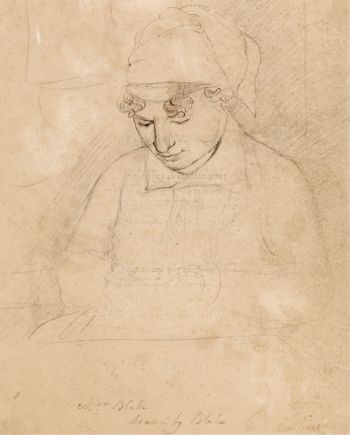
William Blake, Catherine Blake, 1805, graphite on paper (London: Tate Britain).
Blake was a staunch defender of the fundamental role of art in society and the importance of artistic freedom. Shaped by his personal struggles in a period of political terror and oppression, his technical innovation, and his political commitment, these beliefs have inspired the generations that followed and remain pertinent today. Tate Britain’s exhibition will open with Albion Rose (c.1793), an exuberant visualisation of the mythical founding of Britain, created in contrast to the commercialisation, austerity, and crass populism of the times. A section of the exhibition will also be dedicated to his illuminated books such as Songs of Innocence and of Experience (1794), his central achievement as a radical poet.
Additional highlights will include a selection of works from the Royal Collection and some of his best-known paintings including Newton (1795–c.1805) and Ghost of a Flea (c.1819–20). The latter work was inspired by a séance-induced vision and will be shown alongside a rarely seen preliminary sketch. The exhibition will close with The Ancient of Days (1827), a frontispiece for an edition of Europe: A Prophecy, completed only days before the artist’s death.
William Blake is curated by Martin Myrone, Lead Curator pre-1800 British Art, and Amy Concannon, Assistant Curator British Art 1790–1850. The exhibition will be accompanied by a catalogue from Tate Publishing (distributed by Princeton University Press), along with a programme of talks and events in the gallery.
Martin Myrone, ed., William Blake (London: Tate Publishing, 2019), 224 pages, ISBN: 978-0691198316, £43 / $55.
◊ ◊ ◊ ◊ ◊
Note (added 30 November 2019) — The original posting used the exhibition’s initial working title, William Blake: The Artist.
New Book | Romanticism and Illustration
From Cambridge UP:
Ian Haywood, Susan Matthews, and Mary Shannon, eds., Romanticism and Illustration (New York: Cambridge University Press, 2019), 360 pages, ISBN: 978-1108425711, $120.
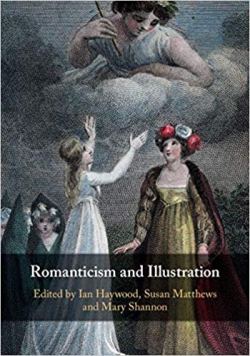 This collection of essays takes a fresh look at the important role of illustration in Romantic literature. The late eighteenth century saw an explosion of illustrated editions of literary classics and the emergence of a new culture of literary art, including the innovative literary galleries. The impact of these developments on the reading and viewing of literary texts is explored in a series of case studies covering poetry, historical texts, drama, painting, reproductive prints, magazines and ephemera. Romanticism and Illustration argues for a more detailed study of illustration which includes the context of a wider circulation of images across different media. The modern understanding of the word ‘illustration’ fails to convey the complex relationship between the artist, the engraver, the publisher, the text and the audience in Romantic Britain. In teasing out the implications of this dynamic cultural matrix, this book opens up a new field of Romantic studies.
C O N T E N T S
Figures
Notes on Contributors
Acknowledgements
Editors’ Introduction
Part I. Illustrating Poetry
1 Peter Otto, The Ends of Illustration: Explanation, Critique, and the Political Imagination in Blake’s Title-pages for Genesis
2 Sophie Thomas, ‘With a Master’s Hand and Prophet’s Fire’: Blake, Gray, and the Bard
3 Dustin Frazier Wood, Seeing History: Illustration, Poetic Drama, and the National Past
4 Martin Priestman, ‘Fuseli’s Poetic Eye’: Prints and Impressions in Fuseli and Erasmus Darwin
5 Susan Matthews, Henry Fuseli’s Accommodations: ‘Attempting the Domestic’ in the Illustrations to Cowper
6 Sandro Jung, Reading the Romantic Vignette: Stothard Illustrates Bloomfield, Byron, and Crabbe for The Royal Engagement Pocket Atlas
7 Maureen McCue, Intimate Distance: Thomas Stothard’s and J. M. W. Turner’s Illustrations of Samuel Rogers’s Italy
Part II. The Business of Illustration
8 Ian Haywood, Illustration, Terror, and Female Agency: Thomas Macklin’s Poets Gallery in a Revolutionary Decade
9 Luisa Calè, Maria Cosway’s Hours: Cosmopolitan and Classical Visual Culture in Thomas Macklin’s Poets Gallery
10 Mary Shannon, Artists’ Street: Thomas Stothard, R. H. Cromek, and Literary Illustration on London’s Newman Street
11 Brian Maidment, The Development of Magazine Illustration in Regency Britain: The Example of Arliss’s Pocket Magazine, 1818–1833
Coda, Martin Myrone, Romantic Illustration and the Privatization of History Painting
Bibliography
Index
New Book | The Hand that Rocked the Cradle
Distributed in the US and Canada by The University of Chicago Press:
Sue Laurence, The Hand that Rocked the Cradle: The Art of Birth and Infancy (London: Unicorn Publishing, 2019), 192 pages, ISBN: 978-1911604556, $30.
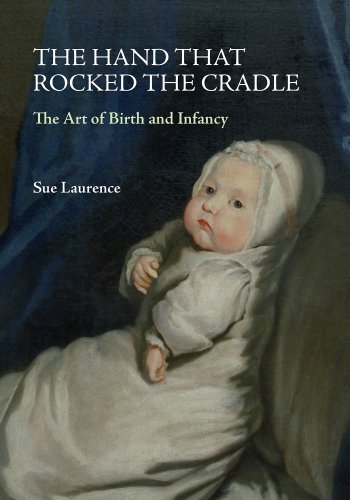 Throughout the history of art, artists have been drawn to images of birth and infancy. After all, who doesn’t want to look at a baby? This book uses that bounty of imagery to offer a fresh perspective on the history of birth and the early years of life through a rich array of images and objects, including paintings, prints, sculptures, metalwork, jewelry, textiles, ceramics, furniture, and woodwork—as well as images from medical and social history collections.
Exploring a long chronological scope, from around 1300 to the turn of the twentieth century, Sue Laurence provides insight into the enduring nature of many traditions and experiences related to childhood and infancy—many of which we tend to assume are of recent vintage, but turn out, when examined closely, to have roots in the medieval era. Packed with beautiful images, and offering surprising new interpretations and contextualization, The Hand That Rocked the Cradle is a treasure trove for any lover of art—or doting parent.
Sue Laurence has served as Head of the V&A Museum of Childhood, where she created many innovative exhibitions as well as securing significant acquisitions. She has also been head of interpretation at the National Archives and a curator at the Florence Nightingale Museum.
New Book | History of Illustration
From Bloomsbury:
Susan Doyle, Jaleen Grove, and Whitney Sherman, eds., History of Illustration (London: Fairchild Books, 2018), 592 pages, ISBN: 978-1501342110 (hardback), $240 / ISBN: 978-1501342103 (paperback), $90.
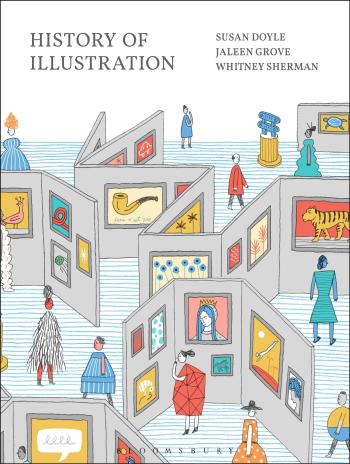 History of Illustration covers image-making and print history from around the world, spanning from the ancient to the modern. Hundreds of color images show illustrations within their social, cultural, and technical context, while they are ordered from the past to the present. Readers will be able to analyze images for their displayed techniques, cultural standards, and ideas to appreciate the art form. This essential guide is the first history of illustration written by an international team of illustration historians, practitioners, and educators.
Susan Doyle is Chair and Associate Professor at Rhode Island School of Design in Providence.
Jaleen Grove is a Post-Doctoral Fellow at the Douglas B. Dowd Modern Graphic History Library at Washington University.
Whitney Sherman is Director of the MFA in Illustration Practice at Maryland Institute College of Art.
C O N T E N T S
Preface
Acknowledgements
Introduction
I. Illustrative Traditions in Europe, Asia, and Africa
1 Image and Meaning, Prehistory to 1500 by Robert Brinkerhoff and Margot McIlwin Nishimura
2 Illustration in Printed Matter in Early Modern Europe, 1400–1660 by Susan Doyle
3 Pluralistic View of Indian Images: 2nd BCE to the 1990s by Binita Desai and Nina Sabnani
4 Illustrative Traditions in the Muslim Context by Irvin Cemil Schick
5 Chinese Illustration before 1900 by Sonja Kelley and Frances Wood
6 Prints and Books in Japan’s Floating World by Daphne Rosenzweig
7 Illustration in Latin America from Pre-Columbian to Modern 1990s by Maya Stanfield-Mazzi
8 Illustration in the African Context by Bolaji Campbell with contributions by Winifred Lambrecht
II. Images as Knowledge, Ideas as Power
9 Observation and the Representation of Natural Science Illustration, 1450–1900 by Shelley Wall
10 Visualizing Bodies: Anatomical and Medical Illustration from the Renaissance to the Nineteenth Century by Shelley Wall
11 Dangerous Pictures: Social Commentary in Europe, 1720–1860 by Robert Lovejoy
12 From Reason to Romanticism by Hope Saska
III. The Advent of Mass Media
13 Illustration on British and North American Printed Ephemera of the Nineteenth and Early Twentieth Centuries by Graham Hudson
14 Illustration in the Expansion of the Graphic Journalism and Magazine Fiction in Europe and North America, 1830–1900 by Brian Kane and Page Knox
15 Beautifying Books and Popularizing Posters: Illustration in the Later Nineteenth Century by Susan Ashbrook and Alison Syme
16 Fantasy and Children’s Book Illustration Nineteenth and Early Twentieth-Century England by Alice Carter
17 Six Centuries of Fashion Illustration by Pamela Parmal
IV. Diverging Paths in 20th-Century American and European Illustration
18 American Narratives: Periodical Illustration in the Late Nineteenth and Early Twentieth Century by Mary Holahan with contributions by Alice Carter and Joyce Schiller
19 Avant-garde Illustration, 1900–1950 by Jaleen Grove
20 Diverse American Illustration Trends in Periodicals, 1915–1940 by Roger Reed
21 Wartime Imagery and Propaganda, 1890–1950 by Thomas LaPadula
22 Illustrating Alternate Realities in Pulps and Other Popular Fiction by Nicholas Egon Jainschigg with contributions by Robert Lovejoy
23 Overview of Comics and Graphic Narratives by Brian M. Kane with contributions by Loren Goodman and Michelle Nolan
V. The Evolution of Illustration in an Electronic Age
24 The Shifting Postwar Marketplace: Illustration Competes with Growing Media Options in the United States and Canada, 1940–1970 by Stephanie Plunkett
25 Children’s Book Illustration, 1920–2000 by H. Nichols B. Clark
26 Countercultures: Underground Comix, Rock Posters, and Protest Art, 1960–1990 by Robert Lovejoy
27 Print Illustration in the Postmodern World by Whitney Sherman
28 Medical Illustration after Gray’s Anatomy: 1859 to the Present by David M. Mazierski
29 Digital Forms by Nanette Hoogslag and Whitney Sherman
Bibliography
Glossary
Index
New Book | Textiles of Japan
From Prestel:
Thomas Murray and Virginia Soenksen, with a foreword by Anna Jackson, Textiles of Japan (London: Prestel, 2018), 520 pages, ISBN: 978-3791385204, $85 / £65.
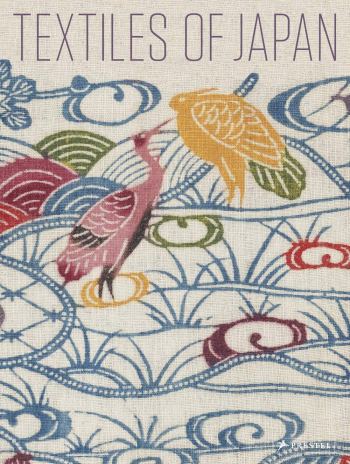 From rugged Japanese firemen’s ceremonial robes and austere rural work-wear to colorful, delicately-patterned cotton kimonos, this lavishly illustrated volume explores Japan’s rich tradition of textiles.
Textiles are an eloquent form of cultural expression and of great importance in the daily life of a people, as well as in their rituals and ceremonies. The traditional clothing and fabrics featured in this book were made and used in the islands of the Japanese archipelago between the late 18th and the mid 20th century. The Thomas Murray collection featured in this book includes daily dress, work-wear, and festival garb and follows the Arts and Crafts philosophy of the Mingei Movement, which saw that modernization would leave behind traditional art forms such as the hand-made textiles used by country people, farmers, and fisherman. It presents subtly patterned cotton fabrics, often indigo dyed from the main islands of Honshu and Kyushu, along with garments of the more remote islands: the graphic bark cloth, nettle fiber, and fish skin robes of the aboriginal Ainu in Hokkaido and Sakhalin to the north, and the brilliantly colored cotton kimonos of Okinawa to the far south. Numerous examples of these fabrics, photographed in exquisite detail, offer insight into Japan’s complex textile history as well as inspiration for today’s designers and artists. This volume explores the range and artistry of the country’s tradition of fiber arts and is an essential resource for anyone captivated by the Japanese aesthetic.
Thomas Murray is a dealer of Asian and tribal art and has an extensive personal collection of Japanese and Indonesian textiles. He is a past president of the Antique Tribal Art Dealers Association (ATADA), and served on President Obama’s Cultural Property Advisory Committee at the Department of State in Washington, D.C.
Virginia Soenksen is Associate Director of the Madison Art Collection at James Madison University in Virginia.
Anna Jackson is Keeper of the Asian Department at The Victoria and Albert Museum in London, where she is responsible for the museum’s collection of Japanese textiles and dress.
Exhibition | Madame de Maintenon
Now on view at Versailles:
Madame de Maintenon: In the Corridors of Power
Château de Versailles, 16 April — 21 July 2019
Curated by Alexandre Maral and Mathieu da Vinha
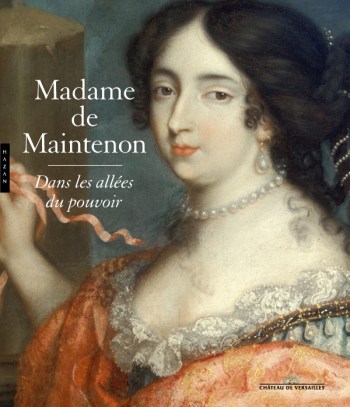 The first exhibition entirely devoted to the Marquise of Maintenon, on the tercentenary of her death on 15 April 1719, recounts the extraordinary life of Françoise d’Aubigné (1635–1719). She was born in a prison yet went on to become the Sun King’s wife in 1683.
The different stages of her life are shown in around 60 works from the collections of Versailles and other museums, including paintings, drawings, engravings, books, sculptures, medals, and so on. The visit passes through the four adjoining rooms of the apartment she lived in from 1682 until 1715, on the first floor of the Palace’s central section.
The scenography returns the walls to their original colours at the time. They are richly draped in alternating silk panels as described in the Furniture Store-House inventories from 1708: red damask, crimson damask, and red taffeta for the second antechamber; green and gold damask for the bedroom; and crimson and gold flower damask for the Chambers. This installation was made possible thanks to the restoration of these wall hangings by Tassinari et Chatel, the nation’s oldest silk manufacturer, founded in Lyon by Louis XIV.
The exhibition is curated by Alexandre Maral (Head Curator for Heritage and Director of the Centre de recherche du château de Versailles) and Mathieu da Vinha (Scientific Director of the Centre de recherche du château de Versailles), with scenography by Jérôme Dumoux.
Alexandre Maral and Mathieu da Vinha, Madame de Maintenon: Dans les allées du pouvoir (Paris: Hazan, 2019), 192 pages, ISBN: 978-2754110723, 35€.
The exhibition brochure (in French and English) is available as PDF file here
◊ ◊ ◊ ◊ ◊
Symposium | Madame de Maintenon, 1719–2019
Château de Versailles, 21–23 March 2019
This international symposium offered a fresh look at this multifaceted historical figure, reviewing the biographical aspects of the Marquise, as well as her correspondence and the literary and iconographic legend surrounding her.
Details along with audio recordings are available here.
Exhibition | A Return to the Grand Tour: Micromosaic Jewels
Opening this weekend at the VMFA:
A Return to the Grand Tour: Micromosaic Jewels from the Collection of Elizabeth Locke
Virginia Museum of Fine Arts, Richmond, 27 April — 2 September 2019
The Gibbes Museum of Art, Charleston, 2020
Curated by Susan Rawles
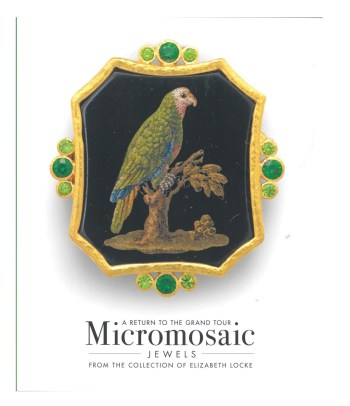 The wide range of subjects depicted in these 92 intricately crafted works of art—precious souvenirs designed for Grand Tour travelers of the mid-18th to late-19th centuries—include Renaissance paintings, architecture, birds, animals, historical sites, landscapes, and portraits. These micromosaic jewels reflect the sophisticated pursuits of elite Europeans for whom travel was a rite of passage.
Diminutive forms of ancient Roman, Grecian, and Byzantine mosaics, ‘micromosaics’—a term coined in the 1970s by collector Sir Arthur Gilbert—are made using a painstaking technique that involves tesserae, small pieces of opaque enamel glass. The tiny mosaics were first developed with regularity in the second half of the 18th century by the Vatican Mosaic Workshop. By the 19th century, numerous independent studios devoted to the production of these small keepsakes were established to meet travelers’ demands and to capitalize on the increasing popularity of micromosaics as symbols of status, sophistication, and social polish. For an English traveler to Rome, Venice, or Milan, for example, a micromosaic of an Italian Renaissance painting or ancient architectural monument captured the journey and today reflects that era’s fascination with the classics and societal requisite travel to the ‘cradle of western civilization’.
The works of art on view in this exhibition, which are predominantly stunning pieces of jewelry, are dazzling in their exquisite detail and craftsmanship. In addition to the tiny enameled glass that forms the mosaic, eye-catching designs include gold, precious stones, and diamonds. VMFA is pleased to present this decorative arts exhibition and to share these fine works of art from the Elizabeth Locke Collection of Micromosaics.
The exhibition is organized by the Virginia Museum of Fine Arts and curated by Dr. Susan J. Rawles, Associate Curator of American Painting and Decorative Arts, VMFA.
Susan Rawles, with a foreword by John Guare, A Return to the Grand Tour: Micromosaic Jewels from the Collection of Elizabeth Locke (Richmond: Virginia Museum of Fine Arts, 2019), 118 pages, ISBN: 978-1934351154, $25.
New Book | Joseph Rose: Working Drawings. Facsimile of a Sketchbook
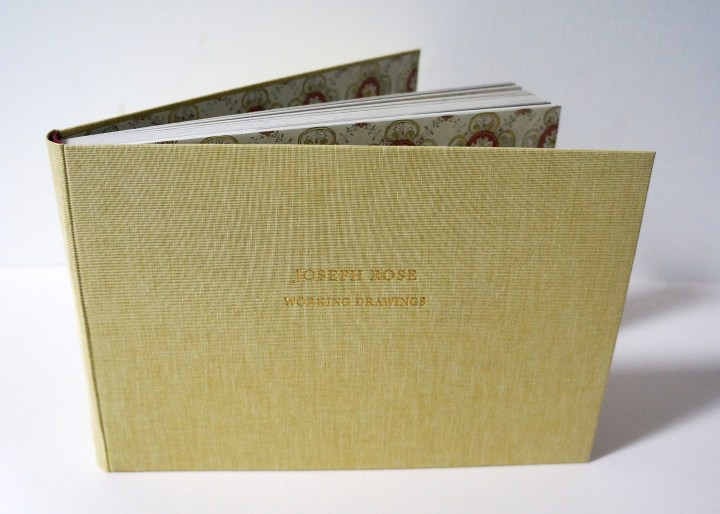
Joseph Rose: Working Drawings. Facsimile of a Sketchbook at Harewood House, with an introduction by Ashleigh Murray (Frome, Somerset: Kate Holland, 2019). Limited edition of 50, of which 48 are ‘ordinary’ (£150) and 2 ‘extraordinary’ (£3000).
The two extraordinary copies are bound in full alum tawed calfskin with hand dyed calfskin inlays and blind and gold tooling. A plasterwork rosette by Hayles and Howe, gilded by Glenny Thomas, is inset into the front board. Hand coloured edges. Hand sewn silk endbands. Printed endpapers from an original watercolour.
This book came about following an invitation to Kate Holland to exhibit as one of the 26 makers selected to feature in the inaugural celebration of contemporary craft at Harewood House, Useful/Beautiful: Why Craft Matters, on view from 23 March until 1 September 2019. A preliminary visit to the house culminated in a behind-the-scenes tour of the archives. In one drawer was a small, nondescript, slightly battered book that revealed a series of working drawings by both Joseph Rose Senior (ca. 1723–1780) and Joseph Rose Junior (1745–1799).
The Roses were the pre-eminent master plasterers of their day and worked closely with Robert Adam (1728–1792) on the ceilings at Harewood in the 1760s as well as on many other big houses, several of which feature in this book. The sketchbook gives a fascinating glimpse into the minds of two incredible craftsmen working on highly significant commissions with some of the foremost architects and interior designers of their time. It is the perfect record of the link between commissioner, designer, and craftsman. Particularly because craftsmen too often fade into the background, Holland wanted to celebrate them especially for this celebration of craft.
As well as the facsimile sketchbook, there is also included an introduction by Ashleigh Murray, currently the academic expert on Joseph Rose in the UK. There are also contemporary images from the workshop floor of Hayles and Howe in Bristol, who still use the same techniques as Joseph Rose today—as well as a full list of plates, transcribed from the manuscript titles, as written by Joseph Rose.
This book is intended to serve not only as an important reference tool for those researching ornamental plasterwork or the work of Robert Adam but also to appeal to a wider audience with an interest in Georgian architecture or the history of interior design and craftsmanship.
For those visiting Harewood House, copies are available at the gift shop. Mail order copies can be arranged by contacting Kate Holland directly, katehollandbookbinder@gmail.com.
More information on the exhibition Useful/Beautiful: Why Craft Matters is available here.

New Book | Romantic Legacies
From Routledge:
Shun-liang Chao and John Michael Corrigan, eds., Romantic Legacies: Transnational and Transdisciplinary Contexts (London: Routledge, 2019), 336 pages, ISBN: 978-0367076726, £115 / $145.
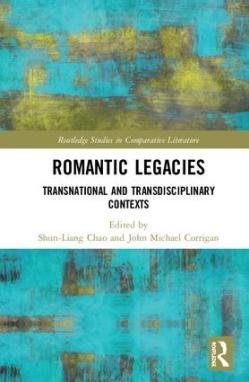 Romantic Legacies: Transnational and Transdisciplinary Contexts presents the most wide-ranging treatment of Romantic regenerations, covering the cross-pollination between the arts or between art and thought within or across the borders of Germany, Britain, France, the US, Russia, India, China, and Japan. Each chapter examines a legacy or afterlife in a comparative context to demonstrate ongoing Romantic legacies as fully as possible in their complexity and richness. The volume provides a lens through which to understand Romanticism not merely as an artistic heritage but as a dynamic site of intellectual engagement that crosses nations and time periods and entails no less than the shaping of our global cultural currents.
Shun-liang Chao is Associate Professor of English and Comparative Literature at National Chengchi University, Taiwan. He’s the author of Rethinking the Concept of the Grotesque: Crashaw, Baudelatire, Magritte (Legenda/Routledge, 2010) and co-editor of Humour in the Arts: New Perspectives (Routledge, 2018).
John Michael Corrigan is Associate Professor of English and Digital Humanities at National Chengchi University, Taiwan. He’s the author of American Metempsychosis: Emerson, Whitman, and the New Poetry (Fordham UP, 2012).
C O N T E N T S
Foreword, James Engell
Introduction, Shun-liang Chao and John Michael Corrigan
I. Realist Romanticism
1 Romantic Walking and Railway Realism, Rachel Bowlby
2 The Use and Abuse of Romance: Realist Revisions of Walter Scott in England, France, and Germany, Geoffrey Baker
3 Chekhov on the Meaning of Life: After Romanticism and Nihilism, Yuri Corrigan
II. Fin-de-Siècle Romanticism
4 Keats Gone Wilde: Wilde’s Romantic Self-Fashioning at the Fin de Siècle, Ya-Feng Wu
5 Delacroix, Signac, and the Aesthetic Revolution in Fin-de-siècle France, Shao-Chien Tseng
6 Mediating Richard Wagner and Henry Bishop: Frederick Corder and the Different Legacies of German and English Romantic Opera, David Chandler
III. (Post)Modern Romanticism
7 Platonism, Its Heirs, and the Last Romantic, Arthur Versluis
8 Vexed Meditation: Romantic Idealism in Coleridge and Its Afterlife in Bataille and Irigaray, Justin Prystash
9 ‘You have to be a transparent eyeball’: Transcendental Afterlives in Matthew Weiner’s Mad Men, John Michael Corrigan
IV. Environmental Romanticism
10 Tracing Romanticism in the Anthropocene: An Ecocritical Reading of Ludwig Tieck’s Rune Mountain, Caroline Schaumann
11 The Eye of the Earth: Nonhuman Vision from Blake to Contemporary Ecocriticism, Sophie Laniel-Musitelli
12 ‘Indistinctness is my forte’: Turner, Ruskin, and the Climate of Art, Carmen Casaliggi
V. Oriental Romanticism
13 ReOrienting Romanticism: The Legacy of Indian Romantic Poetry in English, Steve Clark
14 Grafting German Romanticism onto the Chinese Revolution: Goethe, Guo Morou, and the Pursuit of Self-Transcendence, Johannes Kaminski
15 Two Chinese Wordsworths: The Reception of Wordsworth in Twentieth-Century China, Li Ou
16 ‘The world must be made Romantic’: The Sentimental Grotesque in Tetsuya Ishida’s ‘Self-Portraits of Others’, Shun-liang Chao
Index










 Enfilade
leave a comment