New Book | Burlington House
Available from Distributed Art Publishers (DAP) . . .
Nicholas Savage, Burlington House: The Architectural History of the Home of the Royal Academy of Arts (London: Royal Academy of Arts, 2018), 368 pages, ISBN: 978-1910350805, £60 / $75.
 On Charles II’s restoration to the throne in 1660, four of his supporters were provided with plots of land in a leafy suburb of London, on which to build their extravagant town palaces. The only one to survive—built for the poet and courtier Sir John Denham (1615–1669) and now situated in the heart of Piccadilly—became the home of the Royal Academy of Arts, its exhibitions and its Schools.
This significant study charts the history of the estate through its many owners, including the 3rd Earl of Burlington (1694–1753), who gave the house not only its name but also its influential character and distinctive architecture, which remains an unparalleled example of the Palladian style in England. Nicholas Savage’s thorough research studies 350 years of social and architectural history, as well as revealing the next phase in the life of the estate, with the joining up of Burlington House and James Pennethorne’s nineteenth-century neo-classical building that was constructed in its garden. This link opens up Burlington House as never before in a breath-taking redevelopment led by Sir David Chipperfield to celebrate the institution’s 250th anniversary.
The architectural historian Nicholas Savage is former Head of Collections at the Royal Academy of Arts and co-author of Genius and Ambition: The Royal Academy of Arts, London, 1768–1918 (RA Publications, 2015).
C O N T E N T S
Preface
1 Sir John Denham
2 The Earls of Burlington and Cork
3 The Cavendish Family
4 Her Majesty’s Office of Works
5 Royal Academy of Arts
Notes
Selected Bibliography and Further Reading
Photographic Acknowledgments
Index
New Book | La griffe du peintre
From Le Seuil:
Charlotte Guichard, La griffe du peintre: La valeur de l’art, 1730–1820 (Paris: Le Seuil, 2018), 352 pages, ISBN: 978-2021402315, 31€.
 Comment le nom de l’artiste est-il devenu un élément clef de la valeur symbolique et commerciale des œuvres ? La question est au cœur de cette enquête novatrice sur la signature en peinture. C’est à Paris, entre les années 1730 et 1820, que se déploie cette enquête richement illustrée, lorsque s’instaurent les institutions modernes des mondes de l’art : salons et expositions publiques, ventes aux enchères, musées. Les peintres français (Jean-Siméon Chardin en tête) se mettent à apposer leur nom sur les tableaux alors même que le nom de l’artiste devient un élément clef qui organise les écrits sur l’art : critiques, catalogues, cartouches et cartels, au point qu’un contemporain constate alors, avec dépit, que les amateurs se mettent à acheter « des noms, et non plus des œuvres ».
Mais pourquoi placer ainsi son nom sur un panneau de bois ou sur une toile ? La tradition est ancienne, et remonte à l’Antiquité. Pourtant, les peintres de l’âge des Lumières surent investir le nom de significations nouvelles. À Paris, le marché pour leurs peintures s’était élargi, avec la multiplication des ventes aux enchères, et ils ne pouvaient plus se contenter des cercles étroits de la commande princière ou celle des riches élites. Il fallait susciter le désir de consommation au moment où un premier capitalisme commercial fondé sur le luxe et sur la mode connaissait un essor sans précédent avant de s’imposer aux sociétés européennes au siècle suivant. La signature fut ce lieu, dans le tableau, où la valeur pouvait se concentrer et perdurer, où le culte de l’artiste pouvait matériellement se déposer.
Charlotte Guichard est historienne de l’art, directrice de recherche au CNRS et professeure attachée à l’École normale supérieure. Spécialiste des cultures visuelles et de l’art des Lumières, elle a publié Les Amateurs d’art à Paris au XVIIIe siècle (Champ Vallon, 2008) et Graffitis. Inscrire son nom à Rome. XVIe-XIXe siècle (Seuil, 2014).
Exhibition | De Vouet à Boucher
Now on view at Musée des Beaux-Arts d’Orléans:
De Vouet à Boucher, au cœur de la collection de Motais de Narbonne
Musée des Beaux-Arts d’Orléans, 15 September 2018 — 13 January 2019
Curated by Olivia Voisin and Viviane Mesqui
 Le musée des Beaux-Arts d’Orléans présentera du 15 septembre 2018 au 13 janvier 2019 l’intégralité de la collection d’Héléna et de Guy Motais de Narbonne dans une exposition originale plongeant au coeur de l’univers des collectionneurs : entre culture muséale et connoisseurship, les Motais de Narbonne ont rassemblé 80 tableaux des XVIIe et XVIIIe siècles, italiens et français, résolument tournés vers l’histoire.
Leur collection, qui par ses artistes et par ses sujets entre en résonnance avec la collection de peintures anciennes du musée des Beaux-Arts d’Orléans, sera montrée pour la première fois au public dans son intégralité, en dialogue avec des oeuvres de collections publiques ou privées.
Cette exposition se place sous le parrainage de Pierre Rosenberg, membre de l’Académie française et grand connaisseur de la collection Motais de Narbonne, en collaboration avec de nombreux historiens de l’art. Tout au long du parcours, le visiteur pénétrera dans l’intimité d’une collection privée vivante, rythmée par les histoires et les coups de coeur qui ont conduit à sa constitution. Les Motais de Narbonne partagent avec cette exposition non seulement l’exceptionnelle collection qu’ils ont rassemblée, mais également une part de l’histoire intime qui se tisse entre un amateur et un tableau. L’émotion, les motifs insolites et surprenants occupent ainsi une place particulière dans le coeur d’Héléna et de Guy Motais de Narbonne, stimulant leur regard et générant parfois une acquisition. De même, leur vif intérêt pour les musées, qui a joué un rôle déterminant dans la formation de leur regard et de leur goût, ponctue le parcours par des rapprochements avec des peintures qui les ont inspirés.
The press kit (dossier de presse) is available here»
Viviane Mesqui and Pierre Rosenberg, De Vouet à Boucher, au coeur de la collection Motais de Narbonne (Heule: Snoeck, 2018), 263 pages, ISBN: 978-9461614742, $50.
New Book | The Art of Armenia: An Introduction
From Oxford UP:
Christina Maranci, The Art of Armenia: An Introduction (Oxford University Press, 2018), 272 pages, ISBN: 978-0190269005, $40.
 Though immediately recognizable in public discourse as a modern state in a political ‘hot zone’, Armenia has a material history and visual culture that reaches back to the Paleolithic era. This book presents a timely and much-needed survey of the arts of Armenia from antiquity to the early eighteenth century CE. Divided chronologically, it brings into discussion a wide range of media, including architecture, stone sculpture, works in metal, wood, and cloth, manuscript illumination, and ceramic arts. Critically, The Art of Armenia presents this material within historical and archaeological contexts, incorporating the results of specialist literature in various languages. It also positions Armenian art within a range of broader comparative contexts including, but not limited to, the ancient Mediterranean and Near East, Byzantium, the Islamic world, Yuan-dynasty China, and seventeenth-century Europe. The Art of Armenia offers students, scholars, and heritage readers of the Armenian community something long desired but never before available: a complete and authoritative introduction to three thousand years of Armenian art, archaeology, architecture, and design.
Christina Maranci is Arthur H. Dadian and Ara T. Oztemel Professor of Armenian Art at Tufts University, and a specialist on the medieval era. She has published and lectured widely, having authored three previous monographs and over seventy essays, articles, and reviews. Her work combines scholarship on the history of Armenian art and architecture with advocacy for at-risk Armenian heritage, particularly medieval monuments in the Republic of Turkey.
C O N T E N T S
Exhibition | Armenia!

Altar Frontal, detail, New Julfa, 1741; gold, silver, and silk threads on silk (Mother See of Holy Etchmiadzin, Armenia; photo by Hrair Hawk Khatcherian and Lilit Khachatryan).
◊ ◊ ◊ ◊ ◊
Press release (20 September 2018) for the exhibition now on view at The Met:
Armenia!
The Met Fifth Avenue, New York, 22 September 2018 — 13 January 2019
Curated by Helen Evans, with C. Griffith Mann and Constance Alchermes
Armenia! explores the arts and culture of the Armenians from their conversion to Christianity in the early fourth century through their leading role on international trade routes in the 17th century. The exhibition emphasizes how Armenians developed a distinctive national identity in their homeland at the base of Mt. Ararat (widely accepted as the resting place of Noah’s Ark) and how they maintained and transformed their traditions as their communities expanded across the globe.
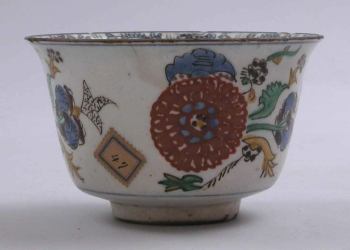
Kütahya Vessel, 18th century, stonepaste; polychrome painted under transparent glaze, 6.7 cm high (New York: The Metropolitan Museum of Art, 02.5.45).
More than 140 opulent gilded reliquaries, richly illuminated manuscripts, rare textiles, liturgical furnishings made of precious materials, khachkars (cross stones), church models, and printed books demonstrate Armenia’s distinctive imagery in their homeland and other major Armenian sites, from the Kingdom of Cilicia on the Mediterranean to New Julfa, in Safavid Persia. Select comparative works display Armenian interaction with other cultures. Major Armenian repositories of their culture provide almost all the works in the exhibition. Most are on view in the United States for the first time; many have not traveled for centuries.
Armenia! focuses on major Armenian centers of production from their homeland west and east. It includes images of Armenians, from self-portraits to depictions of male and female rulers, donors, theologians, and historians. Special attention is given to works by major artists such as T’oros Roslin, Sargis Pidzak, Toros Taronatsi, and Hakob of Julfa working in the Armenian homeland, the Kingdom of Cilicia, and New Julfa.
More than half of the works on display are on loan from The Republic of Armenia with the support of The Ministry of Culture. Imposing liturgical works are coming from the Mother See of Holy Etchmiadzin, the primary site of the Armenian Church. In Yerevan, the ‘Matenadaran’ Mesrop Masthots` Institute – Museum of Ancient Manuscripts is lending exceptional manuscripts, and the History Museum of Armenia is lending monumental church sculptures. The Holy See of Cilicia in Lebanon, the Armenian Patriarchate of Jerusalem, and the Armenian Mekhitarist Congregation in Venice are the other major Armenian religious communities lending exceptional works. Armenian collections lending select works are the Calouste Gulbenkian Museum in Portugal and in America, the Diocese of the Armenian Church (Eastern) (New York); the Armenian Museum of America (Boston); and the Alex and Marie Manoogian Museum (Southfield, Michigan). Additional works are coming from The Met and other American and European institutions.
Photographs of Armenian architecture and landscapes by noted Armenian-Canadian photographer Hrair Hawk Khatcherian and his assistant Lilit Khachatryan will provide context for the works in the exhibition, in the catalogue, and on the exhibition page of the website.
The exhibition was organized by Helen C. Evans, the Mary and Michael Jaharis Curator of Byzantine Art, with the support of C. Griffith Mann, the Michel David-Weill Curator in Charge, Department of Medieval Art and The Cloisters, and the assistance of Constance Alchermes, Research Assistant. Exhibition design is by Michael Langley, Exhibition Design Manager; graphics are by Chelsea Amato and Morton Lebigre, Graphic Designers; and lighting is by Clint Ross Coller and Richard Lichte, Lighting Design Managers.
The exhibition is made possible by The Hagop Kevorkian Fund. Additional support is provided by the Carnegie Corporation of New York, the Michel David-Weill Fund, the Armenian General Benevolent Union, The Giorgi Family Foundation, The Hirair and Anna Hovnanian Foundation, the Karagheusian Foundation, The Nazar and Artemis Nazarian Family, the Ruddock Foundation for the Arts, The Strauch Kulhanjian Family and The Paros Foundation, Aso O. Tavitian, and the National Endowment for the Arts.
The catalogue is distributed by Yale UP:
Helen Evans, ed., Armenia: Art, Religion, and Trade in the Middle Ages (New York: The Metropolitan Museum of Art, 2018), 352 pages, ISBN: 978-1588396600, $65.
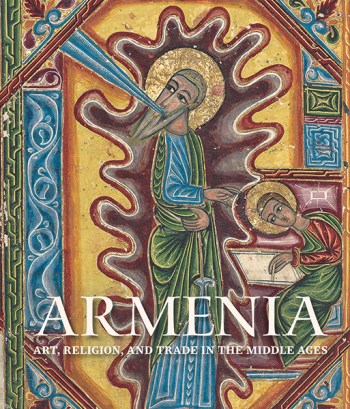 As the first people to officially convert to Christianity, Armenians commissioned and produced astonishing religious objects. This sumptuous volume depicts and contextualizes the compelling works of art that defined the rich and complicated culture of medieval Armenians, including carvings, liturgical furnishings, beautifully illustrated manuscripts, gilded reliquaries, exquisite textiles, printed books, and more. Situated at the center of trade routes that connected the East and West during the Middle Ages, Armenia became a leading international trade partner for Seljuk, Mongol, Ottoman, and Persian overlords, while also serving as a powerful ally to Byzantium and European Crusader states. Written by a team of international scholars, with contributions from Armenian religious leaders, this book will stand as the definitive text on the art and culture of medieval Armenia.
Helen C. Evans is Mary and Michael Jaharis Curator of Byzantine Art in the Department of Medieval Art and The Cloisters at The Metropolitan Museum of Art.
New Book | Fonthill Recovered
Distributed in North America by The University of Chicago Press:
Caroline Dakers, ed., Fonthill Recovered: A Cultural History (London: UCL Press, 2018) 406 pages, ISBN: 978-1787350465 (hardcover), $90 / ISBN: 978-1787350472 (paperback), $60.
 Fonthill, Wiltshire, is typically associated with the writer and collector William Beckford, who built his Gothic fantasy house, Fonthill Abbey, there at the end of the eighteenth century. The collapse of the Abbey’s tower in 1825 transformed the name Fonthill into a symbol for overarching ambition and folly. But Fonthill is much more than the story of one man’s excesses, and the Abbey was only one of several important houses to be built there, all eventually consumed by fire or deliberately demolished—and all strangely forgotten by contemporary history
Fonthill Recovered draws on new research to explore the rich cultural history of this place where little remains today—a tower, a stable block, the ruins of what was once a kitchen, and an indentation in a field. The first half of the book traces the occupation of Fonthill from the Bronze Age to the twenty-first century. Some of the owners surpassed Beckford in terms of their wealth and political power—and even, in one case, their sexual proclivities. They include Charles I’s Chancellor of the Exchequer and the richest British commoner of the nineteenth century. The second half of the book consists of essays on specific topics, examining such crucial areas as the complex history of the designed landscape, the sources of the Beckfords’ wealth and their extensive art collection, and the recent appearance of the Abbey in a video game.
Caroline Dakers is professor of cultural history at Central Saint Martins and the author of several books, including Forever England and A Genius for Money. She has also curated exhibitions at the Leighton House Museum, London.
Exhibition | Empresses of China’s Forbidden City, 1644–1912
PEM press release:
Empresses of China’s Forbidden City, 1644–1912
Peabody Essex Museum, Salem, Massachusetts, 18 August 2018 — 10 February 2019
Freer|Sackler, Smithsonian Institution, Washington, D.C., 3 March — 23 June 2019
Curated by Daisy Yiyou Wang and Jan Stuart
 The Peabody Essex Museum (PEM) debuts Empresses of China’s Forbidden City, the first major international exhibition to explore the role of empresses in China’s last dynasty—the Qing dynasty, from 1644 to 1912. Nearly 200 spectacular works, including imperial portraits, jewelry, garments, Buddhist sculptures, and decorative art objects from the Palace Museum, Beijing (known as the Forbidden City), tell the little-known stories of how these empresses engaged with and influenced court politics, art and religion. On an exclusive U.S. tour, this exhibition is a once-in-a-lifetime opportunity to see rare treasures from the Forbidden City, including works that have never before been publicly displayed and many of which have never been on view in the United States. Coinciding with the 40th anniversary of the establishment of U.S.-China diplomatic relations, the exhibition is organized by the Peabody Essex Museum, Salem, Massachusetts; the Smithsonian’s Freer Gallery of Art and Arthur M. Sackler Gallery (Freer|Sackler), Washington, D.C.; and the Palace Museum, Beijing.
A leader in preserving and promoting Chinese art and architecture, PEM honors over 200 years of U.S.-Chinese commercial and cultural exchange through its renowned collection and exhibition program. Working closely with its partnering organizations, PEM presents this unprecedented exhibition in order to celebrate the vibrant legacy of cultural dialogue between these two countries.
With an international team of experts, exhibition co-curators Daisy Yiyou Wang, PEM’s Robert N. Shapiro Curator of Chinese and East Asian Art, and Jan Stuart, the Melvin R. Seiden Curator of Chinese Art at the Freer|Sackler, spent four years travelling to the Forbidden City to investigate the largely hidden world of the women inside. Delving into the vast imperial archives and collection, their fresh research unveils how these women influenced history as well as the spectacular art made for, by and about them. “This exhibition establishes a new model for future international research and museum collaborations,” says Dr. Shan Jixiang, director of the Palace Museum.
Revealing the Hidden World of the Empresses

Court painters in Beijing, possibly including Zhang Zhen or his son Zhang Weibang, Drinking Tea from Yinzhen’s Twelve Ladies, Kangxi period, 1709–23, hanging scroll, ink and color on silk (Beijing: Palace Museum, Gu6458-7/12).
China’s grand imperial era—the Qing dynasty—was a multiethnic and multicultural state founded in 1644 by a small northeast Asian group who came to call themselves ‘Manchus’. These conquering rulers adopted the Forbidden City in Beijing as the seat of the government. The Manchu ruling house differed from their populous Han Chinese subjects by language, history, and culture. In the Qing dynasty, Manchu customs prohibited foot-binding and encouraged women to learn to ride and hunt. In general, Manchu women enjoyed more freedom and rights than their Han Chinese counterparts.
While the Qing imperial court was strictly patriarchal and hierarchical, a few empresses stood out and helped shape the long history of the dynasty. The empress headed the imperial harem and could influence the emperor. She was regarded as the ‘mother of the state’ and a role model for all women. Presiding over the state ritual promoting silk production, empresses honored women’s vital role in the economic health of the state through textile production.
While the emperor-centric Qing imperial court recorded only skeletal outlines of the empresses’ lives, only recently have historians begun to fill in a more complete picture. Exhibition curators were able to reconstruct their rich and active lifestyles from the lavish art produced by the Qing court. Sumptuous objects showcased in this exhibition include the largest assemblage of imperial textiles and jewelry that have ever traveled to the U.S. from the Palace Museum. These works demonstrate how Qing dynasty empresses projected authority through what they wore, from stunningly embroidered socks to splendid dragon robes.
“We are very proud to reclaim the presence and influence of these empresses, about whom history has largely been silent,” says Daisy Wang, PEM’s curator for this exhibition. “The exquisite objects related to the empresses give us a better understanding of these intriguing women. Further evidence found in court archives and other historical sources help illuminate their hidden, but inspiring lives.”
Stories of Opulence and Influence
Out of two dozen Qing empresses, this exhibition focuses on three key figures: Empress Dowager Chongqing (1693–1777), Empress Xiaoxian (1712–1748) and Empress Dowager Cixi (1835–1908). Their life experiences revolve around six core themes: imperial weddings, power and status, family roles, lifestyle, religion, and political influence.

Imperial Workshop, Beijing, Stupa Containing Empress Dowager Chongqing’s Hair and Amitayus Buddha, Qianlong period, 1777, gold and silver alloy with coral, turquoise, lapis lazuli, and other semiprecious stones, and glass; pedestal: zitan wood (Beijing, Palace Museum, Gu11866).
Empress Dowager Chongqing came from humble beginnings, entering a princely household as a maidservant at age 11 and bearing her only child at age 18. Her son eventually became the Qianlong emperor, which made Chongqing the focus of his filial piety, a core Confucian virtue. He honored her as the Sage Mother of the state, a status vividly captured by two life-size portraits of her in the exhibition. After her death in 1777, she was commemorated by her son with a 237-pound gold shrine. Encrusted with gemstones, the shrine holds her hair to ensure her rebirth in the Buddhist paradise. As the largest of its kind in the Palace Museum’s collection, the shrine will be displayed at PEM and the Freer|Sackler for the first time outside of China.
Fifteen-year-old Xiaoxian married the future Qianlong emperor while he was a prince. She became the empress after her husband ascended the throne. As childhood soulmates and confidants, Xiaoxian closely attended to her husband as he endured a months-long illness. She was a caring daughter-in-law and a wise manager of imperial family affairs, qualities that garnered her widespread respect.
In 1748, at the age of 36, Xiaoxian fell ill and died while traveling with her husband. In response, the heartbroken emperor brushed a poem to mourn his beloved wife. Empresses of China’s Forbidden City is the first exhibition to ever reveal this soulful elegy to the public.
Though tradition declared that “women shall not rule,” there was room for ambitious Qing empresses. Soon after giving birth to the Xianfeng emperor’s only heir, Cixi, a low-ranking consort, received a promotion. Facing a succession crisis after the death of her husband in 1861, Cixi, alongside the other empress dowager Ci’an (1837–1881), instigated a coup to gain political power and become co-regents to Cixi’s son, the child emperor. As the most powerful empress in Chinese history, Cixi ruled China for nearly half a century, bringing radical changes to the role of women in court politics and art patronage.
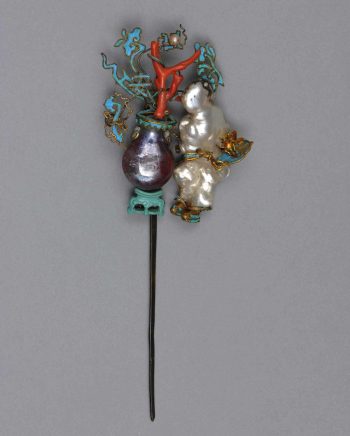
Hairpin with Figure and Vase, 18th or 19th century, pearls, sapphire, coral, turquoise, kingfisher feather, and silver with gilding (Beijing: Palace Museum, Gu10130).
The exhibition culminates with a commanding sixteen-foot oil portrait of Empress Cixi. It was her gift to President Theodore Roosevelt in 1905. Cixi directed the American artist Katharine Carl to create an image of a youthful and benevolent ruler to express her good will to people in America at a time when U.S. and China experienced challenging relations. A recent conservation project at the Smithsonian has restored the painting to its original splendor. Empresses of China’s Forbidden City marks its first public display in the U.S. since the 1960s.
“The study of women in history is exciting, timely and necessary,” says Jan Stuart, co-curator at the Freer|Sackler. “By focusing on the material and spiritual world of these women, we begin to fill in details absent from previous accounts of women in Chinese history. To the extent that the empresses’ experience of the expectations and constraints finds echo in our own world, we hope this exhibition will prompt broader reflection on the position of women in society and fosters a sense of commonality and connection across time and cultures.”
Surrounded by a dazzling array of imperial treasures, visitors will also discover engaging in-gallery interactive experiences, such as creating an empress’s robe. Other experiences include immersive videos and opera performance, as well as English and Chinese language label text and guided tours. In November 2018, halfway through the run of the six-month exhibition at PEM, an additional 30 artworks from the Palace Museum will be installed in the galleries, including magnificent paintings and imperial robes.
“This exciting exhibition fulfills our institutions’ shared commitment to expanding the appreciation of China’s rich culture, in this instance by recovering the preeminence of the Qing empresses through these stunning and rare objects,” notes Dan Monroe, the Rose-Marie and Eijk van Otterloo Director and CEO of Peabody Essex Museum, and Julian Raby, Director Emeritus, Freer Gallery of Art and Arthur M. Sackler Gallery, Smithsonian Institution.
The catalogue is distributed by Yale UP:
Daisy Yiyou Wang and Jan Stuart, eds., with essays and entries by Daisy Yiyou Wang, Jan Stuart, Lin Shu, Luk Yu-ping, Ying-chen Peng, Evelyn Rawski, and Ren Wanping, Empresses of China’s Forbidden City, 1644–1912 (New Haven: Yale University Press, 2018), 264 pages, ISBN: 978-0300237085, $60.
Empresses in the Qing dynasty (1644–1912) played an influential role in the imperial court and the cosmopolitan culture of their time. Offering compelling insights into the material culture, activities, and living spaces of Qing empresses, this lavishly illustrated book features over one hundred spectacular works of art from the Palace Museum in Beijing—including large-scale portraits, court robes, and richly decorated Buddhist sutras—that bring the splendor of the Qing court to life. A series of insightful essays examines the fascinating ways that key imperial women engaged with art, religion, and politics. This unprecedented exploration of the Qing court from the perspective of its royal women is an important new contribution to our understanding of Chinese art and history.
Daisy Yiyou Wang is the Robert N. Shapiro Curator of Chinese and East Asian Art at the Peabody Essex Museum. Jan Stuart is the Melvin R. Seiden Curator of Chinese Art at the Freer Gallery of Art and Arthur M. Sackler Gallery, Smithsonian Institution.
New Book | Early Modern Media and the News in Europe
From Brill:
Joop W. Koopmans, Early Modern Media and the News in Europe: Perspectives from the Dutch Angle (Leiden: Brill, 2018), 262 pages, ISBN: 978-9004379329, €140 / $169.
 During the seventeenth and eighteenth centuries, the Dutch Republic was one of the main centers of media in Europe. These media included newspapers, pamphlets, news digests, and engravings. Early Modern Media and the News in Europe brings together fifteen articles dealing with this early news industry in relation to politics and society, written by Joop W. Koopmans in recent decades. They demonstrate the important Dutch position within early modern news networks in Europe. Moreover, they address a variety of related themes, such as the supply of news during wars and disasters, the speed of early modern news reports, the layout of early newspapers and the news value of their advertisements, and censorship of books and news media.
Joop W. Koopmans is Senior Lecturer of Early Modern History at the University of Groningen. He has published on early modern Dutch history in a European context, including the Historical Dictionary of the Netherlands.
C O N T E N T S
Acknowledgements
Introduction
Storehouses of News: The Meaning of Early Modern News Periodicals in Western Europe
Restricted Access: The Presentation of News in the Europische Mercurius, 1690–1756
The Glorification of Three Prussian Sovereigns in the Europische Mercurius, 1690–1756
Politics in Title Prints: Examples from the Dutch News Book Europische Mercurius, 1690–1756
Publishers, Editors, and Artists in the Marketing of News in the Dutch Republic, ca. 1700: The Case of Jan Goeree and the Europische Mercurius
Research in Digitized Early Modern Dutch Newspapers and the News Value of Advertisements
Anything but Marginal: The Politics of Paper Use and Layout in Early Modern Dutch Newspapers
A Sense of Europe: The Making of This Continent in Early Modern Dutch News Media
Supply and Speed of Foreign News to the Netherlands during the Eighteenth Century: A Comparison of Newspapers in Haarlem and Groningen
The Early 1730s Shipworm Disaster in Dutch News Media
The Varying Lives and Layers of Mid-Eighteenth-Century News Reports: The Example of the 1748 Peace of Aix-la-Chapelle in Dutch News Media
The 1755 Lisbon Earthquake and Tsunami in Dutch News Sources: The Functioning of Early Modern News Dissemination
Wars in Early Modern News: Dutch News Media and Military Conflicts
Dutch Censorship in Relation to Foreign Contacts, 1581–1795
Spanish Tyranny and Bloody Placards: Historical Commonplaces in the Struggle between Dutch Patriots and Orangists around 1780?
Bibliography
New Book | Becoming Property
From Yale UP:
Katie Scott, Becoming Property: Art, Theory, and Law in Early Modern France (New Haven: Yale University Press, 2018), 384 pages, ISBN: 978-0300222791, $75.
 This original and relevant book investigates the relationship between intellectual property and the visual arts in France from the 16th century to the French Revolution. It charts the early history of privilege legislation (today’s copyright and patent) for books and inventions, and the translation of its legal terms by and for the image. Those terms are explored in their force of law and in relation to artistic discourse and creative practice in the early modern period. The consequences of commercially motivated law for art and its definitions, specifically its eventual separation from industry, are important aspects of the story. The artists who were caught up in disputes about intellectual property ranged from the officers of the Academy down to the lowest hacks of Grub Street. Lessons from this book may still apply in the 21st century; with the advent of inexpensive methods of reproduction, multiplication, and dissemination via digital channels, questions of intellectual property and the visual arts become important once more.
Katie Scott is Professor of History of Art and Architecture at the Courtauld Institute of Art, London.
Exhibition | Sidesaddle, 1690–1935

Johan Zoffany, The Drummond Family, detail, ca. 1769, oil on canvas, 41 × 63 inches
(New Haven: Yale Center for British Art, Paul Mellon Collection)
◊ ◊ ◊ ◊ ◊
On view at the National Sporting Library & Museum:
Sidesaddle, 1690–1935
National Sporting Library & Museum, Middleburg, VA, 8 September 2018 — 24 March 2019
Curated by Ulrike Weiss and Claudia Pfeiffer
In art and sport, the poised equestrian riding aside embodies the essence of elegance, power, and grace. Hidden beneath the flowing skirts of the rider is the sidesaddle, the design of which has evolved dramatically in response to the physical demands of sporting women (and sometimes men) requiring a firm seat as they began to meet the challenges of jumping and galloping across the countryside.
Sidesaddle, 1690–1935 presents a revealing perspective on the history and culture of women as equestrians, their depictions in sporting art, and the evolution of sidesaddle tack and attire represented in British, Continental, and American art from the 17th to the 20th centuries. The exhibition showcases over sixty paintings, works on paper, and sculptures on loan from museums and private collections. Co-curators Dr. Ulrike Weiss, Lecturer at the University of St. Andrews in Scotland, and Claudia Pfeiffer, the George L. Ohrstrom, Jr. Curator of Art at NSLM, are contributing essays to the accompanying catalog.
Ulrike Weiss and Claudia Pfeiffer, Sidesaddle, 1690–1935 (Middleburg: National Sporting Library & Museum, 2018), ISBN: 978-0996890540, $25.










 Enfilade
leave a comment