New Book | The Beauty of Time
From Rizzoli:
François Chaille and Dominique Fléchon, The Beauty of Time (Paris: Flammarion, 2018), 280 pages, ISBN: 978-2080203410, $85.
 Published in partnership with the prestigious Fondation Internationale de la Haute Horlogerie, this book presents the most beautiful timepieces from the Middle Ages to the present. Lavishly illustrated, The Beauty of Time contains a selection of nearly two hundred wonders—from mechanical and pendulum clocks to pocket and wristwatches. The timepieces are annotated by an expert horology historian and accompanied by a text that elucidates the cultural and artistic contexts in which they were created. As a counterpoint to the timepieces, extensive reproductions of artistic masterpieces provide perspective regarding the technical advances of each period and demonstrate the evolution of aesthetic tastes over time.
François Chaille is passionate about art history, fashion, jewelry, and horology; he has published over a dozen works with Flammarion. A historian and expert on fine watchmaking, Dominique Fléchon is the author of many specialist works, including The Secrets of Vacheron Constantin and The Mastery of Time, both published by Flammarion. Franco Cologni is the author of numerous books, including The Cartier Tank Watch (Flammarion, 2017).
New Book | Imagining Qianlong
From Columbia University Press:
Florian Knothe, Pascal-François Bertrand, Kristel Smentek, and Nicholas Pearce, Imagining Qianlong: Louis XV’s Chinese Emperor Tapestries and Battle Scene Prints at the Imperial Court in Beijing (Hong Kong University Press, 2017), 84 pages, ISBN: 9789881902498, $25 / £20.
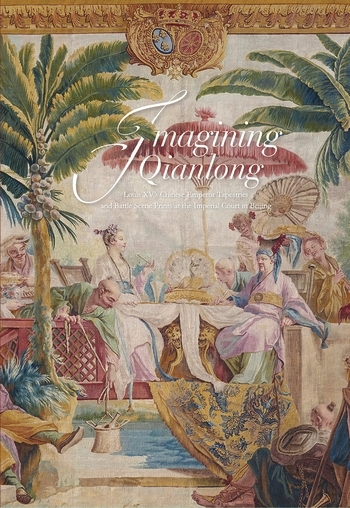 This publication accompanies an unprecedented exhibition (on view at Hong Kong University from 15 March until 28 May 2017) highlighting four of the magnificent chinoiserie tapestries of Chinese Emperor Qianlong, woven after designs by François Boucher at the famous Beauvais manufactory between 1758 and 1760. The large and well-preserved textiles form part of the royal French commission by King Louis XV, objects of which were presented to Qianlong in 1766.
These celebrated tapestries are joined by another historic set of culturally related depictions in print—The Battles of the Emperor of China. The engravings were ordered by Qianlong, drawn by Jesuit painters at the Imperial Court in Beijing and then printed in Paris 1769–74. The ‘culture’ of these prints follows King Louis XIV’s influential images of the Histoire du Roi and presents Qianlong as both a war hero and as the undisputed leader of China in the mid-eighteenth century. These depictions date to the exact same time period, one that coincides with the high demand for chinoiserie in France—culminating in the world-famous designs by Boucher—and the Imperial Court of China’s interest in French design and culture. Despite their world-renowned fame, these groups of images previously have not been shown together.
Imagining Qianlong presents one of the rare topics to celebrate the court cultures in both France and China, at a time when the empires idolized each other, and cultural influences and exchanges were highly significant and supported by well-established and prosperous monarchs during an increasingly enlightened eighteenth century.
New Book | The Art of the Peales
Distributed by Yale UP:
Carol Eaton Soltis, The Art of the Peales in the Philadelphia Museum of Art: Adaptations and Innovations (Philadelphia: Philadelphia Museum of Art, 2017), 344 pages, ISBN: 978 0300229 363, $65.
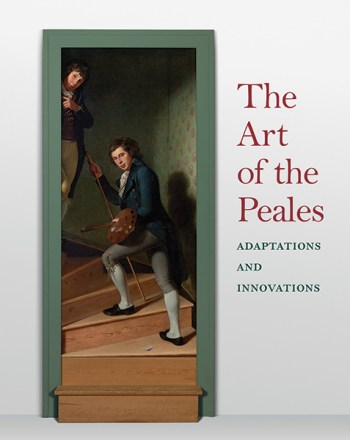 Active from the late 18th through the early 20th century, the Peale family was America’s first artistic dynasty. This overview of the art of the Peales documents and interprets more than 160 works in a variety of media from the renowned collection of the Philadelphia Museum of Art. With discussions of both internationally famous masterworks such as Charles Willson Peale’s Staircase Group and lesser-known but equally engaging pictures including Rubens Peale’s Magpie Eating Cake, Carol Eaton Soltis traces the family’s history and reveals how the Peales’ energy, innovation, and entrepreneurship paved the way for generations of American artists.
Rigorously researched and generously illustrated, The Art of the Peales is an essential and wide-ranging study that considers the family’s substantial output and contextualizes their historical legacy. Examining the different ways that the Peales instructed, influenced, supported, and competed with one another, this book is full of new revelations on this extraordinary family that remained a transformative force in America’s cultural life for more than a century.
Carol Eaton Soltis is project associate curator at the Philadelphia Museum of Art.
Exhibition | Georges Michel: The Sublime Landscape
Now on view at the Fondation Custodia:
The Sublime Landscape: Georges Michel
Monastère Royal de Brou, Bourg-en-Bresse, 6 October 2017 — 7 January 2018
Fondation Custodia / Collection Frits Lugt, Paris, 27 January — 29 April 2018
Curated by Ger Luijten and Magali Briat-Philippe
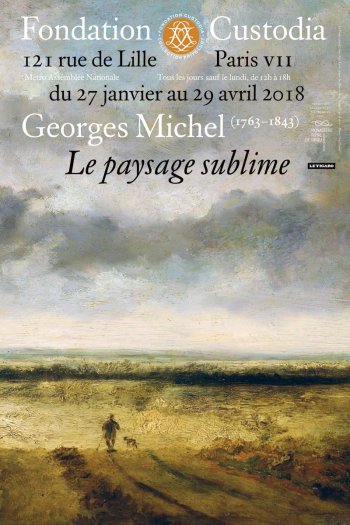 Admired by Vincent van Gogh, Georges Michel (1763–1843) is held to be the precursor of plein air painting. He was influenced by the painters of the Dutch Golden Age, earning the nickname of ‘the Ruisdael of Montmartre’. Yet today he is not widely known. The Fondation Custodia, in collaboration with the Monastère royal de Brou, is proposing to unveil the artist whose merits were first remarked by the dealer Paul Durand-Rueil in the nineteenth century. The first one-man exhibition for fifty years of the work of Georges Michel will be held from 27 January to 29 April 2018 at 121 rue de Lille, Paris. About fifty paintings and forty drawings—on loan mainly from French private and public collections—will be on show, and the exhibition will include some recent acquisitions by the Fondation Custodia.
Georges Michel was born in Paris in 1763 and died there in 1843 after a remarkable career, whether in real terms or in a mythical post-mortem reconstruction of the life of this allegedly misunderstood artist. The main body of what we know about him comes from the biography written by Alfred Sensier in 1873, compiled from information recounted to him by the artist’s widow. Michel kept his distance from official art circles and only took part in the Salon between 1791—the date when the exhibition first opened its doors to artists who were not members of the former Académie royale—and 1814. His name was not mentioned thereafter until the sale of his work and the contents of his studio a year before his death.
The exhibition at the Fondation Custodia opens with youthful work by the artist, still betraying the influence of the eighteenth-century French landscape tradition as embodied in the art of Lazare Bruandet (1755-1804) or Jean-Louis Demaine (1752–1829), with whom Michel explored the Ile-de-France in search of subjects for sketching. He remained loyal to Paris and the surrounding countryside, claiming that ‘anyone unable to spend a lifetime painting within a range of four leagues is just a blundering fool searching for a mandrake—he will find only a void’. Saint-Denis, Montmartre or La Chapelle, the Buttes-Chaumont and the banks of the Seine, the countryside to the north of Paris offered a variety of hills and plains, dotted with quarries, mills and scattered dwellings.
Georges Michel’s style developed gradually away from the picturesque, anecdotic landscape that was in vogue between 1770 and 1830, achieving a notable originality. His paintings capture, with sincerity and a hint of the romanticism to come, the rural spots threatened with extinction as the villages around Paris began to be subsumed into the capital during the 1860s.
At a period when the painting of the Northern schools was enjoying a revival in France, Georges Michel, according to his widow, carried out some restoration work on Dutch paintings for the influential Paris dealer Jean-Baptiste Pierre Le Brun (1748–1813) and for the Muséum central des Arts (now the Musée du Louvre), at the behest of its director, Dominique Vivant Denon (1747–1825). Even though no trace of this activity can be found in the archives, Michel’s work is incontrovertibly influenced by the masters of the Dutch Golden Age. The exhibition at the Fondation Custodia—one of whose aims is to study the reception of Dutch art in France—takes this opportunity to compare Michel with the predecessors he so admired—and whose work he sometimes copied. From Jacob van Ruisdael (1628/1629–1682) he borrows compositions enlivened by vast, windswept skies, with sometimes a shaft of brilliant sunlight breaking through the clouds. The masterly chiaroscuro in his paintings, however, has its source in the work of Rembrandt (1606–1669). Philips Koninck (1619–1688), whose work in the eighteenth century was sometimes confused with that of Rembrandt, also evidently inspired Michel with his vast landscapes and limitless skies.
The Fondation Custodia, a home for art on paper in Paris, has recently acquired a large number of sheets by Georges Michel. The last section of the exhibition is devoted to these drawings. Michel’s prolific graphic work is characterised by its wide variety of techniques and subjects. The artist excelled in capturing vibrant views of Paris—in black chalk or, less frequently, pen and ink. The topographical nature of these drawings makes identification of the chosen locations simple: the Louvre, the Tuileries, the Jardin des Plantes, the Barrières de Ledoux.
Curators: Ger Luijten, director of the Fondation Custodia; and Magali Briat-Philippe, conservateur, responsable du service des patrimoines, Monastère royal de Brou.
More information, including a selection of images, is available here»
Magali Briat-Philippe and Ger Luijten, eds., Georges Michel: Le paysage sublime (Paris: Fondation Custodia, 2017), 208 pages, ISBN 978 9078655 268, 29€.
Exhibition | The Object of My Affection
Now on at the The Fitzwilliam:
The Object of My Affection: Stories of Love from the Fitzwilliam Collection
The Fitzwilliam Museum, Cambridge, 30 January — 28 May 2018
Love is very much in the air in this exhibition, which contains objects alive with the range of emotions that it commands: from admiration and affection, joy and passion, longing and despair, to insults, indifference, grief and remembrance. The exhibition showcases the Fitzwilliam Museum’s collection of valentines, which date from the 18th century to the 20th and include a wide variety of sentimental and decorative types as well as comic examples. Alongside the valentines will be an assortment of other objects relating to the theme of love, including posy rings, love tokens, and works by Dante Gabriel Rossetti (1828–1882) and James Gillray (1756–1815).
Rebecca Virag, Valentines: Highlights from the Collection at The Fitzwilliam Museum (Cambridge: The Fitzwilliam, 2018), 120 pages, £10.
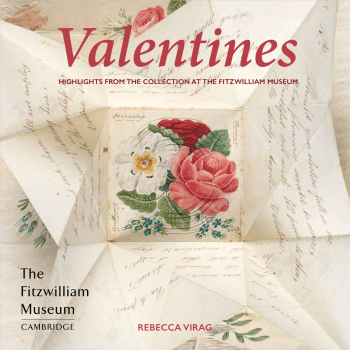 It is probably a little known fact that the Fitzwilliam Museum has a large collection of around 1,600 valentines, which range in date from the early eighteenth century to the 1920s. The vast majority were left to the Museum in 1928 by mathematician and Fellow of Trinity College, J.W.L. Glaisher. Two more Cambridge alumni, the Rev. Herbert Bull (Trinity) and Sir Stephen Gaselee (King’s) also gave their much smaller collections of valentines to the Museum in 1917 and 1942. The Bull valentines are particularly fascinating as they are rare survivals of mid-eighteenth century silhouette cut-paper work and are unlike anything collected by either Glaisher or Gaselee. The Glaisher collection alone is one of the largest amassed by a single collector currently in a UK public collection.
The Glaisher valentines have not been seen in public since 1995, some twenty-three years ago, and since then the entire valentine collection has been catalogued, researched, photographed, and re-housed. This selection of highlights has been published to coincide with a new display of some of these extraordinary objects as part of the exhibition The Object of my Affection: Stories of Love from the Fitzwilliam Collection.
New Book | Versailles et l’Europe
All essays are available for download as PDF files from ArtHistoricum.net:
Thomas Gaehtgens, Markus Castor, Frédéric Bussmann, and Christophe Henry, eds., Versailles et l’Europe: L’appartement monarchique et princier, architecture, décor, cérémonial (Paris: Centre allemand d’histoire de l’art 2018), 896 pages, ISBN: 9782955931509.
 Les 31 contributions de cet ouvrage examinent en premier lieu la signification et la fonction des appartements royaux de Louis XIV en France, puis leur réception dans les cours du Saint Empire romain germanique, avant de s’intéresser aux résidences des Pays-Bas, de l’Angleterre, de la Suède, de la Pologne et de l’Espagne au cours des XVIIe et XVIIIe siècles.
Der vorliegende Band untersucht den Einfluss eines der brillantesten Repräsentationsleistungen der Frühen Neuzeit auf die europäischen Höfe des 17. und 18. Jahrhunderts. Das Versailler Schloss, ein „Showroom“, der die französischen Luxusgüter über die Grenzen hinaus bekannt und zum begehrten Gut machte, zog die Blicke aller Regenten der Zeit auf sich. Doch wenngleich von Künstlern und Kunsthandwerkern, die sich an den europäischen Höfen niederließen, zahlreiche Formen und Ideen übernommen wurden, darf die Beharrlichkeit der lokalen Traditionen dennoch nicht unterschätzt werden.
Beginnend mit einer Analyse des Versailler Appartements nach Form und Funktion wird das in Frankreich entwickelte Modell in seiner Bedeutung für die Konzepte des Appartements der europäischen Höfe betrachtet. Die Beiträge analysieren das Zusammenspiel von Architektur, Dekor und Zeremoniell und die besondere Bedeutung des Appartements für die höfische Repräsentation. Die räumliche Disposition tritt als komplexes Verweissystem hervor, das die Inszenierung der Macht und die Zugänglichkeit des Regenten bestimmte. Die Logik der Ausstattungssysteme erschließt sich nur in interdisziplinärer Betrachtung, die auch die sozialen und politisch—historischen Bedingungen berücksichtigt. Bereits vorhandene Traditionen der europäischen Häuser werden in diesem Prozess zwischen Übernahmen und Transformationen neu konfiguriert.
Der erste Teil widmet sich dem in Frankreich entwickelten Modell des Appartements und versucht die komplexe Entwicklung in Versailles bis 1701 nachzuvollziehen, in der die Chambre de Parade zum Herzstück des Schlosses wurde. Im zweiten Teil beleuchten die Fallstudien zu Residenzen der deutschsprachigen Länder den komplexen Austausch und die Vielfalt der heterogenen Lösungen. Mit Beiträgen zu einigen wesentlichen europäischen Höfen in England, Holland, Schweden, Polen, Spanien und Italien schließt die Studie ab.
Thomas W. Gaehtgens (Director, Getty Research Institute, LA); Markus A. Castor (Directeur de Recherche, DFK-Paris); Freddric Bussmann (Kurator, Museum der bildenden Künste Leipzig); Christophe Henry (Professeur Grandes Ecoles, Histoire et theorie des arts).
C O N T E N T S
Thomas Kirchner, Préface
Thomas Gaehtgens, Markus Castor, Frédéric Bussmann, Appartement, décor et cérémonial: une introduction
Versailles et la France
• Raphaël Masson, Thierry Sarmant, COMITAS ET MAGNIFICENTIA. Essai sur l’appartement royal en France
• Jean-Pierre Samoyault, L’appartement du roi à Fontainebleau sous Louis XIV (1643–1715)
• Stéphane Castelluccio, L’appartement du roi à Versailles, 1701 : le pouvoir en représentation
• Max Tillmann, « Une étiquette prétentieuse » La cour princière de l’électeur Max-Emmanuel de Bavière au château de Compiègne (1708–1715)
• Jörg Garms, Les appartements du duc Léopold à Lunéville
Les cours princières du Saint-Empire entre Habsbourg et Bourbon
• Katharina Krause, Des exemples à suivre absolument ? Distribution française et commodité allemande dans le traité et la pratique architecturale au tournant du xviiie siècle
• Cordula Bischoff, Le Frauenzimmer-Ceremoniel (cérémonial des femmes) et ses conséquences sur la distribution des appartements princiers des dames vers 1700
• Rainer Valenta, L’appartement impérial à l’époque de Charles VI. Proposition de reconstitution
• Ulrike Seeger, L’appartement électoral entre Vienne et Versailles. L’appartement de parade de la résidence princière de Rastatt
• Annegret Kotzurek, Les appartements ducaux du corps de logis baroque du château de Ludwigsbourg
• Kathrin Ellwardt, Les appartements du château de Mannheim
• Eva-Bettina Krems, « Le sujet est de ceux qui […] s’accompagnent du plus grand nombre de pointillés. » – De la diversité des espaces d’audience dans les châteaux français et allemands autour de 1700
• Henriette Graf, La fonction des appartements de l’électeur Charles-Albert de Bavière dans le cérémonial de cour vers 1740
• Virginie Spenlé, Galeries de peintures et appartements princiers dans le Saint-Empire romain germanique
• Marc Jumpers, L’appartement d’apparat de la résidence de Bonn : une tentative de reconstitution
• Martin Miersch, Le rôle des diplomates français dans la formation du « bon goût » chez le prince électeur de Cologne Clément-Auguste
• Frédéric Bussmann, Le château de Nordkirchen, le « Versailles de Westphalie » ? Architecture, distribution et décor des appartements de la résidence du prince évêque de Münster et de la famille Plettenberg
• Verena Friedrich, La décoration française à la résidence de Wurtzbourg. Les projets du premier appartement de l’évêque de Wurtzbourg
• Claudia Schnitzer, « …afin d’en laisser à la postérité un souvenir ineffaçable » Les pièces de parade du château de Dresde dans la relation de la fête organisée à l’occasion du mariage de 1719
• Katja Heitmann, Distribution et ornementation. Le château de Heidecksburg à Rudolstadt et l’influence de l’architecture française sur les châteaux princiers allemands
• Martin Pozsgai, L’appartement de parade dans les châteaux des princes protestants du Saint-Empire romain germanique
• Guido Hinterkeuser, Les pièces d’habitation et les salles d’apparat de Sophie-Charlotte et Frédéric Ier au château de Charlottenburg : finalité, aménagement et usage
• Thomas W. Gaehtgens, Frédéric Ier, Frédéric -Guillaume Ier et Frédéric II. Trois conceptions de la représentation et de l’habitat princier à la cour de Prusse
• Peter O. Krückmann, Le Vieux Château de l’Ermitage à Bayreuth. L’iconographie du pouvoir au temps de l’absolutisme et des Lumières
Les autres grandes cours européennes, un tour d’horizon
• Johan de Haan, L’appartement princier au palais du Stadhouder à Leeuwarden 1650–1710
• Konrad Ottenheym, Les appartements princiers des résidences du prince d’Orange dans la Hollande du xviie siècle
• Michael Schaich, La chambre de parade sous la monarchie anglaise autour de 1700
• Linda Hinners, Martin Olin, Les appartements royaux du château de Stockholm
• Anna Olenska, L’Union de Pologne-Lituanie a-t-elle eu son « Versailles » ? Du Wilanów de Jean III Sobieski au Bialystok du prétendant au titre de Jean IV Branicki
• Elisabeth Wünsche- Werdehausen, Entre Bourbon et Habsbourg ? Les grands appartements du palais royal de Turin
• Markus A. Castor, Anne Kurr, Philippe V de Bourbon à Madrid -Architecture, décor et cérémonial entre changement programmatique et tradition
Plans des châteaux
Abrévations
Bibliographie
Glossaire franco-allemand
Index des noms propres
Index topographique
Crédits photographiques
Exhibition | Drawn to Greatness
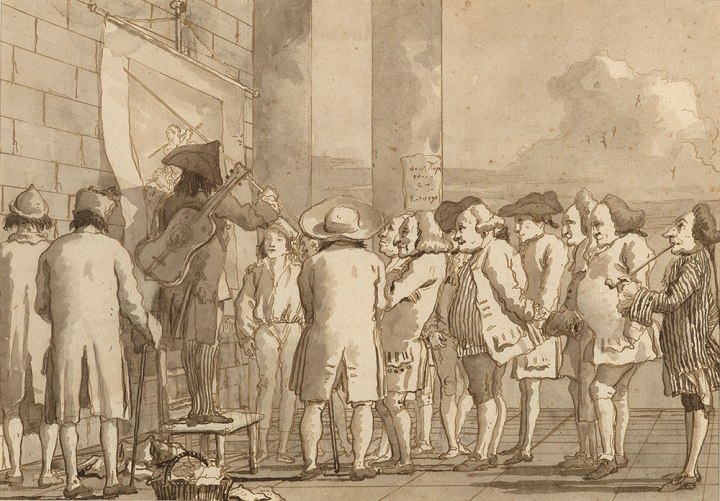
Giovanni Domenico Tiepolo, Scene of Contemporary Life: The Picture Show, 1791; pen and brown and black ink and wash over black chalk on paper, 11 5/16 × 16 5/16 inches (New York: Morgan Library & Museum, 2017.253)
◊ ◊ ◊ ◊ ◊
Press release (15 December 2017) for the exhibition now on view at The Clark:
Drawn to Greatness: Master Drawings from the Thaw Collection
The Morgan Library & Museum, New York, 29 September 2017 — 7 January 2018
The Sterling and Francine Clark Art Institute, Williamstown, MA, 3 February — 22 April 2018
Curated by Jennifer Tonkovich and Jay Clarke
Over the past fifty years, New York art dealer and philanthropist Eugene V. Thaw assembled one of the world’s finest private collections of drawings. The collection, known for its breadth and exceptional quality, charts the high points of drawing from the Renaissance through the twentieth century and features works made by pivotal artists at key moments in the history of the art form. Mr. Thaw donated his collection of more than 400 drawings to the Morgan Library & Museum, New York, which celebrated the gift with the September 2017 opening of Drawn to Greatness: Master Drawings from the Thaw Collection, an exhibition that has drawn critical acclaim for the diversity and quality of the works presented. In recognition of Mr. Thaw’s longstanding interest in the Clark Art Institute, Drawn to Greatness will travel to Williamstown for an exclusive presentation at the Clark from February 3 through April 22, 2018. Featuring 150 drawings that tell the story of a visionary collector, the exhibition examines five centuries of western drawing. Sketchbooks belonging to Jackson Pollock, Francisco de Goya, Edgar Degas, and Paul Cézanne and illustrated letters from Vincent van Gogh are among the works exhibited.
“It is an honor for the Clark to have the opportunity to show this exquisite collection in our galleries,” said Olivier Meslay, the Felda and Dena Hardymon Director of the Clark. “The works in this exhibition provide an incredibly rich and remarkable opportunity to consider the art form as practiced by generations of masters. It is one of the most important and impressive drawing exhibitions that has been assembled in decades.”
The exhibition is organized in a series of chronological sections that illustrate key moments in the history of draftsmanship while also highlighting the work of artists whom the Thaws collected in depth, among them Rembrandt van Rijn, Francisco de Goya, Odilon Redon, and Edgar Degas.
“These exceptional drawings, watercolors, and collages exemplify both the eternal power of the drawn line and the innovative genius of the artists who have explored the medium over five centuries,” said Jay A Clarke, Manton Curator of Prints, Drawings, and Photographs. “It is a truly spectacular collection of works and I am thrilled to be able to work in collaboration with the Morgan’s curatorial team to bring this show to the Clark.”
The exhibition extends the Institute’s relationship to Mr. Thaw who, in 2016, made a generous gift to create the Eugene V. Thaw Gallery for Works on Paper in the Clark’s Manton Research Center. Drawn to Greatness: Master Drawings from the Thaw Collection is organized by the Morgan Library & Museum, New York. The curator of the exhibition at the Morgan is Jennifer Tonkovich, Eugene and Clare Thaw Curator of Drawings and Prints; the curator at the Clark is Jay A. Clarke, Manton Curator of Prints, Drawings, and Photographs. Presentation of Drawn to Greatness at the Clark is made possible by the Eugene V. and Clare E. Thaw Charitable Trust. Major support is provided by the Fernleigh Foundation in memory of Clare Thaw. This exhibition is supported by an indemnity from the Federal Council on the Arts and the Humanities.
An exhibition checklist is available here»
Jennifer Tonkovich, ed., Drawn to Greatness: Master Drawings from the Thaw Collection (New York: The Morgan Library & Museum, 2017), 295 pages, ISBN: 978-0875981826, $40.
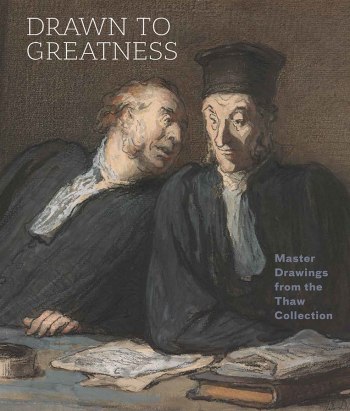 The catalogue features a series of essays by leading scholars devoted to pivotal moments in the history of drawing. Authors include Jane Shoaf Turner, Head of Rijksprentenkabinet, Amsterdam; Andrew Robison, former Head of Drawings, Prints, and Photographs at the National Gallery of Art; Matthew Hargraves, Chief Curator of Art Collections, Yale Center for British Art; Richard R. Brettell, Chair of Art and Aesthetic Studies, University of Texas at Dallas; Jay A. Clarke, Manton Curator of Prints, Drawings, and Photographs, Clark Art Institute; and, of the Morgan Library & Museum, Colin B. Bailey, Director; John Marciari, Curator and Department Head of Drawings and Prints; and Jennifer Tonkovich, Eugene and Clare Thaw Curator.
A selection of programming:
Jennifer Tonkovich | French Artists and Their Models
Sunday, 11 February 2018, 3:00pm
Jennifer Tonkovich, Eugene and Clare Thaw Curator of Drawings at the Morgan Library & Museum, explores how French artists worked with models during the eighteenth and early nineteenth centuries. Where did they find their models? What role did the models play in the creative process? How does an individual artist’s approach to the model reveal their broader outlook? A close look at studies by Watteau, Fragonard, Prud’hon, Gericault, Ingres, and Delacroix illuminates the challenges inherent in working from the model.
Matthew Hargraves | Visionaries: Romantic Drawings from the Thaw Collection
Sunday, 15 April 2018, 3:00pm
Drawn to Greatness includes some of Eugene Thaw’s finest Romantic drawings, among them outstanding works of art by William Blake, Caspar David Friedrich, and J.M.W. Turner. This lecture by Matthew Hargraves, chief curator of art collections and head of college information and access at the Yale Center for British Art, focuses on the visionary qualities of these Romantic artists and explores how they abandoned the simple imitation of the natural world to capture truths beyond the reach of the human eye.
New Book | Colouring the Caribbean
From Manchester UP:
Mia Bagneris, Colouring the Caribbean: Race and the Art of Agostino Brunias (Manchester: Manchester University Press, 2017), 272 pages, ISBN: 978-15261-20458, £75 / $115.
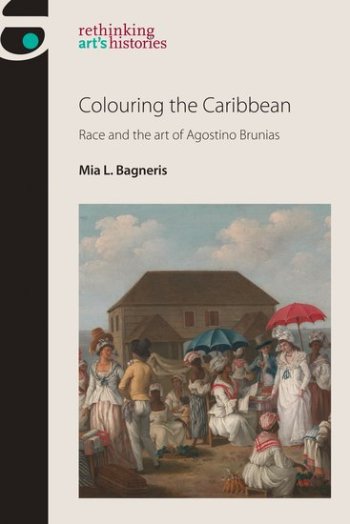 Colouring the Caribbean offers the first comprehensive study of Agostino Brunias’s intriguing pictures of colonial West Indians of colour—so called ‘Red’ and ‘Black’ Caribs, dark-skinned Africans and Afro-Creoles, and people of mixed race—made for colonial officials and plantocratic elites during the late-eighteenth century. Although Brunias’s paintings have often been understood as straightforward documents of visual ethnography that functioned as field guides for reading race, this book investigates how the images both reflected and refracted ideas about race commonly held by eighteenth-century Britons, helping to construct racial categories while simultaneously exposing their constructedness and underscoring their contradictions. The book offers provocative new insights about Brunias’s work gleaned from a broad survey of his paintings, many of which are reproduced here for the first time.
Mia L. Bagneris is Jesse Poesch Junior Professor of Art History at Tulane University.
C O N T E N T S
Introduction
1 Brunias’s Tarred Brush, or Painting Indians Black: Race-ing the Carib Divide
2 Merry and Contented Slaves and Other Island Myths: Representing Africans and Afro-Creoles in the Anglo-American World
3 Brown-Skinned Booty, or Colonising Diana: Mixed-Race Venuses and Vixens as the Fruits of Imperial Enterprise
4 Can You Find the White Woman in This Picture? Agostino Brunias’s ‘Ladies’ of Ambiguous Race
Coda: Pushing Brunias’s Buttons, or Re-Branding the Plantocracy’s Painter: The Afterlife of Brunias’s Imagery
Index
New Book | Pretty Gentleman
From Yale UP:
Peter McNeil, Pretty Gentleman: Macaroni Men and the Eighteenth-Century Fashion World (New Haven: Yale University Press, 2018), 256 pages, ISBN: 978 03002 17469, $45.
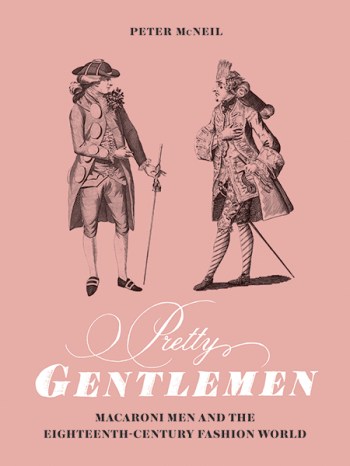 The term ‘macaroni’ was once as familiar a label as ‘punk’ or ‘hipster’ is today. In this handsomely illustrated book devoted to notable 18th-century British male fashion, award-winning author and fashion historian Peter McNeil brings together dress, biography, and historical events with the broader visual and material culture of the late 18th century. For thirty years, macaroni was a highly topical word, yielding a complex set of social, sexual, and cultural associations. Pretty Gentlemen is grounded in surviving dress, archival documents, and art spanning hierarchies and genres, from scurrilous caricature to respectful portrait painting. Celebrities hailed and mocked as macaroni include politician Charles James Fox, painter Richard Cosway, freed slave Julius ‘Soubise’, and criminal parson Reverend Dodd. The style also rapidly spread to neighboring countries in cross-cultural exchange, while Horace Walpole, George III, and Queen Charlotte were active critics and observers of these foppish men.
Peter McNeil is distinguished professor at University of Technology Sydney and Aalto University, Helsinki.
New Book | The Challenge of the Sublime
From Manchester UP:
Hélène Ibata, The Challenge of the Sublime: From Burke’s Philosophical Enquiry to British Romantic Art (Manchester: Manchester University Press, 2018), 336 pages, ISBN: 978 15261 17397, £75 / $115.
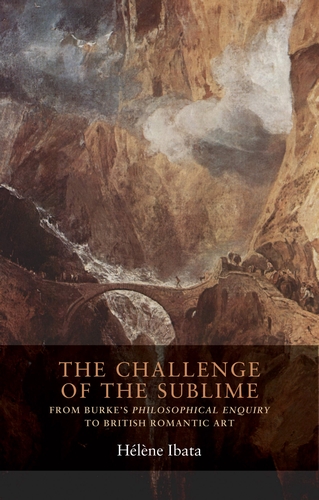 This book examines the links between the unprecedented visual inventiveness of the Romantic period in Britain and eighteenth-century theories of the sublime. Edmund Burke’s Philosophical Enquiry into the Origin of our Ideas of the Sublime and Beautiful (1757), in particular, is shown to have directly or indirectly challenged visual artists to explore not just new themes, but also new compositional strategies and visual media such as panoramas and book illustrations, by arguing that the sublime was beyond the reach of painting. More significantly, it began to call into question mimetic representational models, causing artists to reflect about the presentation of the unpresentable and drawing attention to the process of artistic production itself, rather than the finished artwork.
Helene Ibata is Professor of English and Visual Studies at the University of Strasbourg
C O N T E N T S
Introduction
Part I: From the Enquiry to the Academy
1 The Philosophical Enquiry, Theories of the Sublime and the Sister Arts Tradition
2 Presenting the Unpresentable: The Modernity of Burke’s Enquiry
3 Reynolds, the Great Style, and the Burkean Sublime
4 The Sublime Contained: Academic Compromises
Part II: Beyond the ‘Narrow Limits of Painting’
5 Immersive Spectatorship at the Panorama and the Aesthetics of the Sublime
6 Frames, Edges, and ‘Unlimitation’
7 ‘Sublime Dreams’: Ruin Paintings and Architectural Fantasies
Part III: Relocating the Sublime: Blake, Turner and Creative Endeavour
8 Against and beyond Burke: Blake’s ‘Sublime Labours’
9 Turner: From Sublime Association to Sublime Energy
Conclusion
Bibliography
Index










 Enfilade
leave a comment