The Burlington Magazine, January 2018
The eighteenth century in The Burlington, which includes, as noted last week, mention of HECAA and J18 in the editorial in connection with the new scholarship:
The Burlington Magazine 160 (January 2018)
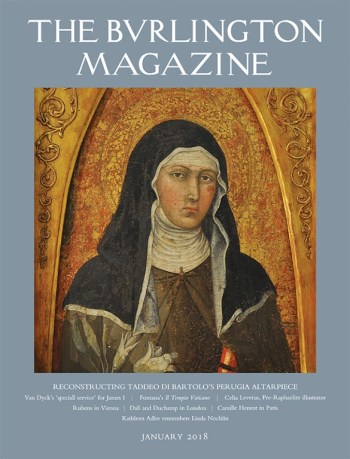 E D I T O R I A L
“The Burlington Magazine Scholarship for the Study of French Eighteenth-Century Fine and Decorative Art,” p. 3. This month The Burlington Magazine launches an annual scholarship for the study of French eighteenth-century fine and decorative art. Initiated and funded by Richard Mansell-Jones, a trustee of The Burlington Magazine Foundation, the scholarship offers £10,000 to a student based anywhere in the world who has embarked or is about to embark on an M.A. or Ph.D. or is undertaking research in a post-doctoral or independent capacity. The full review is available here (also see below).
A R T I C L E S
• Aloisio Antinori, “New Light on the Production of Il Tempio Vaticano,” pp. 22–30.
R E V I E W S
• Susan Walker, Review of Elizabeth Bartman, The Ince Blundell Collection of Classical Sculpture, Volume 3: The Ideal Sculpture (Liverpool University Press, 2017), pp. 64–5.
• Elizabeth Savage, Review of Mark Stocker and Phillip Lindley, eds., Tributes to Jean Michel Massing: Towards a Global Art History (Harvey Miller, 2016), p. 74. [The volume includes Robin Middleton’s essay, “A Cautionary Tale: The History of Eighteenth-Century Architecture in France.”]
• Jeremy Warren, Review of Giovanna Baldissin Molli and Elda Martellozzo Forin, eds., Gli inventari della Sacrestia della Cattedrale di Padova, secoli XIV–XVIII (Il Prato Publishing House, 2016), p. 75.
◊ ◊ ◊ ◊ ◊
The Burlington Magazine Scholarship for the Study of French Eighteenth-Century Fine and Decorative Art
Applications due by 1 March 2018
The Burlington Magazine is pleased to announce the launch of The Burlington Magazine scholarship for the study of French 18th-century fine and decorative art. The scholarship has been created to provide funding over a 12-month period to those engaged in the study of French 18th-century fine and decorative art to enable them to develop new ideas and research that will contribute to this field of art historical study.
Applicants must be studying, or intending to study, for an MA, PhD, post-doctoral or independent research in the field of French 18th-century fine and decorative arts within the 12-month period the funding is given. Applications are open to scholars from any country. A grant of £10,000 will be awarded to the successful applicant.
More information is available here»
New Book | Schenau (1737–1806)
From Imhof:
Anke Fröhlich-Schauseil, Schenau (1737–1806): Monografie und Werkverzeichnis der Gemälde, Handzeichnungen und Druckgrafik von Johann Eleazar Zeissig, gen. Schenau (Petersberg: Imhof, 2018), 640 pages, ISBN: 978 373190 5684, 78€ / $135.
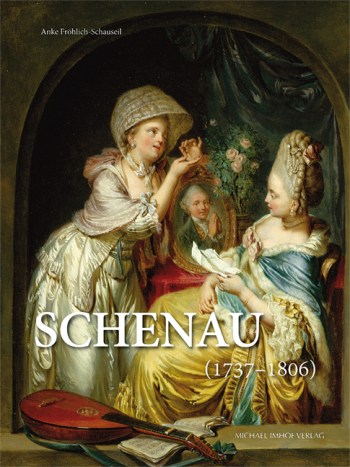 Das Werk des Malers Johann Eleazar Zeißig, gen. Schenau (1737–1806), erhielt lange Zeit auch von der Kunstgeschichte nur wenig Aufmerksamkeit; dabei war er mit seinem in Frankreich entwickelten, empfindsamen Rokokostil zu Lebzeiten in Deutschland und darüber hinaus bekannt und berühmt. In Sachsen hatte er als Direktor der Dresdner Kunstakademie sowie als Leiter der Zeichenschule der Porzellanmanufaktur in Meißen eine einflussreiche Stellung inne. Sein OEuvre umfasst Gemälde, Radierungen sowie zahlreiche Zeichnungen und Aquarelle. Hinzu kommt eine große Zahl von französischen und deutschen Kupferstichen nach Werken von seiner Hand, die im vorliegenden Band in Wort und Bild vorgestellt werden.
Exhibition | Winckelmann and the Capitoline Museum
From the Capitoline Museum:
The Treasure of Antiquity: Winckelmann and the Capitoline Museum in Eighteenth-Century Rome
Musei Capitolini, Rome, 7 December 2017 — 22 April 2018
Curated by Eloisa Dodero and Claudio Parisi Presicce
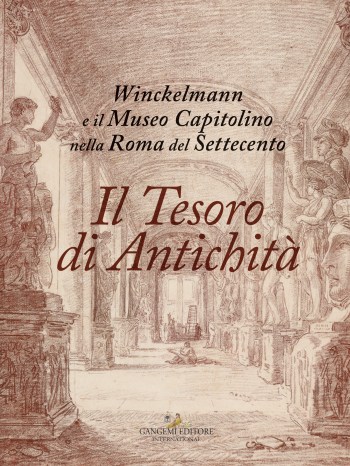 Una mostra per celebrare gli anniversari della nascita e della morte del fondatore dell’archeologia moderna, Johann Joachim Winckelmann (1717–1768)
La mostra Il Tesoro di Antichità. Winckelmann e il Museo Capitolino nella Roma del Settecento intende celebrare gli importanti anniversari winckelmanniani del 2017 (300 anni dalla nascita) e del 2018 (250 anni dalla morte) e si inserisce nel contesto delle manifestazioni europee coordinate dalla Winckelmann Gesellschaft di Stendal, dall’Istituto Archeologico Germanico di Roma e dai Musei Vaticani. L’esposizione ha una duplice finalità: la prima, offrire ai visitatori il racconto degli anni cruciali che hanno portato, nel dicembre del 1733, all’istituzione del Museo Capitolino, il primo museo pubblico d’Europa, destinato non solo alla conservazione ma anche alla promozione della “magnificenza e splendor di Roma”; la seconda, presentare le sculture capitoline sotto una luce diversa, ovvero attraverso le intuizioni, spesso geniali, del grande Winckelmann.
Arricchita da una selezione di 124 opere e da apparati multimediali realizzati appositamente, il Tesoro di Antichità si sviluppa in tre sedi diverse nell’ottica di una “mostra diffusa”: le Sale Espositive di Palazzo Caffarelli, le Stanze Terrene di Sinistra del Palazzo Nuovo e le Sale museali del Palazzo Nuovo.
Negli anni in cui Winckelmann rivoluziona il modo di studiare le testimonianze del mondo antico dando inizio alla moderna archeologia, il modello di museo pubblico rappresentato dal Museo Capitolino si diffonde rapidamente in tutta Europa, segnando la nascita di modalità del tutto nuove di fruizione dei beni artistici: un Tesoro di Antichità non più concepito come proprietà esclusiva di pochi, ma come luogo destinato all’avanzamento culturale della società.
Eloisa Dodero and Claudio Parisi Presicce, Il Tesoro di Antichità: Winckelmann e il Museo Capitolino nella Roma del Settecento (Rome: Gangemi Editore, 2017), 384 pages, ISBN: 978 884923 5371, 35€.
«Vivo come un artista e come tale sono accolto nei luoghi dove ai nella Roma del Settecento giovani è permesso di studiare, come nel Campidoglio. Qui è il Tesoro delle Antichità di Roma e qui ci si può trattenere in tutta libertà dalla mattina alla sera». È il 7 dicembre del 1755 ed è con queste parole che Johann Joachim Winckelmann (1717–1768) descrive a un amico la sua prima visita al Museo Capitolino. Negli anni in cui Winckelmann rivoluziona il modo di studiare le testimonianze del mondo antico, il modello di museo pubblico rappresentato dal Museo Capitolino si diffonde in tutta Europa, segnando la nascita di nuove modalità di fruizione dei beni culturali: un «Tesoro di Antichità» non più concepito come proprietà esclusiva di pochi, ma come luogo destinato all’avanzamento culturale della società.
Exhibition | Thomas Gainsborough: Modern Landscape

Thomas Gainsborough, Mr. and Mrs. Andrews, ca. 1750
(London: National Gallery)
◊ ◊ ◊ ◊ ◊
On view this spring at the Hamburger Kunsthalle:
Thomas Gainsborough: The Modern Landscape / Die moderne Landschaft
Hamburger Kunsthalle, 2 March — 27 May 2018
Curated by Katharina Hoins and Christoph Martin Vogtherr
Thomas Gainsborough (1727–1788) was a pioneering artist in the development towards ›modern‹ landscape painting of around 1800. He was mainly perceived as a painter of brilliant society portraits by his contemporaries, although he personally far preferred his landscapes. They reflect the dramatic technological and artistic developments of his time and the growing contradictions in British society. Landscape painting served Gainsborough as a laboratory to transform impressions into innovation. He experimented with colours and techniques, painted on glass and combined natural materials into landscape models. Establishing England as a centre of European landscape painting, he created images of timeless power. Iconic works like Mr and Mrs Andrews will feature in the exhibition. Gainsborough: Modern Landscape is the first exhibition by a German museum devoted to Gainsborough. For a German and an international public it promises the (re-)discovery of an exceptional painter.
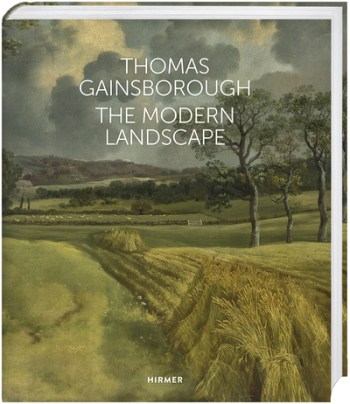 M. Bills, B. Gockel, M. Hallett, K. Hoins, R. Jones, J. Karg, S. Pisot, and C. Vogtherr, Thomas Gainsborough: The Modern Landscape (Munich: Hirmer, 2018), 224 pages, ISBN: 978 37774 29977, $65.
Gainsborough himself favoured landscape painting, a field to which he made important contributions, over his well-known portraits. His works are fascinating for their painterly subtlety and technical variation. This volume brings together German and British traditions of viewing, interpreting, and studying Gainsborough. It looks at the connections to the Dutch landscapes, explains Gainsborough’s unusual and experimental techniques from an art technological point of view, and situates his landscapes in the context of the social tensions of early industrialisation.
New Book | The Gardens of La Gara
Distributed by ACC Publishing and The University of Chicago Press:
Anette Freytag, ed., The Gardens of La Gara: An 18th-Century Estate in Geneva with Gardens Designed by Erik Dhont and a Labyrinth by Markus Raetz (Zurich: Scheidegger and Spiess, 2017), 272 pages, ISBN: 978 38588 18027, $99 / £85.
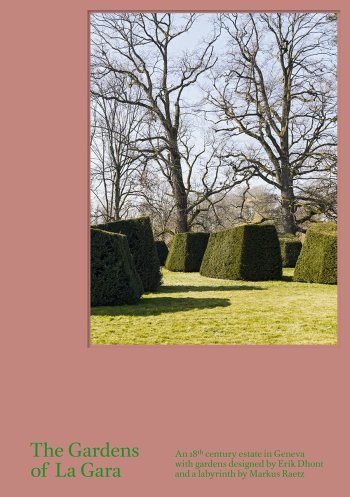 La Gara is an 18th-century country estate in Jussy, a village near Geneva, Switzerland. The buildings have been carefully restored by Swiss architect Verena Best, who also added inspired touches to the interior design. The renowned Belgian landscape designer Erik Dhont reinterpreted and subtly redesigned the gardens and surrounding grounds, completed by a palindrome-like labyrinth designed by Swiss artist Markus Raetz. This new book tells the story of the La Gara estate and illustrates its beauty. The essays investigate its preservation and restoration of buildings and gardens and the contemporary interventions. They highlight features such as the historic watering system for the gardens and the fishponds and look at the specific Genevan garden tradition and characteristics of the rural landscape around Jussy with its biodiversity. Moreover, they contextualise La Gara with the ‘ferme ornée’, a villa with agricultural and ornamental features following ancient Roman models. The beautiful volume is rounded out with newly commissioned photographs by renowned Swiss photographer Georg Aerni.
Anette Freytag is Professor of Landscape Design at Rutgers University in New Brunswick, New Jersey.
New Book | Joseph Banks’ Florilegium
From Thames & Hudson:
David Mabberley, Mel Gooding, and Joe Studholme, Joseph Banks’ Florilegium: Botanical Treasures from Cook’s First Voyage (London: Thames & Hudson, 2017), 320 pages, ISBN: 978 050051 9363, £65, $85.
 This is the first full-colour publication of some of the most extraordinary botanical prints of the 18th century. Banks’ Florilegium is not only a great scientific record, but also a major achievement of collaborative Enlightenment art and a work of botanical illustration of outstanding beauty.
Joseph Banks accompanied James Cook on his first voyage around the world between 1768 and 1771. A gifted and wealthy young naturalist, Banks collected exotic flora from Madeira, Brazil, Tierra del Fuego, the South Pacific, New Zealand, Australia and Java, bringing back over 1,300 species hitherto unknown to science. On his return, Banks commissioned over 700 superlative engravings as a scientific record. Known collectively as Banks’ Florilegium, they are some of the most precise and exquisite examples of botanical illustration ever made—yet they were never published in Banks’s lifetime.
The present selection has been made from a unique limited colour edition of the prints, with expert botanical commentaries provided by Professor David Mabberley. Mel Gooding describes the Endeavour voyage and the making of the Florilegium. An afterword by Joe Studholme outlines the history of the modern printing.
David Mabberley has served as Executive Director of the Royal Botanic Gardens and Domain Trust in Sydney. He is an Emeritus Fellow at Wadham College, Oxford, Adjunct Professor at Macquarie University, Sydney, and Professor Extraordinary at the University of Leiden, The Netherlands.
Mel Gooding is an art historian, writer and curator. He has taught at Edinburgh and Wimbledon Schools of Art, among others, and contributes regularly to the art press.
Joe Studholme co-founded Editions Alecto and undertook the printing of Banks’ Florilegium from the original copper plates between 1980 and 1990.
C O N T E N T S
• The Making of Banks’ Florilegium I: The Voyage of Endeavour, Mel Gooding
• The Plates, David Mabberley
• The Making of Banks’ Florilegium II: The Florilegium, 1772–1990, Mel Gooding
• The Modern Printing of the Florilegium, Joe Studholme
Exhibition | Luigi Valadier: Splendor in Eighteenth-Century Rome
Looking ahead to the fall, from the press release:
Luigi Valadier: Splendor in Eighteenth-Century Rome
The Frick Collection, New York, 31 October 2018 — 20 January 2019
Galleria Borghese, Rome, 30 October 2019 — 2 February 2020
Curated by by Alvar González-Palacios and Xavier Salomon

Luigi Valadier, Herma with Bacchus for the Palazzo Borghese, alabaster and glazed bronze with traces of gilding, 1773, 69 inches (Rome: Galleria Borghese; photo by Mauro Magliani).
Of the many artists who flourished in Rome during the eighteenth century, the silversmith Luigi Valadier (1726–1785) was among those particularly admired by popes, royalty, and aristocrats. Luigi was born in Rome in 1726, about six years after his parents emigrated from France. His father, Andrea, established a silversmith workshop that quickly captured the attention of the wealthiest Roman aristocrats. Heir to his father’s business, Luigi had an unsurpassed technical expertise, which, combined with his avant-garde aesthetic, resulted in extraordinary works in silver and bronze. Well aware of the evolution of artistic taste throughout Europe, he had an impressive ability to reframe examples of ancient Roman art and architecture within the context of contemporary Rome. Sculptures in private collections, cameos, architectural details, and ruins of ancient monuments served as his inspiration for candelabra, tableware, altars, and centerpieces in both silver and bronze. Luigi’s fame and influence spread beyond the borders of Italy, and he received commissions from patrons in France, England, and Spain. He was, however, burdened by debts for commissions undertaken but never paid for, and, in 1785, he committed suicide, drowning himself in the Tiber. Following this tragic event, his workshop passed to his son Giuseppe.
Illustrating the uncommon versatility of Luigi Valadier, who produced everything from large altar pieces to intricate works of jewelry, the Frick’s fall 2018/winter 2019 exhibition will include more than sixty works carefully selected from the vast production of the Valadier workshop. Preparatory drawings of both sacred and profane subjects will be displayed alongside finished works. . One of the highlights of the exhibition will be a full centerpiece, or deser (from the Italianization of the French word dessert), created around 1778 for the Bali de Breteuil, Ambassador of the Order of Malta to Rome. Atop a gilt-bronze base inlaid with precious stones, Valadier has re-created temples, triumphal arches, columns, and other miniature representations of ancient Roman monuments. The multiple elements of the Breteuil deser are today separated between two museums in Madrid (the Museo Arqueológico Nacional and the Palacio Real), but will be reunited for this special exhibition at the Frick. It will therefore be possible to admire this masterwork in its entirety, as nobles and cardinals did in 1778, when it was displayed for a few days in Valadier’s workshop in a candle-lit room specially decorated for the occasion.
The exhibition will also feature finely worked silver plates, tureens, salt cellars, and other pieces of tableware. The juxtaposition of these individual works with the complete centerpiece will illustrate the evolution of the Valadier workshop. While the earliest pieces presented are distinctly in the Baroque style, Valadier’s work becomes more refined in the Rococo style, before becoming neoclassical by the late-eighteenth century. The monochrome silver objects will be contrasted with polychrome works in gilt-bronze, marble, and precious stones, such as the Egyptian clock, a table from Villa Borghese, and extraordinary mounts for two antique cameos once in the Vatican collections and now at the Musée du Louvre.
One section of the exhibition will be devoted to reproductions in bronze of famous antique sculptures in Roman collections, such as the Apollo Belvedere and the Ares Ludovisi.
Luigi Valadier: Splendor in Eighteenth-Century Rome is co-curated by Professor Alvar González-Palacios, considered the world’s authority on Valadier, and Xavier F. Salomon, Peter Jay Sharp Chief Curator of The Frick Collection. It is part of a series of monographic exhibitions that focus on remarkable decorative arts artists and follows the ground-breaking and critically acclaimed Pierre Gouthière: Virtuoso Gilder at the French Court, organized by the Frick, where it was on view in fall 2016 before traveling to the Musée des arts décoratifs, Paris, in spring 2017.
Accompanying the exhibition will be the first complete monograph on Luigi Valadier. Written by González-Palacios, the book will shed new light on the provenance and dating of some works. It also identifies the exact roles performed inside the workshop by Andrea, Luigi, and Giuseppe Valadier, tracing the genesis of inventions and the authorship of models. The monograph also details the Valadier family’s collaborations with other workshops and artists. Typically, works in various materials such as bronze, marble, and precious stones were realized not by one person but by many artisans working together. The decoration of both sacred and private buildings likewise involved outside artisans and architects. This will be the only comprehensive publication on Valadier in English and, lavishly illustrated, it will feature much-needed new photography.
Together, the monograph and exhibition at the Frick will reconstruct the artistic endeavors of one of the most important silversmith families, shedding new light on the cultural life of Rome and, more broadly, Europe, during the eighteenth century. Following the presentation of this show in New York, a related exhibition will be on view later in 2019 at the Galleria Borghese, Rome.
◊ ◊ ◊ ◊ ◊
Note (added 20 December 2019) — The posting was updated to include specific dates for the Galleria Borghese.
Exhibition | Oser l’Encyclopédie: Un combat des Lumières
Now on view at the Mazarin Library (with the full press release available as a PDF file here)
Oser l’Encyclopédie: Un combat des Lumières
Bibliothèque Mazarine, Paris, 20 October 2017 — 19 January 2018
 L’Encyclopédie, ou Dictionnaire raisonné des sciences, des arts et des métiers (1751–1772), codirigée par Diderot, D’Alembert et Jaucourt, constitue la plus vaste entreprise éditoriale du 18e siècle, par le nombre des forces humaines mobilisées, l’étendue des savoirs convoqués, et son retentissement en Europe. La publication de cet « ouvrage immense et immortel » (Voltaire), dont la première édition rassemble 28 volumes, quelque 74 000 articles et près de 2 600 planches, s’étend sur plus de 25 ans. Autorisée par un privilège de librairie (1746), elle est censurée alors que deux tomes sont déjà imprimés (1752), puis tolérée (1753), à nouveau interdite et condamnée à la destruction (1759), et enfin poursuivie grâce à une permission tacite (1759–1772). Et, parce qu’elle constitue une entreprise commerciale à succès, elle connaît immédiatement réimpressions et contrefaçons.
Pour la première fois, une édition critique de l’Encyclopédie voit le jour. Réalisée au format numérique et menée de façon collaborative par plus de 120 chercheurs de tous horizons, elle vise l’annotation progressive des articles et des planches, en mobilisant l’ensemble des connaissances sur l’ouvrage. Soutenue par l’Académie des sciences, l’Édition Numérique Collaborative et CRitique de l’Encyclopédie (ENCCRE)1 s’appuie sur un exemplaire exceptionnel du premier tirage de la première édition, conservé par la Bibliothèque Mazarine qui en a fait l’acquisition au 18e siècle, volume après volume.
L’exposition met en relation cet exemplaire original et l’édition numérique. Elle montre ce que fut le travail de l’Encyclopédie au 18e siècle, et ce que représente son édition critique au 21e. De l’architecture complexe de l’ouvrage à son histoire éditoriale, on y découvre matériellement et numériquement l’intérieur de l’œuvre, ses enjeux et ce qui fut une de ses ambitions fondamentales : « changer la façon commune de penser ». (Diderot).
Organisation et commissariat
Alain Cernuschi (Université de Lausanne)
Alexandre Guilbaud (Institut de mathématiques de Jussieu) Marie Leca Tsiomis (Université Paris Ouest, Société Diderot) Irène Passeron (Institut de mathématiques de Jussieu)
Yann Sordet (Bibliothèque Mazarine)
Anne Weber (Bibliothèque Mazarine)
Alain Cernuschi, Alexandre Guilbaud, Marie Leca-Tsiomis, Irène Passeron, with Yann Sordet, preface by Cathérine Bréchignac, Oser l’Encyclopédie: Un combat des Lumières (Paris: EDP Sciences, 2017), 120 pages, ISBN: 978 27598 21389, 15€.
New Book | The Enlightenment Rediscovery of Egyptology
From Routledge:
Angela Scattolin Morecroft, The Enlightenment Rediscovery of Egyptology: Vitaliano Donati’s Egyptian Expedition, 1759–62 (New York: Routledge, 2017), 216 pages, ISBN: 978 140944 7771, $150.
 In 1759 the botanist and scientist Vitaliano Donati led an expedition to Egypt under the patronage of King Carlo Emanuele III of Sardinia, to acquire Egyptian antiquities for the Museum in Turin. Charting his tumultuous expedition, this book reveals how, in spite of his untimely death in 1762, Donati managed to send enough items back to Turin to lay the foundations for one of the earliest and largest systematic collections of Egyptology in Europe and help to bring the world of ancient Egypt into the consciousness of Enlightenment scholarship. Whilst the importance of this collection has long been recognised, its exact contents have been remained largely unknown. War, the Napoleonic occupation of Italy and the amalgamation and reorganisation of museum collections resulted in a dispersal of objects and loss of provenance. As a result it had been supposed that the actual contents of Donati’s collection could not be known. However, the discovery by Angela Morecroft in 2004 of Donati’s packing list reveals the exact quantity and type of objects that he acquired, offering the possibility to cross-reference his descriptions with unidentified artifacts at the Museum. By examining Donati’s expedition to Egypt and seeking to identify the objects he sent back to Turin, this book provides a fascinating insight into early collecting practice and the lasting historical impact of these items. As such it will prove a valuable resource for all those with an interest in the history of museums and collecting, as well as enlightenment travels to Egypt.
Angela Scattolin Morecroft holds an MA in Egyptian Archaeology from University College London and an MPhil and PhD in Egyptology from Cambridge University. Her discovery of Donati’s packing list was announced in The Journal of Egyptian Archaeology in 2006.
C O N T E N T S
1 Introduction
2 Vitaliano Donati
3 Donati’s Egyptian Journey
4 Loss of the Collection and the ‘Quinternetto’
5 The Written Evidence from the Turin Egyptian Museum
6 The New Primary Source: Donati’s List
7 The Statues in Donati’s Collection
8 Investigation and Identification of the Oil Lamps
9 Statuettes and Other Small Objects
10 Conclusion
New Book | From Gluttony to Enlightenment: The World of Taste
A revised and translated edition of Viktoria von Hoffmann’s Goûter le monde: une histoire culturelle du goût à l’époque moderne (Brussels: Peter Lang, 2013), published by the University of Illinois Press:
Viktoria von Hoffmann, From Gluttony to Enlightenment: The World of Taste in Early Modern Europe (Champaign: University of Illinois Press, 2017), 282 pages, ISBN: 978 02520 40641 (cloth), $95 / ISBN: 978 02520 82146 (paper), $28.
 Scorned since antiquity as low and animal, the sense of taste is celebrated today as an ally of joy, a source of adventure, and an arena for pursuing sophistication. The French exalted taste as an entrée to ecstasy, and revolutionized their cuisine and language to express this new way of engaging with the world. Viktoria von Hoffmann explores four kinds of early modern texts—culinary, medical, religious, and philosophical—to follow taste’s ascent from the sinful to the beautiful. Combining food studies and sensory history, she takes readers on an odyssey that redefined a fundamental human experience. Scholars and cooks rediscovered a vast array of ways to prepare and present foods. Far-sailing fleets returned to Europe bursting with new vegetables, exotic fruits, and pungent spices. Hosts refined notions of hospitality in the home while philosophers pondered the body and its perceptions. As von Hoffmann shows, these labors produced a sea change in perception and thought, one that moved taste from the base realm of the tongue to the ethereal heights of aesthetics.
Viktoria von Hoffmann is a postdoctoral researcher at the University of Liège.










 Enfilade
leave a comment