New Book | The Art of Painting in Colonial Bolivia
From Saint Joseph’s University Press:
Suzanne Stratton-Pruitt, ed., The Art of Painting in Colonial Bolivia / El arte de la pintura en Bolivia colonial (Philadelphia: Saint Joseph’s University Press, 2017), 530 pages, ISBN: 978 1945402 319, $120.
 This anthological volume is dedicated to the art of painting in pre-independence Bolivia, prompted by the belief that a compendium of handsomely photographed, full-color images will bring renewed public and scholarly attention to a rich cultural heritage that has not received its due. An ambitious round of new photography has been joined by an international roster of scholarly contributors from the United States, Argentina, Peru, and Bolivia to offer both the general reader and specialists an overview of the art of painting in the region of South America once called ‘Charcas’ and later ‘Alto Perú’. Attention is brought to the role of European subjects and styles in the development of regional forms of expression, as well as the influence of art and artists from Cuzco, Peru. Works by painters active in La Paz, Sucre, and Potosí such as Leonardo Flores, Melchor Pérez Holguín, and Gaspar Miguel de Berrío have received close reading of iconographical themes that were often of particularly local interest.
Suzanne L. Stratton-Pruitt has, from the mid-1970s, taught, published, and curated exhibitions about Spanish Early Modern art, for which she was awarded the Lazo de Dama de la Orden de Isabel la Católica. Since 2003 she has focused on Spanish colonial art, co-editing with Joseph J. Rishel the catalogue of the exhibition The Arts in Latin America 1492–1820 (Philadelphia Museum of Art, 2006). As curator of the Carl and Marilynn Thoma Collection of Spanish Colonial Painting, she organized the exhibition catalogue The Virgin, Saints, and Angels: South American Paintings 1600–1825 from the Thoma Collection (Milan: Skira editore, 2006). Stratton-Pruitt edited The Art of Painting in Colonial Quito/El arte de la pintura en Quito colonial (Philadelphia: Saint Joseph’s University Press, 2012) as well as Journeys to New Worlds: Spanish and Portuguese Colonial Art in the Roberta and Richard Huber Collection (Philadelphia Museum of Art, 2013), and she wrote about “Paintings in the Home in Spanish Colonial America” for the catalogue of the exhibition Behind Closed Doors: Art in the Spanish-American Home 1492–1898 (Brooklyn Museum, 2013).
C O N T E N T S
Mitchell Codding, Prologue / Prólogo
Acknowledgments / Agradecimientos
Essays
• Suzanne Stratton-Pruitt, The Art of Painting in Colonial Bolivia 1600&1825 / El arte de la pintura en la Bolivia colonial, 1600&1825
• Philipp Schauer, Mural Painting in Bolivia / Pintura mural en la Bolivia
• Ramón Mujica Pinilla, The Pillars of Hercules in Charcas: Imperial Visual Politics in the Viceregal Art in Bolivia / Las columnas de Hércules en Charcas: Política visual imperial en el arte virreinal boliviano
• Almerindo Ojeda Di Ninno, The Use of Prints in Spanish Colonial Art: Approaching the Bolivian Corpus / El uso de grabados en el arte colonial: Una aproximación al corpus boliviano
• Carolyn C. Wilson, The Image of Saint Joseph in a Selection of Colonial Paintings in Bolivian Collections / La imagen de San José en una selección de pinturas coloniales en colecciones bolivianas
• Jaime Mariazza F., Portraiture in the Real Audiencia of Charcas / El retrato en la Real Audienca de Charcas
• Agustina Rodríguez Romero, Old Testament Paintings in Colonial Bolivia: A Remote Past for New Believers / Pinturas del Antiguo Testamento en la Bolivia colonial: Un pasado remoto para nuevos creyentes
• Jeffrey Schrader, Statue Paintings: The Wayfaring Marian Images of Spain in Bolivia / Pinturas de estatua: Las imágenes españolas viajares de María en Bolivia
• Maya Stanfield-Mazzi, Uniquely American Visions of the Virgin Mary / Imágenes unívocamente americanas de la Virgen María
• Gustavo Tudisco, Mountains, Volcanoes, Stones and Promontories: Eighteenth-Century Marian Devotion and Painting in the Andes / Montañas, volcanes, piedras y promontorios. El culto a María en los Andes y la pintura devocional del siglo XVIII
• Jeanette Favrot Peterson, Through Ocaña’s Eyes: Our Lady of Guadalupe in Sucre, Bolivia / A través de la mirada de Ocaña: Nuestra Señora de Guadalupe en Sucre, Bolivia
• Adriana Pacheco Bustillos, The Nuns of Colonial Bolivia and the Art of Painting / Las monjas en la Bolivia colonial y el arte de la pintura
• Gabriela Siracusano, The Carabuco Paintings of the ‘Four Last Things’ /La pinturas de las Postrimerías de Carabuco
• Lucía Querejazu Escobari, Iconography and Ideology in the Paintings of Caquiaviri / Iconografía e Iconología en las pinturas de Caquiaviri
Iconographical Studies / Estudios iconográficos
With contributions by Suzanne Stratton-Pruitt, Lucía Querejazu Escobari, Agustina Romero Rodríguez, Héctor Schenone, and Gustavo Tudisco
• The Painted Decoration of the Church of Jerusalem, Potosí / La decoración pintada de la Iglesia de Jerusalén de Potosí
• The Presbytery at the Sanctuary of Copacabana, Bolivia / Decoración del Presbiterio del Santuario de Copacabana, Bolivia
• Christ Crucified with Saints, Church of Santo Domingo, Sucre / Crucificado de Santo Domingo de Sucre
• Christ Carrying the Cross / Cristo con la cruz a cuestas
• The Passion of Christ / La Pasión de Cristo
• Christ of Malta / El Cristo de Malta
• ‘True Portraits’ of Jesus Christ and the Virgin Mary / ‘Retratos Verdaderos’ de Jesucristo y de la Virgen María
• Praise be / Alabado Sea
• The Soul of Mary / El Alma de María
• Our Lady of Succor / Nuestra Señora de Socorro
• Our Lady of Remedies of La Paz / Nuestra Señora de los Remedios de La Paz
• Our Lady of Multiple Devotions / Nuestra Señora de Advocaciones Múltiples
• Mary, Queen of Heaven / María, Reina del Cielo
• The Divine Shepherdess / La Divina Pastora
• Presentation of the Chasuble to Saint Ildephonsus / La imposición de la casulla a San Ildefonso
• Our Lady of Soterraña of Nieva / Nuestra Señora de Soterraña de Nieva
• The Virgin of the Immaculate Conception in Paintings in Colonial Bolivia / La Virgen de la Inmaculada Concepción en las pinturas de la Bolivia colonial
• The Painted Angels of Colonial Bolivia / Las pinturas de ángeles de la Bolivia colonial
• Saint Nicholas of Tolentino and Saint Nicholas of Bari / San Nicolás de Tolentino y San Nicholás de Bari
• Saint Augustine, Patron Saint of the Rich Hill of Potosí / San Agustín, Santo Patrono del Cerro Rico de Potosí
• Virgin Saints and Martyrs / Vírgenes Santas y Mártires
Bibliography/ Bibliografía
Index/ Índice
Contributors / Autores
New Book | Enchanted World of German Romantic Prints
The related exhibition was on display at the Philadelphia Museum of Art in the autumn of 2013. From Yale UP:
John Ittmann, ed., with essays by Warren Breckman, Mitchell B. Frank, Cordula Grewe, John Ittmann, Catriona MacLeod, and F. Carlo Schmid, Enchanted World of German Romantic Prints, 1770–1850 (New Haven: Yale University Press, 2017), 424 pages, ISBN: 978 03001 97624, $65.
 From the 1770s through the 1840s, German, Austrian, and Swiss artists used the medium of printmaking to create works that synthesized poetry, literature, music, and the visual arts in new and captivating ways. Finding an eager audience in the growing number of educated middle-class collectors, printmakers experimented with modern technologies, such as lithography, and drew on the contemporary interest in regional folklore and traditional fairy tales to produce innovative compositions that both contributed to and reflected the dramatic cultural and political upheavals of the Romantic era. Featuring the work of more than 120 artists, including Casper David Friedrich, Ludwig Emil Grimm, Joseph Anton Koch, Philipp Otto Runge, and Johann Gottfried Schadow, this authoritative book contains many unique and never-before-published examples of prints from the Philadelphia Museum of Art’s unrivaled collection.
John Ittmann is the Kathy and Ted Fernberger Curator of Prints at the Philadelphia Museum of Art.
New Book | Reconstructing the Lansdowne Collection
Published by Hirmer and distributed by The University of Chicago Press:
Elizabeth Angelicoussis, Reconstructing the Lansdowne Collection of Classical Marbles (Munich: Hirmer, 2017), 2 vols., 624 pages, ISBN: 978 37774 28178, £60 / $80.
 Begun by Gavin Hamilton (1723–1798), one of the most prominent British explorers of classical sites of the eighteenth century, the Lansdowne Collection came to hold more than one hundred stellar examples of classical statuary, displayed in a specially designed gallery in Lansdowne-House in London. The collection, however, was dispersed in the years after 1930, and its works are now scattered across the globe. This book reunites the collection, under the expert guidance of Roman sculpture specialist Elizabeth Angelicoussis. Volume one relates the history of the collection and the gallery, while the second catalogs and assess each known sculpture, setting it in the context of the most current research into Roman art history.
Elizabeth Angelicoussis is a fellow of the Society of Antiquarians, a member of the Institute of Classical Studies, London, and a senior member of the American School of Classical Studies, Athens.
Print Quarterly, September 2017
The eighteenth century in the current issue of Print Quarterly:
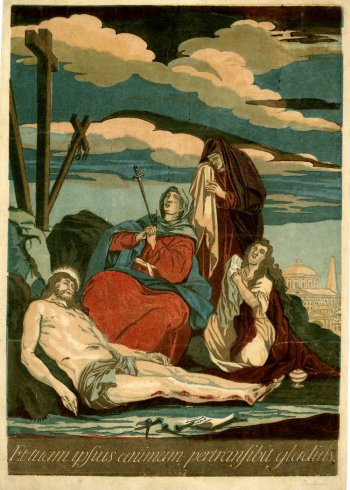
John Baptist Jackson, Lamentation over the Body of Christ, ca. 1740–44, woodcut with embossing (London: The British Museum).
Print Quarterly 34.3 (September 2017)
A R T I C L E S
• Evelyn Wöldicke, “John Baptist Jackson’s Woodcuts and the Question of Embossing,” pp. 298–310.
• Freyda Spira, “Micrographic Allegories by Johann Michael Püchler and Matthias Buchinger,” pp. 310–16.
R E V I E W S
• Adriano Aymonino, Review of the exhibition catalogue, Maria Rosaria Nappi, ed., Immagini per il Grand Tour: L’attività della Stamperia Reale Borbonica (Edizioni Scientifiche Italiane, 2015), pp. 328–31.
• Rolf Reichardt, Review of Philippe de Carbonnières, La Grande Aarmée de papier: Caricatures napoléoniennes (Presses Universitaires de Rouen et du Havre, 2015), pp. 331–33.
• Perrin Stein, Review of Kristel Smentek, Mariette and the Science of the Connoisseur in Eighteenth-Century Europe (Ashgate, 2014), pp. 340–44.
Exhibition | In Her Majesty’s Hands: Medals of Maria Theresa
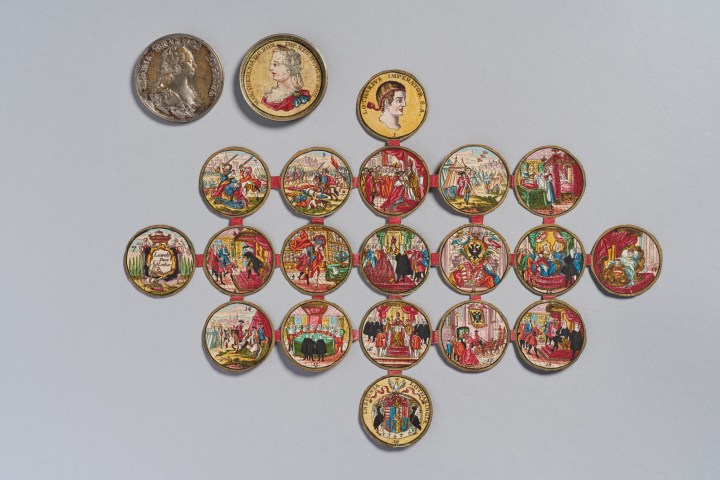
Matthäus Donner / Andreas Vestner, Maria Theresa Box Medal (Schraubmedaille) containing hand-coloured drawings; silver, hand-coloured drawing on paper inside the medal (Vienna, Kunsthistorisches Museum, Coin Collection, inv.no. 5955/1914B).
◊ ◊ ◊ ◊ ◊
Press release (via Art Daily) for the exhibition now on view at the KHM:
In Her Majesty’s Hands: Medals of Maria Theresa
Kunsthistorisches Museum, Vienna, 28 March 2017 — 18 February 2018
Curated by Anna Fabiankowitsch and Heinz Winter
The Kunsthistorisches Museum’s Coin Collection holds both the largest and by far the most important collection of coins minted under Maria Theresa; it is the best place, and now is the best time, to host an exhibition that presents the monarch’s life in medals to celebrate what would have been her 300th birthday.
 The exhibition focuses on the most important topoi in Maria Theresa’s private and public life. It presents her in the company of her large family, running the gamut of events from dynastic marriages to heart-breaking calamities. It showcases her role as a ruler forced to fight several wars for her inheritance and, together with her son and co-regent Joseph II, as a pioneering social reformer. The artefacts on show also illustrate the extent of Maria Theresa’s realm, which comprised many different ethnicities and cultures.
All these topoi are reflected in medals that emblematise historical events with the help of allegories. Maria Theresa was already widely glorified and celebrated during her lifetime, but the exhibition also documents how she was portrayed by her enemies. So-called satirical medals, which were passed around in private, turned Maria Theresa into an object of derision.
The exhibition focuses, too, on the historical background of medal production to illustrate the requisite technical skills, expenditure, and effort; introduce the most important protagonists; and document the range, purview, and media-value of Maria Theresa’s medals.
Maria Theresa (1717–1780) became a legend during her lifetime, and few female rulers were depicted more frequently or diversely. Her many likenesses—among them portraits, engravings, medals, and medallions—were designed to preserve her memory for posterity, turning her into an 18th-century media-star.
Medals played a central role in this propaganda effort controlled by the imperial court. Among the period’s foremost artistic mass media, medals were minted under the aegis of the court, and they continue to reflect the ruler’s political aims and the way she saw herself. Over three hundred different medals were produced during Maria Theresa’s reign to commemorate or celebrate either members of the imperial family or political events, both national and international.
Medals functioned as a way to commemorate important events of her reign, and as they were minted in large numbers, the material is noted for its longevity and their handy format made it easy to disseminate them, they were regarded as a historical record that would last forever. Contemporaries called these miniature memorials show- or commemorative coins, and they evolved into much sought-after and frequently exchanged collectors’ pieces. The monarch presented them as signs of imperial favour, in recognition of the recipient’s merits or achievements, or to strengthen diplomatic ties, and the majority of the medals produced in Vienna were destined for the court—ending up in Her Majesty’s hands.
Zuhanden Ihrer Majestät: Medaillen Maria Theresias (Vienna: Kunst Historisches Museum, 2017), 100 pages, 15€.

Curator Anna Fabiankowitsch during preparations for the exhibition
Photo by Lukas Beck
New Book | Maria Theresa and the Arts
From Hirmer:
Stella Rollig and Georg Lechner, eds., Maria Theresa and the Arts (Munich: Hirmer Velag, 2017), 232 pages, ISBN: 978 37774 29236, £38.
With contributions by A. Gamerith, S. Grabner, M. Hohn, R. Johannsen, G. Lechner, M. Pötzl-Malikova, S. Rollig, B. Schmidt, K. Schmitz-von Ledebur, S. Schuster-Hofstätter
 The 300th birthday of Empress Maria Theresia provides an opportunity to examine her outstanding interest in the fine arts. At the invitation of the reforming monarch a large number of painters, sculptors and other artists in Austria and abroad found a wealth of work opportunities. Correspondingly, this era has left its mark on the countries of the former Habsburg monarchy to this day. Maria Theresia pursued an individual approach with regard to cultural policy. She was interested in reform not only in education, but also in the field of art. She commissioned contemporary artists and helped portrait painting to a new upswing, leading not least to the international consolidation of the newly formed House of Habsburg-Lorraine. This was the function also fulfilled by the allegorical paintings and ceiling frescoes for which impressive cartoons have survived. Landscape painting was highly esteemed, and finally outstanding masterpieces were produced in sculpture and three-dimensional works, for example by Balthasar Ferdinand Moll and Franz Xaver Messerschmidt.
New Book | The Museum by the Park: 14 Queen Anne’s Gate
From Paul Holberton Publishing:
Max Bryant, The Museum by the Park: 14 Queen Anne’s Gate (London: Paul Holberton Publishing, 2017), 128 pages, ISBN: 978 1911300 328, £25 / $35.
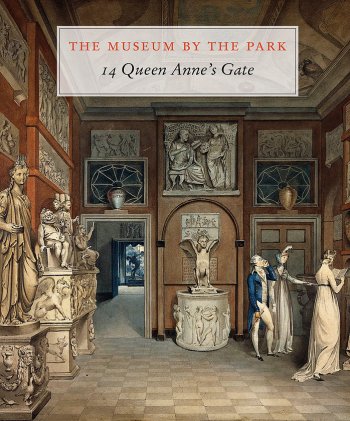 The depth of history at Queen Anne’s Gate—a handsome Baroque street overlooking St James’s Park—is unusual even in London, and few houses resonate with more memories than the extraordinary number 14. The story of the house over the centuries features political revolutionaries, occult initiations, clandestine war meetings, and a decapitated head. It begins, however, as a museum of Roman sculpture, unrivalled outside Italy, designed for connoisseur and virtuoso Charles Townley (1737–1805). Townley embodied Enlightenment values perhaps more completely than any other figure in the art world of 18th-century Britain—his portrait by Johann Zoffany is one of the iconic paintings of the period—yet remarkably he has never been the subject of a major publication.
Written with a sparkle matching Townley’s own enthusiasm, this beautiful and engaging publication tells the story of 14 Queen Anne’s Gate and examines the extraordinary life of Charles Townley and his remarkable collection of over 150 Roman marble statues (mostly now in The British Museum but captured in spectacular engravings of the period). It will be a revelation.
The house was designed as a temple to the past, reviving in the modern city the occult practices of the ancient world. Here visitors in the eighteenth century would have found an assembly of Roman sculpture unrivalled outside Italy, as well as a library and collection devoted to understanding a universal ‘generative sprit’ worshipped by early civilizations. That spirit may be found in the succession of major roles the house has continued to take through generations of dramatic change up to the present day.
Charles Townley, for whom the house was built, was a figure both marginal and emblematic. Catholic and bisexual, he forged a life literally on the borders of the Protestant British establishment. He remains little understood or appreciated in his homeland and, remarkably, has never been the subject of a major exhibition or publication. The ‘emblematic’ side of Townley’s life was dedicated to virtù, the term used for an appreciation of fine art pursued for its own sake. The ‘marginal’ side of Townley, by contrast, manifested itself in a fascination with the ancient occult, particularly the Bacchic mysteries. The house he made for himself was at once a temple to virtu and to Bacchus and contained an unprecedented programme of Bacchic iconography.
The Burlington Magazine, August 2017
The eighteenth century in The Burlington:
The Burlington Magazine 159 (August 2017)
 E D I T O R I A L
• “Reflected Glory: University Art Collections in Britain,” p. 599.
O B I T U A R I E S
• Simon Jervis, “Rudolf Hermann Wackernagel (1933–2017),” p. 639. His great article, “Carlton House Mews: The State Coach of the Prince of Wales and of the Later Kings of Hanover, A Study in the Late-Eighteenth-Century ‘Mystery’ of Coach-Building, in Furniture History 31 (1995) remains the most authoritative statement on London coach building in the late eighteenth century. But his crowning achievement was the massive two-volume Staats- und Galawagen der Wittelsbacher (Stuttgart, 2002). This is a catalogue of the wonderful collection of the Marstallmuseum at Schloss Nymphenburg, outside Munich, where he generously deposited part of his own extensive and systematic archive on coaches and carriages…
R E V I E W S
• Gauvin Alexander Bailey, Review of Christine Casey, Making Magnificence: Architects, Stuccatori and the Eighteenth-Century Interior (Yale University Press, 2017), pp. 642–43.
• Ayla Lepine, Review of Julian Holder and Elizabeth McKellar, eds., Neo-Georgian Architecture, 1880–1970: A Reappraisal (Historic England, 2016), pp. 643–44.
• Michael Hall, Review of Pauline Prévost-Marcilhacy, ed., Les Rothschild: une dynastie de mécènes en France, 1873–2016 (Somogy éditions d’Art, 2016), pp. 644–46.
• Francis Russell, Review of the exhibition Canaletto and the Art of Venice (London: The Queen’s Gallery, Buckingham Palace, 2017), pp. 651–52.
• Matthi Forrer, Review of the exhibition Hokusai: Beyond the Great Wave (London, The British Museum; and Osaka: Abeno Harukas Art Museum, 2017), pp. 652–53.
•Eric Zafran, Review of the exhibition America Collects Eighteenth-Century French Painting (Washington: D.C.: National Gallery of Art, 2017), pp. 669–70.
R E C E N T A C Q U I S I T I O N S
Recent acquisitions (2007–17) by regional university collections in Britain
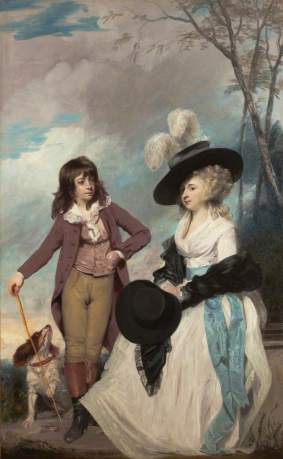
Joshua Reynolds, Maria Marow Gideon and Her Brother, William, 1786–87 (Birmingham: The Barber Institute of Fine Arts), January 2013.
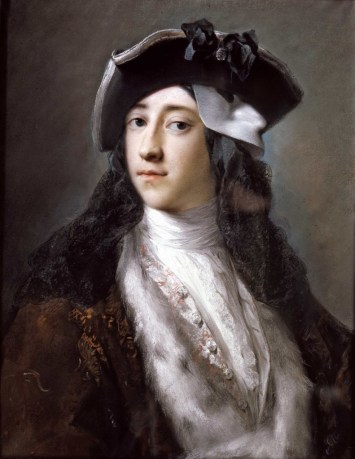
Rosalba Carriera, Portrait of Gustavus Hamilton, 2nd Viscount Boyne, ca. 1730–31; pastel, heightened with white bodycolour on paper (Birmingham: The Barber Institute of Fine Arts), 2009.
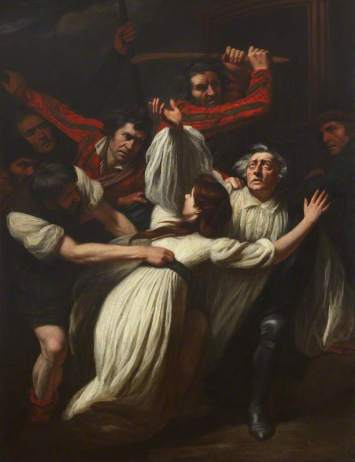
John Opie, The Death of Archbishop Sharpe, 1797; oil on canvas (University of St Andrews), 2008.
Exhibition | Basic Instincts

Joseph Highmore, The Angel of Mercy, ca. 1746; oil on canvas, 59.7 × 48.3 cm (New Haven: Yale Center for British Art, Paul Mellon Collection, B1981.25.362).
◊ ◊ ◊ ◊ ◊
Press release from The Foundling Museum:
Basic Instincts
The Founding Museum, London, 29 September 2017 — 7 January 2018
Curated by Jacqueline Riding
A highly successful artist and Governor of the Foundling Hospital, Joseph Highmore (1692–1780) is best known as a portrait painter of the Georgian middle class. However, during the 1740s Highmore’s art radically shifted as he turned his focus to societal attitudes towards women and sexuality. Curated by Highmore expert, Dr Jacqueline Riding, Basic Instincts explores this ten-year period and his disruptive commentary, reflecting his engagement with the work of the new Foundling Hospital and its mission to support desperate and abused women. On public display in the UK for the first time is a remarkable painting that still retains the power to shock.
In 1744 Highmore created a series of 12 paintings on his own initiative inspired by Samuel Richardson’s international bestseller, Pamela, or Virtue Rewarded. First published in 1740, the novel’s sixth edition of 1742 included illustrations by Hubert Gravelot and Francis Hayman. However, unlike the commissioned illustrations, Highmore’s paintings explicitly make reference to the abuse and sexual violence at the heart of Richardson’s story of a virtuous young maidservant fighting off the unwanted advances of her predatory master. Highmore and Richardson became friends, and Highmore subsequently illustrated Richardson’s masterpiece, Clarissa, or, the History of a Young Lady, whose tragic heroine avoids a forced marriage, but dies having been abandoned by her family, duped by an admirer, drugged and raped.
Unlike William Hogarth, Highmore’s representation of Georgian society favoured realism over broad humour and theatricality, so his nuanced articulation of social attitudes towards women and sexuality means that modern audiences can miss his challenging commentary. However, at the heart of Basic Instincts is a remarkable painting that has never before been publically displayed in the UK and which does not fail to shock. The Angel of Mercy (c.1746) depicts a desperate mother in the act of killing her baby, with the distant Foundling Hospital presented as an alternative solution. This painting is unique in western art for showing maternal infanticide as a contemporary reality. The fashionably dressed mother is free from direct biblical or mythological allusion, unlike Hagar and Ishmael (1746) the large canvas Highmore donated to the newly established Hospital, which represents an Old Testament story of maternal abandonment. Instead The Angel of Mercy confronts the ‘elephant in the room’ in terms of the Hospital’s campaign; that without Christian compassion and practical support, even respectable women will be driven to murder.
Basic Instincts curator Jacqueline Riding said: “This is the first major Highmore exhibition for 50 years and nowhere can his life and work have greater resonance than at the Foundling Museum: an organisation at the forefront of the public display, interpretation and appreciation of early-Georgian art. Setting The Angel of Mercy, the Pamela paintings and Hagar and Ishmael among Highmore’s most tender portraits of mothers and children, family and friends, uniquely demonstrates the artist’s depth and variety, while indicating the true breadth of British Art in a period still labelled ‘The Age of Hogarth’.”
Foundling Museum director Caro Howell said: “Basic Instincts demonstrates that in the eighteenth century, the Foundling Hospital’s impact on contemporary artists went far beyond a simple donation of art. For Joseph Highmore it sparked a radical engagement with the issue of women’s vulnerability to sexual assault and society’s unwillingness to support them, culminating in a work of quite exceptional power.”
Basic Instincts explores the limits and narratives around female respectability in Georgian society, and reveals the complexity of Highmore’s engagement with issues surrounding women’s vulnerability to male exploitation. The first major publication dedicated to Joseph Highmore and written by Dr Riding will be published by Paul Holberton publishing to coincide with the exhibition. The exhibition is supported by the Paul Mellon Centre for Studies in British Art.
On display in the Museum’s historic rooms, a series of nine previously unseen sculptures by acclaimed contemporary artist Rachel Kneebone provide a highly charged counterpoint to Basic Instincts. Exploiting porcelain’s history as a material of refinement and rococo exuberance, Kneebone subverts viewers’ expectations by creating works that are simultaneously delicate and visceral. Raft of the Medusa’s tumbling limbs and fractured swags are at once coquettish and sinister; their gleaming white surfaces and exquisite detail belie scenes of collapse and dismemberment. Displayed amongst the Museum’s historic Collection, these works distil and abstract the Foundling Hospital’s suppressed narratives of sexual desire, emotional damage, and female strength.
Jacqueline Riding specialises in Georgian history and art. She read History and Art History at the universities of Leicester, London, and York and has over twenty-five years’ experience working as a curator and consultant within a broad range of museums, galleries, and historic buildings, including the Guards Museum, Tate Britain, and Historic Royal Palaces. From 1993 until 1999 she was Assistant Curator of the Palace of Westminster and later founding Director of the Handel House Museum in London. She has published widely on early-Georgian art and history, including her major book Jacobites: A New History of the ’45 Rebellion (Bloomsbury 2016). She is currently writing a biography of William Hogarth (Head of Zeus). She was the consultant historian and art historian on Mike Leigh’s award-winning film Mr. Turner (2014) and is the consultant historian on his next feature film, Peterloo. Jacqueline Riding is Associate Research Fellow in the School of Arts, Birkbeck College, University of London and a Fellow of the Clore Leadership Programme.
Rachel Kneebone (b. 1973) lives and works in London. Recent solo exhibitions include Rachel Kneebone at the V&A, London (2017); 399 Days, White Cube Bermondsey (2014) and London; and Regarding Rodin, Brooklyn Museum, New York (2012). Group exhibitions include Obsession, Maison Particulière, Brussels and Flesh, York Art Gallery (2016); Lust for Life, Galleri Anderson Sandstrom, Stockholm and Ceramix at Bonnefantenmuseum, Maastricht (2015); 3am: Wonder, Paranoia and the Restless Night, The Bluecoat, Liverpool and Chapter, Cardi (2013–14); The Surreal House, Barbican Centre, London (2010); Summer Exhibition, Royal Academy of Arts, London (2008); and Mario Testino at Home, Yvon Lambert, New York (2007). In 2005, Kneebone was nominated for the MaxMara Art Prize and this year has been nominated for the breakthrough award for the 2017 South Bank Show Sky Arts Award.
The accompanying book is published by PHP:
Jacqueline Riding, Basic Instincts: Love, Passion, and Violence in the Art of Joseph Highmore (London: Paul Holberton Publishing, 2017), 120 pages, ISBN: 978 1911300 281, £25.
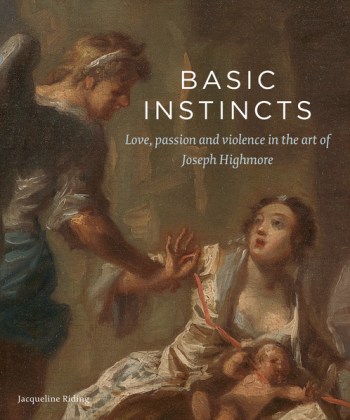 Published to coincide with the exhibition at the Foundling Museum in London, this fascinating book will re-introduce Joseph Highmore (1692–1780), an artist of status and substance in his day, who is now largely unknown. It takes as its focus Highmore’s small oil painting known as The Angel of Mercy (ca. 1746, Yale), one of the most shocking and controversial images in 18th-century British art.
The painting depicts a woman in fashionable mid-18th-century dress strangling the infant lying on her lap. A cloaked, barefooted figure cowers to the right as an angel intervenes, pointing towards the Foundling Hospital, the recently built refuge for abandoned infants, in the distance. The image attempts to address one of the most disturbing aspects of the Foundling Hospital story—certainly a subject that many (now as then) would consider beyond depiction. But if any artist of the period had attempted such a subject it would surely be William Hogarth, not the portrait painter Joseph Highmore? In fact, the painting was attributed to Hogarth for almost two centuries, until its reattribution in the 1990s. Even so, it is surprising that despite the wealth of scholarship associated with Hogarth and the ‘modern moral subject’ of the 1730s and 1740s, The Angel of Mercy has received little attention until now. The book and exhibition seeks to address this, while encouraging greater interest in, and appreciation for, this significant British artist.
Jacqueline Riding sets this extraordinary painting within the context of the artist’s life and work, as well as broader historical and artistic contexts. This includes exploration of superb examples of Highmore’s portraiture, such as his complex, monumental group portrait The Family of Sir Eldred Lancelot Lee and the exquisite small-scale ‘conversations’ The Vigor Family and The Artist and his Family, juxtaposed with analysis of key subject paintings, including the Foundling Museum’s Hagar and Ishmael and Highmore’s Pamela series, inspired by Samuel Richardson’s bestselling novel. Collectively they tackle relevant and highly contentious issues around the status and care of women and children, master/servant relations, motherhood, abuse, abandonment, infant death, and murder.
New Book | Chevening: A Seat of Diplomacy
From Paul Holberton Publishing:
Julius Bryant, Chevening: A Seat of Diplomacy (London: Paul Holberton Publishing, 2017), 96 pages, ISBN: 978 191130 0113, £30.
 A welcome introduction to the handsome architecture, splendid decoration, notable collections, and glorious gardens of Chevening, the grand country residence used for several decades by Britain’s Foreign Secretary.
Chevening stands in a magnificent park below the wooded escarpment of the North Downs in Kent. It has a history dating back around 800 years, but the Chevening we see today we see today is almost entirely the creation of seven generations of the Stanhope family, building on the original Inigo Jones house of 1630. For 250 years the Stanhopes served their country as soldiers and statesmen, and at Chevening as patrons of architecture and art. This new guide highlights the contributions of the Earls and Countesses Stanhope to the building, furniture, pictures, gardens and landscape of Chevening. It also gives a short account of the family in the wider world in order to set their creations in context.
The decoration and architectural features of each of the rooms—from the Entrance Hall with its spectacular swirling staircase of c. 1721 to the sumptuous Tapestry Room with its rare Berlin tapestries woven by Huguenot craftsmen in 1708—are described and illustrated, and significant and unusual works of art highlighted, such as important portraits by Allan Ramsay, Thomas Gainsborough, and Sir Thomas Lawrence.
The Estate consists of some 3,000 acres, and the gardens include a lake, maze, parterre and a double-walled hexagonal kitchen garden. The history of the garden is explored, from the extensive landscaping in the formal style by the 1st and 2nd Earls in the early 18th century, to the naturalistic style created in 1775–78—much of the character of which survives today—to the re-formalizing in the 19th century, with the creation of the ‘Italian’ gardens, a maze and hedged allées. The wonderful restoration of recent decades and the replanting to the designs of Elizabeth Banks is celebrated with new photography.
Published to coincide with the 50th anniversary of the Chevening Act coming into effect with the death of the last Earl Stanhope and the 300th anniversary of his family’s acquisition of the Chevening estate.
Julius Bryant is Keeper of Word and Image at the Victoria and Albert Museum, London.










 Enfilade
leave a comment