Exhibition | Visual Voyages: Images of Latin American Nature
Press release from The Huntington:
Visual Voyages: Images of Latin American Nature from Columbus to Darwin
The Huntington Art Gallery, San Marino, 16 September 2017 — 8 January 2018
Curated by Catherine Hess and Daniela Bleichmar
 A sweeping international loan exhibition at The Huntington Library, Art Collections, and Botanical Gardens will explore how the depiction of Latin American nature contributed to art and science between the late 1400s and the mid-1800s. Visual Voyages: Images of Latin American Nature from Columbus to Darwin, on view in the MaryLou and George Boone Gallery from September 16, 2017 to January 8, 2018, will feature more than 150 paintings, rare books, illustrated manuscripts, prints, and drawings from The Huntington’s holdings as well as from dozens of other collections. Many of these works will be on view for the first time in the United States.
Visual Voyages will be complemented by a richly illustrated book, along with an array of other programs and exhibitions, including a sound installation by Mexican experimental composer Guillermo Galindo. The exhibition is a part of the Getty’s Pacific Standard Time: LA/LA initiative, an exploration of Latin American and Latino art that involves more than 70 arts institutions across Southern California.
“Despite notorious depredation of people and resources during the period, the brilliant work of a number of Latin Americans and Europeans helped to illuminate our understanding of the natural world,” said Catherine Hess, chief curator of European art at The Huntington and co-curator of Visual Voyages. “We aim to shed light on this relatively unexamined piece of the story—to show how beautiful, surprising, and deeply captivating depictions of nature in Latin America reshaped our understanding of the region and, indeed, the world—essentially linking art and the natural sciences.”
Visual Voyages looks at how indigenous peoples, Europeans, Spanish Americans, and individuals of mixed-race descent depicted natural phenomena for a range of purposes and from a variety of perspectives: artistic, cultural, religious, commercial, medical, and scientific. The exhibition examines the period that falls roughly between Christopher Columbus’s first voyage in 1492 and Charles Darwin’s publication of On the Origin of Species in 1859, a work based largely on Darwin’s own voyage to the region in the 1830s.
“Information and materials circulated at an unprecedented rate as people transformed their relationship to the natural world and to each other,” said Daniela Bleichmar, associate professor of art history and history at the University of Southern California (USC) and co-curator of the exhibition. “Images served not only as artistic objects of great beauty but also as a means of experiencing, understanding, and possessing the natural world. These depictions circulated widely and allowed viewers—then and now—to embark on their own ‘visual voyages’.”
Bleichmar, who was born in Argentina and raised in Mexico, is an expert on the history of science, art, and cultural contact in the early modern period. Her publications include the prize-winning book Visible Empire: Botanical Expeditions and Visual Culture in the Hispanic Enlightenment (The University of Chicago Press, 2012).
The Huntington’s three collection areas—library, art, and botanical—all contribute to Visual Voyages. Its Library is one of the world’s greatest research institutions in the fields of British and American history, art, and the history of science, stretching from the 11th century to the present, and includes such riches as the first European depiction of a pineapple and a rare 16th-century manuscript atlas that includes three stunning maps of the Americas. From The Huntington’s art holdings, Frederic Edwin Church’s monumental painting Chimborazo (1864) will be on display, depicting a Latin American landscape both real and imaginary. The Huntington’s 120 acres of gardens include several thousand plant species from Latin America, including pineapple, vanilla, cacao, and various orchids and succulents.
Designed by Chu+Gooding Architects of Los Angeles, Visual Voyages engages visitors through an evocative installation that includes interactive media, display cases of specimens and rare materials, and two walls almost completely covered with grids of visually arresting depictions of botanical specimens and still lifes.
The exhibition opens with a playful display of taxidermy mounts to make vivid the rare animals that captured the imagination of Europeans and were avidly collected during the period. Visual Voyages then begins with a section on “Rewriting the Book of Nature,” in which manuscripts, maps, and publications show how nature came to be reconsidered in the first century of contact. This section includes a copy of the 1493 letter Christopher Columbus wrote to the King and Queen of Spain while on the return leg of his first voyage to the New World. He writes that the region is “so fertile that, even if I could describe it, one would have difficulty believing in its existence.” This section highlights the many contributions of indigenous Americans to the exploration of New World nature, among them two large-scale maps painted by indigenous artists in Mexico and Guatemala; a volume from the Florentine Codex, a 16th-century Mexican manuscript on loan from the Laurentian Library, Florence; and a spectacular feather cape created by the Tupinambá of Brazil.
Next, a gallery called “The Value of Nature” explores the intertwining of economic and spiritual approaches to Latin American nature. Commercial interests resulted in the investigation, depiction, and commercialization of such natural commodities as tobacco and chocolate. Indigenous religions considered the natural world to be infused with the divine, while Christian perspectives led observers to envision Latin American nature as both rich in signs of godliness as well as marked with signs of the devil—and needing eradication. Various depictions of the passion flower, a New World plant, show how the flower’s form recalled to missionaries the instruments of Christ’s Passion.
A third section, “Collecting: From Wonder to Order,” shows how the ‘wonder’ that European collectors held for the astonishing material coming from the New World became a desire to possess and, later, to “order” this material, following systems of taxonomy and classification. On view will be a spectacular set of large paintings depicting Brazilian fruits and vegetables by the Dutch painter Albert Eckhout (ca.1610–1665) as well as 30 artful, vivid, and detailed drawings of botanical specimens painted by artists from New Granada (present-day Colombia, Ecuador, Panama, Venezuela, Peru, northern Brazil, and western Guyana), never before seen in the United States.
The final section of the exhibition, called “New Landscapes,” examines scientific and artistic perspectives on Latin America created in the 19th century, a period when a new wave of voyagers explored the region and independence wars resulted in the emergence of new nations. The Romantic and imperial visions of artists and scientists from Europe and the U.S. are juxtaposed with the patriotic and modernizing visions of artists and scientists from Latin America, who envisioned nature as an integral part of national identity. This juxtaposition can be seen visually in the pairing of The Huntington’s monumental Chimborazo by Church with the equally monumental Valley of Mexico (1877) by Mexican painter José María Velasco, on loan from the Museo Nacional de Arte in Mexico City.
Gallery text is in Spanish and English.
Daniela Bleichmar, Visual Voyages: Images of Latin American Nature from Columbus to Darwin (New Haven: Yale University Press, 2017), 240 pages, ISBN: 978 030022 4023, $50.
Visual Voyages: Images of Latin American Nature from Columbus to Darwin is accompanied by a hardcover book of the same title written by Daniela Bleichmar, co-curator of the exhibition. In a narrative addressed to general audiences as well as students and scholars, Bleichmar reveals the fascinating story of the interrelationship of art and science in Latin America and Europe during the period.
More information is available from Yale UP.
◊ ◊ ◊ ◊ ◊
The Huntington will present an array of public programs to complement Visual Voyages, including a lecture, a curator tour, and focused exhibitions.
Guillermo Galindo Installation and Performance
16 September 2017 — 8 January 2018
Experimental composer, sonic architect, and performance artist Guillermo Galindo will create an outdoor sound installation and performance at The Huntington during the run of the exhibition. The program is part of USC Annenberg’s Musical Interventions, a series of public events organized for Pacific Standard Time: LA/LA by Josh Kun, historian of popular music and recently named a MacArthur Fellow.
Nuestro Mundo
16 September 2017 — 8 January 2018
About two dozen paintings by students of Art Division make up this installation of works inspired by Visual Voyages. Art Division is a non-profit organization dedicated to training and supporting underserved Los Angeles youth who are committed to studying the visual arts. Flora-Legium Gallery, Brody Botanical Center (weekends only).
In Pursuit of Flora: Eighteenth-Century Botanical Drawings
28 October 2017 — 19 February 2018
European exploration of other lands during the so-called Age of Discovery revealed a vast new world of plant life that required description, cataloging, and recording. By the 18th century, the practice of botanical illustration had become an essential tool of natural history, and botanical illustrators had developed strategies for presenting accurate information through exquisitely rendered images. From lusciously detailed drawings of fruit and flowers by Georg Dionysius Ehret (1708–1770), a collaborator of Linnaeus, to stunning depictions of more exotic examples by the talented amateur Matilda Conyers (1753–1803), In Pursuit of Flora reveals the 18th-century appreciation for the beauty of the natural world.
Symposium: Indigenous Knowledge and the Making of Colonial Latin America
The Getty Center, Los Angeles, 8-10 December 2017
This symposium will bring together an interdisciplinary group of scholars to explore the ways in which indigenous knowledge contributed to the making of colonial Latin America. A dozen talks will examine practices related to art, architecture, science, medicine, governance, and the study of the past, among other topics. Curator-led visits to two related exhibitions—Visual Voyages at The Huntington and Golden Kingdoms: Luxury and Legacy in the Ancient Americas at The J. Paul Getty Museum—will allow participants to view magnificent examples of work by indigenous artists and authors, including more than half a dozen rare pictorial manuscripts (codices). The symposium is organized by Daniela Bleichmar, co-curator of Visual Voyages and Kim Richter, co-curator of Golden Kingdoms and senior research specialist at the Getty Research Institute, with funding from the USC-Huntington Early Modern Studies Institute, the Seaver Institute, and the Getty Research Institute
New | Book Silent Witnesses: Trees in British Art, 1760–1870
From Sansom & Co:
Christiana Payne, Silent Witnesses: Trees in British Art, 1760–1870 (Bristol: Sansom & Company, 2017), 176 pages, ISBN: 978 1911408 123, £25.
 In the eighteenth and nineteenth centuries, naturalists, poets and artists were united in their love of trees. William Gilpin began his influential Remarks on Forest Scenery (1791) with the bold statement that ‘It is no exaggerated praise to call a tree the grandest, and most beautiful of all the productions of the earth.’ Illustrated books and tree portraits celebrated the beauty, antiquity and diversity of individual, and particularly ancient specimens. A wide range of drawing manuals showed artists and amateurs how to express their ‘character’ and ‘anatomy’, as if they were human subjects.
Paintings of woodland scenes provided welcome relief from city life, and studies of exotic trees reflected the growth of tourism and empire. The arrival of new species from all over the world aroused much excitement and scientific activity. At the same time, the native trees—oak, ash, beech, elm—acquired new resonance as emblems of the rural countryside. Many of Britain’s most important landscape painters, including Paul Sandby, John Constable, Samuel Palmer, Edward Lear, and the Pre-Raphaelites, made themselves experts in the drawing and painting of trees.
Christiana Payne is Professor of History of Art at Oxford Brookes University, where she has been teaching since 1994. Her previous books include Where the Sea Meets the Land: Artists on the Coast in Nineteenth-Century Britain (Sansom and Company, 2007) and John Brett, Pre-Raphaelite Landscape Painter (Yale University Press, 2010). She has curated major exhibitions and displays at the Yale Center for British Art, Tate Britain, and the Royal West of England Academy, Bristol.
New Book | The Prince of Antiquarians: Francesco de Ficoroni
Available from ArtBooks.com:
Ronald Ridley, The Prince of Antiquarians: Francesco de Ficoroni (Rome: Quasar, 2017), 300 pages, ISBN: 978 887140 7753, 36€ / $55.
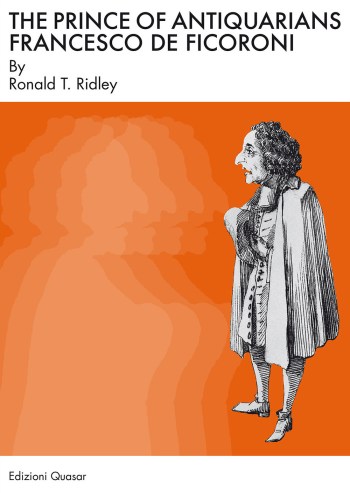 In all the literature on Rome in the eighteenth century, a figure is constantly—but fleetingly—mentioned: (Francesco di) Ficoroni. It is time to restore him to his rightful place, namely as the leading antiquarian in Rome of his age (1662–1747). He is the author of many books on his collections, and more than 500 of his letters survive, showing him as a central figure in the antiquarian life of Europe in the first half of the century, relied on by aristocrats, Church figures, and collectors. He was the leading cicerone (guide) to the early visitors of the Grand Tour. The richness and importance of his life are here revealed for the first time.
Ronald T. Ridley retired from University of Melbourne in 2005. He is the author of numerous books, including Napoleon’s Proconsul in Egypt, The Eagle and the Spade, and The Emperor’s Retrospect. He is a Fellow of the Antiquaries’ Society, the Royal Historical Society, the Pontifical Academy of Roman Archaeology, and the Australian Academy of the Humanities.
New Book | Cerimoniale dei Borbone di Napoli
Available from ArtBooks.com:
Attilio Antonelli, ed., Cerimoniale dei Borbone di Napoli, 1734–1801 (Naples: Arte’m, 2017), 560 pages, ISBN: 9788 85690 5595, 65€ / $100.
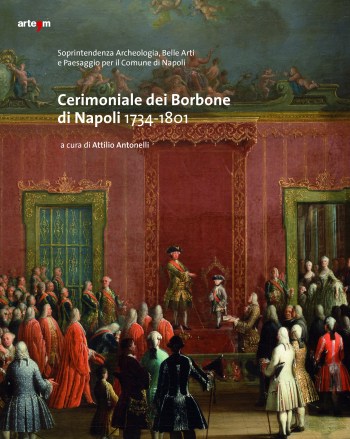 Quarto volume della collana, esemplare per rigore filologico e ricchezza degli apparati iconografici, dedicata ai cerimoniali della corte di Napoli, dato alle stampe in occasione del terzo centenario della nascita di Carlo di Borbone. Arricchito da una magistrale introduzione di Raffaele Ajello, il volume—corredato di saggi, illustrazioni, note e apparati corposi—presenta due manoscritti che illustrano la vita di corte nell’arco della lunga parabola del nuovo regno: dall’arrivo di Carlo nel 1734 fino alla sua partenza nel 1759, quando meriterà una nuova corona, quella di re di Spagna. Accanto a Carlo, le figure della moglie Maria Amalia di Sassonia e del ministro Bernardo Tanucci. Il ritorno di Ferdinando di Borbone da Palermo a Napoli nel 1801 segna il momento conclusivo della cronaca cerimoniale.
The Burlington Magazine, July 2017
The eighteenth century in The Burlington:
The Burlington Magazine 159 (July 2017), Decorative Arts

E D I T O R I A L
• “Furniture History: The Digital Future,” p. 519.
On the eve of the 300th anniversary of the birth of Thomas Chippendale in 2018, the editorial addresses the British and Irish Furniture Makers Online Project (BIFMO), which updates the The Dictionary of English Furniture Makers 1660–1840, edited by Geoffrey Beard and Christopher Gilbert and published by the Furniture History Society in 1986. The BIFMO—a collaboration between the FHS and the Centre for Metropolitan History (CMH) at the Institute of Historical Research, University of London—is an open-access searchable database of all the entries from The Dictionary, together with the names of furniture makers from Laurie Lindey’s recent PhD thesis (Lindey, as a post-doctoral research fellow is overseeing the project at the IHR with Mark Merry of the CMH). The first phase of the BIFMO’s launch is scheduled for 30 September.
A R T I C L E S
• Koenraad Brosens and Astrid Slegten, “Creativity and Disruption in Brussels Tapestry, 1698–1706: New Data on Jan van Orley and Judocus de Vos,” pp. 528–35.
• Francesco Morena, “The Emperor of Mexico’s Screen: Maximilian I’s ‘Biombo’ in Trieste,” pp. 536–43.
R E V I E W S
• Simonetta Prosperi Valenti Rodinò, Review of Sabina de Cavi, ed., Dibujos y ornamento: Trazas y Dibujos de Artes decorativas entre Portugal, España, Italia, Malta y Grecia: Estudio en honor de Fuensanta García de la Torre (De Luca Editori d’Arte, 2015), pp. 559–60.
• Pierre Terjanian, Review of A. V. B. Norman and Ian Eaves, Arms & Armour in the Collection of Her Majesty The Queen, European Armour (Royal Collection Trust, 2016),” pp. 560–61.
• Robin Hildyard, Review of Brian Gallagher, Barbara Stone Perry, Letitia Roberts, Diana Edwards, Pat Halfpenny, Maurice Hillis and Margaret Ferris Zimmerman, British Ceramics, 1675–1825: The Mint Museum (D. Giles, 2015), pp. 561–62.
• Gauvin Alexander Bailey, Review of Christopher M.S. Johns, China and the Church: Chinoiserie in Global Context (University of California Press, 2016) and Marco Musillo, The Shining Inheritance: Italian Painters at the Qing Court, 1699–1812 (Getty Publications, 2016),” pp. 562–63.
• Philippa Glanville, Review of James Rothwell, Silver for Entertaining: The Ickworth Collection (Philip Wilson, 2017), pp. 563–64.
• Humphrey Wine, Review of the exhibition Le Baroque des Lumières: Chefs-d’œuvre des églises parisiennes au XVIIIe siècle (Paris: Petit Palais, 2017), pp. 572–73.
• Patrick Bade, Review of the exhibition La Quête de la ligne: Trois siècles de dessin en Allemagne (Hamburg: Kunsthalle, 2016 and Paris: Fondation Custodia, 2017), pp. 574–75.
• Jamie Mulherron, Review of the exhibition Marie Madeleine: La Passion révélée (Bourg-en-Bresse: Monastère Royal de Brou; Carcassonne: Musée des Beaux Arts; and Douai: Musée de la Chartreuse, 2017), pp. 577–79.
• Elsje van Kessel, Review of the newly refurbished gallery of Portuguese painting and sculpture at the Museu Nacional de Arte Antiga (MNAA), pp. 579–80.
• Philippe Bordes, Review of the exhibition Charles Percier: Architecture and Design in an Age of Revolutions (New York, Bard Graduate Center Gallery; and Château de Fontainebleau, 2016–17), pp. 583–84.
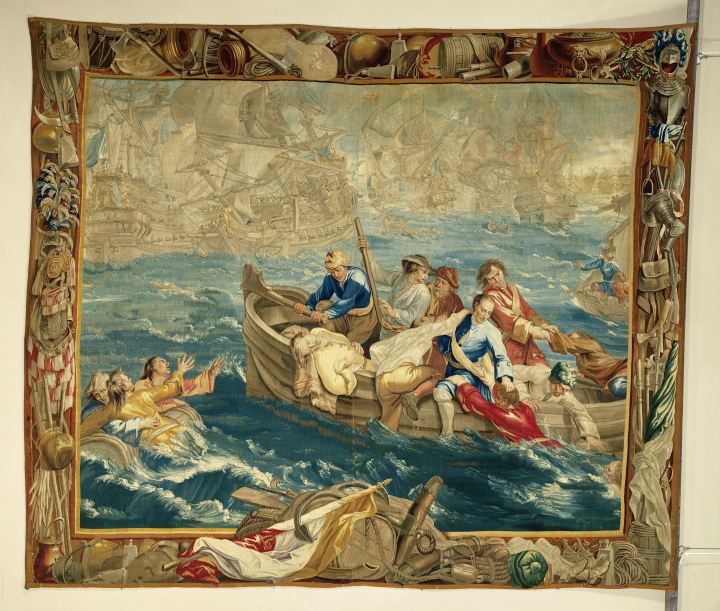
Judocus de Vos, after Lambert de Hondt, Lucas Achtschellinck, and Jan van Orley, Naval Battle from the Art of War series, ca. 1715–20; wool and silk, 344 × 400 cm (Amsterdam: Rijksmuseum).
New Book | Pour la plus grande gloire du roi: Louis XIV en thèses
As Pierre-Henri Biger notes on his Facebook page (with thanks to him for forwarding the notice for publication here at Enfilade) . . .
Comment réaliser des ouvrages traitant de l’Art abondamment illustrés et savants sans qu’ils coûtent une fortune ? Cela les écarte de leur public, car les savants sont rarement riches, et les riches rarement savants dans ce domaine. Mme Véronique Meyer, qui me fit l’honneur d’être membre de mon jury de thèse (et donné le plaisir de lire son élogieux pré-rapport) a élégamment, intelligemment et généreusement résolu le problème. Pour accompagner l’ouvrage Pour la plus grande gloire du Roi qu’elle publie aux Presses Universitaires de Rennes, elle met en ligne un impressionnant catalogue, plein d’images de thèses à la gloire de Louis XIV et de commentaires détaillés. Et ce document a vocation à s’enrichir. Bravo, Madame (et bravo aux PUR et au Centre de Recherches du Château de Versailles) !
From PUR:
Véronique Meyer, Pour la plus grande gloire du roi: Louis XIV en thèses (Rennes: Presses Universitaires de Rennes, 2017), 372 pages, ISBN: 978 27535 54641, 23€.
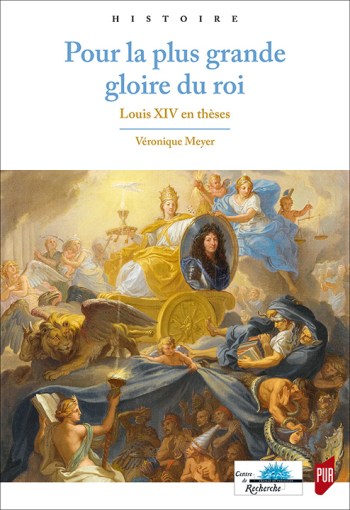 C’est au xviie siècle en France que la thèse illustrée connaît son apogée. À l’exemple de Richelieu et de Mazarin, Louis XIV accorda aux thèses une place de choix dans la di usion de son image. De 1638 à 1704, plus de 130 thèses de philosophie, théologie, droit et médecine lui furent dédiées. Même si certaines sont destinées à son père, à sa mère ou aux parlements de province, il apparaît en haut de l’a che en personne ou par ses armoiries. Les étudiants étaient issus de l’entourage royal, ls de ministres ou de parlementaires, membres de congrégations religieuses, et quelquefois même étrangers. Courtisans, parlementaires et ecclésiastiques de haut rang participaient à la soutenance publique où le candidat et sa famille adressaient des éloges au roi. On y distribuait des a ches ornées de son portrait ou d’une allégorie à sa gloire exécutées par les meilleurs artistes du temps, aussi les dépenses engagées étaient-elles considérables. Soutenues à Paris, mais également en province et à l’étranger, les thèses, et avec elles l’image du roi, pénétraient les demeures des Français et se di usaient à l’extérieur du royaume. Cet ouvrage décrit successivement la place des thèses dans le cursus universitaire, leur soutenance, leur dédicace et leur di usion ainsi que l’élaboration de leurs illustrations, en insistant sur le rôle des peintres, graveurs et éditeurs. Il montre comment elles rendent compte de l’histoire du roi et de l’évolution de son portrait physique et moral. Ce volume est accompagné d’un catalogue raisonné, abondamment illustré, des thèses dédiées au roi, consultable sur les sites du Centre de recherche du château de Versailles et des Presses universitaires de Rennes.
Veronique Meyer, professeur d’histoire de l’art à l’université de Poitiers, est spécialiste de l’estampe à l’époque moderne. Elle a publié notamment avec la Commission des travaux historiques de la Ville de Paris L’illustration des thèses à Paris dans la seconde moitié du xviie siècle. Peintres, graveurs, éditeurs (2002) et L’œuvre gravé de Gilles Rousselet (2004), et participé à l’exposition Images du Grand Siècle. L’estampe française au temps de Louis XIV (1660–1715), (Bnf-Getty Research Institute, 2015–16).
T A B L E D E S M A T I È R E S
Remerciements
Avertissement
Introduction
Première partie: LA THÈSE : L’UNIVERSITÉ, LE CANDIDAT ET LE DÉDICATAIRE
1 Les thèses dans le cursus universitaire
La faculté des arts
La faculté de théologie
La faculté de médecine et de pharmacie
La faculté de droit
2 La soutenance
Les candidats
L’invitation à la soutenance
Le décor de la salle: tapisseries et tentures
Le dais et le portrait du roi
Le public
Protocole et préséance
Panégyriques, harangues et odes
3 L’illustration des thèses
Le placard et le livret
La dédicace et ses raisons d’être
Les cadres
La réception
Deuxième partie: ÉLABORATION, DIFFUSION, RÉCEPTION
4 Les peintres
Charles Le Brun
Pierre Mignard
Nicolas Mignard
Pierre-Paul Sevin
Antoine Paillet
5 Les graveurs
Les portraitistes
Les graveurs d’histoire
Les graveurs en lettres
6 Contrats et dépenses
Le prix des gravures
Diffusion et réutilisation
Troisième partie: LE ROI, SON HISTOIRE ET SON PORTRAIT
7 L’histoire du roi
De la naissance au règne personnel, 1638–1660
Célébration du roi en province et à l’étranger, 1649–1653
Vers l’affirmation du pouvoir royal, 1653–1660
Le pouvoir personnel : le roi triomphant, 1661–1715
8 Le portrait du roi
Le portrait physique : du visage au costume
Le portrait moral dans les sujets d’histoire : l’allégorie et l’emblème
Les vertus
Le portrait en buste : attributs et symboles
Conclusion
Abréviations
Table des thèses dédiées au roi
Annexe : table des thèses dédiées à la famille royale, aux fils légitimés de Louis XIV et aux favorites
Sources et bibliographie
Table de concordance
Table des illustrations
Crédits photographiques
Index des noms de personnes
More information about the online Catalogue des theses dediees à Louis XIV is available here»
New Book | Tin-Glazed Earthenware
Distributed by The University of Chicago Press:
Ulla Houkjær, Tin-Glazed Earthenware from the Netherlands, France, and Germany, 1600–1800 (Copenhagen: Museum Tusculanum Press, 2017), 415 pages, ISBN: 978 8763545 655, $75.
 Designmuseum Denmark is home to a large collection of ceramic works that is quite unique in terms of size and width of representation, since the collection covers all known techniques within the main groups of earthenware, stoneware, tin-glazed earthenware, and porcelain as well as new hybrid materials and techniques. This catalogue covers an extremely important period in the history of European glazed ceramic ware from c. 1600 to 1800 when the technique enjoyed the widest distribution. Ulla Houkjaer focuses on three central areas: the Netherlands, France, and Germany. This comprehensive and highly illustrated introduction to the history of tin-glazed earthenware in these three countries offers an overview of the history of important developments within the field during the period and highlights important changes in aesthetics and usage.
Ulla Houkjær is curator at Designmuseum Denmark. She is the author of Tim-Glazed Earthenware, 1300–1750: Spain, Italy, France.
New Book | Malleable Anatomies
From OUP:
Lucia Dacome, Malleable Anatomies: Models, Makers, and Material Culture in Eighteenth-Century Italy (Oxford: Oxford University Press, 2017), 320 pages, ISBN: 978 01987 36189, $99.
 Malleable Anatomies offers an account of the early stages of the practice of anatomical modeling in mid-eighteenth-century Italy. It investigates the ‘mania’ for anatomical displays that swept the Italian peninsula and traces the fashioning of anatomical models as important social, cultural, and political as well as medical tools. Over the course of the eighteenth century, anatomical specimens offered particularly accurate insights into the inner body. Being colored, soft, malleable, and often life-size, they promised to foster anatomical knowledge for different audiences in a delightful way. But how did anatomical models and preparations inscribe and mediate bodily knowledge? How did they change the way in which anatomical knowledge was created and communicated? And how did they affect the lives of those involved in their production, display, viewing, and handling?
Examining the circumstances surrounding the creation and early viewing of anatomical displays in Bologna and Naples, Malleable Anatomies addresses these questions by reconstructing how anatomical modeling developed at the intersection of medical discourse, religious ritual, antiquarian and artistic cultures, and Grand Tour display. While doing so, it investigates the development of anatomical modeling in the context of the diverse worlds of visual and material practices that characterized the representation and display of the body in mid-eighteenth-century Italy. Drawing attention to the artisanal dimension of anatomical practice and to the role of women as both makers and users of anatomical models, it considers how anatomical specimens lay at the center of a composite world of social interactions, which led to the fashioning of modelers as anatomical celebrities. Moreover, it examines how anatomical displays transformed the proverbially gruesome practice of anatomy into an enthralling experience that engaged audiences’ senses.
Lucia Dacome is an associate professor and Pauline M.H. Mazumdar Chair in the History of Medicine at the IHPST, University of Toronto. She received her PhD from the University of Cambridge and held postdoctoral fellowships at the Max Planck Institute for the History of Science in Berlin, the Wellcome Trust Centre for the History of Medicine at UCL, the UCLA Centre for seventeenth- and eighteenth-century studies in Los Angeles, and a Marie Curie Intra-European Fellowship supported by the European Commission at the Centre Alexandre Koyre/CNRS in Paris. Her research focuses on themes at the intersection of the history of medicine, the history of the body, the history of visual and material cultures of medicine, gender history, the history of the self, and that of medical practices and exchanges in the Mediterranean world.
C O N T E N T S
Acknowledgments
List of Plates
List of Figures
List of Abbreviation
Introduction
1 Prospero’s Tools
2 Artificer and Connoisseur
3 Anatomy, Embroidery, and the Fabric of Celebrity
4 Women, Wax, and Anatomy
5 Blindfolding the Midwives
6 Transferring Values
7 Injecting Knowledge
Epilogue: Becoming Obsolete
Selected Bibliography
Index
New Book | Cottages Ornés
From Yale UP:
Roger White, Cottages Ornés: The Charms of the Simple Life (New Haven: Yale University Press, 2017), 272 pages, ISBN: 978 03002 26775, $50.
 Tracing the history of cottages ornés (ornamental cottages), this copiously illustrated volume offers an engaging survey of an often-overlooked architectural genre. An invention of mid-18th-century England, these cottages were designed to facilitate a more informal way of living and were built in different guises that range from royal and imperial cottages to the working-class lodges that still dot the English countryside. Analyzing cottage designs by some of the leading architects of late-Georgian England—including Robert Adam, John Soane, and John Nash—Roger White explores the aesthetic values that made the form so appealing. As he follows the development of cottages ornés from the Celtic fringes to the Continent and the British colonies, White reveals the significant impact of the genre on social, cultural, and political history and examines the influence of cottage design on the architectural developments of the Victorian period and even the 20th century.
Roger White is an architectural historian specializing in the Georgian period.
New Book | A World Trimmed with Fur
From Stanford UP:
Jonathan Schlesinger, A World Trimmed with Fur: Wild Things, Pristine Places, and the Natural Fringes of Qing Rule (Stanford: Stanford University Press, 2017), 288 pages, ISBN: 978 080479 9966, $65.
 In the eighteenth and nineteenth centuries, booming demand for natural resources transformed China and its frontiers. Historians of China have described this process in stark terms: pristine borderlands became breadbaskets. Yet Manchu and Mongolian archives reveal a different story. Well before homesteaders arrived, wild objects from the far north became part of elite fashion, and unprecedented consumption had exhausted the region’s most precious resources.
In A World Trimmed with Fur, Jonathan Schlesinger uses these diverse archives to reveal how Qing rule witnessed not the destruction of unspoiled environments, but their invention. Qing frontiers were never pristine in the nineteenth century—pearlers had stripped riverbeds of mussels, mushroom pickers had uprooted the steppe, and fur-bearing animals had disappeared from the forest. In response, the court turned to ‘purification’; it registered and arrested poachers, reformed territorial rule, and redefined the boundary between the pristine and the corrupted. Schlesinger’s resulting analysis provides a framework for rethinking the global invention of nature.
Jonathan Schlesinger is Assistant Professor of History at Indiana University.
C O N T E N T S
Introduction
1 The View from Beijing
2 Pearl Thieves and Perfect Order
3 The Mushroom Crisis
4 The Nature in the Land of Fur
Conclusion










 Enfilade
leave a comment