2017 Charles Eldredge Prize | Transporting Visions
Press release (13 April 2017) from the Smithsonian:
Jennifer L. Roberts, Transporting Visions: The Movement of Images in Early America (Los Angeles: University of California Press, 2014), 240 pages, ISBN: 978-0520251847, $60 / £42.
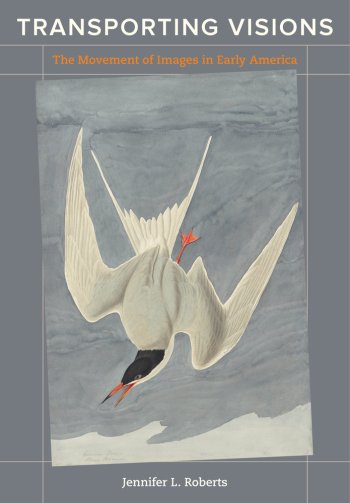 The Smithsonian American Art Museum has awarded the 2017 Charles C. Eldredge Prize for Distinguished Scholarship in American Art to Jennifer L. Roberts, the Elizabeth Cary Agassiz Professor of the Humanities at Harvard University, for her book Transporting Visions: The Movement of Images in Early America (University of California Press, 2014). The jurors wrote in a joint statement: “Roberts’s adventurous account provides an exciting indication of where the field of American art is going as it pushes analysis of visual material into new terrain.”
The three jurors who awarded the $3,000 prize were Jennifer Greenhill, associate professor of art history at the University of Southern California; Jessica May, deputy director and Robert and Elizabeth Nanovic Chief Curator at the Portland Museum of Art, Maine; and Akela Reason, associate professor of history at the University of Georgia.
The jurors continued: “Transporting Visions: The Movement of Images in Early America [is] a book of rare ambition whose impact on the field is undeniable. Methodologically sophisticated in its treatment of the material properties of objects on the move—the literal ‘weight and heft’ of things in the physical world—Roberts demonstrates just how much art historians have to contribute to contemporary, cross-disciplinary debates about the complex meanings of matter. The arguments about John Singleton Copley, John James Audubon, and Asher B. Durand are elegantly conceived and tightly crafted, making the book truly a pleasure to read. Rarely does such a field-shaping book come along.”
Roberts is the Elizabeth Cary Agassiz Professor of the Humanities at Harvard University. She teaches American art from the colonial period to the present, with particular focus on issues of landscape, expedition, material culture theory, and the history and philosophy of science. Roberts is the author of Mirror-Travels: Robert Smithson and History (2004) and Jasper Johns/In Press: The Crosshatch Works and the Logic of Print (2012). She is the co-author of the forthcoming catalog raisonné of Jasper Johns’ monotypes and is working on a book, The Matrix, about the broad cultural and philosophical implications of the physical operations of printing. She received a bachelor’s degree from Stanford University (1992) and earned her doctorate in art history from Yale University (2000). Roberts currently holds a Harvard College Professorship that was awarded for distinguished research and undergraduate teaching. She will occupy the Slade Professorship in Fine Arts at Cambridge University in 2019.
Roberts will give the annual Eldredge Prize lecture at the Smithsonian American Art Museum in the spring of 2018. More information about the prize, along with a list of past winners, is available here.
Exhibition | Treasures of the Hispanic Society of America
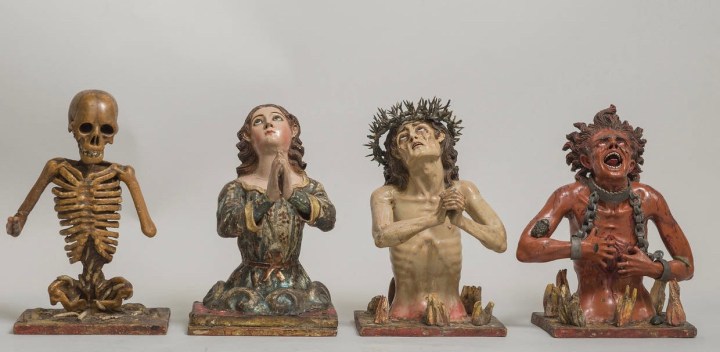
Manuel Chili, known as Caspicara, Four Fates of the Soul: Death, Soul in Heaven, Soul in Purgatory, and Soul in Hell, ca. 1775 (New York: The Hispanic Society of America).
◊ ◊ ◊ ◊ ◊
Press release (31 March 2017) for the exhibition:
Treasures of the Hispanic Society of America: Visions of the Hispanic World
Museo Nacional del Prado, Madrid, 4 April — 10 September 2017
Curated by Mitchell Codding
Through September 10, the Museo del Prado will present the treasures of the museum and library of the Hispanic Society, an institution located in Upper Manhattan in New York, founded in 1904 by Archer Milton Huntington (1870–1955), one of America’s greatest philanthropists. Huntington created an institution that reflected an appreciation of Spanish culture and the study of the literature and art of Spain, Portugal, and Latin America. Treasures of the Hispanic Society of America: Visions of the Hispanic World brings together more than two hundred works of art including paintings, drawings, and sculpture, archaeological artifacts, liturgical vestments, furniture, and books and manuscripts from the library, creating a fascinating chronological and thematic experience of the highlights of the Hispanic Society’s vast collections.
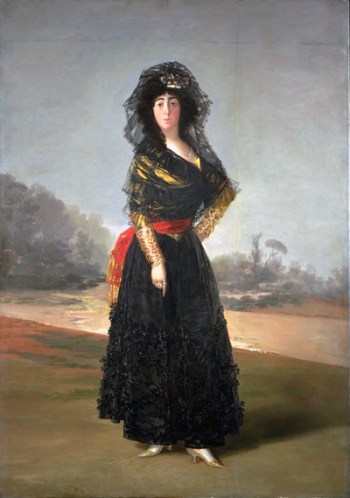
Francisco de Goya y Lucientes, The Duchess of Alba, 1796–97, oil on canvas, 210 × 149 cm (New York: The Hispanic Society of America).
With this exhibition—which occupies all of the temporary exhibition galleries in the new extension—the Museo del Prado offers its visitors the privilege of enjoying one museum within another, as it did in 2012 with the exhibition The Hermitage in the Prado. In this case, the renovation of the Hispanic Society’s galleries has allowed the treasures of their collections of Spanish and Latin American art, along with rare books and manuscripts, to travel to Spain. Many of the works of art that will be shown have not previously been exhibited or were unknown, including the reliquary busts of Santa Marta and Santa María Magdalena by Juan de Juni and the Fates of Man by Manuel Chili, known as Caspicara. Others have recently been identified, such as the Map of Tequaltiche, which was thought to be lost. Besides the individual value of each work of art, this exceptional grouping gives context to the magnitude of the rich history of Hispanic culture in the Iberian Peninsula, America, and Philippines. Spanning more than 3,000 years, the collection shows a quality of art works that no museum outside of Spain can compete with, demonstrating the passion of a unique collector who put his resources and knowledge towards creating a Spanish museum in America.
The extraordinary selection of paintings includes master works such as Portrait of a Little Girl, Camillo Astalli and Gaspar de Guzmán, Conde-Duque de Olivares by Velázquez, Pieta by El Greco, The Prodigal Son by Murillo, Santa Emerenciana by Zurbarán, and the emblematic Duchess of Alba by Goya, especially conserved for this occasion at the Museo del Prado with the collaboration of Fundación Iberdrola. Also represented are paintings by Post-Impressionists and modern artists, such as Zuloaga, Sorolla, and Santiago Rusiñol. The selection of sculpture includes, among others: the Efigie of Mencía Enríquez de Toledo from the Workshop of Gil de Siloé, the terracotta The Mystical Marriage of Saint Catherine by Luisa Roldán, and Fates of Man, a group of polychromed wood sculptures by Manuel Chili, known as Caspicara.
The exhibition also includes a selection of important archaeological artifacts, among them Celtiberian jewelry, Bell-Beaker vessels, and a Visigothic belt buckle. Completing the survey is a significant selection of decorative arts, with Renaissance and Baroque metalwork, ceramics from Manises, Talavera and Alcora, and an exquisite Pyxis made of ivory with gold plated hinges. Alongside these objects are textiles including a Fragment of the tunic of Prince Felipe de Castilla and a Nazrid silk textile.
An innovative mounting technique will allow the important holdings of the library of the Hispanic Society to be appreciated in all their splendor; works include A grant (Privilegio) issued by Alfonso VII, king of Castile and León, Biblia sacra iuxta versionem vulgata. Bible in Latin; unique letters such as Holograph instructions for his son Philip, the Letter to Phillip II of Spain from Elizabeth I, Queen of England, and the Holograph letter, signed “Diego de Silva Velazquez” to Damián Gotiens; and various maps including Portolan Atlas by Battista Agnese and the Mapamundi by Juan Vespucci.
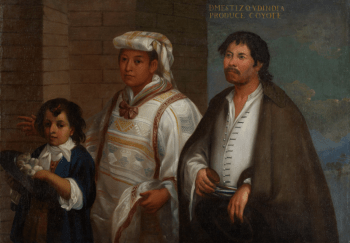
Juan Rodríguez Juárez, De Mestizo y de India produce Coyote, ca. 1716–20; Mexico, oil on canvas, 104 × 146 cm (New York: The Hispanic Society of America).
The first part of the exhibition (Galleries A and B) is organized chronologically and thematically by period in Spain and Latin America and comprises archaeological artifacts from sites on the Iberian Peninsula, Roman sculpture, magnificent ceramics, glass, furniture, textiles, silverworks, and Islamic and Medieval treasures as well as those from the Golden Age. Of particular relevance are Spanish paintings, in dialogue with the collections of the Prado, and colonial art closely related to the peninsula’s artistic legacy. Also included is a section dedicated to the library at the Hispanic Society, one of the most important in the world.
Gallery C offers a broad selection of the best Spanish painting from the 19th century through the early 20th century, including an exceptional collection of portraits of the leading Spanish scholars of that period, who worked closely with Huntington. After the First World War, Archer Huntington halted acquisitions, but maintained a close relationship with Spanish art and culture through his friendship with various painters, principally Joaquín Sorolla, who was commissioned to paint the famous series of large scale canvases depicting the regions of Spain for the Hispanic Society.
Accompanying the exhibition is a documentary projected in Gallery D, directed by Francesco Jodice, that transports the visitor to New York in the beginning of the twentieth century and narrates the history of the Hispanic Society and the passion of its founder, the philanthropist Archer Milton Huntington. The film contextualizes the origins of the early collecting practices of Huntington; the construction and inauguration of the headquarters of the Hispanic Society; Huntington’s collections and the fantastic holdings of the library; his relationship with Spain through Alfonso XII and the great Spanish intellectuals of the era; his friendship with Sorolla in New York; and the philanthropy of this great patron who wanted to remain anonymous during his entire life. The story is told by the director, Mitchell Codding, Chairman of the Board of Trustees, Philippe de Montebello, and the curators. The film, which runs for approximately 20 minutes, was filmed in New York and at the Prado Museum and is in English with Spanish subtitles.
Visions of the Hispanic World is the latest chapter in the decade-long collaboration between the Museo del Prado and the BBVA Foundation, involving the annual organization of a major exhibition event. This partnership has made possible such celebrated exhibitions as Passion for Renoir, The Hermitage in the Prado, El Greco and Modern Painting, and Bosch: The 5th Centenary Exhibition. Thanks to the Prado’s select network of relations with public and private lenders, these shows are the opportunity for an international public to view works that might otherwise never be seen under one roof. The exhibitions presented by the Prado and BBVA Foundation have met with an extraordinary response. In particular, those devoted to the Hermitage and Bosch successively broke the record of visits to the Madrid museum’s temporary exhibits, with over 580,000 spectators each.
Archer Milton Huntington, only son of one of the wealthiest families in The United States, from a young age possessed a profound interest in the Hispanic world. His education and numerous trips to Europe inspired an interest in collecting, always with the idea of creating a museum. In less than forty years, Huntington created a library and museum designed to elevate the study of Hispanic art through unparalleled collections in both scope and quality. At the same time, he published various facsimiles of important rare books and manuscripts. Huntington, in an effort to not deprive Spain of its artistic treasures, acquired most of his collection outside of the country. One can confirm, as did Jonathan Brown, that Huntington saw the Hispanic Society as an encyclopedic depository of Spanish art and literature. Huntington was one of the first Hispanists in the United States in the first half of the 20th century. For this reason he was awarded by numerous American universities. He was an active member of various Spanish museums and was invested as member of the Spanish Royal Academies. This exhibition pays homage to Huntington’s lifelong work for The Hispanic Society Museum & Library in the diffusion and study of Spanish culture in the United States of America.
Tesoros de la Hispanic Society of America (Madrid: Museo Nacional del Prado, 2017), 448 pages, ISBN: 978 84848 04079, 35€.
ASECS Awards, 2016–17
Recent awards from ASECS (with a full list available here) . . .
The Biennial Annibel Jenkins Biography Prize
Jane Kamensky (Professor of History and Pforzheimer Foundation Director of the Schlesinger Library, Harvard University), A Revolution in Color: The World of John Singleton Copley (New York: W. W. Norton and Company, 2016).
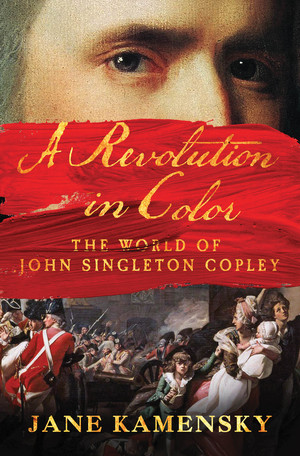 Committee’s evaluation: Kamensky’s “brilliantly written study of an ambitious painter in colonial Boston and then England is a joy to read from beginning to end. Kamensky is a deft storyteller with a keen eye for irony and paradox, and she draws upon a transatlantic archive that includes printed, manuscript, and visual sources. She cross fertilizes between history and art history in dazzling ways, and readers are sure to learn a great deal about the craft, politics, and finances of painting in colonial America and on the Continent as well. In making visible the complexities of cultural identity in a time of vexed allegiances, the author brings texture and depth to our understanding of Copley’s world before, during, and after the American Revolution.”
The Biennial Annibel Jenkins Biography Prize is given to the author of the best book-length biography of a late seventeenth-century or eighteenth-century subject. The prize is named in honor of Annibel Jenkins, Professor of English (Emerita) at the Georgia Institute of Technology. A founding member of the Southeastern American Society for Eighteenth-Century Studies, she was an outstanding teacher and scholar who has been for many years one of the most active and encouraging members of the academic community in America.
Robert R. Palmer Research Travel Fellowship
Margo Bernstein (Art History and Archaeology, Columbia University) “Carmontelle’s Profile Pictures and the Things that Made Them Modern.”
New Book | Jean-Baptiste Descamps
From Brepols:
Gaëtane Maës, De l’expertise artistique à la vulgarisation au siècle des Lumières: Jean-Baptiste Descamps (1715–1791) et la peinture flamande, hollandaise et allemande (Turnhout: Brepols Publishers, 2016), 608 pages, ISBN: 978 2503 567709, 125€.
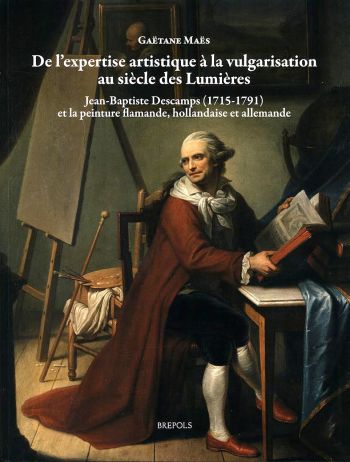 Peintre flamand peu connu aujourd’hui, Jean-Baptiste Descamps (1715–1791) demeure important par les livres qu’il a publiés de son vivant. Entre 1753 et 1763, paraissent ainsi les quatre volumes de son recueil intitulé La vie des peintres flamands, allemands et hollandois, suivis en 1769 de la publication d’un Voyage pittoresque de la Flandre et du Brabant. Ces textes ont longtemps été négligés car, contrairement aux modèles représentés par Giorgio Vasari et Karel van Mander, ils sont considérés comme de simples compilations. Consacrer une étude aux ouvrages de Descamps vise, par conséquent, à remettre en question ce postulat en soulignant les réels enjeux intellectuels que revêt l’écriture de ce polygraphe. Par ses livres, Descamps a, en effet, su se construire une visibilité et une légitimité d’expert de la peinture septentrionale, qui lui ont ouvert les portes de l’Académie royale de Peinture et de Sculpture à Paris en 1764.
Dans ce contexte, l’enquête monographique sert ici de simple fil conducteur à des questionnements variés sur la France des Lumières, et plus particulièrement sur le rapport entre Paris et la province, entre les grands et petits maîtres, entre la littérature érudite et les écrits de vulgarisation. L’étude s’attache aussi à définir la place des Arts dans l’espace public ouvert par le développement des expositions, du marché de l’art et du tourisme culturel. Elle met enfin l’accent sur l’attraction puissante qu’ont exercée les œuvres flamandes, hollandaises et allemandes sur les collectionneurs du XVIIIe siècle.
Cette synthèse sera prochainement suivie de la réédition critique du Voyage pittoresque de la Flandre et du Brabant, qui a été le premier guide publié en France avec l’intention explicite de proposer aux artistes et amateurs d’art une autre destination que l’Italie.
Gaetane Maes est Maître de conférences habilitée à diriger des recherches, et elle enseigne l’Histoire de l’Art des Temps modernes à l’université de Lille. Ses recherches s’attachent autant à l’art des anciens Pays-Bas (Flandre et Hollande) qu’à l’art français, afin de les envisager dans un esprit de décloisonnement. Avec Jan Blanc, elle a notamment publié Les échanges artistiques entre la France et les anciens Pays-Bas. 1482–1814 (Brepols, 2010). Elle est également l’auteur de nombreux articles sur l’historiographie des peintres et les fonctions sociales de l’art.
T A B L E D E S M A T I E R E S
Introduction
1ère partie. La vie et la carrière d’un peintre flamand en France
1 Entre vie mythique et vie réelle
2 Du peintre à l’entrepreneur : une stratégie de carrière réfléchie
3 La gloire ou l’argent ?
Conclusion de la 1ère partie
2e partie. L’entreprise éditoriale de La vie des peintres
4 Le peintre-écrivain au XVIIIe siècle: entre mythe et concurrence
5 Le livre comme objet social
6 Méthode de travail et documentation
Conclusion de la 2e partie
3e partie. Le sens de La vie des peintres : une théorie implicite ?
7 Un manuel pour connaisseurs
8 Le commerce contre l’histoire ou l’impossible union
9 La pensée esthétique de Descamps
10 Les goûts artistiques de Descamps
Conclusion de la 3e partie
4e partie. Le Voyage pittoresque de la Flandre et du Brabant
11 L’élaboration d’un best-seller
12 Le contenu du Voyage pittoresque
13 L’art et son public ou le Voyage pittoresque comme préfiguration de la notion de patrimoine
Conclusion de la 4e partie
Conclusion générale
Annexes
Bibliographie
Liste des illustrations
Crédits photographiques
Index des noms propres
Planches en couleurs
New Book | Plans of the Earl of Mar
From Four Courts Press:
Margaret Stewart, The Architectural, Landscape and Constitutional Plans of the Earl of Mar, 1700–32 (Dublin: Four Courts Press, 2016), 448 pages, ISBN: 978 18468 25750, £55.
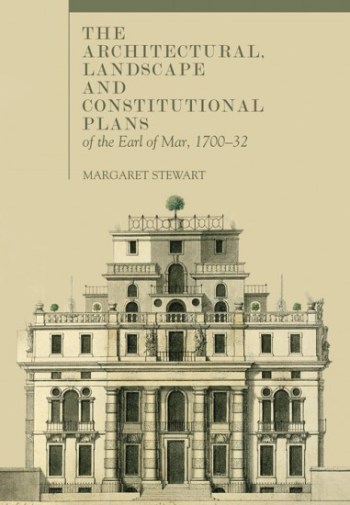 Politics, architecture, landscapes, city designs, and infrastructure planning were the substance of the creative thinking of John Erskine, Earl of Mar (1675–1732) before and after the Anglo-Scottish Union of 1707. Condemned as a traitor after he led and lost the Jacobite Rising of 1715, Mar devoted his time in exile to creating a new constitution for the UK in which England, Ireland, and Scotland would become equal partners in a federation with France for the enduring peace of Europe. Richly illustrated with Mar’s magnificent designs for cities, palaces, and houses, this is the first book about this controversial figure.
Margaret Stewart was born and educated in Edinburgh. She is an art historian and curator and is currently a lecturer in architectural history at University of Edinburgh.
New Book | Building the British Atlantic World
From The UNC Press:
Daniel Maudlin and Bernard Herman, eds., Building the British Atlantic World: Spaces, Places, and Material Culture, 1600–1850 (Chapel Hill: The University of North Carolina Press, 2016), 352 pages, ISBN: 978 14696 26826, $40.
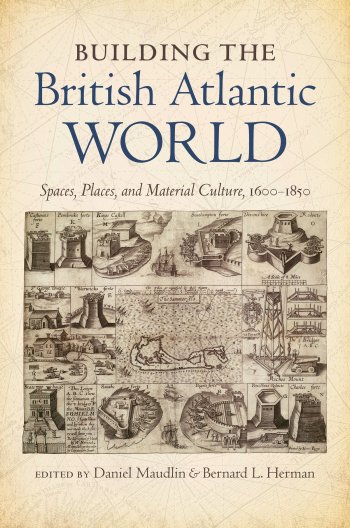 Spanning the North Atlantic rim from Canada to Scotland, and from the Caribbean to the coast of West Africa, the British Atlantic world is deeply interconnected across its regions. In this groundbreaking study, thirteen leading scholars explore the idea of transatlanticism—or a shared ‘Atlantic world’ experience—through the lens of architecture, built spaces, and landscapes in the British Atlantic from the seventeenth century through the mid-nineteenth century. Examining town planning, churches, forts, merchants’ stores, state houses, and farm houses, this collection shows how the powerful visual language of architecture and design allowed the people of this era to maintain common cultural experiences across different landscapes while still forming their individuality.
By studying the interplay between physical construction and social themes that include identity, gender, taste, domesticity, politics, and race, the authors interpret material culture in a way that particularly emphasizes the people who built, occupied, and used the spaces and reflects the complex cultural exchanges between Britain and the New World.
Daniel Maudlin is Professor of Early Modern History at the University of Plymouth. Bernard L. Herman is George B. Tindall Distinguished Professor of Southern Studies and Folklore at the University of North Carolina at Chapel Hill.
C O N T E N T S
Daniel Maudlin and Bernard Herman, Introduction
Part I: Empire and Government
1 Emily Mann, To Build and Fortify: Defensive Architecture in the Early Atlantic Colonies
2 Carl Lounsbury, Seats of Government: The Public Buildings of British America
3 Anna O. Marley, Landscapes of the New Republic at Thomas Jefferson’s Monticello
Part II: Religion and the Churches
4 Peter Guillery, English Artisans’ Churches and North America: Traditions of Vernacular Classicism in the Eighteenth Century
5 Peter Benes, The New England Meetinghouse: An Atlantic Perspective
6 Alison Stanley, The Praying Indian Towns: Encounter and Conversion through Imposed Urban Space
Part III: Commerce, Traffic, and Trade
7 Christopher DeCorse, Tools of Empire: Trade, Slaves, and the British Forts of West Africa
8 Louis P. Nelson, The Falmouth House and Store: The Social Landscapes of Caribbean Commerce in the Eighteenth Century
9 Kenneth Morgan, Building British Atlantic Port Cities: Bristol and Liverpool in the Eighteenth Century
Part IV: Houses and the Home
10 Stephen Hague, Building Status in the British Atlantic World: The Gentleman’s House in the English West Country and Pennsylvania
11 Bernard Herman, Parlor and Kitchen in the Borderlands of the Urban British American Atlantic World, 1670–1720
12 Lee Morrissey, Palladianism and the Villa Ideal in South Carolina: The Transatlantic Perils of Classical Purity
13 Daniel Maudlin, Politics and Place-Making on the Edge of Empire: Loyalists, Highlanders, and the Early Farmhouses of British Canada
Selected Bibliography
Contributors
Index
Exhibition | The Philosophy Chamber
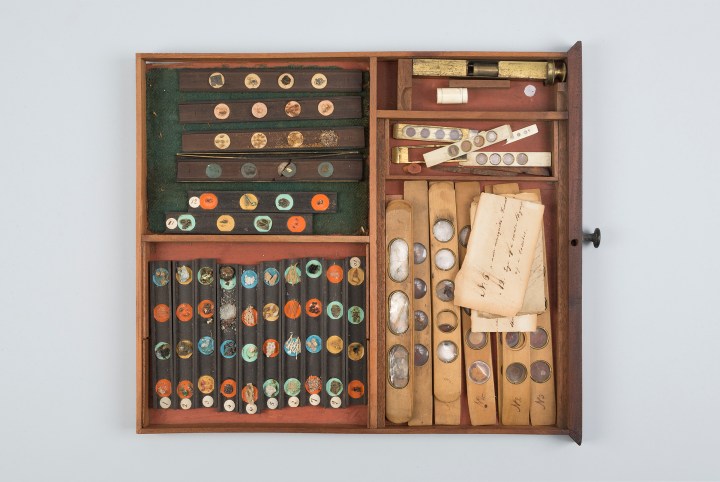
William and Samuel Jones, Jones’s Most Improved and Solar Compound Microscope, ca. 1798; drawer removed from box, displaying slides, mounted specimens, and accessories; brass, glass, and mahogany, with slides of paper and organic materials (Collection of Historical Scientific Instruments, Harvard University, 1184).
◊ ◊ ◊ ◊ ◊
Press release from Harvard Art Museums:
The Philosophy Chamber: Art and Science in Harvard’s Teaching Cabinet, 1766–1820
Harvard Art Museums, Cambridge, 19 May — 31 January 2017
The Hunterian, University of Glasgow, 23 March — 24 June 2018
Curated by Ethan Lasser
This spring, the Harvard Art Museums will present The Philosophy Chamber: Art and Science in Harvard’s Teaching Cabinet, 1766–1820, a special exhibition that brings together many long-forgotten icons of American culture. It will present new findings on this unique space—equal parts laboratory, picture gallery, and lecture hall—that stood at the center of artistic and intellectual life at Harvard and in New England for more than 50 years.
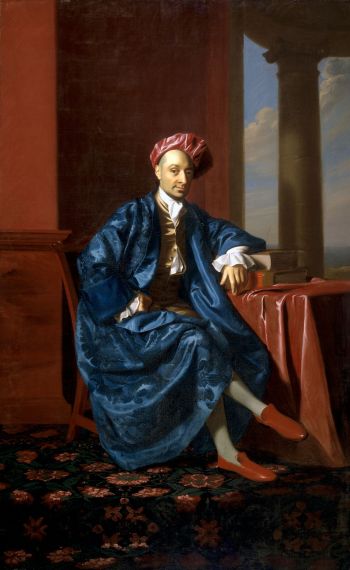
John Singleton Copley, Nicholas Boylston, 1773,oil on canvas (Harvard University Portrait Collection, H20, Harvard Art Museums).
Celebrated at the time as one of the grandest spaces in America, the original Philosophy Chamber and its adjacent rooms housed an extraordinary collection of paintings, portraits, and prints; mineral, plant, and animal specimens; scientific instruments; indigenous American artifacts; and relics from the ancient world—all of which was used regularly for lectures, discussions, and demonstrations. Highlights include: full-length portraits by John Singleton Copley, Native Hawaiian feather work, carving by indigenous artists of the Northwest Coast, Stephen Sewall’s 1768 mural-sized copy of the Native American inscription on the famous Dighton Rock in southeastern Massachusetts, and the elaborately ornamented grand orrery (a model of the solar system) created by Joseph Pope between 1776 and 1787. Many of the objects in the exhibition have not been shown publicly since the collection was dispersed almost 200 years ago.
The reassembled Philosophy Chamber invites visitors to examine the role that images and objects play in building, organizing, and transmitting knowledge; and as a historical study, it deepens our understanding not only of Harvard’s past, but also the history of early American art and culture.
The exhibition presents more than 70 objects from the earliest days of Harvard’s collecting, shown together with a small group of objects with 18th-century American provenances that closely match the description of original pieces in the collection that have been lost or destroyed, or that survive but are too fragile for display. In addition, the show includes period representations of other teaching cabinets to contextualize the material on display. The exhibition’s accompanying catalogue expands on the research into the chamber’s collection, history, and uses, presenting information on the approximately 200 objects that have been tracked thus far—just one-fifth of the original collection once housed in Harvard Hall.
The exhibition and catalogue provide a 360-degree view of early American history through the examination of the artwork displayed in the Philosophy Chamber, the instruments and specimens handled by the students and faculty who met there, and the cultural artifacts dispatched to the college by foreign envoys and the nation’s first merchant explorers. The project considers what the convergence of these objects in a New World college can tell us about the transfer of knowledge, burgeoning trade, the role of collections, and New England’s emerging self-identity in the mid-18th to early 19th century.
“Rooted in deep research and fresh curatorial insight, this exhibition invites audiences—both American and international—to explore a cultural landmark of the 18th-century Atlantic World,” said Martha Tedeschi, the Elizabeth and John Moors Cabot Director of the Harvard Art Museums. “Our efforts to unearth this largely forgotten landmark of early American art and culture led us to map collections, library archives, herbaria, and other museums across campus, in addition to public and private institutions throughout the Northeast and abroad. Thanks to this exceptional cross-institutional collaboration, we can present an immersive interdisciplinary experience that brings an important period of history to life for all visitors.”
“Weaving together art and science, this exhibition considers one of the most vibrant spaces in early America and presents a veritable cross-section of the period’s art and material culture,” said Ethan W. Lasser, curator of the exhibition, and the Theodore E. Stebbins Jr. Curator of American Art and head of the Division of European and American Art at the Harvard Art Museums. “The Philosophy Chamber opens a window into a forgotten piece of American history; the story of this room intersects with some of the most admirable—and the most challenging—aspects of Harvard’s past.”
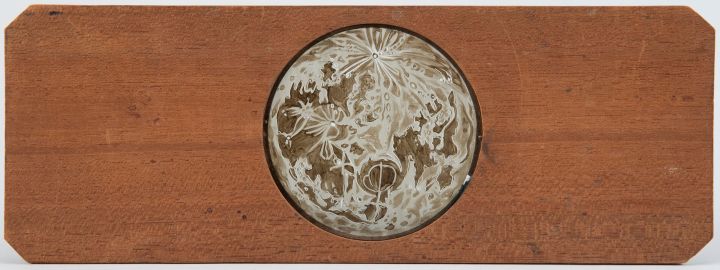
Unknown maker, possibly William and Samuel Jones, Lantern Slide of Painted Moon, late 18th century; painted glass and wood (Collection of Historical Scientific Instruments, Harvard University, 1998-1-1272).
◊ ◊ ◊ ◊ ◊
History of the Philosophy Chamber
Between 1766 and 1820, Harvard College assembled an extraordinary collection of specially commissioned scientific instruments and benefactor portraits, as well as donations from supporters around the globe. These objects were displayed in a set of three rooms adjacent to the college library in Harvard Hall, a large brick building that still stands at the center of campus today. The largest of these spaces, the Philosophy Chamber, was an ornately decorated room named for the discipline of natural philosophy, a field of study that wove together the sciences that sought to explain the natural world.
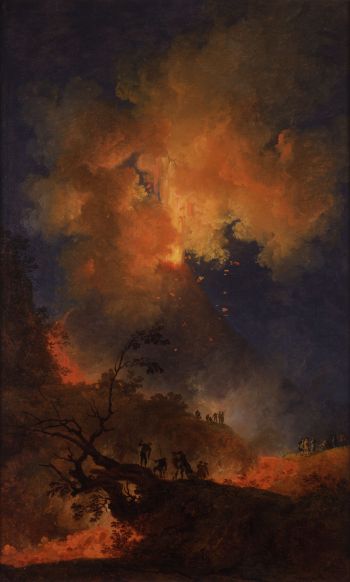
Pierre-Jacques Volaire, Vesuvius Erupting at Night, 1767, oil on canvas (Compton Verney Art Gallery and Park, Warwickshire).
The collection and the chamber, which came into existence when Harvard Hall was rebuilt after the Great Fire of 1764, played a vital role in teaching and research at Harvard, while also serving as the center of artistic and intellectual life in the greater New England region for over 50 years. Artists, scientists, students, and advocates of American Independence—including George Washington—came to the Philosophy Chamber to discover, discuss, and disseminate new knowledge. Students attended lectures and demonstrations there, and visitors from around the globe flocked to the space to see works by some of the Atlantic World’s greatest artists and artisans, including John Singleton Copley and John Trumbull.
The only repository of its kind in New England when it was established, the Philosophy Chamber was deeply connected to the network and ideology of other teaching cabinets established in Europe, the United States, and South America, such as the Ashmolean Museum at Oxford University, the Académie des Sciences in Paris, the American Philosophical Society in Philadelphia, and the University of Córdoba in Argentina. These teaching cabinets were offspring of the 17th-century Wunderkammer, or privately held cabinets of curiosities, and ultimately foreshadowed the beginnings of the modern museum.
While the chamber’s collection survived the Revolutionary War thanks to a temporary relocation (along with all of Harvard College) to Concord, Massachusetts, in 1775, an expansion of the college library in 1820 ultimately led to the dispersal of the collection to various university departments and local museums.
Research
The exhibition has its origins in curator Ethan Lasser’s early days at the Harvard Art Museums. While researching the Fogg Museum’s holdings of early American art, Lasser repeatedly came across references to the Philosophy Chamber. Intrigued, he initiated a campaign to locate the artifacts with a team of researchers at the museums. Lasser then expanded on the research by co-teaching a graduate seminar with Harvard professor Jennifer Roberts in Fall 2014. They enlisted their students to research the history of the chamber, the objects that were accessioned, and the people who visited. To date, the growing team of researchers—including curators, professors, conservators, scientists, and students from across the university—has tracked approximately 200 objects, or roughly one-fifth of the collection once housed in Harvard Hall. The whereabouts of the remaining four-fifths of the collection are unknown. Over the past 200 years, many objects have no doubt been lost, stolen, or destroyed, while some may be stored undetected in various campus and regional collections.
The Installation / Works on View
The Philosophy Chamber features more than 100 works displayed within four thematic sections.
The first section addresses how the collection was used in teaching and research, and includes tools and specimens that were regularly deployed for teaching in the 18th century. Included is the large-scale orrery, a dazzling astronomical model created by Joseph Pope. Labored over by Pope for 12 years, it was only the third orrery made in America, and was among the most celebrated objects to enter the chamber. Also included: one of two portable electrical machines for conducting demonstrations related to electricity (Benjamin Franklin advised on its purchase) and a group of six recently discovered drawings of skulls by Harvard professor and naturalist William Dandridge Peck, dated to around 1810. A projector installed in this gallery will show large-scale digitized images of solar microscope specimens and magic lantern slides.
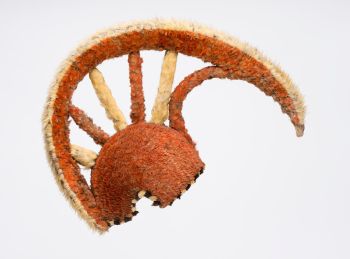
Unknown artist, Native Hawaiian, Mahiole (Crested Feathered Helmet), 18th century; ‘I’iwi (Vestiaria coccinea) and ‘ō’ō (Moho nobilis) feathers; and olonā (Touchardia latifolia) and ‘ie’ie (Freycinetia arborea) fibers (Peabody Museum of Archaeology and Ethnology, Harvard University, Gift of the Heirs of David Kimball, 99-12-70/53559).
A second gallery explores how the non-commissioned objects in the chamber’s collection arrived at Harvard and reflects on the collecting practices of wealthy alumni, entrepreneurial merchants, and scholars who sent objects from abroad. At the time, there was no curator of the collection, and very few objects were specifically solicited, resulting in a rather haphazard and idiosyncratic collection. This gallery features gifts sent to Harvard by five different donors or donor groups. In the late 18th century, as American ships began circumnavigating the globe, new courses were charted, and trade routes were established. An early 19th-century French map in this gallery shows the routes around North and South America that Captain James Cook and other explorers used. Shipmates on these missions brought back the exceptional examples of Native Hawaiian feather work on a colorful cape and a crested helmet seen in this space, as well as examples of carving by indigenous artists of the Northwest Coast. A touchscreen monitor in this gallery presents an animated map with points of origin of some of the objects in the collection, as well as demonstrations of two objects from Harvard’s Collection of Historical Scientific Instruments.
A third section addresses the entangled histories of the objects gathered in the chamber and the origin story of the United States after the Revolutionary War. Works here show how artists and scholars were actively writing American history. Included are engravings after paintings by John Trumbull, who gave a portrait of Cardinal Guido Bentivoglio to the college, which also hangs in this space. The gallery includes another celebrated object in the chamber’s history: Stephen Sewall’s mural-sized copy of the Native Americans’ inscriptions on the landmark known as Dighton Rock, an 11-foot boulder formerly located in the Taunton River, and now housed in a museum. Sewall was a professor at Harvard and his 1768 drawing is the only life-size representation of the monument known to exist. The rock was puzzled over by scholars from Harvard and around the world, and a variety of theories about the origin of the inscriptions were posited. Today, scholars attribute the inscriptions on the rock to the Algonquian-speaking peoples of the Eastern Woodlands, and more specifically to the Wampanoag who lived in the rock’s vicinity. By contrast, in the period when Sewall made his drawing, European interpreters actively disavowed the possibility of Native American authorship.
The final room is a loose reconstruction of the Philosophy Chamber itself, an experiential space complete with a re-created version of the red wallpaper that John Hancock had donated to the original room. Three early full-length portraits of Harvard benefactors by John Singleton Copley are included, as is a series of six mezzotints after Copley paintings that were given to Harvard by the artist’s heirs. Harvard was Copley’s first major patron, and plans to turn the Philosophy Chamber into a space dedicated to the artist’s life were never realized; the gift of mezzotints has never been shown until now. A bust of William Pitt the Elder, Earl of Chatham, given by Benjamin Franklin in 1769, was the first gift of sculpture the college received after the Great Fire consumed Harvard Hall in 1764. This gallery will be complemented by a digital tool, accessible on the museums’ website, that allows visitors to access recordings of present-day Harvard students reading from period sources, offering a sense of the kinds of conversations and debates that took place in the original chamber. The tool will also include deeper information about the objects displayed in the gallery.
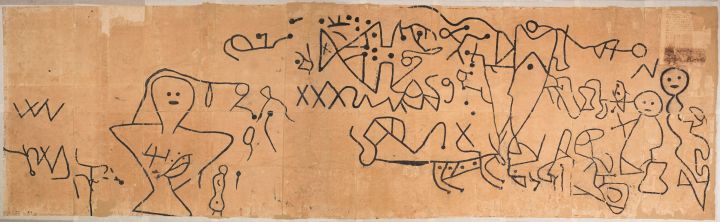
Stephen Sewall, Copy of Inscription on Dighton Rock, 1768, black ink on paper (Peabody Museum of Archaeology and Ethnology, Harvard University, 967-28-10/45474, digital file 99270006).
◊ ◊ ◊ ◊ ◊
Conservation
The research and rediscovery of objects once belonging to the Philosophy Chamber collection has led to exciting research by conservators and conservation scientists in the museums’ Straus Center for Conservation and Technical Studies. Several members of the Straus Center staff contributed essays to the exhibition catalogue on the following topics:
• Conservators were able to examine two of the full-length portraits by John Singleton Copley. Use of X-radiography and infrared digital photography helped them determine earlier iterations of a portrait of Thomas Hancock, painted between 1764 and 1766, showing Copley had reworked the painting twice to arrive at the formal, dignified pose seen in the final portrait. By contrast, a painting of college benefactor Thomas Hollis III was shown to have very few changes.
• Joseph Wilton’s bust of William Pitt the Elder, Earl of Chatham—given to Harvard by Benjamin Franklin—underwent scientific, technical, and art historical research, allowing staff to assess how the ceramic sculpture was made and to document its alteration over the centuries at Harvard. Guided by this research, the conservation treatment included removal of later overpaint layers and cleaning to uncover the original white painted surface.
• A close examination of Stephen Sewall’s drawing of the inscription on Dighton Rock sheds light on his chosen materials and processes. Conservators believe Sewall directly traced the markings rather than using a rubbing or chalking method.
Publication
Ethan Lasser, ed., The Philosophy Chamber: Art and Science in Harvard’s Teaching Cabinet, 1766–1820 (Cambridge: Harvard University Press, 2017), 312 pages, ISBN 978 0300 225921, $55.
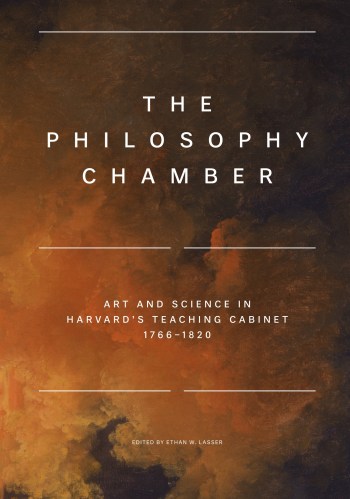 A catalogue, edited by Ethan Lasser, with essays by a mix of curators, professors, conservators, conservation scientists, and doctoral candidates, will be published in conjunction with the exhibition. The publication will advance new understandings of early American art history, and will serve as a rich resource for any reader interested in the art and culture of the Atlantic World. The catalogue is published by the Harvard Art Museums and distributed by Yale University Press. Contributors include Aleksandr Bierig, Anne Driesse, Katherine Eremin, Andrew Gelfand, Claire Grech, Teri Hensick, Jane Kamensky, Ethan W. Lasser, Georgina Rayner, Jennifer L. Roberts, Whitney Barlow Robles, María Dolores Sánchez-Jáuregui, Anthony Sigel, Kate Smith, Lucie Steinberg, and Oliver Wunsch.
Online Resources
Once the exhibition opens, supplementary digital content will be accessible via the exhibition page on the museums’ website. The digital tool complementing the room within the exhibition that loosely reconstructs the Philosophy Chamber will include “Voices of the Philosophy Chamber,” a group of audio recordings by present-day Harvard students reading from period sources. The recordings will give a sense of the conversation and debate that once filled the Philosophy Chamber. The tool will also provide additional information about the works on view.
The website will also include a series of audio recordings of gallery talks planned for the run of the exhibition. The robust series of talks by the students, staff, faculty, and scholars involved with the Philosophy Chamber research will explore the range of objects and themes in the exhibition as well as the history of the chamber. New recordings will be added on a regular basis.
Programming
A wide range of events, including lectures, a symposium, gallery talks, Materials Lab Workshops on Wampum jewelry making, and special member events, will be offered throughout the duration of the exhibition. Harvard professor Jane Kamensky will give a free public lecture, The Hungry Eye: Art and Ambition in Copley’s Boston, on Tuesday, May 23, at 3pm. Kamensky is the author of the recent biography A Revolution in Color: The World of John Singleton Copley, and also contributed to the Philosophy Chamber catalogue. During the fall semester, programming includes major lectures by artist Simon Starling and James Delbourgo (Rutgers University); The Room Where It Happens: On the Agency of Interior Spaces, a two-day public symposium featuring a keynote lecture by Louis Nelson (University of Virginia) and a full day of panel discussions; and a special late-night event for Harvard students. Detailed information about programs is forthcoming here.
Credits
The Philosophy Chamber: Art and Science in Harvard’s Teaching Cabinet, 1766–1820 is organized by the Harvard Art Museums. Curated by Ethan W. Lasser, the Theodore E. Stebbins Jr. Curator of American Art and Head of the Division of European and American Art at the Harvard Art Museums. The exhibition is supported in part by major grants from the Terra Foundation for American Art and the Henry Luce Foundation. The exhibition and catalogue also received support from the following endowed funds: the Bolton Fund for American Art, Gift of the Payne Fund; the Henry Luce Foundation Fund for the American Art Department; the William Amory Fund; and the Andrew W. Mellon Publication Funds, including the Henry P. McIlhenny Fund.
Lenders at Harvard University include: the Collection of Historical Scientific Instruments; the Harvard Map Collection, Pusey Library; the Harvard University Archives; Houghton Library; the Mineralogical and Geological Museum; the Museum of Comparative Zoology; the Peabody Museum of Archaeology & Ethnology; and the Warren Anatomical Museum, Countway Library of Medicine.
Other lenders from private, academic, and public collections in the United States and the United Kingdom include: the American Academy of Arts and Sciences, Cambridge, MA; the Richard Balzer Collection, Brookline, MA; Compton Verney Art Gallery and Park, Warwickshire, U.K.; The Library Company of Philadelphia; the Massachusetts Historical Society, Boston; Metropolitan Museum of Art, New York; Museum of Fine Arts, Boston; Peabody Essex Museum, Salem, MA; and a private collection in Boston.
New Book | The Power of Objects in Eighteenth-Century British America
From UNC Press:
Jennifer Van Horn, The Power of Objects in Eighteenth-Century British America (Chapel Hill: The University of North Carolina Press, 2017), 456 pages, ISBN: 978 14696 29568, $55.
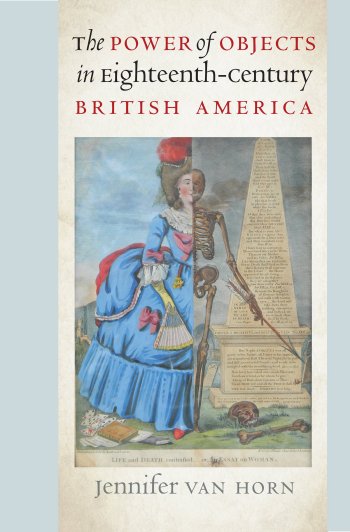 Published for the Omohundro Institute of Early American History and Culture, Williamsburg, Virginia.
Over the course of the eighteenth century, Anglo-Americans purchased an unprecedented number and array of goods. The Power of Objects in Eighteenth-Century British America investigates these diverse artifacts—from portraits and city views to gravestones, dressing furniture, and prosthetic devices—to explore how elite American consumers assembled objects to form a new civil society on the margins of the British Empire. In this interdisciplinary transatlantic study, artifacts emerge as key players in the formation of Anglo-American communities and eventually of American citizenship. Deftly interweaving analysis of images with furniture, architecture, clothing, and literary works, Van Horn reconstructs the networks of goods that bound together consumers in Boston, New York, Philadelphia, and Charleston.
Moving beyond emulation and the desire for social status as the primary motivators for consumption, Van Horn shows that Anglo-Americans’ material choices were intimately bound up with their efforts to distance themselves from Native Americans and African Americans. She also traces women’s contested place in forging provincial culture. As encountered through a woman’s application of makeup at her dressing table or an amputee’s donning of a wooden leg after the Revolutionary War, material artifacts were far from passive markers of rank or political identification. They made Anglo-American society.
Jennifer Van Horn is assistant professor of art history and history at the University of Delaware.
C O N T E N T S
Acknowledgments
List of Illustrations
Introduction
1 Imprinting the Civil
2 The Power of Paint
3 Portraits in Stone
4 Masquerading as Colonists
5 The Art of Concealment
6 Crafting Citizens
Epilogue
Index
New Book | Textile Terms: A Glossary
From Gebr. Mann Verlag (and soon to be available from Amazon) . . .
Anike Reineke, Anne Röhl, Mateusz Kapustka, and Tristan Weddigen, eds., Textile Terms: A Glossary (Berlin: Edition Imorde 2017), 359 pages, ISBN: 978 39428 10364, 360 pages, 40€ / $60.
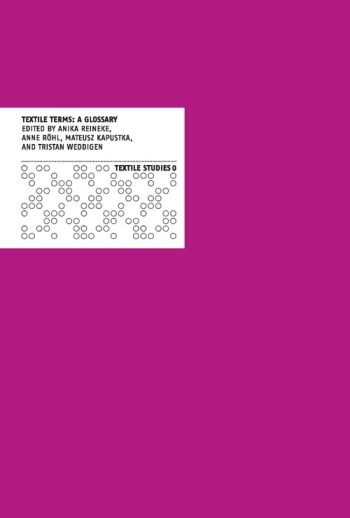 The glossary is addressed to scholars and students of art and architectural history and related fields as well as to artists and curators. It offers a new point of reference and departure for future research on the textile medium as such. It presents sixty-five critical terms that define the textile medium as a specific form, material, technique, and metaphor from antiquity to the present through contributions by international specialists in the field. Each entry discusses one illustrated object which epitomizes the main concepts related to one of the volume’s keywords:
Absorption, Abstraction, Affect, Canopy, Canvas, Carpet, Case, Clothing, Cotton, Craft, Curtain, Cushion, Cut, Digitality, Display, Drapery, Dye, Embroidery, Felt, Flag, Flatness, Fold, Formlessness, Gender, Globalism, Glove, Grid, Hair, Hem, Knitting, Knot, Labor, Lace, Marginalization, Mobility, Network, Ornament, Patchwork, Pattern, Rags, Recto/Verso, Revival, Sacredness, Sampler, Screen, Sewing, Silk, Skin, Space, Spider, Stockings, Tactility, Tapestry, Tear, Technology, Tent, Texture, Textus, Thread, Upholstery, Veil, Wallpaper, Weaving, Wrapping, Wool.
Anika Reineke, Anne Röhl, Mateusz Kapustka, and Tristan Weddigen are part of the SNF Research Project Textile: An Iconology of the Textile in Art and Architecture, University of Zurich.
Exhibition | America Collects Eighteenth-Century French Painting
From the NGA:
America Collects Eighteenth-Century French Painting
National Gallery of Art, Washington, D.C., 21 May — 20 August 2017

When Joseph Bonaparte, elder brother of Napoleon, arrived in the United States in 1815, he brought with him his exquisite collection of eighteenth-century French paintings. Put on public view, the works caused a sensation, and a new American taste for French art was born. Over the decades, appreciation of French eighteenth-century art has fluctuated between preference for the alluring decorative canvases of rococo artists such as François Boucher and Jean Honoré Fragonard to admiration for the sober neoclassicism championed by Jacques Louis David and his pupils. This exhibition brings together sixty-eight paintings that represent some of the best and most unusual examples of French art of that era held by American museums and tells their stories on a national stage: Who were the collectors, curators, museum directors and dealers responsible for bringing eighteenth-century French painting to America? Where are the paintings now?
The exhibition highlights smaller museum collections, less well-known paintings, and diverse locations across the United States, from Pittsburgh and Indianapolis to Birmingham and Phoenix. It considers eighteenth-century America’s very real fascination with France—a staunch ally in the American Revolution, an intellectual model for Benjamin Franklin, Thomas Jefferson, and other Americans abroad—and how the cultural ideal of eighteenth-century France has continued to endure in the American imagination to this day.
Image: Joseph Ducreux, Le Discret, ca. 1791, oil on aluminum, transferred from canvas (Lawrence: Spencer Museum of Art, University of Kansas).
◊ ◊ ◊ ◊ ◊
Note (added 28 May 2017) — A checklist for the exhibition is available here. Online, there’s also a useful chronology (condensed from the catalogue), establishing larger contexts and tracing the history of selected works in the exhibition.
Note (added 30 May 2017) — The catalogue is published by Lund Humphries:
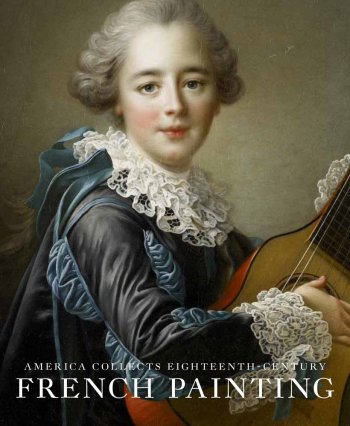
Yuriko Jackall, Philippe Bordes, Jack Hinton, Melissa Hyde, Joseph Rishel, and Pierre Rosenberg, with Joseph Baillio, Susan Earle, Christophe Leribault, Robert Schindler, and D. Dodge Thompson, America Collects Eighteenth-Century French Painting (London: Lund Humphries, 2017), 304 pages, ISBN: 978 18482 22342, £50 / $70.
 C O N T E N T S
Director’s Foreword
Acknowledgments
Lenders to the Exhibition
Essays
• Pierre Rosenberg, Only in America
• Yuriko Jackall, American Visions of Eighteenth-Century France
• Joseph Bailliom, Wildenstein in America
• Jack Hinton, Fiske Kimball and French Period Rooms in America
• Christophe Leribault, The Tuck Donation to the Petit Palais: A Mirror of American Taste
• Melissa Hyde, Femmes-Artistes and America from the Early Republic to the Gilded Age
• Robert Schindler, Eugenia Woodward Hitt Collects
• Philippe Bordes, Buying against the Grain: American Collections and French Neoclassical Paintings
• Susan Earle, Joseph Ducreux, John Maxon, and the Spencer Museum of Art
• D. Dodge Thompson, When the Eighteenth Century Was New: Joseph Bonaparte in America
• Joseph Rishel, Notes on the American Reception of Eighteenth-Century French Painting
Plates
Yuriko Jackall
• Collector’s Century: From the King’s Mistress to the Shores of San Francisco
• Sensual Century: Pursuit of Love
• Opulent Century: Douceur de Vivre
• Playful Century: Games and Pastimes
• Fanciful Century: Masquerade and the Pleasures of the Imagination
• Inspired Century: Artists and Artistic Practice
• Virtuous Century: Institutional Taste
• Enlightened Century: Science, Nature, and the Passage of Time
Checklist of the Exhibition
Chronology
Bibliography
Index










 Enfilade
leave a comment