Exhibition | Indigenous Australia: Enduring Civilisation
Press release (January 2015) for The British Museum exhibition:
Indigenous Australia: Enduring Civilisation
The British Museum, London, 23 April – 2 August 2015
National Museum of Australia, Canberra, Fall 2015

Kunmanara Hogan, Tjaruwa Woods, Yarangka Thomas, Estelle Hogan, Ngalpingka Simms and Myrtle Pennington, Kungkarangkalpa, acrylic on canvas, 2013. © The artists, courtesy Spinifex Arts Project.
In April 2015 the British Museum will open a major exhibition presenting a history of Indigenous Australia, the first exhibition in the UK devoted to the history and culture of Indigenous Australians: both Aboriginal peoples and Torres Strait Islanders. Drawing on objects from the British Museum’s collection, accompanied by important loans from British and Australian collections, the show will present Indigenous Australia as a living culture, with a continuous history dating back over 60,000 years. The objects in the exhibition will range from a shield believed to have been collected at Botany Bay in 1770 by Captain Cook or one of his men, a protest placard from the Aboriginal Tent Embassy established in 1972, contemporary paintings, and specially commissioned artworks from leading Indigenous artists. Many of the objects have never been on public display before.
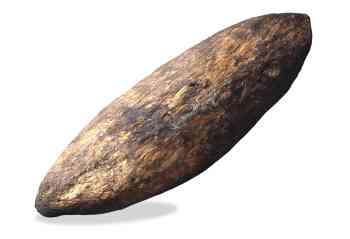
Shield collected at Botany Bay during Captain Cook’s visit, 1770 (London: The British Museum).
The objects displayed in this exhibition are immensely important. The British Museum’s collection contains some of the earliest objects collected from Aboriginal people and Torres Strait Islanders through early naval voyages, colonists, and missionaries dating as far back as 1770. Many were collected at a time before museums were established in Australia and they represent tangible evidence of some of the earliest moments of contact between Aboriginal people, Torres Strait Islanders and the British. Many of these encounters occurred in or near places that are now major cities such as Sydney, Melbourne, Adelaide, and Perth. As a result of collecting made in the early 1800s, many objects originate from coastal locations
rather than the arid inland areas often associated with
Indigenous Australia in the popular imagination.
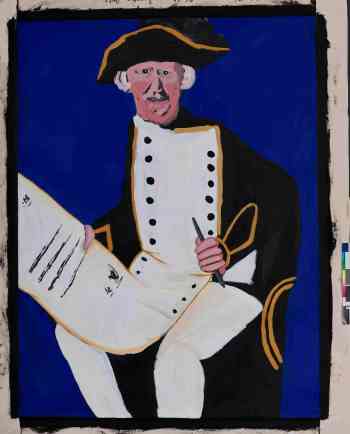
Vincent Namatjira, James Cook—with the Declaration, 2014. © Vincent Namatjira
The exhibition will present not only Indigenous ways of understanding the land and sea but also the significant challenges faced by Indigenous Australians from the colonial period until to the present day. In 1770 Captain Cook landed on the east coast of Australia, a continent larger than Europe. In this land there were hundreds of different Aboriginal groups, each inhabiting a particular area, and each having its own languages, laws and traditions. This land became a part of the British Empire and remained so until the various colonies joined together in 1901 to become the nation of Australia we know today. In this respect, the social history of 19th-century Australia and the place of Indigenous people within this is very much a British story. This history continues into the twenty first century. With changing policies towards Indigenous Australians and their struggle for recognition of civil rights, this exhibition shows why issues about Indigenous Australians are still often so highly debated in Australia today.
The exhibition brings together loans of special works from institutions in the United Kingdom, including the British Library, the Pitt Rivers Museum and the Cambridge Museum of Archaeology and Anthropology. A number of works from the collection of the National Museum of Australia will be shown, including the masterpiece ‘Yumari’ by Uta Uta Tjangala. Tjangala was one of the artists who initiated the translation of traditions of sand sculptures and body painting onto canvas in 1971 at Papunya, a government settlement 240km northwest of Alice Springs in the Northern Territory. Tjangala was also an inspirational leader who developed a plan for the Pintupi community to return to their homelands after decades of living at Papunya. A design from ‘Yumari’ forms a watermark on current Australian passports.
This exhibition has been developed in consultation with many Aboriginal and Torres Strait Islander individuals, Indigenous art and cultural centres across Australia, and has been organised with the National Museum of Australia. The broader project is a collaboration with the National Museum of Australia. It draws on a joint research project, funded by the Australian Research Council, undertaken by the British Museum, the National Museum of Australia and the Australian National University. Titled Engaging Objects: Indigenous communities, museum collections and the representation of Indigenous histories, the research project began in 2011 and involved staff from the National Museum of Australia and the British Museum visiting communities to discuss objects from the British Museum’s collections. The research undertaken revealed information about the circumstances of collecting and significance of the objects, many of which previously lacked good documentation. The project also brought contemporary Indigenous artists to London to view and respond to the Australian collections at the British Museum.
Neil MacGregor, Director of the British Museum said, “The history of Australia and its people is an incredible, continuous story that spans over 60,000 years. This story is also an important part of more recent British history and so it is of great significance that audiences in London will see these unique and powerful objects exploring this narrative. Temporary exhibitions of this nature are only possible thanks to external support so I am hugely grateful to BP for their longstanding and on-going commitment to the British Museum. I would also like to express my gratitude to our logistics partner IAG Cargo and the Australian High Commission who are supporting the exhibition’s public programme.”
Peter J. Mather, Group Regional Vice President, Europe and Head of Country, UK, BP: “BP is extremely pleased to support The BP Exhibition Indigenous Australia: Enduring Civilisation, part of our five year commitment to the museum’s special exhibitions programme. BP has had a presence in Australia for almost 100 years and our support for this exhibition is part of BP’s wider contribution to the societies where we operate, enabling audiences to connect with a variety of different cultures. We are delighted to continue our long-standing relationship with the British Museum by supporting this exhibition which we hope will inspire interest in Australia’s indigenous people and culture for many thousands of visitors.”
Dr Mathew Trinca, National Museum of Australia Director, welcomed the British Museum exhibition: “We are delighted to support this major exhibition in London with the loan of some key objects from our collection. We look forward to continuing our work together to realise our ambition for an exhibition of these artefacts in Canberra in late 2015.”
Patron: HRH The Prince of Wales
Supported by BP
Organised with the National Museum of Australia
Logistics partner IAG Cargo
Public programme supported by the Australian High Commission
Gaye Sculthorpe, John Carty, Howard Morphy, Maria Nugent, Ian Coates, Lissant Bolton, and Jonathan Jones, Indigenous Australia: Enduring Civilisation (London: The British Museum Press, 2015), 272 pages, ISBN: 978-0714126944, £30.
This ground-breaking publication explores the unique and ongoing relationship that Aboriginal people and Torres Strait Islanders have to place and country. It also explores the profound impact and legacy of colonialism, the nature of collecting and the changing meaning of objects now in the collection of The British Museum.
Exhibition | Spirits of the Passage: The Transatlantic Slave Trade
From the press release for the exhibition:
Spirits of the Passage: The Story of the Transatlantic Slave Trade
The Frazier History Museum, Louisville, Kentucky, February 2 through June 16, 2013
The DuSable Museum of African American History, Chicago, 19 September 2014 — 4 January 2015
Reading Public Museum, Reading, Pennsylvania, 24 January — 3 May 2015

Slave Shackles from The Henrietta Marie, ca. 1700 (Key West: The Mel Fisher Maritime Museum)
The Reading Public Museum invites guests to the new exhibition, Spirits of the Passage: The Story of the Transatlantic Slave Trade, exploring the transatlantic slave trade through a display of nearly 150 historical objects, many salvaged from sunken ships. This exhibition, sponsored locally by The Historic Abraham Lincoln Hotel, was developed in conjunction with the 150th anniversary of Abraham Lincoln’s 1863 Emancipation Proclamation and the turning point it represented for thousands of enslaved people at a pivotal point in the American Civil War. It’s the first exhibit of its kind to examine the entire history of the Transatlantic Slave Trade from the 16th through 19th centuries, while also presenting the most up-to-date research and discoveries to the public. These include the latest marine archaeological discoveries from the Mel Fisher Maritime Museum, new research on key African societies, and an exploration of the slave trade’s modern day legacies.
Spirits of the Passage allows guests to see authentic artifacts from the wreck of an actual slave ship, such as restraints, tools, plates and trade goods, as well as dozens of other objects from West African societies that show the uniqueness of the individual cultures they represent. These include religious objects, bronze- and beadwork, pottery, and jewelry. These compelling artifacts create a provocative picture of this tragic era, while also engendering a sense of pride in the legacy of strength these enslaved people left behind.
Spirits of the Passage was produced in partnership by The Mel Fisher Maritime Museum in Key West, Florida and The Frazier History Museum in Louisville, Kentucky.
◊ ◊ ◊ ◊ ◊
The 1972 discovery of The Henrietta Marie occasioned this 1997 book:
Madeleine Burnside and Rosemarie Robotham, with a foreword by Cornell West, Spirits of the Passage: The Transatlantic Slave Trade in the Seventeenth Century (New York: Simon & Schuster, 1997), 192 pages, ISBN: 978-0684818191.
 In a watery grave off the coast of Florida lies the earliest slave ship ever recovered. The English-owned Henrietta Marie plied the waters from Europe to Africa and the New World, sinking in the year 1700. She has waited three hundred years to reveal her story. Taking the wreck of the ship as its dramatic heart, Spirits of the Passage presents the first general-interest history of the early years of the slave trade. Told in part from the decks and the cargo hold of a single merchant slaver, this powerful and fascinating story covers a period that has heretofore been largely the territory of scholars—the late seventeenth century, when the slave trade began a period of explosive growth.
Spirits of the Passage describes the story of the largest forced migration in human history, with a powerful text that personalizes the experience of slavery in the most gripping way. Richly illustrated with artifacts found in the wreck along with etchings and paintings of the time, the book documents a tragic tale of human misery even as it reveals the strength of spirit that made survival possible for enslaved Africans. Included throughout are narratives of resistance and survival, many of them never before told. The mosaic of profiles breathes life into stories from all sides of the trade, stories that will contribute to a more complete understanding of the dilemmas of the time. As integral parts of this important volume, profiles, anecdotes, illustrations, and incisive narrative all combine to create a compelling account of one of history’s most important, and shattering, moments.
New Book | Antiquity, Theatre, and the Painting of Henry Fuseli
From Oxford UP:
Andrei Pop, Antiquity, Theatre, and the Painting of Henry Fuseli (Oxford: Oxford University Press, 2015), 288 pages, ISBN: 978-0198709275, £70 / $115.
 The rediscovery of Pompeii and Herculaneum in the eighteenth century challenged European assumptions about ancient life; just as influential, if quieter, was the revolution caused by translations of Greek tragedy. Art of the mid-eighteenth to early nineteenth centuries dealt with the violence and seeming irrationality of tragic action as an account of the rituals and beliefs of a foreign culture, worshipping strange gods and enacting unfamiliar customs. The result was a focus on the radical difference of the past which, however, was thought to still have something to teach us: not how to live better, but that we live differently and should allow others to do so as well. In recognizing tragedy as an alien cultural form, modern Europe recognized its own historical status as one culture among many.
Naturally, this insight was resisted. Greek tragedy was seldom performed. In painting, it lived a shadow existence alongside more didactic subject matter, emerging explicitly only in a corpus of wash drawings by Anglo-Swiss artist Henry Fuseli (1741-1825) and an international circle of artists active in Rome in the 1770s. In this volume, Pop examines Fuseli as exemplary of a pluralist classicism, paying especial attention to his experiments with moral and aesthetic conventions in the more private medium of drawing. He analyses this broad view of culture through the lens of Fuseli’s life and work. His remarkable acquaintances Emma Hamilton, Erasmus Darwin, and Mary Wollstonecraft, and the great theorists of art and morals to whom he responded, Jean-Jacques Rousseau, Johann Joachim Winckelmann, and David Hume, play prominent roles in this investigation of how antiquity became modern.
Andrei Pop is Associate Professor in the John U. Nef Committee on Social Thought at the University of Chicago.
◊ ◊ ◊ ◊ ◊
C O N T E N T S
Introduction: Classicism and its Discontents
1 Tragedy, the Cultural Relativism of Henry Fuseli
2 Grave Monuments, Writing, and the Antique Present
3 Comedy, Dreaming, and the Sympathetic Spectator
4 Winckelmann’s Fake and Activist Neoclassicism
5 The Satyr Play, or Naturalizing Human Nature
6 Ordinary Antiquity
Conclusion
Appendix I: Fuseli and Herder
Appendix II: Fuseli and Homer
Bibliography
Index
Exhibition | Bonaparte and the British: Prints and Propaganda

James Gillray, Maniac Ravings, 1803, hand-coloured etching on paper
(London: The British Museum)
◊ ◊ ◊ ◊ ◊
From The British Museum:
Bonaparte and the British: Prints and Propaganda in the Age of Napoleon
The British Museum, London, 5 February — 16 August 2015
This exhibition focuses on the printed propaganda that either reviled or glorified Napoleon Bonaparte, on both sides of the English Channel. It explores how his formidable career coincided with the peak of political satire as an art form. 2015 marks the 200th anniversary of the Battle of Waterloo—the final undoing of brilliant French general and emperor Napoleon Bonaparte (1769–1821). The exhibition will include works by British and French satirists who were inspired by political and military tensions to exploit a new visual language combining caricature and traditional satire with the vigorous narrative introduced by Hogarth earlier in the century.
The print trade had already made the work of contemporary British artists familiar across Europe. Continental collectors devoured the products of the London publishers, and artists across Europe were inspired by British satires. This exhibition includes work by James Gillray, Thomas Rowlandson, Richard Newton and George Cruikshank, some of the most thoughtful and inventive artists of their day. The range and depth of the British Museum’s collection allows the satirical printmakers’ approach to be compared with that of portraitists and others who tended to represent a more sober view of Napoleon.
The exhibition begins with portraits of the handsome young general from the mid-1790s and ends with a cast of his death mask and other memorabilia acquired by British admirers. Along the way, the prints will examine key moments in the British response to Napoleon—exultation at Nelson’s triumph in the Battle of the Nile in 1798, celebration of the Peace of Amiens in 1802, fear of invasion in 1803, the death of Nelson at the Battle of Trafalgar in 1805, and Napoleon’s triumph at Austerlitz, delight at his military defeats from 1812 onwards, culminating in his exile to Elba in 1814. 1815 sees triumphalism after Waterloo and final exile to St Helena, but some prints reflect an ambiguous view of the fallen emperor and doubts about the restoration of the French king Louis XVIII.
◊ ◊ ◊ ◊ ◊
From The British Museum Press:
Tim Clayton and Sheila O’Connell, Bonaparte and the British: Prints and Propaganda in the Age of Napoleon (London: The British Museum Press, 2015), 256 pages, ISBN: 9780714126937, £25.
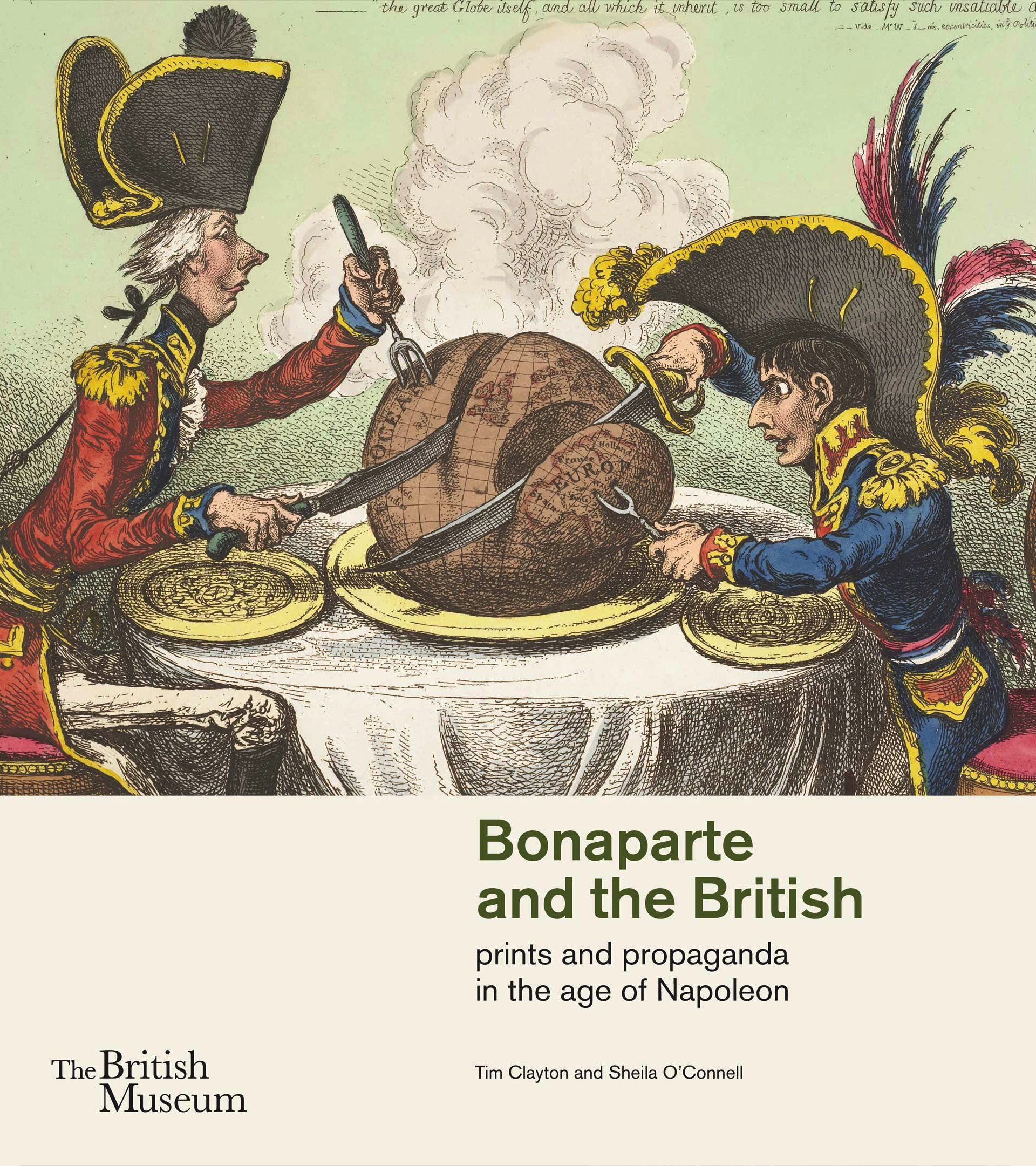 This fascinating book explores through contemporary prints how Bonaparte was seen from across the English Channel where hostile propaganda was tempered by admiration for his military and administrative talents. Featuring works from The British Museum’s world-renowned collection of political satires, including examples by the greatest masters of the genre, James Gillray, Thomas Rowlandson and George Cruikshank, the authors examine in detail these fascinating and humorous prints.
Attitudes to Bonaparte were coloured by political tensions in Britain as highlighted in satires of Charles James Fox, Richard Brinsley Sheridan, Lord Holland and other radicals. French, German, Russian and Spanish copies of British prints demonstrate the wide dissemination of prints and the admiration of continental artists for British satirists. From portraits of the handsome young general to the resplendent Emperor to the cast of his death mask, this book explores crucial events of Bonaparte’s career and the period. French satires showing the British in relation to Bonaparte are also included alongside portraits of Bonaparte and his family made for the British market. This richly illustrated title reveals the stories behind the prints, explaining how satire was used as propaganda and how the artists worked. It features intricately detailed prints in full colour, bringing to life a key period in European history.
Tim Clayton is a leading authority on British prints of the period and the author of several critically acclaimed military histories. Sheila O’Connell is curator of British prints before 1900 at The British Museum.
Exhibition | Vanishing Ice: Alpine and Polar Landscapes in Art

William Hodges, The Resolution and Adventure, 4 January 1773, Taking Ice for Water, Latitude 61 Degrees South, ink and wash on paper; 14 x 22″ (Mitchell Library, State Library of New South Wales).
Click here for more information.
◊ ◊ ◊ ◊ ◊
From the McMichael press release (9 December 2014) for the Vanishing Ice exhibition:
Vanishing Ice: Alpine and Polar Landscapes in Art, 1775–2012
Whatcom Museum, Bellingham, Washington, 3 November 2013 — 16 March 2014
El Paso Museum of Art, 1 June — 24 August 2014
Glenbow Museum, Calgary, Alberta, 27 September 2014 — January 4, 2015
McMichael Canadian Art Collection, Kleinburg, Ontario, 31 January — 26 April 2015
On January 31, 2015, the powerful and provocative exhibition Vanishing Ice: Alpine and Polar Landscapes in Art, 1775–2012 opens at the McMichael Canadian Art Collection. Since debuting in 2013 at the Whatcom Museum in Bellingham, Washington, the exhibition has garnered attention for its unique interweaving of art, history, and science. Showcasing the beauty and fragility of Earth’s frozen frontiers through the eyes of artists, writers, and naturalists over a period of more than 200 years, the exhibition offers a unique take on the timely subject of climate change.
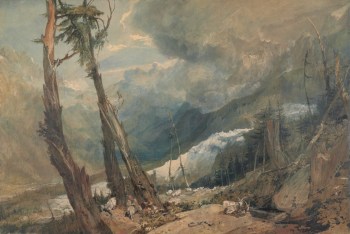
Joseph Mallord William Turner, Mer de Glace, in the Valley of Chamouni, Switzerland, 1803, watercolor, graphite, gum, 28 x 41″ (New Haven: Yale Center for British Art, Paul Mellon Collection)
Vanishing Ice features over seventy works including drawings, prints, paintings, photographs, videos, and installations by fifty artists from twelve countries. Among these historical and contemporary artists are: Ansel Adams, Lita Albuquerque, James Balog, Thomas Hart Benton, David Buckland, Gustave Doré, Lawren Harris, Isaac Julien, Kahn & Selesnick, Rockwell Kent, Paul D. Miller (aka DJ Spooky), Alexis Rockman, Camille Seaman, and Spencer Tunick. The exhibition unfolds thematically, geographically, and chronologically, moving from alpine to Arctic and Antarctic landscapes.
The idea for Vanishing Ice grew out of curator Barbara Matilsky’s doctoral dissertation, written thirty years ago about the sublime landscapes of French artist-naturalist-explorers who were among the first to depict the poles and mountain glaciers. As Matilsky became aware of the increasing number of contemporary artists who were venturing to the Arctic and Antarctic, she saw an opportunity to compare historical and contemporary depictions of these rapidly changing landscapes, as epitomized by the juxtaposition of Arthur Oliver Wheeler’s 1917 image of the Athabasca Glacier in Jasper National Park and Gary Braasch’s 2005 photograph of the same location.
“I am hoping that Vanishing Ice will stimulate a new appreciation for alpine and polar landscapes by revealing their significance for both nature and culture,” said exhibition curator Barbara Matilsky from the Whatcom Museum. “In the past, artists and naturalists expanded the public’s awareness of Earth’s icy frontiers. Today, artists continue to collaborate with scientists, motivated by the belief that art will help people to visualize the accelerating effects of climate change. They awaken the world to both the beauty and increasing vulnerability of ice, which is critical for biological and cultural diversity. Their work will hopefully inspire activism on the regional and national levels to make the requisite policy changes that will bring Earth back into balance.”
The McMichael is the exhibition’s final stop on a tour that included the Whatcom Museum; the El Paso Museum in Texas; and most recently the Glenbow Museum in Calgary.
“The McMichael nurtures a special interest in exploring the intersection of art and nature, and encouraging meaningful dialogue about the environment,” said Dr. Victoria Dickenson, Executive Director and CEO of the McMichael. “Vanishing Ice is both a beautiful glimpse of some of the most remote and fragile ecosystems, and a call to action on what many people hold to be the defining issue of this generation.”
Vanishing Ice, which will span the McMichael’s upper level of gallery spaces, will be complemented by an exhibition based on the McMichael’s permanent collection of works related to the Arctic, opening on February 14, 2015. The installation will include paintings and drawings by members of the Group of Seven, including Lawren Harris—famed for his depiction of icebergs and glaciers—and works by Inuit artists, including Tim Pitsiulak.
Vanishing Ice: Alpine and Polar Landscapes in Art, 1775–2012 is organized by the Whatcom Museum. Major funding for the exhibition has been provided by the Paul G. Allen Family Foundation and the National Endowment for the Arts with additional support from the Norcliffe Foundation, the Washington State Arts Commission, and the City of Bellingham.
From the University of Washington Press:
◊ ◊ ◊ ◊ ◊
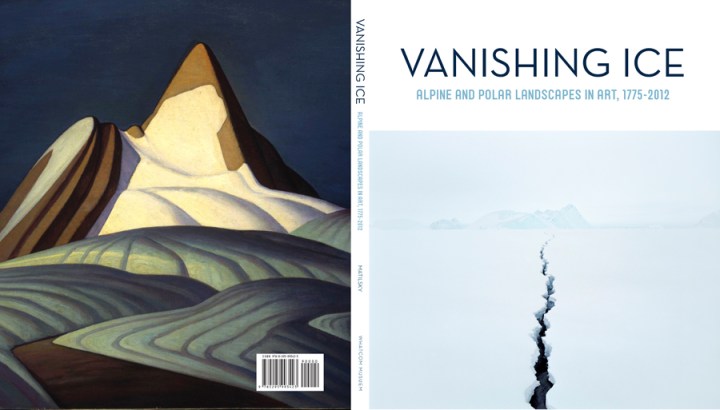
Barbara C. Matilsky, Vanishing Ice: Alpine and Polar Landscapes in Art, 1775–2012 (Seattle: University of Washington Press, 2013), 144 pages, ISBN: 978-0295993423, $40.
Vanishing Ice introduces the rich artistic legacy of the planet’s frozen frontiers now threatened by a changing climate. Tracing the impact of glaciers, icebergs, and fields of ice on artists’ imaginations, this interdisciplinary survey explores the connections between generations of artists who adopt different styles, media, and approaches to interpret alpine and polar landscapes.
Beginning in the eighteenth century, collaborations between the arts and sciences contributed to a deeper understanding of snowcapped mountains, the Arctic, and Antarctica. A resurgence of interest in these environments as dramatic indicators of climate change galvanizes contemporary expeditions to the glaciers and the poles. Today, artists, writers, and scientists awaken the world to both the beauty and increasing vulnerability of ice.
Barbara C. Matilsky is curator of art at the Whatcom Museum, Bellingham, Washington. She is the author of numerous books, including Fragile Ecologies: Contemporary Artists’ Interpretations and Solutions.
C O N T E N T S
Director’s Foreword
Prologue
From the Sublime to the Science of a Changing Climate
Voyage to Glacial Peaks
Magnetic Attraction: The Allure of the Poles
Elegy: The Open Polar Sea
Timeline
Checklist of the exhibition
New Book | Country Houses and the British Empire, 1700–1930
From Manchester UP:
Stephanie Barczewski, Country Houses and the British Empire, 1700–1930 (Manchester: Manchester University Press, 2014), 230 pages, ISBN: 978-0719096228, £75.
 Country Houses and the British Empire, 1700–1930 assesses the economic and cultural links between country houses and the Empire between the eighteenth and twentieth centuries. Using sources from over fifty British and Irish archives, it enables readers to better understand the impact of the empire upon the British metropolis by showing both the geographical variations and its different cultural manifestations. Stephanie Barczewski offers a rare scholarly analysis of the history of country houses that goes beyond an architectural or biographical study, and recognises their importance as the physical embodiments of imperial wealth and reflectors of imperial cultural influences. In so doing, she restores them to their true place of centrality in British culture over the last three centuries, and provides fresh insights into the role of the Empire in the British metropolis.
Stephanie Barczewski is Professor of Modern British History at Clemson University.
◊ ◊ ◊ ◊ ◊
C O N T E N T S
Introduction: British Country Houses and Empire, 1700–1930
1 Colonial Merchants
2 Indian Nabobs
3 West Indian Planters
4 Military and Naval Officers and Other Categories of Imperial Estate Purchasers
5 The Impact of Imperial Wealth on British Landed Estates
6 The Cultural Display of Empire in Country Houses
7 The Discourse of Commodities
8 The Discourse of Cosmopolitanism
9 The Discourse of Conquest
10 The Discourse of Collecting
Conclusion
Appendices
Select bibliography
Index
New Book | Commercial Visions in the Dutch Golden Age
From The University of Chicago Press:
Dániel Margócsy, Commercial Visions: Science, Trade, and Visual Culture in the Dutch Golden Age (Chicago: The University of Chicago Press, 2014), 336 pages, ISBN: 978-0226117744, $40.
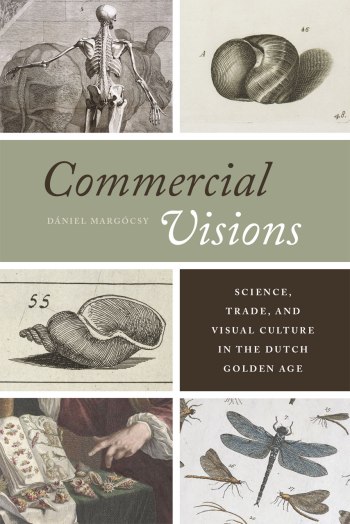 Entrepreneurial science is not new; business interests have strongly influenced science since the Scientific Revolution. In Commercial Visions, Dániel Margócsy illustrates that product marketing, patent litigation, and even ghostwriting pervaded natural history and medicine—the ‘big sciences’ of the early modern era—and argues that the growth of global trade during the Dutch Golden Age gave rise to an entrepreneurial network of transnational science.
Margocsy introduces a number of natural historians, physicians, and curiosi in Amsterdam, London, St. Petersburg, and Paris who, in their efforts to boost their trade, developed modern taxonomy, invented color printing and anatomical preparation techniques, and contributed to philosophical debates on topics ranging from human anatomy to Newtonian optics. These scientific practitioners, including Frederik Ruysch and Albertus Seba, were out to do business: they produced and sold exotic curiosities, anatomical prints, preserved specimens, and atlases of natural history to customers all around the world. Margócsy reveals how their entrepreneurial rivalries transformed the scholarly world
of the Republic of Letters into a competitive marketplace.
Margócsy’s highly readable and engaging book will be warmly welcomed by anyone interested in early modern science, global trade, art, and culture.
Dániel Margócsy is assistant professor at Hunter College, City University of New York.
◊ ◊ ◊ ◊ ◊
C O N T E N T S
List of Illustrations
1 Baron von Uffenbach Goes on a Trip: The Infrastructure of International Science
2 Shipping Costs, the Exchange of Specimens, and the Development of Taxonomy
3 Image as Capital: Forging Albertus Seba’s Thesaurus
4 Anatomical Specimens in the Republic of Letters: Scientific Publications as Marketing Tools
5 Commercial Epistemologies: The Anatomical Debates of Frederik Ruysch and Govard Bidloo
6 Knowledge as Commodity: The Invention of Color Printing
7 Peter the Great on a Shopping Spree
Acknowledgments
Abbreviations
Notes
Bibliography
Editorial | Digital Textbooks / Thomas Buser’s History of Drawing

Jacques-Louis David, The Intervention of the Sabine Women, 1794. Black chalk, pen and black ink, gray wash with white heightening on two sheets and five fragments of paper pasted together, 25.7 x 34 cm (Paris: Louvre; photo: T. Le Mage).
Click here for more information.
◊ ◊ ◊ ◊ ◊
As someone regularly faced with assigning new editions of textbooks that seem increasingly overpriced, I wonder how long it will be until resources such as the basic art history survey text are available digitally for free. Yes, these are choppy waters—pedagogically, methodologically, ideologically, and as business practice—further complicated by recent legislation, primarily from California: SB48 signed into law in 2010 along with SB 1052 and SB 10532 signed in 2012. But I think the stakes are high in our getting this right.
Thomas Buser’s History of Drawing, which surveys Western drawing from the fifteenth to twentieth centuries, seems worth noting to me as an early example of what we might see more of in the coming years. I imagine most instructors would assign pieces in conjunction with other materials, but the price (free) facilitates such flexibility. If students in a studio drawing course are introduced to eighteenth-century artists they otherwise wouldn’t know about, that seems useful to me. In the context of a survey, I can imagine building one or two individual class sessions around the topic of drawing with this as a starting point for students. While there aren’t notes—an all too common and unfortunate characteristic of the textbook genre that could be rectified in the digital realm—there is a reasonably extensive bibliography, excluding (at least presently) the twentieth century.
With permissions an ever moving target, we’ve made huge strides during the last decade toward more open policies. Buser has adopted an approach that likely wouldn’t work with publishers (or profits) involved, but again this strikes me as a gain. If the image selection is admirable, in most cases the image quality is not. On the other hand, Buser’s text is also a work in progress, one of the biggest advantages of this new format.
I don’t usually voice opinions too loudly here (I try not to voice many opinions even softly and I’m certainly not speaking on behalf of HECAA), but here’s my concern: if art history—and I have in mind a discipline much larger than the eighteenth century—doesn’t move toward more affordable digital options, we will be further marginalized, characterized as an intellectual luxury, available only to a small, elite segment of higher education. At least at its best, the museum as an institution is premised on public access; it’s time we find some way to extend this vision to introductory art history texts.
–Craig Hanson
◊ ◊ ◊ ◊ ◊
From Busser’s History of Drawing:
History of Drawing is a textbook and reference book available free to anyone who loves drawings. . . .Thomas Buser earned his doctorate in Art History from NYU’s Institute of Fine Arts in 1974. He taught courses in Baroque Art and the course History of Prints and Drawings at the University of Louisville until his retirement in 2005. He has published Religious Art in the Nineteenth Century in Europe and America (two volumes, 2002) and the textbook Experiencing Art Around Us (second edition, 2006).
New Book | The Marble Index: Roubiliac and Sculptural Portraiture
From Yale UP:
Malcolm Baker, The Marble Index: Roubiliac and Sculptural Portraiture in Eighteenth-Century Britain (London: The Paul Mellon Centre for Studies in British Art, 2015), 420 pages, ISBN: 978-0300204346, £50 / $85.
 Providing the first thorough study of sculptural portraiture in 18th-century Britain, this important book challenges both the idea that portrait necessarily implies painting and the assumption that Enlightenment thought is manifest chiefly in French art. By considering the bust and the statue as genres, Malcolm Baker, a leading sculpture scholar, addresses the question of how these seemingly traditional images developed into ambitious forms of representation within a culture in which many core concepts of modernity were being formed. The leading sculptor at this time in Britain was Louis François Roubiliac (1702–1762), and his portraits of major figures of the day, including Alexander Pope, Isaac Newton, and George Frederic Handel, are examined here in detail. Remarkable for their technical virtuosity and visual power, these images show how sculpture was increasingly being made for close and attentive viewing. The Marble Index eloquently establishes that the heightened aesthetic ambition of the sculptural portrait was intimately linked with the way in which it could engage viewers familiar with Enlightenment notions of perception and selfhood.
Malcolm Baker is distinguished professor of art history at the University of California, Riverside.
◊ ◊ ◊ ◊ ◊
C O N T E N T S
1 Introduction: Addressing the Sculptural Portrait
Part I Characteristics: The Bust and the Statue as Genres
2 The Place of Sculptural Portraiture
3 Sculptural Conventions and Meaning
4 Setting up the Bust and the Statue
5 Making Images
Part II Exemplary Cases: Sitters, Patrons, Sculptors and Viewers
6 A Portrait Sculptor, his Sitters and his Viewers: Roubiliac and his Career
7 Celebrating the Illustrious
8 Groups, Networks, and Connections
9 Contemporary Heads
Appendices
Notes
Bibliography
Illustration credits
Index
A detailed table of contents is available (as a PDF file) here»
New Book | Architecture 1600–2000: Art and Architecture of Ireland
From Yale UP:
Edited by Rolf Loeber, Hugh Campbell, Livia Hurley, John Montague, and Ellen Rowley, Architecture 1600–2000: Art and Architecture of Ireland (London: The Paul Mellon Centre for Studies in British Art, 2014), 600 pages, ISBN: 978-0300179224, $150.
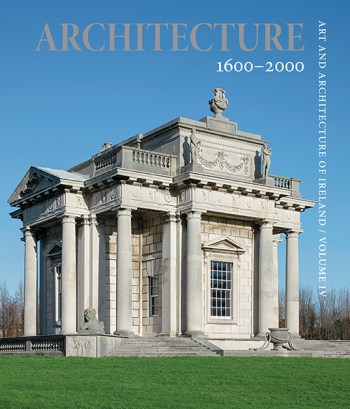 Art and Architecture of Ireland is an authoritative and fully illustrated survey that encompasses the period from the early Middle Ages to the end of the 20th century. The five volumes explore all aspects of Irish art—from high crosses to installation art, from illuminated manuscripts to Georgian houses and Modernist churches, from tapestries and sculptures to oil paintings, photographs and video art. This monumental project provides new insights into every facet of the strength, depth and variety of Ireland’s artistic and architectural heritage.
Architecture, 1600–2000 is the most complete survey of architecture in Ireland ever published. The essays in this volume cover all aspects of Ireland’s built environment, not only buildings but infrastructure, landscape development, public and private construction and much else. The volume challenges and expands the traditional understanding of Irish ‘architecture’, giving novel and exciting interpretations of the field and, by means of many striking illustrations, encourages us to think anew about the environment that surrounds us.
Rolf Loeber holds professorships at the University of Pittsburgh, where he oversees research on the causes of crime as well as mental health problems in young people. He has published extensively on Irish architecture, the history of fiction, and social, economic and plantation history. Hugh Campbell is professor of architecture at University College, Dublin, where he is currently head of the School of Architecture. He has published extensively on subjects from Irish architecture and urbanism to photography and urban space. Livia Hurley is an architect and architectural historian working in private practice in Dublin. Her research interests include urban history and the study of industrial sites and monuments. John Montague is assistant professor in the College of Architecture, Art and Design at the American University of Sharjah, UAE. His research interests include medieval and early modern architecture, and urban mapping. He is co-author, with Colm Lennon, of John Rocque’s Dublin: A Guide to the Georgian City (Dublin, 2010). Ellen Rowley is an architectural historian, researching 20th-century architecture in Ireland and beyond. She has written extensively on architectural modernism and edited a collection of Irish architectural writing: Patterns of Thought (2012). She is a research fellow at Trinity College Dublin.










 Enfilade
leave a comment