New Book | Solomon’s Secret Arts: The Occult in the Enlightenment
This book from Paul Monod (like John Fleming’s The Dark Side of the Enlightenment: Wizards, Alchemists, and Spiritual Seekers in the Age of Reason, featured in the previous posting) appeared last year, but since I failed to note it and since we’ve just highlighted the Gothic Imagination and Witches, it seemed like a good time to backtrack.
And, I would note, after so many events to mark the Hanoverian anniversary, Coronation Day is finally here: George I was crowned at Westminster Abbey on 20 October 1714. –CH
◊ ◊ ◊ ◊ ◊
From Yale UP:
Paul Kléber Monod, Solomon’s Secret Arts: The Occult in the Age of Enlightenment (New Haven: Yale University Press, 2013), 440 pages, ISBN: 978-0300123586, $50.
 The late seventeenth and eighteenth centuries are known as the Age of Enlightenment, a time of science and reason. But in this illuminating book, Paul Monod reveals the surprising extent to which Newton, Boyle, Locke, and other giants of rational thought and empiricism also embraced the spiritual, the magical, and the occult. Although public acceptance of occult and magical practices waxed and waned during this period they survived underground, experiencing a considerable revival in the mid-eighteenth century with the rise of new anti-establishment religious denominations. The occult spilled over into politics with the radicalism of the French Revolution and into literature in early Romanticism. Even when official disapproval was at its strongest, the evidence points to a growing audience for occult publications as well as to subversive popular enthusiasm. Ultimately, finds Monod, the occult was not discarded in favor of ‘reason’ but was incorporated into new forms of learning. In that sense, the occult is part of the modern world, not simply a relic of an unenlightened past, and is still with us today.
Paul Monod is A. Barton Hepburn Professor of History at Middlebury College. He lives in Weybridge, Vermont.
New Book | The Dark Side of the Enlightenment
From Norton:
John V. Fleming, The Dark Side of the Enlightenment: Wizards, Alchemists, and Spiritual Seekers in the Age of Reason (New York: W. W. Norton, 2013), 432 pages, ISBN: 978-0393079463, $28.
 In The Dark Side of the Enlightenment, John V. Fleming shows how the impulses of the European Enlightenment—generally associated with great strides in the liberation of human thought from superstition and traditional religion—were challenged by tenacious religious ideas or channeled into the ‘darker’ pursuits of the esoteric and the occult. His engaging topics include the stubborn survival of the miraculous, the Enlightenment roles of Rosicrucianism and Freemasonry, and the widespread pursuit of magic and alchemy.
Though we tend not to associate what was once called alchemy with what we now call chemistry, Fleming shows that the difference is merely one of linguistic modernization. Alchemy was once the chemistry, of Arabic derivation, and its practitioners were among the principal scientists and physicians of their ages. No point is more important for understanding the strange and fascinating figures in this book than the prestige of alchemy among the learned men of the age.
Fleming follows some of these complexities and contradictions of the ‘Age of Lights’ into the biographies of two of its extraordinary offspring. The first is the controversial wizard known as Count Cagliostro, the ‘Egyptian’ freemason, unconventional healer, and alchemist known most infamously for his ambiguous association with the Affair of the Diamond Necklace, which history has viewed as among the possible harbingers of the French Revolution and a major contributing factor in the growing unpopularity of Marie Antoinette. Fleming also reviews the career of Julie de Krüdener, the sentimental novelist, Pietist preacher, and political mystic who would later become notorious as a prophet.
Impressively researched and wonderfully erudite, this rich narrative history sheds light on some lesser-known mental extravagances and beliefs of the Enlightenment era and brings to life some of the most extraordinary characters ever encountered either in history or fiction.
John V. Fleming is the Louis W. Fairchild, ’24 Professor of English and Professor of Comparative Literature emeritus at Princeton University, where he taught for forty years before retiring in 2006. Fleming graduated from Sewanee (the University of the South) in 1958, before spending three years in Oxford as a Rhodes Scholar. After taking his Ph.D. from Princeton in 1963, he taught for two years at the University of Wisconsin (Madison). He has published widely in the fields of medieval literature, art history, and religious history.
Exhibition | Witches and Wicked Bodies
I noted this exhibition last year when it went on display in Scotland, but I didn’t realize it would also be on view in London. The description on The British Museum’s website provides additional information. I saw the exhibition Friday evening, and I think it’s fabulous (a nice complement to the British Library’s exhibition Terror and Wonder: The Gothic Imagination, even as they do very different things). There are stunning eighteenth-century images, and the period anchors the show more than the descriptions might suggest (including gorgeous prints after Salvator Rosa). –CH
From The British Museum:
Witches and Wicked Bodies
Scottish National Gallery of Modern Art, Edinburgh, 27 July — 3 November 2013
The British Museum, London, 25 September 2014 — 11 January 2015

Saul and the Witch of Endor, after Salvator Rosa.
Click on the image for details.
This exhibition will examine the portrayal of witches and witchcraft in art from the Renaissance to the end of the 19th century. It will feature prints and drawings by artists including Dürer, Goya, Delacroix, Burne-Jones and Dante Gabriel Rossetti, alongside classical Greek vessels and Renaissance maiolica.
Efforts to understand and interpret seemingly malevolent deeds—as well apportion blame for them and elicit confessions through hideous acts of torture—have had a place in society since classical antiquity and Biblical times. Men, women and children have all been accused of sorcery. The magus, or wise practitioner of ‘natural magic’ or occult ‘sciences’, has traditionally been male, but the majority of those accused and punished for witchcraft, especially since the Reformation, have been women. They are shown as monstrous hags with devil-worshipping followers. They represent an inversion of a well-ordered society and the natural world.
The focus of the exhibition is on prints and drawings from the British Museum’s collection, alongside a few loans from the V&A, the Ashmolean, Tate Britain and the British Library. Witches fly on broomsticks or backwards on dragons or beasts, as in Albrecht Dürer’s Witch Riding backwards on a Goat of 1501, or Hans Baldung’s Witches’ Sabbath from 1510. They are often depicted within cave-like kitchens surrounded by demons, performing evil spells, or raising the dead within magic circles, as in the powerful work of Salvator Rosa, Jacques de Gheyn and Jan van der Velde.
Francisco de Goya turned the subject of witches into an art form all of its own, whereby grotesque women conducting hideous activities on animals and children were represented in strikingly beautiful aquatint etchings. Goya used them as a way of satirising divisive social, political and religious issues of his day. Witches were also shown as bewitching seductresses intent on ensnaring their male victims, seen in the wonderful etching by Giovanni Battista Castiglione of Circe, who turned Odysseus’s companions into beasts.
During the Romantic period, Henry Fuseli’s Weird Sisters from Macbeth influenced generations of theatre-goers, and illustrations of Goethe’s Faust were popularised by Eugène Delacroix. By the end of the 19th century, hideous old hags with distended breasts and snakes for hair were mostly replaced by sexualised and mysteriously exotic sirens of feminine evil, seen in the exhibition in the work of Edward Burne-Jones, Dante Gabriel Rossetti and Odilon Redon.
The exhibition includes several classical Greek vessels and examples of Renaissance maiolica to emphasise the importance of the subject in the decorative arts.
Exhibition | Terror and Wonder: The Gothic Imagination
◊ ◊ ◊ ◊ ◊
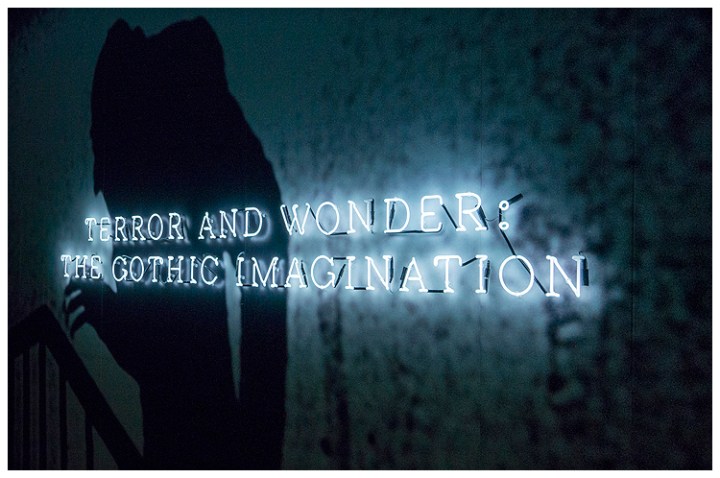
This year marks the 250th anniversary of the publication of Horace Walpole’s ’s The Castle of Otranto, and the British Library celebrates with an exhibition exploring the the relationship between the Gothic and the British imagination up to the present. The wall colors are from Farrow & Ball, with Lulworth Blue (No. 89) providing the backdrops for most of the Walpole material at the beginning of the exhibition, along with Great White (No. 2006), before things go really dark with Pitch Black (No. 256) and Rectory Red (No. 217). Of course, there’s Rectory Red in this show.
From the BL:
Terror and Wonder: The Gothic Imagination
British Library, London, 3 October 2014 — 20 January 2015
Curated by Tim Pye

John Giles Eccardt, Portrait of Horace Walpole, 1754 (London: National Portrait Gallery)
Two hundred rare objects trace 250 years of the Gothic tradition, exploring our enduring fascination with the mysterious, the terrifying and the macabre. From Mary Shelley and Bram Stoker to Stanley Kubrick and Alexander McQueen, via posters, books, film and even a vampire-slaying kit, experience the dark shadow the Gothic imagination has cast across film, art, music, fashion, architecture and our daily lives.
Beginning with Horace Walpole’s The Castle of Otranto, Gothic literature challenged the moral certainties of the 18th century. By exploring the dark romance of the medieval past with its castles and abbeys, its wild landscapes and fascination with the supernatural, Gothic writers placed imagination firmly at the heart of their work—and our culture. Iconic works, such as handwritten drafts of Mary Shelley’s Frankenstein, Bram Stoker’s Dracula, the modern horrors of Clive Barker’s Hellraiser, and the popular Twilight series, highlight how contemporary fears have been addressed by generation after generation.
Dozens of press images can be found here»
◊ ◊ ◊ ◊ ◊
◊ ◊ ◊ ◊ ◊
Dale Townsend, ed., Terror and Wonder: The Gothic Imagination (London: The British Library, 2014), 224 pages, softcover, ISBN: 978-0712357913, £25 / hardcover, ISBN: 978-0712357555, £35.
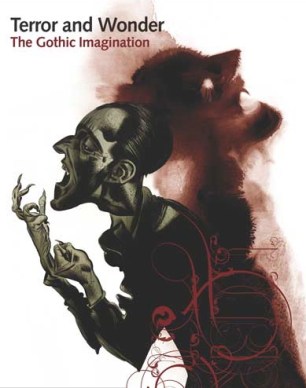 The Gothic imagination, that dark predilection for horrors and terrors, spectres and sprites, occupies a prominent place in contemporary Western culture. First given fictional expression in Horace Walpole’s The Castle of Otranto of 1764, the Gothic mode has continued to haunt literature, fine art, music, film and fashion ever since its heyday in Britain in the 1790s. Terror and Wonder, which accompanies a major exhibition at the British Library, is a collection of essays that trace the numerous meanings and manifestations of the Gothic across time, tracking its prominent shifts and mutations from its eighteenth-century origins, through the Victorian period, and into the present day. Edited and introduced by Dale Townshend, and consisting of original contributions by Nick Groom, Angela Wright, Alexandra Warwick, Andrew Smith, Lucie Armitt and Catherine Spooner, Terror and Wonder provides a compelling and comprehensive overview of the Gothic imagination over the past 250 years
Dale Townshend is Senior Lecturer in Gothic and Romantic Literature at the University of Stirling, Scotland. His most recent publications include The Gothic World (with Glennis Byron; Routledge, 2014) and Ann Radcliffe, Romanticism and the Gothic (with Angela Wright; Cambridge University Press, 2014).
C O N T E N T S
Dale Townshend, Introduction
Nick Groom, Gothic Antiquity: From the Sack of Rome to The Castle of Otranto
Angela Wright, Gothic, 1764–1820
Alexandra Warwick, Gothic, 1820–1880
Andrew Smith, Gothic and the Victorian Fin de siècle, 1880–1900
Lucie Armitt, Twentieth-Century Gothic
Catherine Spooner, Twenty-First-Century Gothic
Martin Parr, Photographing Goths: Martin Parr at the Whitby Goth Weekend
◊ ◊ ◊ ◊ ◊
From the exhibition press release (2 October 2014). . .
Terror and Wonder: The Gothic Imagination opens at the British Library exploring Gothic culture’s roots in British literature and celebrating 250 years since the publication of the first Gothic novel.
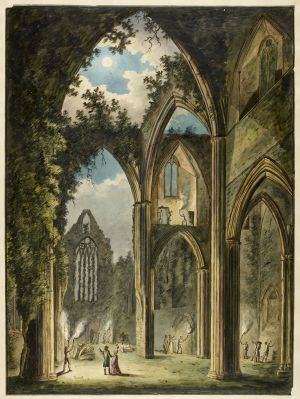
Tintern Abbey, watercolour, 1812 (London: British Library)
Alongside the manuscripts of classic novels such as Frankenstein, Dracula, and Jane Eyre, the exhibition brings the dark and macabre to life with artefacts, old and new. Highlights of the exhibition include a vampire slaying kit and 18th- and 19th-century Gothic fashions, as well as one of Alexander McQueen’s iconic catwalk creations. Also on display is a model of the Wallace and Gromit Were-Rabbit, showing how Gothic literature has inspired varied and colourful aspects of popular culture in exciting ways over centuries.
Celebrating how British writers have pioneered the genre, Terror and Wonder takes the first Gothic novel, The Castle of Otranto by Horace Walpole, and exhibits treasures from the Library’s collections to carry the story forwards to the present day. Eminent authors over the last 250 years, including William Blake, Ann Radcliffe, Mary Shelley, Charles Dickens, the Brontës, Edgar Allan Poe, Bram Stoker, MR James, Mervyn Peake, Angela Carter and Neil Gaiman, underpin the exhibition’s exploration of how Gothic fiction has evolved and influenced film, fashion, music, art and the Goth subculture.

An early illustration of a ‘wicker man’ from Nathaniel Spencer’s The Complete English Traveller (1771)
Lead curator of the exhibition, Tim Pye, says: “Gothic is one the most popular and influential modes of literature and I’m delighted that Terror and Wonder is celebrating its rich 250 year history. The exhibition features an amazingly wide range of material, from stunningly beautiful medieval artefacts to vinyl records from the early Goth music scene, so there is truly something for everyone.”
From Nosferatu to the most recent zombie thrillers, the exhibition uses movie clips, film posters, costume designs and props to show how Gothic themes and literature have been adapted for stage and screen, propelling characters like Dracula, Jekyll and Hyde and Frankenstein’s monster to mainstream fame. Exciting exhibits on loan to the Library include Clive Barker’s original film script and sketches for Hellraiser, as well as Stanley Kubrick’s annotated typescript of The Shining.
Showing how Gothic fiction has inspired great art, the exhibition features fine paintings and prints, such as Henry Fuseli’s Hamlet, Prince of Denmark and Nathaniel Grogan’s Lady Blanche Crosses the Ravine, a scene taken directly from the Queen of Terror Ann Radcliffe’s The Mysteries of Udolpho. These classic images precede dramatic contemporary artworks, such as Jake and Dinos Chapman’s series Exquisite Corpse, showing how the dark and gruesome still inspire today’s artists.
Celebrating the British Goth scene, we are delighted to reveal a brand new series of photographs of the Whitby Goth Weekend by the award-winning photographer Martin Parr. Commissioned specially for this exhibition, the photographs take a candid look at the biannual event, which takes place in the town famously featured in Dracula, capturing its diversity and energy.
Earlier this year the Library announced that we are putting our literary treasures online for the world to see with a new website, Discovering Literature. Many of the Gothic literary greats featuring in the exhibition, including the Brontës, Charles Dickens and Wilkie Collins, can be explored amongst the Romantic and Victorian literature now available online.
The Library has partnered with BBC Two and BBC Four to celebrate all things Gothic this autumn with a new season of programmes exploring the literature, architecture, music and artworks that have taken such a prominent place in British culture.
A host of famous literary faces will look back on Frankenstein’s creation in A Dark and Stormy Night: When Horror Was Born, while in The Art of Gothic: Britain’s Midnight Hour Andrew Graham-Dixon looks back at how Victorian Britain turned to the past for inspiration to create some of Britain’s most famous artworks and buildings. In God’s own Architects: The First Gothic Age, Dr Janina Ramirez looks at Perpendicular Gothic, Britain’s first cultural style and Dan Cruickshank looks back at Gothic architecture’s most influential family in A Gothic Dynasty: A Victorian Tale of Triumph and Tragedy. BBC Four delves into the archives uncovering classic performances from Siouxsie and the Banshees, Bauhaus, The Cure, Sisters of Mercy, The Mission and more in Goth at the BBC.
For the second year running the Library, GameCity and Crytek are running an exciting video game competition, Off the Map, this time with a Gothic edge. Following last year’s winners, who recreated London before the Great Fire, this year entrants will use ruined abbeys, the town of Whitby or Edgar Allan Poe as inspiration for a brand new interactive game.
A wide range of literary, film and music events will accompany the exhibition, with speakers including writers Susan Hill, Sarah Waters, Audrey Niffenegger and Kate Mosse, actor Reece Shearsmith, comedian Stewart Lee and musician Brian May.
Exhibition | Adriaan de Lelie and the Family Portrait
From the Museum Van Loon (with thanks to Hélène Bremer for noting it). . .
Adriaan de Lelie and the Eighteenth-Century Family Portrait
Museum Van Loon, Amsterdam, 17 October 2014 — 19 January 2015

Adriaan De Lelie, Jan van Loon and His Family, 1786
(Amsterdam: Museum van Loon)
From 17 October 2014 Museum Van Loon will show works by Adriaan de Lelie (1755–1820). It is the first time that so much of De Lelie’s œuvre will be on view to the public. Most of the paintings are from private collections. Next to paintings by De Lelie, family portraits by famous contemporaries like Tischbein, Regters, Laquy and Quinkhard are on display. The thirty paintings on show give a perfect reflection of family bliss and the lavish interiors of the 18th century.
Although little has been published about De Lelie, he is without doubt one of the most important portrait painters of his time. He was born in Tilburg, and after having studied in Antwerp and Düsseldorf, he settled in Amsterdam where he quickly integrated in the upper classes. With his keen eye for detail, refined palette, and smooth hand he was a successful portraitist. Governors, bankers, notaries, officers, professors, and wealthy merchants had themselves painted by him. Thus De Lelie literally gave face to Amsterdam at the turn of the century.
As a family home, Museum Van Loon is the place for showing family portraits. With this exhibition it intends to disclose its own 18th-century collection of paintings and to offer the public the unique opportunity to view the oeuvre of De Lelie and his contemporaries in the house of one of his large commissioners. For visitors the historic perspective is strengthened by the connection between the paintings, furniture, tapestry and carpets in the rooms as one will see one’s immediate surroundings in the museum reflected in the 18th-century interiors in the paintings.
◊ ◊ ◊ ◊ ◊
From W Books:
Josephina de Fouw, Adriaan de Lelie (1755–1820) en het achttiende-eeuwse familieportret (Zwolle: W Books, 2014), 64 pages, ISBN: 978-9462580398, €15.
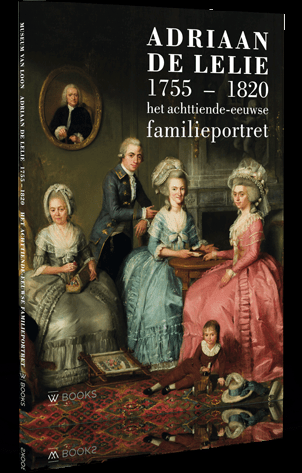 Adriaan de Lelie behoort zonder meer tot de belangrijkste portretschilders van zijn tijd. Zijn wieg stond in Tilburg en na een studietijd in Antwerpen en Düsseldorf vestigde hij zich definitief in Amsterdam. Daar wist hij al snel door te dringen in de kringen van de gegoede burgerij. Met zijn oog voor detail en verfijnde palet was hij een veelgevraagd portrettist. Notabelen, bankiers, notarissen, officieren, hoogleraren en vermogende koopmannen: allen lieten zich door de schilder vereeuwigen. De Lelie heeft zo letterlijk een gezicht gegeven aan het Amsterdam van rond de eeuwwisseling.
In deze eerste publicatie gewijd aan De Lelie wordt een beeld geschetst van deze portretten en wordt ingegaan op de karakteristieken van zijn familieportretten. Ook wordt zijn werk vergeleken met voorgangers en tijdgenoten, zoals Tibout Regters, Tischbein en Laquy.
Exhibition | Treasures from the Collection Rudolf-August Oetker
From the Museum Huelsmann
Wie es uns gefällt: Kostbarkeiten aus der Sammlung Rudolf-August Oetker
Museum Huelsmann, Ravensberger Park, Bielefeld, 14 September 2014 — 28 January 2015
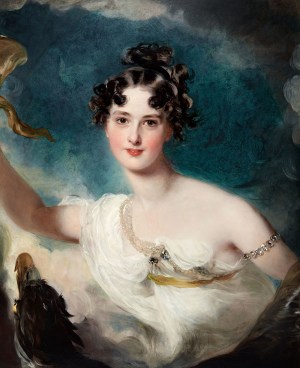
Thomas Lawrence, Princess Clementine de Metternich, ca. 1818–20.
Die umfangreiche Kunstsammlung des Bielefelder Unternehmers, Sammlers und Mäzens Rudolf-August Oetker (1916–2007) gehört in der Sammlungsgeschichte Deutschlands zu den wenigen privaten Beispielen des 20. Jahrhunderts.
Ausgewählte Kostbarkeiten der Malerei des Barock, Rokoko und Klassizismus sowie des europäischen Kunsthandwerks, darunter selten gezeigte Porzellane, auserlesenes Silber und fürstliche Schatzkunst repräsentieren den individuellen, aber auch universellen Charakter des Sammlers und stehen im Kontext des 18. Jahrhunderts, dem Jahrhundert, das das Aufkommen des individuellen Geschmacks betont.
Installation photos from the firm DesignPosition are available here»
The exhibition flyer is available as a PDf file here»
◊ ◊ ◊ ◊ ◊
From Hirmer Verlag:
Monika Bachtler, ed., Wie es uns gefällt: Kostbarkeiten aus der Sammlung Rudolf-August Oetker (Munich: Hirmer Verlag, 2014), 144 pages, ISBN: 978-3777422930, 35€.
 Die umfangreiche Sammlung des Bielefelder Unternehmers Rudolf-August Oetker ist eines der wenigen Beispiele der Geschichte privaten Sammelns in Deutschland während des 20. Jahrhunderts, das gleichermaßen universelle wie individuelle Maßstäbe setzte. Anhand der daraus ausgewählten Kostbarkeiten der Malerei des Barock und Rokoko und des europäischen Kunsthandwerks entsteht ein kulturgeschichtlich plastisches Bild dieser Zeit, aber auch eine Vorstellung vom repräsentierenden Charakter einer persönlich geprägten Ankaufstrategie. Das Katalogbuch spiegelt die Opulenz dieser Sammlerwelt in Bildern und Texten wider.
Exhibition | Canaletto, Bernardo Bellotto Paints Europe
Last fall, I noted this exhibition Canaletto, Bernardo Bellotto Paints Europe / Bernardo Bellotto Malt Europa, which opens this week at Munich’s Alte Pinakothek, Munich (17 October 2014 — 19 January 2015), but that was admittedly ages ago (thanks to Hélène Bremer for the useful reminder). And here’s the information for the catalogue. –CH
The German edition catalogue will soon by published by Hirmer; the English edition, distributed by The University of Chicago Press, will be available in January:
Andreas Schumacher, Canaletto, Bernardo Bellotto Paints Europe (Munich: Hirmer Publishers, 2015), 360 pages, ISBN: 978-3777422473, $75.
 In 1761, Bernardo Bellotto painted his famous panorama of Munich, signing the painting ‘Canaletto’—as he signed many of his paintings—in tribute to his uncle and teacher Giovanni Antonio Canal. In addition to the famous panorama, Bellotto completed over the course of several months two stunning palace views for the Duke of Bavaria, Maximilian III Joseph.
Placing Bellotto’s Munich paintings within the artist’s broader body of work, this well-illustrated book highlights the Italian painter and printmaker’s capacity to create paintings of European cities that are both remarkably realistic and compositionally idealistic. Depicting Dresden, Vienna, Turin, and Warsaw, the paintings demonstrate an elaborate attention to architectural and natural detail and a sophisticated understanding of the specific quality of light in each place. By juxtaposing the paintings with Bellotto’s preparatory sketches, the book also sheds light on his complicated process, which is thought to have included the use of the popular optical aid of that time, the camera obscura. Rounding out the book is a contemporary artistic reevaluation of the paintings through the medium of photography.
Bringing together many well-known works by the Venetian vedute with a trove of paintings rarely seen, including a series of highly idealized architectural depictions, the book illustrates his critical contribution to this important European tradition.
Andreas Schumacher is a director at the Alte Pinakothek, Munich, where he is responsible for the museum’s Collection of Italian Painting to the End of the Eighteenth Century. He is also an associate lecturer at the Institute for Art History at the University of Bonn, Germany.
◊ ◊ ◊ ◊ ◊
Exhibition | Dining with the Tsars: Fragile Beauty from the Hermitage

Items from the Service of the Order of St George, Porcelain manufactory of Franz (Francis) Gardner in Verbilki, Dmitrovsky, Moscow Province, Russia. 1777–78 (State Hermitage Museum, St Petersburg)
◊ ◊ ◊ ◊ ◊
Press release from the Hermitage Amsterdam:
Dining with the Tsars: Fragile Beauty from the Hermitage / Breekbare schoonheid uit de Hermitage
Hermitage Amsterdam, 6 September 2014 — 1 March 2015
The Hermitage Amsterdam’s fifth anniversary exhibition Dining with the Tsars: Fragile Beauty from the Hermitage opens on 6 September 2014. Eight magnificent porcelain and creamware services from the collection of the Hermitage in St Petersburg will be exhibited in a setting that conveys what the balls and banquets of the Tsar’s court were like. Visitors will imagine they are guests, in possession of a coveted imperial invitation, climbing the steps of the Winter Palace, reviewing the rules of etiquette and preparing for a festive occasion. Finally they enter the main hall where the fine porcelain dinnerware is set out in a festive display.

Items from the Green Frog Service, Wedgwood, Etruria (Stoke-on-Trent). 1773–74 (State Hermitage Museum, St Petersburg)
The exquisite porcelain services, comprising no less than 1,034 pieces, exhibited on authentically laid tables with decorative centrepieces, reveal the enchanting grandeur of the Tsars’ banquets. The exhibition tells the story of the lavish ball and banqueting culture that reached its zenith under the reign (1762–1796) of Catherine the Great, Queen of Feasts, when hundreds of dishes would be served at a single banquet and thousands of guests attended the balls. The last tsar, Nicholas II (ruled 1894–1917) and his wife Alexandra, who organised the largest balls but were only present for as briefly as possible. With their abdication, the ball and banqueting customs that had once captured the imagination of all the courts of Europe came to an end.
The finest pieces are from the dinnerware collections of Catherine the Great, such as the Green Frog Service (Wedgwood, England), the Cameo Service (Sèvres, Paris, exhibited for the first time with silver gilt flatware), which at one time comprised nearly a thousand pieces, and the Berlin Dessert Service (Königliche Porzellan-Manufaktur Berlin). The services of later Tsars were no less impressive and significant for their connection to European history. The services are exhibited in accordance with the rules of etiquette, augmented with ornate centrepieces, gold-rimmed crystal glassware, candelabras, vases, detailed silverwork and wall decorations. The exhibition features a wide range of pieces, from ice buckets for liqueur bottles and ice-cream coupes to salt and pepper sets and table figurines.
The exhibition also offers a culinary view of imperial dining customs, in a culture where banquets of 300 dishes were no exception. Dessert was the highpoint of the meal and the ideal course for showing off the host’s wealth and refined taste. Richly decorated delicacies were served with exceptional inventiveness. There is attention for iconography and the diplomatic function of giving services as gifts and hosting state dinners in the eighteenth and nineteenth centuries. And the balls and performances, gossip and scandal also feature in the exhibition. Evidence of the excesses of the imperial court abounds. Particularly revealing are the quotes drawn from the memoires of Marie Cornélie van Wassenaer Obdam. She visited the Winter Palace in 1824 as a member of the retinue of Anna Paulowna and the later King Willem II.
The surpring final exhibit is the service given to Stalin by the Hungarian people in 1949, which has never been used or exhibited before. It illustrates the diplomatic role that dinnerware also played in the twentieth century.
Never before have so many porcelain dinnerware pieces from the Hermitage been exhibited in the Netherlands. The rich collection of European porcelain from the Hermitage in St Petersburg comprises over 15,000 items, purchased by or given as gifts to the Tsars of Russia between 1745 and the years prior to the First World War. The services, which include many unique pieces, were produced by leading porcelain manufacturers such as Meissen, Sèvres, Gardner and Wedgwood and decorated to the highest artistic standard.
Spatial designer Lies Willers and stylist Jeanine Aalfs joined forces to produce an innovative, festive, engaging, dreamlike and overwhelming scenography.
Dozens of high-resolution images are available here»
New Book | The Drawing Room: English Country House Decoration
From Rizzoli:
Jeremy Musson, foreword by Julian Fellowes with photographs by Paul Barker, The Drawing Room: English Country House Decoration (New York: Rizzoli, 2014), 272 pages, ISBN: 978-0847843336, $60.
 A highly detailed look at the most accomplished English country house interiors, exemplifying English decorating at its best. The English drawing room, a formal place within a house of status where family and honored guests could retire from the more public arena, is one of the most important rooms in an English country house, and thus great attention has been paid to preserving the decoration of this most elegant of spaces: the center of life in the English countryside and the epitome of English country house decoration. This book offers privileged access to fifty of the finest drawing rooms of country houses and historic townhouses—many still in private hands—including Althorp, Attingham, and Knepp Castle. Through these sumptuous rooms, readers experience a history of English decorating from the sixteenth century to the present day, including the work of design legends such as David Hicks, Nancy Lancaster, John Fowler, and David Mlinaric. Specially commissioned photographs capture the entirety of each room, as well as details of furniture, architectural elements, artwork, collections, and textiles, creating a visually seductive book that will inspire interior designers and homeowners interested in the widely popular classic English look.
Jeremy Musson is the former architectural editor of Country Life, the cowriter and presenter of the BBC television series The Curious House Guest, and the author of many books, including English Country House Interiors, The English Manor House, How to Read a Country House, and The Country Houses of Sir John Vanbrugh. Paul Barker is one of England’s premier interior and architectural photographers, whose books include English Country House Interiors, England’s Thousand Best Churches, and English Ruins. Julian Fellowes is the creator of the hit series Downton Abbey.
Albertine Books Opens in New York
◊ ◊ ◊ ◊ ◊
It’s an intriguing model for a what bookstore might be, a model that underscores the cultural and ideological work such a store can do, and this at a time when we seem to hear only about the economics of bookstores. William Grimes covers the story for The New York Times (9 October 2014). The next step will be getting the store to host an eighteenth-century festival. –CH
From the Albertine:
The Cultural Services of the French Embassy in New York is pleased to announce the opening of Albertine Books in French and English, the new reading room and bookshop devoted to works in French and in translation on Saturday September 27, 2014. Named after the beautiful, omnipresent and unknowable female character in Marcel Proust’s classic In Search of Lost Time, Albertine will offer the most comprehensive selection of French-language books and English translations in New York, with over 14,000 contemporary and classic titles from 30 French-speaking countries in genres including novels, non-fiction, art, comic, or children’s books.
Housed in one of the few remaining iconic Stanford White-designed mansions on Fifth Avenue, Albertine was designed and fashioned by French architect Jacques Garcia, in the model of a grand private French library. The two-floor space includes a reading room and inviting nooks furnished with lush sofas and armchairs.
Albertine will also be a venue for French-American and European-American debates and discussions on subjects varying from politics to economics to art, literature or sciences and will explore classical culture through a modern and global lens. To highlight its role as an exciting new hub for intellectual debate in New York City, Albertine will present a six-night festival from October 14–19, curated by cultural critic and author Greil Marcus, featuring French and American artists and thinkers.
The Albertine team looks forward to welcoming you to our bookshop!
Spread the word to all your francophile and francophone friends.
Albertine
972 Fifth Avenue (between 78th & 79th street)
Opening Hours
Monday to Thursday and Saturday: 11–7
Friday: 11–10
Sunday: 11–6
Follow Albertine on Facebook, Twitter and Instagram: @albertinebooks










 Enfilade
leave a comment