Reviewed | Judith Bonner on ‘The Coast and the Sea’
Linda S. Ferber, The Coast and the Sea: Marine and Maritime Art in America (New York and London: New-York Historical Society in association with D. Giles Limited, 2014), 104 pages, ISBN 978-1907804311, $30 / £20.
Reviewed for Enfilade by Judith H. Bonner
 The New-York Historical Society, that city’s oldest museum, is celebrating its recent reopening after its lengthy renovation with a traveling exhibition and accompanying catalogue by Linda S. Ferber.1 The exhibition features more than 60 artworks and artifacts, primarily paintings, including portraits, genre scenes, and marine and maritime scenes. Overall, the images document the development of the New York area with its harbor and its close relationship with the Atlantic Ocean, the great maritime highway for trade and immigration.
Works selected for the exhibition have their origins in the eighteenth century, beginning in 1728 and ending in 1904. Maritime-related artifacts include a vintage spyglass, scrimshaw, snuff boxes, and an 1816 silver presentation soup tureen commemorating acts of bravery during the War of 1812. The provenance of each artwork documents the development of the New-York Historical Society, as well as the city’s art collectors, their tastes, and their interests.
The exhibition features work by artists whose names are familiar, as well as those who are unfamiliar. The painters include Thomas Birch, Thomas Buttersworth, Carlton Theodore Chapman, Thomas Cole, Jasper Francis Cropsey, Julian Oliver Davidson, Mauritz Frederick Hendrick De Haas, James Guy Evans, Robert Havell Jr., John Frederick Kensett, Rembrandt Peale, Francis Augustus Silva, and John Vanderlyn.
Several artists had nautical experience that informed their art in subject, rigging, and construction of the vessels. Buttersworth served in the British navy, while De Haas held an artist’s commission in the Dutch navy. James Guy Evans possibly served in the American navy. Chapman ran away to sea as a teenager; and Davidson sailed the globe, making sketches that provided visual sources for many years. Evident in these artists’ works is their understanding of the action of waves and atmospheric effects over the seas at different times of the day or season.
The marine subjects include frigates engaged in famous sea battles, working vessels and bustling port scenes, marine recreation scenes, portraits of heroic sea captains, and pioneering merchants. Marine scenes focus on recreation, shipwrecks, disasters, and military encounters, particularly those in the War of 1812 and Civil War. The exhibition spreads its reach down the East Coast, swinging farther south to the Battle of Mobile Bay in the Gulf of Mexico and the Battle of Port Hudson up the Mississippi River about 100 miles above New Orleans.
Portraitists range from eighteenth-century painter John Wollaston to early nineteenth-century painters John Vanderlyn and Rembrandt Peale, the latter of whom executed a portrait of naval hero Commodore Stephen Decatur in dress uniform and set against a dramatic stormy sky. Wollaston’s circa-1750 portrait of wealthy colonial merchant-shipbuilder Captain John Waddell, who owned a fleet of ships, sets the stage for the succession of ships’ portraits seen throughout the catalogue. Early portraits include personages having distinguished careers or an association with maritime enterprises. The sitter is often shown near an open window through which one views a conventionalized seascape or harbor scene with masted vessels. Other sitters are shown with maps, globes, compass, a spyglass, or other maritime instruments.
The catalogue is well researched and documented with a select bibliography. Explanations of the marine scenes are succinct yet vivid; the prose is fluid and often poetic. Ferber distinguishes between marine scenes—which focus on the pure seascape, its coast and environs—and maritime paintings. The latter, Ferber explains, emphasize human activity and other enterprises on shore or at sea. Her knowledge of nautical terminology and national history is evident throughout. She traces visual conventions from their development in seventeenth-century Holland, their passage into the British school of marine painting, and subsequent introduction into English colonies in the New World.
Ferber consistently places artworks within a broader historical context and, when appropriate, within a cultural narrative. Brief biographical sketches of artists trace their artistic development within the maritime tradition. Ferber discusses allegorical themes in paintings, as well as the effect that nostalgic longing for historically simpler times had upon the proliferation and re-creation of popular scenes celebrating heroic national victories and spirited naval encounters.
The book invites readers to the repeated examination of the images, some of which, like those illustrating the America’s Cup, are iconic. Truly memorable is a painting by Howard Pyle, A Privateersman Ashore (1893), shown in historically correct clothing and accouterments. The privateer stands near the Battery and Castle Clinton at the time of the War of 1812, posed and preening, with smoke from his cigar curling upward from the corner of his mouth as townspeople in the distance look toward him with disdain. The latter is a comment about the disapprobation citizens held for such freebooters, who preyed upon British ships.
Closing this maritime jaunt through history are two paintings. The first, by Andrew Meyer, shows President Grover Cleveland reviewing a naval parade in New York Harbor as the setting for opening ceremonies of Chicago’s Columbian Exposition in 1893, with the Statue of Liberty clearly visible, as though she also stands in review of the parade. Lastly, in 1904 Chapman portrays the Great East River Bridge (now Brooklyn Bridge) over the East River, celebrating New York’s location on the rim of the Atlantic, the gateway to America.
1. Venues for exhibition include: The Society of the Four Arts, Palm Beach, Florida (25 January — 9 March 2014); The Baker Museum of Art, Naples, Florida (19 April — 6 July 2014); Portland Museum of Art, Portland, Maine (January — May 2015); The Mattatuck Museum, Waterbury, Connecticut (6 June — 13 September 2015); and The New York State Museum, Albany, New York (24 October 2015 — 22 February 2016).
◊ ◊ ◊ ◊ ◊
Judith H. Bonner is Senior Curator and Curator of Art at The Historic New Orleans Collection.
New Book | The Self-Portrait: A Cultural History
From Thames & Hudson:
James Hall, The Self-Portrait: A Cultural History (London: Thames & Hudson, 2014), 288 pages, ISBN 978-0500239100, £25.
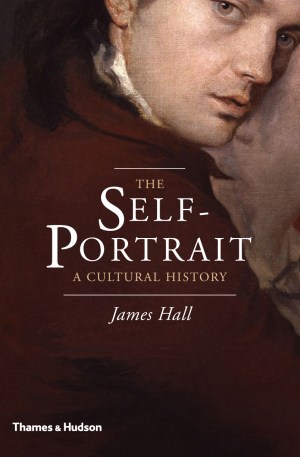 In this broad cultural survey, art historian and critic James Hall brilliantly maps the history of self-portraiture, from the earliest myths of Narcissus to the prolific self-image-making of contemporary artists.
His intelligent and vivid account shows how artists’ depictions of themselves have been part of a continuing tradition that reaches back for centuries. Along the way he reveals the importance of the medieval ‘mirror craze’; the explosion of the genre during the Renaissance; the confessional self-portraits of Titian and Michelangelo; the role of biography for serial self-portraitists such as Courbet and van Gogh; themes of sex and genius in works by Munch, Bonnard and Modersohn-Becker; and the latest developments of the genre in the era of globalization.
The full range of self-portraits is covered here, from comic and caricature self-portraits to ‘invented’ or imaginary ones, as well as key collections of self-portraiture such as that of the Medici in Florence. Throughout, Hall asks why—and when—artists have chosen to make self-portraits, and looks deeply into the worlds and mindsets of the artists who have created them.
Comprehensive and beautifully illustrated, the book features the work of a wide range of artists including Alberti, Caravaggio, Courbet, Dürer, Emin, Gauguin, Giotto, Goya, Kahlo, Koons, Magritte, Mantegna, Picasso, Raphael, Rembrandt and Warhol. Offering a rich and lively history, The Self-Portrait is an essential read for all those interested in this most enduringly popular and humane of art forms.
James Hall is an art critic and historian whose previous books include The World as Sculpture: The Changing Status of Sculpture from the Renaissance to the Present Day; Michelangelo and the Reinvention of the Human Body; Coffee with Michelangelo; and The Sinister Side: How Left-Right Symbolism Shaped Western Art.
Exhibition | William Blake: Apprentice and Master
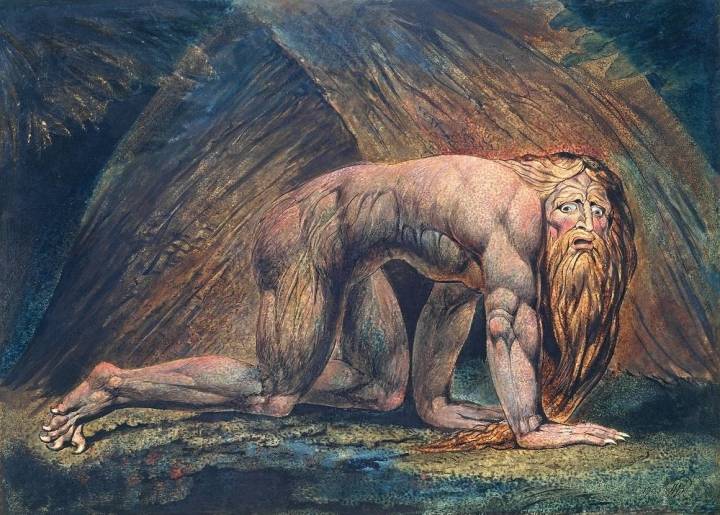
William Blake, Nebuchadnezzar, ca. 1795–1805, colour print,
ink, and watercolour on paper, 54.3 x 72.5 cm (London: Tate)
◊ ◊ ◊ ◊ ◊
From the Ashmolean:
William Blake: Apprentice and Master
Ashmolean, Oxford, 4 December 2014 — 1 March 2015
Curated by Michael Phillips and Colin Harrison
This major exhibition focuses on the extraordinary life and work of William Blake (1757–1827), printmaker, painter and revolutionary poet of the prophetic books. It examines his formation as an artist, apprenticeship as an engraver, and his maturity during the 1790s when he was at the height of his powers as both an artist and revolutionary poet. We also explore his influence on the young artist-printmakers who gathered around him in the last years of his life, including Samuel Palmer, George Richmond and Edward Calvert.
One of the most popular English artists, William Blake is still one of the least understood. His radical politics were reflected in his extraordinary technical innovations, especially in the field of printmaking and the illuminated book. This exhibition brings together more than 90 of Blake’s most celebrated works and offers new insights into his remarkable originality and influence.
At a young age William Blake showed artistic promise and, at the age of 15, was apprenticed to James Basire, the official engraver to the Society of Antiquaries. Under Basire’s tutelage, Blake was sent out to study London’s gothic churches and, most particularly, the monuments and decorations in Westminster Abbey—an experience which was to prove formative for his later style and imagery. The first section of the exhibition looks at Blake’s early work, exemplifying his already unorthodox approach.
After studying at the Antique School of the Royal Academy, Blake opened a print shop with his former apprentice colleague, James Parker, and from this point he began to associate with the leading writers and intellectuals of radical politics such as Mary Wollstonecraft and Thomas Paine, who gathered at the house of publisher, Joseph Johnson. Blake was soon producing prints of startling originality, which anticipate by nearly a century the monotypes made by artists such as Edgar Degas from the 1880s onwards. The exhibition examines Blake’s technical innovations in the creation of his illuminated books, which brought a new sophistication to colour printing. Among the works on display are several of the most extraordinary illuminated books, including The Marriage of Heaven and Hell, and a complete set of the plates from Europe: A Prophecy, together with some of the finest separate plates, among them Nebuchadnezzar and Newton.
Apprentice and Master will also look at Blake’s later career when, encouraged by his friendship with the young artist, John Linnell, he developed an interest in the great artist-printmakers of the Renaissance such as Albrecht Dürer and Lucas van Leyden. It was Linnell who commissioned the last of Blake’s great series of watercolours, the illustrations to the Book of Job and to Dante. It was these works, and above all the small woodcut illustrations to Virgil’s Pastorals, which inspired the young artists Samuel Palmer, George Richmond, and Edward Calvert, known as the Ancients. During the last three years of his life, they visited Blake and his wife in their two-room flat off the Strand. This exhibition juxtaposes many of the works the Ancients would have seen on these visits, with their own early works. Among the most notable are Palmer’s greatest creations, the six sepia drawings of 1825; and Calvert’s exquisite woodcuts of the late 1820s.
William Blake: Apprentice and Master has been curated by Dr Michael Phillips (Centre for Eighteenth Century Studies, University of York) and Mr Colin Harrison (Senior Curator of European Art, Ashmolean Museum).
Michael Phillips is currently writing a biography of William Blake in Lambeth during the anti-Jacobin Terror in Britain, entitled Blake and the Terror. His edition in facsimile of Blake’s The Marriage of Heaven and Hell was published by the Bodleian Library and the University of Chicago Press in 2011. He was guest curator of the William Blake Exhibition that opened in Paris at the Petit Palais from 1 April to 28 June 2009 and editor of the catalogue. He was also guest curator of the major Blake exhibition at Tate Britain and the Metropolitan Museum of Art, New York, 2000–2001, and is currently guest curator of the Blake exhibition opening in December 2014 in the new galleries of the Ashmolean Museum of the University of Oxford, William Blake: Apprentice & Master, where Blake’s printmaking studio at No. 13 Hercules Buildings, Lambeth, will be recreated.
◊ ◊ ◊ ◊ ◊
Michael Phillips, William Blake: Apprentice and Master (Oxford: Ashmolean Museum, 2015), 200 pages, ISBN: 978-1854442888, £21 / $40.
Exhibition | Robert Le Vrac Tournières: Portaitriste au XVIIIe siècle
From the Musée des Beaux-Arts de Caen:
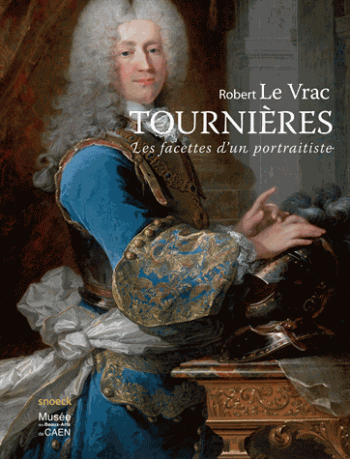
Robert Le Vrac Tournières: Portaitriste au XVIIIe siècle
Musée des Beaux-Arts de Caen, 14 June — 21 September 2014
 L’exposition d’été du musée des Beaux-Arts de Caen dépend étroitement du chiffre 3 : 3 artistes (deux portraitistes et un paysagiste), 3 siècles (les XVIIIe, XIXe et XXe), 3 époques, 3 temps de l’histoire de l’art mais aussi de l’histoire du musée des Beaux-Arts de Caen.
Robert Le Vrac Tournières (1667–1752) et Marie-Gabrielle Capet (1761–1818) furent de ramarquables portraitistes, chacun dans leur genre : Tournières fut un des grands maîtres du portrait au temps de Louis XV et Capet porta le genre de la miniature (précieux portraits peints sur ivoire) à un point éblouissant. Joan Mitchell (1925–1992), quant à elle, demeure l’un des grands peintres abstraits de la seconde moitié du XXe siècle.
La muséographie des trois salles est spécialement conçue pour chaque artistes : elle met en valeur les compositions de Tournières, suggére l’atmosphère d’un cabinet d’amateur pour les miniatures de Capet et joue des vastes espaces lumineux pour les paysages de Mitchell. Il se trouve aussi que chacun de ces artistes tient une place importante dans l’histoire du musée pour des raisons très différentes. Tournières, car des oeuvres insignes de ce maître sont récemment entrées dans les collections. Capet, car ce qui est probablement son chef-d’oeuvre est conservé au musée après y avoir été volé puis restitué. Joan Mitchell est un temps fort des collections contemporaines de Caen. Ces trois peintres sont le point de départ de trois expositions au cours desquelles sont évoqués leur histoire, leur oeuvre, leur art. Une façon de réconcilier le hasard et la raison.
Robert Le Vrac Tournières, né et mort à Caen (1667–1752), a eu une longue et brillante carrière presque exclusivement parisienne. Pendant près d’un demi-siècle, c’est une clientèle aristocratique et bourgeoise qui fréquente son atelier où il propose un art hérité de Rigaud, sans exclure une production de petits tableaux dans le goût nordique, tout comme des allégories décoratives. Jalon important de l’histoire du portrait français. Tournières n’a jamais fait l’objet d’exposition monographique. Il appartient au musée de Caen, qui possède un ensemble significatif de ses oeuvres, d’organiser une manifestation qui restitue l’étendue de son art, en regroupant des oeuvres provenant essentiellement des grandes collections publiques.
Eddie Tassel and Patrick Ramade, Robert Le Vrac Tournières: Les facettes d’un portraitiste (Cologne: Snoeck Verlagsgesellschaft, 2014), 96 pages, ISBN: 978-9461611840, 18€.
◊ ◊ ◊ ◊ ◊
As reported by Didier Rykner for La Tribune de l’Art (July 2014), the Musée des Beaux-Arts de Caen purchased at Christie’s (New York, 30 January 2014) Robert Le Vrac Tournières’s 1704 Self-portrait with Pierre de la Roche, which had previously been in the collection of The Metropolitan Museum of Art. The painting sold for $37,500.
Exhibition | Marie-Gabrielle Capet: Une Virtuose de la Miniature
From the Musée des Beaux-Arts de Caen:
Marie-Gabrielle Capet: Une Virtuose de la Miniature
Musée des Beaux-Arts de Caen, 14 June — 21 September 2014
 L’exposition d’été du musée des Beaux-Arts de Caen dépend étroitement du chiffre 3 : 3 artistes (deux portraitistes et un paysagiste), 3 siècles (les XVIIIe, XIXe et XXe), 3 époques, 3 temps de l’histoire de l’art mais aussi de l’histoire du musée des Beaux-Arts de Caen.
Robert Le Vrac Tournières (1667–1752) et Marie-Gabrielle Capet (1761–1818) furent de ramarquables portraitistes, chacun dans leur genre : Tournières fut un des grands maîtres du portrait au temps de Louis XV et Capet porta le genre de la miniature (précieux portraits peints sur ivoire) à un point éblouissant. Joan Mitchell (1925–1992), quant à elle, demeure l’un des grands peintres abstraits de la seconde moitié du XXe siècle.
La muséographie des trois salles est spécialement conçue pour chaque artistes : elle met en valeur les compositions de Tournières, suggére l’atmosphère d’un cabinet d’amateur pour les miniatures de Capet et joue des vastes espaces lumineux pour les paysages de Mitchell. Il se trouve aussi que chacun de ces artistes tient une place importante dans l’histoire du musée pour des raisons très différentes. Tournières, car des oeuvres insignes de ce maître sont récemment entrées dans les collections. Capet, car ce qui est probablement son chef-d’oeuvre est conservé au musée après y avoir été volé puis restitué. Joan Mitchell est un temps fort des collections contemporaines de Caen. Ces trois peintres sont le point de départ de trois expositions au cours desquelles sont évoqués leur histoire, leur oeuvre, leur art. Une façon de réconcilier le hasard et la raison.
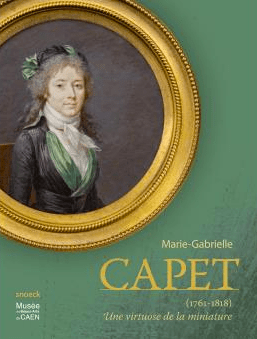
Marie-Gabrielle Capet: Une Virtuose de la Miniature
L’an dernier, le musée a pu retrouver, presque par miracle, une miniature volée en 1925 : le Portrait de Jean-Antoine Houdon sculptant le buste de Voltaire, chef-d’oeuvre de la grande miniaturiste Marie-Gabrielle Capet (1761–1818). Avec comme prétexte cet heureux évènement, l’exposition se propose de rassembler le meilleur de la production de l’artiste ; des miniatures, mais aussi des tableaux issus de collections publiques et privées, françaises et étrangères, qui permettront d’illustrer un style qui fascina son époque, exactitude illusionniste de la touche et rendu vibrant de la lumière. L’ensemble permet d’évoquer l’influence capitale de ses maîtres, Adélaïde Labille-Guiard et son époux François-André Vincent.
Marie-Gabrielle Capet (1761–1818): Une Virtuose de la Miniature (Cologne: Snoeck Verlagsgesellschaft, 2014), 2014) 104 pages, ISBN: 978-9461611659, 18€.
New Book | Selling Silks: A Merchant’s Sample Book
From the V&A:
Lesley Ellis Miller, Selling Silks: A Merchant’s Sample Book (London: V&A Publishing, 2014), 272 pages, ISBN: 978-1851777815, £35.
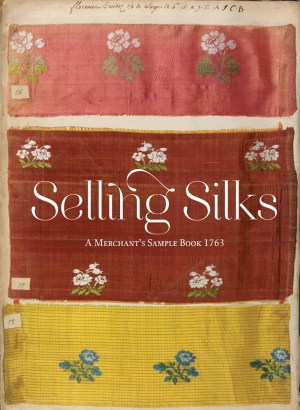 In 1764, British Customs confiscated a book containing hundreds of silk samples of different qualities from French agents who were attempting to sell them illegally in London. The merchant’s sample book acquired in 1972 by the V&A may be this very book, a fascinating record of the eighteenth-century French and English silk industries and their commercial practices.
Alongside a full and faithful reproduction of the whole album, Lesley Miller sets in context the role of the book as a marketing tool from the premier European silk-weaving centre of Lyon and as a model for Spitalfields manufacturers. This publication makes accessible the contents of an extremely rare and fragile object. Translations of French inscriptions, identification of how samples have migrated from one page to another, and technical analysis of some of the silks, as well as a glossary and biographical data on the Lyonnais suppliers make this an invaluable resource for historians, collectors and designers.
Lesley Ellis Miller is Senior Curator of Textiles and Fashion at the V&A. She is a specialist in the silk industry of eighteenth-century Lyon. She is author of a monograph on the fashion designer Cristobal Balenciaga (V&A 2007) and is currently working on the refurbishment of the V&A’s galleries of European seventeenth- and eighteenth-century decorative arts.
Sample pages are available here»
◊ ◊ ◊ ◊ ◊
From La Bibliothèque des Arts:
Lesley Ellis Miller, Soieries: Le livre d’échantillons d’un marchand français au siècle des Lumières, translated by Anne de Thoisy-Dallem (Lausanne: La Bibliothèque des Arts, 2014), 272 pages, ISBN: 978-2884531818, €49.
 Par sa grande rareté, le livre d’échantillons reproduit ici pour la première fois et dont l’original est conservé au Victoria & Albert Museum de Londres, présente un intérêt unique. C’est une véritable révélation qui offre une source d’informations capitale sur la création des soieries en France au XVIIIe siècle.
La provenance de ce livre d’échantillons est originale à elle toute seule. En effet, il fut saisi en 1764 par les Douanes anglaises qui luttaient contre les importations illégales de textiles, qu’organisaient des agents français. Nous sommes aussi en plein roman d’espionnage et de contre –espionnage industriel, comme l’explique l’auteur Lesley E. Miller, conservatrice en chef du Département des Textiles et de la Mode au Victoria and Albert Museum. Son texte vivant nous immerge dans la vie quotidienne des soyeux lyonnais des années 1760. Elle apporte un éclairage très documenté sur la fabrication et sur le commerce des textiles à cette époque qu’elle a étudiée pendant plusieurs années. L’auteur brosse également un panorama illustré de la mode et de l’usage des soieries françaises en Europe sous l’Ancien Régime.
Une analyse technique rigoureuse de chacun des échantillons confère à ce livre le caractère d’un ouvrage de référence qui satisfera les attentes les plus exigeantes. Mais c’est le charme immense qui se dégage de la partie « fac-similé » qui fait de ce livre d’échantillons, reproduit intégralement, un véritable objet de séduction. L’original, relié en carton et en parchemin ne pèse pas moins de 8,400 kg ! Source inépuisable d’inspiration, ces centaines de «morceaux d’étoffe » aux noms pleins de poésie, aujourd’hui disparus, touchent par la fraîcheur de leurs tons et la richesse des motifs.
En dehors des spécialistes et des professionnels de la mode et des textiles, ce livre s’adresse également à tous les amateurs des arts décoratifs.
The French edition was recently featured at La Tribune de l’Art.
New Book | Printed Textiles: British and American Cottons and Linens
From Monacelli:
 The Winterthur Museum’s richly illustrated history of British and American fabrics made or used from 1700 to 1850 is a visual reference for designers and a definitive contribution to textile studies. From slipcovers that belonged to George Washington, to bedhangings described by Harriet Beecher Stowe, Delaware’s Winterthur Museum holds some of the finest cotton and linen textiles made or used in America and Britain between 1700 and 1850. One of the fastest growing and potentially most lucrative trades in the eighteenth and early nineteenth centuries, on the forefront of developments in science and engineering, chemistry and technology, the textile industry is a fascinating lens into international trade relations and cultural exchange over nearly two centuries.
New Book | Start with a House, Finish with a Collection
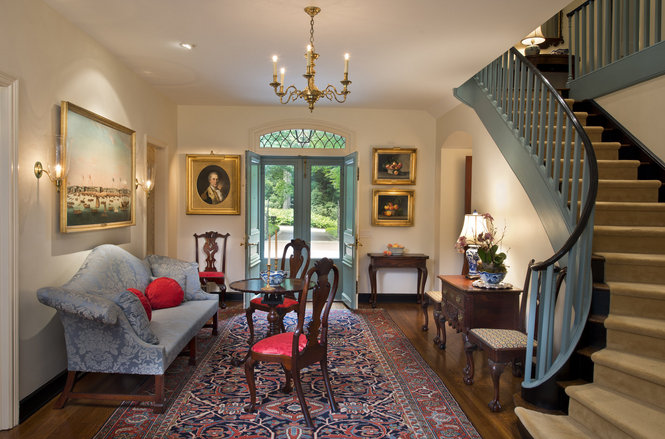 Home of Leslie Ann Miller and her husband, Richard Worley, photo from The Patriot News
◊ ◊ ◊ ◊ ◊
From Scala:
Leslie Anne Miller and Alexandra Kirtley, Start with a House, Finish with a Collection (New York: Scala Arts Publishers, 2014), 272 pages, ISBN: 978-1857599190, $75.
 Start with a House, Finish with a Collection is the story of how a couple’s use of American art and antiques evolved from furnishing a house into a full-blown passion for collecting. Featuring exquisite examples of Hollingsworth and Morris family furniture, Weber boxes, Pennsylvania clocks and Kirk-Stieff silver, as well as American paintings by the Peale family, Edward Hicks, Edward Redfield and Horace Pippin, this museum-caliber collection reveals a pride in the early American sensibility. The combination of text and extraordinary photographs traces this remarkable journey and demonstrates that life can be more than comfortable living among these collections. The compendium catalogues the diversified and important collection, making this a valuable scholarly reference as well as a reading pleasure.
Leslie Anne Miller, a Philadelphia attorney and community leader, has been collecting American art and antiques with her husband Richard Worley for more than 25 years. Alexandra Kirtley is The Montgomery-Garvan Associate Curator of American Decorative Arts at the Philadelphia Museum of Art.
Exhibition | A Royal Collecting Passion: Wilhelm I of Württemberg
From the Staatsgalerie Stuttgart:
A Royal Collecting Passion: Wilhelm I of Württemberg
Staatsgalerie Stuttgart, 18 July — 26 October 2014

Gottlieb Schick, Apollo among the Shepherds, 1806–08, (Staatsgalerie Stuttgart)
As a regent, Wilhelm Friedrich Karl von Württemberg (1781–1864) gave the young kingdom of Württemberg a historical identity; his multifarious initiatives as a collector and patron, however, have all but sunk into oblivion. The holdings of the Staatsgalerie, which opened in 1843, were expanded by artworks in royal ownership as well as by personal gifts. Wilhelm I moreover initiated the acquisition of the Barbini-Breganze collection, which today forms the core of the Staatsgalerie Stuttgart’s holdings in the area of Italian Baroque painting. The royal gifts, still present in our museum’s collection in their near entirety, are now to be presented to the public for the first time in many decades. Numerous furnishings from Wilhelm I’s private residences as well as masterpieces from his private painting collection—disbanded after 1918—will be on view. On the basis of the records at the Staatsarchiv Baden-Württemberg, which have been preserved almost in full, light will also be shed on the history of the royal purchases. The exhibition is being realized in cooperation with the Staatliche Schlösser und Gärten Baden-Württemberg.
More information (in German) is available here»
◊ ◊ ◊ ◊ ◊
The catalogue, published by Nicolai Verlag, is available from ArtBooks.com:
Königliche Sammellust: Wilhelm I. von Württemberg als Sammler und Förderer der Künste (Berlin: Nicolai, 2014), 208 pages, ISBN: 978-3894798727, 35€ / $68.
Exhibition | Masks, Masquerades, and Mascarons

Claude Gillot , The Two Coaches, 1712–16
(Paris: Musée du Louvre)
From the Louvre:
Masques, Mascarades, Mascarons
Musée du Louvre, Paris, 19 June — 22 September 2014
Organized by Françoise Viatte, Dominique Cordellier, and Violaine Jeammet
The exhibition presents approximately one hundred artworks showing the paradoxical function of the mask, an emblem of illusion that consists of “disguising and producing a double.” Masked men have existed in the West since ancient times. The mask hides the face in favor of its double, concealing one to reveal the other, in an act that gives shape to mystery. It belongs to the sacred and the profane, truth and vanity, reality and fiction. It horrifies and seduces, imitates and misleads.
Drawings, sculptures, paintings, and engravings demonstrate its religious role in Greek theater, its playful and rather diabolical force of expression in feasts, balls, and Italian comedies, its funereal presence on the deathbed, and its lasting and protective force on the tombstone. The duplicity of the mask in the world of allegory will also be explored, along with its presence in decoration through the mascaron which appears to be simply an avatar of Medusa’s head cut off by Perseus and placed on Athena’s shield to retain its astonishing power.
◊ ◊ ◊ ◊ ◊
The catalogue is published by Officina Libraria:
Françoise Viatte, Dominique Cordellier, and Violaine Jeammet, Masques, Mascarades, Mascarons (Milan: Officina Libraria, 2014), 272 pages, ISBN: 978-8897737377, 32€.
 L’exposition évoque, à travers une centaine d’oeuvres, la fonction paradoxale du masque, emblème de l’illusion, qui consiste à « dérober et produire un double ».Dessins, sculptures, peintures, gravures montreront son rôle religieux dans le théâtre grec, sa force expressive, ludique et quelque peu diabolique dans la fête, le bal ou la comédie italienne, son empreinte funèbre au lit de mort et sa force pérenne et protectrice au tombeau. Seront aussi abordées la duplicité du masque dans le monde de l’allégorie, sa présence dans l’ornement sous la forme du mascaron qui ne semble rien d’autre qu’un avatar de la tête de la Gorgone coupée par Persée et placée sur les armes d’Athéna pour y conserver son pouvoir sidérant.










 Enfilade
leave a comment