New Title | ‘The Goldfish in the Chandelier’
From The Getty:
Casie Kesterson with illustrations by Gary Hovland, The Goldfish in the Chandelier (Los Angeles: Getty Publications, 2012), 32 pages, ISBN 9781606060940, $18.
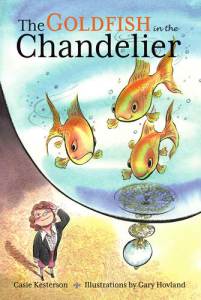 A different kind of adventure story, The Goldfish in the Chandelier takes place just outside of Paris in the early 1800s. Uncle Henri is stuck. He has been commissioned to design a chandelier for a great house in Paris, but he can’t figure out what form it will take. His young nephew, Louis Alexandre, comes to the rescue with some dazzling ideas—inspired by Alexander the Great and the first hot-air balloon flights over Paris—that surprise them both. Together, they use a lot of imagination to create something that never existed before—something new, unexpected, and very beautiful.
This delightful story was inspired by the Gérard-Jean Galle chandelier, one of the most popular pieces in the J. Paul Getty Museum’s impressive collection of French decorative arts. An information page about the chandelier is included in the back of the book. For children ages 7 to 10.

Gérard-Jean Galle, ca. 1818 (Los Angeles: The J. Paul Getty Museum)
Formerly on staff at the Getty Research Institute, Casie Kesterson currently is a consultant specializing in matters relating to the history of collecting art. Gary Hovland’s illustrations have appeared in such nationally and internationally known publications as the New Yorker, the Wall Street Journal, and the New York Times. His illustrations for If the Walls Could Talk: Family Life at the White House (Simon & Schuster, 2004) won a Toy Portfolio Platinum Book Award in 2005.
Autumn Exhibition in Venice | Francesco Guardi
From the Correr:
Francesco Guardi, 1712-1793
Museo Correr, Venice, 28 September 2012 — 6 January 2013
Curated by Alberto Craievich and Filippo Pedrocco

Francesco Gurdi, The Parlour of the Nuns at San Zaccaria
ca. 1750 (Venice: Ca’ Rezzonico), Photo: Wikimedia Commons
◊ ◊ ◊ ◊ ◊
In the third centenary of the birth of Francesco Guardi, the last great landscape artist of the 18th century, the monographic exhibition promoted by the Fondazione dei Musei Civici di Venezia aims to highlight his complex artistic production, from the lesser-known figure paintings of his youth to the ‘interior scenes’, concluding with the splendid views of Venice and his fabulous capriccios, painted in his maturity and old age. The exhibition at the Museo Correr will illustrate the various phases in Guardi’s development thanks to a series of major loans of works never before made to Venice.
It is known that Francesco Guardi’s training took place within a modest family workshop in which everyone was a painter, from his father, Domenico, to his brothers, Nicolò and Antonio. None of them in life was able to attain a certain degree of prosperity, let alone success. After his death in 1793, Francesco Guardi was forgotten. His rediscovery is the merit of 20th-century criticism, and attained a high point in the fine exhibition curated by Pietro Zampetti, held in Palazzo Grassi in 1965.
The first part of the exhibition will focus on the production of works of a prevalently everyday life subject inspired by genre painting of costume painting, one dominated by Pietro Longhi. The exhibition will present two masterpieces from this period: The Ridotto and The Parlour of the Nuns at San Zaccaria, now in Ca’ Rezzonico. A little later, Francesco Guardi began his production of the views, capriccios and fantastic landscapes that underpin his fame today. It is not certain when exactly he began working as a landscape painter; perhaps it was around 1755, when the painter was over 40 years old and had a less than exhilarating career as a figure painter behind him. His first works echoed the compositions of Canaletto and Marieschi, with fluid, controlled brushstrokes, still a long way from the bubbling, shorthand manner that would make him famous. But his unique style does already emerge in some of these works from the first period, including in the St. Mark’s Square belonging to the National Gallery in London, in which the figures, painted by frothy little impastos of colour, reveal a lively chromatic touch. His period of greatest success was between the 1760s and 1770s and it was in this period that he painted the 12 canvases of the Ducal celebrations adapted from Canaletto’s own models and engraved by Giambattista Brustolon. Guardi based his paintings, today in the Louvre, on these prints; the result is truly astonishing and reveals the artist’s transfiguring, fantastic skill.
The picture showing the Bucentaur at San Nicolò on the Lido is exemplary: although faithful to its model, it creates an image of unmatched appeal. The gondolas and Bucentaur used for special occasions seem to shimmer on the water; a myriad of reflections sparkle on the slightly choppy sea, while tiny figures resembling Oriental ideograms bustle in the vessels. In 1782, Guardi was commissioned to paint four pictures to commemorate the visit of Pope Pius VI to Venice. For the 70-year-old artist, here at last was an official commission, and it was followed by the celebratory paintings of the incognito visit to Venice of the Russian archdukes, who travelled under the name of the Counts of the Nort
Over time, his highly personal style became increasingly free and allusive; the proportions between the various elements were freely modified, the perspective framework became elastic and was deformed, losing all association with reality. And finally, the figures became simply splashes of colour, a rapid white scribble or black dot traced out with a trembling movement.
Apart from a number of airy capriccios, he also painted some splendid pictures of villas half-hidden in the green Veneto countryside, and alongside traditional views of Venice he added others of the lagoon, broadening the horizons of 18th-century Venetian landscape and dissolving it in wide stretches of water and sky.
The exhibition will present a total of over 100 paintings and drawings from leading Italian and foreign institutions, including the Musée du Louvre in Paris, the Metropolitan Museum of Art of New York, the National Gallery of Washington, the National Gallery in London, the Gemäldegalerie in Berlin, the Alte Pinakothek of Munich, the Gulbenkian Foundation of Lisbon, the Hermitage of Saint Petersburg, the Fine Art Museum of Boston, the Accademia Carrara in Bergamo and the Poldi Pezzoli of Milan. The exhibition can boast an academic committee formed of the leading international scholars of 18th-century Venetian painting, and will be accompanied by a comprehensive, well-illustrated catalogue edited by Alberto Craievich and Filippo Pedrocco, and published by Skira, containing the latest studies concerning the artist.
Curators: Alberto Craievich and Filippo Pedrocco
Academic Committee: Giuseppe Pavanello, Charles Beddington, Catherine Whistler, Keith Cristiansen, Stephane Loire, Andrew Robison, Irina Artemieva, Lino Moretti
Scientific Director: Gabriella Belli
◊ ◊ ◊ ◊ ◊
Catalogue: Alberto Craievich and Filippo Pedrocco, eds., Francesco Guardi, 1712-1793 (Milan: Skira, 2012), ISBN: 9788857214818, $90. Available October 2012
New Title | ‘Debates in the Digital Humanities’
My sense is that Art History is by and large (and yes I’m generalizing), a few steps behind other disciplines in terms of the digital humanities (in contrast, for instance, to the large umbrella of eighteenth-century studies). One might explain the lag (if I’m even correct in characterizing it as such) in terms of the differences between texts and images. I suspect, however, that the limitations of working with large numbers of images in terms of searches and quantification will soon begin to recede. -CH
◊ ◊ ◊ ◊ ◊
From the U of Minnesota Press:
Matthew K. Gold, ed., Debates in the Digital Humanities (Minneapolis: University of Minnesota Press, 2012), 532 pages, ISBN 9780816677955 ($35) / ISBN 9780816677948 ($105).
 Debates in the Digital Humanities brings together leading figures in the field to explore its theories, methods, and practices and to clarify its multiple possibilities and tensions. Together, the essays—which will be published later as an ongoing, open-access website—suggest that the digital humanities is uniquely positioned to contribute to the revival of the humanities and academic life.
Encompassing new technologies, research methods, and opportunities for collaborative scholarship and open-source peer review, as well as innovative ways of sharing knowledge and teaching, the digital humanities promises to transform the liberal arts—and perhaps the university itself. Indeed, at a time when many academic institutions are facing austerity budgets, digital humanities programs have been able to hire new faculty, establish new centers and initiatives, and attract multimillion-dollar grants.
Clearly the digital humanities has reached a significant moment in its brief history. But what sort of moment is it? Debates in the Digital Humanities brings together leading figures in the field to explore its theories, methods, and practices and to clarify its multiple possibilities and tensions. From defining what a digital humanist is and determining whether the field has (or needs) theoretical grounding, to discussions of coding as scholarship and trends in data-driven research, this cutting-edge volume delineates the current state of the digital humanities and envisions potential futures and challenges. At the same time, several essays aim pointed critiques at the field for its lack of attention to race, gender, class, and sexuality; the inadequate level of diversity among its practitioners; its absence of political commitment; and its preference for research over teaching.
Together, the essays in Debates in the Digital Humanities—which will be published both as a printed book and later as an ongoing, open-access website—suggest that the digital humanities is uniquely positioned to contribute to the revival of the humanities and academic life.
New Title | ‘Knowing Nature: Art and Science in Philadelphia’
From Yale UP:
Amy R. W. Meyers and Lisa L. Ford, eds., Knowing Nature: Art and Science in Philadelphia, 1740-1840 (New Haven: Yale University Press, 2012), 424 pages, ISBN: 9780300111040, $65.
 Philadelphia developed the most active scientific community in early America, fostering an influential group of naturalist-artists, including William Bartram, Charles Willson Peale, Alexander Wilson and John James Audubon, whose work has been addressed by many monographic studies. However, as the groundbreaking essays in Knowing Nature demonstrate, the examination of nature stimulated not only forms of artistic production traditionally associated with scientific practice of the day, but processes of making not ordinarily linked to science.
The often surprisingly intimate connections between and among these creative activities and the objects they engendered are explored through the essays in this book, challenging the hierarchy that is generally assumed to have been at play in the study of nature, from the natural sciences through the fine and decorative arts, and, ultimately, popular and material culture. Indeed, the many ways in which the means of knowing nature were reversed – in which artistic and artisanal culture informed scientific interpretations of the natural world – forms a central theme of this pioneering publication.
Exhibition | Gainsborough’s Landscapes
From the Holburne Museum in Bath . . .
Gainsborough’s Landscapes: Themes and Variations
Holburne Museum, Bath, 24 September 2011 — 22 January 2012
Compton Verney, Warwickshire, 11 February — 10 June 2012

Thomas Gainsborough, Landscape with a View of a Distant
Village, ca. 1750 (Edinburgh: National Gallery of Scotland)
◊ ◊ ◊ ◊ ◊
Gainsborough’s Landscapes: Themes and Variations is the first exhibition in fifty years devoted solely to his landscape paintings and drawings, bringing together remarkable works from public and private collections, many of them little known and some not previously exhibited. For Gainsborough, if portraiture was his business, landscape painting was his pleasure, and his landscape paintings and drawings reveal his mind at work, the extraordinary breadth of his invention and the dazzling quality of his technique.
Thomas Gainsborough (1727-1788) sold relatively few of his landscape paintings, and none of his drawings, but he regarded them as his most important work. His paintings do not represent real views, but are creations ‘of his own Brain’, as he put it. A limited number of rural subjects exercised his imagination from one decade to the next, changing as he developed an increasingly energetic ‘hand’, or manner of painting, and becoming ever grander in conception.
The exhibition includes some of his most famous and popular works including The Watering Place from the National Gallery (the most famous of all his landscape compositions in his life-time) and less well-known works such as the little-seen but ravishing Haymaking from Woburn. The paintings have been selected to represent six landscape themes; the remarkable drawings and prints show Gainsborough returning to these themes and demonstrate the longevity of each theme and the degree of experimentation that was involved in the search for the perfect composition.
The evolution of Gainsborough’s style is traced from early naturalistic landscapes in the Dutch manner, enlivened with small figures (pictured above), to grand scenery that is dramatically lit and obviously imaginary, such as the Romantic Landscape from the Royal Academy of Arts. In the Girl with Pigs, from the Castle Howard Collection, a rustic figure takes centre stage: fancy figures of this kind are, in Gainsborough’s art, closely integrated with his landscape practice.
◊ ◊ ◊ ◊ ◊
Accompanying publication: Susan Sloman, Gainsborough’s Landscapes: Themes and Variations (London: Philip Wilson Publishers, 2011), ISBN: 9780856676970, £14.99
New Title | James Wyatt, 1746-1813: Architect to George III
From Yale UP:
John Martin Robinson, James Wyatt, 1746-1813: Architect to George III (London: Paul Mellon Centre for Studies in British Art, 2012), 400 pages, ISBN: 9780300176902, $75.
 James Wyatt (1746–1813) is widely recognized as the most celebrated and prolific English architect of the 18th century. At the start of his lengthy career, Wyatt worked on designs for the Oxford Street Pantheon’s neo-Classical interior as well as Dodington, the Graeco-Roman house that served as the model for the Regency country house. Wyatt was the first truly eclectic and historicist architect, employing several versions of Classical and Gothic styles with great facility while also experimenting in Egyptian, Tudor, Turkish, and Saxon modes. His pioneering Modern Gothic marked him as an innovator, and his unique neo-Classical designs were influenced by his links with the Midlands Industrial Revolution and his Grand Tour education.
This groundbreaking book sheds new light on modern architectural and design history by interweaving studies of Wyatt’s most famous works with his fascinating life narrative. This masterly presentation covers the complex connections formed by his web of wealthy patrons and his influence on both
his contemporaries and successors.
John Martin Robinson is an independent architectural historian. He is a partner in Historic Buildings Consultants, Librarian to the Duke of Norfolk, Maltravers Herald Extraordinary and Vice Chairman of the Georgian Group. He is a regular architectural contributor to Country Life and the author of numerous books.
Reviewed | Charlotte Yeldham’s ‘Maria Spilsbury’
Recently added to caa.reviews:
Charlotte Yeldham, Maria Spilsbury (1776–1820): Artist and Evangelical (Burlington: Ashgate, 2010). 230 pages, ISBN: 9780754669913, $125.
Reviewed by Jonathan Rinck, Spring Arbor University; posted 22 March 2012.
In her short biographical work ‘Father and Daughter: Jonathan and Maria Spilsbury’ (London: Epworth, 1952), Ruth Young, a descendant of Maria Spilsbury (Spilsbury-Taylor, after her marriage in 1808), recounts a delightful anecdote in which the future King George IV visited Spilsbury’s studio on St. George’s Row, London. Impatient with how slowly work was progressing on his commission which, to his judgment, seemed complete, he exclaimed, ‘Really, Mrs. Taylor, I swear that you can do no more to that! You’ve finished it and a damned good picture it is’. Unconvinced, Spilsbury sought a second opinion from her maid. Upon close inspection, the maid astutely pointed out that, distressingly, the woman sewing in the painting still lacked a thimble. At this, the exasperated prince, Young writes, chased the maid out of the room, ‘her cap-strings flying’ (32). Any other artist might have obligingly yielded to the prince, but such was Spilsbury’s notoriety that visits from the Prince Regent, her chief patron, were merely commonplace.
In spite of her success and popularity, astonishingly little scholarly attention has been given to Spilsbury. Redressing this problem, Charlotte Yeldham’s ‘Maria Spilsbury (1776–1820): Artist and Evangelical’ fills a void that has remained embarrassingly vacant for too long. Additionally, Yeldham offers special attention to the influence of the Evangelical faith upon Spilsbury’s art, a topic which has also been largely ignored, not merely in the life of Spilsbury, but in the larger context of late eighteenth-century artists in general. On both fronts, this book will prove to be an invaluable and authoritative contribution to Spilsbury scholarship.
In the introduction, Yeldham writes that the intent of her book is to give attention to an artist who exhibited at the Royal Academy at the age of fifteen, was exhibited at the British Institution, is represented in public and private collections in England, Ireland, America, Australia, and New Zealand, and frequently present in auction houses, yet of whom very little is known . . .
The full review is available here» (CAA membership required)
Reviewed | ‘The Culture of Architecture in Enlightenment Rome’
Recently added to caa.reviews:
Heather Hyde Minor, The Culture of Architecture in Enlightenment Rome, Buildings, Landscapes, and Societies, vol. 6 (University Park: Pennsylvania State University Press, 2010), 312 pages, ISBN: 9780271035642, $95.
Reviewed by Richard Wittman, University of California at Santa Barbara; posted 22 March 2012.
The most famous works of eighteenth-century Roman architecture and urbanism, such as the Trevi Fountain or the Spanish Steps, have always seemed more at home at the end of histories of Baroque architecture than at the start of histories of modern architecture; there, one is more likely to encounter Laugier’s hut or Soufflot’s Sainte-Geneviève. The idea that the architectural initiative passed from Rome to the north sometime around 1700 extends back to the eighteenth century itself, and was rarely questioned in the century-long tradition of formalist architectural history inaugurated in the late nineteenth century. But while eighteenth-century Rome has had its apologists who complain that the quality of its architectural output is unfairly overlooked, it was the rise of culturally and socially oriented models of architectural history that really gave eighteenth-century Rome its second chance. These approaches were less concerned with aesthetic distinction or innovation than with interpreting architecture in relation to broader historical transformations. True, Rome had only a tenuous connection to the new master narratives of eighteenth-century scholarship, which center on that world-changing cocktail of Enlightenment ideas mixed with growing middle-class participation in public culture. (Rome had a negligible productive economy, and therefore lacked a bourgeoisie comparable to those of northern cities.) But this is not to say that the new ideas of the century had no impact in the Eternal City. On the contrary; but the impact came strictly within the politically stable limits of clerical culture, where such ideas inspired reformers hoping to re-arm the Church in its battle against the decline of Catholic influence. And it has been by studying how architecture and planning were drawn into these debates—debates local in scope but international in significance—that recent scholars have unlocked the rich interest of Roman architectural culture during this period. Heather Hyde Minor’s informative, wide-ranging, and deeply researched new book follows squarely in that path. . .
The full review is available here» (CAA membership required)
April 2012 Issue of ‘Apollo Magazine’
Eighteenth-century offerings from the latest Apollo Magazine (for the full text of each article, click on the images below). . .
◊ ◊ ◊ ◊ ◊
Anne Kapeller, “A Unique Heritage: Treasures of the Swiss National Museum in Nyon,” Apollo Magazine (April 2012).
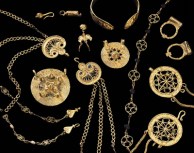 . . . In 1741, the curate Johann Georg Sulzer carried out a series of excavations at Lunnern, in the Reuss Valley near Zurich, leading to the discovery of a Roman temple, baths and a necropolis. On 17 November, he uncovered a hoard consisting of 17 pieces of gold jewellery and 84 silver coins, hidden in a recess. Three days later news of the sensational discovery reached Zurich. The painter Johann Balthasar Bullinger was commissioned to visit the site and produce a picture of the excavations. It was preserved along with the jewels in the art collection of the Wasserkirche in Zurich, before becoming part of the collections of the SNM. . .
◊ ◊ ◊ ◊ ◊
Lucy Davis & Christoph Martin Vogtherr, “A Taste for Blue,” Apollo Magazine (April 2012).
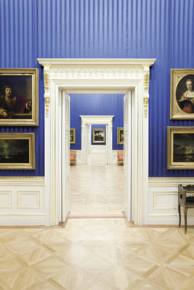 The Wallace Collection is famous for its exceptional group of works from the French 18th century. A smaller collection of around 150 Dutch 17th-century paintings is of equally fine quality, including masterpieces by Frans Hals, Rembrandt, Gerard ter Borch, Pieter de Hooch, Jan Steen, Gabriel Metsu, Caspar Netscher, Jacob van Ruisdael, Nicolaes Berchem, Philips Wouwermans and other leading painters of the Golden Age. It is particularly rich in genre paintings, landscapes by the Dutch Italianates and the work of some outstanding artists – Rembrandt first of all, but also Steen, Metsu, Willem van de Velde, Meindert Hobbema and Willem van Mieris. The resulting view of Dutch art does not provide a systematic overview but follows the personal preferences of the collectors and the typical view of Dutch art during the 18th and early 19th centuries. Artists such as Jan van Goyen, Hercules Seghers and Vermeer, but also the earlier periods before Rembrandt, are hardly represented. They were only admitted to the canon
at a time when the Hertford family had stopped collecting Dutch art. . .
◊ ◊ ◊ ◊ ◊
Juliet Carey, “A House of Cards: Taking Time,” Apollo Magazine (April 2012).
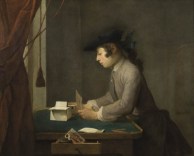 Waddesdon Manor is temporarily home to a small but extraordinarily beautiful group of works by one of the most revered of all French painters. The exhibition Taking Time: Chardin’s ‘Boy Building a House of Cards’ and Other Paintings is prompted by the recent acquisition of one of four works by Jean-Siméon Chardin (1699–1779) of a subject that particularly fascinated him. The last to enter the public domain, the Waddesdon canvas, is united for the first time with three other variations on the theme, on loan from national collections in France, Britain and the United States. . .
◊ ◊ ◊ ◊ ◊
Humphrey Wine, “The Art of a Connoisseur: Review of Pierre Rosenberg and Laure Barthélemy-Labeeuw, Les Dessins de la Collection de Pierre-Jean Mariette (2011),” Apollo Magazine (April 2012).
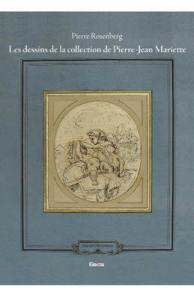 Soon after the death of Pierre-Jean Mariette (1694–1774) his heirs had Pierre François Basan organise a sale of his collection. It included paintings (among them Poussin’s Nurture of Bacchus, c. 1628, now in the National Gallery, London), terracottas, antique marbles, bronzes and engraved gems; the bulk of the sale, however, comprised some 9,000 Italian, Dutch, Flemish and French drawings. It was not only size that distinguished Mariette’s collection of drawings – the earlier collection of Pierre Crozat, built with Mariette’s advice, had been twice as large – but also its quality and comprehensive nature. . . .
Exhibition | The Art of German Stoneware
From the Philadelphia Museum of Art:
The Art of German Stoneware
Philadelphia Museum of Art, 5 May — 5 August 2012
Curated by Jack Hinton

Inkstand and Candleholder with Musicians, Animals, and a Griffin, ca. 1740. German Salt-glazed stoneware with painted decoration, roughly 20 x 10 x 7 in. (Philadelphia Museum of Art)
From the fourteenth through eighteenth centuries, stoneware ceramics from Germanspeaking centers in modern-day Germany and the Low Countries were valued and widely traded throughout northern Europe. In the 1600s—the heyday of stoneware production—they found an enthusiastic market in colonial North America. The medium’s success is due to its stonelike durability and imperviousness to liquid, making it perfect for cooking, storage, and drinking vessels. The social aspect of stoneware ceramics explains the crisp relief decoration on sixteenth- and seventeenth-century pieces, which feature moralizing images or political figures and their coats of arms; later pieces often eschew such ornament for floral or geometric patterns inspired by Far Eastern porcelains imported to Europe. Inkstand and Candleholder with Musicians, Animals, and a Griffindemonstrates the inventiveness and artistry of stoneware potters, even when faced with a dwindling market for their works in the homes of the well-to-do. This exhibition examines German stoneware from its origins to later revivals in the nineteenth-century and celebrates its long-standing relationship with the city of Philadelphia. It features selections from the Museum, seventeenth-century Dutch pictures demonstrating the high status of stoneware, and a generous promised gift of around forty pieces of German
stoneware from Dr. Charles W. Nichols. The exhibition is accompanied by an
illustrated publication by Jack Hinton, Assistant Curator of European Decorative
Arts and Sculpture.
◊ ◊ ◊ ◊ ◊
From Yale UP:
Jack Hinton, The Art of German Stoneware, 1300-1900 From the Charles W. Nichols Collection and the Philadelphia Museum of Art (New Haven: Yale University Press, 2012), 60 pages, ISBN: 9780300179781, $20.
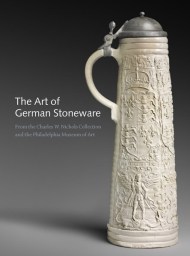 Beautiful and eminently useful, stonewares produced in the German-speaking lands from the Middle Ages onward were highly valued for their durability and suitability for a range of domestic and social uses. Widely traded throughout Europe, they were also among the first European ceramics to reach colonial North America. During the Renaissance the addition of brilliant salt glazes—s well as relief imagery that communicated with the user—raised the status of these wares. Later examples introduced abstract floral or geometric decorations and more unusual, original forms, which retained broad cultural significance.
About ninety fine stoneware pieces from the Philadelphia Museum of Art and a promised private collection testify here to the success, artful decoration, and fascinating variety of this medium. Jack Hinton describes the developments in stoneware through these notable examples, and beautiful color images bring
their details vividly to life.










leave a comment