Exhibition | The Horse: From Arabia to Royal Ascot
While you probably wouldn’t know it from the description provided below, the eighteenth century is a major theme for this exhibition on horses at The British Museum — with a good showing of Stubbs, including Letitia, Lady Lade from the Royal Collection, but other treats, too. I found it immensely instructive, one of the most interestingly layered exhibitions I recall seeing in a long time. There’s something for everyone — antiquity and the role of the horses in early civilizations and empires of Mesopotamia and Egypt, extraordinary Persian and Mughal miniatures, textiles, equestrian rock art (photographed in stunning detail), paintings, books, portraiture, agrarian history, and sport. The challenge, however, is not simply putting together a varied exhibition but imparting coherence, and given just how much is covered in this relatively modest sized show, it succeeds brilliantly, appropriately acknowledging both the Diamond Jubilee and the Olympics without being obsequious to either one. It also offers, I think, an example of how projected photographs and video can be used effectively in an exhibition without taking over or supplanting the objects on display. For better or worse, I’m guessing we’ll see lots more moving images in the exhibitions of the future. Integrating that technology thoughtfully into the larger intellectual program of a show is a tall order. The Horse: From Arabia to Royal Ascot offers a start and plenty else besides.
-Craig Hanson
◊ ◊ ◊ ◊ ◊
From The British Museum:
The Horse: From Arabia to Royal Ascot
The British Museum, London, 24 May — 30 September 2012
Curated by John Curtis and Nigel Tallis
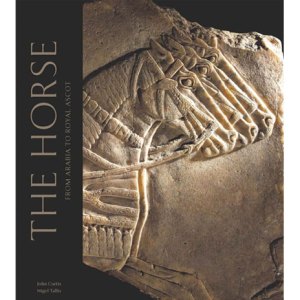 The history of the horse is the history of civilisation itself. The horse has had a revolutionary impact on ancient civilisations and this major exhibition explores the influence of horses in Middle Eastern history, from their domestication around 3,500 BC to the present day. Britain’s long equestrian tradition is examined from the introduction of the Arabian breed in the 18th century to present day sporting events such as Royal Ascot and the Olympic Games.
Important loans from the British Library, the Fitzwilliam Museum and the Royal Armouries, as well as rare material from Saudi Arabia, will be seen alongside objects from the British Museum’s exceptional collection, including famous pieces such as the Standard of Ur and Achaemenid Persian reliefs. Supported by the Board of Trustees of the Saudi Equestrian Fund, the Layan Cultural Foundation and Juddmonte Farms. In association with the Saudi Commission for Tourism & Antiquities. (more…)
Enfilade at Three — Buy a Book and Open a Door
From the Editor
 Enfilade turns three today, and to celebrate, I’m announcing a campaign to establish June 22 as Buy-an-Art-Book Day. As I’ve said repeatedly, you deserve credit for making this site so much more than I could have possibly envisioned when I stepped on-board several years ago as newsletter editor. With more than 220,000 hits on some 1300 posts, Enfilade attests to the global depth of interest in eighteenth-century art — both among scholars and a wider, engaged public. The site now receives around 10,000 hits each month with some 1500 from returning visits. In short, there are hundreds of you who read Enfilade on a regular basis, and the site’s success depends on you. Thank you!
With these numbers in mind, it seems to me that Enfilade readers could mobilize to make an impact — modest perhaps but still an impact. In transitioning from traditional print formats to the digital realm, academic publishing, particularly art historical publishing, faces tremendous challenges. With the ‘business’ of the academy more generally plagued by questions of sustainability, it’s easy to see how hard decisions about budgets have wreaked havoc on the sales of books (when major universities are cutting whole departments, declining library budgets may seem relatively benign, but in both cases, fewer books will be sold). For most of us, such gloomy observations are all too familiar, and you don’t turn to Enfilade for more bad news. Today is after all a birthday celebration!
So as a gesture of positive action, I’m asking all of you to buy a book today (and fellow bloggers to spread the word). It’s easy to think that it won’t matter, but it does. Most people are astounded to learn just how small the circulation numbers are for art history books published by university presses. However humbling it may be for those of us who spend years of our lives producing a book, it’s not uncommon for only 400 or 500 copies to be sold. Surpass 1000 and you’re a superstar. There’s a tendency to assume that university presses receive generous funding from their host universities. It’s almost never the case. If they’re not in the business to turn huge profits, they must still be economically viable. Several years ago, I heard Susan Bielstein, executive editor at the University of Chicago Press, give a talk on the nuts and bolts of publishing. How did she begin? By asking members of her audience (almost entirely composed of art historians) to go buy a book. She was entirely serious. So am I.

Many of you buy lots of art history books already. Bravo! Buying a book today won’t be any major change for you. As I think about my own buying habits, they tend to go something like this: I buy discounted display copies at conferences, I buy things I need for an upcoming talk, I buy remaindered copies of books I should have bought a year or two earlier, or I buy used copies I need for an article via Amazon. None of that’s what I have in mind in launching Buy-an-Art-Book Day. Those used books do nothing to help the authors or the university presses who produced them. For that matter, new purchases through Amazon often result in smaller royalties than buying from the publisher directly. Ever wonder who shoulders the expense of that reduced price? Yes, the publisher and the writer.
If 200 or 300 of you buy an art history book this week — ideally one treating the eighteenth century and, better yet, one written by a HECAA member — it would send a strong message that there is an eager audience for such books. Whether you spend $6 or $1000, buy a book.
I like the metaphor of an enfilade because of the way it suggests an open — almost limitless — vista, with each room leading to a deeper, more intimate experience. But such a vision is premised on those doors being opened. Reading a book — buying a book — is one way we turn the handle, one way we open doors to the eighteenth century.
-Craig Hanson
Exhibition | Canaletto: The Venetian Notebook
Thanks to Stacey Sloboda for noting this one that almost slipped by me (a brief English description is available here). From the Palazzo Grimani:
Canaletto: Il Quaderno Veneziano
Palazzo Grimani, Venice, 1 April — 1 July 2012
Curated by Annalisa Perissa Torrini
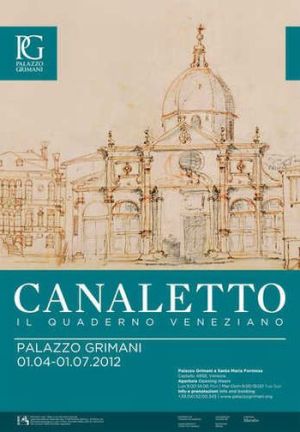 Apre a Venezia il 1 aprile, nella cornice straordinaria delle sale di Palazzo Grimani, la mostra Canaletto. Il Quaderno veneziano dedicata al celebre Quaderno di schizzi di Canaletto, un unicum nella storia dell’arte del Settecento, codice mai visibile al pubblico, ora presentato assieme a ventiquattro disegni di antica provenienza veneziana, appartenenti a collezioni pubbliche e private, per la prima volta insieme.
Il progetto espositivo è a cura del Direttore del Gabinetto dei Disegni delle Gallerie dell’Accademia, Annalisa Perissa Torrini, programmato nell’ambito della valorizzazione del fondo grafico, promosso dalla Soprintendenza Speciale per il Patrimonio storico, artistico ed etnoantropologico e per il Polo Museale della città di Venezia e dei comuni della Gronda lagunare e prodotto da Venezia Accademia con il contributo di Save Venice Inc.
La mostra indaga il modus operandi dell’artista, definendone la concreta operatività nella fase di costruzione grafica e stabilisce il ruolo svolto dalla camera ottica nell’ideazione e realizzazione delle vedute di Venezia.
Il Quaderno di Canaletto è un prezioso piccolo volume (mm 175×235) formato da 7 fascicoli, rilegati nell’Ottocento, ma in origine sciolti, ricolmo di schizzi realizzati probabilmente in un breve arco di tempo, poi riutilizzato dal pittore veneziano negli anni. Ogni fascicolo racconta il processo creativo del suo lavoro: le tipiche annotazioni sui colori, sui materiali e sui luoghi ritratti, le correzioni e abrasioni, i cambi di inchiostro e di penna, lo sporadico uso del righello e l’impiego della punta metallica, la cui presenza è stata osservata nel corso degli studi e delle analisi delle tecniche e della carta.
Insieme al Quaderno, vengono esposti otto fogli, tra cui il cosiddetto “scarabotto” con il Canal Grande di fronte alla Salute e il Traghetto di San Moisé, della raccolta delle Gallerie, sette fogli della Galleria Nazionale d’Arte Antica di Trieste, sette fogli poco noti di collezione privata italiana di provenienza Corniani-Algarotti, il foglio della Fondazione Cini e quello del Museo Correr di Venezia. Importanti dipinti di collezioni pubbliche e private mostreranno poi la realizzazione pittorica di alcuni disegni esposti in mostra: capolavori delle Gallerie dell’Accademia, di Ca’ Rezzonico, degli Uffizi, di Castello Sforzesco e di importanti collezioni private italiane, mentre alcune incisioni, di Visentini e Smith, documentano l’importanza delle stampe sia nell’iter creativo dell’artista, che nella diffusione della sua opera.
In occasione della mostra verrà pubblicato un fac-simile del Quaderno di Canaletto, edito da Marsilio Editori, accompagnato da un saggio storico interpretativo di Annalisa Perissa Torrini e seguito da uno studio sulla fascicolazione e rilegatura condotto da Barbara Biciocchi, da un testo sulla camera ottica a cura di Dario Maran, e documenti sulla vita di Canaletto trovati da Alessandra Schiavon all’Archivio di Stato di Venezia.
Il progetto di allestimento, curato da Annunziata Genchi, comprende supporti audiovisivi e multimediali didattici, fra i quali una riproduzione digitale del Quaderno, realizzata da Mauro Tarantino, che permetterà al visitatore di sfogliare virtualmente tutte le pagine del prezioso codice, mentre diversi filmati illustreranno l’utilizzo e le finalità della camera ottica, i modi di fascicolazione del volume e le tecniche grafiche di esecuzione, un filmato in 3D con il confronto tra i disegni e i dipinti ed un altro sul funzionamento della camera ottica. Un modello funzionante di camera ottica, inoltre, è stato realizzato in collaborazione con il Musée Maillol di Parigi, dove il visitatore potrà guardare le “vedute” come faceva lo stesso Canaletto.
◊ ◊ ◊ ◊ ◊
From Marsilio:
Annalisa Perissa Torrini, ed., Canaletto. Il Quaderno veneziano (Marsilio, 2012), 236 pages, ISBN: 9788831713009, €33.
 In occasione della mostra Canaletto. Il Quaderno veneziano, in programma a Venezia nella splendida cornice di Palazzo Grimani dall’1 aprile all’1 luglio, verrà pubblicato un fac-simile dell’affascinante manufatto, un unicum nella storia dell’arte del Settecento, solitamente non visibile al pubblico. Il prezioso volume formato da sette fascicoli, rilegati nell’Ottocento ma in origine sciolti, ricolmo di schizzi realizzati probabilmente in un breve arco di tempo, venne riutilizzato negli anni da Canaletto come strumento di lavoro. Ogni fascicolo racconta l’operare del maestro veneziano: racchiude le tipiche annotazioni sui colori, sui materiali e sui luoghi raffigurati, le correzioni e le abrasioni, i cambi di inchiostro e di penna, tutte quelle tracce che rappresentano la sua memoria grafica, la registrazione di dati veri, oggettivi, esatti da interpretare e rielaborare nella fase creativa della composizione della veduta. In apparato al fac-simile saranno inseriti, oltre agli interessanti risultati delle recenti analisi sulle cosiddette informazioni “nascoste” – non visibili a occhio nudo – e su fascicolazione e rilegatura dell’opera, anche un saggio storico interpretativo di Annalisa Perissa e un testo di Dario Maran che stabilisce il ruolo svolto dalla camera ottica nell’ideazione e realizzazione delle vedute di Venezia.
◊ ◊ ◊ ◊ ◊
Exhibition | Expanding Horizons: Lusieri and the Panoramic Landscape
From the National Galleries of Scotland, as noted by Hélène Bremer:
Expanding Horizons: Giovanni Battista Lusieri and the Panoramic Landscape
Scottish National Gallery, Edinburgh, 30 June — 28 October 2012
Curated by Aidan Weston-Lewis

Giovanni Battista Lusieri, The Monument to Philopappos, Athens, ca. 1805-07
Giovanni Battista Lusieri (1754–1821) was hailed during his lifetime as one of the most gifted of all living landscape artists and his exquisitely crafted works were eagerly sought by collectors. But within a few years of his death his reputation descended into an obscurity from which it has only recently begun to re-emerge. His name will still be unfamiliar to all but a few specialists, a neglect which this exhibition, the first ever devoted to the artist, aims to redress.
Lusieri was one of very few Italian artists to have adopted watercolour as their favoured medium. From the outset his work exhibits the meticulous detail, precision and faultless perspective that remained the hallmarks of his style throughout his career, combined with a panoramic breadth of vision and an astonishing ability to render brilliant effects of light. The latter part of Lusieri’s career was spent mainly in Athens as Lord Elgin’s resident artist and agent. In that capacity he was closely involved in supervising the removal and shipping of the celebrated marbles from the Acropolis, now in the British Museum.
◊ ◊ ◊ ◊ ◊
Catalogue: Aidan Weston-Lewis with Fabrizia Spirito, Kim Sloan, and Dyfri Williams, Giovanni Battista Lusieri and the Panoramic Landscape: Expanding Horizons (Edinburgh: National Galleries of Scotland, 2012), 236 pages, ISBN: 9781906270469, £25 / $63 — available from Artbooks.com in August
 This is the first publication in English devoted to the extraordinary work of the Italian landscape watercolourist Giovanni Battista Lusieri (1754-1821). His career took him from his native Rome to Naples, then to Sicily and finally to the eastern Mediterranean, where he spent twenty years in the service of the 7th Earl of Elgin as his resident artist and agent in Athens. In that capacity he was closely involved in the removal of the celebrated marbles from the Parthenon and other monuments in Greece. Lusieri’s watercolours combine a broad, panoramic vision, an uncanny ability to capture brilliant Mediterranean light and a meticulous, almost photographic attention to detail. He was widely acclaimed as one of the most accomplished landscape artists of his day, and his works were eagerly sought by British Grand Tourists, but after his death he was soon forgotten, and only recently have his exceptional gifts begun to be recognised once again.
Contents
Foreword
Acknowledgements
Aidan Weston-Lewis — ‘The most exact and eloquent transcriptions of nature I ever saw’: Giovanni Battista Lusieri, Life, and Work
Fabrizia Spirito — Lusieri and his Contemporaries | Drawing on the Spot around Rome and Naples
Aidan Weston-Lewis — Rome | An Early Patron: Philip Yorke; entries 1-13
Kim Sloan — Naples | ‘Naples, where the landscape painter is most truly in his element’; entries 14-59
Fabrizia Spirito — Sicily | Lusieri in Sicily; entries 60-66
Dyfri Williams — Greece | Lusieri in the Eastern Mediterranean, 1800-1821; entries 67-92
Bibliography
Notes and References
◊ ◊ ◊ ◊ ◊
Aidan Weston-Lewis is Chief Curator at the Scottish National Gallery with responsibility for the Italian and Spanish collections. He has organised numerous exhibitions at the Gallery and been closely involved with many major acquisitions. He has a particular interest in north Italian painting and drawing of the sixteenth and seventeenth centuries and has published widely in this area.
Forthcoming | French Funerary Arts and Tomb Cult, 1750-1870
Due out in September from Ashgate:
Suzanne Glover Lindsay, Funerary Arts and Tomb Cult: Living with the Dead in France, 1750–1870 (Aldershot: Ashgate, 2012), 260 pages, ISBN: 9781409422617.
Even before the upheaval of the Revolution, France sought a new formal language for a regenerated nation. Nowhere is this clearer than in its tombs, some among its most famous modern sculpture-rarely discussed as funerary projects. Unlike other art-historical studies of tombs, this one frames sculptural examples within the full spectrum of the material funerary arts of the period, along with architecture and landscape. This book further widens the standard scope to shed new and needed light on the interplay of the funerary arts, tomb cult, and the mentalities that shaped them in France, over a period famous for profound and often violent change. Suzanne Glover Lindsay also brings the abundant recent work on the body to the funerary arts and tomb cult for the first time, confronting cultural and aesthetic issues through her examination of a celebrated sculptural type, the recumbent effigy of the deceased in death. Using many unfamiliar period sources, this study reinterprets several famous tombs and funerals and introduces significant enterprises that are little known today to suggest the prominent place held by tomb cult in nineteenth-century France. Images of the tombs complement the text to underline sculpture’s unique formal power in funerary mode.
Contents
Introduction: Revisiting 18th- and 19th-Century French Tombs
1. Reforming Funerary Cult in France, 1750–1870
2. 18th-Century France: Rethinking Sculpture and the Body
3. The Bonchamps Project: Reinventing the Effigy Tomb
4. Louis-Philippe’s Tombs: Burying a Modern Royal Family
5. The Poetics of the Exhumed Corpse I: A Tomb for Napoléon
6. The Poetics of the Exhumed Corpse II: The Cavaignac Tomb
Bibliography
Index
New Title | Treasures of Chinese Export Ceramics
From Yale UP:
William R. Sargent, with an essay by Rose Kerr, Treasures of Chinese Export Ceramics from the Peabody Essex Museum (New Haven: Yale University Press), 568 pages, ISBN: 9780300169751, $65.
 Beginning in the sixteenth century when Portuguese traders started importing blue and white porcelain to Europe, Chinese ceramics manufacturers produced goods specifically for export to the West. The industry flourished through the early twentieth century as the market for fine porcelain expanded in Europe and the Americas. Among the Peabody Essex Museum’s founders in 1799 were sea captains and supercargoes involved in extensive trade with Asia, and many of the remarkable examples of export wares they brought back provided a foundation for the Museum’s world-renowned collection of Chinese export ceramics.
Written by William R. Sargent, a leading expert in the field, Treasures of Chinese Export Ceramics is one of the most authoritative sources on this topic. Its scholarly entries on 287 representative objects that date from the fifteenth to the twentieth century are divided into sections by type of ware. Although these examples only hint at the Museum’s vast holding, together they encompass its broad range of Chinese export ceramics. An essay on Jingdezhen, the “Porcelain City,” by Rose Kerr, a glossary of ceramics terminology, and appendix on armorials, and an extensive bibliography all contribute to making this an invaluable resource.
William R. Sargent is the former H. A. Crosby Forbes Curator of Asian Export Art at the Peabody Essex Museum. Rose Kerr is Curator Emeritus of the Far Eastern Collection of Chinese Ceramics at the Victoria and Albert Museum, London.
Exhibition | Napoleon: Revolution to Empire
Press release from the NGV:
Napoleon: Revolution to Empire
National Gallery of Victoria, Melbourne, 2 June — 7 October 2012
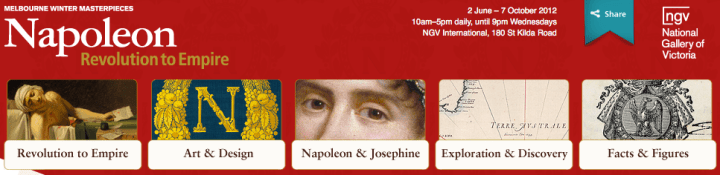
On 2 June 2012 the National Gallery of Victoria will opened this year’s spectacular Melbourne Winter Masterpieces exhibition, Napoleon: Revolution to Empire, examining French art, culture, and life from the 1770s to the 1820s. Its story runs from the first French voyages of discovery to Australia during the reign of Louis XV to the end of Napoleon’s transforming leadership as first Emperor of France.
Premier and Minister for the Arts Ted Baillieu said, “Now a well-established highlight of our major events calendar, the Melbourne Winter Masterpieces series has set the benchmark for blockbuster exhibitions in this country. I’m pleased to welcome the latest installment, Napoleon: Revolution to Empire. Through hundreds of priceless treasures, never before seen in Australia, this exhibition brings to life the legend one of history’s most extraordinary and complex figures. It’s another great Melbourne exclusive, another tourism drawcard for Victoria and another stunning exhibition for the NGV.”
This panoramic exhibition features nearly 300 works, dating from the 1770s to the 1820s, objects of breathtaking opulence and luxury – from paintings, drawings, engravings, sculpture, furniture, militaria, textiles, porcelain, gold and silver, fashion and jewellery.
Dr Gerard Vaughan, Director NGV, said, “Napoleon: Revolution to Empire continues the tradition of spectacular NGV exhibitions which have become a winter highlight in Victoria’s cultural calendar. This year visitors will be intrigued by the life of Napoleon, a man who held the world captive to his ambition. He had a vision of a united Europe, but a Europe controlled by France and united through conquest. Napoleon is well known as a master military strategist; this exhibition reveals that he was also a passionate lover and dedicated patron of the arts, sciences and literature.”
Napoleon: Revolution to Empire explores, amongst other themes, the stormy period of social change forced upon France through the outbreak of the French Revolution, the execution of Louis XVI and Marie-Antoinette, and the rise to power of the young Napoleon Bonaparte and his new wife Josephine, as the couple worked to cement their place as France’s new political and social leaders.
Ted Gott, Senior Curator International Art, NGV said, “World leaders in the Age of Exploration, Napoleon and Josephine were a true power couple- famous and stylish. The stunning artworks and objects in this exhibition illustrate their belief that the advancement of knowledge was integral to social order; they welcomed scientists and artists to receptions and dinners where world affairs were reshaped under their rule.”
Personal items will give visitors a glimpse into an extravagant private world of the couple. Jewels owned by Josephine, Napoleon’s personal weapons, lavish furniture from private residences and a lock of Napoleon’s hair feature alongside spectacular decorative objects, bejewelled gifts given to dignitaries, military uniforms and a beautiful court dress- the only surviving garment worn at Napoleon’s coronation ceremony in 1804.
Napoleon: Revolution to Empire also considers the enormous cultural and scientific contact between Australia and France from the 1770s to the 1820s. This is a story that is not often told. Both Napoleon and Josephine were captivated by Australia, which had newly entered the world’s imagination following the publication of Captain Cook’s travels. The exhibition tells the story of how this fascination spurred Napoleon to fund a voyage in 1805 that collected information about the continent and produced the first map of the southern Australian coastline with the land we now know as Victoria, but which was at the time first named Terre Napoléon (Napoleon Land). French voyages to Australia returned with collection’s of Australian flora and fauna, much specifically earmarked for the hothouses and enclosures of Napoleon and Josephine’s country residence Malmaison. Captivating works in the exhibition show kangaroos, black swans and a range of native Australian plants in the grounds of this quintessentially French estate.
Organised in partnership with the Fondation Napoléon in Paris, who are lending many of their greatest works, the exhibition also features incomparable treasures drawn from Europe’s most important Revolutionary and Napoleonic collections, including the Château de Malmaison, Château de Versailles, Musée Carnavalet and Musée de l’Armée in France, the Napoleonmuseum Thurgau in Switzerland, and the Museo Napoleonico in Rome.
More information is available at the exhibition website.
◊ ◊ ◊ ◊ ◊
From the NGV:
Catalogue: Ted Gott and Karine Huguenaud with contributing authors, Napoleon: Revolution to Empire (Melbourne: National Gallery of Victoria, 2012), 336 pages, ISBN: 9780724103560 (hardback) /978072410355-3 (paperback).
 This panoramic volume tells the story of French art, culture and life from the 1770s to the 1820s: the first French voyages of discovery to Australia, the stormy period of social change with the outbreak of the French Revolution, and the rise to power of the young Napoleon Bonaparte and his wife Josephine. Together the couple defined taste for a new century, and in the age of exploration developed a particular fascination for Australia. As well as telling the remarkable story of France’s close involvement with Australia in the early 1800s, Napoleon: Revolution to Empire showcases hundreds of works of breathtaking opulence and luxury. Featuring insightful writing by world-renowned historians of Napoleonic art and design, this authoritative publication celebrates the vital contributions to the visual arts made by Napoleon as first Emperor of France.
New Title | ‘Don’t Ask for the Mona Lisa’
This small book looks useful not only for those new to working on exhibitions but also as a model for how a conference session with real-world application could be shaped into a publication and made available to a larger audience through print-on-demand (POD) services like Lulu.com. –CH
◊ ◊ ◊ ◊ ◊
From the AAH:
Heather Birchall and Amelia Yeates, Don’t Ask for the Mona Lisa: Guidelines for Academics on How to Propose, Prepare, and Organise an Exhibition (London: Association of Art Historians, 2012), 36 pages, ISBN: 9780957147706, £5 (hardcopy) / £3 (PDF download), available at Lulu.com.
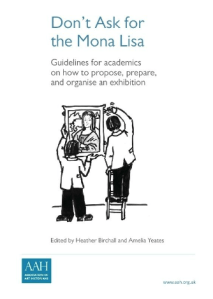
36 pages, ISBN: 9780957147706
The writing and publication of these guidelines was prompted by an event held by the Committee of the Museums & Exhibition Members Group of the Association of Art Historians (AAH), at the AAH Annual Conference at Manchester Metropolitan University in 2009. The session, entitled Curators Don’t Bite, attracted a large crowd of academics and museum professionals eager to hear about the experiences, both positive and negative, of other academics and curators who had organised exhibitions. Following the event, it was clear that there was a demand for some advice on how to propose exhibitions and, once a show had been agreed, the practicalities of working with curators and other museum staff. This publication therefore aims to provide an introduction to key aspects of exhibition curation, from the early planning stages to the design and opening of the show.
Of course, every exhibition is different and, whilst this document cannot cover every aspect of exhibition planning, it does provide assistance to those organising both small-scale and large exhibitions, as well as offering guidance on working with paintings, sculptures, and contemporary installations. Whether your exhibition is to be held at a large venue, such as Tate Britain, with a team of curators, conservators, and technicians, or a smaller institution with only one or two members of staff, the intention of the authors has been to outline the possible eventualities and responsibilities associated with exhibition planning.
The first part of this publication gives guidance on why and how to propose an exhibition, and offers general advice on exhibition planning and installation. It describes the roles performed by certain staff members in galleries and museums, and the responsibilities they carry when an exhibition is being put together. Some technical terms are highlighted in bold in the main text, and defined in the
margin.
The second part comprises case studies by academics who have worked on exhibitions for both large organisations, such as Birmingham Museum and Art Gallery, and small venues, including the Henry Moore Institute. This section also includes an interview with an exhibition designer that sets out some of the demands of fitting the design around the show’s theme, and sheds light on how to create a space that doesn’t overwhelm the exhibits.
At a time when museums and galleries are constantly tightening their budgets, a page at the end of this publication includes a list of funders to be approached if the museum’s budget cannot cover all the costs associated with the show, such as producing a catalogue or organising an associated study day or conference. Although the publication is primarily aimed at academics, and also freelances and students who may be considering putting together an exhibition proposal, we hope that it will also be useful for curators in the early stages of their careers working in a museum or gallery.
Information on ordering a copy is available here»
Forthcoming | ‘London: A Social and Cultural History’
Robert Bucholz, Professor of History at Loyola University Chicago, has been teaching a thematic course on London for years (a version is available at The Great Courses). Long dissatisfied with the available options for texts, he finally decided — with his co-author Joseph Ward — to write one. With its emphasis on the experience of living in early modern London and the varied lives of the city’s residents, the book is good news for anyone trying to fit the city into a semester. -CH
◊ ◊ ◊ ◊ ◊
From Cambridge UP:
Robert O. Bucholz and Joseph P. Ward, London: A Social and Cultural History, 1550–1750 (New York: Cambridge University Press, 2012), 415 pages, ISBN: 9780521896528, $28.
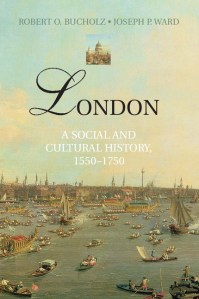 Between 1550 and 1750 London became the greatest city in Europe and one of the most vibrant economic and cultural centres in the world. This book is a history of London during this crucial period of its rise to world-wide prominence, during which it dominated the economic, political, social and cultural life of the British Isles, as never before nor since. London incorporates the best recent work in urban history, contemporary accounts from Londoners and tourists, and fictional works featuring the city in order to trace London’s rise and explore its role as a harbinger of modernity, while examining how its citizens coped with those achievements. London covers the full range of life in London, from the splendid galleries of Whitehall to the damp and sooty alleyways of the East End. Readers will brave the dangers of plague and fire, witness the spectacles of the Lord Mayor’s Pageant and the hangings at Tyburn, and take refreshment in the city’s pleasure-gardens, coffee-houses and taverns.
Contents
Introduction: London’s Importance
1. London in 1550
2. The Socioeconomic Base
3. Royal and Civic London
4. Fine and Performing Arts
5. The Public Sphere and Popular Culture
6. The People on the Margins
7. Riot and Rebellion
8. Plague and Fire
Conclusion: London in 1750
New Title | ‘London in the Eighteenth Century’
From the Random House Group:
Jerry White, London in the Eighteenth Century: ‘A Great and Monstrous Thing’ (London: Bodley Head, 2012), 704 pages, 9781847921802, £25.
 London in the eighteenth century was very much a new city, risen from the ashes of the Great Fire. With thousands of homes and many landmark buildings destroyed, it had been brought to the brink. But the following century was a period of vigorous expansion, of scientific and artistic genius, of blossoming reason, civility, elegance and manners. It was also an age of extremes: of starving poverty and exquisite fashion, of joy and despair, of sentiment and cruelty. Society was fractured by geography, politics, religion and history. And everything was complicated by class. As Daniel Defoe put it, London really was a ‘great and monstrous Thing’.
Jerry White’s tremendous portrait of this turbulent century explores how and to what extent Londoners negotiated and repaired these open wounds. We see them going about their business as bankers or beggars, revelling in an enlarging world of public pleasures, indulging in crimes both great and small – amidst the tightening sinews of power and regulation, and the hesitant beginnings of London democracy.
In the long-awaited finale to his acclaimed history of London over 300 years, Jerry White introduces us to shopkeepers and prostitutes, men and women of fashion and genius, street-robbers and thief-takers, as they play out the astonishing drama of life in eighteenth-century London.










1 comment