Reviewed: Fordham’s ‘British Art and the Seven Years’ War’
Recently added to caa.reviews:
Douglas Fordham, British Art and the Seven Years’ War: Allegiance and Autonomy (Philadelphia: University of Pennsylvania Press, 2010), 352 pages, ISBN: 9780812242430, $65.
Reviewed by Kay Dian Kriz, Brown University; posted 8 December 2011.
In ‘British Art and the Seven Years’ War: Allegiance and Autonomy’, Douglas Fordham offers an original and provocative re-interpretation of the emergence of public art and art institutions in eighteenth-century Britain. Scholars have long noted that the 1750s and 1760s were marked by increasing concern about the development and institutionalization of a school of British art. “Why,” Fordham asks, “did the visual arts become a pressing national concern at this moment in Britain’s history?” (1) He argues that any answer to such a question must take into account the “transformative place in British culture” (2) occupied by the Seven Years’ War, which was fought in the middle of this time period (1756–63). And indeed, cultural, political, and military history were deeply intertwined at this moment when the British Empire in America was firmly secured through a war that has largely been overlooked by art historians.
Books about art and war usually focus on military painting; Fordham’s book is much more expansive and ambitious, being concerned with the effects of militarism on the development and organization of the arts, as well as on their subject matter. . . .
The full review is available here» (CAA membership required)
Exhibition: Piranesi at the Hermitage
From the Hermitage:
Ruins, Palaces and Prisons: Piranesi and Italian Eighteenth-Century Architectural Fantasies
State Hermitage Museum, St Petersburg, 7 December 2011 — 25 March 2012
Curated by A.V. Ippolitov, M.F. Korshunova, and V.M. Uspenskiy
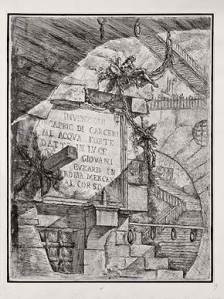
Piranesi, Title page of the 'Carceri' series, 1749-1750
On December 7th, 2011, Saint Catherine’s day, the State Hermitage Museum welcomed an exhibition entitled Ruins, Palaces and Prisons: Giovanni Battista Piranesi and Italian Eighteenth-Century Architectural Fantasies, dedicated to the early period of Piranesi’s work. This exhibit is being held as part of the Year of Italy in Russia and Year of Russia in Italy 2011 program, which continues tradition of partnership and cooperation between the two countries in the fields of art and culture.
This exhibition, presenting about 100 drawings and prints from the collection of the Hermitage, is divided into two parts: the first is dedicated to Piranesi and will present the series entitled Prima Parte (“Prima Parte “), Grotteschi (“Grotesques”) and Carceri (“Dungeons”) in their rare original condition, which have never been published in Russia before. All of them are from the 1750 album Opere Varie, which was acquired by the Empress Catherine the Great in 1768 as part of the collection of Count Bruhl and became the basis of the graphic arts collection of the Hermitage. The Carceri is presented in two conditions; the early one, from the Bruhl
collection, and a later one which was extensively revised. This is the first
time this sort of juxtaposition has been presented in Russia.

Piranesi, "Drawbridge," A page from the 'Carceri' series, 1749-1750
The second part consist of drawings by Italian artists of the 18th century who worked as scene decorators, designers and architects and created the unique genre of imaginative Veduta, which is important for understanding the style of the settecento, as the 18th century is called in Italian, a unique and complex phenomenon. Imaginative Veduta is represented by the work of the Galli Bibiena family, G. Valeriani, Pietro Gonzaga, G. Barbari, G. Mannocchi, many of which are being published for the first time. The phenomenon of Piranesi’ early fantasies is put in the context of a unique genre, and is examined at this exhibit as original sources, as is the influence of the Piranesi phenomenon on the later development of imaginative Veduta.
Giovanni Battista Piranesi (1720-1778) has an enduring place in the history or art as an artist who defined European art in the mid 18th- early 19th century. Piranesi is acknowledged as a reformer of public taste and one of the progenitors of neoclassicism, which might be called the Avant Garde of the 18th century, and as such his name is associated with this movement. However, while the series of etching entitled Carceri (dungeons), a procession of frightening, inexplicable and obscure images was not well known in the artist’s life, was many decades ahead of its time. Carceri become of the works of art most beloved by modernism. This series, which was not particularly popular during Piranesi’s life, a rediscovery of Romanticism attracted writers, architects, directors then and continues to do so now not only with its unusual subject matter, but also with its unusual spatial construction, which reminds one not of real architecture, but of the unreal space of a dream or hallucination. (more…)
Reviewed: Trio of Books on the Dilettanti and Antiquarianism
Recently added to caa.reviews:
Bruce Redford, Dilettanti: The Antic and the Antique in Eighteenth-Century England, exhibition catalogue (Los Angeles: Getty Trust Publications, 2008), 232 pages, ISBN: 9780892369249, $49.95.
Ilaria Bignamini and Clare Hornsby, Digging and Dealing in Eighteenth-Century Rome, 2 volumes (New Haven: Yale University Press, 2010), 622 pages, ISBN: 9780300160437, $85.
Jason M. Kelly, The Society of Dilettanti: Archaeology and Identity in the British Enlightenment (New Haven: Yale University Press, 2010), 366 pages, ISBN: 9780300152197, $75.
Reviewed by Susan Dixon, University of Tulsa; posted 1 December 2011.
These three recent books explore an eighteenth-century British engagement with classical archaeology during a time when the practice was transforming from an early modern antiquarianism into a modern scientific discipline. Two of the books are monographic studies of the Society of the Dilettanti, an organization that became known for its support of unprecedented archaeological activity in Greece, while a third outlines how British subjects, some of whom were Dilettanti, undertook archaeological excavations on Italian soil and refurbished, sold, and bought the antiquities found there. In some measure, all the authors note this engagement as integral to shaping British cultural identity in the eighteenth century, and in this way add to robust scholarship on the issue. . . .
The full review is available here» (CAA membership required)
Submissions for the Oscar Kenshur Book Prize
Oscar Kenshur Book Prize
Applications due by 31 January 2012
The Center for Eighteenth-Century Studies at Indiana University is pleased to announce its annual book prize, to be awarded for an outstanding monograph of interest to eighteenth-century scholars working in a range of disciplines. The prize honors the work of Oscar Kenshur, professor emeritus of comparative literature at Indiana University, a dix-huitièmiste par excellence, and one of the founding members of the Center.
Submissions in English from any discipline are welcome; authors can submit their work irrespective of citizenship. Multi-authored collections of essays and translations, as well as books by members of the Indiana-University-Bloomington faculty, are not eligible. The Kenshur prize of $1000 will be awarded together with an invitation to the Center for Eighteenth-Century Studies for a workshop dedicated to the winning book, in which several colleagues will discuss the book from different disciplinary perspectives. The Center will cover the author’s expenses to attend this event.
To be eligible for this year’s competition, a book must carry a 2011 copyright date. Submissions can be made by the publisher or the author: three copies must be received at the ASECS office by the 31st of January 2012. Please send the books (clearly marked for Kenshur Prize) to ASECS, 2598 Reynolda Rd., Suite C, Winston-Salem, NC 27106. For further inquiries please contact Professor Mary Favret, Director of the Center for Eighteenth-Century Studies at Indiana University (email favretm@indiana.edu).
Reviewed: Meredith Martin’s ‘Dairy Queens’
Recently added to caa.reviews:
Meredith Martin, Dairy Queens: The Politics of Pastoral Architecture from Catherine de’ Medici to Marie-Antoinette, Harvard Historical Studies, vol. 176 (Cambridge: Harvard University Press, 2011), 336 pages, ISBN: 9780674048997, $45.
Reviewed by Jean-François Bédard; posted 3 November 2011.
Among the most fanciful objects commissioned by the French monarchy is a pair of Sèvres porcelain pails designed for Marie-Antoinette’s pleasure dairy at the Château de Rambouillet. They are shaped like tinettes—wooden buckets used on ordinary dairy farms for making fresh cheese—and painted with wood grain to imitate their rustic models. Like Marie-Antoinette’s mock hamlet at Trianon, the Rambouillet pails are outlandish inventions of the pastoral movement in literature and art, which celebrated naturalness with contrived theatricality. As the ill-fated monarch so cruelly experienced, bourgeois sensibilities soon lashed out at this noble ostentation. To pre-Revolutionary critics of the society of orders, a queen masquerading as a dairy maid in a luxurious simulated farm was particularly odious. Marie-Antoinette’s pastoral persona triggered venomous accusations of social irresponsibility, political usurpation, and even sexual deviance that contributed to her downfall and still taint her reputation.
The pastoral has not always elicited such heated reactions. In her amusingly titled book, Meredith Martin sets out to rehabilitate this courtly art form. Looking beyond the alleged frivolity of pastoral art and architecture, Martin emphasizes the crucial role they played in the social and political self-fashioning the French nobility, most notably the queens, forged for itself. Her discussion focuses on the pleasure dairy—known in French as the ‘laiterie d’agrément’, or ‘laiterie de propreté’, to distinguish it from the functioning dairy (laiterie de préparation). . . . Martin makes a convincing case for the importance of pleasure dairies as sites of empowerment for French noblewomen. . . .
The full review is available here» (CAA membership required)
Reviewed: ‘Thomas Lawrence: Regency Power and Brilliance’
Recently added to caa.reviews:
Cassandra Albinson, Peter Funnell, and Lucy Peltz, eds., Thomas Lawrence: Regency Power and Brilliance, exhibition catalogue (New Haven and London: Yale Center for British Art, National Portrait Gallery, London, and Yale University Press, 2011), 280 pages, ISBN: 9780300167184, $70.
Reviewed by Bruce Redford; posted 17 November 2011.
‘How various he is!’ Thomas Gainsborough’s tribute to Joshua Reynolds applies equally well to their successor in grand-manner portraiture. It is one of the signal achievements of ‘Thomas Lawrence: Regency Power and Brilliance’ that it removes any lingering traces of the negative stereotype: Lawrence the slick, formulaic sycophant who prostituted his gifts in the service of a decadent Regency elite. In its place this wide-ranging exhibition and thoughtful catalogue substitute a dynamic, probing, and inventive explorer of human psychology—one who is keenly attentive to the interplay of surface and depth, social mask and private self. Even Lawrence’s most public statements create a form of co-extensive space: not by breaking the picture plane, as in Caravaggio for instance, but by drawing the viewer into an
electric zone of intimacy. . . .
The full review is available here» (CAA membership required)
November 2011 Issue of ‘Art History’
Eighteenth-century offerings from the November 2011 issue:
Andrei Pop, “Sympathetic Spectators: Henry Fuseli’s Nightmare and Emma Hamilton’s Attitudes,” Art History 34.5 (November 2011): 934-57.
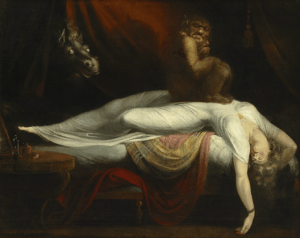
Henry Fuseli, "The Nightmare," 1781, exhibited in 1782 at the Royal Academy of London (Detroit Institute of Arts)
Abstract: Henry Fuseli’s painting The Nightmare (1782), unusual in the artist’s oeuvre and in the painting of its time as the public visualization of a private mental state, can be made sense of in light of late eighteenth-century practices and theories of privacy and of the agency that minds can exert on the world on on each other. By comparison with another dream-like performance, Emma Hamilton’s Attitudes, and informed by David Hume’s theory of sympathy, which was designed to explain the social communicability of mental states, a reading of The Nightmare emerges which shows that it did not aim to make visible dream imagery, but to induce spectators to have or feel as if they had an analogous experience. The painting is thus typical of the formative stage of a modern understanding of public life as a contingent
association of private lives.
Andrei Pop studied art history at Stanford and Harvard Universities and is a postdoctoral fellow at the Universität Berlin. The present essay is part of Neopaganism, a book in progress on the cultural politics of classicism. His article on Fuseli and tragedy will appear in the March 2012 Art Bulletin. His translation, together with Mechtild Widrich, of Karl Rosenkranz’s Aesthetics of Ugliness (1853) is forthcoming.
◊ ◊ ◊ ◊ ◊
Steven Adams, “Amateurs and Revolutionaries in Eighteenth-century France,” Art History 34.5 (November 2011): 1042-46.
 Review of Charlotte Guichard, Les Amateurs d’art à Paris au XVIII siècle (Paris: Champ Vallon, 2008); Laura Auricchio, Adélaïde Labille-Guiard: Artist in the Age of Revolution (Los Angeles: Getty Publications, 2009); and Rolf Reichardt and Hubertus Kohle, Visualizing the Revolution: Politics and the Pictorial Arts in Late Eighteenth-century France (London: Reaktion Books, 2008).
◊ ◊ ◊ ◊ ◊
Marion Endt-Jones, “Commemorative Reconsiderations,” Art History 34.5 (November 2011): 1053-56.
 Review of Diana Donald and Jane Munro, eds., Endless Forms: Charles Darwin, Natural Science, and the Visual Arts (New Haven and London: Yale Center for British Art, 2009); and Andrew Graciano, ed., Visualizing the Unseen: Imagining the Unknown, Perfecting the Natural: Art and Science in the 18th and 19th Centuries (Newcastle: Cambridge Scholars Publishing, 2008).
◊ ◊ ◊ ◊ ◊
Editor’s Note: At February’s CAA meeting in Los Angeles, there is an entire session, sponsored by the Midwest Art History Society, on the subject of The Nightmare. -CH.
Icons of the Midwest: Henry Fuseli’s Nightmare
Wednesday, 22 February, 12:30–2:00
Chairs: Laura Gelfand (Utah State University) and Judith Mann (Saint Louis Art Museum)
• Salvador Salort-Pons (Detroit Institute of the Arts), Living with Fuseli’s Nightmare
• Beth S. Wright (University of Texas at Arlington), ‘As I Was Perpetually Haunted by These
Ideas’: Fuseli’s Influence on Mary Shelley’s Mathilda and Frankenstein
• Scott Bukatman (Stanford University), Dreams, Fiends, and Dream Screens
Exhibition: French Drawings in Grenoble

Jean-François-Pierre Peyron, “Curius Denatus refusant les présents
des ambassadeurs Samnites,” XVIIIe siècle, Musée de Grenoble
◊ ◊ ◊ ◊ ◊
Currently on display at the Musée de Grenoble, as noted by Hélène Bremer . . .
L’idée et la ligne – Dessins français
Musée de Grenoble, 5 November 2011 — 12 February 2012
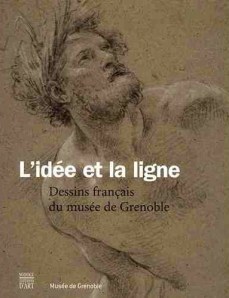 Après la présentation de ses plus belles feuilles italiennes, le musée de Grenoble met en valeur son extraordinaire fonds de dessins français. De la Renaissance à la fin du XVIIIe siècle, les plus grands artistes répondent présents. Nicolo dell’Abate, appelé pour travailler à Fontainebleau, offre une introduction magistrale à un parcours graphique qui puise ses sources en Italie. Laurent de la Hyre, Simon Vouet, Philippe de Champaigne, Patel, Charles Mellin, Charles Alphonse Dufresnoy ou François Perrier illustrent brillament les tendances d’une école française qui s’affirme et prend peu à peu son indépendance face à l’Italie. Le Brun, Noël Coypel, Jean-Baptiste de Champaigne, Louis de Boulogne et Charles de la Fosse poursuivent les avancées sous Louis XIV. La partie la plus riche et paradoxalement la moins connue de cette collection concerne le XVIIIe siècle : Boucher, Pierre ou Huber Robert viennent marquer le triomphe de la couleur et de la nature. Feuillet après feuillet, un pan entier de l’histoire de l’art française se dessine
sous nos yeux.
◊ ◊ ◊ ◊ ◊
Catalogue: Guillaume Kazerouni, Barbara Brejon de Lavergnée, Jérôme Delaplanche and Pierre Rosenberg, L’idée et la ligne: Dessins français du musée de Grenoble, XVIe-XVIIIe siècle (Paris: Somogy éditions d’art, 2011), 240 pages, ISBN: 9782757204818, €35.
Exhibition: Boxes and Objets de Vertu
From the Cognacq-Jay, as noted by Hélène Bremer . . .
Boîtes en or et objets de vertu
Cognacq-Jay Museum, Paris, 21 December 2011 — 6 May 2012
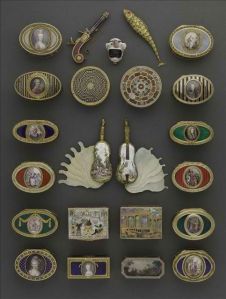 A l’occasion de la parution du Catalogue raisonné des Boîtes en or et objet de vertu, le musée Cognacq-Jay expose cet hiver sa riche collection de boîtes, tabatières, étuis, boîtes à rouge, à mouches, nécessaires de toilette, à écrire… Avec 240 objets, celle-ci est l’une des plus importantes des musées français.
Chefs-d’œuvre de l’orfèvrerie, en or, enrichis de pierres dures ou précieuses, d’émail, de porcelaine, d’ivoire ou de nacre. . . étaient dès le XVIIIe siècle l’objet d’orgueil et de convoitise Leur forme était parfois étrange, prenant l’apparence d’un dromadaire, d’un tatou, d’une jambe, d’une tête, d’un violoncelle. . . Leur usage, participant aux rituels de la vie quotidienne, témoigne des pratiques de la sociabilité au Siècle des Lumières : le tabac, les modes cosmétiques, le jeu. . .
L’exposition mettra exceptionnellement en lumière cette collection, au moyen d’une scénographie originale et surprenante, et en réunissant autour de ces
objets des dessins, des gravures pour mieux comprendre leurs secrets de
fabrication et leur usage.
◊ ◊ ◊ ◊ ◊
Catalogue: Objets de Vertus, Boites, Tabatieres, Etuis et Necessaires Collections D’Orfevrerie (Paris: Paris Musées, 2011), ISBN: 9782759601813, €44.
Holiday Gift Guide, Part 2: Food
By Courtney Barnes and Craig Hanson
Culinary gifts — whether primarily about cooking or eating — regularly appear on holiday wish lists, but how much more fun it could be to give a taste of the eighteenth century.
◊ ◊ ◊ ◊ ◊
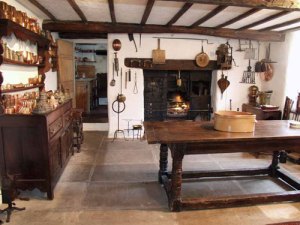
1. A Two-Day Historic Food Course with Ivan Day on Georgian Cookery — With forty years of experience cooking period food, Day is well-known for recreating historic tables, particularly in museum contexts. He’s also worked in television and radio and written books and articles on the history of English food. To judge from the website, I think it would be an incredibly fun experience — even better with four or five friends (Day’s blog, Food History Jottings, is also pretty wonderful). From the Historic Food website:
Ivan Day's Historic Food kitchen in Cumbria
We are located at Wreay Farm, a small seventeenth-century farmhouse in Cumbria, on the edge of the Lake District National Park. The farmhouse kitchen (known locally as a firehouse) is equipped with a wide range of antique kitchen utensils and a roasting range complete with clockwork jacks. It has frequently been used as a television kitchen (recently in the US Food Network’s Food Fit for a King and for BBC2 Open University’s Open Minds). We also have a confectionery room and a small bakehouse with wood-fired oven. We limit our group size to six participants per course, which means you get plenty of individual attention. . .
And if this isn’t enough to tempt you, there’s a lovely account of Day’s period sugarworks course at Fiona Leahy Designs (from May 2010).
◊ ◊ ◊ ◊ ◊
2. A Visual Feast at Houston’s Rienzi House — We noted the exhibition back in August here at Enfilade, but a visit to English Taste: The Art of Dining in the Eighteenth Century (organized by the Museum of Fine Arts Houston and installed, incidentally, by Day) would be a lovely way to spend an afternoon during the holidays. From the MFAH website:
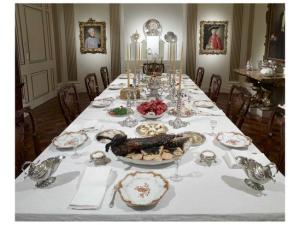 The 18th-century English dinner table was a feast for the eyes. In order to impress their guests and assure them that they were dining amid fashionable people of consequence, hosts served sumptuous dishes, adorned with towering sugar constructions and amusing trompe l’oeil (fool-the-eye) jellies of playing cards or bacon and eggs, all on exquisite silver and porcelain.
Rienzi re-creates this elaborate dining experience in English Taste: The Art of Dining in the Eighteenth Century. The first special exhibition ever held at Rienzi, the MFAH house museum for European decorative arts, English Taste treats you to a dining-room extravaganza typical of a 1760s English country house. Lifelike fish, fowl, and flummeries—complete with lavish, Georgian silver fittings and place settings—grace the table, created with guidance from the influential period cookbook The Experienced English Housekeeper by Elizabeth Raffald, the “Martha Stewart of the 18th century.”
◊ ◊ ◊ ◊ ◊
3. A Taste of Life at Mount Vernon — Stephen McLeod, ed., Dining with the Washingtons: Historic Recipes, Entertaining, and Hospitality from Mount Vernon (Chapel Hill: University of North Carolina, 2011), 224 pages, 9780807835265 $35. From the publisher:
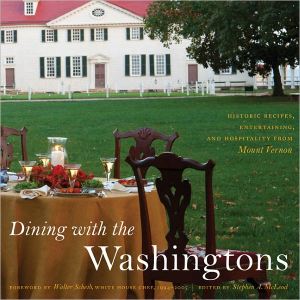 Combining vivid photography with engaging essays, Dining with the Washingtons explores the menus, diet, and styles of entertaining that characterized the beloved home of the nation’s principal founding father. Compelling accounts, historic artwork, and images of gardens, table settings, prepared food, and objects from the Mount Vernon collection blend to shed fresh light on the daily lives of George and Martha Washington, on their ceaseless stream of household guests and those who served them, and on the ways food and drink reflected the culture of eighteenth-century America. . .
Janet Blyberg provides a fine sampling of the book at her blog, JCB.
◊ ◊ ◊ ◊ ◊
4. A Guide to Kitchens in Eighteenth-Century France — If the food gets you wondering about the cooks who produced it, this new book might be just the thing for a cold winter day, ideally curled up next to a crackling fire. From the Johns Hopkins UP:
Sean Takats, The Expert Cook in Enlightenment France (Baltimore: Johns Hopkins University Press, 2011), 216 pages, 9781421402833, $60.
 In the eighteenth-century French household, the servant cook held a special place of importance, providing daily meals and managing the kitchen and its finances. In this scrupulously researched and witty history, Sean Takats examines the lives of these cooks as they sought to improve their position in society and reinvent themselves as expert, skilled professionals. Much has been written about the cuisine of the period, but Takats takes readers down into the kitchen and introduces them to the men and women behind the food. It is only in that way, Takats argues, that we can fully recover the scientific and cultural significance of the meals they created, and, more important, the contributions of ordinary workers to eighteenth-century intellectual life. He shows how cooks, along with decorators, architects, and fashion merchants, drove France’s consumer revolution, and how cooks’ knowledge about a healthy diet and the medicinal properties of food advanced their professional status by capitalizing on the Enlightenment’s new concern for bodily and material happiness. The Expert Cook in Enlightenment France explores a unique intersection of cultural history, labor history, and the history of science and medicine. Relying on an unprecedented range of sources, from printed cookbooks and medical texts to building plans and commercial advertisements, Takats reconstructs the evolving role of the cook in Enlightenment France.
◊ ◊ ◊ ◊ ◊
 5. Dinner at Husk or McCrady’s in Charleston, South Carolina — Over the past year, Sean Brock has managed to astound quarters of America’s food establishment that don’t necessarily pay much attention to the South. Writing in The New York Times in February, for instance, Sam Sifton judged the experience “well worth . . . the flight from New York.” In September, Bon Appétit named Husk the year’s Best New Restaurant in America, and Brock has been featured in a dizzying array of publications from Esquire to The New Yorker. In the latter, Burkhard Bilger details what’s driving Brock’s success — an intense commitment to traditional Southern ingredients that have all but disappeared from the American table. There’s nothing purely eighteenth-century going on here, but there is a profound if simple point to be made: without ingredients that were used two or three centuries ago, it’s ultimately impossible to recreate what people ate. We can only hope this is more than just a passing trend and that other regions with rich culinary histories take up the challenge.










leave a comment