New Title: Facing Beauty, Painted Women and Cosmetic Art
From Yale UP:
Aileen Ribeiro, Facing Beauty: Painted Women and Cosmetic Art (New Haven: Yale University Press, 2011), 256 pages, ISBN: 9780300124866, $45.
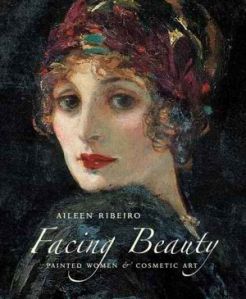 Throughout the history of the Western world, countless attempts have been made to define beauty in art and life, especially with regard to women’s bodies and faces. Facing Beauty examines concepts of female beauty in terms of the ideal and the real, investigating paradigms of beauty as represented in art and literature and how beauty has been enhanced by cosmetics and hairstyles.
This thought-provoking book discusses the shifting perceptions of female beauty, concentrating on the period from about 1540 to 1940. It begins with the Renaissance, when a renewed emphasis on the individual was reflected in the celebration of beauty in the portraits of the day. The fluid, sensual lines of the Baroque period initiated a shift toward a more “natural” look, giving way in the 18th century to a more stylized and artificial face, a mask of ideal beauty. By the late 19th century, commercial beauty preparations had become more readily available, leading to new technological developments within the beauty industry in the early 20th century. Beauty salons and the wider availability of cosmetics revolutionized the way women saw themselves.
Ravishing images of some of the most beautiful women in history, both real and ideal, accompanied by illustrations from costume books, fashion plates, advertisements, caricatures, and cosmetics, bring the evolving story of beauty to life.
Aileen Ribeiro is Professor Emeritus in the history of art at the Courtauld Institute of Art, London.
◊ ◊ ◊ ◊ ◊
Kimberly Chrisman Campbell recently interviewed Ribeiro for Worn Through (15 February 2012). A sampling:
KCC: Was it a natural progression from writing about dress to writing about beauty?
AR: Beauty and cosmetics are intimately linked with clothing. In the Renaissance, the word “cosmetic” was defined in the broadest way as the enhancing of body and face. Painting the face can be equated with dressing the body, and both are about appearances and their meanings. . . .
The full interview is available here»
New Title: ‘The Perfect Foil’
From the U of Minnesota Press:
Elizabeth C. Mansfield, The Perfect Foil: François-André Vincent and the Revolution in French Painting (Minneapolis: University of Minnesota Press, 2011), 320 pages, ISBN 9780816675814 (paper, $35) / ISBN 9780816675807 (cloth, $105).
 Art history is haunted by the foil: the dark star whose diminished luster sets off another’s brilliance. Relegated to this role by modern historians of Revolutionary-era French art, François-André Vincent (1746–1816) is chiefly viewed in the reflection of his contemporary, Jacques-Louis David. The Perfect Foil frees Vincent from this distorting mirror. Offering a nuanced and historically accurate account of Vincent’s life and work, Elizabeth C. Mansfield reveals the artist’s profound influence on the visual culture of the French Revolution—and, paradoxically, on the art historical narrative that would consign him to obscurity.
The Vincent of The Perfect Foil is an artist whose life and work responded to cultural conditions—religious difference, emotional bonds, institutional pressures—only now finding their way into art historical accounts of the period. A successful academician despite his status as a member of the Protestant minority, a leading reformer of arts institutions during the Revolution, the progenitor of French Romanticism, and the husband of one of the period’s most celebrated women artists, François-André Vincent emerges in these pages as an embodiment of the ambivalences and contradictions of life in France in the wake of the Enlightenment.
By giving us a detailed and faithful portrait of this artist poised at the turning point of history, Mansfield restores a critically important body of work to its rightful place in the story of French art and reorients Revolutionary-era French art history toward a broader, more inclusive understanding of the period.
Elizabeth Mansfield’s The Perfect Foil is a remarkable piece of scholarship that both transcends and transforms the genre of the art historical monograph. It is a sophisticated work that expands the way we conceive of how the visual arts and politics interacted during the French Revolution. Mansfield’s provocative and methodological surefootedness will make readers aware of the contingencies that inform their own thinking.
—Julie Anne Plax, author of Watteau and the Cultural Politics of Eighteenth Century France
◊ ◊ ◊ ◊ ◊
Elizabeth C. Mansfield is associate professor of art history at New York University. Her publications address topics ranging from seventeenth-century Dutch printmaking and the history of modernism to contemporary obscenity laws governing digital artworks and the surgical performances of Orlan. She has edited two volumes of essays on the institutional history of the discipline of art history and is coediting an anthology on eighteenth-century satire and visuality. Too Beautiful to Picture: Zeuxis, Myth, and Mimesis, published by the University of Minnesota Press, received the Charles Rufus Morey Book Award from the College Art Association. Her research has been supported by fellowships from the National Humanities Center, the Gladys Krieble Delmas Foundation, and the Paul Mellon Centre for Studies in British Art.
Reviewed: ‘Picturing Art History’
Recently added to caa.reviews:
Ingrid R. Vermeulen, Picturing Art History: The Rise of the Illustrated History of Art in the Eighteenth Century (Amsterdam: Amsterdam University Press, 2011), 359 pages, ISBN: 9789089640314, $69.50.
Reviewed by Pamela J. Warner, University of Rhode Island; posted 9 February 2012.
Ingrid Vermeulen undertakes an important self-reflexive task in ‘Picturing Art History’: the examination of the transition from unillustrated to illustrated texts about art. Surprisingly, that transformation had little to do with technological changes. Using three specific publications as examples, she argues that eighteenth-century scholars increasingly came to conceive of the artistic past not as a series of biographies of artists, but rather as a seamless “chain” of artworks in which historical progress can, and indeed must, be seen to be fully understood. Vermeulen tracks her topic through four related questions: What types of images were considered appropriate to the study of art history? How should we understand the notion that drawing and reproductive print collections, along with illustrated art books, embody the artistic past? How did collecting traditions relate to art-historigraphic traditions? And to what extent did eighteenth-century scholars believe that works on paper were faithful representations of the artworks they studied? (12–13) She organizes her answers into three chapters dedicated to case studies of individual projects by Giovanni Bottari, Johann Joachim Winckelmann, and Jean-Baptiste Séroux d’Agincourt, each of whom mobilized a different type of visual resource, namely prints, drawings, and book illustrations. . . .
The full review is available here» (CAA membership required)
Exhibition: The Look of Love, Eye Miniatures
From the Birmingham Museum of Art:
The Look of Love: Eye Miniatures from the Skier Collection
Birmingham Museum of Art, Birmingham, Alabama, 7 February — 10 June 2012
University of Georgia, Athens, 6 October 2012 — 6 January 2013
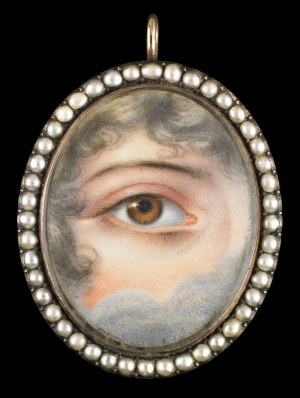 This stunning exhibition explores the little-known subject of “lover’s eyes,” hand-painted miniatures of single human eyes set in jewelry and given as tokens of affection or remembrance. In 1785, when the Prince of Wales secretly proposed to Mrs. Maria Fitzherbert with a miniature of his own eye, he inspired an aristocratic fad for exchanging eye portraits mounted in a wide variety of settings including brooches, rings, lockets, and toothpick cases. With over 100 examples, the collection of Dr. and Mrs. David A. Skier of Birmingham is the largest in the world. This exhibition offers an unprecedented look at these unusual and intriguing works of art.
Visitors can also interact with the exhibition in a new way: the Museum’s very first iPad app! The Look of Love app allows visitors to see these tiny, intricate objects at up to twenty times their actual size. They can also see images of the backs of objects or short videos of how the objects open. Twenty iPad devices are available for check-out and use in the Arrington Gallery, and
volunteers are on hand to show how the devices and the app
work.

ISBN: 9781907804014, $35
The exhibition is accompanied by a full color, hardbound catalogue of the same name, edited by Dr. Graham C. Boettcher, The William Cary Hulsey Curator of American Art, and published by D Giles Ltd., London. An essay by Elle Shushan sets the historical scene and examines the role of lover’s eyes in the broader context of Georgian and early Victorian portrait miniatures. Boettcher looks at the language and symbolism of these tokens and their jeweled settings. Additionally, novelist and biographer Jo Manning offers five fictional vignettes imagining the circumstances surrounding the creation of these extraordinary objects.
◊ ◊ ◊ ◊ ◊
N.B. — Notice of the exhibition at the Georgia Museum of Art in Athens was added on 24 October 2012
The Progress of Love
From D. Giles publishing:
Colin B. Bailey, Fragonard’s Progress of Love at The Frick Collection (London: D. Giles, 2011), 192 pages, ISBN: 9781904832607, £30 / $45.
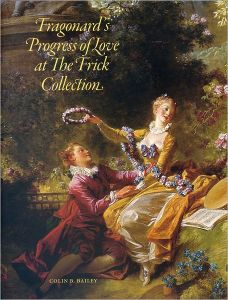 This richly illustrated volume reveals the intriguing story behind the commission, rejection, and rehousing of Jean- Honoré Fragonard’s Progress of Love, a series of 14 paintings considered by many to be the artist’s masterpiece. Fragonard (1732–1806) completed four large canvases for the comtesse du Barry’s chateau at Louveciennes, but they were replaced and returned to the artist. In 1790 Fragonard moved them to his cousin’s house in Grasse, and over the course of the year painted two further large-scale works and 18 additional panels.
With 140 colour images of the Fragonard paintings, details, shots of the room, plans, original sketches, and other comparative images, author Colin Bailey explores the commission of the four main panels, their original arrangement at Louveciennes and the possible reasons for their rejection. Equally enthralling is the history of how the paintings were rediscovered in
the late 19th century and how they eventually came to The Frick Collection.
Colin B. Bailey is Associate Director and Peter Jay Sharp Chief Curator at The Frick Collection, New York. Recent publications include Watteau to Degas: French Drawings from the Frits Lugt Collection (2009); Gabriel de Saint-Aubin (1724–1780) (2007); and The Age of Watteau, Chardin and Fragonard: Masterpieces of 18th-century French Genre Painting (2003).
Exhibition: Colorful Realm in Washington
Thanks to Courtney Barnes at Style Court for noting this one. From the National Gallery of Art:
◊ ◊ ◊ ◊ ◊
Colorful Realm: Japanese Bird-and-Flower Paintings by Itō Jakuchū (1716–1800)
National Gallery of Art, Washington, D.C., 30 March — 29 April 2012
 Celebrating the centennial of Japan’s gift of cherry trees to the nation’s capital, this exhibition features one of Japan’s most renowned cultural treasures, the 30-scroll set of bird-and-flower paintings by Itō Jakuchū. Titled Colorful Realm of Living Beings (J. Dōshoku sai-e; c. 1757–1766), these extraordinary scrolls are being lent to the National Gallery of Art by the Imperial Household. Their exhibition here—for one month only—provides a unique, once-in-a-lifetime opportunity: not only is it the first time all 30 paintings will be on view in the United States, but it is also the first time any of the works will be seen here after their six-year-long restoration.
Colorful Realm stands as the most dynamic and comprehensive—yet meditative and distilled—expression of the natural world in all of Japanese art. Synthesizing numerous East Asian traditions of bird-and-flower painting, the set depicts each of its 30 subjects in wondrously meticulous detail, but in such a way as to transcend surface appearances and capture the otherwise ineffable, vital essence of the cosmos, the Buddha nature itself. To present the full significance of Colorful Realm, the exhibition and its catalogue reunite this masterpiece with Jakuchū’s triptych of the Buddha Śākyamuni from the Zen monastery Shōkokuji in Kyoto. Jakuchū had donated both works to the monastery, which displayed them in a large temple room during Buddhist rituals.
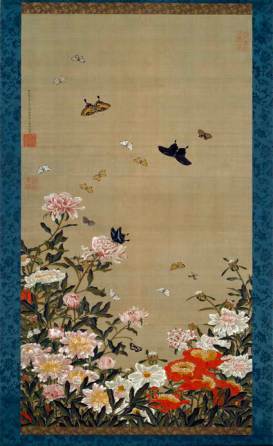 Recent conservation of Colorful Realm has generated an entirely new awareness of the material profile of the set and the technical means by which Jakuchū created each scroll. Drawing upon these findings as well as the most recent research on Jakuchū’s life and cultural environment, this exhibition offers a multifaceted understanding of the artist’s virtuosity and experimentalism as a painter—one who not only applied sophisticated chromatic effects but also masterfully rendered the richly symbolic world in which he moved.
The earliest of the 30 scrolls, Peonies and Butterflies, combines two subjects that enjoyed great popularity in East Asian pictorial traditions. On the one hand, the peony flower was likened to both feminine beauty and prosperity. It became the preferred garden flower of the imperial and aristocratic elite during China’s Tang dynasty (618–907) and at the court of Emperor Xuanzong in particular; in East Asian literary traditions Li Bai’s verse likening the beauty of Xuanzong’s favorite consort Yang Guifei (719–756) to a peony cemented the flower’s association with feminine beauty. Meanwhile, its full and gorgeous appearance lent itself to uncomplicated associations with affluence and good fortune. The butterfly also served as an auspicious symbol, though its popularity was equally attributable to its appearance in one of the most famous parables in early Chinese thought: Zhuangzi’s dream of a butterfly. According to this parable, the legendary sage Zhuangzi dreams that he is a carefree yellow butterfly. Upon awakening, however, “he didn’t know if he was Zhuangzi who had dreamt he was a butterfly, or a butterfly dreaming he was Zhuangzi.” Paintings of butterflies inevitably invoked the oneiric setting and queried selfhood of the Zhuangzi anecdote in most East Asian contexts and particularly in Jakuchū’s circle of erudite Sinophile monks, scholars, and merchants. While visually opulent, Peonies and Butterflies also suggests the uncertainty of a just-awoken dreamer who momentarily confuses reverie with reality.
Careful study of the painting’s pigmentation points to Jakuchū’s remarkable distillation and intensification of traditional East Asian coloration techniques. Different grades of opacity and transparency are achieved in the butterflies, flowers, stems, and leaves by varying the use of mineral and vegetal pigments, occasionally layering them one on top of another and adding a sublayer of color on the back of the silk. This complex stratigraphy of colors results in a convincing imbrication of the motifs in their surroundings. Indeed, when Jakuchū’s cultural and spiritual mentor Daiten (1719–1801) encountered the painting in 1760, he titled it “Beautiful Mist and Fragrant Wind” (Enka kōfū), suggesting that the real subject here was not the peonies and butterflies, but the conceptual atmosphere that enveloped them, the invisible ether within which they swayed and glided.
◊ ◊ ◊ ◊ ◊
Exhibition catalogue: Yukio Lippit, with Ota Aya, Oka Yasuhiro, and Hayakawa Yasuhiro, Colorful Realm: Japanese Bird-and-Flower Paintings by Itō Jakuchū (Chicago: University of Chicago Press, 2012), 224 pages, ISBN: 9780226484600, $50.
◊ ◊ ◊ ◊ ◊
Public Conference: The Art of Itō Jakuchū
National Gallery, East Building Concourse, Auditorium, 30 March 2012, 10:00 to 5:00
Illustrated lectures by noted scholars and conservators of Japanese art. This program is co-organized by the Center for Advanced Study in the Visual Arts, National Gallery of Art, and the Freer Gallery of Art and the Arthur M. Sackler Gallery, Smithsonian Institution. Presented in honor of the National Cherry Blossom Festival.
Reviewed: The English Virtuoso
On a personal note, I want to say how much I appreciate Janice Neri’s thoughtful review. Her reading of my book is, I think, careful and fair. More importantly, her questions and criticisms are spot-on. Thanks as well to Laura Auricchio for doing such a terrific job coordinating reviews as the field editor for the eighteenth century! -CH
Recently added to caa.reviews:
Craig Ashley Hanson, The English Virtuoso: Art, Medicine, and Antiquarianism in the Age of Empiricism (Chicago: University of Chicago Press, 2009), 344 pages, ISBN: 9780226315874, $50.
Reviewed by Janice Neri, Boise State University; posted 28 December 2011.
To the modern day reader, hospitals and scientific societies might seem to be unlikely settings for exhibiting and discussing contemporary art. In ‘The English Virtuoso: Art, Medicine, and Antiquarianism in the Age of Empiricism‘, Craig Ashley Hanson shows how it made perfect sense that such venues would foster art theory and practice in seventeenth- and eighteenth-century England. The leading role in this book is played by the figure of the virtuoso, whose eclectic interests were united under the umbrella of curiosity. Encompassing activities as wide ranging as medicine (learned and unlearned), classical studies, and art collecting, patronage, practice, and theory, Hanson’s study of English virtuoso culture makes an important contribution to an understanding of the intellectual foundations of art scholarship and writing. In illuminating the complex world of the virtuoso, this insightful book also shows how early forms of interdisciplinarity actually worked. Drawing connections between the seventeenth and eighteenth centuries, ‘The English Virtuoso’ provides an opportunity to reflect on the ways that boundaries were often blurred between intersecting areas of knowledge. . . .
The full review is available here» (CAA membership required)
Reviewed: Architectural Space in Eighteenth-Century Europe
Recently added to caa.reviews:
Denise Amy Baxter and Meredith Martin, eds., Architectural Space in Eighteenth-Century Europe: Constructing Identities and Interiors (Burlington: Ashgate, 2010), 284 pages, ISBN: 9780754666509), $119.95.
Reviewed by Heather Hyde Minor, University of Illinois, Urbana-Champaign; posted 13 December 2011.
Eighteenth-century Europe was home to a dazzling array of architectural interiors, from priest-holes designed to hide ecclesiastics from Protestant authorities in England to the home theaters of courtesans in Paris. Diverse characters populated these domains. Bluestockings gathered in a Chinoiserie room while guests waited to be served refreshments before taking in Europe’s premier public collection of ancient sculpture.
‘Architectural Space in Eighteenth-Century Europe’ examines all of these environments and personages, exploring the role architecture and interiors played in fashioning identity in the eighteenth century. The ten essays that it gathers together seek to demonstrate that these spaces served to form a sense of self in creative ways. The book’s editors, Denise Amy Baxter and Meredith Martin, are to be commended for addressing this important question, one that spans a range of fields, and for gathering essays written by scholars from a range of disciplines. Contributing to the recent explosion of interest in eighteenth-century interiors, the volume builds on the work of Katie Scott, Mimi Hellman (both of whom are cited in the introduction), and others. . . .
The full review is available here» (CAA membership required)
Exhibition: Royalists to Romantics
The following exhibition soon opens at the National Museum of Women in the Arts (in conjunction, artist-in-residence Celia Reyer will be creating a Brunswick traveling coat inspired by 18th-century fashion). -AH
◊ ◊ ◊ ◊ ◊
Royalists to Romantics: Women Artists from the
Louvre, Versailles, and Other French National Collections
National Museum of Women in the Arts, Washington, D.C., 24 February — 29 July 2012

Rose Adélaïde Ducreux, "Portrait of the Artist," ca. 1799 (Rouen: Musée des beaux-arts)
In keeping with its mission to rediscover and celebrate women artists of the past and demonstrate their continued relevance, the National Museum of Women in Arts (NMWA) presents Royalists to Romantics: Women Artists from the Louvre, Versailles, and Other French National Collections. The exhibition features 77 paintings, prints, and sculptures dating from 1750 to 1850—many of which have never been seen outside of France. To develop the exhibition, NMWA spent months scouring the collections of dozens of French museums and libraries to cull rarely-seen works by women artists. Royalists to Romantics showcases these exceptional works and reveals how the tumultuous period that saw the flowering of the court of Louis XVI and Marie Antoinette, the terrors of the French revolution, the rise and fall of Napoleon, and the restoration of the monarchy affected the lives and careers of women artists.
Featuring 35 artists, including Marguerite Gérard, Antoine Cecile Haudebourt-Lescot, Adélaïde Labille-Guillard, Sophie Rude, Anne Vallayer-Coster, and Élisabeth Louise Vigée-Lebrun, the exhibition explores the political and social dynamics that shaped their world and influenced their work. Some of these artists flourished with support of such aristocratic patrons as Marie Antoinette, who not only appointed her favorite female artists Élisabeth Louise Vigée-LeBrun and Anne Vallayer-Coster to court, but advocated their acceptance into the Académie Royale de peinture et de sculpture. The political upheavals of the French Revolution and the following decades brought a new set of challenges for women artists. Royalists to Romantics explores the complex ways that women negotiated their cultural positions and marketed their reputations in France’s shifting social, political and artistic environment.
Royalists to Romantics: Women Artists from the Louvre, Versailles, and other French National Collections has been organized by the National Museum of Women in the Arts, Washington, D.C., with logistical support from sVo Art, Versailles.
◊ ◊ ◊ ◊ ◊
 Laura Auricchio, Melissa Hyde, and Mary D. Sheriff have contributed essays to the catalogue:
Jordana Pomeroy, ed. Royalists to Romantics: Women Artists from Versailles, the Louvre, and Other French National Collections (New York: Scala Publishers, 2012), 144 pages, ISBN: 9781857597431, $45.
This beautifully illustrated book examines eighteenth-century French theories of sexual difference and their influence on the ‘woman-artist question’; paradoxical Revolutionary attitudes toward women artists, who encountered as many new limitations as opportunities; and the complex ways that women marketed their reputations and managed their cultural positions in France’s intricate social and artistic hierarchy.
Kark Kirk to Head up Getty Publications
Press release (25 January 2012) from the Getty:
 The J. Paul Getty Trust announced today the appointment of Kara Kirk as publisher of Getty Publications, effective April 13. Kirk, who was chosen after an international search, most recently served for six years as associate publisher at The Museum of Modern Art (MoMA) in New York, where she worked on all aspects of the publications process, from editorial development to distribution and sales. In addition, she managed a variety of new media projects and worked as part of a museum-wide team to develop a strategic plan for MoMA’s digital publishing initiatives.
Prior to moving to New York, Kirk served as the Getty’s general manager of publications from 2002–2006. Previously, she was the director of publications and graphic design at the San Francisco Museum of Modern Art. She holds an MLA from Stanford University and a BA from Pomona College.
As publisher, Kara will work to ensure that the Getty is a leader in art publishing in both print and new media. “Our goal is to create a list that reflects the Getty’s current activities and aspirations, one that builds on a record of excellence to achieve real eminence,” said Deborah Marrow, director of the Getty Foundation, who oversees the work of Getty Publications. “We are delighted that Kara will be the one to guide us on this path.”
“I am delighted to be returning to the Getty and to have the chance to work with such a stellar team. It is an interesting moment to be a publisher and I look forward to addressing the many challenges and opportunities afforded by the changing terrain to insure that the Getty continues to make valuable and lasting contributions to art history publishing.










leave a comment