Exhibition | Jean Bardin (1732–1809)
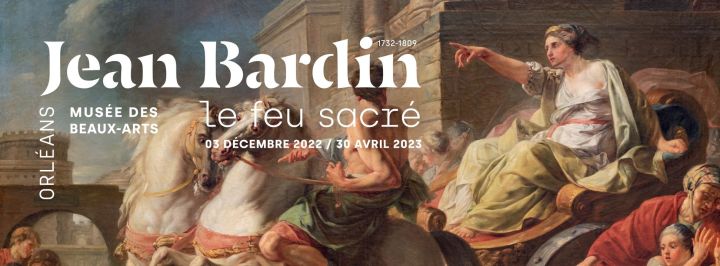
Jean Bardin, Tullia Driving Her Chariot over the Body of Her Father, detail, 1765, oil on canvas, 114 × 146 cm
(Landesmuseum Mainz)
◊ ◊ ◊ ◊ ◊
Now on view at the Museum of Fine Arts in Orléans:
Jean Bardin (1732–1809), le feu sacré
Le musée des Beaux-Arts d’Orléans, 3 December 2022 — 30 April 2023
Curated by Frédéric Jimeno
Le musée des Beaux-Arts d’Orléans présente la première exposition rétrospective consacrée à l’un de ses grands hommes : le peintre Jean Bardin (1732–1809).
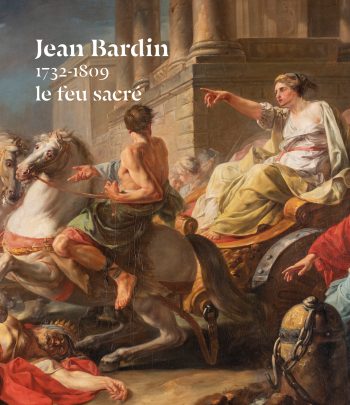 L’exposition Jean Bardin (1732–1809), le feu sacré réunit pour la première fois le corpus de l’artiste. Des tableaux provenant de cathédrales et églises françaises (Bayonne, Mesnil-le-Roi, Charmentray…), récemment restaurés, seront présentés aux côtés d’œuvres provenant des grands musées français (Louvre, Nancy…) et européens (Albertina à Vienne, Mayence…) ainsi que de collections particulières. L’un des temps forts sera le cycle monumental des Sept sacrements, réalisé entre 1780 et 1791 pour la chartreuse de Valbonne et aujourd’hui conservée à la chartreuse d’Aula Dei à Saragosse. Cette série monumentale est exposée en France pour la première fois.
Cette exposition, initiée en 2016 avec Frédéric Jimeno, spécialiste de l’artiste et commissaire scientifique de l’exposition, est le fruit de plusieurs années de recherches. Elle révèle un artiste parmi les principaux de son temps, dans les premières lueurs du néoclassicisme. Le catalogue de l’exposition constitue la première monographie du peintre et propose également une synthèse sur la naissance des institutions artistiques orléanaises sous son égide. Jean Bardin (1732–1809), le feu sacré déploie ainsi un parcours allant de ses débuts dans l’atelier de Jean-Baptiste- Marie Pierre jusqu’à sa mort, qui laisse en héritage les fondements du musée des Beaux-Arts actuel qui ouvrira en 1825. Cette exposition est par ailleurs l’occasion d’évoquer l’entourage familial du peintre, à commencer par la figure de sa fille, Ambroise- Marguerite (1768–1842), artiste formée par son père, seconde femme peintre orléanaise connue après Thérèse Laperche (1743–1814), elle-même révélée au public en 2020 dans le cadre de l’exposition Jean- Marie Delaperche.
Mehdi Korchane, ed., Jean Bardin (1732–1809), le feu sacré (Paris: Les éditions Le Passage, 2023), 304 pages, ISBN: 978-2847424973, €38.
Additional information and more images can be found here»
Exhibition | Hieroglyphs: Unlocking Ancient Egypt

Mummy bandage of Aberuait, linen, Egypt, Ptolemaic Period 332–30 BC (Paris: Musée du Louvre / photo: Georges Poncet). This bandage was a souvenir from one of the earliest ‘mummy unwrapping events’ in the late seventeenth century, where attendees would witness a mummy’s unwrapping and receive a piece of the wrapping linen, preferably inscribed with hieroglyphs.
◊ ◊ ◊ ◊ ◊
From the press release (July 2022) for the exhibition:
Hieroglyphs: Unlocking Ancient Egypt
The British Museum, London, 13 October 2022 — 19 February 2023
Curated by Ilona Regulski
Hieroglyphs: Unlocking Ancient Egypt, a major exhibition at the British Museum, marks one of the most important moments in our understanding of ancient history: the decipherment of Egyptian hieroglyphs. The exhibition explores the inscriptions and objects that helped scholars unlock one of the world’s oldest civilisations 200 years ago.
At the exhibition’s heart is the Rosetta Stone, amongst the world’s most famous ancient objects and one of the British Museum’s most popular exhibits. Before hieroglyphs could be deciphered, life in ancient Egypt had been a mystery for centuries with only tantalising glimpses into this forgotten world. The discovery of the Rosetta Stone in 1799, with its decree written in hieroglyphs, demotic, and the known language of ancient Greek, provided the key to decoding hieroglyphs in 1822—a breakthrough that expanded the modern world’s knowledge of Egypt’s history by some 3,000 years.
 This immersive exhibition brings together over 240 objects, including loans from national and international collections, many of which will be shown for the first time. It will chart the race to decipherment, from initial efforts by medieval Arab travellers and Renaissance scholars to more focussed progress by French scholar Jean-François Champollion (1790–1832) and England’s Thomas Young (1773–1829). The Rosetta Stone is on view alongside the very inscriptions that Champollion and other scholars studied in their quest to understand the ancient past. The exhibition also features stunning objects that highlight the impact of that breakthrough.
Star objects include ‘the Enchanted Basin’, a large black granite sarcophagus from about 600 BCE, covered with hieroglyphs and images of gods. The hieroglyphs were believed to have magical powers and that bathing in the basin could offer relief from the torments of love. The reused ritual bath was discovered near a mosque in Cairo, in an area still known as al-Hawd al-Marsud—‘the enchanted basin’. It has since been identified as the sarcophagus of Hapmen, a nobleman of the 26th Dynasty.
Rarely on public display, the richly illustrated Book of the Dead papyrus of Queen Nedjmet is over 3,000 years old and more than four metres long. A recitation of the texts demonstrates the power of the spoken word, with ritual spells there to be pronounced. The papyrus is presented alongside a set of four canopic vessels that preserved the organs of the deceased. These were dispersed over French and British collections after discovery, and this is the first time this set of jars has been reunited since the mid-1700s.
Among the exceptional loans to the exhibition is the mummy bandage of Aberuait from the Musée du Louvre, which has never been shown in the UK. It was a souvenir from one of the earliest ‘mummy unwrapping events’ in the 1600s where attendees received a piece of the linen, preferably inscribed with hieroglyphs. The exhibition also brings together personal notes by Champollion from the Bibliothèque nationale de France, and by Young from the British Library. A 3,000-year-old measuring rod from the Museo Egizio in Turin was an essential clue for Champollion to unravel Egyptian mathematics, discovering that the Egyptians used units inspired by the human body.
The striking cartonnage and mummy of the lady Baketenhor, on loan from the Natural History Society of Northumbria, was studied by Champollion in the 1820s. In correspondence with colleagues in Newcastle, Champollion correctly identified the inscription on the mummy cover as a prayer addressed to several deities for the soul of the deceased only a few years after he cracked the hieroglyphic writing system. Baketenhor lived to about 25–30 years of age, sometime between 945 and 715 BCE.
From love poetry and international treaties, to shopping lists and tax returns, the exhibition reveals fascinating stories of life in ancient Egypt. As well as an unshakeable belief in the power of the pharaohs and the promise of the afterlife, ancient Egyptians enjoyed good food, writing letters, and making jokes.
Many people in ancient Egypt could not read or write so language was enjoyed through readings, recitations, and performances. The exhibition includes digital media and audio to bring the language to life alongside the objects on display. As part of the interpretation, the British Museum has worked with Egyptian colleagues and citizens from Rashid (modern day Rosetta), with their voices featured throughout the exhibition.
Ilona Regulski, Curator of Egyptian Written Culture at the British Museum, said: “The decipherment of hieroglyphs marked the turning point in a study that continues today to reveal secrets of the past. The field of Egyptology is as active as ever in providing access to the ancient world. Building on 200 years of continuous work by scholars around the globe, the exhibition celebrates new research and shows how Egyptologists continue to shape our dialogue with the past.”
Hartwig Fischer, Director of the British Museum, said: “Hieroglyphs: Unlocking Ancient Egypt marks 200 years since the remarkable breakthrough to decipher a long-lost language. For the first time in millennia the ancient Egyptians could speak directly to us. By breaking the code, our understanding of this incredible civilisation has given us an unprecedented window onto the people of the past and their way of life. I would like to express my gratitude to our long-term exhibition partner BP. Without their support, the British Museum would not be able to present such exhibitions, allowing visitors to discover the art, culture and language of ancient Egypt through the eyes of the pioneering scholars who unlocked those ancient secrets.”
Ilona Regulski, Hieroglyphs: Unlocking Ancient Egypt (London: The British Museum, 2022), 272 pages, ISBN: 978-0714191287 (hardback), £35 / ISBN: 978-0714191294 (paperback), £20.
Exhibition | Kimono Style
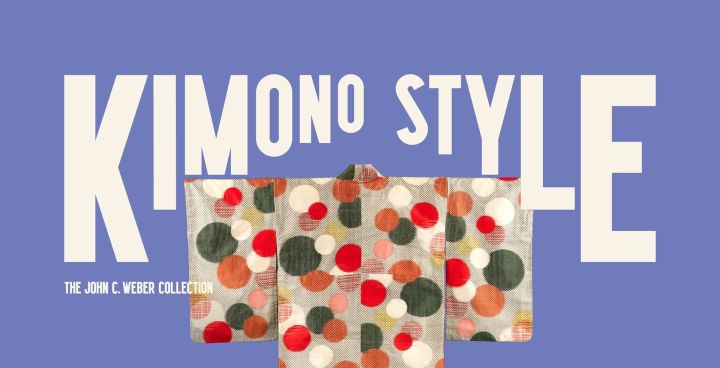
From the press release (1 June 2022) for the exhibition:
Kimono Style: The John C. Weber Collection
The Metropolitan Museum of Art, New York, 7 June 2022 — 20 February 2023
Curated by Monika Bincsik, with Karen Van Godtsenhoven
Kimono Style: The John C. Weber Collection traces the transformation of the kimono from the late 18th through the early 20th century, as the T-shaped garment was adapted to suit the lifestyle of modern Japanese women. The exhibition features a remarkable selection of works, including a promised gift of numerous modern kimonos from the renowned John C. Weber Collection of Japanese art, as well as highlights from The Costume Institute’s collection. More than 60 kimonos, including men’s and children’s wear, are displayed alongside Western garments, Japanese paintings, prints, and decorative art objects.
“This outstanding exhibition presents the kimono from a transnational perspective, highlighting the artistic conversations between Japan and the West, and the garment’s continued impact on designers around the world,” said Max Hollein, Marina Kellen French Director of The Metropolitan Museum of Art. “We are extremely grateful to John C. Weber for his promised gift, his loans to this exhibition, and his long-term support of Asian art at The Met.”

青竹色地輪宝瑞雲模様唐織, Noh Costume (Karaori) with Dharma Wheels and Clouds, Edo period (1615–1868), mid-18th century, twill-weave silk with silk supplementary weft patterning, 158 × 136 cm (John C. Weber Collection).
Monika Bincsik, the Diane and Arthur Abbey Associate Curator for Japanese Decorative Arts, said, “The kimono has served for centuries as a tableau on which to describe and record the histories of women. The variety of patterns and colors and the often-changing trends reveal much about Japanese culture and society when we shed light on the circumstances of the owners of these intricate garments and their production techniques. For many Western couturiers and designers, the kimono was a catalyst to inspire new motifs and novel cuts and to provide freedom to the wearer by creating space between the body and the clothes. At the same time, Western manufacturing techniques and materials along with artistic trends contributed to the modernization of the T-shaped garments and helped to create fresh styles.”
The weaving, dyeing, and embroidery techniques for which Japan is so well known reached their peak of artistic sophistication during the Edo period (1615–1868). Members of the ruling military class were the primary consumers of sumptuous kimonos, each one being custom made. At the same time, a dynamic urban culture emerged, and the merchant class used its wealth to acquire material luxuries. One of the most visible art forms in daily life, kimonos provided a way for townspeople to proclaim their aesthetic sensibility. The kimono-pattern books and ukiyo-e woodblock prints used during that time are comparable to modern fashion magazines and provide evidence of a sophisticated system of production, distribution, and consumption.
Depictions of kimonos in Japanese woodblock prints were widely studied by Western couturiers in the late 19th century who were first inspired by the garment’s decorative motifs. Later, the kimono’s comparatively loose, enveloping silhouette and its rectilinear cut would have a most profound and lasting influence on Western fashion, with couturiers like Madeleine Vionnet and Cristóbal Balenciaga taking inspiration for their avant-garde creations from the kimono’s construction and geometric lines.
In the Meiji period (1868–1912), Western clothing was introduced to Japan. Simultaneously, modernization and social changes enabled more women to gain access to silk kimonos than ever before. Later, some of the kimono motifs were even inspired by Western art. Around the 1920s, affordable ready-to-wear kimonos (meisen) became very popular and reflected a more Westernized lifestyle. These were sold in department stores modeled on Western retailers, following Western-style marketing strategies.
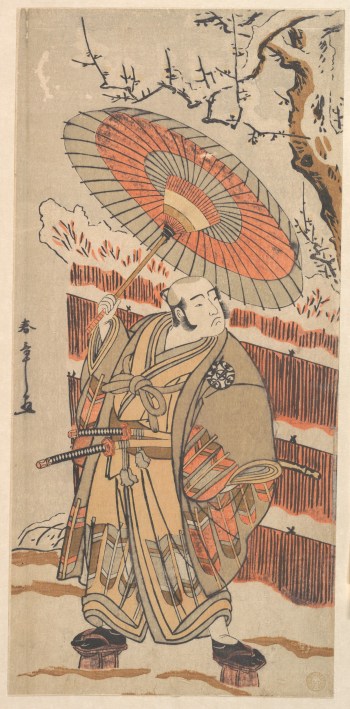
Katsukawa Shunshō (Japanese, 1726–1792), 勝川春章画 二代目中村傳九郎, Kabuki Actor Nakamura Denkurō II, Edo period (1615–1868), ca. 1770s, woodblock print (nishiki-e); ink and color on paper, 29 × 14 cm (New York: The Metropolitan Museum of Art, Rogers Fund, 1914, JP125).
Kimono Style is organized thematically and largely chronologically across 10 galleries. A number of the textiles were rotated in October. The exhibition begins with a look at the costumes worn for Japan’s traditional forms of theater, Noh and Kyōgen, to highlight earlier traditions of clothing from which these elaborate costumes derive. While the two theater forms share roots, they grew from different stage conventions: Noh is solemn drama, while Kyōgen is comic and emphasizes dialogue. They developed together in the 14th century, with Kyōgen pieces performed during interludes or between acts of the main Noh play. The costumes—ornately decorated silk weaves, often made in the Nishijin district of Kyoto, for Noh, and simpler dyed fabrics for Kyōgen, such as the Kyōgen suit with rabbits jumping over waves—were integral to distinguishing the age, social status, and gender of the different characters, all played by male actors. Deriving from actual garments, these costumes preserved past traditions of apparel and shed light on Japanese textile history.
In the early days of Noh theater, during the Muromachi period (1392–1573), audience members often gave their own richly decorated clothing to actors in appreciation. These precious gifts subsequently were transformed into costumes, a tradition that likely led to the creation of exquisite garments specifically for the stage, such as the elegant Noh costume (nuihaku) with orchids and interlinked circles on view in the exhibition, decorated with refined gold foil and silk embroidery patterns
During the Edo period (1615–1868), the military government’s strict control of society meant that dress was not an entirely free or personal choice. Many aspects of clothing, such as the use of gold and expensive techniques, were regulated by the Tokugawa shogunate. At the top of the social hierarchy were the samurai. On the rare official occasions when elite samurai women were seen in public, they wore finely crafted silk garments rooted in conservative traditions, like the Summer robe (hito-e) with court carriage and waterside scene from the late Edo period, made for a woman in the Tokugawa shogun family. Of the three tiers of commoners who followed the samurai in the social order—farmers, artisans, and merchants—merchant-class women had the most freedom in deciding what to wear. Although their choices were supposed to reflect their class position and conform to sumptuary laws, they often disregarded such rules in order to be fashionable and to show off their families’ wealth. Their distinct looks will be illustrated through a number of Edo-period woodblock prints and fashion books depicting the patterns and dye techniques.

茶緑段蘭七宝模様縫箔, Noh Costume (Nuihaku) with Orchids and Interlinked Circles, Edo period (1615–1868), 18th century, plain-weave silk with gold- and silver-leaf application and silk embroidery, 168 × 136 cm (John C. Weber Collection).
Specialized apparel worn to conduct dangerous tasks—whether fighting enemy warriors or battling fires—exemplified the fusion of function and fashion in Japanese textiles. High-ranking samurai had access to the finest materials, including wool imported from Europe, and used boldly decorated battle surcoats (jinbaori) to project status and individual taste. Jinbaori, produced from about the 15th through the mid-19th century, were sleeveless garments originally worn over armor as protection from the weather that eventually became ceremonial wear, such as the Battle surcoat with tattered fan. Firefighters also enjoyed respect in Japan, especially in Edo (present-day Tokyo), where wood architecture led to frequent outbreaks of fire. Samurai firefighters wore expensive garments made of imported wool. The townsmen’s coats were reversible and made of thick, quilted cotton with a plain indigo-dyed exterior and an elaborately decorated interior, usually depicting warrior heroes and mythical creatures that instill bravery or are related to water. One example portrays a legendary warrior, Tarō Yoshikado, who acquired magical skills to be able to morph into a toad.
Access to cotton for commoners, especially those living in the north, increased in the late 17th century with the establishment of the kitamaesen, a commercial shipping route between northern and central Japan, which enabled the secondhand clothing trade to flourish. Castoff cotton clothing was brought from Edo to Osaka and dispersed to the north. Nothing was wasted. The respect for and ingenious use of scarce materials led to the emergence of regional folk textile traditions. On view will be sturdy working clothes for farmers and fishermen as well as lightweight indigo-dyed cotton kimonos for women intended for summertime.
After the collapse of the Tokugawa shogunate in 1868 and the abolition of the class structure, the modernization of the Japanese fashion system occurred first in textile production. Global trade and industrialization in the second half of the 19th century vastly expanded Japan’s access to expensive or restricted wool, cotton, and machine-spun silk. Kimono patterns in the early to mid-20th century increasingly drew from Western art movements, including the organic style characteristic of Art Nouveau and the bold, geometric forms of Art Deco, as can be seen in the Summer kimono (hito-e) with swirls. At the same time, Western couturiers looked to Japanese art and clothing. Kimonos were first reinterpreted as dressing gowns, and later, primarily their fabrics, became a source of inspiration for the creations of couture houses such as Worth. By the early decades of the 20th century, the garment’s rectilinear form and loose shape revolutionized Western fashion: couturiers gave up the S-shaped, corseted bodice for a flat, straighter, modern line. Parisian innovators such as Paul Poiret, Callot Soeurs, and Madeleine Vionnet borrowed Japanese ideas and draped their garments from the shoulder, rather than tailoring the fabric to follow the shape of the body. For example, Poiret’s modernist ‘Paris’ coat from 1919, one of the highlights from The Costume Institute’s collection, was constructed using a single 15-foot length of silk velvet with minimal cutting, recalling the concept of creating a kimono from a single bolt of fabric without any waste and using only rectilinear elements.
 In the Edo period, dry-goods stores or fabric merchants (gofukuten) sold high-quality, made-to-order kosode (the predecessor of the kimono, with small sleeve openings) of silk or fine hemp to men and women of the samurai and wealthy merchant classes. Precursors to the department store, the best-known gofukuten all had branches in multiple cities, including Kyoto, from where they ordered the fabrics. Around the early 20th century, these gofukuten gradually transitioned into modern department stores, adopted Western retail practices, and promoted a modernized lifestyle.
Affordable, stylish kimonos made from meisen, an inexpensive silk woven from predyed yarns, a technique known as ikat (kasuri), became popular in the early 20th century. By the 1920s and 1930s, working- and middle-class women from high-school students to shop assistants could buy these casual, bright-colored, ready-to-wear modern kimonos with bold, graphic patterns. Department stores frequently released new designs to spark trends and inspire purchases. Many meisen kimono patterns were inspired by avant-garde art movements, such as Italian Futurism and the Dutch ‘De Stijl’. Piet Mondrian’s compositions were particularly influential, as demonstrated by a large ikat (ōgasuri) kimono in bright yellow, teal, and raspberry red.
Since the second half of the 20th century, the kimono’s iconic structure has been a source of inspiration in both Japanese and Western fashion. Some modern designers use its shape as a starting point for architecturally constructed garments, as seen in the work of Issey Miyake and Cristobal Balenciaga, whose Evening wrap from 1951 will be on view. Others play with the kimono’s symbolic associations. Remixed and reinterpreted by Japanese designers active in the West, including Yohji Yamamoto and Rei Kawakubo, the kimono dynamically reflects Japanese culture both to the world and back onto itself as evident in Rei Kawakubo’s Ensemble for Comme des Garçons featuring a manga figure. Through all these iterations, the kimono has gestured toward a future beyond fashion trends, cultural boundaries, and gender norms.
Kimono Style: The John C. Weber Collection is curated by Monika Bincsik, Diane and Arthur Abbey Associate Curator for Japanese Decorative Arts, with guest co-curator Karen Van Godtsenhovenk. The exhibition is made possible by the Mary Livingston Griggs and Mary Griggs Burke Foundation Fund, 2015. A fully illustrated catalogue accompanies the exhibition. Published by The Metropolitan Museum of Art and distributed by Yale University Press, it is made possible by the Florence and Herbert Irving Fund for Asian Art Publications. Additional support is provided by the Richard and Geneva Hofheimer Memorial Fund.
Monika Bincsik, Karen van Godtsenhoven, and Masanao Arai, Kimono Style: Edo Traditions to Modern Design (New York: The Metropolitan Museum of Art, 2022), 176 pages, ISBN: 978-1588397522, $35.
Monika Bincsik is the Diane and Arthur Abbey Associate Curator for Japanese Decorative Arts in the Asian Art Department at The Metropolitan Museum of Art, New York. Karen Van Godtsenhoven is an independent curator based in Belgium. Arai Masanao is a textile historian based in Japan.
Basile Baudez’s Inessential Colors Wins the 2022 Hitchcock Medallion
The Society of Architectural Historians of Great Britain (SAHGB) recently announced its award winners for 2022.
 We are pleased to congratulate the winners of this year’s SAHGB awards. The Alice Davis Hitchcock Medallion has been awarded annually since 1959 to a monograph that makes an outstanding contribution to the study or knowledge of architectural history. This year’s winner is:
Basile C. Baudez’s Inessential Colors: Architecture on Paper in Early Modern Europe (Princeton University Press), which the panel commend as a landmark work, beautifully written, methodologically innovative and which will have significant impact on future studies.
Elizabeth McKellar, on behalf of the judging panel, commented: “The judges praised this as an original, complex and ambitious work which examines changes in architectural drawing c. 1500–1800. The author skilfully weaves an investigation of the changing use of colour in architectural representation to argue for new understandings of draughtsmanship and its place in architectural practice. Furthermore, Baudez reveals how histories of the practice of architecture are inextricably interwoven with those of painting, engineering and cartography as well as the professional, commercial and institutional networks that shaped its activities. The book is to be commended for its mastery of a huge range of secondary literature across the broad chronological and geographical sweep of both southern and northern Europe (including Britain) in an integrated approach. The book is beautifully and generously illustrated incorporating a breath-taking range of sources, many of them little-known. The quality of this visual material together with the clarity of the writing combine to produce a powerful re-assessment of the role of coloured maps, plans and drawings in communicating and defining early modern architecture in Europe.”
The shortlist is available here, with the full announcement of winners here.
New Book | Collective Wisdom: Collecting in the Early Modern Academy
From Brepols:
Anna Marie Roos, Vera Keller, eds., Collective Wisdom: Collecting in the Early Modern Academy (Brepols, 2022), 325 pages, ISBN: 978-2503588063, €85.
 Collective Wisdom analyses the connections between early modern scholarly societies and to what extent these networks shaped the formation of early museums and the categorisation of knowledge.
This volume analyses how and why members of scholarly societies such as the Royal Society, the Society of Antiquaries of London, and the Leopoldina collected specimens of the natural world, art, and archaeology in the seventeenth and eighteenth centuries. These scholarly societies, founded before knowledge became subspecialised, had many common members. We focus upon how their exploration of natural philosophy, antiquarianism, and medicine were reflected in collecting practice, the organisation of specimens and how knowledge was classified and disseminated. The overall shift from curiosity cabinets with objects playfully crossing the domains of art and nature, to their well-ordered Enlightenment museums is well known. Collective Wisdom analyses the process through which this transformation occurred, and the role of members of these academies in developing new techniques of classifying and organising objects and new uses of these objects for experimental and pedagogical purposes.
Anna Marie Roos, FLS FSA is the Professor of the History of Science and Medicine at the University of Lincoln (UK). Vera Keller is Professor of History at the University of Oregon.
C O N T E N T S
Vera Keller and Anna Marie Roos — Introduction
Kelly J. Whitmer — Putting Play to Work: Collections of Realia and Useful Play in Early Modern Educational Reform Efforts
Chantal Grell — Tito Livio Burattini, a Seventeenth-Century Engineer and Egyptologist
Georgiana Hedesan — University Reform and Medical Alchemy in Ole Worm’s Museum Wormianum (1655)
Fabien Krämer — The Curiosi as Collectores: The Publications of the Academia Naturae Curiosorum, c. 1652–1706
Vera Keller — Vernacular Knowledge, Learned Medicine, and Social Technologies in the Leopoldina, 1670–1700, or, How to Publish on Sirens, Dragons, and Basilisks
Philip Beeley — ‘The Antiquity, Excellence, and use of Musick’: Wallis, Wanley, and the Reception of Ancient Greek Music in Late Seventeenth-Century Oxford
Julia A. Schmidt-Funke — Urban Fabric and Knowledge of Nature: Physicians as Naturalists in Early Modern Commercial Towns
Kim Sloan — Sloane’s Antiquities: Providing a ‘Body of History’ through Beads, Bottles, Brasses and Busts
Dustin Frazier Wood — Antiquarian Science and Scientific Antiquarianism at the Spalding Gentlemen’s Society
Anna Marie Roos — The First Egyptian Society
Louisiane Ferlier — Collective Wisdom in the Digital Age: Digitizing Early Modern Collections at the Royal Society
New Book | Appropriation and Invention
Published by Hirmer and distributed by The University of Chicago Press:
Jorge Rivas Pérez, ed., Appropriation and Invention: Three Centuries of Art in Spanish America (Munich: Hirmer Verlag, 2023), 296 pages, ISBN: 978-3777439686, $50. With contributions by O. I. Acosta Luna, Luisa E. Alcalá, E. Arroyo Lemus, Carla Aymes, Michael A. Brown, James M. Cordova, Gustavo Curiel, C. Fernández Salvador, Raphael Fonseca, Philippe Halbert, Ricardo Kusunoki, Natalia Majluf, F. M. Neff, J. Rodríguez Nóbrega, Sofia Sanabrais, and L. E. Wuffarden Revilla.
 A bilingual guide to the Denver Art Museum’s permanent collection of Latin American art, covering masterpieces from three centuries of art in Spanish America.
Drawing from the renowned collection of Latin American Art at the Denver Art Museum, this bilingual catalog examines the processes of appropriation and invention in the arts of Spanish America from the 1520s to the 1820s. The book highlights Latin American masterpieces, including paintings, sculptures, and decorative arts, made shortly after the conquest and before the independence movements. Arranged regionally, the book’s essays explore how artists found artistic freedom under colonial authority. The book shows that while still pleasing clients, many artists of Indigenous and African descent also reclaimed and reshaped the arts for themselves and their new colonial realities. Essays that consider modern and contemporary trends round out the volume.
Jorge F. Rivas Pérez is the Frederick and Jan Mayer Curator of Latin American Art at the Denver Art Museum. He is the co-editor of Revisión: A New Look at Arts in the Americas.
Online Catalogue | The Nelson-Atkins Museum of Art, French Paintings

From The Nelson-Atkins:
The Nelson-Atkins Museum of Art
French Paintings Catalogue
Learn more about the remarkable French paintings and pastels at the Nelson-Atkins Museum of Art. View the entire collection online, delve into recent scholarly insights and technical discoveries, or read about the history of collecting French art in Kansas City. Art historians and conservators provide fresh perspectives on the French collection, and comprehensive research sheds new light on the provenance (ownership history), exhibition history, and publication history of each work. Whether you are seeking a quick overview or deep dive, the French Paintings Catalogue is the perfect place to explore and learn more.
The French Paintings Catalogue is generously supported by The Marion and Henry Bloch Family Foundation, The National Endowment for the Humanities, Adelaide Cobb Ward in honor of Donald J. Hall’s retirement, The Mellon Endowment for Scientific Research, The National Endowment for the Arts, The James Sight Fund, and The Samuel H. Kress Foundation.
C O N T E N T S
Publication Installments
Director’s Foreword — Julián Zugazagoitia
Preface and Acknowledgments — Aimee Marcereau DeGalan
Timeline — Meghan L. Gray and Glynnis Stevenson
The Collecting of French Paintings in Kansas City — Aimee Marcereau DeGalan
Conservation Introductory Essay — Mary Schafer, Rachel Freeman, and John Twilley
Notes to Reader
Seventeenth Century, 1600–1699
Eighteenth Century and Pre-Revolution, 1700–1789
Neoclassicism and Romanticism, 1790–1860
Nineteenth Century, Realism, Barbizon, 1830–1890
Impressionism, 1860–1900s
Post-Impressionism, 1886–1900s
A Modern World, 1900–1945
Appendix I: Other Works in the Bloch Collection of The Nelson-Atkins Museum of Art
Appendix II: Other French Works in the Collection of The Nelson-Atkins Museum of Art
Glossary
About
Contributors
Photograph Credits
New Book | Jena 1800: The Republic of Free Spirits
From Macmillan:
Peter Neumann, Jena 1800: The Republic of Free Spirits, translated by Shelley Frisch (New York: Farrar, Straus and Giroux, 2022), 256 pages, ISBN: 978-0374178697, $27.
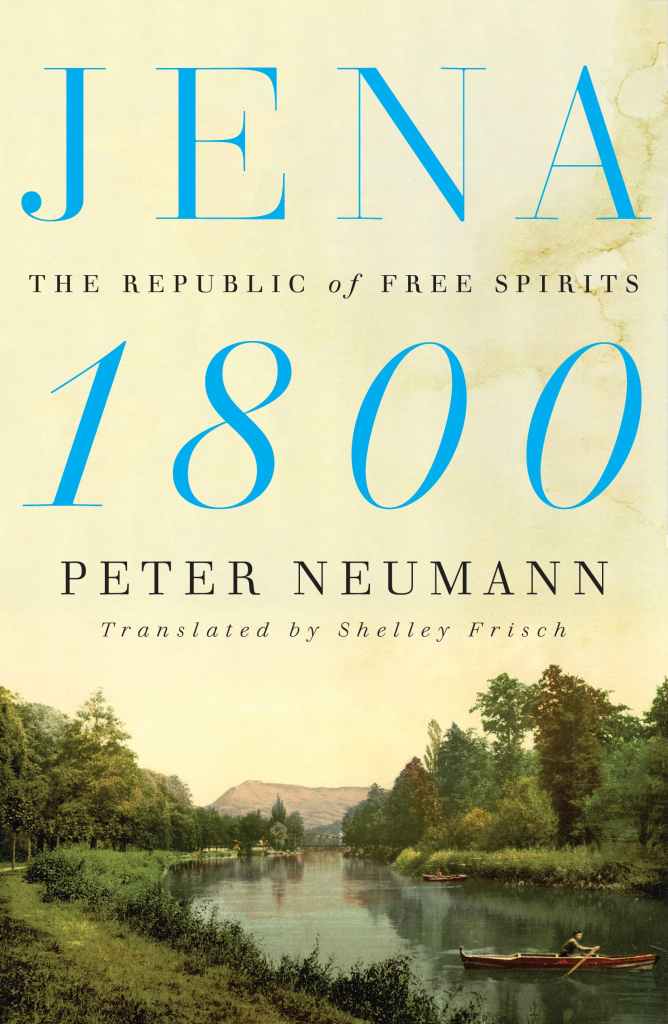 Around the turn of the nineteenth century, a steady stream of young German poets and thinkers coursed to the town of Jena to make history. The French Revolution and the Napoleonic Wars had dealt a one-two punch to the dynastic system. Confidence in traditional social, political, and religious norms had been replaced by a profound uncertainty that was as terrifying for some as it was exhilarating for others. Nowhere was the excitement more palpable than among the extraordinary group of poets, philosophers, translators, and socialites who gathered in this Thuringian village of just four thousand residents.
Jena became the place for the young and intellectually curious, the site of a new departure, of philosophical disruption. Influenced by Johann Wolfgang von Goethe, then an elder statesman and artistic eminence, the leading figures among the disruptors—the translator August Wilhelm Schlegel; the philosophers Friedrich ‘Fritz’ Schlegel and Friedrich Schelling; the dazzling, controversial intellectual Caroline Schlegel, married to August; Dorothea Schlegel, a poet and translator, married to Fritz; and the poets Ludwig Tieck and Novalis—resolved to rethink the world, to establish a republic of free spirits. They didn’t just question inherited societal traditions; with their provocative views of the individual and of nature, they revolutionized our understanding of freedom and reality. With wit and elegance, Peter Neumann brings this remarkable circle of friends and rivals to life in Jena 1800, a work of intellectual history that is colorful and passionate, informative and intimate—as fresh and full of surprises as its subjects.
Peter Neumann studied philosophy, political science, and economics in Jena and Copenhagen. He holds a PhD in philosophy and writes for the weekly newspaper Die Zeit. He is the author of the poetry collections secure and areas & days, which have been awarded several prizes and scholarships.
Shelley Frisch’s translations from the German―which include biographies of Friedrich Nietzsche, Albert Einstein, Leonardo da Vinci, Marlene Dietrich/Leni Riefenstahl (dual biography), and Franz Kafka―have been awarded numerous translation prizes. She lives in Princeton, New Jersey.
New Book | Magnificent Rebels: The First Romantics
From Penguin Random House:
Andrea Wulf, Magnificent Rebels: The First Romantics and the Invention of the Self (New York: Knopf, 2022), 512 pages, ISBN: 978-0525657118, $35.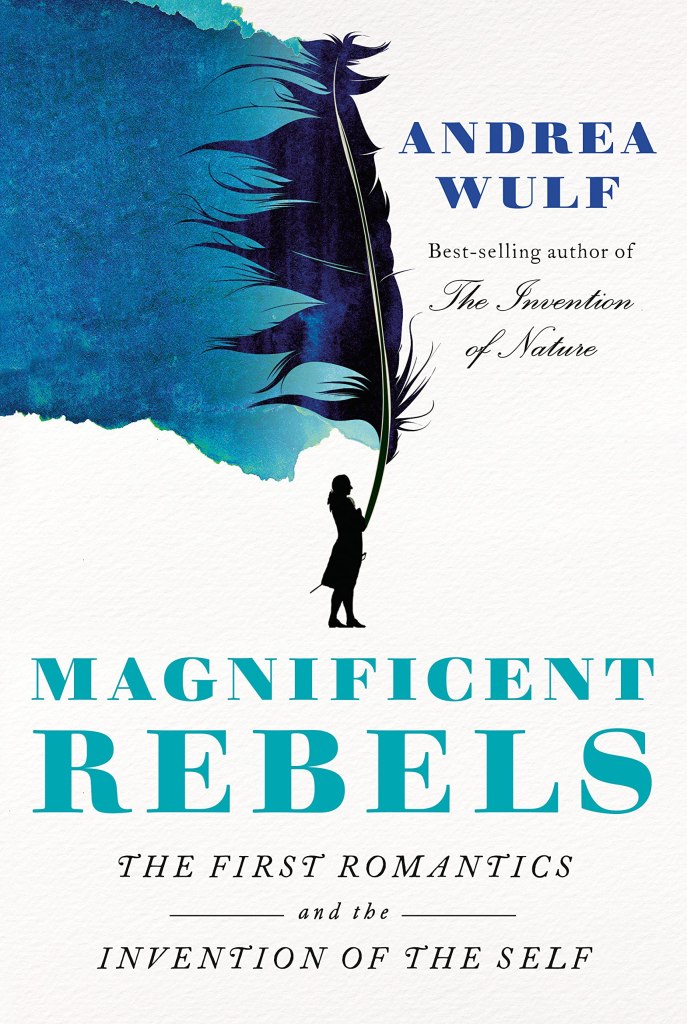 When did we begin to be as self-centered as we are today? At what point did we expect to have the right to determine our own lives? When did we first ask the question, How can I be free? It all began in Jena, a quiet university town in Germany, in the 1790s, when a group of playwrights, poets, and writers put the self at center stage in their thinking, their writing, and their lives. This brilliant circle included the famous poets Goethe, Schiller, and Novalis; the visionary philosophers Fichte, Schelling, and Hegel; the contentious Schlegel brothers; and, in a wonderful cameo, Alexander von Humboldt. And at the heart of this group was the formidable Caroline Schlegel, who sparked their dazzling conversations about the self, nature, identity, and freedom.
The French revolutionaries may have changed the political landscape of Europe, but the young Romantics incited a revolution of the mind that transformed our world forever. We are still empowered by their daring leap into the self, and by their radical notions of the creative potential of the individual, the highest aspirations of art and science, the unity of nature, and the true meaning of freedom. We also still walk the same tightrope between meaningful self-fulfillment and destructive narcissism, between the rights of the individual and our responsibilities toward our community and future generations. At the heart of this inspiring book is the extremely modern tension between the dangers of selfishness and the thrilling possibilities of free will.
Andrea Wulf was born in India and moved to Germany as a child. She is the author of Founding Gardeners, Brother Gardeners, and The New York Times best seller The Invention of Nature, which has been published in twenty-seven languages and won fifteen international literary awards. Wulf has written for many newspapers and magazines, including The New York Times, The Guardian, The Los Angeles Times, The Wall Street Journal, and The Atlantic. She is a member of PEN America and a fellow of the Royal Society of Literature. She lives in London.
When did we begin to be as self-centered as we are today? At what point did we expect to have the right to determine our own lives? When did we first ask the question, How can I be free? It all began in Jena, a quiet university town in Germany, in the 1790s, when a group of playwrights, poets, and writers put the self at center stage in their thinking, their writing, and their lives. This brilliant circle included the famous poets Goethe, Schiller, and Novalis; the visionary philosophers Fichte, Schelling, and Hegel; the contentious Schlegel brothers; and, in a wonderful cameo, Alexander von Humboldt. And at the heart of this group was the formidable Caroline Schlegel, who sparked their dazzling conversations about the self, nature, identity, and freedom.
The French revolutionaries may have changed the political landscape of Europe, but the young Romantics incited a revolution of the mind that transformed our world forever. We are still empowered by their daring leap into the self, and by their radical notions of the creative potential of the individual, the highest aspirations of art and science, the unity of nature, and the true meaning of freedom. We also still walk the same tightrope between meaningful self-fulfillment and destructive narcissism, between the rights of the individual and our responsibilities toward our community and future generations. At the heart of this inspiring book is the extremely modern tension between the dangers of selfishness and the thrilling possibilities of free will.
Andrea Wulf was born in India and moved to Germany as a child. She is the author of Founding Gardeners, Brother Gardeners, and The New York Times best seller The Invention of Nature, which has been published in twenty-seven languages and won fifteen international literary awards. Wulf has written for many newspapers and magazines, including The New York Times, The Guardian, The Los Angeles Times, The Wall Street Journal, and The Atlantic. She is a member of PEN America and a fellow of the Royal Society of Literature. She lives in London.
Huge New Discovery of Notes on Hegel’s Lectures
From The Guardian:
Sara Tor, “Manuscript Treasure Trove May Offer Fresh Understanding of Hegel,” The Guardian (29 November 2022).
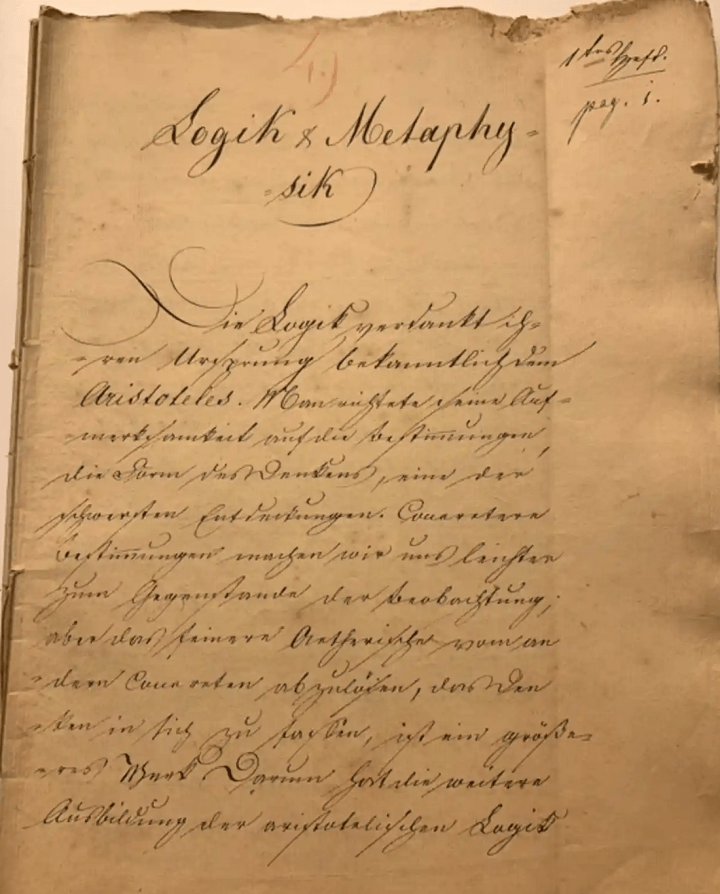
One of the papers from a trove of 4,000 notes on Hegel, found by Professor Klaus Vieweg (Photograph: Marko Fuchs/Copyright Archiv und Bibliothek des Erzbistums München und Freising).
Library discovery of undocumented transcripts of German philosopher’s lectures like ‘finding new Beethoven score’
A biographer researching the German philosopher Hegel (1770–1831) has uncovered a massive treasure trove of previously undocumented lectures that could change perceptions regarding one of the leading figures of modern western philosophy. More than 4,000 pages of notes on Georg Wilhelm Friedrich Hegel’s lectures were found by Klaus Vieweg in the library of the archdiocese of Munich and Freising.
“The discovery of these manuscripts is comparable to finding a new score by Beethoven or a previously unseen painting by Constable,” said Vieweg, a professor at the Friedrich Schiller University Jena in Germany.
He said an early reading of the notes had hinted at a fresh understanding of how Hegel formed his influential ideas on aesthetics, the philosophy around beauty and art, and how he analysed Shakespeare’s plays to help develop his ideas.
The transcripts are thought to have been written by Friedrich Wilhelm Carové, one of the first students at Heidelberg University to be taught by Hegel during the philosopher’s time there between 1816 and 1818. Hegel’s ideas and works are notable for their formidable difficulty. The British philosopher Bertrand Russell described him as “the hardest to understand of the great philosophers.” Vieweg hopes the new find might bring clarity. The papers will now be compiled into an annotated edition by a team of international experts, headed by Vieweg and Christian Illies, a professor of philosophy at the University of Bamberg.
“Major sections of Hegel’s work are only known through his lectures, so scholars have long been trying to find transcripts,” said Illies. “Several were found and published in the 19th and 20th centuries, but over the years uncovering new material has become less and less likely.”
Vieweg’s find is probably the single largest of its kind ever made. It was unearthed after a reader of his recent biography on Hegel pointed him to the archive of Friedrich Windischmann. Windischmann was a professor of Catholic theology in Munich whose father, Karl Joseph Hieronymous Windischmann, was a philosopher and friend of Hegel. A letter between Hegel and Karl Windischmann shows that Carové gave the set of manuscripts to the latter as a gift.
Although research on the material has only just begun, there has already been one significant find: the boxes contain a transcript from one of the very first lectures Hegel gave on aesthetics. Currently, any knowledge of Hegel’s thoughts on aesthetics originates from much later lectures given in Berlin. These were published after his death by his student Heinrich Gustav Hotho using a combination of lecture transcripts and Hegel’s own notes. As there have been no other sources to compare this with, questions have arisen as to how far this material was influenced by Hotho. The discovery of early lectures, therefore, could help to finally clear up the uncertainty. . . .
The full article is available here»










 Enfilade
leave a comment