New Book | Seventeenth-Century Water Gardens
From Oxbow Books:
Stephen Wass, Seventeenth-Century Water Gardens and the Birth of Modern Scientific Thought in Oxford: The Case of Hanwell Castle (Oxford: Windgather Press, 2022), 240 pages, ISBN: 978-1914427169, £40.
 Based on a decade of archaeological investigation and historical research, this book tells the story of the Copes of Hanwell Castle in north Oxfordshire and the creation of a garden with links to the development of scientific thinking in Oxford in the late seventeenth century. New research using Robert Plot’s Natural History of Oxfordshire as a starting point has uncovered details of a remarkable family and their rise and tragic downfall, their social circle, that included some great names in the development of early scientific thinking, and their garden that in effect became a place dedicated to the wonders of technology. The complex tale weaves together the activities of a royalist agent, Richard Allestree, a prodigious musician, Thomas Baltzar, John Claridge, a Hanwell Shepherd with a penchant for weather forecasting, and Sir Anthony Cope who in an atmosphere of secrecy and distrust began to gather together a community that eventually was named by Plot as The New Atlantis, a reference to a book published earlier in the century by Sir Francis Bacon in which he suggests a model for a Utopian science-focused society.
The book also chronicles the programme of archaeological excavation that has uncovered several unusual garden features and, most significantly of all, describes in detail the unique collection of seventeenth-century terracotta garden urns, an assemblage that is unparalleled in post-medieval archaeology. This collection was destroyed in a single episode of vandalism around 1675 and has been preserved in deeply buried deposits of mud and silt. Their analysis and reconstruction is opening new insights into the decorative schemes of seventeenth-century gardens. There is coverage of other gardens of the period and their surviving features as well as an examination of early science and how gardens impacted on its development in many ways.
Stephen Wass completed his MA in historical archaeology at the University of Leicester and then established himself as a freelance consultant specialising in historic gardens. Much of his work has been for the National Trust including major sites such as Chastleton House, Packwood House, Croft Castle, and Stowe Landscape Gardens. The current volume arises from a programme of doctoral research at the University of Oxford.
C O N T E N T S
Preface: Robert Plot and Sir Anthony Cope
1 Introduction
• The Study of Gardens in Theory and Practice
• Hanwell: Geology, Geography, Archaeology, and History
2 The Sixteenth Century
• William Cope and the Building of Hanwell House
• The Origins of Early Modern Water Gardens
• Water Gardens in the Sixteenth Century
3 The Seventeenth Century
• Continental Engineers and Their Influence
• The Copes in Ascendancy
• Walter Cope’s Water Maze
• Francis Bacon, Gardening, and The New Atlantis
• Thomas Bushell and the Enstone Marvels
• Other Early Seventeenth-Century Water Gardens
4 At Hanwell House
• The Archaeology of the Gardens, 1600–1660
• Sir Anthony Cope, the Fourth Baronet
• Sir Anthony Cope in His Social Setting
• Hanwell, Cope, and Plot
• Sir Anthony’s Companions
• The Archaeology of the Gardens, 1660–1675
• Reconstructing the House of Diversion
• The Hanwell Pots and Other Finds
5 The End of it All
• The Aftermath, the Family and Estate after 1675
• The Archaeology of the Gardens from 1675 to the Present Day
6 Oxford, Science, and Gardening
• Oxford, Hanwell, and Early Scientific Thinking
• Gardens and Science
• The Tangley Mystery and Hanwell as the New Atlantis
Conclusions
New Book | Thomas White (c. 1736–1811)
From Oxbow Books:
Deborah Turnbull and Louise Wickham, Thomas White (c. 1736–1811): Redesigning the Northern British Landscape (Oxford: Windgather Press, 2021), 272 pages, ISBN: 978-1914427008, £40 / $55.
 This volume aims to restore the reputation of Thomas White, who in his time was as well respected as his fellow landscape designers Lancelot ‘Capability’ Brown and Humphry Repton. By the end of his career, White had produced designs for at least 32 sites across northern England and over 60 in Scotland. These include nationally important designed landscapes in Yorkshire such as Harewood House, Sledmere Hall, Burton Constable Hall, Newby Hall, and Mulgrave Castle, as well as Raby Castle in Durham, Belle Isle in Cumbria, and Brocklesby Hall in Lincolnshire. He had a vital role in the story of how northern English designed landscapes evolved in the 18th century. The book focuses on White’s known commissions in England and sheds further light on the work of other designers such as Brown and Repton, who worked on many of the same sites. White set up as an independent designer in 1765, having worked for Brown from 1759, and his style developed over the next thirty years. Never merely a ‘follower of Brown’, as he is often erroneously described, White was admired for his designs, which influenced the later, more informal styles of the picturesque movement. The improvement plans he produced for his clients demonstrate his surveying and artistic skills. These plans were working documents but at the same time works of art in their own right. Over 60 of his beautifully-executed coloured plans survive as a testament to the value his clients placed on them. This book makes available for the first time over 90% of the known plans and surveys by White for England. Also included are plans by White’s contemporaries, together with later maps, estate surveys, and contemporary illustrations to understand which parts of improvement plans were implemented.
C O N T E N T S
Acknowledgements
List of Figures
Abbreviations
1 Thomas White in Context
2 Early Career and Working with Brown
3 First Commissions, 1765–68
4 Established Landscape Designer, 1769–80
5 Later Career, 1781–1803
6 Getting the Commission
7 His Landscape Designs
8 Working Methods
9 Arboricultural Activities
10 Thomas White in Scotland by Christopher Dingwall
11 White’s Sites in England
Bibliography
Index
New Book | Humphry Repton: Designing the Landscape Garden
From Rizzoli:
John Phibbs, with photographs by Joe Cornish, Humphry Repton: Designing the Landscape Garden (New York: Rizzoli, 2021), 288 pages, ISBN: 978-0847863549, $75.
 Widely acknowledged as the last great landscape designer of the eighteenth century, Humphry Repton created work that survives as a bridge between the picturesque theory of Capability Brown and the pastoral philosophy of Frederick Law Olmsted. By turns inspired by and in opposition to the grandeur of Brown’s estates, Repton’s contribution to the British landscape encompassed a tremendous range, from subtle adjustments that emphasized the natural features of the countryside to deliberate interventions that challenged the notion of the picturesque. This remarkable book explores 15 of Repton’s most celebrated landscapes—from the early maturity of his gardens at Courteenhall and Mulgrave Castle to more adventurous landscapes at Stanage, Brightling, and Endsleigh that would point the way toward how we envision parkland today. With photography by Joe Cornish commissioned specially for the book, and including reproductions of key illustrations and plans for garden design from the famous red books that shed light on Repton’s vision and process, this book illuminates some of Britain’s most beautiful gardens and parks—and the masterful mind behind their creation.
John Phibbs is a renowned garden historian with more than 30 years’ experience in the management and restoration of historic landscapes. He is the author of Capability Brown: Designing the English Landscape. Joe Cornish is an award-winning landscape photographer and an honorary fellow of the Royal Photographic Society, with a studio and gallery in Yorkshire.
New Book | French Suite: A Book of Essays
Distributed by The University of Chicago Press:
Michael Fried, with an introduction by Stephen Bann, French Suite: A Book of Essays (London: Reaktion Books, 2022), 356 pages, ISBN : 978-1789146042, $45.
 French Suite examines a range of important French painters and two writers, Baudelaire and Flaubert, from the brothers Le Nain in the mid-seventeenth century to Manet, Degas, and the Impressionists in the later nineteenth century. A principal theme of Michael Fried’s essays is a fundamental concern of his throughout his career: the relationship between painting and the beholder. Fried’s typically vivid and strongly argued essays offer many new readings and unexpected insights, examining both familiar and lesser-known French artistic and literary works.
Art critic, art historian, literary critic-historian, and poet Michael Fried is the J. R. Herbert Boone Emeritus Professor of Humanities and the History of Art at Johns Hopkins University. His many books include The Moment of Caravaggio.
Stephen Bann, CBE, is professor emeritus of the history of art and a senior research fellow at Bristol University. His recent books include Distinguished Images: Prints in the Visual Economy of Nineteenth-Century France and Stonypath Days: Letters between Ian Hamilton Finlay and Stephen Bann, 1970–72.
C O N T E N T S
Preface
Introduction by Stephen Bann
1 Being Seen and Seeing: Thoughts on the Le Nains
2 Hubert Robert and the ‘Pastoral’ Conception of Painting
3 The Hand on the Page: Three Works by Théodore Géricault
4 Painting Memories: On Baudelaire’s Salon of 1846
5 Facingness Meets Mindedness: Manet’s Luncheon in the Studio and Balcony
6 Degas and Antitheatricality
7 Chapter One of L’Education sentimentale as a Work of Writing
8 Corot’s Figure Paintings and the Apotheosis of Touch
9 Unknown Daubigny
10 The Moment of Impressionism
Coda: The House at Rueil
References
Acknowledgments
List of Illustrations
Index
Exhibition | Claude Gillot: Satire in the Age of Reason

Claude Gillot, Scene of the Two Carriages / Les Deux carrosses, ca. 1710–12, oil on canvas, 127 × 160 cm
(Paris: Musée du Louvre, RF2405)
◊ ◊ ◊ ◊ ◊
Now on view at The Morgan:
Claude Gillot: Satire in the Age of Reason
The Morgan Library & Museum, New York, 24 February — 28 May 2023
Curated by Jennifer Tonkovich
Around 1700, as an increasingly pious Louis XIV withdrew to Versailles, Paris flourished. The dynamic artistic scene included specialists such as Claude Gillot (1673–1722) who forged a career largely outside of the Royal Academy, designing everything from opera costumes to tapestries.
 Known primarily as a draftsman, Gillot specialized in scenes of satire. He found his subjects among the irreverent commedia dell’arte performances at fairground theaters, in the writings of satirists who waged the Quarrel of the Ancients and Moderns, and in the antics of vice-ridden satyrs whose bacchanals exposed human folly. Gillot’s amusing critiques and rational perspective heralded the advent of the Age of Reason while his innovative approach attracted the most talented artists of the next generation, Antoine Watteau and Nicolas Lancret, to his studio.
With over seventy drawings, prints, and paintings, including an exceptional contingent from the Louvre, Claude Gillot: Satire in the Age of Reason explores the artist’s inventive and highly original draftsmanship and places his work in the context of the artistic and intellectual activity in Paris at the dawn of a new century.
The catalogue accompanying the exhibition, published by Paul Holberton, will provide the first comprehensive account of Gillot’s career.
Jennifer Tonkovich, Claude Gillot: Satire in the Age of Reason (London: Paul Holberton, 2023), 240 pages, ISBN: 978-1913645373, $60.
Exhibition | Sublime Ideas: Drawings by Giovanni Battista Piranesi
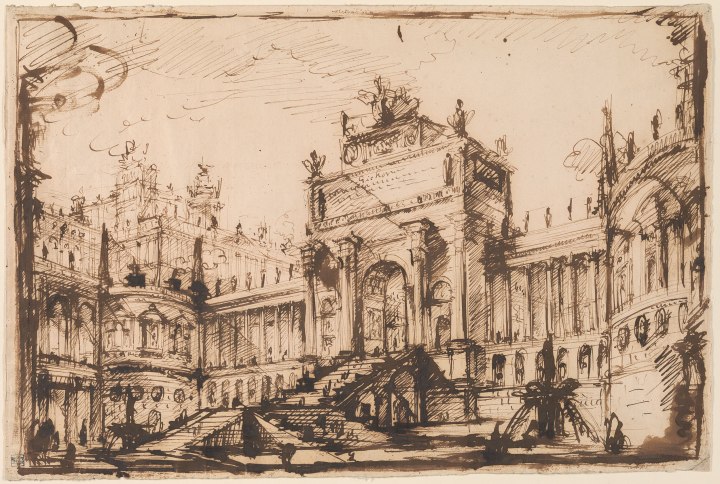
Giovanni Battista Piranesi, Fantasy of a Magnificent Forum, ca. 1765, pen and brown ink and wash, 33 × 49 cm
(New York: Morgan Library & Museum, 1974.27)
◊ ◊ ◊ ◊ ◊
From the press release for the exhibition:
Sublime Ideas: Drawings by Giovanni Battista Piranesi
The Morgan Library & Museum, New York, 10 March — 4 June 2023
Curated by John Marciari
In a letter written near the end of his life, Giovanni Battista Piranesi (1720–1778) explained to his sister that he had lived away from his native Venice because he could find no patrons there willing to support “the sublimity of my ideas.” He resided instead in Rome, where he became internationally famous working as a printmaker, designer, architect, archaeologist, theorist, dealer, and polemicist. While Piranesi’s lasting fame is based above all on his etchings, he was also an intense, accomplished, and versatile draftsman, and much of his work was first developed in vigorous drawings.
The Morgan holds the largest and most important collection of Piranesi’s drawings, well over 100 works that encompass his early architectural capricci, studies for prints, measured design drawings, sketches for a range of decorative objects, a variety of figural drawings, and views of Rome and Pompeii. These form the core of the exhibition, which will also include seldom-exhibited loans from a number of private collections. Accompanied by a publication offering a complete survey of Piranesi’s work as a draftsman, the exhibition will be the most comprehensive look at Piranesi’s drawings in more than a generation.
 This exhibition begins with Piranesi’s interest in theoretical architecture, showing works that combine an imaginative and fantastic approach to architectural study with a bookish understanding of ancient buildings and a Romantic appreciation of ruins. This blend of fantasy and theory would eventually give birth to the Invenzioni caprici di carceri (Capricious Inventions of Prisons), his most famous work. The drawings in the Morgan’s collection show how Piranesi’s work developed from precise architectural drawings to imaginative fantasies. Later sections of the exhibition document Piranesi’s study of the inventive work of Tiepolo in a series of trips to his native Venice, his turn from architectural theory and fantasy to archaeology, and his work as a practicing architect and as a designer and dealer of classicizing interior decoration.
The exhibition also highlights the role of paper in Piranesi’s working practice, showing his use and reuse of earlier drawings in later works. Close study of his surviving sheets makes clear that Piranesi preserved drawings in the workshop to serve as inspiration for future projects, and many sheets have reworking that can be dated years after the original drawing, a testament to the continual reuse of his archive.
Highlights of the exhibition include Design for a Ceremonial Gondola (1745–47), a large and fanciful design for a craft that was surely never set afloat; Piranesi nonetheless reused much of the decorative language in subsequent works. Piranesi’s Fantasy of a Magnificent Forum (ca. 1765) is one of his most accomplished fantasies, showing a play on ancient Roman architecture in a dramatic sketch that was likely dashed off as a command performance of his skill as a draftsman. The Proposed Alteration of San Giovanni in Laterano, with Columnar Ambulatory (ca. 1763–64) is Piranesi’s largest architectural drawing, a rendering almost five feet wide with an ambitious plan for the expansion of one of the largest churches in Rome. In addition, this exhibition includes a number of preparatory designs for his etchings, including very rare proof impressions of his printed views of Rome and Tivoli with drawn corrections by the artist. The exhibition ends with a group of large drawings of Pompeii, made in the bold style that Piranesi adopted in the last few years of his life.
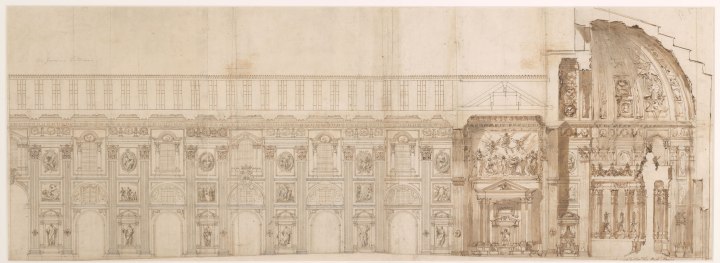
Giovanni Battista Piranesi and workshop, Proposal for the Alteration of San Giovanni in Laterano, with Columnar Ambulatory, ca. 1763-64, pen and brown ink and wash, and gray wash, over graphite, on paper, 21 × 58 inches (New York: Morgan Library & Museum, 1966.11:55).
◊ ◊ ◊ ◊ ◊
The Morgan’s Director, Colin B. Bailey, said, “Given the depth of our collection of drawings by Giovanni Battista Piranesi, the Morgan has long been a leading institution in the study of his works. This new exhibition, the most complete showing of our Piranesis since 1989, reflects long study as well as new discoveries, and will bring Piranesi alive to a new generation of visitors.”
This exhibition is curated by John Marciari, Charles W. Engelhard Curator, Head of the Department of Drawings and Prints, and Curatorial Chair. Marciari is also the author of the accompanying publication, which reaches beyond the Morgan’s collections to offer a complete survey of Piranesi’s work as a draftsman. Marciari explains, “Very few of Piranesi’s drawings were carefully finished works made for sale or exhibition, but in looking closely at the hundreds of working drawings that survive, we not only see the artist devising new ideas and working through problems, but also understand how the archive of drawings served his workshop as a constant source of inspiration.”
John Marciari, Sublime Ideas: Drawings by Giovanni Battista Piranesi (London: Paul Holberton Publishing, 2023), 224 pages, ISBN: 978-1913645380, £40 / $60.
◊ ◊ ◊ ◊ ◊
Note (added 6 March 2023) — The exhibition was originally planned for 2020 (May–September) to mark the 300th anniversary of Piranesi’s birth; like so many other things, it had to be rescheduled for obvious reasons.
Exhibition | Cabinet of Dutch Drawings: The 18th Century

Isaac de Moucheron, Italian Landscape with Trees and a Port / Paysage italien avec arbres et un port, 1738
(Brussels: Musées Royaux des Beaux-Arts de Belgique; photo by J. Geleyns)
◊ ◊ ◊ ◊ ◊
Now on view at the Fondation Custodia / Collection Frits Lugt:
Cabinet of Dutch Drawings: The 18th Century, from the Collection of the Royal Museums of Fine Arts of Belgium / Cabinet de dessins néerlandais: Le XVIIIe siècle
Musées royaux des Beaux-Arts de Belgique, Brussels, 1 February — 23 May 2019
Rijksmuseum Twenthe, Enschede, 2020
Fondation Custodia / Collection Frits Lugt, Paris, 25 February — 14 May 2023
Curated by Stefaan Hautekeete, Robert-Jan te Rijdt, and Charles Dumas
The Fondation Custodia presents a selection of eighty eighteenth-century drawings, assembled by three generations in the city of Breda, in the province of North Brabant. The entire collection was bequeathed to the Belgian state in 1911, and the works were deposited in the Musées royaux des Beaux-Arts de Belgique.

Bernard Picart, Nu féminin assis, sanguine, 30 × 36 cm (Brussels: Musées Royaux des Beaux-Arts de Belgique).
Many eighteenth-century drawings are preparatory studies for paintings. But drawings were also made for a different purpose, created to be sold as works of art in their own right, albeit on paper. This presupposes a large number of collectors who kept drawings in folders and albums, and who viewed and enjoyed them with fellow enthusiasts or in a family context. The phenomenon became widespread throughout the century and artists capitalised on this market. More than ever, they produced highly finished drawings which were appreciated by collectors of sophisticated taste.
The works in the exhibition provide a better understanding and appreciation of the art of drawing at a time when commerce, science, and culture were experiencing unprecedented development in the Netherlands. At the beginning of the century, historical and mythological scenes were in fashion, but public taste changed and tended to favour representations of an ‘ideal world’, before moving towards greater realism with a production that focused more on landscapes, city views, and interior scenes. Draughtsmen also did not hesitate to take inspiration from the old masters of the 17th century.
 The exhibition is a collaboration with the Royal Museums of Fine Arts of Belgium in Brussels, where it was presented in 2019. It was then shown at the Rijksmuseum Twenthe, in Enschede, in 2020. The exhibition is accompanied by a thoroughly documented catalogue published in French and in Dutch. It is vividly written by a group of specialists led by Stefaan Hautekeete, Curator of Drawings at the Royal Museums of Fine Arts of Belgium, who, together with experts Robert-Jan te Rijdt and Charles Dumas, was responsible for the selection of works.
Cabinet des plus merveilleux dessins: Dessins néerlandais du XVIIIe siècle issus des collections des Musées royaux des Beaux-Arts de Belgique (Ghent: Snoeck Publishers, 2019), 223 pages, ISBN: 978-9461615176 (French version) / ISBN: 978-8461615169 (Dutch version), €29.
New Book | The Temple of Fame and Friendship
Distributed by The University of Chicago Press:
Annette Richards, The Temple of Fame and Friendship: Portraits, Music, and History in the C. P. E. Bach Circle (Chicago: The University of Chicago Press,) 336 pages, ISBN: 978-0226806266, $55.
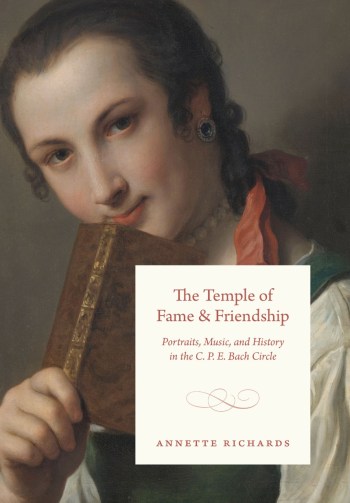 One of the most celebrated German composers of the eighteenth century, C. P. E. Bach spent decades assembling an extensive portrait collection of some four hundred music-related items—from oil paintings to engraved prints. The collection was dispersed after Bach’s death in 1788, but with Annette Richards’s painstaking reconstruction, the portraits once again present a vivid panorama of music history and culture, reanimating the sensibility and humor of Bach’s time. Far more than a mere multitude of faces, Richards argues, the collection was a major part of the composer’s work that sought to establish music as an object of aesthetic, philosophical, and historical study.
The Temple of Fame and Friendship brings C. P. E. Bach’s collection to life, giving readers a sense of what it was like for visitors to tour the portrait gallery and experience music in rooms thick with the faces of friends, colleagues, and forebears. She uses the collection to analyze the ‘portraitive’ aspect of Bach’s music, engaging with the influential theories of Swiss physiognomist Johann Caspar Lavater. She also explores the collection as a mode of cultivating and preserving friendship, connecting this to the culture of remembrance that resonates in Bach’s domestic music. Richards shows how the new music historiography of the late eighteenth century, rich in anecdote, memoir, and verbal portrait, was deeply indebted to portrait collecting and its negotiation between presence and detachment, fact and feeling.
Annette Richards is Given Foundation Professor in the Humanities and university organist at Cornell University, where she is also professor of music and director of the Cornell-Westfield Center for Historical Keyboard Studies. She is the author of The Free Fantasia and the Musical Picturesque; the editor of C. P. E Bach Studies; coeditor, with Mark Franko, of Acting on the Past; and the founding editor of Keyboard Perspectives.
C O N T E N T S
Introduction
1 Exhibiting: The Bach Gallery and the Art of Self-Fashioning
2 Collecting: C. P. E. Bach and Portrait Mania
3 Speculation: Likeness, Resemblance, and Error
4 Character: Faces, Physiognomy, and Time
5 Friendship: Portrait Drawings and the Trace of Modern Life
6 Feeling: Objects of Sensibility and the ‘Portrait of Myself’
7 Memorializing: Portraits and the Invention of Music History
Acknowledgments
Notes
Bibliography
Index
New Book | From the Ruins of Enlightenment
Distributed by The University of Chicago Press:
Richard Kramer, From the Ruins of Enlightenment: Beethoven and Schubert in Their Solitude (Chicago: The University of Chicago Press, 2022), 264 pages, ISBN: 9780226821634, $50.
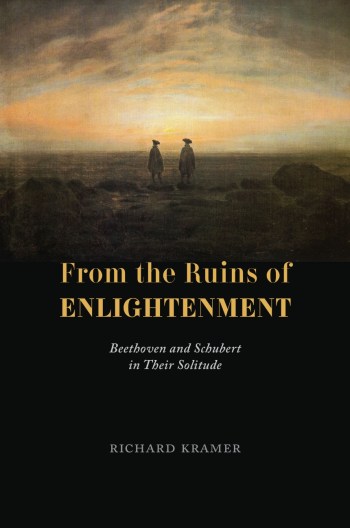 Richard Kramer follows the work of Beethoven and Schubert from 1815 through to the final months of their lives, when each were increasingly absorbed in iconic projects that would soon enough inspire notions of ‘late style’.
Here is Vienna, hosting a congress in 1815 that would redraw national boundaries and reconfigure the European community for a full century. A snapshot captures two of its citizens, each seemingly oblivious to this momentous political environment: Franz Schubert, not yet twenty years old and in the midst of his most prolific year—some 140 songs, four operas, and much else; and Ludwig van Beethoven, struggling through a midlife crisis that would yield the song cycle An die ferne Geliebte, two strikingly original cello sonatas, and the two formidable sonatas for the “Hammerklavier,” opp. 101 and 106. In Richard Kramer’s compelling reading, each seemed to be composing ‘against’—Beethoven, against the Enlightenment; Schubert, against the looming presence of the older composer even as his own musical imagination took full flight.
From the Ruins of Enlightenment begins in 1815, with the discovery of two unique projects: Schubert’s settings of the poems of Ludwig Hölty in a fragmentary cycle and Beethoven’s engagement with a half dozen poems by Johann Gottfried Herder. From there, Kramer unearths previously undetected resonances and associations, illuminating the two composers in their “lonely and singular journeys” through the “rich solitude of their music.”
Richard Kramer is distinguished professor emeritus of music at the Graduate Center of the City University of New York. A fellow of the American Academy of Arts and Sciences, he is the author of the award-winning Distant Cycles: Schubert and the Conceiving of Song, as well as Unfinished Music and Cherubino’s Leap: In Search of the Enlightenment Moment.
C O N T E N T S
Preamble: 1815 and Beyond
In the Silence of the Poem
1 Hölty’s Nightingales, and Schubert’s
2 Herder’s Hexameters, and Beethoven’s
3 Whose Meeres Stille?
Toward a Poetics of Fugue
4 Gradus ad Parnassum: Beethoven, Schubert, and the Romance of Counterpoint
5 Con alcune licenze: On the Largo before the Fugue in Op. 106
Sonata and the Claims of Narrative
Beethoven
6 On a Challenging Moment in the Sonata for Pianoforte and Violoncello, Op. 102, No. 2
Schubert
7 Against the Grain: The Sonata in G (D 894) and a Hermeneutics of Late Style
Last Things, New Horizons
8 Final Beethoven
9 Posthumous Schubert
Postscript: . . . and Beyond
Acknowledgments
List of Tables, Examples, and Figures
Works Cited
Index
New Book | Edward Geoffrey Stanley, A Grand Tour Journal, 1820–22
From Fonthill Media:
Edward Geoffrey Stanley, with an introduction and notes by Angus Hawkins, A Grand Tour Journal, 1820–1822: The Awakening of the Man (Stroud: Fonthill Media, 2022), 224 pages, ISBN: 978-1781558904, £25 / $35.
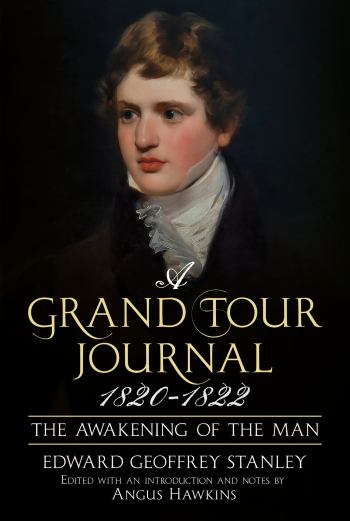 In December 1820, at twenty-one years old, Edward Geoffrey Stanley, the future 14th earl of Derby and three-times prime minister, began an extensive tour of continental Europe. By the time of his return to England twenty months later, he had visited many of the foremost centres for art and culture in Europe, and mostly in Italy. In his travel diaries he recorded his intensive social life, his visits to historical sites, his viewings of art collections, his comments on architecture, his admiration of landscapes, and his impressions of foreign societies. He was energetic, enthusiastic, and discerning: the bridge of Augustus in Umbria gave him “a stupendous idea of Roman grandeur”; the charm of the towns crowning the Tuscan hills struck him with the same delight that he felt when gazing at one of Poussin’s paintings; the waterfall at Terni, which dropped 370 feet into an abyss of spray, was “awfully magnificent”; while the ceremonies of the Italian Catholic Church he judged to be a blend of mummery, superstition, and bigotry. Sights and experiences like these influenced him for the rest of his life. This precious collection of diaries—found only recently and published here for the first time—reveal Edward Stanley to have been a young man of diligence, courage, and decisiveness: a future leader with a conspicuous and burgeoning sense of political and social justice. It was these characteristics, seen in early development within these pages, that shaped the man and the extraordinary career to come.
Edward Geoffrey Stanley (1799–1869), later Lord Stanley and the 14th earl of Derby, was the first British statesman to become prime minister three times and remains the longest serving party leader in modern British politics.
Angus Hawkins (1953–2020) was a fellow of the Royal Historical Society and director of the Research Centre in Victorian Political Culture at Keble College, University of Oxford. Professor Hawkins wrote an acclaimed two-volume biography of Edward Geoffrey Stanley, The Forgotten Prime Minister, published by Oxford University Press in 2007 and 2008.










leave a comment