New Book | Politics and the English Country House, 1688–1800
From McGill-Queen’s University Press:
Joan Coutu, Jon Stobart, and Peter Lindfield, eds., Politics and the English Country House, 1688–1800 (Montreal: McGill-Queen’s University Press, 2023), 344 Pages, ISBN: 978-0228014027, $95.
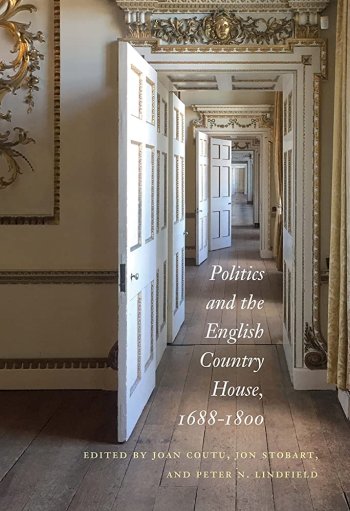 Politics has always been at the heart of the English country house, in its design and construction, as well as in the activities and experiences of those who lived in and visited these places. As Britain moved from an agrarian to an imperial economy over the course of the eighteenth century, the home mirrored the social change experienced in the public sphere. This collection focuses on the relationship between the country house and the mutable nature of British politics in the eighteenth century. Essays explore the country house as a stage for politicking, a vehicle for political advancement, a symbol of party allegiance or political values, and a setting for appropriate lifestyles. Initially the exclusive purview of the landed aristocracy, politics increasingly came to be played out in the open, augmented by the emergence of career politicians—usually untitled members of the patriciate—and men of new money, much of it created on Caribbean plantations or in the employ of the East India Company. Politics and the English Country House, 1688–1800 reveals how, during this period of profound change, the country house remained a constant. The country house was the definitive tangible manifestation of social standing and, for the political class, owning one became almost an imperative. In its consideration of the country house as lived and spatial experience, as an aesthetic and symbolic object, and as an economic engine, this book offers a new perspective on the complexity of political meaning embedded in the eighteenth-century country house—and on ourselves as active recipients and interpreters of its various narratives, more than two centuries later.
Joan Coutu is professor of art history and visual culture at the University of Waterloo.
Jon Stobart is professor of social history at Manchester Metropolitan University.
Peter Nelson Lindfield is lecturer in history at Manchester Metropolitan University.
C O N T E N T S
Table and Figures
Acknowledgements
1 Introduction — Joan Coutu, Jon Stobart, and Oliver Cox
Part One: Political Positioning after the Glorious Revolution
2 Introduction — Oliver Cox
3 For Politics, Progresses, or Posterity? Some Alternative Reasons for Building State Apartments — Amy Lim
4 Holding Court at Marlborough House: The London Residence of Sarah, Duchess of Marlborough — Juliet Learmouth
Part Two: The Question of Style
5 Introduction — Anne Bordeleau
6 Gothic Architecture and the Liberty Trope — Matthew M. Reeve
7 ‘Whig Gothic’: An Antidote to Houghton Hall — Peter N. Lindfield
8 The House with Two Faces: From Baroque to Palladian at Wentworth Woodhouse — Dylan Wayne Spivey
Part Three: The Social Politics of the Country House
9 Introduction — Jon Stobart
10 Burke’s Exemplum: The ‘Natural Family Mansion’ and Wentworth Woodhouse — Joan Coutu
11 House Painting: Place and Position in Estate Portraiture, circa 1770 — John Bonehill
12 The House and Estate of a Rich West Indian: Two Slaveholders in Eighteenth-Century East Anglia — Elisabeth Grass
Part Four: Houses and Homes
13 Introduction — Kate Retford
14 The Clives at Home: Self-Fashioning, Collecting, and British India — Kieran Hazzard
15 William Pitt the Younger, 1759–1806: Reshaping the Political Home — Rowena Willard-Wright
Afterword: Whose Country House? — Dana Arnold
Bibliography
Contributors
Index
New Book | The Story of Follies
Distributed by The University of Chicago Press:
Celia Fisher, The Story of Follies: Architectures of Eccentricity (London: Reaktion Books, 2023), 398 pages, ISBN: 978-1789146356, $50.
 Are they frivolous or practical? Follies are buildings constructed primarily for decoration, but they suggest another purpose through their appearance. In this visually stunning book, Celia Fisher describes follies in their historical and architectural context, looks at their social and political significance, and highlights their relevance today. She explores follies built in protest, follies in Oriental and Gothic styles, animal-related follies, waterside follies and grottoes, and, finally, follies in glass and steel. Featuring many fine illustrations, from historical paintings to contemporary photographs and prints, and taking in follies from Great Britain to Ireland, throughout Europe, and beyond, The Story of Follies is an amusing and informative guide to fanciful, charming buildings.
Celia Fisher has lectured and written widely on the history of plants and gardens in art. Her books include Flower: Paintings by Forty Great Artists and Tulip, the latter also published by Reaktion Books.
C O N T E N T S
Preface
Introduction: A Taste of Follies
1 Seeking out the Origins
2 Some Names to Conjure with
3 Telling a Story
4 Concepts of Freedom and Victory
5 Hunting and Husbandry
6 Waterside Follies and Grottos
7 The Lure of the East
8 From Ruins to Gothic and Picturesque
9 Hermitages and Tree Hoses
10 Into the Future
References
Further Reading
Acknowledgments
Photo Acknowledgments
Index
New Book | The Bridges of Robert Adam
From Triglyph Books:
Benjamin Riley, The Bridges of Robert Adam: A Fanciful and Picturesque Tour (London: Triglyph Books, 2023), 156 pages, ISBN: 978-1916355477, £45 / $60.
 The bridge has always stood as a transitional structure—not purely a work of engineering, nor simply a work of architecture. Its functional requirements are more stringent than those of the average building; it not only must stand up; it must stand up, support those who cross it, and effectively span the space over which it stands. As Samuel Johnson said, “the first excellence of a bridge is strength … for a bridge that cannot stand, however beautiful, will boast its beauty but a little while.” The Scottish architect Robert Adam (1728–1792) understood these precepts well, continually building bridges that were not just structurally sound, but also aesthetically pleasing. Unlike his contemporaries, Adam did not view bridges as mere skeletons upon which to apply ornament. Rather, he sought to achieve architectural totality, incorporating his bridge designs into greater architectural programs, thereby producing aesthetically pleasing and contextually specific designs. From the Pulteney Bridge in Bath to the ruined arch and viaduct at Culzean Castle in Ayrshire, The Bridges of Robert Adam: A Fanciful and Picturesque Tour will take the reader across Britain, shedding new light on an understudied aspect of the great architect’s career.
Benjamin Riley is the managing editor of The New Criterion, a monthly review of the arts and intellectual life based in New York. He holds degrees from Dartmouth College and the Courtauld Institute of Art, where his dissertation focused on the bridges of Robert Adam, becoming the basis for this book. His writing has appeared in The Georgian Group Journal, The New Criterion, The Spectator, and The Wall Street Journal, among other outlets. He lives in New York.
New Book | Enriching Architecture
From UCL Press: (also see the CraftValue project website). . .
Christine Casey and Melanie Hayes, eds., Enriching Architecture: Craft and Its Conservation in Anglo-Irish Building Production, 1660–1760 (London: UCL Press, 2023), 396 pages, ISBN: 978-1800083561 (hardback), £55 / ISBN: 978-1800083554 (paperback), £35. Available as a free PDF file here»
 Refinement and enrichment of surfaces in stone, wood, and plaster is a fundamental aspect of early modern architecture which has been marginalised by architectural history. Enriching Architecture aims to retrieve and rehabilitate surface achievement as a vital element of early modern buildings in Britain and Ireland. Rejected by modernism, demeaned by the conceptual ‘turn’, and too often reduced to its representative or social functions, craft skill here is presented as a primary agent in architectural production. In contrast to the connoisseurial and developmental perspectives of the past, this book is concerned with how surfaces were designed, achieved, and experienced. Contributors draw upon the major rethinking of craft and materials within the wider cultural sphere in recent years to deconstruct traditional, oppositional ways of thinking about architectural production. This is not a craft for craft’s sake argument but an effort to embed the tangible findings of conservation and curatorial research within an evidence-led architectural history that illuminates the processes of early modern craftsmanship. The book explores broad themes of surface treatment such as wainscot, rustication, plasterwork, and staircase embellishment, together with chapters focused on virtuoso buildings and set pieces which illuminate these themes.
Christine Casey is Professor in Architectural History and a fellow of Trinity College Dublin.
Melanie Hayes is Post-Doctoral Research Fellow of the Irish Research Council CraftValue project at Trinity College Dublin.
C O N T E N T S
List of figures
List of contributors
List of abbreviations
Foreword by Glenn Adamson
Acknowledgements
Introduction, Enriching Architecture: Craft and Its Conservation in Anglo-Irish Architectural Production, 1660–1760 — Christine Casey and Melanie Hayes
Part 1 | Loss and Retrieval
1 ‘Onslow Palace’: New Evidence of Eighteenth-Century Craft Technique at Clandon Park — Sophie Chessum
2 Piercing the Surface: Virtuoso Wooden Staircases from Cassiobury Park and Eyrecourt Castle — Mechthild Baumeister and Andrew Tierney
3 Fragments of Eighteenth-Century Craftsmanship: The Pearson Collection — Peter Pearson
4 Experiments with Historic Light in Kensington Palace’s Early Eighteenth-Century Interiors — Lee Prosser
5 Retrieving Craft Practice on the Early Eighteenth-Century Building Site — Melanie Hayes
6 Conserving Craft in Eighteenth-Century Buildings: The Role of the Conservation Architect — Tony Barton
Part 2 | Design and Making
7 The Geometry of Rustication: An Eighteenth-Century Case Study — Edward McParland
8 The Rough and the Smooth: Stone Use in Dublin, 1720–60 — Patrick Wyse Jackson and Louise Caulfield
9 Drawing out a Surface in Lime and Hair — Jenny Saunt
10 ‘Agreeable to Live in’: The Wainscoted Interior in Eighteenth-Century Britain and Ireland — Christine Casey
11 A Glorious Ascent: Staircase Design, Construction, and Craft in the Circle of Richard Castle — Andrew Tierney
Index
New Book | Women Artists in the Reign of Catherine the Great
From Lund Humphries:
Rosalind P. Blakesley, Women Artists in the Reign of Catherine the Great (London: Lund Humphries Publishers, 2023), 152 pages, ISBN: 978-1848225459, £45.
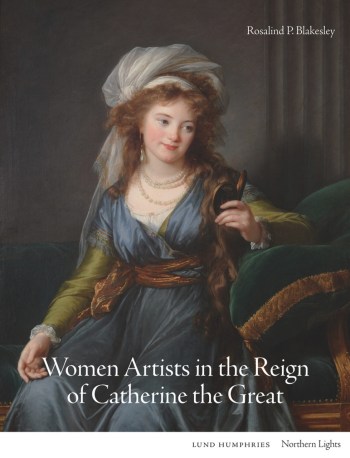 Catherine the Great’s audacious power grab in 1762 marked a watershed in imperial Russian history. During a momentous 34-year reign, her rapacious vision and intellectual curiosity led to vast territorial expansion, cultural advancement, and civic, educational and social reform. In this pioneering book, Rosalind Blakesley reveals the remarkable role women artists played in her pursuit of these ambitions. With challenging commissions for an elite cast of Russian patrons, their work underscores the extent to which cultural enrichment co-existed with the empress’s imperial designs.
Catherine’s acquisitions propelled renowned artists to new heights. The history paintings that she purchased from Angelica Kauffman brought the Swiss artist to the attention of keen new patrons, while Elisabeth Louise Vigée Le Brun found in Russia safe refuge from the horrors of revolutionary France. Just as important were Catherine’s relationships with lesser-known artists. The young sculptor Marie-Anne Collot made the arduous journey from Paris to St Petersburg to assist on the equestrian monument to Peter the Great and enthralled Russian society with her portrait busts, while Grand Duchess Maria Fedorovna, wife of Catherine’s troubled son Paul, sculpted cameos which the empress sent to distinguished correspondents abroad. With stories of extraordinary artistic endeavour intertwined with the intrigue of Catherine’s personal life, Women Artists in the Reign of Catherine the Great uncovers the impact of these and other artists at one of Europe’s most elaborate courts.
Rosalind Polly Blakesley, a prize-winning writer and academic, is Professor of Russian and European Art and a Fellow of Pembroke College at the University of Cambridge. A Trustee of the V&A and Syndic of the Fitzwilliam Museum, she has authored books including The Russian Canvas (Yale University Press, 2016) and The Arts and Crafts Movement (Phaidon Press, 2006), and curated exhibitions at the National Portrait Gallery, London, and the National Museum of Women in the Arts, Washington DC.
C O N T E N T S
Conventions and Abbreviations
Introduction
1 Inscribing a Future Empress
2 Catherine Enthroned
3 The Academy and the Hermitage
4 A Parisian Find
5 The Chisel and the Mallet
6 Unexpected Treasures
7 The Doyenne of Rome
8 An Artist in the Family
9 The Triumphant Refugee
Epilogue
Acknowledgements
List of Illustrations
Bibliography
Index
Exhibition | Muse or Maestra? Women in Italian Art, 1400–1800

Rosalba Carriera, Self-Portrait of the Artist, detail, 1707–08
(Staatliche Museen zu Berlin, Kupferstichkabinett / Jörg P. Anders)
◊ ◊ ◊ ◊ ◊
From the Staatliche Museen zu Berlin:
Muse or Maestra? Women in the Italian Art World, 1400–1800
Muse oder Macherin? Frauen in der italienischen Kunstwelt 1400 – 1800
Kupferstichkabinett, Berlin, 8 March — 4 June 2023
Curated by Dagmar Korbacher
Featuring some 90 works, this special exhibition organised by Berlin’s Kupferstichkabinett elucidates the lives and impact of women such as Rosalba Carriera, Artemisia Gentileschi, Elisabetta Sirani, Diana Scultori, Isabella d’Este, Christina, Queen of Sweden, and others. Their works, fates and enormous influence on the art world of their times have in part been forgotten today.
During the Renaissance and Baroque periods, the art of these women outshone that of their fathers, brothers, and husbands. They created and collected oeuvres that were sought after throughout Europe. They knew how to market themselves and how to network. The protagonists in the exhibition comprise not only women artists who created works in demand, but also wives who supported their husbands and posed for them as models and female patrons who gave commissions for artworks and supported women artists, as well as preservationists and collectors who kept and passed on the works.
Not only does the exhibition show the art of these women, it also provides details about the circumstances of their lives to the extent that this information is known. A number of issues are addressed. These include determining what influence being a woman had on these women’s roles in the art world, whether or not they married and became mothers, and which strategies they pursued to assert themselves in a man’s world, thus making it possible for us to still find traces of their respective impacts.
Women’s diverse, active roles in Italian art are presented with drawings and prints until 1800 from the Kupferstichkabinett’s vast collection, as well as some outstanding loans. In various interventions in the exhibition and catalogue, the youth advisory panel of the Staatliche Museen zu Berlin, Achtet AlisMB, contributes the younger generation’s perspective on this topic.
Muse or Maestra?: Women in the Italian Art World, 1400–1800 is curated by Dagmar Korbacher, director of the Kupferstichkabinett. A catalogue accompanies the exhibition.
New Book | Afterlives: Recovering the Lost Stories of Looted Art
The exhibition was at the Jewish Museum in New York from August 2021 until January 2022. From Yale UP:
Darsie Alexander and Sam Sackeroff, with contributions by Julia Voss and Mark Wasiuta, Afterlives: Recovering the Lost Stories of Looted Art (New Haven: Yale University Press, 2022), 280 pages, ISBN: 978-0300250701, $50.
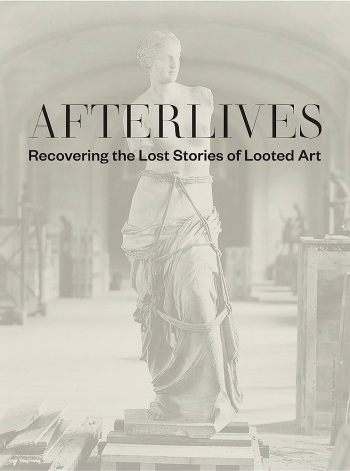 A strikingly original exploration of the profound impact of World War II on how we understand the art that survived it
By the end of World War II an estimated one million artworks and 2.5 million books had been seized from their owners by Nazi forces; many were destroyed. The artworks and cultural artifacts that survived have traumatic, layered histories. This book traces the biographies of these objects—including paintings, sculpture, and Judaica—their rescue in the aftermath of the war, and their afterlives in museums and private collections and in our cultural understanding. In examining how this history affects the way we view these works, scholars discuss the moral and aesthetic implications of maintaining the association between the works and their place within the brutality of the Holocaust—or, conversely, the implications of ignoring this history. Afterlives offers a thought-provoking investigation of the unique ability of art and artifacts to bear witness to historical events. With rarely seen archival photographs and with contributions by the contemporary artists Maria Eichhorn, Hadar Gad, Dor Guez, and Lisa Oppenheim, this catalogue illuminates the study of a difficult and still-urgent subject, with many parallels to today’s crises of art in war.
Darsie Alexander is the Susan and Elihu Rose Chief Curator, and Sam Sackeroff is the Lerman-Neubauer Assistant Curator at the Jewish Museum, New York.
New Book | Twelve Caesars: Images of Power
From Princeton UP:
Mary Beard, Twelve Caesars: Images of Power from the Ancient World to the Modern (Princeton: Princeton University Press, 2021), 392 pages, ISBN: 978-0691222363, $35. The A. W. Mellon Lectures in the Fine Arts, volume 60.
 From the bestselling author of SPQR: A History of Ancient Rome, the fascinating story of how images of Roman autocrats have influenced art, culture, and the representation of power for more than 2,000 years.
What does the face of power look like? Who gets commemorated in art and why? And how do we react to statues of politicians we deplore? In this book―against a background of today’s ‘sculpture wars’―Mary Beard tells the story of how for more than two millennia portraits of the rich, powerful, and famous in the western world have been shaped by the image of Roman emperors, especially the ‘Twelve Caesars’, from the ruthless Julius Caesar to the fly-torturing Domitian. Twelve Caesars asks why these murderous autocrats have loomed so large in art from antiquity and the Renaissance to today, when hapless leaders are still caricatured as Neros fiddling while Rome burns.
Beginning with the importance of imperial portraits in Roman politics, this richly illustrated book offers a tour through 2,000 years of art and cultural history, presenting a fresh look at works by artists from Memling and Mantegna to the nineteenth-century American sculptor Edmonia Lewis, as well as by generations of weavers, cabinetmakers, silversmiths, printers, and ceramicists. Rather than a story of a simple repetition of stable, blandly conservative images of imperial men and women, Twelve Caesars is an unexpected tale of changing identities, clueless or deliberate misidentifications, fakes, and often ambivalent representations of authority. From Beard’s reconstruction of Titian’s extraordinary lost Room of the Emperors to her reinterpretation of Henry VIII’s famous Caesarian tapestries, Twelve Caesars includes fascinating detective work and offers a gripping story of some of the most challenging and disturbing portraits of power ever created.
Published in association with the Center for Advanced Study in the Visual Arts, National Gallery of Art, Washington, DC.
Mary Beard is one of the world’s leading classicists and cultural commentators. A specialist in Roman history and art, she is professor of classics at the University of Cambridge and the author of bestselling and award-winning books, including SPQR: A History of Ancient Rome and Women and Power: A Manifesto. She has also written and presented many television programs, from Civilisations and Meet the Romans to The Shock of the Nude. She lives in Cambridge, England.
C O N T E N T S
List of Tables
Preface
1 The Emperor on the Mall: An Introduction
2 Who’s Who in the Twelve Caesars
3 Coins and Portraits, Ancient and Modern
4 The Twelve Caesars, More or Less
5 The Most Famous Caesars of Them All
6 Satire, Subversion, and Assassination
7 Caesar’s Wife . . . Above Suspicion?
8 Afterword
Acknowledgments
Appendix: The Verses underneath Aegidius Sadeler’s Series of Emperors and Empresses
Notes
Bibliography
List of Illustrations
Index
New Book | American Inheritance: Liberty and Slavery
From Norton:
Edward Larson, American Inheritance: Liberty and Slavery in the Birth of a Nation, 1765–1795 (New York: W. W. Norton & Company, 2023), 368 pages, ISBN: 978-0393882209, $32.
 From a Pulitzer Prize winner, a powerful history that reveals how the twin strands of liberty and slavery were joined in the nation’s founding.
New attention from historians and journalists is raising pointed questions about the founding period: was the American revolution waged to preserve slavery, and was the Constitution a pact with slavery or a landmark in the antislavery movement? Leaders of the founding who called for American liberty are scrutinized for enslaving Black people themselves: George Washington consistently refused to recognize the freedom of those who escaped his Mount Vernon plantation. And we have long needed a history of the founding that fully includes Black Americans in the Revolutionary protests, the war, and the debates over slavery and freedom that followed.
We now have that history in Edward J. Larson’s insightful synthesis of the founding. With slavery thriving in Britain’s Caribbean empire and practiced in all of the American colonies, the independence movement’s calls for liberty proved narrow, though some Black observers and others made their full implications clear. In the war, both sides employed strategies to draw needed support from free and enslaved Blacks, whose responses varied by local conditions. By the time of the Constitutional Convention, a widening sectional divide shaped the fateful compromises over slavery that would prove disastrous in the coming decades. Larson’s narrative delivers poignant moments that deepen our understanding: we witness New York’s tumultuous welcome of Washington as liberator through the eyes of Daniel Payne, a Black man who had escaped enslavement at Mount Vernon two years before. Indeed, throughout Larson’s brilliant history it is the voices of Black Americans that prove the most convincing of all on the urgency of liberty.
Edward J. Larson is the author of many acclaimed works in American history, including the Pulitzer Prize–winning history of the Scopes Trial, Summer for the Gods. He is University Professor of History and Hugh and Hazel Darling Chair in Law at Pepperdine University, and lives with his family near Los Angeles.
Exhibition | The Gregory Gift
From the press release (30 November) for the exhibition:
The Gregory Gift
The Frick Madison, New York, 16 February — 9 July 2023
Organized by Marie-Laure Buku Pongo
 A remarkable gift of twenty-eight fine and decorative works of art recently bequeathed to the Frick by Alexis Gregory (1936–2020) will be shown as a group for the first time at Frick Madison in 2023. The gift includes two eighteenth-century pastels, fifteen Limoges enamels, two eighteenth-century clocks, a large gilt-bronze figure of Louis XIV, and objects made of metal, enamel, and hardstone dating from the sixteenth through eighteenth centuries.
The celebrated holdings of decorative arts objects amassed by Henry Clay Frick have been significantly enriched in recent decades by gifts from other collectors. In 1999, Winthrop Kellogg Edey’s bequest added to the museum’s holdings an important group of European clocks and watches, and in the last decade or so, gifts from Dianne Dwyer Modestini (2008), Melinda and Paul Sullivan (2016), Henry Arnhold (2019), and Sidney R. Knafel (2021) have reshaped The Frick’s holdings of European ceramics with significant groups of Du Paquier and Meissen porcelain, French faience, and Italian maiolica.
The remarkable bequest in 2020 from the collection of Alexis Gregory builds on this tradition by enhancing the museum’s existing holdings and introducing to the museum new types of objects. The exhibition The Gregory Gift features the twenty-eight acquisitions in a variety of media and forms, curious luxury objects that, shown together, suggest a fine collector’s cabinet or Kunstkammer. Among them are fifteen Limoges enamels, two clocks, two ewers, a gilt-bronze sculpture, a serpentine tankard, an ivory hilt, a rhinoceros horn cup, a pomander, and two stunning pastels by Rosalba Carriera. The exhibition is organized by Marie-Laure Buku Pongo, Assistant Curator of Decorative Arts, and will be accompanied by a catalogue and complementary education programs.
Comments Ian Wardropper, Anna-Maria and Stephen Kellen Director of The Frick, “Alexis Gregory had one of the finest collections of Renaissance and Rococo decorative arts in this country. His deep affection for The Frick led to his bequest of a selection of a superb group of objects, and we are gratified to mount this exhibition in his memory.” Buku Pongo adds, “This generous and important gift to The Frick Collection opens new areas of research and lays the groundwork for exciting projects. From research into the context of their creation to technical analyses expanding our knowledge of how these objects were produced, the exhibition at Frick Madison will celebrate Alexis Gregory’s generous gift and The Frick Collection’s commitment to the display of European decorative arts.”

Rosalba Carriera, Portrait of an Unidentified Woman, ca. 1730, pastel on paper, laid down on canvas, 59 × 48 cm (New York: The Frick, Gift of Alexis Gregory, 2020.3.02).
Gregory built his career in book publishing, establishing the celebrated Vendome Press, a publisher of significant volumes on French culture and art. His contributions to and engagement in the arts included serving on art committees at several cultural institutions in the United States, including the visiting committees of European Paintings and European Sculpture and Decorative Arts at The Metropolitan Museum of Art. His history with The Frick began with frequent visits to the museum as a youth. On one occasion, Gregory left the boarding school he was attending with a classmate to visit the museum and managed to convince his friend that he lived in its mansion, as everyone they encountered on staff seemed to know him extremely well. At Harvard, he studied with leading art historians. Those close to him often described him as a Renaissance man as he spoke several languages, wrote books, traveled the globe, and collected art. These pursuits went hand in hand, as collecting art allowed him to research objects and travel around Europe to find new acquisitions. The purchase of his first Renaissance bronze at the age of eighteen marked the starting point of his collection.
Gregory collected widely, from paintings and works on paper to bronzes and sculptures. In the 1980s, his deep interest in European decorative arts prompted him to exchange one of the Impressionist paintings he had inherited from his parents for an assortment of bronzes, sculptures, and Limoges enamels, as well as a watercolor. He later expanded his collection with additional sculptures, Italian bronzes, and Limoges enamels, continuing throughout his life to acquire objects from the United States and Europe. Gregory’s collection echoes, in many ways, the Kunstkammers created by princes during the Renaissance, where they would not only display enamels, faience, carved ivories, automatons and clocks, and precious and mounted metalwork, but also show exotic natural specimens.
A Saint-Porchaire ceramic ewer joins two such objects already in The Frick Collection. This addition is particularly significant as only about seventy Saint-Porchaire works exist today. The ewer is part of a limited experimental production that still poses many questions and is represented in a few museums, among them, The Metropolitan Museum of Art, the Victoria and Albert Museum, and the Musée du Louvre.
Other highlights from the gift include a fine group of Limoges enamels, including a significant number of grisaille examples, which strengthens The Frick’s holdings of mostly polychrome enamels. Grisaille refers to a technique developed in the sixteenth century that was often used by enamelers including the famed Pierre Reymond (1513–after 1584). The Gregory gift includes multiple enamels by Reymond and his workshop, as well as objects by Jean de Court (active 1541–83) and broadens the representation of these artists at The Frick. A large dish enameled on copper with at his center a Saxon silver coin engraved by Hans Biener (ca. 1556–1604), is the first of its kind to enter the collection. It belongs to a rare production in sixteenth-century Venetian workshops, and only about three hundred pieces exist today. (Of these, only about fifty have painted coats of arms or coins, making this example quite rare.)
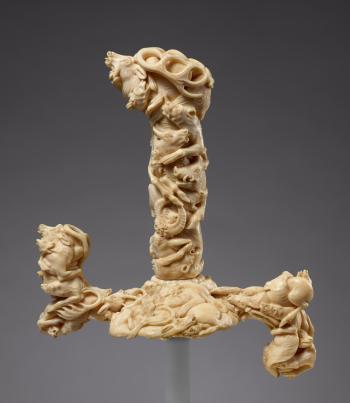
Sword Hilt, possibly by Johann Michael Maucher, ca. 1700, ivory, 16 × 16 × 6 cm (New York: The Frick, Gift of Alexis Gregory, 2021.18.01).
Carved ivory and rhinoceros horn objects also enter the collection for the first time. A fine hilt in ivory, possibly made by Johann Michael Maucher (1645–1701)—one of the most important ivory carvers and sculptors at that time—will shed more light on ivory carving and production in southern Germany during the seventeenth century.
A gilt bronze that represents Louis XIV is attributed to Domenico Cucci (ca. 1635–1704) and his workshop. Cucci was one of the most talented cabinetmakers of the eighteenth century, and this bronze is likely one of the few remaining remnants of a elaborate cabinet made for the king, around 1662–64. In 1883, the Musée du Louvre tried unsuccessfully to acquire the bronze, which mostly remained in private hands before being acquired by Gregory in 2007. Gilt bronzes and other objects designed by Cucci and produced in the Gobelins Manufactory (which made sumptuous furnishings and objects for French royal residences and as lavish diplomatic gifts) are mostly held in private hands. Besides The Frick, only a few collections, including the Château de Versailles, hold remnants of cabinets made by Cucci and his workshop.
Two clocks, one made by the British jeweler and goldsmith James Cox (ca. 1723–1800) and the second by Johann Heinrich Köhler (1669–1736), jeweler at the court of Dresden, diversify The Frick’s holdings of important clocks and watches and are key examples of their respective types. Both jewelers worked for powerful patrons: Köhler for Augustus II (‘the Strong’), Elector of Saxonyand King of Poland, and Cox for the Chinese Qianlong Emperor. Cox crafted automatons with musical movements, also called ‘sing-songs’, which were exported to China, India, Persia, and Russia. Examples of their work are still on view in the Grünes Gewölbe (Green Vault) in Dresden and the Forbidden City in Beijing.
Gregory’s bequest also brings to The Frick several works by women. An enameled medallion by Suzanne de Court (active ca. 1600), the only known female artist to lead a Limoges workshop during the sixteenth century, joins a notable pair of saltcellars signed by de Court already in The Frick’s collection. Two portraits by the celebrated Venetian pastel artist Rosalba Carriera (1673–1757), significantly enhance the museum’s holdings in this medium.
The exhibition Is generously funded by the Alexis Gregory Foundation.
Marie-Laure Buku Pongo, The Gregory Gift (London: Paul Holberton Publishing, 2023), 96 pages, ISBN: 978-1913645434, £25 / $30.










leave a comment