Exhibition | Love Stories from the NPG
Now on view at The Baker Museum in Florida:
Love Stories from the National Portrait Gallery, London
Worcester Art Museum, 13 November 2021 — 13 March 2022
Amsterdam Museum in the Hermitage, 17 September 2022 — 8 January 2023
The Baker Museum, Naples, 4 February – 7 May 2023
Curated by Lucy Peltz
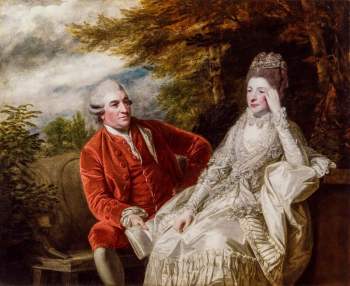
Joshua Reynolds, Portrait of David Garrick and Eva Maria Garrick, 1772–73, oil on canvas, 55 × 67 inches (London: National Portrait Gallery, purchased, 1981).
This groundbreaking exhibition presents masterpieces from the collection of the National Portrait Gallery, London, arguing that ideas of love and desire have been critical to the development of portraiture from the 16th century to the present day. Portraits provide visual records of relationships, are used to memorialize dead or absent lovers and have often been given as love tokens. Featured artists include Sir Joshua Reynolds, Angelica Kauffman, Man Ray, Lee Miller, David Hockney, and others. At the heart of this exhibition are a series of real-life love stories, from the English Renaissance to today, grouped thematically. Each of the love stories sheds light on a different aspect of romantic love and the role of portraits within it, from images that capture an artist’s obsession with their muse to those that record tragic love affairs or celebrate the triumph of love against the odds.
Love Stories from the National Portrait Gallery, London is organized by the National Portrait Gallery, London, and is curated by Dr. Lucy Peltz. The presentation of this exhibition at Artis—Naples, The Baker Museum is curated by Courtney McNeil, museum director and chief curator.
Lucy Peltz, ed., with contributions by Peter Funnell, Simon Callow, Marina Warner, Louise Stewart, and Kate Williams, Love Stories: Art, Passion & Tragedy (London: National Portrait Gallery, 2020), 231 pages, ISBN: 978-1855147034, $40.
Exhibition | The Garden: Six Centuries of Art and Nature

Johan Johnsen, Still Life with a Bouquet of Flowers, detail, oil on canvas, 65 × 50 cm (Stockholm: National Museum, 487, bequest 1863 Marshal of the Court Martin von Wahrendorff).
◊ ◊ ◊ ◊ ◊
Opening this month at Sweden’s Nationalmuseum:
The Garden: Six Centuries of Art and Nature
Trädgården: Konst och natur under sex sekler
Nationalmuseum, Stockholm, 23 February 2023 — 7 January 2024
On display throughout 2023 at the Nationalmuseum, The Garden: Six Centuries of Art and Nature explores how gardens have been portrayed in art. Visitors will experience nearly 300 paintings, drawings, applied art, and sculpture by artists such as Watteau, Boucher, Oudry, Le Nôtre, Monet, and Carl Larsson and, from contemporary times, Peter Frie and Emma Helle.
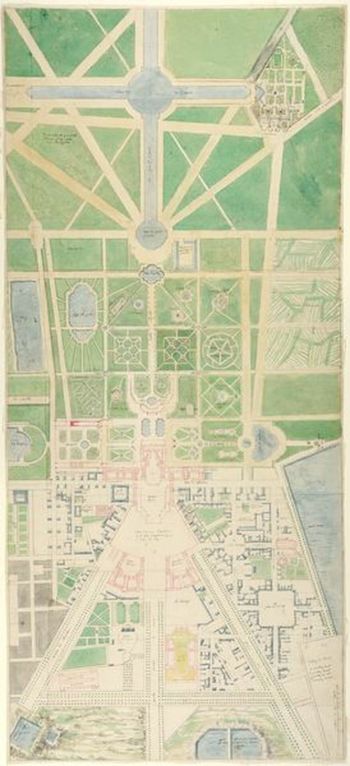
Jean II Le Blond, Versailles, Large Plan of the Château, Town, Gardens, and Surroundings, ca 1687, pen and black ink, grey wash, and watercolour, on paper, 128 × 57 cm (Stockholm: Nationalmuseum, NMH THC 1, transferred in 1866 from Kongl. Museum).
The exhibition takes the form of a grand tour showing how gardens have been portrayed in art, often walking the line between culture and nature. Garden art has always involved living materials: nature itself and the changing seasons. This makes it a dynamic artform—transforming, dying, and renewing in line with the natural cycle.
A garden, whether artful or utilitarian, is not the same thing as nature. It has always been consciously designed in accordance with particular ideas and plans. Ultimately, the garden can be seen as a desire to recreate Paradise. The square, geometric quarters of a Renaissance garden with a fountain in the middle were one expression of this desire. Likewise, baroque pleasure gardens could be seen as a way of restoring what was lost in the fall of man. On the drawing board, God’s creation would be resurrected with the aid of compasses and rulers. Geometry and optics would then translate the architect’s vision into practice.
A complete reappraisal occurred in the 18th century, when humanity suddenly realised that it could be a danger to nature. The dark forests and rugged mountains were no longer considered threatening. Virgin nature, yet to be exploited by mankind, was the new ideal influencing landscape architecture. Eventually, though, the toytown scale and artificial character were perceived as so comical that art and nature went their separate ways after 1800—a distinction that has endured. However, many of the questions raised throughout history about mankind’s relationship with art and nature have persisted and recurred. This is clearly apparent in contemporary art, where both Paradise and the threat to nature are ever present themes.
The relationship between art and nature is central to the exhibition. The introductory section, devoted to the myth of Paradise, occupies a large gallery of its own, lined with cabinets containing the various natural elements as reflected in the artworks. Similarly, the artificial garden forms the focus of the second large gallery, covering the period from the Renaissance to the present day. This gallery is surrounded by smaller exhibition rooms featuring individual design forms ranging from caves to ruins. At the centre of all this is a section covering the human presence in the garden.

Olof Fridsberg, A Huge Pumpkin, 1757, oil on canvas, 89 × 104 cm (Stockholm: National Museum, 7007, Acquisition Gåva 2001 av Nationalmusei Vänner).
As an example of contemporary interpretations, we have invited the artist Peter Frie to take part in the exhibition. Known as a painter of dreamlike landscapes, Frie has created a series of bronze sculptures of trees, having progressed from painting to a three-dimensional format. Trees of various sizes are presented as an installation in dialogue with the historical material on landscape and gardens. Emma Helle, another contemporary artist invited to take part, works in ceramics and draws inspiration from sources such as classical mythology. Her decorative and colourful, almost baroque works take us on a fanciful journey through the history of myth and literature. Helle has also created two new works especially for Nationalmuseum’s exhibition as a commentary on the theme of Paradise.
The majority of the almost 300 exhibits come from Nationalmuseum’s own collections, but the exhibition also includes important pieces on loan, in order to give a complete picture of the garden as a phenomenon. A catalogue with a series of in-depth articles will be published to coincide with the exhibition.
Call for Articles | Spanish Royalty in Naples, 1598–1713
From ArtHist.net:
Spanish Royalty in Naples: Between Art and Architecture, 1598–1713
Edited by Laura García Sánchez
Proposals due by 28 February 2023; final papers due by 31 August 2023
The series Temi e frontiere della conoscenza e del progetto (Themes and Frontiers of Knowledge and Design), published by ‘La scuola di Pitagora’ and edited by prof. Ornella Zerlenga of the University of Campania ‘Luigi Vanvitelli’ in Italy, is launching a call for papers for a forthcoming open access volume entitled Reali spagnoli a Napoli: fra arte e architettura (1598–1713), edited by Prof. Laura García Sánchez, lecturer at the Department of Art History of the University of Barcelona. The series, multidisciplinary in nature, includes volumes that propose a critical reflection on architecture, the city, the environment, and industrial design, investigating disciplinary sources and cultural trends with a focus on the themes of form, structure, innovation, representation, and communication.
The broad scope of the proposed theme allows for a transversal look at the figure of the Viceroy and his closest collaborators and relatives as authentic protagonists of an interesting historical and artistic period. During this period, Naples was not only one of the most prosperous cities in Italy but also one of the largest in Europe and an investment for the Spanish monarchs that dominated it. This unique metropolis had a Spanish presence that lasted four centuries. Traces can still be seen today in the layout of its streets, in some of the city’s most representative monuments as well as the habits and customs of the Neapolitans. This relationship gave rise to one of the city’s most mythical neighbourhoods, the Quartieri Spagnoli, which was founded in the 16th century to house the Spanish military garrisons during the period of the Aragonese’s struggle with the French who, like the Spanish, wanted to take control of the city. Once the war was over, a relatively quiet secular rule began during which Spanish proxies remodelled Naples. The chronology of the volume spans the long period between the reign of Philip III (1598) and the end of the War of the Spanish Succession (1713), a stage in which the figure of the Viceroy was decisive for many reasons in that he not only exercised the administrative and governing function as representative of the Spanish monarchy, but also played an important role in promoting the cultural activities of what was called the Spanish Siglo de Oro and which, in other words, represented the Baroque language par excellence.
In the territories of the Hispanic monarchy, the Viceroys, as alter egos of the king and therefore of noble lineage, travelled frequently. The office or ‘job’ usually lasted from three to six years. During this stay in Naples, the incumbent controlled not only the economic resources, which allowed him to build a residence and surround himself with the most famous artists, thus increasing the prestige of the crown. The Viceroys were not only faithful deliverers of the political power of the kings but also played the role of patrons of the arts, so much so that during the 17th century, it is possible to recognise a significant influence of Naples in Spain through their work. Many of the works that today are exhibited at the Prado Museum in Madrid were sent to Spain by the Viceroys as gifts for the king or, on specific commission, to decorate the royal palaces.
The role of the wives of viceroys is also interesting in this cultural exchange. Women did not possess property titles but did accompany their husbands, which, for example, was not possible for those governing Latin America. This made the role of the vicereine very active in the Kingdom of Naples. Their participation in public ceremonies aroused much interest, helping to consolidate Spanish power in the city.
Original and unpublished contributions are favoured with a focus on the relations between Naples and Spain during the period indicated; without excluding other topics, the following themes are proposed:
• The Viceroys’ journey to Naples: methods; route to Italy; length of stay in Naples; entourage (family, secretaries, servants); trousseaux; gifts to Neapolitan dignitaries.
• Contact with local artists: patronage networks.
• The Spanish influence on Neapolitan religion and beliefs.
• The Vicereine: the role of the wife between interests and influence on locals.
• The Viceroys’ collections: interests; preferences; influence on Spanish artists.
• Investments in public works to demonstrate Spanish power and the expansion of the Hispanic monarchy in Italy: the reform of urban spaces (creation of fountains; squares; etc.).
• The Viceroys and the stories of their return from Spain and vice versa.
• The return of the Viceroys to Spain: construction of palaces and convents; collection of works of art and books from the Kingdom of Naples.
• Founding of convents as family ‘pantheons’, to which the Viceroys donated many Italian works of art.
• Stories of travellers and travel descriptions.
• Representation of the Viceroys in art.
• The Viceroys as seen by the Neapolitan nobility and people.
• The Spanish influence on the architecture of the Kingdom of Naples.
To submit a proposal, please send the provisional title and an abstract of no more than 3,000 characters (including spaces). The material must be sent by 28 February 2023 to ornella.zerlenga@unicampania.it and laura.garcia@ub.edu. The authors of the selected abstracts will be contacted by 31 March 2023, after which the editorial guidelines for the text and images of the paper will be sent by email. Papers must be written between 15,000 and 30,000 characters (including spaces) by 31 August 2023 and sent to the above-mentioned email addresses.
Volumes published in this series will be pre-screened by at least two members of the Scientific Committee, who will assess whether the contribution responds to the research lines of the Series, whether it is based on an adequate bibliographical analysis related to the proposed theme, and whether it offers a careful examination of the sources and/or current trends with respect to the proposed theme. Once this preliminary assessment has been passed, the paper will be submitted to the international Double-blind Peer Review criterion and sent to two anonymous reviewers, at least one of whom must be external to the Scientific Committee. The reviewers, i.e., professors and researchers of recognised competence in the specific fields of study and belonging to various Italian and foreign universities and research institutes, constitute the Refereeing Committee. The list of anonymous reviewers and refereeing procedures is available to national and international scientific assessment bodies.
Texts in Italian, French, Spanish and English are accepted. Translation into English is also required for those submitted in Italian, French and Spanish.
New Book | Making Worlds: Global Invention in the Early Modern Period
From Toronto UP:
Angela Vanhaelen and Bronwen Wilson, eds., Making Worlds: Global Invention in the Early Modern Period (Toronto: University of Toronto Press, 2022), 512 pages, ISBN: 978-1487544935, $95.
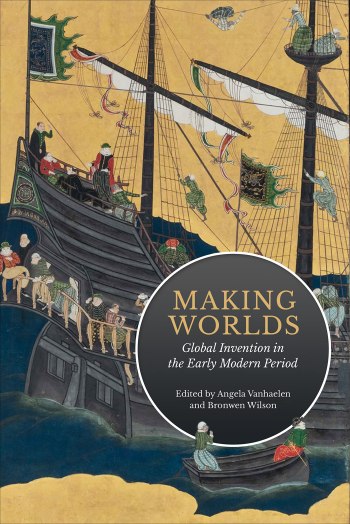 Taking into account the destructive powers of globalization, Making Worlds considers the interconnectedness of the world in the early modern period. This collection examines the interdisciplinary phenomenon of making worlds, with essays from scholars of history, literary studies, theatre and performance, art history, and anthropology. The volume advances questions about the history of globalization by focusing on how the expansion of global transit offered possibilities for interactions that included the testing of local identities through inventive experimentation with new and various forms of culture. Case studies show how the imposition of European economic, religious, political, and military models on other parts of the world unleashed unprecedented forces of invention as institutionalized powers came up against the creativity of peoples, cultural practices, materials, and techniques of making. In doing so, Making Worlds offers an important rethinking of how early globalization inconsistently generated ongoing dynamics of making, unmaking, and remaking worlds. The volume is part of the UCLA Clark Memorial Library Series.
C O N T E N T S
List of Illustrations
Acknowledgments
1. Introduction — Angela Vanhaelen and Bronwen Wilson
Part One: Material Flows
2 The Early Modern Fold: Pleated Media in Japan’s Encounter with Europe — Kristopher Kersey
3 From Textile to Text: Cloth, Slavery, and the Archive in the Dutch Atlantic —Carrie Anderson
4 Drawing Worlds in Smoke, Powder, and Fumes: Bodies and Trifles in Il Tabacco, the Courtly Ballet Staged in Turin (1650) — Elisa Antonietta Daniele
5 From Hot Reverence to Cold Sweat: Christian Art and Ambivalence in Early Modern Japan — Benjamin Schmidt
6 Eggs, Cheese, and (Francis) Bacon — Helen Smith
Part Two: In-Between Spaces
7 The Cabinet and the World: Non-European Objects in Early Modern European Collections — Daniela Bleichmar
8 Le Jeu du monde: Games, Maps, and World Conquest in Early Modern France — Ting Chang
9 The World Contained in an Imperial Ottoman Album — Emine Fetvaci
10 World Building, the Folger Folios, and the University of British Columbia — Patricia Badir
Part Three: Other Worlds
11 Ascetic Ecology: Landscape of a Desert Saint — Lyle Massey
12 The End of All: Worldliness, Piety, and the Social Life of Maps in the Post-Reformation English Household — Gavin Hollis
13 Enlightenment Cosmology: A Medialogical Interpretation — J.B. Shank
14 Masked Alliances: Global Politics and Economy in the Art and Performance Rituals of Mexico’s Indigenous People — John M.D. Pohl and Danny Zborover
15 Unease with the Exotic: Ambiguous Responses to Chinese Material Culture in the Dutch Republic — Thijs Weststeijn
Contributors
Index
Exhibition | Prussian Palaces, Colonial Histories
Opening this summer at Charlottenburg Palace:
Prussian Palaces, Colonial Histories: Biographies and Collections
Schlösser. Preußen. Kolonial. Biografien und Sammlungen
Schloss Charlottenburg, Berlin, 4 July — 31 October 2023

Antoine Pesne, Portrait of Prince Frederick Ludwig or Prince Frederick William of Prussia in a Garden Cart with Friedrich Ludwig (?) (Berlin: Stiftung Preußische Schlösser und Gärten; photo by Jörg P. Anders).
The former palaces and gardens of the Hohenzollern dynasty make Germany’s colonial past visible and tangible today. Attesting to this history is an 18th-century portrait of a young Black boy, possibly Fredrick Ludwig (1708 – date of death unknown), whose father was brought to the Berlin royal court through the slave trade. Another example is provided by the glass beads produced on Peacock Island that were used to purchase slaves and colonial trading goods. With a special exhibition at Charlottenburg Palace, the Prussian Palaces and Gardens Foundation Berlin-Brandenburg (SPSG) is facing the colonial histories of its collections.
Colonial practises and structures can be traced throughout earlier centuries, before German colonialism of the 19th and early 20th centuries, as well as afterwards. In this light, the special exhibition is looking to explore the connection between Germany’s longer colonial history and how they persist today. Based on the scant information that has been preserved over time, the special exhibition attempts to reconstruct the biographies of people after they were forcibly brought to Berlin and Potsdam. These biographies highlight both the ways they were able to socially assimilate and how they resisted the conditions of their lives at court. In addition, the exhibition examines non-European works in the collections that have long been interpreted within strictly European frameworks. As a result, these works were culturally re-appropriated and alienated from their original uses.
The exhibition themes were developed together with various experts in a joint process over the course of five workshops. This special exhibition is part of the annual theme for 2023: “Elector—Emperor—Colonies.” Thus, the SPSG is taking an important step in its ongoing work on this theme that will continue beyond the coming year. This exhibition is supported by the Federal Government Commissioner for Culture and the Media under a resolution passed by the German Parliament.
Carolin Alff, Susanne Evers, and Hatem Hegab, et al., Prussian Palaces, Colonial Histories: Places, Biographies, and Collections (Dresden: Sandstein Verlag, 2023), 168 pages, ISBN: 978-3954987375 (German edition) / ISBN: 978-3954987382 (English edition), €18.
◊ ◊ ◊ ◊ ◊
Note (added 7 September 2023) — The posting was updated to include information on the catalogue.
Exhibition | Crafting Freedom: Thomas W. Commeraw

Thomas W. Commeraw, Jug, detail, ca. 1797–1819, salt-glazed stoneware, cobalt oxide, 12 inches (30 cm) high
(New-York Historical Society, purchased from Elie Nadelman, 1937.820).
◊ ◊ ◊ ◊ ◊
From the press release (6 October 2022) for the exhibition:
Crafting Freedom: The Life and Legacy of Free Black Potter Thomas W. Commeraw
New-York Historical Society, 27 January — 28 May 2023
Fenimore Art Museum, Cooperstown, New York, 24 June — 24 September 2023
Curated by Margi Hofer, Mark Shapiro, and Allison Robinson, with Leslie M. Harris
The New-York Historical Society presents Crafting Freedom: The Life and Legacy of Free Black Potter Thomas W. Commeraw, the first exhibition to bring overdue attention to Thomas W. Commeraw, a successful Black craftsman who was long assumed to be white. Formerly enslaved, Commeraw rose to prominence as a free Black entrepreneur, owning and operating a successful pottery in the city. Over a period of two decades, he amassed property, engaged in debates over state and national politics, and participated in New York City’s free Black community. The exhibition explores Commeraw’s multi-faceted history as a craftsman, business owner, family man, and citizen through approximately 40 pieces of stoneware produced by Commeraw and his competitors between the late 1790s and 1819, in the largest presentation of his work to date. Alongside these pieces are the primary documents that enabled historians to reconstruct the arc of his professional career and personal life, and through them convey a deeper understanding of free Black society in New York in the years between the Revolutionary and Civil Wars.
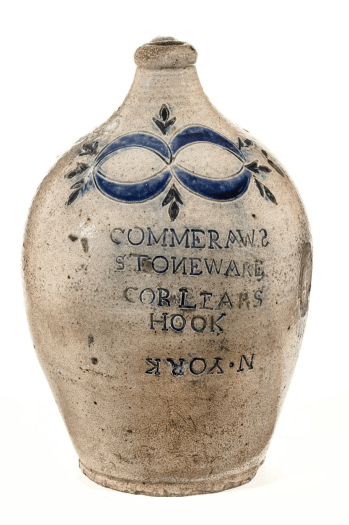
Thomas W. Commeraw, Jug, ca. 1797–1819, salt-glazed stoneware, cobalt oxide, 12 inches (30 cm) high, (New-York Historical Society, purchased from Elie Nadelman, 1937.820).
“Crafting Freedom continues the tradition at New-York Historical of presenting groundbreaking exhibitions that reveal the complex dimensions of race in the early years of New York City and our nation,” said Dr. Louise Mirrer, president and CEO of New-York Historical. “Through this exhibition of Thomas W. Commeraw and his work, we gain an in-depth understanding of a Black artisan’s life in New York, while also seeing how our understanding of history continues to evolve to give us greater insight into issues that affect our society today. This exhibition will transform our visitors’ perspective on New York’s free Black community, challenging long-held myths about post-revolutionary race relations in northern states.”
“This exhibition illuminates the story of a man who was emancipated as a child, went on to own and operate his own business, and advocated for the rights of full citizenship for his fellow Black Americans,” said Margi Hofer, New-York Historical’s vice president and museum director, who co-curated the exhibition. “While Commeraw’s distinctive pottery has been admired and collected for over a century, his true story has been obscured for far too long. It is incredibly meaningful that we are able to bring to light a true portrait of the man, both as a citizen and as a craftsman.”
The New York City directories first list Thomas “Commerau” working as a potter in 1795, living near Pot Baker’s Hill in the vicinity of today’s City Hall. By 1797, he had established his own workshop at Corlears Hook on the East River. There, he produced vessels in the local tradition, often decorated with distinctive flourishes of swags, tassels, and bowknot motifs filled with vivid cobalt. Stoneware vessels were essential kitchenware in that era and stored everything from milk, butter, salted meat, and preserves, to molasses, cider, and beer. Commeraw also manufactured oyster jars for the city’s oystermen, who were predominantly from the free Black community. His crocks and jugs traveled on ships to ports along the eastern seaboard and as far afield as Guyana and Norway. Most of the Commeraw vessels that survive today are boldly stamped with his name and the location of his pottery at Manhattan’s Corlears Hook. In addition to signaling pride in his work, Commeraw’s prominent branding helped him attract and retain customers.
In addition to revealing Commeraw’s successes and struggles as a pottery owner in a city riven by racism, the exhibition explores his commitment to securing a better future for the Black community through his work with abolitionist, political, religious, and mutual aid organizations. In 1790, the majority of Black New Yorkers were enslaved. By 1810, 6 out of 7 were free. Businessmen like Commeraw faced daunting challenges, not just raising capital but building civic and religious organizations to support the Black community. Free Black men had voted in New York since the Revolution, but in 1811, the state legislature passed a law to suppress Black voters, requiring them to submit a Certificate of Freedom that included a sworn statement from a third party attesting to the voter’s free status and residency and to pay a filing fee. A highlight of the exhibition is the 1813 Certificate of Freedom held by New-York Historical’s Patricia D. Klingenstein Library that bears Commeraw’s confident signature as witness. It is the only confirmed manuscript in his hand. The exhibition also examines how Black New Yorkers responded to economic and political oppression by developing a lively cultural and artistic community.
The final chapter in Commeraw’s story concerns his effort to promote the emigration of Black settlers to Sierra Leone, as the prospect of full citizenship for Black New Yorkers dimmed. Commeraw traveled there with his extended family in 1820 on the first voyage of the American Colonization Society. He arrived full of optimism and plans to found a Black republic; instead, he experienced unimaginable hardship and tragedy. What began as a venture for political rights ended as a struggle for survival. Many of the settlers died of malaria, including Commeraw’s wife and niece. He returned to the U.S. in 1822 and died the following year in Baltimore. The exhibition closes with a coda that describes future generations of the Commeraw family carrying forward the potter’s entrepreneurial energy and political engagement.
Additionally, Queens-based ceramic artist and activist Sana Musasama has created a new work that reflects on Commeraw’s life as a New York potter, his transatlantic odyssey of two centuries ago, and her own artistic journey. Passages will be installed in New-York Historical’s grand lobby, the Robert H. and Clarice Smith Gallery, to introduce the exhibition and encourage visitors to contemplate how Commeraw’s story continues to resonate today.
Crafting Freedom is co-curated by New-York Historical’s Vice President and Museum Director Margi Hofer, potter and Commeraw researcher Mark Shapiro, and Mellon Foundation Postdoctoral Fellow in Women’s History and Public History Allison Robinson. Leslie M. Harris, professor of history and African American studies at Northwestern University, served as scholarly advisor. The exhibition next travels to the Fenimore Art Museum, where it will be on view from June 24 until September 24, 2023.
Major support for Crafting Freedom: The Life and Legacy of Free Black Potter Thomas W. Commeraw is provided by the Decorative Arts Trust and Emily and James Satloff.
Leslie Harris in Conversation with David Rubenstein, The Shadow of Slavery and the History of African Americans in New York City, from the Settling of New Amsterdam to the Civil War
New-York Historical Society, 10 April 2023

“Test of Patriotism,” Commercial Advertister (20 August 1814)
(Patricia D. Klingenstein Library, New York Historical Society)
◊ ◊ ◊ ◊ ◊
A. Brandt Zipp, Commeraw’s Stoneware: The Life and Work of the First African-American Pottery Owner (Sparks, Maryland: Crocker Farm, 2022), 311 pages, ISBN: 979-8218002909, $95.
 Presented here for the first time in two centuries is the lost story of New York City potter Thomas W. Commeraw, a key early African American figure whose identity slipped through the fingers of history. Rediscovered by the author in the first years of this century, Commeraw stands as one of the most fascinating of all historic American decorative artists: an abolitionist, activist, highly influential craftsman and, ultimately, the hopeful founder of a new African republic. Topics include: Commeraw’s fascinating life story, from childhood to death; a comprehensive discussion and illustration of Commeraw’s pottery, made from the mid-1790s to late 1810s; Commeraw’s abolitionism, political activism, and role as an important local free black figure; a thorough history of New York City stoneware; an in-depth breakdown of the work of other New York City stoneware manufacturers including Clarkson Crolius Sr., John Remmey III, and David Morgan; and Commeraw’s harrowing experiences on the west coast of Africa.
Brandt Zipp is a founding partner of Crocker Farm, Inc., the nation’s premier auction house specializing in historic American utilitarian ceramics. A graduate of Johns Hopkins University, Brandt’s research regularly breaks important new ground, no greater example being his serendipitous discovery of Thomas Commeraw’s heritage. Commeraw’s Stoneware represents the culmination of almost two decades of research, writing, and lecturing.
Exhibition | Flora Danica: The World’s Wildest Dinnerware

From the Royal Danish Collection:
Flora Danica: The World’s Wildest Dinnerware / Verdens Vildeste Stel
Library Hall, Koldinghus, Kolding, 7 October 2022, ongoing
With 1,530 intact pieces, the Flora Danica dinnerware is not only the best-preserved luxurious porcelain service from the 18th century but also undoubtedly the world’s wildest dinnerware in terms of splendour, storytelling, and decorations. This grand exhibition of the Flora Danica dinnerware at Koldinghus offers a close look at the magnificent set and tells the story of the fascinating ideas and myths associated with it and their connections to national and international politics. With its numerous pieces and painstaking reproductions of wild Danish botany on fragile white porcelain, the service offers an important key to understanding Denmark during the Enlightenment. Like the Danish crown jewels, the dinnerware is still in use today for very special occasions in the Royal House.
The Origins of Flora Danica
The exhibition explores the origins of this historic porcelain service, which is inextricably linked with Flora Danica, the world’s most ambitious reference work on wild plants, which took more than 122 years to complete and features beautiful copperplate prints and precise descriptions of more than 3,240 plant species. The goal of the project was to collect knowledge and facilitate the use of wild plants, lending lustre to the absolute monarchy. Around 1789, it was decided to transplant this prestigious project to precious porcelain. No specific information has been preserved about when this wild idea first arose, who came up with the almost absurd notion of decorating porcelain with wild plants, or for whom this lavish service was intended. Indeed, our knowledge about the early chapters in the story of this magnificent service is as limited as the myths about it are numerous!
Wild Rumours and International Drama
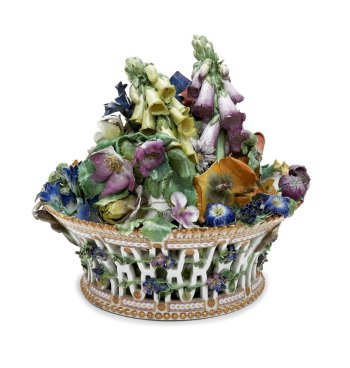
Flower Basket from the Flora Danica set (Photo by Iben Kaufmann).
Even while the service was in production, rumours abounded about the purpose of this lavish dinnerware decorated with wild plants. Rumor spread like wildfire throughout Europe, and there was persistent speculation that it was intended for the Russian Empress Catherine the Great, a porcelain enthusiast. Indeed, the Flora Danica service may have been intended for her, as a diplomatic gift in a time of international tension. Or perhaps, the dinnerware with the wild plants were created for the table of the Danish king as a wild act of political nudging to promote a particular policy.
At the time, the dramatic state of international politics was easily matched by the drama surrounding the political direction of the monarchy in the Danish realm, where a fierce political battle was playing out between pro- and anti-reformists. The exact role and position of the Flora Danica service in the cross-fire of reforms, diplomacy, and wild rumour remain a mystery to this day. Around 1879, that mystery put forth an outstanding flower in the form of this stunning service, unparalleled in scale and wondrous decorations.
Poisonous Mushrooms and Sophisticated Advertising
Each of the many pieces of the Flora Danica service features images from one of the copperplate prints from the reference work, carefully reproduced in full scale. Tureens, wine coolers, and plates are covered in wild flora: from humble algae on Norwegian rocks to poisonous mushrooms in Danish forests and long grasses on the moors of Holstein.
While the copperplate images were easily transferred to the larger pieces, such as tureens and serving dishes, the porcelain painters needed all their skill and ingenuity when it came to the smaller pieces. Long stalks were cut, grasses were laid horizontally, and leaves were twisted to fit the floral decorations onto round and curvy small dishes, custard cups, and salt cellars. The mantra was accuracy above all else, with correct representations taking precedence over beauty. Thus, despite its impressive volume and splendour, the service was mainly conceived as PR for the underlying publication. In fact, it is so inextricably linked to the reference work that the service should not be seen as an independent artistic achievement by the Royal Danish Porcelain Factory but rather as a sophisticated advertising stunt.
The World’s Wildest Dinnerware
Since the large exhibition about the Flora Danica dinnerware in 1990 at Christiansborg Palace, it has not been possible to stage a comprehensive presentation of this wild service, which is almost as storied as it is voluminous. The upcoming exhibition will shed light on the wild myths surrounding the service and offer the audience an up-close look at the unusual decorations and the use of the historical service, which was first used in 1803 at the birthday banquet for Christian VII. Since then, it has been used on very special occasions in the Royal House. Most recently, it was in use at the golden jubilee of HM Queen Margrethe II in January 2022. No other Danish service can boast as long a legacy or a presence at such historic banquets as the Flora Danica service, which remains the world’s wildest dinnerware—in terms of history, storytelling, and decoration.
The exhibition is made possible by loans of items from the State Inventory and contributions from Royal Copenhagen and Georg Jensen Damask. It opened at Koldinghus on 7 October 2022 and will be followed up by events and communication initiatives to shed light on the history, use, and continued relevance of the porcelain service.
Jesper Munk Andersen, Flora Danica: The World’s Wildest Dinnerware (Copenhagen: Kongernes Samling / The Royal Danish Collection, 2022), 104 pages, ISBN: 978-8789542256. Also available in Danish.
More information is available here»
New Book | China and the West: Chinese Reverse Glass Painting
From De Gruyter:
Elisa Ambrosio, Francine Giese, Alina Martimyanova, and Hans Bjarne Thomsen, eds., China and the West: Reconsidering Chinese Reverse Glass Painting (Berlin: De Gruyter for the VitroCentre Romont, 2022), 292 pages, ISBN: 978-3110711752, $58. With contributions by Thierry Audric, Kee Il Choi Jr., Patrick Conner, Karina H. Corrigan, Elisabeth Eibner, Patricia F. Ferguson, Lihong Liu, William H. Ma, Alina Martimyanova, Christopher L. Maxwell, Rupprecht Mayer, Jessica Lee Patterson, Michaela Pejčochová, Jérôme Samuel, Hans Bjarne Thomsen, Jan van Campen, and Rosalien van der Poel. Now digitally available for free as open access.
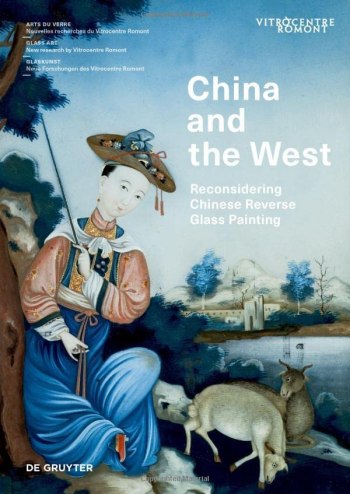 With contributions from outstanding specialists in glass art and East Asian art history, this edited volume opens a cross-cultural dialogue on the hitherto little-studied medium of Chinese reverse glass painting. The first major survey of this form of East Asian art, the volume traces its long history, its local and global diffusion, and its artistic and technical characteristics. Manufactured for export to Europe and for local consumption within China, the fragile artworks studied in this volume constitute a paramount part of Chinese visual culture and attest to the intensive cultural and artistic exchange between China and the West. This book is volume 1 in the series Arts du verre / Glass Art / Glaskunst.
C O N T E N T S
Preface — Danielle Elisseeff
Introduction — Francine Giese, Hans Bjarne Thomsen, Elisa Ambrosio, and Alina Martimyanova
Chinese Reverse Glass Painting and Its Materiality
1 From Virtuosity to Vernacularism: Reversals of Glass Painting — Lihong Liu
2 People in Glass House: The Polite and Polished in Georgian Britain — Christopher L. Maxwell
3 Illusionistic Practices among les Arts du Feu in Mid-Eighteenth-Century Canton — Kee Il Choi Jr.
4 Light, Reflection, and Reverse Glass Painting at the Nguyên Court — William H. Ma
Trasnfer and Transmediality
5 Glass Painting in the Collection of Andreas Everardus Van Braam Houckgeest (1739–1801) — Jan van Campen
6 The Governor of Surat and the Apotheosis of Washington Cantonese Reverse Glass Paintings for Early Nineteenth-Century American Markets — Karina H. Corrigan
7 Regarding the Transfer of Vernacular Motifs and Other Common Features of Chinese New Year Prints and Chinese Reverse Glass Painting — Alina Martimyanova
8 The Nightmare Case Study of a Deliberately Inaccurate Transmission to Glass — Elisabeth Eibner
Contextual Studies of Reverse Glass Painting
9 Varieties of Replication in Chinese Reverse Glass Painting — Jessica Lee Patterson
10 Reflecting Asia: The Reception of Chinese Reverse Glass Painting in Britain, 1738–1770 — Patricia F. Ferguson
11 Japanese Reverse Glass Painting: The Other East Asian Tradition — Hans Bjarne Thomsen
12 ‘In All of Beijing, There Are No More than Four Paintings on Glass That Would Fall within Our Consideration’: Chinese Reverse Glass Paintings from Czech Collections and Their Contexts — Michaela Pejčochová
Regional Receptions of Reverse Glass Painting
13 Reflections in a Chinese Mirror: Westerners Reinterpreted in Early Cantonese Glass Painting — Patrick Conner
14 Eighteenth-Century Chinese Reverse Glass Painting in a Dutch Collection: Art and Commodity — Rosalien van der Poel
15 China and Its South Chinese Ladies on Glass and Other Topics in Nineteenth- and Twentieth-Century Java and Bali — Jérôme Samuel
Pioneering Research in Chinese Reverse Glass Painting
16 A Brief History of Chinese Reverse Glass Painting — Thierry Audric
17 Some Styles in Nineteenth- and Twentieth-Century Chinese Glass Painting: A First Approach — Rupprecht Mayer
List of Authors
Index of Places and People
Credits
New Book | Imagining Sculpture: A Short Conjectural History
Published by Hirmer and distributed by The University of Chicago Press:
Stanley Abe, Imagining Sculpture: A Short Conjectural History (Munich: Hirmer Verlag, 2023), 384 pages, ISBN: 978-3777437583, $45.
 A new critical approach to understanding sculpture across cultures.
Imagining Sculpture is the story of the absence of a powerful European idea: Sculpture. In China statues, stele, and other figural objects were made for millennia but were not categorized as Sculpture. Imagining Sculpture explains how they were seen in China as objects beyond the category of Sculpture. The book is a series of short vignettes—historical and fictional. Travellers, scholars, collectors, and antiquarians encounter statues, figures, and effigies in China, Japan, England, Germany, France, Italy, and the United States from the fourteenth to the beginning of the twentieth century. The book is visual, cinematic, and sumptuous—told with rare photographs, paintings, sketches, letters, and ephemera. With little text, images propel the narrative, offering a different way of seeing and knowing.
Stanley Abe is associate professor in the Department of Art, Art History, and Visual Studies at Duke University. He is the author of Ordinary Images and served as editor in chief of Archives of Asian Art from 2011 to 2018.
Exhibition | Johann Gottfried Schadow: Embracing Forms

Johann Gottfried Schadow, Double Portrait Statue of Princesses Luise and Friederike of Prussia, detail, 1795–97, marble
(Staatliche Museen zu Berlin, Nationalgalerie)
◊ ◊ ◊ ◊ ◊
From the Staatliche Museen zu Berlin:
Johann Gottfried Schadow: Embracing Forms / Berührende Formen
Alte Nationalgalerie, Berlin, 21 October 2022 — 19 February 2023
Curated by Yvette Deseyve
The life-size double statue of Princesses Louise and Frederica of Prussia, known as the Princess Group, is the magnum opus of Johann Gottfried Schadow (1764–1850). Seen as the founder of the Berlin School of sculpture, Schadow came to epitomize German neoclassicism, with this work being emblematic of the movement. As the first sculpture depicting two female historical figures, this work wrote art history, and continues to be a highlight for visitors to Berlin from around the world. The first retrospective in some 30 years, this exhibition presents Schadow’s major sculptural, graphic, and art-theoretical works, arranged into 11 thematic sections. Following extensive conservation and restoration work, the original plaster model of the Princess Group (from 1795) is exhibited alongside the original marble rendering (1797) for the first time ever.
 With more than 150 works, the collection of the Nationalgalerie is home to the world’s largest selection of Schadow’s sculptural works, including both originals of the Princess Group. Since the last retrospective almost 30 years ago (which was first exhibited at the Alte Nationalgalerie), a great deal has been uncovered about the artist, his oeuvre, the functioning of his workshop, and his working methods. This knowledge comes in large part from the major research and restoration project focused on the original plaster model of the Princess Group, the findings of which are here presented to the public for the first time. Numerous international loans of sculptures, paintings, and graphic works, as well as art-theoretical writings, offer insights into the genesis and critical reception of the Princess Group. The exhibition also features works by some of Schadow’s contemporaries, including Gainsborough, Tischbein, Weitsch, Chodowiecki, and Begas.
Johann Gottfried Schadow: Embracing Forms is curated by Yvette Deseyve and is accompanied by catalogues in both English and German. The exhibition was made possible by the Freunde der Nationalgalerie, the Ernst von Siemens Kunststiftung, and the Cultural Foundation of the German Federal States. The three-year conservation and restoration project on the original plaster model of the Princess Group was funded by the Hermann Reemstma Stiftung, the Rudolf-August Oetker-Stiftung, and the Cultural Foundation of the German Federal States. The Bern University of Applied Sciences and the Bern Academy of the Arts supported the project as cooperation partners.
Yvette Deseyve, ed., with contributions by Sintje Guericke, Johann Gottfried Schadow: Embracing Forms (Munich: Hirmer Verlag, 2023), 304 pages, ISBN: 978-3777440873, $65.










leave a comment