New Book | Dinner with Joseph Johnson
Marking Banned Books Week (18–24 September 2022), with an 18th-century reminder of publishing’s power. From Princeton UP (the British cover is, I think, more exciting –CH).
Daisy Hay, Dinner with Joseph Johnson: Books and Friendship in a Revolutionary Age (Princeton: Princeton University Press, 2022), 536 pages, ISBN: 978-0691243962, $40.
 Once a week, in late eighteenth-century London, writers of contrasting politics and personalities gathered around a dining table. The veal and boiled vegetables may have been unappetising, but the company was convivial and the conversation brilliant and unpredictable. The host was Joseph Johnson, publisher and bookseller: a man at the heart of literary life. In this book, Daisy Hay paints a remarkable portrait of a revolutionary age through the connected stories of the men and women who wrote it into being, and whose ideas still influence us today.
Johnson’s years as a publisher, 1760 to 1809, witnessed profound political, social, cultural, and religious changes—from the American and French revolutions to birth of the Romantic age—and many of his dinner guests and authors were at the center of events. The shifting constellation of extraordinary people at Johnson’s table included William Blake, William Wordsworth, Samuel Taylor Coleridge, Benjamin Franklin, the scientist Joseph Priestly, and the Swiss artist Henry Fuseli, as well as a group of extraordinary women—Mary Wollstonecraft, the novelist Maria Edgeworth, and the poet Anna Barbauld. These figures pioneered revolutions in science and medicine, proclaimed the rights of women and children, and charted the evolution of Britain’s relationship with America and Europe. As external forces conspired to silence their voices, Johnson made them heard by continuing to publish them, just as his table gave them refuge.
A rich work of biography and cultural history, Dinner with Joseph Johnson is an entertaining and enlightening story of a group of people who left an indelible mark on the modern age.
Daisy Hay is an award-winning biographer whose previous books include Young Romantics: The Shelleys, Byron, and Other Tangled Lives and Mr. and Mrs. Disraeli: A Strange Romance. She is associate professor of English literature and life writing at the University of Exeter.
Print Quarterly, September 2022
The long eighteenth century in the latest issue of Print Quarterly:
Print Quarterly 39.3 (September 2022)

Anonymous artist after Sébastien Leclerc, View of the Hall of Mirrors, ca. 1684, pen and brown ink, brown wash on paper, 13.6 × 9.1 cm (Musée National des Châteaux du Versailles, INV.DESS 1247).
Tomáš Valeš, “Franz Anton Maulbertsch, Jakob Matthias Schmutzer and the Allegory on the Edict of Toleration, 1785”
This article discusses new insights into the painter Franz Anton Maulbertsch (1724–1796) and the creation of his print, the Allegory on the Edict of Toleration (1785). It adduces two letters from the engraver Jakob Mattias Schmutzer (1733–1811), his collaborator since the 1750s and later his father-in-law. The article discusses the strategies used for the print’s distribution and also presents an analysis of the print’s preparatory drawing and three proof impressions.
Antoine Gallay, “Sébastien Leclerc’s Preparatory Drawing for the View of the Hall of Mirrors (1684): A Reassessment”
This short article re-examines the status of a drawing acquired by the Musée National des Châteaux de Versailles et de Trianon in 2008, traditionally attributed to Sébastien Leclerc and thought to have been made in preparation for his famous print of the View of the Hall of Mirror (1684). The author also presents a second little known drawing which was most certainly made by Leclerc himself in preparation for the print. Comparison between this drawing and the print offers new insight on the early appearance of the Hall of Mirrors and on Leclerc’s artistic conception and practices.
The issue also includes these relevant notes and reviews:
 Battle Engravings for the Emperors of China
Jean Michel Massing, Review of Henriette Lavaulx-Vrécourt, Niklas Leverenz and Alexey Pastukhov, Berlin Battle Engravings: 34 Copperplates for the Emperors of China / Berliner Schlachtenkupfer: 34 Druckplatten der Kaiser von China (Berlin: Staatliche Museen zu Berlin and Deutscher Kunstverlag, 2021), p. 305.
Thomas Gainsborough in London
Anne Lyles, Review of Susan Sloman, Gainsborough in London (London: Modern Art Press, 2021), p. 307.
Utamaro and the Spectacle of Beauty
Adam Haliburton, Review of Julie Nelson Davis, Utamaro and the Spectacle of Beauty (London: Reaktion Books, 2021), p. 308.
The Waterloo Map of Pierre-Jacques Goetghebuer
Inge Misschaert has contributed a brief analysis of the much-copied Map of the Battle of Waterloo (1815) by Belgian architect and engraver Pierre-Jacques Goetghebuer. The article elaborates on the production history of Goetghebuer’s map and its context alongside other adventurous competitors seeking to illustrate the famous battle in its immediate aftermath.
The Reception of Raphael
Carlo Schmid, Review of Andres Stolzenburg and David Klemm, eds., Raffael: Wirkung eines Genies (Petersberg: Hamburger Kunsthalle and Michael Imhof Verlag, 2021), p. 315.
The review focuses on the cult of Raphael which took off at the beginning of the nineteenth century.
The Fruitful Encounter Between Engraving and Photography
Francesca Maria Bonetti, Review of Nicolas Devigne and Virginie Caudron, eds., Contacts – Photographie – Gravure: Jeux et Enjeux (Aire-sur-la-Lys: ateliergaleriéditions and éditions Musée de Gravelines, 2020), p. 318.
Bonetti discusses the different photomechanical processes based on proto-photographic experiments carried out between 1824 and 1827 and known as heliography.
Exhibition | Threads of Power
 Opening this week at BGC:
Threads of Power: Lace from the Textilmuseum St. Gallen
Bard Graduate Center, New York, 16 September 2022 — 1 January 2023
Curated by Emma Cormack, Ilona Kos, and Michele Majer
“I love lace for evening dresses … for a cocktail frock … or for a blouse… . When a fabric is fancy in itself it needs simplicity of design to show it to its best advantage.” —Christian Dior
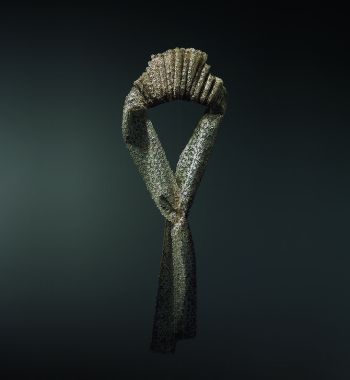
Point de France needle-lace frelange with lappets, Orne, France, ca. 1695, linen (Textilmuseum St. Gallen, acquisition from the John Jacoby Collection, 1954,01246; photo by Michael Rast).
Lace—delicate, sumptuous, enigmatic—takes over the Bard Graduate Center Gallery this fall. Trace the development of European lace from its sixteenth-century origins to the present day. See more than 150 examples of lace from the renowned collection of Switzerland’s Textilmuseum St. Gallen, including some of the world’s finest examples of handmade needle and bobbin lace that were favored by the wealthy and powerful of Bourbon France and Habsburg Spain. Learn about the women who crafted this sought-after status symbol by hand and about the evolution of Swiss chemical lace, known as guipure lace, made on embroidery machines. Explore new innovations in lace production, like laser-cut and 3D-printed lace, used in contemporary haute couture.
Curated by Emma Cormack, associate curator, Bard Graduate Center; Ilona Kos, curator, Textilmuseum St. Gallen; and Michele Majer, assistant professor, Bard Graduate Center. Threads of Power: Lace from the Textilmuseum St. Gallen is organized by Bard Graduate Center and the Textilmuseum St. Gallen. The exhibition will open at Bard Graduate Center Gallery in New York in September 2022 and will be available to tour after closing in January 2023.
◊ ◊ ◊ ◊ ◊
Emma Cormack and Michele Majer, eds., Threads of Power: Lace from the Textilmuseum St. Gallen (New York: Bard Graduate Center, 2022), 432 pages, ISBN: 978-0300263497, $75.
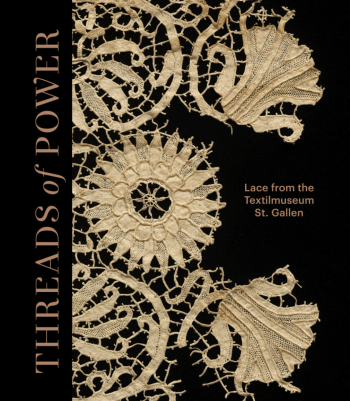 Tracing the history of lace in fashion from its sixteenth-century origins to the present, Threads of Power: Lace from the Textilmuseum St. Gallen offers a look at one of the world’s finest collections of historical lace. The book explores the longstanding connections between lace and status, addressing styles in lace worn at royal courts, including Habsburg Spain and Bourbon France, as well as lace worn by the elite ruling classes and Indigenous peoples in the Spanish Americas. Featuring new research, the publication covers a range of topics related to lace production, lace in fashion and portraiture, lace revivals, the mechanization of the lace industries in the nineteenth and twentieth centuries, and contemporary innovations in lace. With a focus on lace techniques, women lace makers, and lace as a signifier of wealth and power, this richly illustrated book includes wide-ranging contributions by curators and experts from major museums and academic institutions.
C O N T E N T S
Director’s Foreword, Susan Weber
Editor’s Note
Introduction, Emma Cormack and Michele Majer
The Emergence of Lace in Early Modern Europe
1 Barbara Karl — Lace and Status: Luxury, Power, and Control in Early Modernity
2 Femke Speelberg — Putting a Name to Lace: Fashion, Fame, and the Production of Printed Textile Pattern Books
3 Paula Hohti Erichsen — ‘Monstrous’ Ruffs and Elegant Trimmings: Lace and Lacemaking in Early Modern Italy
4 Frieda Sorber — Antwerp, A Center of Lace Making and Lace Dealing, 1550–1750
Lace in Spain and the Americas, 1500–1800
5 Amalia Descalzo Lorenzo — The Triumph of Lace: Spanish Portraiture of the Sixteenth and Seventeenth Centuries
6 Mariselle Méléndez — ‘A desire of being distinguished by an elegant dress is universal’: Clothing, Status and Convenience in Eighteenth-Century Spanish America
7 James Middleton — A Prodigious Excess: Lace in New Spain and Peru, ca. 1600–1800
8 Laura Beltrán-Rubio — ‘Covered in much fine lace’: Dress in the Viceroyalty of New Granada
The Dominance of France, 1660–1790
9 Denis Bruna — Lace and Economy under Louis XIV
10 Lesley Miller — Lace à la Mode, ca. 1690–1790
Mechanization and Revivalism: The Nineteenth Century Lace Industries
11 Emma Cormack and Michele Majer — Fashion and the Lace Industries in France, Belgium, and England, 1800–1900
12 Annabel Bonnin Talbot — Ahead of the Curve: A. Blackbourne & Co. and the Late-Nineteenth Century British Lace Industry
13 Emily Zilber — Italy to New York: Making Historic Textiles Modern at the Scoula d’Industrie Italiane
14 Anne Wanner-JeanRichard and Ilona Kos — Imitation and Inspiration: The Leopold Iklé Collection in St. Gallen
Innovations in Lace, 1900 to Today
15 Catherine Örmen — Fashion and Lace since 1900
16 Annina Dosch, Interview with Tobias Forster, Hans Schreiber, and Martin Leuthold — Lace in St. Gallen Today: Tradition and Innovation at Forster Rohner and Jakob Schlaepfer
Illustrated Checklist of the Exhibition
Glossary, compiled by Kenna Libes
Bibliography
Contributors
Index
The Burlington Magazine, August 2022
The August issue of The Burlington is rich for the eighteenth century, including Karin Wolfe’s obituary for Christopher Johns (details for his memorial service, on 17 September, are emerging here).
The Burlington Magazine 164 (August 2022)
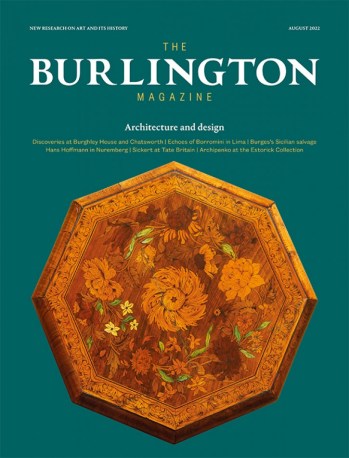 A R T I C L E S
• Gauvin Alexander Bailey, “A Borromini-Inspired Church Plan in Eighteenth-Century Lima,” pp. 740–51.
Built in 1758–66, the Church of Los Huérfanos, Lima, is unique in Spanish South America for its oval plan. Its designer is her identified as a master builder, Cristóbal de Vergas, who was inspired by prints of Francesco Borromini’s S. Carlo alle Quattro Fontane, Rome, exemplifying the revival of interest during the Rococo perios in Roman Baroque precedents.
• Adam Bowett, “The Floral Marquetry Floor at Burghley House,” pp. 752–59.
The possibility that five pieces of eighteenth-century furniture at Burghley House, Stamford, incorporate maquetry made for a floor in the house c.1685 is here confirmed by references in inventories. The marquetry can be linked to furniture in the Royal Collection, raising the possibility that the floor was mdade by Gerrit Jensen incorporating marquetry supplied by Jasper Braems.
• François Marandet, “A Modello by Louis Laguerre and the Programme of the Painted Hall at Chatsworth,” pp. 760–67.
With the help of a recently discovered modello, the subject of Louis Laguerre’s monumental painting on the east wall of the Painted Hall, Chatsworth, is here identified as Augustus Ordering the Closing of the Doors of the Temple of Janus. This allows the political allegory of the room’s decoration, completed in 1694, to be fully understood for the first time.
R E V I E W S
• Neil Jeffares, “Pastels in the Pandemic,” pp. 780–87.
The notoriously fragile medium of pastel has not been out of the public eye during the difficult circumstances of the past two years. Exhibition in San Francisco and Munich and a biography of Rosalba Carriera invite comparisons between the major pastellists of the eighteenth century: Joseph Vivien, Maurice-Quentin de La Tour, and Jean-Étienne Liotard, as well as Carriera.
• Reinier Baarsen, Review of Calin Demetrescu, Les ébénistes de la Couronne sous le règne de Louis XIV (La Bibliothèque des Arts, 2021), pp. 818–19.
• Daniel Fulco, Review of Andreas Schumacher, ed., Venezianische Malerei: Staatsgalerie in der Residenz Würzburg (Schnell & Steiner, 2021), pp. 819–21.
• Howard Coutts, Review of Patricia Ferguson, ed., Pots, Prints, and Politics: Ceramics with an Agenda, from the 14th to the 20th Century (British Museum Press, 2021), pp. 821–22.
• Sophie Rhodes, Review of Tessa Murdoch, Europe Divided: Huguenot Refugee Art and Culture (V&A Museum, 2021), pp. 827–28.
• Patrick Bade, Review of Charles Dellheim, Belonging and Betrayal: How Jews Made the Art World Modern (Brandeis University Press, 2021), p. 828.
O B I T U A R I E S
• Karin Wolfe, Obituary for Christopher M.S. Johns (1955–2022), pp. 829–31.
Professor of History of Art at Vanderbilt University, Nashville, since 2003, Christopher M.S. Johns published widely on Italian art of the seventeenth and eighteenth centuries. His determination to demonstrate the falsity of the belief that the settecento was a period of cultural decline had a substantial influence on both scholarship and academic curricula.
Exhibition | Dare to Know

Alexandre-Evariste Fragonard, A Centurion Begging for Protection from Marc Antony during a Seditious Revolt, ca. 1800, black ink and black and gray wash, probably over graphite, framing lines in black ink, on off-white antique laid paper (laid down), 20 × 48 cm (Harvard Art Museums, 2018.210).
◊ ◊ ◊ ◊ ◊
Opening this week at Harvard:
Dare to Know: Prints and Drawings in the Age of Enlightenment
Harvard Art Museums, Cambridge, MA, 16 September 2022 — 15 January 2023
Curated by Elizabeth Rudy and Kristel Smentek
See how the graphic arts inspired, shaped, and gave immediacy to new ideas in the Enlightenment era, encouraging individuals to follow their own reason when seeking to know more.
 What role did drawings and prints play during the Enlightenment era, from roughly 1720 to 1800? Dare to Know explores many nuances of this complex time—when political and cultural revolutions swept across Europe and the Americas, spurring profound shifts in science, philosophy, the arts, social and cultural encounters, and our shared sense of history. Indeed, the Enlightenment itself has been described as a “revolution of the mind.” Novel concepts in every realm of intellectual inquiry were communicated not only through text and speech, but in prints and drawings that gave these ideas a visual, concrete form. They made new things visible—and familiar things visible in powerful new ways. They wielded the potential to visually articulate, reinforce, or contradict beliefs as well as biases, while also arguing for social action and imagining new realities.
In 1784, in response to a journal article asking “What Is Enlightenment?,” German philosopher Immanuel Kant argued that the Enlightenment’s main impulse was to “dare to know!”: to pursue knowledge for oneself, without relying on others to interpret facts and experiences. But is this ever truly possible?
Bringing together 150 prints, drawings, books, and other related objects from Harvard as well as collections in the United States and abroad, this exhibition offers provocative insights into both the achievements and the failures of a period whose complicated legacies reverberate still today. Dare to Know asks new and sometimes uncomfortable questions of the so-called age of reason, inviting visitors to embrace the Enlightenment’s same spirit of inquiry—to investigate, to persuade, and to imagine.
Curated by Elizabeth M. Rudy, Carl A. Weyerhaeuser Curator of Prints, Harvard Art Museums, and Kristel Smentek, Associate Professor of Art History, Massachusetts Institute of Technology. With special thanks to Heather Linton, Curatorial Assistant for Special Exhibitions and Publications, Division of European and American Art, and Christina Taylor, Associate Paper Conservator, Straus Center for Conservation and Technical Studies. Research contributions by Austėja Mackelaitė, Stanley H. Durwood Foundation Curatorial Fellow (2016–18), and by PhD candidates in Harvard’s Department of History of Art and Architecture and former graduate interns in the Division of European and American Art: J. Cabelle Ahn, Thea Goldring, and Sarah Lund.
This project is supported in part by an award from the National Endowment for the Arts. Support for the exhibition is provided by the Melvin R. Seiden and Janine Luke Fund for Publications and Exhibitions, the Robert M. Light Print Department Fund, the Stanley H. Durwood Foundation Support Fund, the Catalogues and Exhibitions Fund for Pre-Twentieth-Century Art of the Fogg Museum, and the Gladys Krieble Delmas Foundation. The accompanying catalogue was made possible by the Andrew W. Mellon Publication Funds, including the Henry P. McIlhenny Fund. Related programming is supported by the M. Victor Leventritt Lecture Series Endowment Fund.
The catalogue is distributed by Yale UP:
Edouard Kopp, Elizabeth Rudy, and Kristel Smentek, eds., Dare to Know: Prints and Drawings in the Age of Enlightenment (Cambridge: Harvard Art Museums, 2022), 334 pages, ISBN: 978-0300266726, $50.
Are volcanoes punishment from God? What do a fly and a mulberry have in common? What utopias await in unexplored corners of the earth and beyond? During the Enlightenment, questions like these were brought to life through an astonishing array of prints and drawings, helping shape public opinion and stir political change. Dare to Know overturns common assumptions about the age, using the era’s proliferation of works on paper to tell a more nuanced story. Echoing the structure and sweep of Diderot’s Encyclopédie, the book contains 26 thematic essays, organized A to Z, providing an unprecedented perspective on more than 50 artists, including Henry Fuseli, Jean-Honoré Fragonard, Francisco Goya, Jean-Baptiste Greuze, William Hogarth, Giovanni Battista Piranesi, and Giambattista Tiepolo. With a multidisciplinary approach, the book probes developments in the natural sciences, technology, economics, and more—all through the lens of the graphic arts.
Edouard Kopp is the John R. Eckel, Jr., Foundation Chief Curator at the Menil Drawing Institute in Houston; Elizabeth M. Rudy is the Carl A. Weyerhaeuser Curator of Prints at the Harvard Art Museums, Cambridge, MA; and Kristel Smentek is associate professor of art history in the Department of Architecture at the Massachusetts Institute of Technology, Cambridge, MA.
With contributions by J. Cabelle Ahn, Elizabeth Saari Browne, Rachel Burke, Alvin L. Clark, Jr., Anne Driesse, Paul Friedland, Thea Goldring, Margaret Morgan Grasselli, Ashley Hannebrink, Joachim Homann, Kéla Jackson, Penley Knipe, Edouard Kopp, Ewa Lajer-Burcharth, Heather Linton, Austėja Mackelaitė, Tamar Mayer, Elizabeth Mitchell, Elizabeth M. Rudy, Brandon O. Scott, Kristel Smentek, Phoebe Springstubb, Gabriella Szalay, and Christina Taylor.
R E L A T E D E V E N T S
Dare to Know: An Introduction
15 September 2022, 5.30pm
Join us for a series of brief presentations and a discussion about the special exhibition Dare to Know: Prints and Drawings in the Age of Enlightenment, with curators Elizabeth Rudy and Kristel Smentek, along with several contributors to the exhibition catalogue.
Exhibition Tours by Elizabeth Rudy
18 September, 2 and 23 October, 11 December, and 15 January, noon
Join exhibition co-curator Elizabeth Rudy for a tour of the exhibition. She will share insights about how works on paper played a critical role in the 18th century, wielding the power to visually articulate, reinforce, or contradict beliefs as well as biases.
Gallery Talk by Morgan Grasselli
22 September 2022, 12.30pm
Join Margaret Morgan Grasselli for a discussion about the 18th-century invention of the multicolor, multiplate printing technique that laid the foundation for today’s CMYK process.
Gallery Talk by Sam Nehila
30 September 30, 2022, 12.30pm
Join Sam Nehila, curatorial assistant in the Division of European and American Art, for a discussion of William Hogarth’s print series The Four Stages of Cruelty.
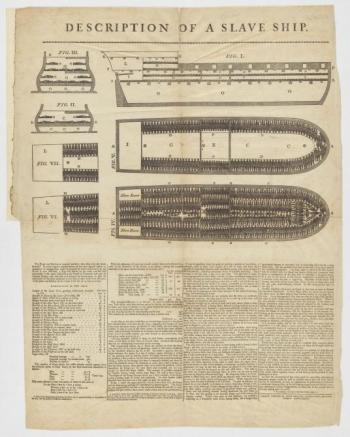
Printed by James Phillips, Description of a Slave Ship, 1789, engraving (Harvard University, Houghton Library, Gift of O. Peck, 1845, p EB75 A100, TL42422.5).
Gallery Talk by John Overholt
25 October 2022, 12.30pm
Join Houghton Library curator John Overholt for a discussion of one of the most important and consequential prints of the 18th century, Description of a Slave Ship.
Gallery Talk by Joachim Homann
27 October 2022, 12.30pm
Join curator Joachim Homann for a discussion about a rare, intact example of French inventor Louis Carrogis de Carmontelle’s multi-sheet drawings on translucent paper. The work was originally attached to rollers, lit from behind with candles, and unfurled for a captive audience.
Gallery Talk by Horace Ballard
3 November 2022, 12.30pm
Join curator Horace Ballard for an exploration of the observation and documentation of astronomical events in the 18th century as exemplified in a drawing by British artist Paul Sandby.
Gallery Talk by Ben Sibson
5 November 2022, 12.30pm
Join Ben Sibson, PhD candidate in Harvard’s Department of Human Evolutionary Biology, for a discussion about the depiction of the human body in selected works on view in the exhibition.
Gallery Talk by Paris A. Spies-Gans
6 November 2022, 12.30pm
Join art historian Paris A. Spies-Gans, of the Harvard Society of Fellows, for a discussion about works of art made by women in the exhibition. Spies-Gans will examine objects by a range of artists, with particular attention given to Marguerite Gérard and Marie-Gabrielle Capet.
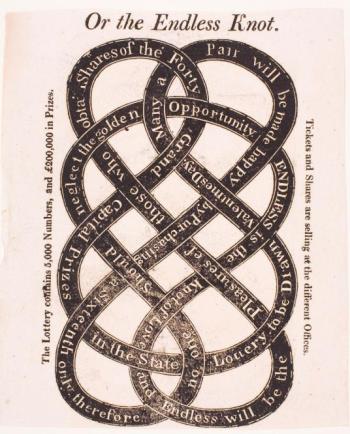
Unidentified artist, American, Lottery Ticket: The Endless Knot, ca. 1785–95, woodcut (Harvard Art Museums/Fogg Museum, Gift of Walter S. Poor, Class of 1905, M20297).
Gallery Talk by Casey Monahan
8 November 2022, 12.30pm
Join curatorial assistant Casey Monahan for a discussion of a dynamic display of ball invitations, advertisements, trade cards, and currency notes in the exhibition. Monahan will share insights about the acquisition of these small prints and the story behind their creative installation.
Gallery Talk by Joachim Homann
10 November 2022, 12.30pm
Join curator Joachim Homann for a discussion of Jean-Honoré Fragonard’s drawing The Girls’ Dormitory.
Gallery Talk by Sarah Mallory
20 November 2022, 12.30pm
Join Sarah Mallory, PhD candidate in Harvard’s Department of History of Art and Architecture, for a discussion of the emergence of the modern notion of ecology in the 18th century as articulated in selected works in the exhibition.
Gallery Talk by Yi Bin Liang
6 December 2022, 12.30pm
Join conservation technician Yi Bin Liang for an exploration of 18th-century methods and techniques of book binding in a close examination of works on view.
New Book | Against Sex
From UNC Press:
Kara French, Against Sex: Identities of Sexual Restraint in Early America (Chapel Hill: The University of North Carolina Press, 2021), 232 pages, ISBN: 978-1469662138 (hardcover), $95 / ISBN: 978-1469662145 (paperback), $30 / ISBN: 978-1469662152 (ebook), $25.
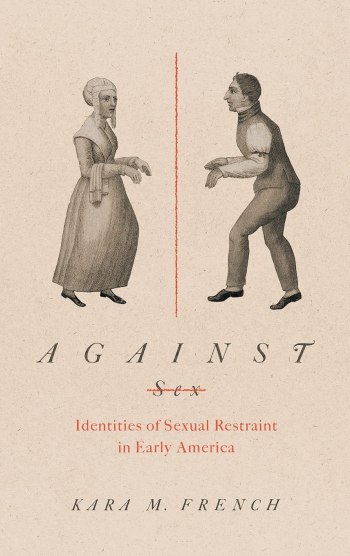 How much sex should a person have? With whom? What do we make of people who choose not to have sex at all? As present as these questions are today, they were subjects of intense debate in the early American republic. In this richly textured history, Kara French investigates ideas about, and practices of, sexual restraint to better understand the sexual dimensions of American identity in the antebellum United States. French considers three groups of Americans—Shakers, Catholic priests and nuns, and followers of sexual reformer Sylvester Graham—whose sexual abstinence provoked almost as much social, moral, and political concern as the idea of sexual excess. Examining private diaries and letters, visual culture and material artifacts, and a range of published works, French reveals how people practicing sexual restraint became objects of fascination, ridicule, and even violence in nineteenth-century American culture.
Against Sex makes clear that in assessing the history of sexuality, an expansive view of sexual practice that includes abstinence and restraint can shed important new light on histories of society, culture, and politics.
Kara M. French is associate professor of history at Salisbury University.
C O N T E N T S
Acknowledgments
Introduction
1 Vinegar-Faced Sisters and Male Monsters: The Gender of Sexual Restraint
2 Identities of Sexual Restraing
3 Breaking and Remaking the Family
4 Alternative Extracts: Sexual Retraint in the Antebellum Marketplace
5 Performing Sexual Restraint
Conclusion
Notes
Bibliography
Index
Exhibition | Feminine Power: The Divine to the Demonic
Closing this month at The British Museum:
Feminine Power: The Divine to the Demonic
The British Museum, London, 19 May — 25 September 2022
Curated by Belinda Crerar and Lucy Dahlsen
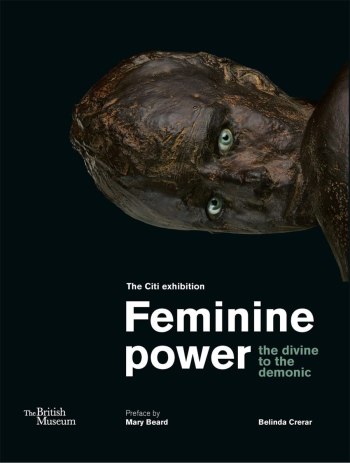 The first exhibition of its kind, Feminine Power takes a cross-cultural look at the profound influence of female spiritual beings within global religion and faith. Explore the significant role that goddesses, demons, witches, spirits and saints have played—and continue to play—in shaping our understanding of the world.
How do different traditions view femininity? How has female authority been perceived in ancient cultures? For insights, the exhibition looks to divine and demonic figures feared and revered for over 5,000 years. From wisdom, passion and desire, to war, justice and mercy, the diverse expression of female spiritual powers around the world prompts us to reflect on how we perceive femininity and gender identity today.
Worship of Pele, the Hawaiian goddess of volcanoes, reveals how her destructive capacity is venerated alongside her ability to create. The Buddhist bodhisattva of compassion, who transcends gender and is visualised in male form in Tibet and female in China and Japan, uncovers the importance of gender fluidity in some spiritual traditions. And the terrifying Hindu goddess Kali, depicted in art carrying a severed head and bloodied sword, is honoured as the Great Mother and liberator from fear and ignorance.

Porcelain Figure of Guanyin, China, 18th century, 41 cm high (London: The British Museum, 1980,0728.93).
Enhanced by engagement with contemporary worshippers, faith communities and insights from high-profile collaborators Bonnie Greer, Mary Beard, Elizabeth Day, Rabia Siddique, and Deborah Frances-White, the exhibition considers the influence of female spiritual power and what femininity means today.
Bringing together sculptures, sacred objects and artworks from the ancient world to today, and from six continents, the exhibition highlights the many faces of feminine power—ferocious, beautiful, creative or hell-bent—and its seismic influence throughout time.
Belinda Crerar, Feminine Power: The Divine to the Demonic (London: The British Museum, 2022), 272 pages, ISBN: 978-0714151304, £30 / $45.
C O N T E N T S
Introduction
1 Forces of Nature
2 Passion and Desire
3 Evil
4 Justice and Defence
5 Compassion and Salvation
Conclusion
Notes and Bibliography
Acknowledgements and Credits
Exhibition | Fuseli and the Modern Woman
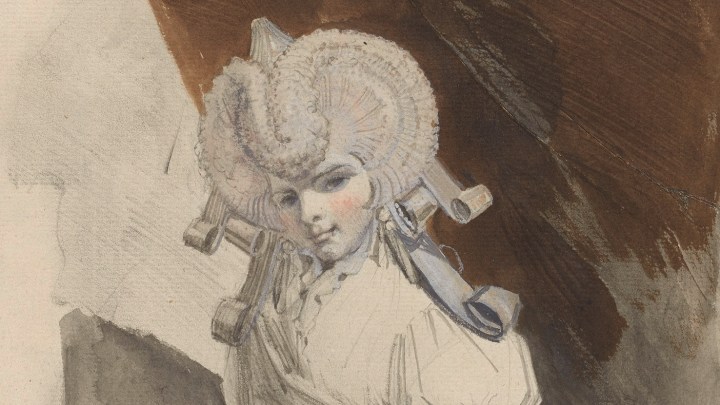
Henry Fuseli, Sophia Fuseli, Her Hair in Large Rolls, with Pink Gloves, in Front of a Brown Curtain, detail, 1790
(Kunsthaus Zürich, Collection of Prints and Drawings)
◊ ◊ ◊ ◊ ◊
From The Courtauld:
Fuseli and the Modern Woman: Fashion, Fantasy, Fetishism
The Courtauld Gallery, London, 14 October 2022 — 8 January 2023
Kunsthaus Zürich, 24 February – 21 May 2023
One of the most original and eccentric artists of the 18th century, Henry Fuseli (1741–1825) will be the subject of a new exhibition at The Courtauld, opening 14 October 2022.

Henry Fuseli, Half-length Figure of a Courtesan with Feathered Head-dress, ca. 1800–10 (Kunsthaus Zürich, Collection of Prints and Drawings).
Born in Zurich, Switzerland, Fuseli spent a formative period in Rome in the 1770s before settling in London, where he was elected Professor of Painting at The Royal Academy and served for 21 years as Keeper of the RA Schools, working and living at Somerset House in what is now The Courtauld Gallery.
While Fuseli was famous in his lifetime for stylised paintings depicting fantastic and supernatural scenes drawn from his imagination and literature, The Courtauld’s exhibition explores an altogether different dimension to his art. Fuseli and the Modern Woman: Fashion, Fantasy, Fetishism will reveal the artist’s secret lifelong obsession with the female figure through fifty of his strange and striking private drawings, many of which depict the spectacularly extravagant hairdos and fashions of the day. The exhibition will explore Fuseli’s fascination with female sexuality and the modern woman—as a figure of mystery, transgression, and dangerous allure—and provides an insight into late 18th- and early 19th-century anxieties about gender, identity, and sexuality during a transformative period in European history.
Organised in collaboration with the Kunsthaus Zürich, the exhibition will showcase drawings brought together from international collections. Following its presentation at The Courtauld, the exhibition will travel to Zürich, the city where Fuseli was born.
The catalogue is published by PHP and distributed by The University of Chicago Press:
David Solkin, ed., with contributions by Jonas Beyer, Mechthild Fend, and Ketty Gottardo, Fuseli and the Modern Woman: Fashion, Fantasy, Fetishism (London: Paul Holberton Publishing, 2022), 168 pages, ISBN: 978-1913645298, £30 / $40.
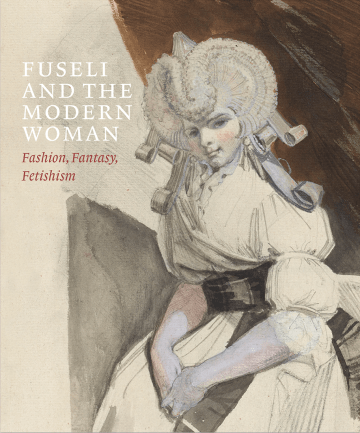 Best known for his notoriously provocative painting The Nightmare, Fuseli energetically cultivated a reputation for eccentricity, with vividly stylised images of supernatural creatures, muscle-bound heroes, and damsels in distress. While these convinced some viewers of the greatness of his genius, others dismissed him as a charlatan, or as completely mad.
Fuseli’s contemporaries might have thought him even crazier had they been aware that in private he harboured an obsessive preoccupation with the figure of the modern woman, which he pursued almost exclusively in his drawings. Where one might have expected idealised bodies with the grace and proportions of classical statues, here instead we encounter figures whose anatomies have been shaped by stiff bodices, waistbands, puffed sleeves, and pointed shoes, and whose heads are crowned by coiffures of the most bizarre and complicated sort. Often based on the artist’s wife Sophia Rawlins, the women who populate Fuseli’s graphic work tend to adopt brazenly aggressive attitudes, either fixing their gaze directly on the viewer or ignoring our presence altogether. Usually they appear on their own, in isolation on the page; sometimes they are grouped together to form disturbing narratives, erotic fantasies that may be mysterious, vaguely menacing, or overtly transgressive, but where women always play a dominant role. Among the many intriguing questions raised by these works is the extent to which his wife Sophia was actively involved in fashioning her appearance for her own pleasure, as well as for the benefit of her husband.
By bringing together more than fifty of these studies (roughly a third of the known total), The Courtauld Gallery will give audiences an unprecedented opportunity to see one of the finest Romantic-period draughtsmen at his most innovative and exciting. Visitors to the show and readers of the lavishly illustrated catalogue will further be invited to consider how Fuseli’s drawings of women, as products of the turbulent aftermath of the American and French Revolutions, speak to concerns about gender and sexuality that have never been more relevant than they are today.
The exhibition showcases drawings brought together from international collections, including the Kunsthaus Zürich, in Zurich, the Auckland Art Gallery in New Zealand, and from other European and North American institutions.
David Solkin is Emeritus Professor at The Courtauld Institute of Art, London.
Jonas Beyer is Curator of Drawings at the Kunsthaus Zürich, Zurich.
Mechthild Fend is Professor of Art History at the Goethe University, Frankfurt am Main.
Ketty Gottardo is Martin Halusa Curator of Drawings at The Courtauld Gallery, London.
New Book | General William Roy (1726–1790)
From Edinburgh UP:
Humphrey Welfare, General William Roy (1726–1790): Father of the Ordnance Survey (Edinburgh: Edinburgh University Press, 2022), 310 pages, ISBN: 978-1399505789, $120.
 The first biography of William Roy, exploring his life, career, and legacy
• Considers the influences on William Roy and his work by examining the people in his circle, including some of the most famous scientists and explorers of the day
• Reviews the importance of the Military Survey of Scotland to the history of cartography
• Considers the significance of Roy’s experiments in measuring heights by barometric pressure
• Re-assesses—for the first time since 1917—his important contribution to British archaeology
Born in Clydesdale, William Roy was a polymath and a visionary. His work established the path that would lead to the formation of the Ordnance Survey and to all of the paper-based and digital mapping products that we use today. His story—very much one of the Enlightenment—demonstrates how one man’s curiosity and diligence enabled him to excel across a diverse range of topics: military reconnaissance and intelligence; the lessons that could be learned from the past about the tactical use of landscape; the science of determining the height of mountains; and the development of a meticulous methodology to achieve an unprecedented accuracy in topographical measurement. In this biography, Humphrey Welfare uncovers the career and activities of this important figure, and in doing so paints a vivid picture of the inner complexities of 18th-century Britain.
Humphrey Welfare is Visiting Fellow in the School of History, Classics, and Archaeology at the University of Newcastle. Formerly he was Director of the Architectural and Archaeological Survey at the Royal Commission, and, after merger with English Heritage, the Director of Research Projects. His last post before retirement in 2011 was as English Heritage Planning and Development Director for the North. Humphrey has published over forty papers in peer-reviewed journals on the archaeology and history of southern Scotland and northern England, as well as three books, including Roman Camps in England: The Field Archaeology (with V. Swan, HMSO, 1995). He is a former editor of the Proceedings of the Society of Antiquaries of Scotland.
C O N T E N T S
Prologue: A Dinner Party for Captain Cook
Acknowledgements
Introduction
1 Foundations
2 The Map-maker: Developing the Soldier’s Eye
3 The Military Engineer: Reconnaissance, Resources, and Fortifications
4 The Antiquary in the Field: Empathy with the Army of Rome
5 The Practical and Sociable Scientist: Hypsometry and the Royal Society
6 The Geodesist: Large Triangles and Miniscule Adjustments
7 Aftermath and Legacy: The Birth of the Ordnance Survey
Appendix 1 Chronology
Appendix 2 General Roy’s Instructions on Reconnoitring
Appendix 3 Glossary
Abbreviations
Bibliographical References
Index
New Book | The Marlborough Mound
From Boydell & Brewer:
Richard Barber, ed., The Marlborough Mound: Prehistoric Mound, Medieval Castle, Georgian Garden (London: Boydell Press, 2022), 224 pages, ISBN: 978-1783271863 (hardcover), £45 / $65 | ISBN: 978-1787446748 (ebook), £20 / $25.
 The Marlborough Mound has recently been recognised as one of the most important monuments in the group around Stonehenge. It was also a medieval castle and a feature in a major Georgian garden. This is the first comprehensive history of this extraordinary site.
Marlborough Mound, standing among the buildings of Marlborough College, has attracted little attention until recently. Records showed it to be the motte of a Norman castle, of which there were no visible remains. The local historians and archaeologists who investigated it found very little in the way of archaeological evidence beyond a few prehistoric antler picks, the odd Roman coin, and a scatter of medieval pottery. The most dramatic discovery came after the Mound Trust began to restore the mound in 2003. English Heritage was investigating Silbury Hill and arranged to take cores from the Mound for dating purposes. The results were remarkable, as they showed that the Mound was almost a twin of Silbury Hill and therefore belonged to the extraordinary assembly of prehistoric monuments centred on Stonehenge.
For the medieval period, this book brings together for the first time all that we know about the castle from the royal records and from chronicles. These show that it was for a time one of the major royal castles in the land. Most of the English kings from William I to Edward III spent time here. For Henry III and his queen Eleanor of Provence, it was their favourite castle after Windsor.
As to its final form as a garden mound next to the house of the dukes of Somerset, in the eighteenth century, this emerges from letters and even poems, and from the recent restoration. Much of this has been slow and painstaking work, however, involving the removal of the trees which endangered the structure of the Mound, the recutting of the spiral path and the careful replanting of the whole area with suitable vegetation. By doing this, the shape of the Mound as a garden feature has re-emerged, and can now be seen clearly.
This book marks the end of the first stage of the work of the Mound Trust, which, following the restoration, turns to its second objective of promoting public knowledge of the Mound based on scholarly research.
Richard Barber has had a huge influence on the study of medieval history and literature, as both a writer and a publisher. His first book on the Arthurian legend appeared in 1961, and his major works include The Knight and Chivalry (winner of the Somerset Maugham Award in 1971), Edward Prince of Wales and Aquitaine, The Penguin Guide to Medieval Europe, and The Holy Grail: the History of a Legend, which was widely praised and was translated into six languages.
C O N T E N T S
Preface — Barry Cunliffe
1 ‘One Remarkable Earthen-work’: The Neolithic Origins of the Marlborough Mound — Jim Leary and Joshua Pollard
2 Castles and the Landscape of Norman Wessex, c. 1066–1154 — Oliver Creighton
3 Marlborough Castle in the Middle Ages — Richard Barber
4 The Mound as a Garden Feature — Brian Dix
5 Epilogue: The Marlborough Mound Trust
Afterword: The Round Mound Project — Jim Leary, Elaine Jamieson, and Phil Stastney
Appendices
A Inquisition into the State of Marlborough Castle, 11 September 1327
B Castellum Merlebergae, by H.C. Brentnall, FSA
C Constables of Marlborough Castle
D Marlborough Castle: Archaeological Findings for the Medieval Period
Bibliography
Index










 Enfilade
leave a comment