Shortlists Announced for Hitchcock Medallion and Colvin Prize
From The Society of Architectural Historians of Great Britain (SAHGB) . . . with shout-out to HECAA member Basile Baudez!
The shortlists for two of the most important prizes in architectural history—the Alice Davis Hitchcock Medallion and the Colvin Prize—were announced this week. The Alice Davis Hitchcock Medallion is awarded to a monograph that makes an outstanding contribution to the study of architectural history—previous winners include Howard Colvin, Dorothy Stroud, John Summerson, Nikolaus Pevsner, Hermione Hobhouse, and Jill Lever. The Colvin Prize, established in 2017, is awarded to an outstanding work of reference of value to the discipline irrespective of format.
The two shortlists for the awards this year demonstrate a broad range of subjects and approaches to architectural history, ranging from a global atlas of queer spaces, forensic analysis of the urban and architectural fabric of Whitechapel, a fulsome biographical dictionary of early-modern architects in Britain, through to a compendious photographic recording of all the 437 Carnegie libraries that still remain in the UK, and much more.
The winners will be selected in the autumn and announced at the Society’s Annual Lecture and Awards Ceremony in December 2022.
The awards are overseen by the SAHGB to reward work that is innovative, ambitious, and rigorous in tackling histories of the built environment as broadly conceived. The SAHGB’s awards programme, which also includes the ‘Hawksmoor’ Essay Medal, Heritage Research Award, and Dissertation Prize, is open and inclusive wherever possible, celebrating diversity of approach and recognising work at all career levels.
◊ ◊ ◊ ◊ ◊
 Alice Davis Hitchcock Medallion Shortlist
• Basile Baudez, Inessential Colors: Architecture on Paper in Early Modern Europe (Princeton University Press)
• Manolo Guerci, London’s ‘Golden Mile’: The Great Houses of the Strand, 1550–1650 (Paul Mellon Centre for Studies in British Art)
• Jasmine Kilburn-Toppin, Crafting Identities: Artisan Culture in London, c. 1550–1640 (Manchester University Press)
• Nathaniel Walker, Victorian Visions of Suburban Utopia: Abandoning Babylon (Oxford University Press)
Colvin Prize Shortlist
• Adam Nathaniel Furman + Joshua Mardell, eds., Queer Spaces: An Atlas of LGBTQIA+ Places and Stories (RIBA Publishing)
• Mark Girouard, A Biographical Dictionary of English Architecture, 1540–1640 (Paul Mellon Centre for Studies in British Art)
• Oriel Prizeman, The Carnegie Libraries of Britain: A Photographic Chronicle (Arts and Humanities Research Council)
• Peter Guillery, ed., Survey of London, Whitechapel: Vols 54 + 55 (Paul Mellon Centre for Studies in British Art/Yale University Press)

New Book | Stourhead: Henry Hoare’s Paradise Revisited
Published by Head of Zeus and distributed by IPG:
Dudley Dodd with an introduction by James Stourton and photographs by Marianne Majerus, Stourhead: Henry Hoare’s Paradise Revisited (London: Apollo, 2021), 320 pages, ISBN: 978-1788543620, £40 / $65.
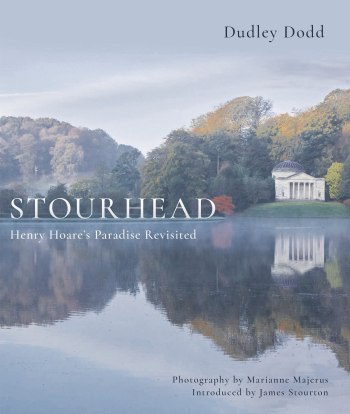 An illustrated history of the landscape garden at Stourhead, created by generations of the Hoare banking dynasty.
Cross the south lawn at Stourhead and enter the leafy embrace of the Shades. Descend through the ancient and rare trees, and as the ground falls away a great lake appears. It is punctuated with classical temples, and a great arched bridge lunges to the other side of the water. Continue on and you will find a mystical, jagged grotto; a gothic hideaway; gods, muses and saints. This is how Henry Hoare—known as Henry the Magnificent—would have approached the garden he designed with Henry Flitcroft. It truly is an English arcadia. Perhaps he imagined himself as a journeying Aeneas, or wished to recreate a Claude Lorrain landscape? This is the history of a unique landscape, created in a misty Wiltshire valley by generations of the Hoare banking family. It follows its evolution, describing how flights of folly, individual flair and tastes, combined with careful stewardship, have formed a national treasure and one of the finest examples of the English landscape garden.
Dudley Dodd had a long career with the National Trust, where he was Secretary of the Arts Panel, and has published widely on Stourhead, whose first modern guidebook he wrote in 1981, as well as guidebooks to several other National Trust houses. He is co-author of Roman Splendour, English Arcadia: The Pope’s Cabinet at Stourhead.
New Book | Ceremonial Splendor
From U of Penn Press:
Joy Palacios, Ceremonial Splendor: Performing Priesthood in Early Modern France (Philadelphia: University of Pennsylvania Press, 2022), 288 pages, ISBN: 978-1512822786, $55.
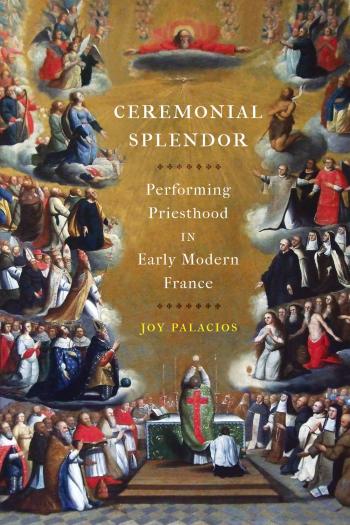 By the end of France’s long seventeenth century, the seminary-trained, reform-minded Catholic priest had crystalized into a type recognizable by his clothing, gestures, and ceremonial skill. Although critics denounced these priests as hypocrites or models for Molière’s Tartuffe, seminaries associated the features of this priestly identity with the idea of the vray ecclésiastique, or true churchman.
Ceremonial Splendor examines the way France’s early seminaries promoted the emergence and construction of the true churchman as a mode of embodiment and ecclesiastical ideal between approximately 1630 and 1730. Based on an analysis of sources that regulated priestly training in France, such as seminary rules and manuals, liturgical handbooks, ecclesiastical pamphlets and conferences, and episcopal edicts, the book uses theories of performance to reconstruct the way clergymen learned to conduct liturgical ceremonies, abide by clerical norms, and aspire to perfection.
Joy Palacios shows how the process of crafting a priestly identity involved a wide range of performances, including improvisation, role-playing, and the display of skills. In isolation, any one of these performance obligations, if executed in a way that drew attention to the self, could undermine a clergyman’s priestly persona and threaten the institution of the priesthood more broadly. Seminaries counteracted the ever-present threat of theatricality by ceremonializing the clergyman’s daily life, rendering his body and gestures contiguous with the mass. Through its focus on priestly identity, Ceremonial Splendor reconsiders the relationship between Church and theater in early modern France and uncovers ritual strategies that continue to shape religious authority today.
Joy Palacios is an Assistant Professor of Religious Studies in the Department of Classics and Religion at the University of Calgary.
New Book | Against the Map
From UVA Press:
Adam Sills, Against the Map: The Politics of Geography in Eighteenth-Century Britain (Charlottesville: University of Virginia Press, 2021), 318 pages, ISBN: 978-0813945989 (hardback), $115 / ISBN: 978-0813946009 (ebook), $35 / ISBN: 978-0813945996 (paperback), $45.
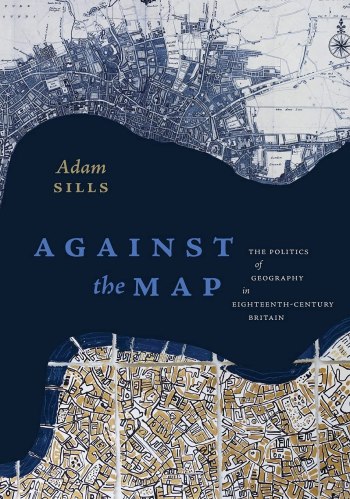 Over the course of the seventeenth and eighteenth centuries, the increasing accuracy and legibility of cartographic projections, the proliferation of empirically based chorographies, and the popular vogue for travel narratives served to order, package, and commodify space in a manner that was critical to the formation of a unified Britain. In tandem with such developments, however, a trenchant anti-cartographic skepticism also emerged. This critique of the map can be seen in many literary works of the period that satirize the efficacy and value of maps and highlight their ideological purposes. Against the Map argues that our understanding of the production of national space during this time must also account for these sites of resistance and opposition to hegemonic forms of geographical representation, such as the map.
This study utilizes the methodologies of critical geography, as well as literary criticism and theory, to detail the conflicted and often adversarial relationship between cartographic and literary representations of the nation and its geography. While examining atlases, almanacs, itineraries, and other materials, Adam Sills focuses particularly on the construction of heterotopias in the works of John Bunyan, Aphra Behn, Jonathan Swift, Daniel Defoe, Samuel Johnson, and Jane Austen. These ‘other’ spaces, such as neighborhood, home, and country, are not reducible to the map but have played an equally important role in the shaping of British national identity. Ultimately, Against the Map suggests that nation is forged not only in concert with the map but, just as important, against it.
Adam Sills is Associate Professor of English at Hofstra University.
New Book | Teachable Monuments
This week (11–12 August) marked the fifth anniversary of the white supremacist rally in Charlottesville. This collection of essays appeared in hardback in 2021; it’s due to be released in paperback this fall from Bloomsbury:
Sierra Rooney, Jennifer Wingate, and Harriet Senie, eds., Teachable Monuments: Using Public Art to Spark Dialogue and Confront Controversy (Bloomsbury Publishing, 2021), 296 pages, ISBN: 978-1501356940 (hardcover), $130 / ISBN: 979-8765100462 (paperback), $35.
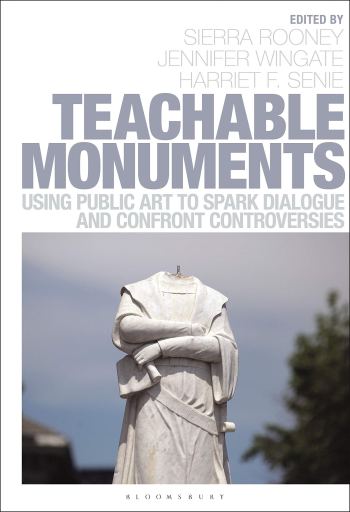 Monuments around the world have become the focus of intense and sustained discussions, activism, vandalism, and removal. Since the convulsive events of 2015 and 2017, during which white supremacists committed violence in the shadow of Confederate symbols, and the 2020 nationwide protests against racism and police brutality, protesters and politicians in the United States have removed Confederate monuments, as well as monuments to historical figures like Christopher Columbus and Dr. J. Marion Sims, questioning their legitimacy as present-day heroes that their place in the public sphere reinforces. The essays included in this anthology offer guidelines and case studies tailored for students and teachers to demonstrate how monuments can be used to deepen civic and historical engagement and social dialogue. Essays analyze specific controversies throughout North America with various outcomes as well as examples of monuments that convey outdated or unwelcome value systems without prompting debate.
Sierra Rooney is Assistant Professor of Art History at University of Wisconsin-La Crosse. She is the author of numerous articles on public monuments and controversy.
Jennifer Wingate is Professor of Fine Arts at St. Francis College. She was co-editor of Public Art Dialogue (2017–2020) and is the author of Sculpting Doughboys: Memory Gender, and Taste in America’s Worlds War I Memorials (2013). She has published on representations of the domestic display of FDR portraits, WWI memorials, and public art.
Harriet F. Senie is Professor Emerita of Art History at the City College of New York and the Graduate Center, The City University of New York. She is the author of Memorials to Shattered Myths: Vietnam to 9/11 (2015), The ‘Tilted Arc’ Controversy: Dangerous Precedent? (2001), and Contemporary Public Sculpture: Tradition, Transformation, and Controversy (1992). She has edited several anthologies on different aspects of public art.
C O N T E N T S
List of Illustrations
List of Contributors
Acknowledgements
Introduction: Why Monuments Matter — Sierra Rooney (University of Wisconsin-La Crosse) and Jennifer Wingate (St. Francis College)
Part I: Teaching Strategies
1 Developing Essential Questions for a Student-Driven 4th Grade Monument Study — Adelaide Wainwright (Oregon Episcopal School)
2 Encouraging Intervention: Project-Based Learning with Problematic Public Monuments — Mya Dosch (California State University-Sacramento)
3 Mapping Art on Campus — Annie Dell’Aria (Miami University)
4 Moving Beyond ‘Pale and Male’: A Museum Educator Approach to the Campus Portrait Debate — Jennifer Reynolds-Kaye (Yale Center for British Art)
5 ‘From Commemoration to Education’: Re-setting Context and Interpretation for a Confederate Memorial Statue on a University Campus — Sarah Sonner (Briscoe Center for American History, University of Texas-Austin)
6 Making Material Histories: Institutional Memory and Polyvocal Interpretation — Kailani Polzak (University of California-Santa Cruz)
Part II: Political Strategies
7 Dismantling the Confederate Landscape: The Case for a New Context — Sarah Beetham (Pennsylvania Academy of the Fine Arts)
8 Learning from Louisville: John Breckenridge Castleman, His Statue, and a Public Sphere Revisited — Chris Reitz (University of Louisville)
9 Addressing Monumental Controversies in New York City Post Charlottesville — Harriet Senie (City University of New York)
10 The Preservation Dilemma: Confronting Two Controversial Monuments in the United States Capitol — Michele Cohen (Architect of the Capitol)
11 Up Against The Wall: Commemorating and Framing the Vietnam War on the National Mall — Jennifer K. Favorite (City University of New York)
12 ‘I feel like I have hated Lincoln for 110 years’: Debates over the Lincoln Statue in Richmond, Virginia — Evie Terrono (Randolph-Macon College)
Part III: Engagement Strategies
13 Paper Monuments as Public Pedagogy — Sue Mobley (Colloqate Design)
14 Charging Bull and Fearless Girl: A Dialogue — Charlene G. Garfinkle (Independent Scholar)
15 The Afterlife of E Pluribus Unum — Laura Holzman (Indiana University–Purdue University Indianapolis), Modupe Labode (National Museum of American History), and Elizabeth Kryder-Reid (Indiana University–Purdue University Indianapolis)
16 Unforeseen Controversy: Reconciliation and Re-contextualization of Wartime Atrocities through ‘Comfort Women’ Memorials in the United States — Jung-Sil Lee (George Washington University and Maryland Institute College of Art)
17 Free History Lessons: Contextualizing Confederate Monuments in North Carolina — Matthew Champagne (North Carolina State University), Katie Schinabeck (North Carolina State University), and Sarah A. M. Soleim (North Carolina State University)
18 Future History: New Monumentality in Old Public Spaces, An interview with Artist Kenseth Armstead — Maria F. Carrascal (Artipica Creative Spaces, Spain)
Index
New Book | Maria Sibylla Merian: Changing the Nature of Art and Science
Coming soon, with distribution by ACC Art Books:
Marieke van Delft, Kay Etheridge, Hans Mulder, Bert van de Roemer, and Florence Pieters, Maria Sibylla Merian: Changing the Nature of Art and Science (Tielt: Lannoo: 2022), 304 pages, ISBN: 978-9401485333, $70.
 The revolutionary artist and naturalist Maria Sibylla Merian (1647–1717) has come into the spotlight in recent years. The life and work of this German-born woman, who would later settle in the Netherlands, has been studied internationally by entomologists, botanists and historians and are a source of inspiration for contemporary artists and writers. In 2016, Lannoo Publishers, in collaboration with the Koninklijke Bibliotheek, republished her masterpiece Metamorphosis insectorum Surinamensium as a facsimile. This well-illustrated book assembles the most recent scientific knowledge about this remarkable woman. The authors examine, among other things, Merian’s pioneering work on the reproduction and development of insects, the methods and materials she used for her work, her remarkable journey to Suriname, her network of family, friends and patrons, and her widespread influence on the history of art and science. Her work is compared to that of early modern and contemporary artists and scientists
This book gathers essays by of 23 international experts, most of whom are connected to the international Maria Sibylla Merian Society. The editorial team consists of Marieke van Delft, Kay Etheridge, Hans Mulder, Bert van de Roemer, and Florence Pieters.
Book Discussion | Grafted Arts
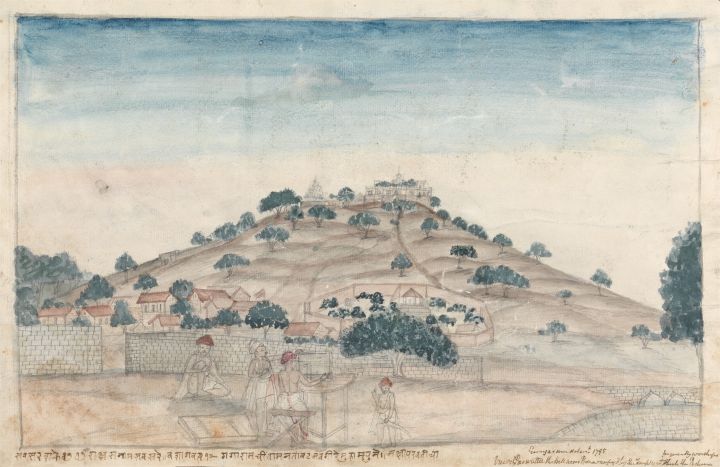
Gangaram Tambat, View of Parbati, a Hill near Poona Occupied by the Temples Frequented by the Peshwa, 1795, watercolor and graphite on paper
(New Haven: Yale Center for British Art, Paul Mellon Collection).
◊ ◊ ◊ ◊ ◊
From YCBA:
Grafted Arts: Art Making and Taking in the Struggle for Western India, 1760–1910
Virtual and in-person, Yale Center for British Art, New Haven, 7 September 2022, 4.00pm
Author Holly Shaffer, Assistant Professor of the History of Art and Architecture, Brown University, in conversation with Laurel Peterson, Assistant Curator of Prints and Drawings, Yale Center for British Art
 During the eighteenth century, Maratha military rulers and British East India Company officials used the arts to engage in diplomacy, wage war, compete for prestige, and generate devotion as they allied with (or fought against) each other to control western India. Shaffer’s book conceptualizes the artistic combinations that resulted as ones of ‘graft’—a term that acknowledges the violent and creative processes of suturing arts, and losing and gaining goods, as well as the shifting dynamics among agents who assembled such materials.
Holly Shaffer’s research focuses on art and architecture in Britain and South Asia across visual, material, and sensory cultures. Her book Grafted Arts: Art Making and Taking in the Struggle for Western India, 1760–1910 was awarded the Edward Cameron Dimock, Jr. Prize in the Indian Humanities by the American Institute of Indian Studies. Shaffer curated the exhibition Adapting the Eye: An Archive of the British in India, 1770–1830 at the Yale Center for British Art. She and Laurel Peterson, Assistant Curator of Prints and Drawings, are co-curators of an upcoming exhibition at the YCBA about artists and the British East India Company.
This program is presented through the generosity of the Terry F. Green 1969 Fund for British Art and Culture.
To watch the livestream on September 7 at 4.00pm, please click here»
◊ ◊ ◊ ◊ ◊
Note (added 15 August 2022) — The posting was updated with the new time (4.00).
New Book | European Fans: The Untold Story
From Scala:
Hahn Eura Eunkyung, European Fans: The Untold Story (London: Scala Arts Publishers, 2022), 248 pages, ISBN: 978-1785514128, £15 / $21.
 Showcasing more than 60 carefully selected fans from a collection of over 1000, this is the first in a series of publications from the Eurus Collection, now available in English for the first time.
Throughout history, fans have had numerous roles: personal items to cool the user, tools for religious and ceremonial events, symbols of royal power and authority or important fashion accessories. As practical, symbolic and decorative objects, they are the meeting point of multiple arts. This book focuses on European fans made in the French Rococo style in the eighteenth century and the Rococo Revival style that emerged in the nineteenth century. Sixty-six superb examples, selected from the Eurus Collection in South Korea, offer a glimpse into the lives of European royalty and aristocracy, including their aesthetic preferences, ideals and views on nature, and demonstrate the intermingling of cultures in the newly emerging painting and craft styles which resulted from trade between Europe and the East. This beautifully illustrated book explores the fans’ thematic and stylistic aspects as well as their assembly and production and invites the reader to discover their untold stories.
The Eurus Collection, under the direction of Hahn Eura Eunkyung, is a sister institution of Hwajeong Museum in Seoul. With more than one thousand fans from all over the world, the Eurus Collection is the second largest of its kind in the world (after The Fan Museum in London) and the largest in Asia.
Hahn Eura EunKyung is the founder and director of Eurus Collection. Most of Eurus Collection’s artefacts were collected by her late father, Dr Hahn Kwang-ho CBE, who was one of the key contributors to the establishment of The Korea Foundation Gallery at the British Museum. Director Hahn’s research interests are in the field of conservation studies and the history of cultural artefacts.
HaYoung Joo is an assistant professor of art theory and criticism at the School of Arts, Chonnam National University, Korea.
H-France Forum 17.5 (2022) | Anne Lafont’s L’art et la race
The latest issue of H-France Forum, edited by Melissa Hyde, is dedicated to Anne Lafont’s L’art et la race. Melissa notes that since she is issue editor for H-France Forum in art history, we can expect to see one issue a year devoted to a recent book in French art history. She welcomes suggestions. And with some 4000 subscribers, H-France is a great place to make art history more visible. So, send her your ideas! –CH
H-France Forum 17.5 (2022)
Issue edited by Melissa Hyde, University of Florida
 Anne Lafont, L’art et la race : l’Africain (tout) contre l’œil des Lumières (Dijon: Les presses du réel, 2019).
Review Essays
• Christy Pichichero, George Mason University
• Andrew Curran, Wesleyan University
• Zirwat Chowdhury, University of California, Los Angeles
• Charlotte Guichard, CNRS and Ecole Normale Supérieure
Response Essay
• Anne Lafont, EHESS
All essays are available here»
Call for Essays | The Académie Royale Art Collection
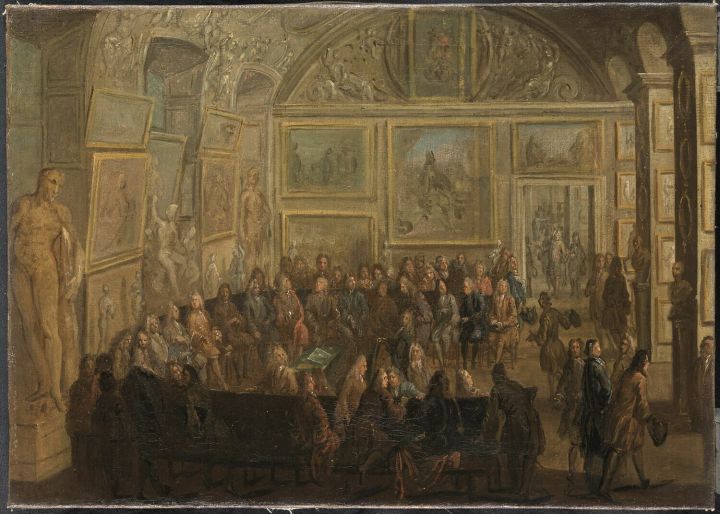
Jean-Baptiste Martin, View of the Salon of Diana at the Louvre, a Gathering of the Académie Royale de Peinture et de Sculpture (Séance de l’Académie royale de peinture et de sculpture au Louvre), ca. 1712–21, oil on canvas, 30 × 42 cm (Paris: Musée du Louvre, RF 1998-36).
◊ ◊ ◊ ◊ ◊
From ArtHist.net:
The Académie Royale Art Collection
Edited by Markus Castor, Sofya Dmitrieva, and Anne Klammt
Proposals due by 30 September 2022; selected contributions will be due 31 March 2023
Our book aspires to highlight the importance of the art collection that the Académie royale de peinture et de sculpture assembled in the century and a half of its existence (1648–1793) and show that this unique, yet almost entirely unstudied, body of works is essential to our understanding of eighteenth-century art and institutional practices.
The Académie royale art collection consisted mainly of reception pieces—the works that young artists submitted for examination by the academic jury to become full members of the institution. It also included miscellaneous donated artworks as well as portraits of the Académie’s patrons that the institution frequently commissioned from current members. Around 300 paintings and some 30 sculptures were on display in the Académie’s rooms at the Louvre and daily surrounded the artists who lived and worked there. The latter could also consult a rich collection of engravings at the Académie’s print room.
The collection was a unique corpus for multiple reasons. Firstly, as almost all the prominent old regime artists were members of the Académie royale, it united such iconic reception pieces as Watteau’s Pilgrimage to the Isle of Cythera (1717), Chardin’s Ray (1728), and Greuze’s Septimius Severus and Caracalla (1769). Secondly, these and other examinational works now offer invaluable insights into academic reception practices and aesthetic values as much as the commissioned portraits of the Académie’s patrons—into its behind-the-scenes personal networks. Finally, the hang of the works in the Louvre is an outstanding example of eighteenth-century curatorial work: since the collection’s arrangement was decided upon by academicians themselves, it stands an important ‘internal’ counterpart to the Académie’s public display, the Salons.
After the French Revolution, this one-of-a-kind body of works got dispersed and is shared today by the Louvre, the Versailles, the ENSBA, and several French regional museums. Thankfully, however, two detailed descriptions are still extant: in 1715, when the collection was housed on the Louvre’s ground floor, it was documented by Nicolas Guérin (Paris: J. Collombat), and in 1781, when it moved to the first floor, it was recorded by Antoine-Nicolas Dezallier d’Argenville (Paris: De Bure). In 1893, the two descriptions were republished as one volume by Anatole de Montaiglon. Two key critical works on the collection are the exhibition catalogue Les peintres du roi, 1648–1793 (Paris: Réunion des musées nationaux, 2000) and Hannah Williams’s monograph Académie Royale: A History in Portraits (Farnham: Ashgate, 2015).
The present book is part of the project run by the DFK Paris in collaboration with the Centre Dominique-Vivant Denon (Louvre) and the INHA that aspires to reconstruct the collection digitally and build a database of the works that constituted it.
We invite contributions that define the role of the Académie royale art collection and discuss its history and arrangement. Issues of our interest include but are not limited to:
• Collection arrangement: How did the hangs of the collection on the first and the ground floor of the Louvre differ? What were the guiding principles of the collection’s arrangement? What role did genre play in it? What was the function of different rooms and how did the works adorning the room reflect it? Did the arrangement reflect the Académie’s institutional hierarchy? How did prints, sculptures, and paintings that formed the collection work together?
• Instructive function of the collection: How did these sculptures, paintings, and prints, seen by the Académie’s students on day-to-day basis, influence their work? What message (if any) did they convey?
• Reception pieces: What role did the reception play in the artist’s career? What was the canon of academic reception pieces? How did it help crystallise the academic genre classification?
• Commissioned portraits: Who were the Académie’s patrons whose portraits the institution commissioned from its members? What role did these patrons play in the history of the Académie royale? How were they related to each other and what was their specific interest in sponsoring the institution?
• Conférences de l’Académie royale: How do the lectures that the members regularly delivered at the Académie royale relate to the collection? How do both reflect the Académie’s institutional and aesthetic values? What is the significance of the Salle d’Assemblée as the centre of the institutional life of the Académie royale?
• Dispersal of the collection: How were the works constituting the collection distributed after the French Revolution? What were the unique stories of these paintings, prints, and sculptures post-1793?
Contributions are welcome in English or French and are expected to be between 5,000 and 15,000 words in length. If you are interested, please send a short 300-word abstract and a brief 50-word biography to Sofya Dmitrieva sofya.k.dmitrieva@gmail.com by 30 September 2022. The deadline for selected contributions will be 31 March 2023.
◊ ◊ ◊ ◊ ◊
Note (added 12 August 2022) — The posting has been updated to include the editors and the painting by Jean-Baptiste Martin (from the PDF file of the Call for Essays)










 Enfilade
leave a comment