New Book | Money and Materiality in the Golden Age of Graphic Satire
From the University of Delaware Press:
Amanda Lahikainen, Money and Materiality in the Golden Age of Graphic Satire (Newark: University of Delaware Press, 2022), 234 pages, ISBN: 978-1644532690 (cloth), $120 / ISBN: 978-1644532683 (paperback), $35.
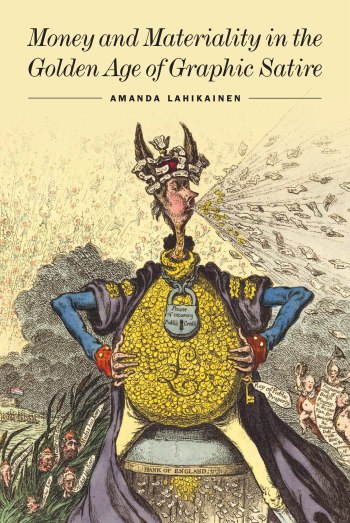 This book examines the entwined and simultaneous rise of graphic satire and cultures of paper money in late eighteenth- and early nineteenth-century Britain. Asking how Britons learned to value both graphic art and money, the book makes surprising connections between two types of engraved images that grew in popularity and influence during this time. Graphic satire grew in visual risk-taking, while paper money became a more standard carrier of financial value, courting controversy as a medium, moral problem, and factor in inflation. Through analysis of satirical prints, as well as case studies of monetary satires beyond London, this book demonstrates several key ways that cultures attach value to printed paper, accepting it as social reality and institutional fact. Thus, satirical banknotes were objects that broke down the distinction between paper money and graphic satire altogether.
Amanda Lahikainen is the executive director of the Ogunquit Museum of American Art in Ogunquit, Maine. Prior to joining OMAA, she served as an associate professor of art history and chairperson of the art department at Aquinas College in Grand Rapids, Michigan.
C O N T E N T S
Acknowledgments
List of Tables and Figures
Introduction: The Inflation of Georgian Graphic Satire
1 Money, Fact, and Value
2 Crisis
3 Subjectivity and Trust
4 Imitation and Immateriality
5 Materiality
6 The Deflation of Georgian Graphic Satire
Epilogue: Beyond Britain
Notes
Bibliography
Index
New Book | Enjoying Claret in Georgian Ireland
From Four Courts Press:
Patricia McCarthy, Enjoying Claret in Georgian Ireland: A History of Amiable Excess (Dublin: Four Courts Press, 2022), 224 pages, ISBN: 978-1801510134, €40.
 This book looks at Ireland’s love affair with claret, which began in earnest with the establishment of Irish families in the wine trade in Bordeaux in the early eighteenth century. So much red wine from Bordeaux was being consumed by Ireland’s nobility and gentry that Jonathan Swift referred to it as ‘Irish wine’, in the full knowledge that his correspondent would understand that he meant claret. One writer observed that ‘drinking had become so fashionable, that gentlemen competed eagerly to have the largest cellar and spend the most on hogsheads of wine every year’, and claret was the wine of choice. At Dublin Castle the amount of wine consumed was prodigious: it was acknowledged by all that balls, dinners and the contents of the Castle’s cellars played a major part in the popularity of the lord lieutenant and indeed resulted in the premature death of one. Not surprisingly, gout—referred to as ‘the Irish hospitality’ by one observer—was rampant and some of the rather bizarre ‘cures’ suggested are discussed. The book deals with questions such as how was the domestic wine cellar planned and used? When did connoisseurship in wine commence? What was the role of the merchant, apart from providing the wine? On the domestic front, to what lengths did men go in purchasing the many fashionable wine accoutrements used in the traditionally ‘male’ dining room? Why did ‘toasts’ figure so prominently, not just at dinner parties in mixed company, but particularly among male groups in clubs and associations? The ‘Irish Wine’ trade fostered not only a reputation for excessive conviviality, but created a healthy profit for its merchant importers.
Patricia McCarthy is an architectural historian and author of ‘A Favourite Study’ Building the King’s Inns (Dublin, 2006), and Life in the Country House in Georgian Ireland (Yale University Press, 2016).
New Book | The Overseas Trade of British America
From Yale UP:
Thomas Truxes, The Overseas Trade of British America: A Narrative History (New Haven: Yale University Press, 2022), 464 pages, ISBN: 978-0300159882, $40.
 A sweeping history of early American trade and the foundation of the American economy
In a single, readily digestible, coherent narrative, historian Thomas M. Truxes presents the three hundred–year history of the overseas trade of British America. Born from seeds planted in Tudor England in the sixteenth century, Atlantic trade allowed the initial survival, economic expansion, and later prosperity of British America, and brought vastly different geographical regions, each with a distinctive identity and economic structure, into a single fabric. Truxes shows how colonial American prosperity was only possible because of the labor of enslaved Africans, how the colonial economy became dependent on free and open markets, and how the young United States owed its survival in the struggle of the American Revolution to Atlantic trade.
Thomas M. Truxes is Clinical Professor of Irish Studies and History at New York University. He is the author of Irish-American Trade, 1660–1783 and Defying Empire: Trading with the Enemy in Colonial New York, among other books.
C O N T E N T S
Preface
A Note on the Text
Introduction
1 Tudor Beginnings, 1485–1603
2 Emergence, 1603–1650
3 Shaping Atlantic Commerce, 1650–1696
4 Engines of Opportunity, 1696–1733
5 Testing the Limits of Empire, 1733–1763
6 Crisis, 1763–1773
7 Trade and Revolution, 1773–1783
Epilogue: The Empress at Sea
Conclusion
Appendix 1: The Balance of Payments of British America
Appendix 2: Statistical Tables
List of Abbreviations and Short Titles
Notes
Index
New Book | African Founders
From Simon & Schuster:
David Hackett Fischer, African Founders: How Enslaved People Expanded American Ideals (New York: Simon & Schuster, 2022), 960 pages, ISBN: 978-1982145095, $40.
 In this sweeping, foundational work, Pulitzer Prize–winning historian David Hackett Fischer draws on extensive research to show how enslaved Africans and their descendants enlarged American ideas of freedom in varying ways in different regions of the early United States.
African Founders explores the little-known history of how enslaved people from different regions of Africa interacted with colonists of European origins to create new regional cultures in the colonial United States. The Africans brought with them linguistic skills, novel techniques of animal husbandry and farming, and generations-old ethical principles, among other attributes. This startling history reveals how much our country was shaped by these African influences in its early years, producing a new, distinctly American culture. Drawing on decades of research, some of it in western Africa, Fischer recreates the diverse regional life that shaped the early American republic. He shows that there were varieties of slavery in America and varieties of new American culture, from Puritan New England to Dutch New York, Quaker Pennsylvania, cavalier Virginia, coastal Carolina, and Louisiana and Texas. This landmark work of history will transform our understanding of America’s origins.
David Hackett Fischer is a University Professor and Warren Professor of History emeritus at Brandeis University in Waltham, Massachusetts. He is the author of numerous books, including the 2005 Pulitzer Prize winner Washington’s Crossing and Champlain’s Dream. In 2015, he received the Pritzker Literature Award for Lifetime Achievement in Military Writing.
New Book | The Fountain of Latona
From Penn Press:
Thomas Hedin, The Fountain of Latona: Louis XIV, Charles Le Brun, and the Gardens of Versailles (Philadelphia: University of Pennsylvania Press, 2022), 296 pages, ISBN: 978-0812253757, $70.
 Ovid tells the story of Latona, the mother by Jupiter of Apollo and Diana. In her flight from the jealous Juno, she arrives faint and parched on the coast of Asia Minor. Kneeling to sip from a pond, Latona is met by the local peasants, who not only deny her effort but muddy the water in pure malice. Enraged, Latona calls a curse down upon the stingy peasants, turning them to frogs.
In his masterful study, Thomas Hedin reveals how and why a fountain of this strange legend was installed in the heart of Versailles in the 1660s, the inaugural decade of Louis XIV’s patronage there. The natural supply of water was scarce and unwieldy, and it took the genius of the king’s hydraulic engineers, working in partnership with the landscape architect André Le Nôtre, to exploit it. If Ovid’s peasants were punished for their stubborn denial of water, so too the obstacles of coarse nature at Versailles were conquered; the aquatic iconography of the fountain was equivalent to the aquatic reality of the gardens.
Latona was designed by Charles Le Brun, the most powerful artist at the court of Louis XIV, and carried out by Gaspard and Balthazar Marsy. The 1660s were rich in artistic theory in France, and the artists of the fountain delivered substantial lectures at the Académie royale de peinture et de sculpture on subjects of central concern to their current work. What they professed was what they were visualizing in the gardens. As such, the fountain is an insider’s guide to the leading artistic ideals of the moment.
Louis XIV was viewed as the reincarnation of Apollo, the god of creativity, the inspiration of artists and scientists. Hedin’s original argument is that Latona was a double declaration: a glorification of the king and a proud manifesto by artists.
Thomas F. Hedin is Emeritus Professor of Art History at the University of Minnesota Duluth. He is the author, with Robert W. Berger, of Diplomatic Tours in the Gardens of Versailles, also published by University of Pennsylvania Press.
C O N T E N T S
Acknowledgments
Note on Measurements
List of Illustrations
Prologue
1 Foundations
2 Fountains in Context
3 Original State
4 Visual Narrative
5 Latona Group
6 Lycean Peasants
7 Panegyric and Manifesto
Epilogue
Appendix A: Execution of the Fountain
Appendix B: Mansart’s Marble Cone
Appendix C: Marsy’s Lecture of 7 December 1669
Appendix D: Nathan Whitman’s ‘Fronde Thesis’
Appendix E: Translations of Ovid
Appendix F: Elaborations of the Western Axis, Briefly
List of Abbreviations
Notes
Bibliography
Index
Illustrations follow page 90
New Book | Carrying All before Her
From the University of Delaware Press:
Chelsea Phillips, Carrying All before Her: Celebrity Pregnancy and the London Stage, 1689–1800 (Newark: University of Delaware Press, 2022), 304 pages, ISBN: 978-1644532492, $120 / ISBN: 978-1644532485, $35.
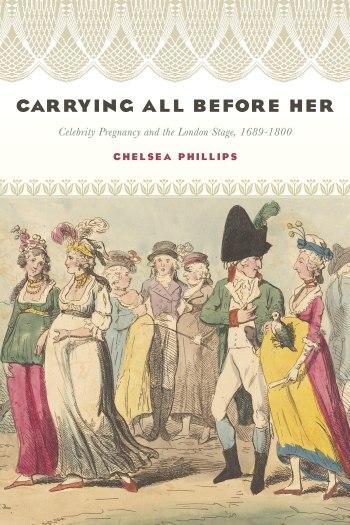 The rise of celebrity stage actresses in the long eighteenth century created a class of women who worked in the public sphere while facing considerable scrutiny about their offstage lives. Such powerful celebrity women used the cultural and affective significance of their reproductive bodies to leverage audience support and interest to advance their careers, and eighteenth-century London patent theatres even capitalized on their pregnancies. Carrying All Before Her uses the reproductive histories of six celebrity women—Susanna Mountfort Verbruggen, Anne Oldfield, Susannah Cibber, George Anne Bellamy, Sarah Siddons, and Dorothy Jordan—to demonstrate that pregnancy affected celebrity identity, impacted audience reception and interpretation of performance, changed company repertory and altered company hierarchy, influenced the development and performance of new plays, and had substantial economic consequences for both women and the companies for which they worked. Deepening the fields of celebrity, theatre, and women’s studies, as well as social and medical histories, Phillips reveals an untapped history whose relevance and impact persists today.
Chelsea Phillips is an associate professor of theatre at Villanova University in Pennsylvania.
C O N T E N T S
Figures
Acknowledgments
Introduction
1 Inheriting Greatness: Susanna Mountfort Verbruggen and Anne Oldfield
2 Pregnant Sensibility: Susannah Cibber and George Anne Bellamy
3 Conceiving Genius: Sarah Siddons
4 Prolific Muse: Dorothy Jordan
Conclusion: Celebrity Pregnancy, Then and Now
Appendix: Birth and Christening Dates
Notes
Bibliography
Index
New Book | Celebrity across the Channel, 1750–1850
From the University of Delaware Press:
Anaïs Pédron and Clare Siviter, eds., Celebrity across the Channel, 1750–1850 (Newark: University of Delaware Press, 2021), 336 pages, ISBN: 978-1644532126, $120 / ISBN: 978-1644532133, $35.
 Celebrity across the Channel, 1750–1850 is the first book to study and compare the concept of celebrity in France and Britain from 1750 to 1850 as the two countries transformed into the states we recognize today. It offers a transnational perspective by placing in dialogue the growing fields of celebrity studies in the two countries, especially by engaging with Antoine Lilti’s seminal work, The Invention of Celebrity, translated into English in 2017.
With contributions from a diverse range of scholarly cultures, the volume has a firmly interdisciplinary scope over the time period 1750 to 1850, which was an era marked by social, political, and cultural upheaval. Bringing together the fields of history, politics, literature, theater studies, and musicology, the volume employs a firmly interdisciplinary scope to explore an era marked by social, political, and cultural upheaval. The organization of the collection allows for new readings of the similarities and differences in the understanding of celebrity in Britain and France. Consequently, the volume builds upon the questions that are currently at the heart of celebrity studies.
Anaïs Pédron is an independent scholar based in London, England. She has recently published the article “‘Nous aussi nous sommes citoyennes’: Female Activism during the French Revolution” in Women in French Studies (special issue 2019) and the chapter “Olympe de Gouges, anti-esclavagiste et anticolonialiste?” in Les Lumières, l’esclavage et l’idéologie coloniale: XVIIIe–XIXe siècle (2020), edited by Pascale Pellerin.
Clare Siviter is a theater historian of the longer French Revolutionary period and is lecturer in French Theatre at the University of Bristol. She is the author of Tragedy and Nation in the Age of Napoleon.
C O N T E N T S
List of Illustrations
Antoine Lilti, Preface
Anaïs Pédron and Clare Siviter, Introduction
Section I: Theorizing Celebrity
1 Chris Haffenden, ‘Immortality in This World’: Reconfiguring Celebrity and Monument in the Romantic Period
2 Blake Smith, The Scholar as Celebrity: Anquetil-Duperron’s Discours Préliminaire
3 Meagan Mason, The Physiognomies of Virtuosi in Paris, 1830–1848
Section II: Representing Celebrity
4 Anna Senkiw, ‘To Perdition’: Politicians, Players, and the Press
5 Anaïs Pédron, Clairon’s Strategies to Achieve Celebrity and Glory
6 Miranda Kiek, Celebrity—Thou Art Translated! Corinne in England
7 Clare Siviter, Celebrity across Borders: The Chevalier d’Eon
Section III: Inheriting Celebrity
8 Emrys D. Jones: ‘Knowing My Family’: Dynastic Recognition in Eighteenth-Century Celebrity Culture
9 Gabriel Wick, Princes of the Public Sphere: Visibility, Performance, and Princely Political Activism, 1771–1774
10 Ariane Viktoria Fichtl, Ancient Parallels to Eighteenth-Century Concepts of Celebrity
11 Laure Philip, The Celebrity, Reputation, and Glory of the Empire and Restoration France through the Lens of Adèle de Boigne’s Memoirs
Bibliography
About the Contributors
Conference | Portrait Miniatures
From the Tansey Miniatures Foundation and the conference programme:
Portrait Miniatures: Artists, Functions, and Collections
Celle Castle, Tansey Miniatures Foundation, Celle Castle (near Hanover), 9–11 September 2022
This conference will take place in conjunction with the seventh exhibition of the Tansey Miniatures Foundation and the publication of the accompanying catalogue Miniatures from the Time of Napoleon in the Tansey Collection. 23 speakers from 11 different countries will address a range of topics related to portrait miniatures:
• Individual miniaturists, specific workshop contexts, and places of production
• Use and functions of both court and private types and their protagonists
• Iconographic aspects in the context of representation or intimacy
• Evolution of techniques and materials
• Private and public collections
The conference will be in English. The presentations will subsequently be published in a richly illustrated book. Admission is free. Both conference venues are within walking distance (20 minutes) from the railway station. Trains from Hannover take approximately 25 to 45 minutes (Deutsche Bahn, Metronom, and S-Bahn). For registration, please contact Juliane Schmieglitz-Otten, The Tansey Miniatures Foundation, juliane.schmieglitz-otten@tansey-miniatures.com. For more information, please contact Bernd Pappe, The Tansey Miniatures Foundation, bernd.pappe@tansey-miniatures.com.
F R I D A Y , 9 S E P T E M B E R 2 0 2 2
16.00 Registration
18.00 Welcome and Opening Lectures
• Juliane Schmieglitz-Otten, Realism and Modernism in the Likenesses of a New Epoch: Highlights of the Exhibition Miniatures from the Time of Napoleon
• Bernd Pappe, Making a Small Man Great: Miniatures of Napoleon I
• Birgitt Schmedding, Two Views: The Power of Seeing
S A T U R D A Y , 1 0 S E P T E M B E R 2 0 2 2
9.00 Objects, Agencies, and Social Practices
• Gerrit Walczak (Berlin), Icons of Intimacy: Sex, Agency, and the Portrait Miniature
• André and Anne-Marie Regnard-Denis (Belgium), Gestures and Their Meaning in Portrait Miniatures
• Karin Schrader (Bad Nauheim), ‘Telling Objects’: Miniatures in 18th-Century Courtly Portraits
• Lea C. Stephenson (Philadelphia), Racial Capital: Peter Marié’s Miniatures and Gilded Age Whiteness
• Jann Matlock (London), The Museum of Lost Portraits: Paris, 1794–1805
• Damiët Schneeweisz (London), Shipped, Worn, or Carried: Portrait Miniatures in the Atlantic Ocean World
13.00 Lunch
14.15 Politics and Representation
• Juliane Schmieglitz-Otten (Celle), Pictorial Family Ties: Series of Portrait Miniatures Serving Political Networks
• Martin Miersch (Ulm), Fashion and Political Statement: Portrait Miniatures from the Time of the French Revolution
• Maxime Charron (Paris), Examples of Intimate Portraits from the Royal and Imperial Courts of France during the First Half of the 19th Century
• Agnieszka Fulińska (Krakow), A Reputed Portrait Miniature of the King of Rome and Images of Children from Napoleon’s Entourage
• Marina Vidas (Copenhagen), Portrait Miniatures Set in Jewellery and Objects of Personal Adornment Connected to Queen Louise of Denmark and Her Daughter, Maria Feodorovna, Empress of Russia
17.30 Special Techniques and Materials
• David Hradil, Janka Hradilová, and Olga Trmalová (Prague), Benefits of Non-Invasive Macro X-Ray Fluorescence Scanning for the Analysis of Materials in Portrait Miniatures
S U N D A Y , 1 1 S E P T E M B E R 2 0 2 2
9.00 Special Techniques and Materials
• Christine Slottved Kimbriel, Paola Ricciardi, and Flavia Fiorillo (London), Unlocking the English Portrait Miniature: The Materiality of Isaac Oliver’s Oeuvre
• Alan Derbyshire and Lucia Burgio (London), The William Wood Manuscripts
10.00 Miniature Painters
• Martin Spies (Giessen), In Search of Charles Townley, Painter of Miniatures and Engraver to the King of Prussia
• Luise Schreiber Knaus and Peter Knaus (Bodelshausen), The Miniature Painter Jeremiah Meyer: His Life and Career during the Reign of King George III
• Sonja Remensberger (Winterthur), Pierre-Louis Bouvier (1765–1836): Life and Work of a Geneva Miniature Painter whilst Working Abroad
• Nathalie Lemoine-Bouchard (Paris), Ambroise Charlemagne Victor Le Chenetier: When a 19th-Century Artist Hides Another One
13.00 Lunch
14.15 Collections of Portrait Miniatures
• Stephen Lloyd (Liverpool), Horace Walpole’s Recently Discovered Plan for Displaying His Miniatures and Enamels in the Cabinet of the Tribuna at Strawberry Hill
• Maria Dunina (Moscow), The Collection of Miniatures of the State Pushkin Museum of Fine Arts, Moscow
• Tatiana Udras (Moscow), Portrait Miniatures of the Romanoff Family in Russian and Foreign Collections
• Cecilia Rönnerstam (Stockholm), On Origins and Originals: The History of a Collection
• Blythe Sobol (Kansas City), An Outsized Passion for Miniatures: The Starr Collection of Portrait Miniatures at the Nelson-Atkins Museum of Art
Exhibition | Miniatures from the Time of Napoleon
From the Tansey Miniatures Foundation:
Miniatures from the Time of Napoleon / Miniaturen der Zeit Napoleons
Tansey Miniatures Foundation, Bomann-Museum, Celle, from 26 June 2020
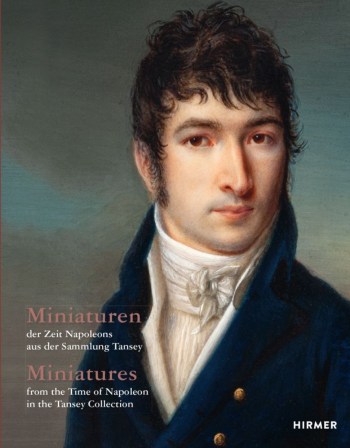 The Tansey miniatures, now held by the Bomann Museum in Celle, represent one of the most significant collections of European miniature paintings. This exhibition showcases a total of 150 works from the time of Napoleon I (1795–1815). These tiny portraits, which were generally intended for personal use, date from the ‘golden age’ of miniature painting. They exhibit a high degree of artistic skill and refined craftsmanship. Unlike the staged, theatrical portraits of absolutism, now for the first time we see realistic likenesses of people who appear ‘modern’—a gallery of women, men, and children from a period of political upheaval dominated by wars.
The accompanying bilingual catalogue (in German and English) provides comprehensive insight into the art of miniature painting in this magnificent era. Specialists have contributed detailed and richly illustrated introductory essays. This volume joins earlier entries in the series, exploring the collection in key periods and presenting new photographic reproductions of the miniatures at actual size.
Bernd Pappe and Juliane Schmieglitz-Otten, with photography by Birgitt Schmedding, Miniatures from the Time of Napoleon in the Tansey Collection (Munich: Hirmer Verlag, 2022), 452 pages, ISBN: 978-3777436098, €58 / $65.
New Book | America’s Philosopher
From The University of Chicago Press:
Claire Rydell Arcenas, America’s Philosopher: John Locke in American Intellectual Life (Chicago: The University of Chicago Press, 2022), 280 pages, ISBN: 978-0226638607, $35.
 America’s Philosopher examines how John Locke has been interpreted, reinterpreted, and misinterpreted over three centuries of American history.
The influence of polymath philosopher John Locke (1632–1704) can still be found in a dizzying range of fields, as his writings touch on issues of identity, republicanism, and the nature of knowledge itself. Claire Rydell Arcenas’s new book tells the story of Americans’ longstanding yet ever-mutable obsession with this English thinker’s ideas, a saga whose most recent manifestations have found the so-called Father of Liberalism held up as a right-wing icon.
The first book to detail Locke’s trans-Atlantic influence from the eighteenth century until today, America’s Philosopher shows how and why interpretations of his ideas have captivated Americans in ways few other philosophers—from any nation—ever have. As Arcenas makes clear, each generation has essentially remade Locke in its own image, taking inspiration and transmuting his ideas to suit the needs of the particular historical moment. Drawing from a host of vernacular sources to illuminate Locke’s often contradictory impact on American daily and intellectual life from before the Revolutionary War to the present, Arcenas delivers a pathbreaking work in the history of ideas.
Claire Rydell Arcenas is assistant professor of history at the University of Montana.
C O N T E N T S
Preface
1 Locke’s Legacy in Early America
2 Locke’s Authority in the Revolutionary and Founding Eras
3 Problematizing Locke as Exemplar in the Early United States
4 Locke Becomes Historical
5 Making Locke Relevant
6 Locke and the Invention of the American Political Tradition
7 Lockean ‘-isms’
Epilogue
Acknowledgments
List of Abbreviations
Notes
Bibliography
Index










 Enfilade
leave a comment