New Books | Recent Biographies
If biographies are your summer thing, some possibilities . . .
Leo Damrosch, Adventurer: The Life and Times of Giacomo Casanova (New Haven: Yale University Press, 2022), 432 pages, ISBN: 978-0300248289, $35.
 A fast-paced narrative about the world-famous libertine Giacomo Casanova, from celebrated biographer Leo Damrosch
The life of the iconic libertine Giacomo Casanova (1725–1798) has never been told in the depth it deserves. An alluring representative of the Enlightenment’s shadowy underside, Casanova was an aspiring priest, an army officer, a fortune teller, a con man, a magus, a violinist, a mathematician, a Masonic master, an entrepreneur, a diplomat, a gambler, a spy—and the first to tell his own story. In his vivid autobiography Histoire de Ma Vie, he recorded at least a hundred and twenty love affairs, as well as dramatic sagas of duels, swindles, arrests, and escapes. He knew kings and an empress, Catherine the Great, and most of the famous writers of the time, including Voltaire and Benjamin Franklin.
Drawing on seldom used materials, including the original French and Italian primary sources, and probing deeply into the psychology, self-conceptions, and self-deceptions of one of the world’s most famous con men and seducers, Leo Damrosch offers a gripping, mature, and devastating account of an Enlightenment man, freed from the bounds of moral convictions.
Leo Damrosch is the Ernest Bernbaum Professor of Literature Emeritus at Harvard University. His many books include The Club: Johnson, Boswell, and the Friends Who Shaped an Age and Jonathan Swift: His Life and His World, winner of the National Book Critics Circle award and Pulitzer finalist for biography. He lives in Newton, MA.
◊ ◊ ◊ ◊ ◊
Tristram Hunt, The Radical Potter: The Life and Times of Josiah Wedgwood (Metropolitan Books, 2021), 352 pages, ISBN: 978-1250128348, $30.
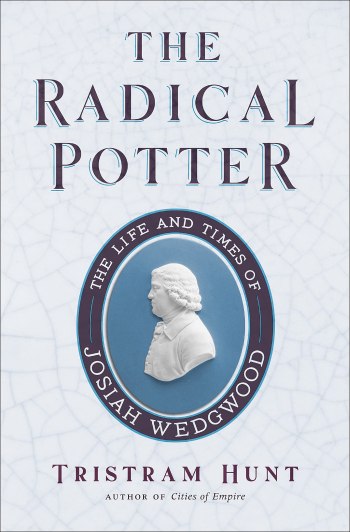 From one of Britain’s leading historians and the director of the Victoria & Albert Museum, a scintillating biography of Josiah Wedgwood, the celebrated eighteenth-century potter, entrepreneur, and abolitionist
Wedgwood’s pottery, such as his celebrated light-blue jasperware, is famous worldwide. Jane Austen bought it and wrote of it in her novels; Empress Catherine II of Russia ordered hundreds of pieces for her palace; British diplomats hauled it with them on their first-ever mission to Peking, audaciously planning to impress China with their china. But the life of Josiah Wedgwood is far richer than just his accomplishments in ceramics. He was a leader of the Industrial Revolution, a pioneering businessman, a cultural tastemaker, and a tireless scientific experimenter whose inventions made him a fellow of the Royal Society. He was also an ardent abolitionist, whose Emancipation Badge medallion—depicting an enslaved African and inscribed “Am I Not a Man and a Brother?”—became the most popular symbol of the antislavery movement on both sides of the Atlantic. And he did it all in the face of chronic disability and relentless pain: a childhood bout with smallpox eventually led to the amputation of his right leg.
As historian Tristram Hunt puts it in this lively, vivid biography, Wedgwood was the Steve Jobs of the eighteenth century: a difficult, brilliant, creative figure whose personal drive and extraordinary gifts changed the way we work and live. Drawing on a rich array of letters, journals, and historical documents, The Radical Potter brings us the story of a singular man, his dazzling contributions to design and innovation, and his remarkable global impact.
Tristram Hunt is the director of the Victoria & Albert Museum and one of Britain’s best-known historians. His previous books, which include Cities of Empire: The British Colonies and the Creation of the Urban World and Marx’s General: The Revolutionary Life of Friedrich Engels, have been published in more than a dozen languages. Until taking on the leadership of the V&A, he served as Member of Parliament for Stoke-on-Trent, the home of Wedgwood’s potteries. A senior lecturer in British history at Queen Mary University of London, he appears regularly on BBC radio and television.
◊ ◊ ◊ ◊ ◊
Catherine Ostler, The Duchess Countess: The Woman Who Scandalized Eighteenth-Century London (New York: Atria Books, 2022), 432 pages, ISBN: 978-1982179731, $30.
 As maid of honor to the Princess of Wales, Elizabeth Chudleigh (1721–1788) enjoyed a luxurious life in the inner circle of the Hanoverian court. With her extraordinary style and engaging wit, she both delighted and scandalized the press and public. She would later even inspire William Thackeray when he was writing his classic Vanity Fair, providing the inspiration for the alluring social climber Becky Sharp. But Elizabeth’s real story is more complex and surprising than anything out of fiction. A clandestine, candlelit wedding to the young heir to an earldom, a second marriage to a duke, a lust for diamonds, and an electrifying appearance at a masquerade ball in a gossamer dress—it’s no wonder that Elizabeth’s eventual trial was a sensation. Charged with bigamy, an accusation she vehemently fought against, Elizabeth refused to submit to public humiliation and retire quietly.
Catherine Ostler has been editor-in-chief of Tatler, the Evening Standard (London), and editor of The Times (London) Weekend Edition. She has also written for a wide range of publications, including Vogue, Daily Mail (London), and Newsweek. She read English at Oxford University, specializing in literature.
◊ ◊ ◊ ◊ ◊
Andrew Roberts, The Last King of America: The Misunderstood Reign of George III (New York: Viking, 2021), 784 pages, ISBN: 978-1984879264, $40. In the UK: George III: The Life and Reign of Britain’s Most Misunderstood Monarch.
 The last king of America, George III, has been ridiculed as a complete disaster who frittered away the colonies and went mad in his old age. The truth is much more nuanced and fascinating—and will completely change the way readers and historians view his reign and legacy.
Most Americans dismiss George III as a buffoon—a heartless and terrible monarch with few, if any, redeeming qualities. The best-known modern interpretation of him is Jonathan Groff’s preening, spitting, and pompous take in Hamilton, Lin-Manuel Miranda’s Broadway masterpiece. But this deeply unflattering characterization is rooted in the prejudiced and brilliantly persuasive opinions of eighteenth-century revolutionaries like Thomas Paine and Thomas Jefferson, who needed to make the king appear evil in order to achieve their own political aims. After combing through hundreds of thousands of pages of never-before-published correspondence, award-winning historian Andrew Roberts has uncovered the truth: George III was in fact a wise, humane, and even enlightened monarch who was beset by talented enemies, debilitating mental illness, incompetent ministers, and disastrous luck.
In The Last King of America, Roberts paints a deft and nuanced portrait of the much-maligned monarch and outlines his accomplishments, which have been almost universally forgotten. Two hundred and forty-five years after the end of George III’s American rule, it is time for Americans to look back on their last king with greater understanding: to see him as he was and to come to terms with the last time they were ruled by a monarch.
Andrew Roberts is the bestselling author of Churchill: Walking with Destiny; Leadership in War; The Storm of War: A New History of the Second World War; Masters and Commanders: How Four Titans Won the War in the West, 1941-1945; Waterloo: Napoleon’s Last Gamble; and Napoleon: A Life, winner of the Los Angeles Times Book Prize for biography and a finalist for the Plutarch Award. He has won many other prizes, including the Wolfson History Prize and the British Army Military Book of the Year. He is the Roger and Martha Mertz Visiting Fellow at the Hoover Institution at Stanford University, chair of the judges of the Gilder Lehrman Military History Prize, and a visiting professor in the Department of War Studies at King’s College, London.
◊ ◊ ◊ ◊ ◊
Anna Marie Roos, Martin Folkes (1690–1754): Newtonian, Antiquary, Connoisseur (Oxford: Oxford University Press, 2021), 432 pages, ISBN: 978-0198830061, $100.
 • First full-length biography of this eminent Enlightenment figure, mathematician, and protégé of Isaac Newton
• Contains the first complete analysis and reconstruction of the tragic life and career of Folkes’s wife, Drury Lane star Lucretia Bradshaw
• Features a novel analysis of the prints and drawings of William Hogarth with regard to the Royal Society, freemasonry, and coffeehouse culture
Martin Folkes (1690–1754): Newtonian, Antiquary, Connoisseur is a cultural and intellectual biography of the only President of both the Royal Society and the Society of Antiquaries. Sir Isaac Newton’s protégé, astronomer, mathematician, freemason, art connoisseur, Voltaire’s friend, and Hogarth’s patron, his was an intellectually vibrant world. Folkes was possibly the best-connected natural philosopher and antiquary of his age, an epitome of Enlightenment sociability, and yet he was a surprisingly neglected figure, the long shadow of Newton eclipsing his brilliant disciple.
Anna Marie Roos is a Professor of the History of Science and Medicine at the University of Lincoln.
New Books | Recent Historical Fiction
If historical fiction is your summer thing, some possibilities . . .
Jessie Burton, The House of Fortune (New York: Bloomsbury, 2022), 304 pages, ISBN: 978-1635579741, $28.
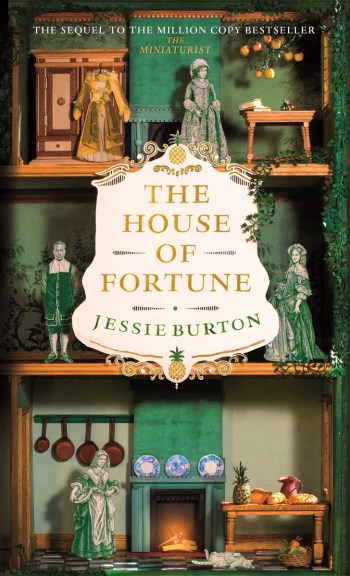 Alive with the magic of 18th-century Amsterdam, an enchanting, fantastical stand-alone companion novel to the sensational New York Times bestseller The Miniaturist, which has sold over two million copies worldwide.
Amsterdam in the year 1705. It is Thea Brandt’s eighteenth birthday. She is ready to welcome adulthood with open arms, but life at home is increasingly difficult. Her father Otto and her Aunt Nella argue endlessly over their financial fate, selling off furniture in a desperate attempt to hold on to the family home.
As catastrophe threatens to engulf the household, Thea seeks refuge in Amsterdam’s playhouses. She loves the performances, and the stolen moments afterwards are even better. In the backrooms of her favorite theater, Thea can spend a few precious minutes with her secret lover, Walter, the chief set-painter, a man adept at creating the perfect environments for comedies and tragedies to flourish. The thrill of their hidden romance offers Thea an exciting distraction from home. But it also puts her in mind of another secret that threatens to overwhelm the present: Thea knows her birthday marks the day her mother, Marin, died in labor. Thea’s family refuses to share the details of this story, just as they seem terrified to speak of ‘the miniaturist’—a shadowy figure from their past who is possessed of uncanny abilities to capture that which is hidden.
Aunt Nella believes the solution to all Thea’s problems is to find her a husband who will guarantee her future. An unexpected invitation to Amsterdam’s most exclusive ball seems like a golden opportunity. But when Thea finds, on her doorstep, a parcel containing a miniature figure of Walter, it becomes clear that someone out there has another fate in mind for the family . . . A feat of sweeping, magical storytelling, The House of Fortune is an unputdownable novel about love and obsession, family and loyalty, and the fantastic power of secrets.
Jessie Burton’s first novel, The Miniaturist, was a New York Times bestseller and was adapted into a PBS series, starring Anya Taylor-Joy. Jessie’s second novel, The Muse, was also a #1 international bestseller. Jessie has written essays and reviews for The New York Times and The Wall Street Journal. She lives in London.
◊ ◊ ◊ ◊ ◊
James Runcie, The Great Passion (London, Bloomsbury, 2022), 272 pages, ISBN: 978-1635570670, $28.
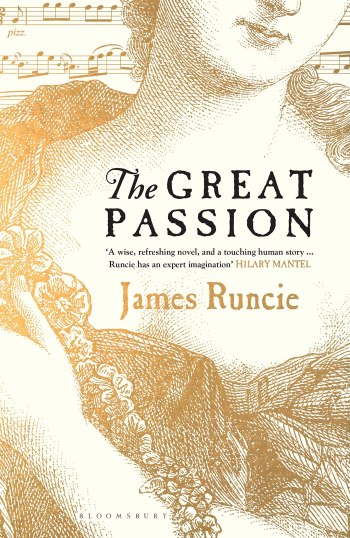 From acclaimed bestselling author James Runcie, a meditation on grief and music, told through the story of Bach’s writing of the St. Matthew Passion.
In 1727, Stefan Silbermann is a grief-stricken thirteen-year-old, struggling with the death of his mother and his removal to a school in distant Leipzig. Despite his father’s insistence that he try not to think of his mother too much, Stefan is haunted by her absence, and, to make matters worse, he’s bullied by his new classmates. But when the school’s cantor, Johann Sebastian Bach, takes notice of his new pupil’s beautiful singing voice and draws him from the choir to be a soloist, Stefan’s life is permanently changed.
Over the course of the next several months, and under Bach’s careful tutelage, Stefan’s musical skill progresses, and he is allowed to work as a copyist for Bach’s many musical works. But mainly, drawn into Bach’s family life and away from the cruelty in the dorms and the lonely hours of his mourning, Stefan begins to feel at home. When another tragedy strikes, this time in the Bach family, Stefan bears witness to the depths of grief, the horrors of death, the solace of religion, and the beauty that can spring from even the most profound losses.
Joyous, revelatory, and deeply moving, The Great Passion is an imaginative tour de force that tells the story of what it was like to sing, play, and hear Bach’s music for the very first time.
James Runcie is an award-winning film-maker, playwright and literary curator. He is the author of twelve novels that have been translated into twelve languages, including the seven books in the Grantchester Mysteries series. He has been Artistic Director of the Bath Literature Festival, Head of Literature and Spoken Word at the Southbank Centre, London, and Commissioning Editor for Arts on BBC Radio 4. He is a Fellow of the Royal Society of Literature. He lives in Scotland.
◊ ◊ ◊ ◊ ◊
Eva Stachniak, The School of Mirrors: A Novel (New York: William Morrow, 2022), 416 pages, ISBN: 978-0063119604, $17.
 A scintillating, gorgeously written historical novel about a mother and a daughter in eighteenth-century France, beginning with decadence and palace intrigue at Versailles and ending in an explosive new era of revolution.
During the reign of Louis XV, impoverished but lovely teenage girls from all over France are sent to a discreet villa in the town of Versailles. Overseen by the King’s favorite mistress, Madame de Pompadour, they will be trained as potential courtesans for the King. When the time is right, each girl is smuggled into the palace of Versailles, with its legendary Hall of Mirrors. There they meet a mysterious but splendidly dressed man who they’re told is merely a Polish count, a cousin of the Queen. Living an indulgent life of silk gowns, delicious meals, and soft beds, the students at this “school of mirrors” rarely ask questions, and when Louis tires of them, they are married off to minor aristocrats or allowed to retire to one of the more luxurious nunneries.
Beautiful and canny Veronique arrives at the school of mirrors and quickly becomes a favorite of the King. But when she discovers her lover’s true identity, she is whisked away, sent to give birth to a daughter in secret, and then to marry a wealthy Breton merchant. There is no return to the School of Mirrors.
This is also the story of the King’s daughter by Veronique—Marie-Louise. Well-provided for in a comfortable home, Marie-Louise has never known her mother, let alone her father. Capable and intelligent, she discovers a passion for healing and science, and becomes an accredited midwife, one of the few reputable careers for women like her. But eventually Veronique comes back into her daughter’s life, bringing with her the secret of Marie-Louise’s birth. But the new King—Louis XVI—is teetering on his throne and it’s a volatile time in France…and those with royal relatives must mind their step very carefully.
Eva Stachniak was born in Wroclaw, Poland. She moved to Canada in 1981 and has worked for Radio Canada International and Sheridan College, where she taught English and humanities. Her first novel of Catherine the Great, The Winter Palace was a #1 international bestseller and was followed by another Catherine the Great novel Empress of the Night, also a bestseller. She lives in Toronto.
Exhibition | Bernardo Bellotto at the Court of Saxony
From the Staatliche Kunstsammlungen Dresden:
Enchantingly Real: Bernardo Bellotto at the Court of Saxony
Zwinger, Gemäldegalerie Alte Meister, Dresden, 21 May — 28 August 2022
Royal Castle, Warsaw, 23 September 2022 — 8 January 2023
 Coinciding with the 300th anniversary of his birth, the Gemäldegalerie Alte Meister is holding a major monographic exhibition in celebration of the work of Venetian painter Bernardo Bellotto (1722–1780). The artist—who, like his uncle and teacher Antonio Canal, also called himself Canaletto—ranks as one of the most important 18th-century painters of city views or vedute. The Dresden retrospective is the culmination of a years-long conservation project and results from a cooperation with the Royal Castle in Warsaw. It features the Gemäldegalerie’s own collection of Bellotto’s paintings, itself the largest in the world.
The show presents Bellotto’s life and work by tracing the most important phases and milestones of his career. After formative years in Venice, he came to Dresden in 1747 and painted large-scale vedute for the Saxon elector and Polish king, Augustus III, as well as for his prime minister, Count Heinrich von Brühl. Bellotto’s paintings continue to offer unique insights into the architecture and life of the royal capital of Saxony as well as the nearby town of Pirna and the fortresses of Sonnenstein and Königstein. After working briefly at the courts of Vienna and Munich, in 1766 Bellotto took up residency in the royal city of Warsaw, painting numerous views of that city until his death in 1780.
Several etchings by the master present another side to Bellotto as printmaker and entrepreneur. The prints stem from Dresden’s Kupferstich-Kabinett, which boasts a remarkably complete collection of the artist’s printmaking oeuvre. Further enriched with drawings loaned from Warsaw and Darmstadt, the survey show reveals the range of Bellotto’s lively pictorial innovations. Also on view are books, porcelain objects, sculptures, and scientific instruments that together create a vivid snapshot of an era that Bellotto, as an artist, helped define.
Stephan Koja and Iris Yvonne Wagner, Zauber des Realen: Bernardo Bellotto am sächsischen Hof (Dresden: Staatliche Kunstsammlungen Dresden, 2022), 256 pages, ISBN: 978-3954986774, €48.
Exhibition | The Key to Life: 500 Years of Mechanical Amusement

From the press release (30 May 2022) from the Staatliche Kunstsammlungen Dresden:
The Key to Life: 500 Years of Mechanical Amusement
Kunsthalle im Lipsiusbau, Dresden, 3 June — 25 September 2022
Automatons, androids and robots—they now dominate our professional and private environments and are expressions of the human desire to create artificial life. The Mathematisch-Physikalischer Salon and the Museum für Sächsische Volkskunst and Puppentheatersammlung of Staatliche Kunstsammlungen Dresden (SKD) are presenting roughly 70 of these artefacts in the exhibition The Key to Life: 500 Years of Mechanical Amusement on view from 3 June to 25 September 2022 in the Kunsthalle im Lipsiusbau.
 For the first time, the SKD is showing the full range of its unique collection of mechanical figurines and amusements in one exhibition, supplementing them with constructions of artificial life. Beside the unique wealth of mechanical objects spanning from the Renaissance to the present day from the inventory of the Mathematisch-Physikalischer Salons, the Grünes Gewölbe, and the Puppentheatersammlung, the exhibition also features selected loans from the Bayerisches Nationalmuseum, the Maximilianmuseum in Augsburg, and the Roentgen-Museum Neuwied, among others. Through several exhibition chapters on the mechanical figurines and tableaux from the period around 1600, 18th-century-androids and mechanical amusements in the 19th century, to the nickelodeons and slot machines of the early 20th century and contemporary moving art, the exhibition showcases how the mechanical has fascinated people for 500 years.
The items on display include complicated mechanical tableaux from the late 16th century that feature not only agile figurines and playing drummers, but also movements on the tableau itself. A fur-covered bear beats its drum every hour on the hour. The replica ‘iron hand’ of knight Götz von Berlichingen is an excellent example of early modern prosthetics. Contemporary research is also represented: the prototype ‘mika²’ from Dresden University of Technology’s historical acoustic and phonetic collection is a mechanical simulation of the main parts of the human vocal tract, which was developed at the Chair of Speech Technology and Cognitive Systems. The exhibition’s interactive design allows visitors to bring the amusements to life themselves and understand their movements. There will be a varied program of tours and workshops, including some during the school holidays and the Dresden Night of Museums.
Peter Plaßmeyer, Hagen Schönrich and Igor A. Jenzen, eds., Der Schlüssel zum Leben: 500 Jahre mechanische Figurenautomaten (Dresden: Sandstein Verlag, 2022), 224 pages, ISBN: 978-3954986828, €38.
New Book | A Revolution on Canvas
Distributed by Yale UP:
Paris Spies-Gans, A Revolution on Canvas: The Rise of Women Artists in Britain and France, 1760–1830 (London: Paul Mellon Centre, 2022), 384 pages, ISBN: 978-1913107291, £45 / $55.
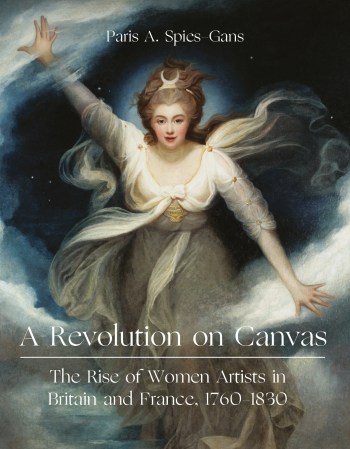 The first collective, critical historical study of women artists in Britain and France during the Revolutionary era
In the late eighteenth and early nineteenth centuries, hundreds of women in London and Paris became professional artists, exhibiting and selling their work in unprecedented numbers. Many rose to the top of their nations’ artistic spheres and earned substantial incomes from their work, regularly navigating institutional inequalities expressly designed to exclude members of their sex. In the first collective, critical history of women artists in Britain and France during the Revolutionary era, Paris Spies-Gans explores how they engaged with and influenced the mainstream cultural currents of their societies at pivotal moments of revolutionary change.
Through an interdisciplinary analysis of the experiences of these narrative painters, portraitists, sculptors, and draughtswomen, this book challenges longstanding assumptions about women in the history of art. Importantly, it demonstrates that women built profitable artistic careers by creating works in nearly every genre practiced by men, in similar proportions and to aesthetic acclaim. It also reveals that hundreds of women studied with male artists, and even learned to draw from the nude. Where traditional histories have left a void, this generously illustrated book illuminates a lively world of artistic production.
Featuring an extensive range of these artists’ paintings, drawings, sculptures, and writings, alongside contemporary prints, satires, and works by their male peers, A Revolution on Canvas transforms our understanding of the opportunities and identities of women artists of the past.
Paris A. Spies-Gans is a historian and an art historian. She has held fellowships at the Harvard Society of Fellows, the Paul Mellon Centre for Studies in British Art, the Getty Research Institute, the Lewis Walpole Library, and the Yale Center for British Art. Her research concentrates on the history of women, gender, and the politics of artistic expression.
◊ ◊ ◊ ◊ ◊
Note (added 17 January 2024) — As announced in January 2024, A Revolution on Canvas was awarded an HBA Book Prize, for a single-authored book with a subject between 1600 and 1800. It’s recognition to add to that which has already been heaped on the book by other organizations:
• Winner of the 2023 Stansky Book Prize, sponsored by NACBS
• Shortlisted for the 2023 Berger Prize, sponsored by The British Art Journal
• Received Honorable Mention from the Louis A. Gottschalk Prize, sponsored by ASECS
• Named one of the Top Art Books of 2022 by The Art Newspaper
• Named one of the Top Art Books of 2022 by The Conversation
New Book | Women Healers
From Penn Press:
Susan Brandt, Women Healers: Gender, Authority, and Medicine in Early Philadelphia (Philadelphia: University of Pennsylvania Press, 2022), 312 pages, ISBN: 978-0812253863, $40.
 In her eighteenth-century medical recipe manuscript, the Philadelphia healer Elizabeth Coates Paschall asserted her ingenuity and authority with the bold strokes of her pen. Paschall developed an extensive healing practice, consulted medical texts, and conducted experiments based on personal observations. As British North America’s premier city of medicine and science, Philadelphia offered Paschall a nurturing environment enriched by diverse healing cultures and the Quaker values of gender equality and women’s education. She participated in transatlantic medical and scientific networks with her friend, Benjamin Franklin. Paschall was not unique, however. Women Healers recovers numerous women of European, African, and Native American descent who provided the bulk of health care in the greater Philadelphia area for centuries.
Although the history of women practitioners often begins with the 1850 founding of Philadelphia’s Female Medical College, the first women’s medical school in the United States, these students merely continued the legacies of women like Paschall. Remarkably, though, the lives and work of early American female practitioners have gone largely unexplored. While some sources depict these women as amateurs whose influence declined, Susan Brandt documents women’s authoritative medical work that continued well into the nineteenth century. Spanning a century and a half, Women Healers traces the transmission of European women’s medical remedies to the Delaware Valley where they blended with African and Indigenous women’s practices, forming hybrid healing cultures.
Drawing on extensive archival research, Brandt demonstrates that women healers were not inflexible traditional practitioners destined to fall victim to the onward march of Enlightenment science, capitalism, and medical professionalization. Instead, women of various classes and ethnicities found new sources of healing authority, engaged in the consumer medical marketplace, and resisted physicians’ attempts to marginalize them. Brandt reveals that women healers participated actively in medical and scientific knowledge production and the transition to market capitalism.
Susan H. Brandt is a Lecturer in the Department of History at University of Colorado, Colorado Springs.
New Book | Patterns of Plague
From MQUP:
Lori Jones, Patterns of Plague: Changing Ideas about Plague in England and France, 1348–1750 (Montreal: McGill-Queens University Press, 2022), 408 pages, ISBN 978-0228010791 (hardcover), $130 / ISBN: 978-0228010807 (paperback), $40.
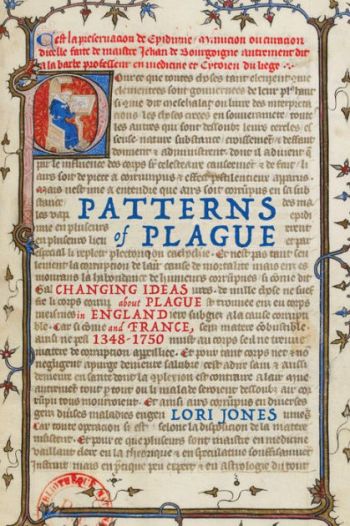 An innovative study of plague in medieval and early modern Europe reveals the changing perceptions surrounding epidemic disease over centuries and across national borders.
For centuries, recurrent plague outbreaks took a grim toll on populations across Europe and Asia. While medical interventions and treatments did not change significantly from the fourteenth century to the eighteenth century, understandings of where and how plague originated did. Through an innovative reading of medical advice literature produced in England and France, Patterns of Plague explores these changing perceptions across four centuries. When plague appeared in the Mediterranean region in 1348, physicians believed the epidemic’s timing and spread could be explained logically and the disease could be successfully treated. This confidence resulted in the widespread and long-term circulation of plague tracts, which described the causes and signs of the disease, offered advice for preventing infection, and recommended therapies in a largely consistent style. What, where, and especially who was blamed for plague outbreaks changed considerably, however, as political, religious, economic, intellectual, medical, and even publication circumstances evolved. Patterns of Plague sheds light on what was consistent about plague thinking and what was idiosyncratic to particular places and times, revealing the many factors that influence how people understand and respond to epidemic disease.
Lori Jones is a historian of medieval and early modern medicine at Carleton University and the University of Ottawa.
New Book | Rhetoric, Public Memory, and Campus History
From Clemson University Press in association with Liverpool University Press:
Rhondda Robinson Thomas, ed., Rhetoric, Public Memory, and Campus History (Clemson: Clemson University Press, 2022), 264 pages, ISBN: 978-1638040200, £95 / $130.
 This essay collection explores the inextricable link between rhetoric, public memory, and campus history projects. Since the early twentieth century after Brown University appointed its Steering Committee on Slavery and Justice, higher education institutions around the globe have launched initiatives to research, document, and share their connections to slavery and its legacies. Many of these explorations have led to investigations about the rhetorical nature of campus history projects, including the names of buildings, the installation of monuments, the publication of books, the production of resolutions, and the hosting of public programs. The essays in this collection examine the rhetorical nature of a range of initiatives, including the creation of land acknowledgement statements, the memorialization of universities’ historic financial ties to the slave trade, the installation and removal of monuments or historical markers, the development of curriculum for campus history projects. The book takes a chronological approach, beginning with the examination of a project at a university that was built on the site of a historic Native American town, moving through a series of essays about initiatives that grew out of universities’ associations with slavery and its legacies in the United Kingdom and America, and ending with a critique of several pedagological approaches in campus history courses designed for undergraduate students.
Rhondda Robinson Thomas is the Calhoun Lemon Professor of Literature at Clemson University where she teaches and researches early African American Literature. She is author of Call My Name, Clemson: Documenting the Black Experience in an American University Community and Faculty Director of the award-winning Call My Name Project for which she has received grants from the National Endowment for the Humanities. She has published articles and books with Cambridge University Press and Oxford University Press as well as in African American Review and American Literary History. She is also the research and community engagement coordinator for the Clemson’s Woodland Cemetery Project.
C O N T E N T S
Rhondda Robinson Thomas — Introduction: The Inextricable Link between Rhetoric and Remembrance in Campus History Projects
1 Andrew Denson — ‘Always Cherokee Land’: Campus History and Indigenous Placemaking in Western North Carolina
2 Stephen Mullen — Acknowledging the Legacies of Enslavement in British Universities: Slavery, Abolition, and the University of Glasgow
3 Christopher P. Lehman — Acknowledging Slavery’s Ties to Minnesota’s Public Universities through Historical Markers
4 Monet Lewis-Timmons — Beyond Kitty’s Cottage: The Double-Containment of Catherine ‘Miss Kitty’ Boyd and Black Commemoration Practices in Oxford, Georgia
5 Cecelia Moore — Reckoning with Silent Sam: The Confederate Monument at the University of North Carolina at Chapel Hill
6 Charles F. Irons — White Memory and White Violence at Elon University
7 Prithi Kanakamedala — ‘We Must Stand United’: Re-telling a Radical History of Bronx Community College at the City University of New York
8 Charissa Fryberger — Looking Racism in the Face at Clemson University
New Book | The Alchemy of Slavery: Human Bondage and Emancipation
First published in 2018 and now available in paperback from Penn Press:
M. Scott Heerman, The Alchemy of Slavery: Human Bondage and Emancipation in the Illinois Country, 1730–1865 (Philadelphia: University of Pennsylvania Press, 2022), 248 pages, ISBN: 978-0812225174 (paperback), $25.
 In this sweeping saga that spans empires, peoples, and nations, M. Scott Heerman chronicles the long history of slavery in the heart of the continent and traces its many iterations through law and social practice. Arguing that slavery had no fixed institutional form, Heerman traces practices of slavery through indigenous, French, and finally U.S. systems of captivity, inheritable slavery, lifelong indentureship, and the kidnapping of free people. By connecting the history of indigenous bondage to that of slavery and emancipation in the Atlantic world, Heerman shows how French, Spanish, and Native North American practices shaped the history of slavery in the United States.
The Alchemy of Slavery foregrounds the diverse and adaptable slaving practices that masters deployed to build a slave economy in the Upper Mississippi River Valley, attempting to outmaneuver their antislavery opponents. In time, a formidable cast of lawyers and antislavery activists set their sights on ending slavery in Illinois. Abraham Lincoln, Lyman Trumbull, Richard Yates, and many other future leaders of the Republican party partnered with African Americans to wage an extended campaign against slavery in the region. Across a century and a half, slavery’s nearly perpetual reinvention takes center stage: masters turning Indian captives into slaves, slaves into servants, former slaves into kidnapping victims; and enslaved people turning themselves into free men and women.
M. Scott Heerman is Associate Professor of History at the University of Miami.
C O N T E N T S
Introduction: Slavery and Freedom on the American Continent
1 Making the French Negroes
2 Another Law and Empire
3 Remaking the French Negroes
4 Contesting Bondage in the Slave North
5 Paths to Independence
6 Freedom Practices, Freedom Politics
Conclusion: North of Slavery, South of Freedom
Notes
Bibliography
Index
Acknowledgments
Print Quarterly, June 2022

Hippolyte Pochon, Du Courage ! En avant Marche (Courage, forward march!), 1815, hand-coloured etching, 23 × 31cm
(Paris, Bibliothèque Nationale)
◊ ◊ ◊ ◊ ◊
The long eighteenth century in the latest issue of Print Quarterly:
Print Quarterly 39.2 (June 2022)
Antony Griffiths, “The Publication of Caricatures in Paris in 1814 and 1815, Part II.”
Part II of Antony Griffiths’ article on “The Publication of Caricatures in Paris in 1814 and 1815” discusses the numerous new names, found only in these years, who deposited prints giving their surname and address. Most of these were the actual producers, and many of the most frequent names can be identified. The article turns to each of the main artists individually, many of whom were leading figures in the school of Jacques Louis David. They included Louis François Charon, Gautier, Charles François Gabriel Levachez, Pierre Audouin, Pierre Marie Bassompierre Gaston, Charles Marie Dubois-Maisonneuve, Pierre Lacroix, Louis Félix Legendre, Jean Jacques Théodore Sauvé, Desalle, Charles Elie, Michael Raphael Vautier and Hippolyte Pochon, whose work was particularly well-executed and imaginative.
The issue also includes these relevant reviews:
Johann Georg Edlinger (1741–1819)
Hans Jakob Meier, Review of Brigitte Huber, Georg Edlinger: Porträts ohne Schmeichelei (Munich: Hirmer Verlag, 2021), p. 194.
Dutch and Flemish Flower Pieces
Nadine Orenstein, Review of Sam Segal and Klara Alen, Dutch and Flemish Flower Pieces: Paintings, Drawings and Prints up to the Nineteenth Century (Leiden: Brill and Hes & De Graaf, 2020), p. 226.










 Enfilade
2 comments