New Book | Madame de Pompadour: Painted Pink
Forthcoming from Harvard Art Museums and distributed by Yale UP:
A. Cassandra Albinson, ed., Madame de Pompadour: Painted Pink (Cambridge: Harvard Art Museums, 2022), 88 pages, ISBN: 978-0300263817, $25.
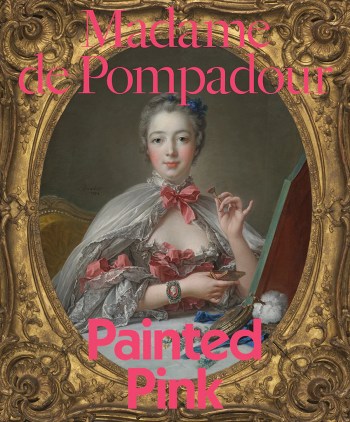 A fresh take on a beloved masterpiece of portraiture, focusing on the complex significance of the color pink in 18th-century France
François Boucher’s 1750 half-length portrait of Madame de Pompadour—influential court figure and mistress to King Louis XV—has been the subject of much art historical attention, particularly with regard to gender and representation. Building on that foundation, this volume turns toward an underappreciated aspect of the portrait: the use and significance of the color pink. Four scholarly essays, including one by noted Boucher expert Mark Ledbury, establish a framework that connects Pompadour’s fondness and promotion of the color, Boucher’s artistic association with the color, and developments in the material basis of the color, including its application in other media such as porcelain. This engaging close look offers new ways to understand the portrait, revealing its links to motherhood and sentiment, race and the transatlantic slave trade, and the crosscurrents of natural history and scientific discovery.
A. Cassandra Albinson is the Margaret S. Winthrop Curator of European Art and Head of the Division of European and American Art at the Harvard Art Museums. With additional contributions by Mark Ledbury, Power Professor of Art History and Visual Culture and director of the Power Institute at the University of Sydney; Gabriella Szalay, PhD candidate, Georg-August-Universität Göttingen, and 2018–20 Renke B. and Pamela M. Thye Curatorial Fellow in the Busch-Reisinger Museum, Harvard Art Museums; and Oliver Wunsch, Assistant Professor of Art History at Boston College and 2018–19 Maher Curatorial Fellow of American Art at the Harvard Art Museums.
New Book | Clothing the New World Church
From the University of Notre Dame Press:
Maya Stanfield-Mazzi, Clothing the New World Church: Liturgical Textiles of Spanish America, 1520–1820 (South Bend: University of Notre Dame Press, 2021), 400 pages, ISBN: 978-0268108052, $50.
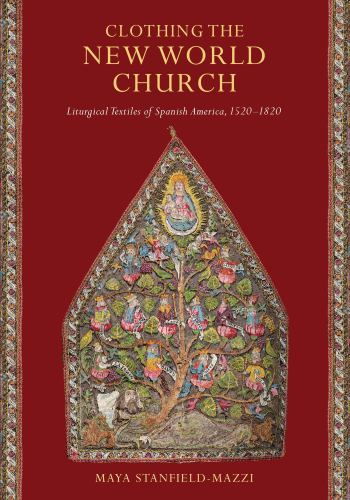 The first broad survey of church textiles of Spanish America, demonstrating that, while overlooked, textiles were a vital part of visual culture in the Catholic Church.
When Catholic churches were built in the New World in the sixteenth century, they were furnished with rich textiles known in Spanish as ‘church clothing’. These textile ornaments covered churches’ altars, stairs, floors, and walls. Vestments clothed priests and church attendants, and garments clothed statues of saints. The value attached to these textiles, their constant use, and their stunning visual qualities suggest that they played a much greater role in the creation of the Latin American Church than has been previously recognized. In Clothing the New World Church, Maya Stanfield-Mazzi provides the first comprehensive survey of church adornment with textiles, addressing how these works helped establish Christianity in Spanish America and expand it over four centuries. Including more than 180 photos, this book examines both imported and indigenous textiles used in the church, compiling works that are now scattered around the world and reconstructing their original contexts. Stanfield-Mazzi delves into the hybrid or mestizo qualities of these cloths and argues that when local weavers or embroiderers in the Americas created church textiles they did so consciously, with the understanding that they were creating a new church through their work.
The chapters are divided by textile type, including embroidery, featherwork, tapestry, painted cotton, and cotton lace. In the first chapter, on woven silk, we see how a ‘silk standard’ was established on the basis of priestly preferences for this imported cloth. The second chapter explains how Spanish-style embroidery was introduced in the New World and mastered by local artisans. The following chapters show that, in select times and places, spectacular local textile types were adapted for the church, reflecting ancestral aesthetic and ideological patterns. Clothing the New World Church makes a significant contribution to the fields of textile studies, art history, Church history, and Latin American studies, and to interdisciplinary scholarship on material culture and indigenous agency in the New World.
Maya Stanfield-Mazzi is an associate professor of art history at the University of Florida. She is the author of Object and Apparition: Envisioning the Christian Divine in the Colonial Andes.
The Burlington Magazine, May 2022
The eighteenth century in the May issue of The Burlington . . .
The Burlington Magazine 164 (May 2022)
 E D I T O R I A L
• “The Rustat Memorial,” p. 443.
When the statue of Edward Colston was defaced and thrown into Bristol harbour on 7th June 2020 the resulting publicity was so enormous that it seemed likely that a wholesale assault on memorials to men who took part in the slave trade or were racist would inevitably follow. In fact, remarkably little has happened. . . .
Little more has been done in the case of church monuments. . . . Only one such case is outstanding, an application by St Peter’s church, Dorchester, to move a late eighteenth-century wall memorial to the slave owner John Gordon from the church to Dorchester Museum. If such an application is contested the matter is referred to the judgment of a diocesan Chancellor in a Consistory Court. This was the result of the ecclesiastical case that has attracted most attention, the application by the Master and governing body of Jesus College, Cambridge, to remove the monument to Tobias Rustat (1608–94) from the college chapel, which was opposed by a group of former members of the college. The case was heard in February by David R. Hodge, Deputy Chancellor of the Diocese of Ely, who in March dismissed the application. Last month the college announced that it would not appeal against his decision. . .
A R T I C L E S
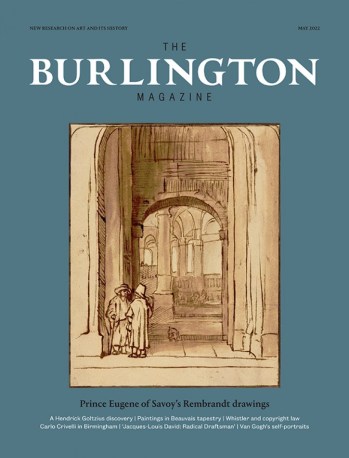
• Antoinette Friedenthal, “Prince Eugene of Savoy’s Rembrandt Drawings: A Newly Discovered Provenance,” pp. 450–61.
• Pascal-François Bertrand and Charissa Bremer David, “Paintings in Beauvais Tapestry, 1764–67,” pp. 462–72. In 1764, at a time when the Royal Tapestry Manufactory at Beauvais was short of work, its directors, Laurent and André Charlemagne Charron, initiated the weaving of small tapestry panels based on designs by François Boucher. Intended as inexpensive, independent works of art, they were in essence a short-lived marketing venture. Records of their weaving in the firm’s payment registers allow a number of surviving examples to be identified.
• Sofya Dmitrieva, “Carle Van Loo at the 1737 Salon,” pp. 473–77. Although not pendants in the traditional sense, since they were painted for different patrons, it is argued here that Carle Van Loo’s A Pasha Having His Mistress’s Portrait Painted and The Grand Turk Giving a Concert to His Mistress, shown at the Salon of 1737, were meant to be read as a pair|—as portraits of the artist and his wife and as allegories of Painting and Music. By linking the paintings, Van Loo, may have intended them to make a statement on the changing relations between art and patronage.
R E V I E W S
• Duncan Robinson, Review of Susan Sloman, Gainsborough in London (Modern Art Press, 2021), pp. 478–85.
• Satish Padiyar, Review of the exhibition Jacques-Louis David: Radical Draftsman (The Metropolitan Museum of Art, 2022), pp. 492–95.
• Kee Il Choi, Jr., Review of the exhibition Inspiring Walt Disney: The Animation of French Decorative Arts (The Metropolitan Museum of Art, The Wallace Collection, and The Huntington, 2022–23), pp. 504–07.
• Camilla Pietrabissa, Review of the re-installation of seventeenth- and eighteenth-century Venetian paintings at the Gallerie dell’Accademia in Venice (from August 2021), pp. 507–09.
• Stefania Girometti, Review of Joachim Jacoby, Städels Erbe: Meisterzeichnungen aus der Sammlung des Stifters (Sandstein Verlag, 2020), pp. 529–30. Comprehensive analysis of “the collection of drawings assembled by Johann Friedrich S (1728–1816), the founder of the art institute and museum in Frankfurt that bears his name.”
• Christoph Martin Vogtherr, Review of the exhibition catalogue Watteau at Work: La Surprise (Getty, 2021), pp. 530–31.
• Hugo Chapman, Review of Cristiana Romalli, Cento Disegni dalla Collezione della Fondazione Marco Brunelli (Ugo Bozzi, 2020), pp. 531–32.
New Book | Survey: Architecture Iconographies
Distributed by The University of Chicago Press:
Matthew Wells, Survey: Architecture Iconographies, edited by Sarah Handelman (Zurich: Park Books, 2021), 176 pages, ISBN: 978-3038602507, $50.
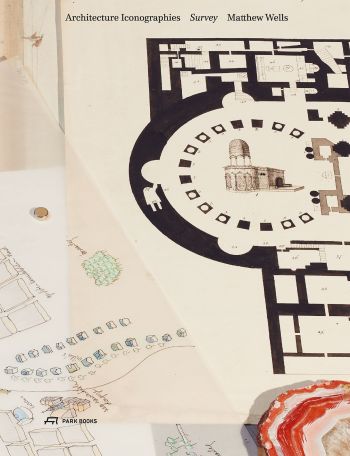 An exploration of the history and significance of the architectural survey drawing through focused studies on John Soane, Charles Robert Cockerell, Detmar Blow, Louis-Hippolyte Lebas, Henri Labrouste, Eugène Viollet-le-Duc, and Peter Märkli.
When architects visit a building and want to record or identify what they see, they take out a bundle of folded sheets in search of a blank piece of paper. These sheets may be ground plans, diagrams, sketches, or ordnance maps. In one way or another, all are survey drawings, operating as both documentation and analysis, enabling an architect to examine certain conditions of the built environment, whether geometric, relational, material, or technical.
This book explores the history of the survey and its multiple forms in order to understand how the methods of recording what already exists can also be used to imagine what might be. Lavishly illustrated, with works from the collection of Drawing Matter and beyond, it addresses the multiple forms of the survey through focused studies—on John Soane (1753–1837), Charles Robert Cockerell (1788–1863), and Detmar Blow (1867–1939); French architects Louis-Hippolyte Lebas (1782–1867), Henri Labrouste (1801–75), and Eugène Viollet-le-Duc (1814–79); and Swiss-based Peter Märkli (born 1953)—and an extensive section of plates with commentaries by contemporary architects. In doing so, it maintains that while all surveys begin with the site, the outcomes are as idiosyncratic as their authors—and their methods have much to offer as tools in design practice.
Survey is the first volume of Architecture Iconographies, a series that considers architecture through its typologies and unique approaches to drawing, aiming to open up further possibilities for their contemporary use in design and teaching. The series is published in collaboration with Drawing Matter, based in Somerset, England, which is committed to exploring the role of drawing in architectural thought and practice.
Matthew Wells is a lecturer and postdoc researcher at ETH Zurich’s Institute for the History and Theory of Architecture. The focus of his research and writing is on representational techniques, environmental technologies, and professionalism in the built environment of the 19th and 20th centuries.
Online Talk | Disaster on the Spanish Main
From the Fraunces Tavern Museum:
Craig S. Chapman, The American Experience in the West Indies, 1740–42
Online, Fraunces Tavern Museum, New York, Thursday, 16 June 2022, 6.30pm (ET)
 Thirty-five years before the battles of Lexington and Concord, the British colonies in North America raised a regiment to serve in the British Army for an expedition to seize control of the Spanish West Indies. The expedition marked the first time American soldiers deployed overseas. In this lecture, Craig Chapman will discuss the Americans’ role in the conflict, their terrible suffering, and the awful results of the expedition. This lecture will be held via Zoom. Registration ends at 5.30pm on the day of the lecture.
The talk is based on the author’s recent book, published by Potomac, an imprint of the University of Nebraska Press:
Craig Chapman, Disaster on the Spanish Main: The Tragic British-American Expedition to the West Indies during the War of Jenkins’ Ear (Lincoln, Nebraska: Potomac Books, 2021), 426 pages, ISBN: 978-1640124318, $30.
Disaster on the Spanish Main unveils and illuminates an overlooked yet remarkable episode of European and American military history and a land-sea venture to seize control of the Spanish West Indies that ended in ghastly failure. Thirty-four years before the Battles of Lexington and Concord, a significant force of American soldiers deployed overseas for the first time in history. Colonial volunteers, 4,000 strong, joined 9,000 British soldiers and 15,000 British sailors in a bold amphibious campaign against the key port of Cartagena de Indias. From its first chapter, Disaster on the Spanish Main reveals a virtually unknown adventure, engrosses with the escalating conflict, and leaves the reader with an appreciation for the struggles and sacrifices of the 13,000 soldiers, sailors, and marines who died trying to conquer part of Spain’s New World empire. The book breaks new ground on the West Indies expedition in style, scope, and perspective and uncovers the largely untold American side of the story.
Craig S. Chapman spent thirty years managing dual careers in telecom network sales and the U.S. Army and National Guard. He is the author of Battle Hardened: An Infantry Officer’s Harrowing Journey from D-Day to VE Day and More Terrible Than Victory: North Carolina’s Bloody Bethel Regiment, 1861–65. Chapman lives and writes in Raleigh, North Carolina.
New Book | Indian Tiles: Architectural Ceramics
From Penguin Random House:
Arthur Millner with contributions by Mehreen Chida-Rasvi, Indian Tiles: Architectural Ceramics from Sultanate and Mughal India and Pakistan (London: Prestel, 2021), 304 pages, ISBN: 978-3791387666, £70 / $95.
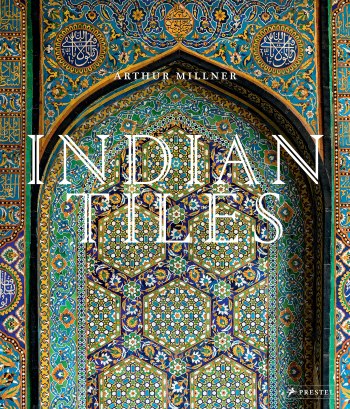 Historic India, which now encompasses the modern nations of India, Pakistan and Bangladesh, is celebrated for the richness of its architectural and decorative arts, but less well known for glazed tiles. Arthur Millner opens up this hitherto neglected subject with a richly illustrated narrative of the development of tiles across the South Asian Subcontinent. Millner traces the craft’s roots in Muslim Persia, Afghanistan and Central Asia, showing how imported glazing techniques combined with an ancient local tradition of clay craftsmanship. He explores the production, designs and influences in Indian tiles from antiquity to the colonial period, tracing the historical evolution through a series of key eras, including the Delhi Sultanate and the Mughal Empire in Northern India as well as the independent sultanates in the Deccan, Bengal, Central India and the Indus region. Although glazed tiles are generally associated with Islam, they also briefly flourished in both Hindu strongholds, such as Gwalior and Orchha, and in Christian Portuguese-ruled Goa. More than four hundred photographs, many of little-known sites, are drawn from the author’s years of travel as well as from colleagues, the archives of the Victoria and Albert Museum, auction houses and other celebrated institutions. These images capture both the architectural context and the visual appeal of the vibrant colors and intricate designs, and provide a visual compendium of the different styles and techniques. Taken together they offer a unique chronicle of an important and environmentally threatened aspect of the region’s cultural, artistic and religious evolution over centuries—one that will appeal to both the specialist and general reader including anyone with an interest in Indian history and architecture, as well as those interested in Islamic art and ceramics.
Arthur Millner is a consultant and independent scholar in the field of Indian and Islamic art. He lectures at the London School of Oriental and African Studies, the Victoria and Albert Museum, the Royal Asiatic Society, and the Oriental Rug and Textile Society. He is the author of numerous articles and the 2015 book, Damascus Tiles (Prestel). He also makes tiles himself in his spare time.
New Book | Indian Botanical Art
Distributed by ACC Art Books:
Martyn Rix, Indian Botanical Art: An Illustrated History (New Delhi: Roli Books, 2022), 224 pages, ISBN: 978-8195256655, $35.
 This book brings together striking botanical art of Indian origin spanning a period of 300 years, focussing on the 18th and 19th centuries. Drawn mostly from original works held in the collections of the Royal Botanic Gardens, Kew, some of the paintings have never been published before. They showcase the richness and variety of art commissioned from talented, mostly unknown, Indian artists who made a substantial contribution to the documentation of the flora of the Indian subcontinent. A foreword written by Sita Reddy places the collections in contemporary context. The book concludes with works from a new generation of botanical artists in India, who excite interest today.
Martyn Rix is a renowned horticulturalist, author of many books, and editor of Curtis’s Botanical Magazine. He is the recipient of the Veitch Memorial Medal from the Royal Horticultural Society for services to horticulture, and a Tercentenary Bronze Medal from the Linnean Society.
Exhibition | Indian Textiles: 1,000 Years of Art and Design

Fragment of chintz, coastal southeast India, 1700–30, made for a Dutch market but found in Japan (Washington, DC: The George Washington University Museum and the Textile Museum, T-2864; Bruce M. White Photography).
◊ ◊ ◊ ◊ ◊
Closing this week at The Textile Museum at The George Washington University (with videos of past programming and the catalogue still available) . . .
Indian Textiles: 1,000 Years of Art and Design
The Textile Museum, The George Washington University, Washington DC, 22 January — 4 June 2022
Vibrant textiles have long been synonymous with Indian culture. Their distinctive abstract, floral, and figurative patterns have inspired countless variations. Featuring masterworks from The Textile Museum Collection and the private collection of Karun Thakar, this major exhibition and accompanying publication showcase court weavings, folk embroideries, and other fabrics from the eighth through the early 20th centuries.
 The Indian subcontinent is home to some of the world’s most ancient and illustrious textile traditions. Over the centuries, Indian textile artists have developed an enduring design vocabulary—from simply woven stripes to floral motifs to complex narrative scenes. Indian Textiles: 1,000 Years of Art and Design presents a stunning array of fabrics patterned with India’s most distinctive designs: abstract, floral, and figurative.
Some of the region’s oldest known textiles feature abstract patterns such as circles, stripes, and zigzags. Examples in the exhibition range from a fragment of a block-printed cloth traded to Egypt around the 15th century to intricately embroidered dresses made in present-day Pakistan’s Swat Valley in the 1800s and 1900s.
Floral patterns in Indian textiles became increasingly widespread in the 13th century, and artists excelled in adapting them for global markets. Embroidered caps from Bengal, for example, were fashionable ‘at home’ wear in 18th-century Europe; a man would often don one in the evening after removing his wig.
Figurative patterns provide a window into different religious beliefs across South Asia. A 15th-century narrative cloth from Gujarat depicts deities and other figures central to the Jain religion. A shrine cloth from Uttar Pradesh honors Sayyid Salar Mas’ud, a Muslim warrior-saint venerated by Muslims and Hindus alike.
The exhibition is accompanied by a gallery guide and a catalogue.
Karun Thakar, Rosemary Crill, Steven Cohen, Avalon Fotheringham, and Sylvia Houghteling, Indian Textiles: 1,000 Years of Art and Design (London: Hali Publications, 2021), 391 pages, ISBN: 978-1898113966, $80.

Installation view of Indian Textiles: 1,000 Years of Art and Design at the George Washington University Museum and the Textile Museum, featuring on the back wall (center, top) a ceremonial cloth crafted in India for Indonesian buyers; late 18th or 19th century, Karun Thakar Collection (Dave Scavone/The George Washington University Museum and the Textile Museum).
Exhibition | Luis Paret (1746–1799)

Luis Paret y Alcázar, The Shop of Geniani, 1772, oil on panel, 49 × 57 cm
(Madrid: Museo Lázaro Galdiano)
◊ ◊ ◊ ◊ ◊
Now on view at the Prado:
Paret
Museo Nacional del Prado, Madrid, 24 May — 21 August 2022
Curated by Gudrun Maurer
In the words of Javier Solana, President of the Royal Board of Trustees of the Museo Nacional del Prado: “Luis Paret is possibly the 18th-century Spanish artist who most deserved a major exhibition of the type now opening at the Museo del Prado.” With the invaluable collaboration of private and public lenders and the support of Fundación AXA, the Prado has thus reunited most of the artist’s known paintings. They include Masquerade, The Puerta del Sol, Paret’s Daughters, View of Bermeo, and The Annunciation to Zacharias, in addition to a remarkable group of drawings such as Hannibal at the Temple of Hercules in Cadiz and The Oath of Allegiance to don Fernando as Prince of Asturias, which together allow for an appreciation of the richness and variety of a painter alert to the changes of his day and one characterised by a remarkable originality and versatility.
In this first monographic exhibition on Paret organised by the Prado, Gudrun Maurer, the museum’s Curator of 18th-century Painting and Goya and the curator of the exhibition, has surveyed Paret’s professional career with the aim of singling out the excellent technical level and striking originality with which the artist depicted his chosen subjects while also presenting the new information on Paret’s working method obtained from the scientific analysis of his paintings undertaken by the Museum’s technical department.
The exhibition offers a complete survey of Paret’s career and is divided into nine sections. The first provides a unique opportunity to compare a key drawing from his early period with the first documented painting by his celebrated fellow-Spaniard Francisco de Goya, who, like Paret, was born in 1746. The two artists started their careers (Paret in fact five years before Goya) after being singled out in competitions organised by different Fine Arts Academies: Paret by the Academia de San Francisco in Madrid and Goya by the one in Parma, Italy. Those two works which brought the artists recognition—both, in fact on the subject of Hannibal—are now on display in the exhibition, one loaned from the Academia de San Fernando and the other in the Prado’s collection. In general, the two paintings reveal the importance of both academic competitions and the period of training in Italy for artists’ careers. The comparison with Goya also emphasises Paret’s notable technical and compositional skills at this early date while the marked artistic personalities of the two artists are evident in the different styles of their works.
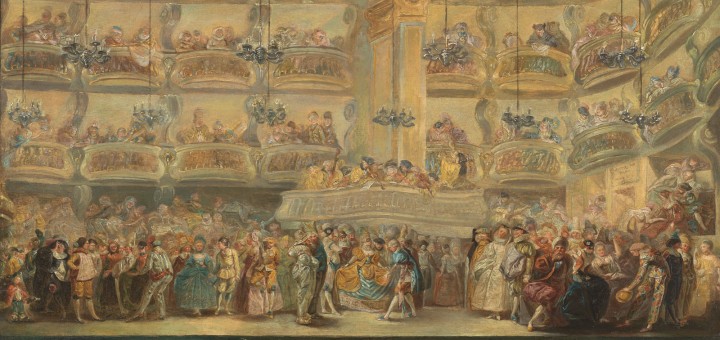
Luis Paret y Alcázar, Masquerade, detail, ca. 1767, oil on panel
(Madrid, Museo Nacional del Prado)
◊ ◊ ◊ ◊ ◊
The next section starts with a small group of early drawings by Paret from the collection of the Prado and the Biblioteca Nacional de España. They reveal the artist’s originality in his inventive and versatile approach to the subjects and the modernity of his choices. Subjects include The Necromancer, The Glory of Anacreon, and Roman Military Trophy. The principal work in this room is one of Paret’s earliest known paintings, Masquerade of 1767 from the Prado’s collection. It once again reveals Paret’s modernity in the context of his time, as an artist who from the outset was able to respond to the new demand for images of society in the public and private space and which reflected the varied fashions and customs of the different social classes. Displayed here are other small-format cabinet paintings on innovative subjects in the context of Spanish art of this period, such as Scene of a Boudoir (previously Play Rehearsal) from the Prado; The Letter from the Musée Goya in Castres; Geniani’s Shop from the Museo Lázaro Galdiano; and The Puerta del Sol from the Museo Nacional de Bellas Artes de Cuba. In addition, paintings on rarely depicted episodes from life at the Spanish court, such as The Royal Couples and Charles III dining before the Court (both in the Prado), offer a panoramic view of different facets of contemporary society and also demonstrate the success Paret enjoyed between 1766 and 1775, the year he was exiled.

Luis Paret y Alcázar, Zebra, 1774, Black pencil, gouache brush and opaque pigment gouache (Madrid: Museo Nacional del Prado).
The third section presents one of the artist’s exquisite coloured drawings of birds alongside Zebra from the Prado’s collection and a private collection respectively, works executed by Paret for the Natural History Cabinet of the Infante don Luis, Charles III’s brother, who appointed Paret his painter in 1774. They reveal the artist’s ability to combine an almost scientific depiction of his subjects with landscape settings of great subtlety and refined beauty.
The fourth section focuses on Paret’s few known portraits, which are notable for their exquisite technique and personal, intimate nature. They also mark the transition between the artist’s Madrid phase and his years in Bilbao. The four known Self-portraits of around 1770–75 to 1780 reflect the painter’s powerful, self-confident personality but also his different states of mind. This is evident during his exile in Puerto Rico when he portrayed himself not just as a jíbaro or local peasant in 1776 but also in the melancholy Self-portrait in the Studio of 1777 which Paret sent to a trusted individual in Madrid, as the inscription detected by the recent X-radiograph reveals. Shown alongside these works are other portraits such as those of the artist’s wife and their daughters, compositions enhanced by complex floral ornamentation; a portrait of a typical Enlightenment gentleman (on loan from the Real Academia de Bellas Artes de San Fernando); and that of Antonio Sancha from the Biblioteca Nacional de España. Finally, there are compositions on the theme of motherhood, such as the small painting of The Virgin and Child from the Abelló Collection, The Orange Seller from Patrimonio Nacional, and the two floral bouquets from the Prado. Flowers were an enormously important motif in Paret’s work and one that reveals the virtuosity characteristic of all the paintings in this section.
The fifth section opens with a painting of The Circumspection of Diogenes which Paret sent from Bilbao in 1780 to the Real Academia de Bellas Artes de San Fernando and which led to his nomination as an Academician of Merit. His subsequent enhanced reputation is evident in the large-format religious compositions that he executed in Bilbao, such as The Invention of the True Cross painted for the Gortázar family and their family chapel (private collection) and The Martyrdom of Saint Lucy for the parish church of Santa María in Larrabezúa (now in the Museo Diocesano de Arte Sacro in Bilbao). These exceptionally exquisite paintings of great technical and compositional delicacy demonstrate Paret’s importance in the context of 18th-century Spanish art. Their presence in the exhibition makes it possible to appreciate his mastery in devising subjects that were unusual in the context of the day and his ability to create scenes of a monumental nature with extremely dynamic figures. Furthermore, they reveal the artist’s extensive knowledge of classical sculpture and the work of the Old Masters such as Rubens, as well as his exceptional manner of combining grandiose, classical beauty with lighter Rococo resources such as a markedly pastel palette. The juxtaposition of these works with small-format paintings and drawings on religious subjects—including The Apparition of Saint Michael to Charles VIII of France and Saint Francis of Paula (private collection), a unique subject in Spanish art—and with a number of his designs for religious monuments in Bilbao further reveals Paret’s multifaceted nature in this pictorial genre.

Luis Paret y Alcázar, Self-portrait Attired in Blue, ca. 1780, oil on paper affixed to canvas (Colección Abelló).
The next section is devoted to paintings and drawings on bucolic subjects and classical, erotic ones produced for private clients. These reveal Paret’s enormously original powers of invention, including The Triumph of Love over War from the Museo de Bellas Artes de Bilbao and the drawings of The Eclogue from the Prado, which are shown together with paintings on similar subjects from real life, albeit with a certain critical element, such as Gallant Scene of High Society and Gallant Scene of Low Life (private collection), Saying the Rosary from Patrimonio Nacional and the drawing of The Procuress and the Lovers from the Prado. The small painting of Young Woman asleep in a Hammock from the Prado establishes a connection between the two worlds through references to classical sculpture and modern society, the latter including the exoticism of the Caribbean.
The seventh section features eight of the nine currently known views of the Basque Country painted by Paret, executed for the Prince of Asturias, for private clients and as commissions for Charles III. These are now divided between museums in Spain, France, and the UK. The group constitutes a striking survey of landscape and also of the variety of society of the day, its different working and leisure activities and the region’s ports and coastline. These notably complex paintings in both technical and compositional terms are among Paret’s most important creations from his time in Bilbao. Also on display are the two fine drawings of ports in the Basque country, loaned from private collections, which reveal the artist’s masterly ability in the use of different media, such as black chalk, pen, and brush, which he employed to capture the characteristics of these landscapes and the brilliant effects of light observed in nature.
The eighth section focuses on two oils on canvas executed by the artist for the chapel of San Juan del Ramo in the church of Santa María de la Asunción in Viana: The Annunciation to Zacharias and The Visitation of the Virgin to Saint Elizabeth. In these striking paintings, which are among the last produced by Paret during his Bilbao period, the remarkable quality and technical and compositional complexity achieved by the artist reaches its peak. Furthermore, they reveal the original way in which he made use of models to add liveliness and expressivity to his figures and scenes, as well as the excellent technique that he employed to describe all the details in his works with enormous naturalness and variety. Also evident is the way in which Paret applied a modern, art historian’s eye to make use of the Baroque and Neo-classical styles in order to emphasise the era of the scenes depicted. Finally, this section includes a group of excellent preparatory drawings for one of these paintings (private collection) and for the mural decoration of this chapel (Museo del Prado).

Luis Paret y Alcázar, The Oath of Allegiance to Ferdinand VII as Prince of Asturias, 1791, oil on canvas, 237 × 159 cm (Madrid: Museo Nacional del Prado).
Following his return to Madrid in 1789, in 1792 Paret was appointed Vice-secretary of the Academia de San Fernando and Secretary to its Architectural Committee, receiving few commissions for paintings but producing numerous drawings of beautiful scenes and figures for book illustrations and other projects. The paintings from the end of the artist’s career are displayed in this ninth section of the exhibition. They include three allegories of one of the provinces of Spain, works of enormous classical beauty which are the only ones now known from a series of ten paintings executed in 1789 for the headquarters of the Five Major Guilds in Madrid (private collection and Museo del Prado). The one in the Prado was only rediscovered five years ago and was acquired for the Museum. Finally, visitors will be able to appreciate an example of Paret’s creative process through the painting of The Oath of Allegiance to don Fernando as Prince of Asturias, its remarkable preparatory drawing in the Louvre, two preliminary drawings of details for that work (Biblioteca Nacional), and an infrared reflectograph that reveals an excellent underdrawing. Other equally important examples are shown in a video.
The exhibition closes with an unfinished painting of The Botanical Garden from the Paseo del Prado. It depicts the entrance to the garden, located close to the Museo del Prado.
This extremely comprehensive survey of Paret’s career furthers an analysis of his approach and techniques while promoting his recognition as the most important Spanish artist of the 18th century alongside Goya.
The exhibition is accompanied by a catalogue by the curator Gudrun Maruer with texts written by her, by other specialists, and by the technical staff of the Museo del Prado and the Museo de Bellas Artes de Bilbao.
Gudrun Maurer, ed., Paret (Madrid: Prado, 2022), 288 pages, €28.
Exhibition | Fashioning Masculinities: The Art of Menswear
Press release for the exhibition now on view at the V&A:
Fashioning Masculinities: The Art of Menswear
Victoria & Albert Museum, London, 19 March — 6 November 2022
Curated by Claire Wilcox and Rosalind McKever
Fashioning Masculinities: The Art of Menswear is the first major V&A exhibition to celebrate the power, artistry, and diversity of masculine attire and appearance. The show traces how menswear has been fashioned and refashioned over the centuries, and how designers, tailors, and artists—together with their clients and sitters—have constructed and performed masculinity, and unpicked it at the seams.
 Fashioning Masculinities will present around 100 looks and 100 artworks, displayed thematically across three galleries. Contemporary looks by legendary designers and rising stars will be displayed alongside historical treasures from the V&A’s collections and landmark loans: classical sculptures, Renaissance paintings, iconic photographs, and powerful film and performance. From looks by Harris Reed, Gucci, Grace Wales Bonner and Raf Simons, to paintings by Sofonisba Anguissola and Joshua Reynolds, contemporary artworks by Robert Longo and Omar Victor Diop, to an extract from an all-male dance performance by Matthew Bourne’s New Adventures, the exhibition will showcase the variety of possible masculinities across the centuries from the Renaissance to the global contemporary. Outfits worn by familiar faces will be interspersed throughout, from Harry Styles, Billy Porter and Sam Smith, to David Bowie and Marlene Dietrich. Innovative creations and diverse representations will highlight and celebrate the multiplicities of masculine sartorial self-expression, dressing beyond the binary.
Claire Wilcox and Rosalind McKever, co-curators of Fashioning Masculinities: The Art of Menswear, said: “Masculine fashion is enjoying a period of unprecedented creativity. It has long been a powerful mechanism for encouraging conformity or expressing individuality. Rather than a linear or definitive history, this is a journey across time and gender. The exhibition will bring together historical and contemporary looks with art that reveals how masculinity has been performed. This will be a celebration of the masculine wardrobe, and everyone is invited to join in.”
Fashioning Masculinities opens with a Craig Green SS2021 ensemble of a deconstructed suit, alluding to the construction and deconstruction of both the masculine body and conventions of masculinity, a central theme throughout the show. The three main galleries—’Undressed’, ‘Overdressed’, and ‘Redressed’—follow, with the exhibition design by JA Projects. ‘Undressed’ explores the male body and underwear in a utopian dreamscape, whilst ‘Overdressed’ takes visitors into the elite masculine wardrobe in a sumptuous, immersive space with courtly grandeur, featuring oversized silhouettes, abundant colour, and lavish materials. The third section, ‘Redressed’, explores the construction and dissolution of the suit, with the exhibition design conveying the idea of an urban reawakening.
‘Undressed’ explores the male body and underwear, looking at how classical European ideals of masculinity have been perpetuated and challenged over the centuries. Plaster casts of the Apollo Belvedere and the Farnese Hermes—which highlight a tradition of depicting idealised male bodies draped in textiles that reveal more than they conceal—are juxtaposed with modern and contemporary representations of the body, from prints and photography by David Hockney, Lionel Wendt, Zanele Muholi, and Isaac Julien, to a Calvin Klein advertisement.
Also on display is a film of Matthew Bourne’s Spitfire (1988) performed by New Adventures dancers, which takes place in the world of men’s underwear advertising and mail order catalogue photography, whilst contemporary ensembles highlight how designers are appropriating sheer fabrics to create ensembles, alluding to a new honesty about menswear. Fashion’s fascination with the body has seen it support changing masculine ideals from evoking classical drapery, to sculpting flesh—as seen in garments by Jean-Paul Gaultier and A- COLD-WALL*—to celebrating body diversity. This is exemplified in the exhibition by excerpts of Arrested Movement by Anthony Patrick Manieri, an inclusive portrait series and awareness initiative celebrating and promoting positive body image. ‘Undressed’ ends with Auguste Rodin’s Age of Bronze sculpture, and Tiresias, a performance by Cassils, in which the artist melts a neoclassical torso carved in ice with their body heat.

Installation view, V&A.
◊ ◊ ◊ ◊ ◊
The second gallery, ‘Overdressed’, explores the elite masculine wardrobe, epitomised by oversized silhouettes, lavish materials like silks and velvet in daring colours, and symbolic patterns to express status, wealth, and individuality. Drawing synergies across the centuries, the section will feature armoured breastplates to silky smoking suits, sweeping capes to ribbons and lace, including Grinling Gibbons’ wooden carving imitating a Venetian needlepoint lace cravat, displayed alongside real lace, and a Dolce & Gabbana cape juxtaposed with a Sofonisba Anguissola painting. The section also includes grooming, with makeup and shaving equipment.
Historically, menswear was full of pattern and colour, and a section on scarlet and pink highlights the return of this masculine colour to popularity. Aristocratic sitters in oil paintings by Joshua Reynolds and Jean-Baptiste Perronneau are displayed alongside pink ensembles by Harris Reed and Grace Wales Bonner among others. Nearby, a custom Randi Rahm ensemble—a suit and full-length embroidered cloak with a hot pink lining—worn by Billy Porter at the Golden Globes in 2019, complement the selection. Internationally traded textiles, imported silks, and floral patterns reflect their wearers relationship to the world. Through the lens of contemporary fashion, from Kim Jones for Fendi and Alessandro Michele for Gucci to Rahemur Rahman, Ahluwalia and Orange Culture, ‘Overdressed’ shows how historic ideas begin to shift, with a full rainbow of masculine outfits on display.
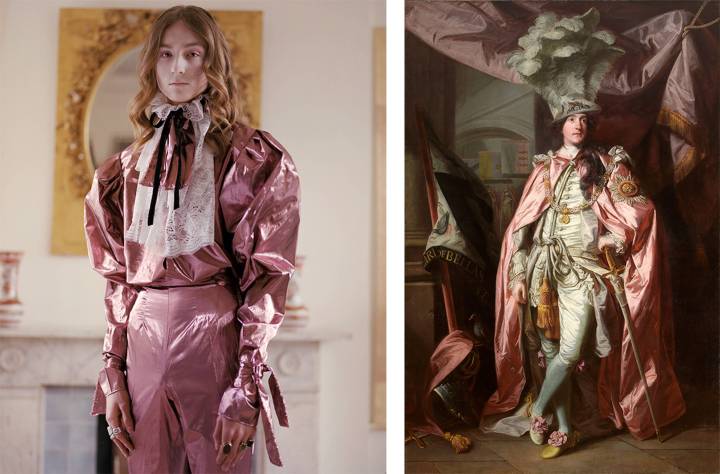
Left: Harris Reed Fluid Romanticism 001 (Courtesy Harris Reed; photo by Giovanni Corabi). Right: Joshua Reynolds, Portrait of Charles Coote, 1st Earl of Bellamont (1738–1800), in Robes of the Order of the Bath, 1773–74 (Dublin: National Gallery of Ireland).
◊ ◊ ◊ ◊ ◊
The third gallery, ‘Redressed’, pieces together the modern masculine uniform of the suit, from Beau Brummell to the contemporary runway. ‘Redressed’ opens with a reflection on English country tailoring and the origins of the suit—with historic garments from the V&A collection shown alongside contemporary reimaginings, including a kilt by Nicholas Daley—before exploring how military attire influenced civilian dress.
In the twentieth century an abundance of mass-produced suits bred creativity as Mods, Teddy Boys, and all manner of subcultures looked to define their styles through tailoring, explored in the exhibition through garments and photography. A section on leather shows how designers like Tom Ford for Gucci and Donatella Versace took their interest in leather to a new place, whilst a series of frock coats from the mid-nineteenth century to the present day include examples by Prada, Alexander McQueen, and Raf Simons. ‘Redressed’ also includes paintings as well as extensive photography showing changing styles and attitudes, from Oscar Wilde, Claude Cahun, and Cecil Beaton to The Beatles and Sam Smith.
Robert Longo’s 1981 drawing from the series Men in the Cities introduces the final part of the section about the dissolving of the suit. A new wave of fashion designers from Rick Owens to JW Anderson to Comme des Garçons to Lesiba Mabitsela are slashing away at conventions, both for menswear and masculinity.
Claire Wilcox and Rosalind McKever, eds., Fashioning Masculinities: The Art of Menswear (London: V&A Publishing, 2022), 272 pages, ISBN: 978-1838510114, $60.










 Enfilade
leave a comment