New Book | Everyday Rococo
Scheduled for publication in October:
Rosalind Savill, Everyday Rococo: Madame de Pompadour and Sèvres Porcelain (London: Unicorn Press, 2021), 704 pages, ISBN: 978-1916495715, £200.
 Jeanne Antoinette Poisson (1721–1764), Marquise de Pompadour, the 300th anniversary of whose birth will be celebrated on 29 December 2021, became the official mistress of Louis XV of France in 1745, and for the rest of her life their patronage of Vincennes/Sèvres helped to make it one of the greatest porcelain factories in history. Everyday Rococo: Madame de Pompadour and Sèvres Porcelain is a year-on-year richly-illustrated chronology of her daily life and purchases. Although also partly a social history revealing Madame de Pompadour as a major player in the art and politics of eighteenth-century France, Rosalind Savill’s diligent research has concentrated on the everyday details of Madame de Pompadour’s life for which Vincennes/Sèvres catered so perfectly.
Rosalind Savill, DBE, FBA, FSA, was Director of the Wallace Collection in London from 1992 until 2011, and is a specialist in French decorative arts, especially Sèvres porcelain. Her major publication, The Wallace Collection: Catalogue of Sèvres Porcelain, 3 vols, 1988, was awarded the National Art-Collection Fund prize for Scholarship in 1990. She was appointed CBE for Services to the Study of Ceramics in 2000, won the European Woman of Achievement Award (Arts and Media) in 2005, was appointed DBE for Services to the Arts in 2009, and was appointed an Ocier dans L’Ordre des Arts et des Lettres, France, in 2014. She co-curated the exhibition The Art of Love: Madame de Pompadour at the Wallace Collection in 2002.
New Book | Invisible Enlighteners: The Jewish Merchants of Modena
From Penn Press:
Federica Francesconi, Invisible Enlighteners: The Jewish Merchants of Modena, from the Renaissance to the Emancipation (Philadeaphia: University of Pennsylvania Press, 2021), 400 pages, ISBN: 978-0812253146, $80 / £64.
 Federica Francesconi writes the history of the Jewish merchants who lived and prospered in the northern Italian city of Modena, capital city of the Este Duchy, during the seventeenth and eighteenth centuries. Her protagonists are men and women who stood out within their communities but who, despite their cultural and economic prominence, were ghettoized after 1638. Their sociocultural transformation and eventual legal and political integration evolved through a complex dialogue between their Italian and Jewish identities, and without the traumatic ruptures or dramatic divides that led to the assimilation and conversion of many Jews elsewhere in Europe.
In Modena, male and female Jewish identities were contoured by both cultural developments internal to the community and engagement with the broader society. The study of Lurianic and Cordoverian Kabbalah, liturgical and nondevotional Hebrew poetry, and Sabbateanism existed alongside interactions with Jesuits, converts, and inquisitors. If Modenese Jewish merchants were absent from the public discourse of the Estes, their businesses lives were nevertheless located at the very geographical and economic center of the city. They lived in an environment that gave rise to unique forms of Renaissance culture, early modern female agency, and Enlightenment practice. New Jewish ways of performing gender emerged in the seventeenth century, giving rise to what could be called an entrepreneurial female community devoted to assisting, employing, and socializing in the ghetto. Indeed, the ghetto leadership prepared both Jewish men and women for the political and legal emancipation they would eventually obtain under Napoleon. It was the cultured Modenese merchants who combined active participation in the political struggle for Italian Jewish emancipation with the creation of a special form of the Enlightenment embedded in scholarly and French-oriented lay culture that emerged within the European context.
Federica Francesconi is on the faculty of History and is the Director of the Judaic Studies Program at the University at Albany, State University of New York.
C O N T E N T S
Note on Spelling, Translations, and Currency
Introduction
1 A Network of Jewish Families in the Early Modern Period: The Road Toward Ghettoization
2 Jewish Leaders, Their Circles, and Their Books Before the Inquisition: A Parallel Story
3 The Jewish Household: Family Networks, Social Control, and Gendered Spaces
4 The ‘Invisible’ Wealth of Silver: The Journey of the Formigginis from the Ghetto to the Ducal Court
5 Jewish Female Agency in the Ghetto Mercantile Elite
6 The Jewish Urban Geography of the Ghetto and Beyond
7 Moisè Formiggini Before Napoleon: Two Steps Toward Emancipation and One Step Back
List of Abbreviations
Notes
Bibliography
Index
Acknowledgments
New Book | Places of Worship in Great Britain, 1689–1829
Published earlier this year by Shaun Tyas:
P. S. Barnwell and Mark Smith, eds., Places of Worship in Great Britain, 1689–1829 (Donington, Lincolnshire: Shaun Tyas, 2021), ISBN: 978-1907730887, £40.
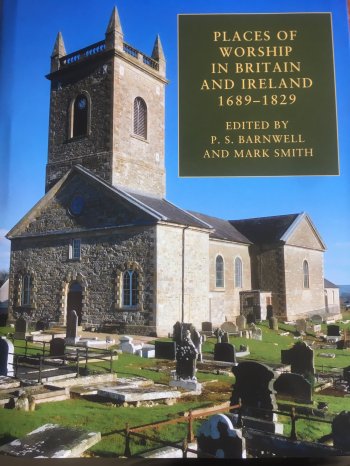 This book, the sixth in a series on places of worship in Britain and Ireland, contains eleven essays on a period of relative calm after the radical changes during the previous reformations and civil wars. The dates are set by the Act of Toleration from the new government of William and Mary and the Catholic Emancipation Act of 1829. The period saw a renewed emphasis on auditory worship, preaching, and a new social conscience marked by educational and welfare initiatives and a desire to build churches in every locality. The architecture of the period is marked by simplicity, some geometrical experiments, and an eclectic mix of styles for details—mostly classical or vernacular—though the first stirrings of the Gothic Revival also appeared.
Paul Barnwell (FSA) was Director of Studies in the Historic Environment at the University of Oxford from 2006 to 2020, having previously worked for the Royal Commission on the Historical Monuments of England and then for English Heritage. Mark Smith is Director of Studies in Local History at the University of Oxford.
C O N T E N T S
• Mark Smith provides a general overview
• John Harper on worship and music
• W. M. Jacobs on Anglican churches, 1689–1790
• Christopher Webster on Anglican churches, 1790–1840
• William Roulston on Irish places of worship
• Richard Fawcett on Scottish developments
• Christopher Wakeling on chapel building in the age of Methodism
• Ann-Marie Akehurst on Quaker meeting houses
• Roderick O’Donnell on new Catholic places of worship
• Sharman Kadish on the Georgian synagogue
• P. S. Barnwell provides a conclusion
New Book | The Thing about Religion
From The University of North Carolina Press:
David Morgan, The Thing about Religion: An Introduction to the Material Study of Religions (Chapel Hill: The University of North Carolina Press, 2021), 268 pages, ISBN: 978-1469662824, $95 / ISBN: 978-1469662831 (paperback), $25.
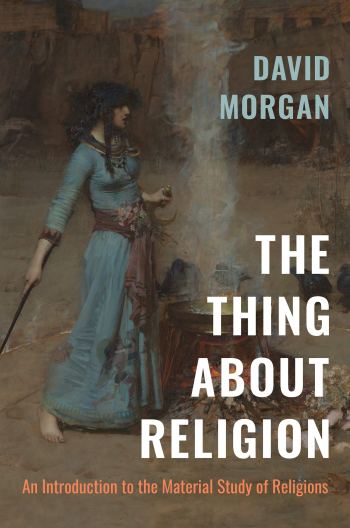 Common views of religion typically focus on the beliefs and meanings derived from revealed scriptures, ideas, and doctrines. David Morgan has led the way in broadening that framework to encompass the understanding that religions are fundamentally embodied, material forms of practice. This concise primer shows readers how to study what has come to be termed material religion—the ways religious meaning is enacted in the material world. Material religion includes the things people wear, eat, sing, touch, look at, create, and avoid. It also encompasses the places where religion and the social realities of everyday life, including gender, class, and race, intersect in physical ways. This interdisciplinary approach brings religious studies into conversation with art history, anthropology, and other fields. In the book, Morgan lays out a range of theories, terms, and concepts and shows how they work together to center materiality in the study of religion. Integrating visual evidence, he then applies these ideas and methods to case studies across a variety of religious traditions, modeling step-by-step analysis and emphasizing the importance of historical context.
David Morgan is professor of religious studies and art, art history, and visual studies at Duke University. His most recent book is Images at Work: The Material Culture of Enchantment.
C O N T E N T S
Acknowledgments
Introduction: How Materiality Matters to the Study of Religion
Part I. Theories and Definitions
1 How Some Theories of Religion Dematerialize It
2 What Is the Material Study of Religion?
3 How Religions Happen Materially
Part II. Studying Material Religion
4 The Power of Things: A History of Magic Wands
5 Notre-Dame de Paris: Religion and Time
6 Words and Things
Conclusion: Things, Networks, and Agents
Resources for Classroom Use
Primary Texts, Key Terms, and Online Resources
Writing Guide
Bibliography to Support Student Research
Notes
Index
New Book | A Companion to Viceregal Mexico City, 1519–1821
From Brill:
John López, ed., A Companion to Viceregal Mexico City, 1519–1821 (Leiden: Brill, 2021), 470 pages, ISBN: 978-9004335561, €233 / $280. Volume 3 in Brill’s Companions to the Americas series.
 This book presents a historical overview of colonial Mexico City and the important role it played in the creation of the early modern Hispanic world. Organized into five sections, an interdisciplinary and international team of twenty scholars scrutinize the nature and character of Mexico City through the study of its history and society, religious practices, institutions, arts, and scientific, cartographic, and environmental endeavors.
The Companion ultimately shows how viceregal Mexico City had a deep sense of history, drawing from all that the ancient Americas, Europe, Asia, and Africa offered but where history, culture, and identity twisted and turned in extraordinary fashion to forge a new society.
John F. López (Ph.D., Massachusetts Institute of Technology, 2013) is Assistant Professor of Early Modern European and Latin American art and architecture at the University of California, Davis. López has authored numerous articles and has edited special issues for Ethnohistory, Latin American Geography, and Monumentos históricos.
C O N T E N T S
List of Figures and Tables
Archival and Image Repositories
Notes on Contributors
Acknowledgements
John F. López — Introduction: Viceregal Mexico City, Colonial Cosmopolitanism, and the Hispanic World
Part 1. History and Society
1 Matthew Restall — Fear, Wonder, and Absence: Our Distorted View of Moctezuma’s Tenochtitlan
2 Luis Fernando Granados — The Weirdest of All? Indigenous Peoples and Polities of Colonial Mexico City
3 Joan C. Bristol — Blackness and Blurred Boundaries in Mexico City
4 Sonya Lipsett-Rivera — Of Pleasures and Proscriptions: Or How Residents of Mexico City Negotiated Gender and Family Norms
5 Frances L. Ramos — War, Legitimacy, and Ceremony in 18th-Century Mexico City: The Annual Funerary Honors for Fallen Soldiers
Part 2. Religious Life
6 Antonio Rubial García — City of Friars, City of Archbishops: The Church in Mexico City in the Age of the Hapsburgs
7 Alejandro Cañeque — The Cabildo of Mexico City, Patron Saints, and the Making of Local and Imperial Identities
8 Cristina Cruz González — Visualizing Corporate Piety: The Art of Religious Brotherhoods
Part 3. Institutions
9 Iván Escamilla González — Permanence and Change in Mexico City’s Viceregal Court, 1535–1821
10 María del Pilar and Martínez López-Cano — Finance and Credit in Viceregal Mexico City
11 Enrique González González — Uneven Chances: Education in Colonial Mexico City
12 Paula S. De Vos — Medicine and Municipal Rights in Viceregal Mexico City
Part 4. Special Themes
13 Barbara E. Mundy — The Urban Plans of Mexico City, 1520–1810
14 John F. Lopez — The Desagüe’s Watermark: Cartography and Environmental Crisis at Viceregal Mexico City
15 Miruna Achim — Urban Science in 18th-Century Mexico City
Part 5. The Arts
16 Kelly Donahue-Wallace — A Culture of Print in Viceregal Mexico City
17 Martha Lilia Tenorio — Novohispanic Baroque Poetry: A Lyric Chronicle of Mexico City
18 Jesús A. Ramos-Kittrell — Music and Literature in New Spain: The Politics of Buen Gusto in 18th-Century Mexico City
19 Amy C. Hamman and Stacie G. Widdifield — The Royal Academy of San Carlos, 1781–1800
Index
New Book | Green Unpleasant Land
From Peepal Tree Press:
Corinne Fowler, Green Unpleasant Land: Creative Responses to Rural England’s Colonial Connections (Leeds: Peepal Tree Press, 2021), 324 pages, ISBN: 978-1845234829, £20 / $30.
 Green Unpleasant Land explores the countryside’s repressed colonial past and demonstrates its importance as a source of ideas about Englishness. The book presents historical evidence to show that rural England was a place of conflict and global expansion. It also examines four centuries of literary response to explore how race, class, and gender have both created and deconstructed England’s pastoral mythologies. In particular, the book argues that Black and British Asian writers have challenged narrow, nostalgic views of rural England but also expressed attachment to English landscapes and the natural world.
The book questions the countryside’s reputation as a retreat from urban life. It interrogates the idea that country houses are models for civilised living or that moorlands are places of freedom. It presents new perspectives on the ‘English’ flora and fauna that feature in literature, parks, allotments, and suburban gardens. The book reconsiders a range of rural locations through the lens of British colonial involvement, including East India Company activity and the slavery business. The book connects England’s outward-reaching histories to what was happening in the countryside: the enclosure of common land, the beginnings of industrial mass farming, and the reshaping of landownership through imperial profits. In bringing together histories usually separated by the Atlantic, Green Unpleasant Land makes connections, for instance, between the rebellion of enslaved people for their freedom in Jamaica in 1831, and the struggles of English agricultural workers in the Captain Swing uprising of the same year.
But Green Unpleasant Land is more than an academic study—accessibly written as it is—because it contains a section of Corinne Fowler’s own stories and poems written in response to the research she has undertaken and the material objects she has encountered. It is a personal story, too, of her own family relationship to transatlantic enslavement.
Green Unpleasant Land should make uncomfortable reading for anyone who wants to uphold nostalgic views of rural England. The heatedness of the recent media response to such work shows just what is at stake: a selective vision of nation that underplays the impact of four colonial centuries, or a vision that embraces, as Paul Gilroy expresses it, a post-imperial “convivial culture.”
Corinne Fowler is a research expert at the University of Leicester, and is Director of Colonial Countryside: National Trust Houses Reinterpreted. Professor Fowler is an expert in the legacies of colonialism and postcolonialism to literature, heritage, and representations of British history. She co-founded and led the Centre for New Writing for six years, where she bought together writers and researchers to commission over 100 creative works.
C O N T E N T S
Acknowledgments
Preface
Part I. Empire, Literature, and Rural England
1 Nation at the Crossroads
2 Green Unpleasant Land
3 Pastoral
4 Country Houses
5 Moorlands
6 Plants, Gardens, and Empire
Part II. Creative Responses: The Colonial Countryside
Fields Strawberries
Gardens Azaleas
Graveyards Myrtilla
Hills Cotswolds
Maypoles Green and Pleasant Land
Moorlands Heathcliff
Parks Kings Heath Park
Pastoral A New Chronology
Pubs Public Houses of Britain
Seeds William Blathwayt of Dyrham Park
Woodlands An Escaped Slave from Yorkshire, 1789
Epilogue
Further Reading
Index
Addressing Colonialism and Historic Slavery at the National Trust
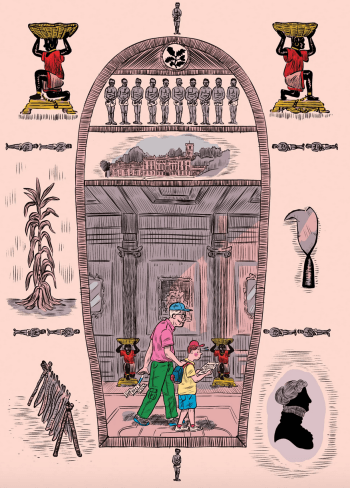
Illustration by Michael Kennedy for Sam Knight’s article in The New Yorker (23 August 2021), p. 31
The National Trust released its Interim Report on the Connections between Colonialism and Properties Now in the Care of the National Trust, Including Links with Historic Slavery in September 2020. Sam Knight’s recent article, “Britain’s Idyllic Country Houses Reveal a Darker History” from The New Yorker (23 August 2021), pp. 30–41, explores the wider context of the report along with its British reception.*
The article is, to my thinking, immensely instructive, usefully framing the scale of the problem (historically) and the magnitude of work now to be done (both professionally and societally). As Knight writes, “The National Trust, more than any other institution, helped to create the idealized version of the English country house. Almost every historian I spoke to supported the charity’s decision to reinterpret its properties, but many also observed that it did not have a choice. . . . Given Britain’s changing demographics and the weight of recent decades of colonial history, the elisions of the past were no longer tenable. The National Trust has been forced to explode a myth of its own making. But many English people preferred the myth as it was” (34).
As for the report itself, much of the attention has been directed to its listing of National Trust properties. In fact, taken as a whole, it provides an excellent guide to crucial historic institutions—with essays ranging from compensation for slave-ownership to the East India Company—along with relevant bibliographies (I can imagine lots of useful teaching applications). –CH
* In the same issue of The New Yorker, Adam Gopnik writes of ‘What the French Make of Lafayette,” pp. 66–70, observations occasioned by two recent biographies Mike Duncan’s Hero of Two Worlds: The Marquis de Lafayette in the Age of Revolution (Public Affairs, 2021) and Laurent Zecchini’s Lafayette: héraut de la liberté (Fayard, 2019).
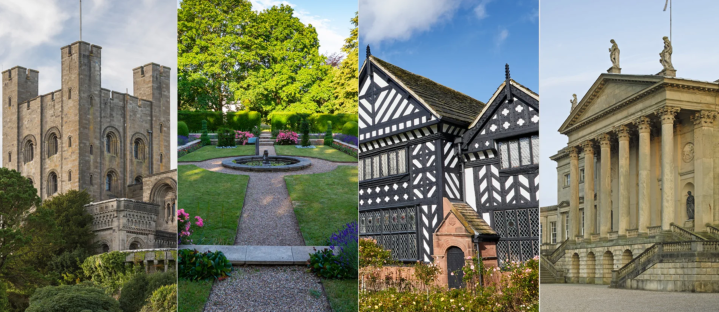
Penrhyn Castle in Wales, Clandon Park Gardens in Surrey, Speke Hall in Liverpool, and Kedleston Hall in Derbyshire (National Trust); all four properties are included in the report’s “Gazetteer.”
◊ ◊ ◊ ◊ ◊
From the NT:
The National Trust cares for places and collections on behalf of the nation, and many have direct and indirect links to colonialism and historic slavery. We’ve released a report examining these connections as part of our broader commitment to ensure that these links are properly represented, shared and interpreted.
The buildings in our care reflect many different periods and a range of British and global histories—social, industrial, political and cultural. As a heritage charity, it’s our responsibility to make sure we are historically accurate and academically robust when we communicate about the places and collections in our care.
The Interim Report on the Connections between Colonialism and Properties Now in the Care of the National Trust, Including Links with Historic Slavery details the connections 93 historic places in our care have with colonialism and historic slavery. This includes the global slave trades, goods and products of enslaved labour, abolition and protest, and the East India Company.
It draws on recent evidence including the Legacies of British Slave-ownership project and the Trust’s own sources. It also documents the way that significant Trust buildings are linked to the abolition of slavery and campaigns against colonial oppression.
It has been edited by Dr Sally-Anne Huxtable (National Trust Head Curator), Professor Corinne Fowler (University of Leicester), Dr Christo Kefalas (National Trust World Cultures Curator), and Emma Slocombe (National Trust Textiles Curator), with contributions from other National Trust curators and researchers around the country. Some of the research has already been used to update our digital content and supports visitor information and interpretation at relevant places.
Sally-Anne Huxtable, Corinne Fowler, Christo Kefalas, and Emma Slocombe, eds., Interim Report on the Connections between Colonialism and Properties Now in the Care of the National Trust, Including Links with Historic Slavery (Swindon: National Trust, 2020).
C O N T E N T S
Authorship and Acknowledgements
Foreword, Gus Casely-Hayford
Introduction — Sally-Anne Huxtable, Tarnya Cooper, and John Orna-Ornstein
1. Wealth, Power, and the Global Country House — Sally-Anne Huxtable
2 Trade in Enslaved People — Jane Gallagher
3 Abolition, Resistance and Protest — Christo Kefalas
4 Compensation for Slave-ownership — Elizabeth Green, Christo Kefalas, and Emma Slocombe
5 Merchant Companies — Rupert Goulding
6 The East India Company — Lucy Porten
7 Banking and Bankers — Frances Bailey
8 The British Raj in India after 1857 — Rachel Conroy
9 Industrialisation and the Import of Cotton — Emma Slocombe
10 Research — Sophie Chessum
Gazetteer of National Trust Properties
Appendix: Next Steps
Bibliography
Further Reading
New Book | Bravura
From Princeton UP:
Nicola Suthor, Bravura: Virtuosity and Ambition in Early Modern European Painting (Princeton: Princeton University Press, 2021), 304 pages, ISBN: 978-0691204581, $65 / £50.
 The painterly style known as bravura emerged in sixteenth-century Venice and spread throughout Europe during the seventeenth century. While earlier artistic movements presented a polished image of the artist by downplaying the creative process, bravura celebrated a painter’s distinct materials, virtuosic execution, and theatrical showmanship. This resulted in the further development of innovative techniques and a popular understanding of the artist as a weapon-wielding acrobat, impetuous wunderkind, and daring rebel. In Bravura, Nicola Suthor offers the first in-depth consideration of bravura as an artistic and cultural phenomenon. Through history, etymology, and in-depth analysis of works by such important painters as Franҫois Boucher, Caravaggio, Francisco Goya, Frans Hals, Peter Paul Rubens, Tintoretto, and Diego Velázquez, Suthor explores the key elements defining bravura’s richness and power.
Suthor delves into how bravura’s unique and groundbreaking methods—visible brushstrokes, sharp chiaroscuro, severe foreshortening of the body, and other forms of visual emphasis—cause viewers to feel intensely the artist’s touch. Examining bravura’s etymological history, she traces the term’s associations with courage, boldness, spontaneity, imperiousness, and arrogance, as well as its links to fencing, swordsmanship, henchmen, mercenaries, and street thugs. Suthor discusses the personality cult of the transgressive, self-taught, antisocial genius, and the ways in which bravura artists, through their stunning displays of skill, sought applause and admiration. Filled with captivating images by painters testing the traditional boundaries of aesthetic excellence, Bravura raises important questions about artistic performance and what it means to create art.
Nicola Suthor is professor of art history at Yale University. She is the author of Rembrandt’s Roughness (Princeton University Press).
C O N T E N T S *
Introduction
1 Celebrations of Violence
2 The Figural Tour de Force
3 The Spatial Tour de Force
4 Bravura as Painterly Style
5 Communicating Artifice
6 Economies of Practice
7 Arte-Factum: The Feminizing Bravura
8 Endangering the Youth
9 The Academic Response
10 Reenactments and Echoes
Notes
Bibliography
Index
Photo Credits
* A more detailed table of contents is available via Amazon; Alexander Marr recently reviewed the book for Apollo Magazine (17 August 2021).
.
Exhibition | Imperfect History
From the press release (20 August 2021) . . .
Imperfect History: Curating the Graphics Arts Collection at Benjamin Franklin’s Public Library
The Library Company of Philadelphia, 20 September 2021 — 8 April 2022
Curated by Erika Piola and Sarah Weatherwax
 New exhibition reveals visual cues of bigotry and inequality over hundreds of years in America.
At a time when Americans are constantly bombarded with graphics, some with hidden meanings, our ability to interpret visuals has taken on new urgency. Imperfect History: Curating the Graphics Arts Collection at Benjamin Franklin’s Public Library is a new exhibit designed to help us read between the lines of popular graphics. Drawing from a collection of extraordinary breadth spanning 300 years, Imperfect History showcases hidden and rare items, the unseen stories of everyday people, and the prejudices and preconceptions of different time periods. It’s a visual time machine of the good, the bad, and the ugly of American culture.
“The point is not to take things at face value,” said Michael Barsanti, the Edwin Wolf 2nd Director of the Library Company. “Inequalities and prejudices have existed in plain view for centuries. We just need to look for the clues in visual materials. Our hope is that this exhibition will help teach the public to understand racist, sexist, and other biased imagery in popular culture today and throughout history, in an effort to mitigate bigotry.”
Items glorifying white men, stereotyping African Americans, satirizing feminism, and representing economic disparities will be on display. So too will ‘imperfect’ works that would never see the light of day in a fine arts exhibit, but that offer important lessons in how people lived, what they cared about and what they really thought.
“We want to help patrons understand American history through graphic materials,” notes co-curator Erika Piola, Director of the Visual Culture Program. “These are images created and seen by everyday people. They were collected by the son of a Library Company librarian, hung on the walls of American homes, were saved in scrapbooks, and mailed to the dwellings of average citizens.”
Included in the exhibition are an ink blotter with female nudes on lettuce, a promotional item never seen before publicly. There are rare items such as a print of an enslaved teen with vitiligo who was exploited as a sideshow curiosity and a lithograph of living and dead all-white male Masons described as the “wise and good among mankind.”
Among the exhibition’s five areas is the ‘Imperfection Section’ with items that have been altered, suffered age deterioration, damage, have artistic errors, or inscriptions. “We want people to appreciate that just because items like photographs, prints and sketches might be damaged, it doesn’t make them any less important to future generations,” says Piola.
Co-curator Sarah Weatherwax, Senior Curator of Graphic Arts notes, “Benjamin Franklin founded the Library Company to prepare colonists for citizenship by giving them access to books. But today, being an engaged citizen requires us to look beyond text and also focus on visuals, to understand nuance and context.”
The Imperfect History project includes an exhibition, publication, digital catalog, a visual literacy workshop, a one-day symposium, and a curatorial fellowship. It is in commemoration of the Fiftieth Anniversary of the Graphic Arts Department.
Digital Catalog
The digital catalog creatively demonstrates multiple viewpoints through descriptions of the same visual material written by four guest catalogers from different fields. The exhibition publication is an illustrated catalog providing an overview of the history of graphics collecting at the Library Company as well as narratives and a case study of the relationships between American art history, visual culture and literacy, race, gender, and Philadelphia imagery and image makers.
Visual Literacy Workshop: Urban In-sights
A select group of historians, curators, and other professionals from around the U.S. gathered virtually at the end of June for a workshop designed to enhance participants’ ability to ‘read’ and analyze graphic materials. In addition to historical context, they learned about different graphic processes, and how to conduct primary and secondary research using graphic materials.
Symposium: Collecting, Curating, and Consuming American Popular Graphic Arts Yesterday and Today
The one-day symposium scheduled for 25 March 2022 will examine the changing and innovative trends in how popular graphics are curated, interpreted, used and understood by those who produced, viewed, and consumed them.
Curatorial Fellowship
Imperfect History included a 20-month fellowship providing an aspiring graphics curator with practical career training.
Support for Imperfect History is provided by the Henry Luce Foundation, Walter J. Miller Trust, Center for American Art, Philadelphia Museum of Art, Jay Robert Stiefel, and Terra Foundation for American Art.
◊ ◊ ◊ ◊ ◊
About the Library Company of Philadelphia
Established in 1731 by Benjamin Franklin, the Library Company of Philadelphia was founded as the first public library with the mission of putting books in the hands of ‘ordinary citizens’. It is the oldest cultural institution in America, the Nation’s first Library of Congress, and the largest lending library through the Civil War.
Today, the Library Company is an independent research library and educational institution specializing in American and global history from the 17th through the early 20th centuries. With one of the world’s largest holdings of early Americana, the Library Company also has close to one million pieces in their collections that relate to African American history, economic and women’s history, the history of medicine, and visual culture. The Library Company promotes access to these collections through fellowships, exhibitions, programs, and online resources.
The holdings of over 100,000 items in the Graphic Arts Collection comprise one of the few public collections in the United States specializing in historical American popular graphics from the 17th century through the early 20th century. The works represent the multiple perspectives and aesthetic senses of their creators, while they also serve as material documents of the culture, politics, and economics in which they were produced and consumed.
New Book | Strata
Published by Thames & Hudson and The University of Chicago Press:
Edited by the Oxford University Museum of Natural History, with an introduction by Douglas Palmer and a foreword by Robert Macfarlane, Strata: William Smith’s Geological Maps (Chicago: The University of Chicago Press, 2020), 256 pages, ISBN: 978-0226754888, $65.
 Lavishly illustrated with full-color geological maps, tables of strata, geological cross-sections, photographs, and fossil illustrations from the archives of the Oxford University Museum of Natural History, the Geological Society, the London Natural History Museum, and others, Strata provides the first complete presentation of the revolutionary work of nineteenth-century geologist William Smith, the so-called father of English geology. It illustrates the story of his career, from apprentice to surveyor for hire and fossil collector, from his 1799 geological map of Bath and table of strata to his groundbreaking 1815 geological strata map, and from his imprisonment for debt to his detailed stratigraphical county maps.
This sumptuous volume begins with an introduction by Douglas Palmer that places Smith’s work in the context of earlier, concurrent, and subsequent ideas regarding the structure and natural processes of the earth, geographical mapping, and biostratigraphical theories. The book is then organized into four parts, each beginning with four sheets from Smith’s hand-colored, 1815 strata map, accompanied by related geological cross-sections and county maps, and followed by fossil illustrations by Smith contemporary James Sowerby, all organized by strata. Essays between each section explore the aims of Smith’s work and its application in the fields of mining, agriculture, cartography and hydrology. Strata concludes with reflections on Smith’s later years as an itinerant geologist and surveyor, plagiarism by a rival, receipt of the first Wollaston Medal in recognition of his achievements, and the influence of his geological mapping and biostratigraphical theories on the sciences—all of which culminated in the establishment of the modern geological timescale.
C O N T E N T S
Foreword — Robert Macfarlane
Introduction — Douglas Palmer
1 Borders and the North
Fossils: London Clay to Greensand
i Apprentice — Peter Wigley
2 Wales and Central England
Fossils: Brickearth to Clunch Clay and Shale
ii Mineral Prospector — Peter Wigley
iii Field Work — Dave Williams
3 East Anglia and the South East
Fossils: Kelloways Stone to Fuller’s Earth Rock
iv Cartographer — Tom Sharpe
v Fossil Collector — Jill Darrell and Diana Clements
4 The West
Fossils: Blue Marl to Redland Limestone
vi Well Sinker — John Mather
vii Mentor — John Henry
Table Detailing William Smith’s Fossils Featured as Photographic Plates in This Book
Bibliography and Sources of Illustrations
Index and Acknowledgments










 Enfilade
leave a comment