Call for Papers | Maritime Culture in the Age of J.M.W. Turner
From the Royal Museums Greenwich:
Maritime Culture and Britain in the Age of J.M.W. Turner
Royal Museums Greenwich, London, 21–22 March 2014
Proposals due by 6 September 2013
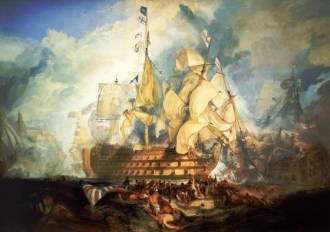
J.M.W. Turner, The Battle of Trafalgar, 21 October 1805, 1822-24 © National Maritime Museum, Greenwich, London
To coincide with a major exhibition of the work of J.M.W. Turner (1775-1851), Royal Museums Greenwich will host an innovative, interdisciplinary conference exploring the cultural impact of the sea in the 19th century. The exhibition will be the first full-scale examination of Turner’s lifelong preoccupation with the sea, and features many of the artist’s most celebrated works, from his transformative Academy paintings of the late 1790s and early 1800s to the unfinished, experimental seascapes he produced towards the end of his life.
Paintings on display will include Fishermen at Sea (Tate), The Wreck of a Transport Ship (Museu Calouste Gulbenkian), The Battle of Trafalgar (Royal Museums Greenwich), The Fighting ‘Temeraire’ (National Gallery), Snow Storm – Steam-Boat off a Harbour’s Mouth (Tate) and Whalers (Metropolitan Museum of Art). By placing these and other works alongside those by other British, European and American marine artists, the exhibition will give visitors the opportunity to discover the myriad ways in which Turner responded to the maritime art of the past while challenging his audiences with new ways of representing the sea. (more…)
Call for Papers | Visions of Enchantment
From the conference website:
Visions of Enchantment: Occultism, Spirituality and Visual Culture
University of Cambridge, 17-18 March 2014
Proposals due by 31 October 2013
This two-day event is a collaboration between the Department of History of Art, University of Cambridge and the Arts University Bournemouth and is organised in association with the European Society for the Study of Western Esotericism. The conference seeks to investigate the formative role that occultism and magic have played in Western and non-Western visual and material culture. It aims to present original research in this field as well as to establish a productive dialogue between academics with a particular research interest in occultism and visual
culture.
We invite proposals from a variety of disciplines and perspectives, provided that they present innovative insights into visual, symbolic or material aspects of the esoteric tradition. Acceptable topics may include, but are by no means limited to, the following areas:
• Alchemy and Hermetic symbolism
• Astrology and astrological illustrations
• The visual and material culture of witchcraft, black magic and sorcery
• Talismans, totems, fetishes and other apotropaic objects
• Occult and spiritual aspects of Jewish, Christian, Islamic and Hindu art
• Theosophy and modern visual culture
• The visual and material culture of other occult movements and societies
• Surrealism and the occult
• The influence of occultism and the spiritual on other avant-garde movements
• Occult art, counter-culture and radical/subversive politics
• Women artists and the occult
• Gendered, sexual and ‘queer’ ramifications of esoteric art
• Photography, spiritism, séances and automatic drawings/paintings
• The supernatural in performance, cinema, experimental film and video-installations
• Occultism and magic in contemporary visual culture
Papers should be 20 minutes in length and will be followed by a 10-minute Q&A session. Abstracts of no more than 500 words and a short bio-sketch of no more than 150 words should be sent as a single Word.doc to
enchantment2014@gmail.com by 31 October 2013. Early applications are encouraged.
We plan to publish the proceedings of this conference. Please indicate therefore whether you would be interested in further developing your paper for a publication of collected essays after the event.
Confirmed keynote speakers:
M. E. Warlick (University of Denver)
Emilie Savage-Smith (University of Oxford)
Marco Pasi (University of Amsterdam)
Sarah Turner (University of York)
For more information, please visit www.visionsofenchantment.com.
Call for Papers | Digital Art History Workshop
From the University of Leipzig:
Workshop | Art History: Research and Teaching Going Digital
University of Leipzig, 22 July — 2 August 2013
Proposals due by 15 June 2013
The 2013 European Summer School in Digital Humanities, focusing on Culture & Technology, is taking place at the University of Leipzig, 22 July-2 August 2013. It includes a workshop on “Art History: Research and Teaching Going Digital” organized by Elli Doulkaridou (PhD candidate in art history at the University of Paris I Panthéon-Sorbonne and a research assistant at the Institut national d’histoire de l’art) and Elaine Hoysted (doctoral candidate at University College, Cork). This joint workshop aims to question research and teaching practices in the field of art history in the digital age.
The first part of this course will be dedicated to investigating the challenges and opportunities that have emerged in the digital realm for scholars in art history. The second half will focus on an analysis of how these resources can be utilized as effective teaching and learning tools within the academic system. The fact that this is going to be a
joint course will allow us to focus on each theme but also bring them together during the collective discussions that will accompany the end of each course.
This workshop does not intend to propose technical training in the use of dedicated tools or encoding languages. Its purpose is to foster a collaborative reflection, in matters of art historical research and teaching methodology. We will be questioning the notion of digital art history through the study of various digital corpora, produced in different fields of art history, such as image databases, digital catalogs, scholarly critical editions, etc. Part of the course will also be dedicated to the commentary and collective debate of recent studies. (more…)
Call for Papers | Nun Artists in Early Modern Italy
Nun Artists in Early Modern Italy
Biblioteca Domenicana, Florence, 5 October 2013
Proposals due by 31 July 2013
Co-sponsored by the Medici Archive Project’s Jane Fortune Research Program on Women Artists and the Biblioteca Domenicana in Santa Maria Novella, this conference highlights new research on artistic production in female monastic communities since the early Renaissance until the Napoleonic suppression.
Demolishing older notions of enclosure as an absolute barrier between nuns and the world outside, recent research on social and religious aspects has begun to reinsert the convent within the wider networks of patronage and economic life in the early modern state, and to reposition it within larger civic and ecclesiastical discourses.
Presumably this model can also be applied to the study of nun artists. By framing research on nun artists and their activities within broader visions of society and material culture, we hope to arrive at a clearer understanding of the significance of nuns’ artistic production.
We welcome papers on a variety of topics regarding convents and their artistic production, from painting, to needlework, to carta pestata sculpture, to ephemera, to manuscript illumination. Suggested topics include but are not limited to:
• monographic studies on single artists
• studies of artistic practice in one or more female religious communities
• stylistic analysis and attributions of artworks
• studies of the visual culture of nun artists
• the role of art in the economic and patronage strategies of monastic communities
• the teaching of art in female religious communities
• comparisons between nuns’ artistic patronage their artistic production
• investigations of the relations and tensions between piety and artistic production
• historiographic studies of nun artists
Paper presentations, which must feature original research, may be given in Italian or English, and should be no longer than 20 minutes. A publication based on the conference papers is planned. Some support for travel expenses may be available. To apply, please send a one-page abstract and a brief c.v. to Dr. Sheila Barker (barker@medici.org) and Dr. Luciano Cinelli, O.P. (memorie.domenicane@gmail.com). The deadline for applications is July 31, 2013.
Conference | 300th Anniversary of Mandeville’s Fable of the Bees
From the conference website:
Eutopia Seated in the Brain: The 300th Anniversary of
Bernard de Mandeville’s The Fable of the Bees
Coimbra University, Portugal, 27-29 November 2013
Proposals due by 5 September 2013
Dutch physician with a literary, humanist formation, Bernard de Mandeville (1670-1733) is known as a portraitist of manners, a satirist and a fine observer of socio-economic behavior. From the perspective of the literary genre, B. Mandeville was a cultivator of the satirical fable, continuing La Fontaine and P. Scarron. His moral and political thought falls into several lines of the development of the European Enlightenment. His originality was only fully recognized many centuries later. One of his criticisms is related to Shaftesbury’s appreciation of virtue and moral sense in the Characteristics. The possibility of the contribution of pleasure and virtue for the formation of the human society, emphasized again in F. Hutcheson’s Remarks upon the Fable of the Bees, was the controversial point in Mandeville’s point of view. From his peculiar idea about the combination of virtue and the pure self-interest in social behavior evolved his idea of society. The modern sense of ‘interest’ had in B. de Mandeville a former inventor. Additionally, B. Mandeville has questioned the meaning of the connection between conscious actions with defined purposes and the objective results in the market of the autonomous individual drives. His depiction of the creation of social wealth reveals the relative independence of the objective results of individual actions regarding the initial purposes of the conscious agents. Luxury was one of the subjects that B. Mandeville addressed clearly. He tried to explain the imaginary mechanisms allied to the formation of luxury in the nations that explain why luxury cannot result from actions motivated solely by virtue or vice. (more…)
Call for Papers | Eighteenth-Century Fiction
The editors of Eighteenth-Century Fiction are interested in publishing occasional ‘image essays’ and welcome proposals. These pieces are often shorter than the average ECF research article, with some latitude for essay-like musings. Image essays complement the expanded mandate of Eighteenth-Century Fiction, which includes various media and cultural studies and provides ECF readers with examples of the editors’ very broad definition of ‘fiction’. Ideas and proposals can be submitted to ecf@mcmaster.ca.
Examples of past ECF image essays can be found here:
• Frank Felsenstein, “Unravelling Ann Mills: Some Notes on Gender Construction and Naval Heroism,” Eighteenth-Century Fiction 19.1 (2006), here»
• Maximillian E. Novak, “The Cave and the Grotto: Realist Form and Robinson Crusoe’s Imagined Interiors” Eighteenth-Century Fiction 20.3 (2008). here»
• and most of the recent special issue, Gestes admirables, ou la culture visuelle de l’imprimé, Eighteenth-Century Fiction 23.4 (2011).
Call for Papers | Bringing Art into Being in the Early Modern Period
Fifth Early Modern Symposium
Work in Progress: Bringing Art into Being in the Early Modern Period
The Courtauld Institute of Art, London, 26 October 2013
Organised by Anya Matthews and Giulia Martina Weston
Proposals due by 21 June 2013
Complex narratives spanning months, years or even decades exist behind the single bracketed date attached to artworks to indicate their moment of execution or completion. This one-day symposium will explore the ‘ante-natal’ development of early modern art from its conception to its ‘quickening’ and eventual birth. The process fascinated contemporary theorists and continues to raise questions for modern art historians. For example, when was an artistic project considered finished or unfinished? What terms were used to indicate the various stages of bringing an artwork into being, and what implications did these terms have for authorship and authenticity? The creation of art is not the work of a moment or achieved at a single stroke; it involves a series of transpositions from idea to study or plan, from sketch to painting, from plan to building and so on. How did early modern art reflect on the process of its own making?
We invite 20-minute papers considering artistic ‘work in progress’ in the early modern period (c.1550-1800): (more…)
Call for Papers | 2014 Society of Architectural Historians, Austin
From SAH:
Society of Architectural Historians 67th Annual Conference
Austin, Texas, 9-13 April 2014
Proposals due by 1 June 2013
The Society of Architectural Historians is now accepting abstracts for its 67th Annual Conference in Austin, TX, April 9-13, 2014. Please submit abstracts no later than June 1st for one of the 31 thematic sessions or open sessions. Sessions have been selected to cover topics across all time periods and architectural styles. SAH encourages submissions from architectural, landscape, and urban historians; museum curators; preservationists; independent scholars; architects; and members of partner organizations.
Please submit abstracts of no more than 300 words no later than June 1st for one of the 31 thematic sessions. There will also be open sessions for those whose research does not match any of the themed sessions.
◊ ◊ ◊ ◊ ◊
An example of one of the thematic sessions:
The Elusive Gothic in the Long 18th Century
Chairs: Sylvia Shorto, American University of Beirut, ss56@aub.edu.lb; and Zirwat Chowdhury, Clark Memorial Library, UCLA, zirwat@u.northwestern.edu
By the later 18th century, Gothic architecture had already called attention to its own alterity. Western opinions as to its possible Eastern origins were mixed: British academician Thomas Sandby’s lectures disputed Sir Christopher Wren’s earlier genealogy of the Gothic, whilst the painter William Hodges embraced and furthered the position in his Dissertation on the Prototypes of Architecture, Hindoo, Moorish, and Gothic (1786). Meanwhile, antiquarians were busy reconfiguring the Gothic canon with localised studies, new designs and restoration. Later, in the mid-19th century, John Ruskin and his followers would champion a nostalgic and value-laden way of thinking about a past which privileged things made locally and by hand, resulting in the separation between pre-modern and modern, architecture and vernacular building, design and workmanship: false dichotomies that would become cemented in a Modernist historiography of architecture. There were no such artificial distinctions in the manifold awareness of the late 18th-century Gothic.
As a way of registering alternative histories at this transitional stage to industrial making, this session will explore the heterogeneity of the Gothic in Britain and Europe, in their expanding imperial territories, and in contemporary non-Western empires during the long 18th century. While we invite papers that use the Gothic to widen the current discourse on the handmade, topics might also address, but are not limited to, shifts in the antiquarian imagination; revolutionary aesthetics; notions of decay and decline; the peripatetic Gothic; nascent architectural preservation in Europe and its empires; and the material relationships between neoclassicism and Gothic. We especially welcome submissions that address non-European interlocutors of Gothic styles, and that incorporate the use of painting and other visual media in furthering understanding of the topic.
Call for Papers | The Sites of Opera
From Calenda (published 17 April 2013) and Le Blog de l’ApAhAu (with thanks to Pierre-Henri Biger). . .
Les lieux de l’opéra (XVIIe-XXIe siècle)
Opéra-comique, Paris, 21-23 November 2013
Proposals due by 15 May 2013
Alors que l’on observe depuis plusieurs années un rapprochement entre musicologues et historiens pour aborder la dimension spatiale et sociale des lieux de musique, les lieux de l’opéra n’ont guère fait l’objet d’une approche interdisciplinaire. Observés sous un angle unique, le plus souvent celui de l’architecture monumentale occupant une place à part dans l’espace urbain, ces lieux de spectacle méritent pourtant d’être abordés de façon plurielle. Ils doivent faire l’objet d’une réflexion prenant en compte la complexité des problématiques liées à ces espaces particuliers, qui sont eux-mêmes multiples. Destinés à accueillir des manifestations liant musique et théâtre, ils se prêtent également au jeu de la sociabilité aristocratique dans un premier temps, puis bourgeoise et, dans une certaine mesure, populaire. Intrinsèquement liés à la ville, ces lieux peuvent aussi être ceux offerts par une villa vénitienne, un manoir anglais ou un théâtre de verdure, reconsidérant l’image d’un espace perçu a priori comme essentiellement urbain. De même, si l’opéra est une forme lyrique traditionnellement représentée dans des lieux clos, de nombreuses expériences ont montré, dès le xviie siècle, qu’il pouvait s’épanouir en plein air, ce qui pose la question des rapports entre forme musicale et lieu d’exécution. Une étude des lieux de l’opéra permettra également de mener une réflexion sur la mutation des pratiques culturelles et sociales de la musique entre les XVIIe et XXe siècles, mutation en partie liée à la transformation des espaces qui hébergent et structurent l’activité musicale. (more…)
Call for Papers and Session Topics | CAA and ASECS, 2014
The original May 6 deadline for paper proposals for CAA 2014 in Chicago has been extended to May 13 (thanks, Alicia, for the clarification). More information is available here»
The deadline for proposing a session at ASECS 2014 in Williamsburg has been extended until 1 June 2013. More information is available here»










leave a comment