Call for Papers | Gender and the Hunt
From ArtHist.net:
Hunting Troubles: Gender and Its Intersections in the Cultural History of the Hunt
Flüchtige Identitäten: Jagd als Schauplatz geschlechtlicher Phantasien
Online, Bremen, 12–14 May 2022
Proposals due by 31 December 2021
Hunting has always been an arena of gender fantasies. Its function as a social practice and aesthetically orchestrated event far outweighed its significance in terms of food procurement or defense against wild animals—this was not only the case in European cultural history. The pursuit and killing of animals were above all an area where physical, cognitive, and social superiority were demonstrated. Hunting therefore created and reinforced images of the ‘masculine’ as well as the ‘feminine’. Countless ancient myths focus on male heroes whose political and sexual violence is linked to images of the hunt. At the same time, however, hunting is not always and unquestionably associated with masculinity. The same myths are also populated by hunting women—such as the Greek goddess Artemis, her nymphs Daphne, Kalisto and Echo, and mortals such as Atalante, who, after gaining access to a male hunting party through her lover, decisively wounds the Calydonian boar. Later on, in the Minnelieder songs of the Middle Ages, lovers engage in an erotic chase during which the role of the hunter and the hunted seem—at times—interchangeable. And the carefully orchestrated portraits of early modern princesses in hunting costumes bear as much witness to the subversion of gender roles as the (self-) representations of colonial huntresses since the nineteenth century.
As a symbol and technique that—in itself—seemed to gesture towards asymmetrical power structures, hunting has always served to naturalise gender difference and binarity. However, hunts and their representations always seem to open up spaces in which gender and other boundaries are not only established and consolidated, but also unsettled and blurred. Both the young man Leukippos in the ancient myth who disguises himself as a woman in order to gain access to the virgin nymph’s hunting party and the male animal in Ernst Jünger’s short story “Die Eberjagd” (“The Boar Hunt”) (1952) that is, at the moment of the kill, are transformed and can be read as ‘female’. There is an—albeit temporary—ambiguity of gender boundaries, a floundering, which seems—if not inevitably but repeatedly—to go hand in hand with the principal liminality of the hunting situation and its stagings.
These ambivalences of hunting as a cultural and symbolic practice as well as its aesthetic (literary, artistic, performative) stagings are the starting point of the conference and the publication project, which is designed to give an extensive overview of the interrelations between gender and the hunt in European cultural history. From a historical as well as intersectional perspective, we wish to examine how the interplay between actual hunting and its representations reinforced and/or destabilized certain gender images. The focus will be on the following intersecting approaches:
Hunting practices
What role did different hunting practices and their stagings play in the construction of gender identities? When and why were which hunting practices considered specifically ‘male’ or ‘female’? Which historical caesurae inform the history of gender images when it comes to hunting: are there historical constants, epochal changes and regional differences that can be identified?
Men’s Worlds
Which concepts of masculinity have been produced through the practice and representation of the hunt? Which customs, techniques and laws made hunting an effective means of demonstrating and narrating virility? Are these narratives tied to specific artistic genres? How were notions of gender difference naturalised through hunting? Which homoerotic constellations did hunting produce and sublimate?
Women on the Hunt
Which concepts of femininity were produced through hunting, its performance and aesthetic representation? Under what social and political conditions could women reinterpret hunting semantics or subvert heteronormative relations? Are narratives of female hunting bound to certain artistic genres, genres, etc. or excluded from them, and, if so, why? What needs (or fears) were expressed by narratives of mythical female hunters and the omnipresence of Artemis/Diana in images, buildings or festivals of hunting?
Female, Male, and Other Animals
How did the relationship to wild or domestic animals such as horses and dogs affirm or subvert heteronormative gender notions? How was the pronounced sexual dimorphism reflected – especially in cases where the larger females were the preferred hunting animals, such as in the case of the goshawk or sparrowhawk? Which role did the gender of hunted animals play in empathic descriptions of the hunter’s desire and identification with the pursued animal?
Intersectional Perspectives
To what extent is the relationship between ‘human’ and ‘animal’, ‘nature’ and ‘culture’ as well as ‘foreign’ and ‘familiar’ in literary and artistic representations of hunting gendered and to what extent is this subject to historical change? In which constellations did hunting as a technique of demonstrating superiority in terms of gender, class and race reach its limits? Did hunting also produce non-binary (gender) constellations and/or transcultural situations? To what extent are these also partly intertwined with the transgression or consolidation of social boundaries?
For these and related questions, we especially ask for suggestions for topics in literature, art and cultural studies, history, and other fields. To submit send a 250-word abstract for a 20- or 30-minute paper (English/German) and a short bio to Dr. Laura Beck (laura.beck@uni-bremen.de) and Prof. Dr. Maurice Saß (Maurice.Sass@alanus.edu) before 31 December 2021. Please name one of the approaches above (hunting practices, men‘s worlds, etc.) to which you would assign your proposal. Partial reimbursements of travel and/or stay may be offered. After the conference we would like to publish the results in an anthology as soon as possible.
Schedule
Deadline for submissions: 31 December 2021
Applicants will be notified by 10 January 2022
Date of the conference (online or presentational in Bremen, Germany): 12–14 May 2022
Deadline for submission of manuscripts: 1 November 2022
◊ ◊ ◊ ◊ ◊
Note (added 13 January 2024) — The conference was part of the activities of the Cultural History of the Hunt research network (Netzwerk Jagdgeschichten).
Call for Papers | Women and Religion in Eighteenth-Century France

After Magdeleine Horthemels, Burial of Nuns at the Abbey of Port-Royal-des-Champs (Musée de Port-Royal des Champs).
◊ ◊ ◊ ◊ ◊
From the Call for Papers:
Women and Religion in Eighteenth-Century France: Ideas, Controversies, and Representations
In-Person and Online, Queen Mary, University of London, 24 June 2022
Organized by Marie Giraud and Cathleen Mair
Proposals due by 21 January 2022
In the decades since Peter Gay argued that religion occupied no place in the French Enlightenment, scholars including Dale Van Kley, Suzanne Desan, and Mita Choudhury have shown how religious beliefs and controversies informed philosophical ideas, political practices, social relations, and cultural identities in eighteenth-century France.
Owing to this scholarship, it has also become clear that women of faith—from the Jansenist nuns forcibly removed from Port-Royal to the Carmelites guillotined during The Terror—played an important role in French social, cultural, and political life in the period. Representations of convents took on new and urgent meanings amidst mounting political and financial pressure on the Ancien Régime. Influential women on the peripheries of religion were instrumental in the dissemination of controversial beliefs and new philosophical ideas, like the Protestant salonnière Mme Necker who hosted celebrated writers and academicians at her home and Mlle de Joncoux, known as l’invisible, who devoted her life to defending the nuns of Port-Royal. In the revolutionary period, nuns challenged the suppression of religious orders while Catholic women became symbols of resistance in the religious riots of the late 1790s.
Drawing on new approaches and sources, this interdisciplinary workshop will consider the identities, controversies, ideas, experiences, and representations of religious women in eighteenth-century France. What role did these women play in the political and intellectual culture of the Ancien Régime and the French Revolution? How did they and their supporters or enemies navigate a period of extraordinary social change and political upheaval? In what ways did they adopt, challenge, or subvert the religious canon, cultural norms, and societal conventions as the understanding of religion, politics, and power shifted rapidly throughout the eighteenth century?
We invite proposals for twenty-minute papers from scholars in History or related disciplines such as Art History, Gender and Sexuality Studies, Literary Studies, and Theology. We especially welcome proposals from graduate and early career researchers. Proposals for papers may wish to consider the following themes:
• Devotional and liturgical practices
• The circulation of religious ideas, books, and objects
• Representations of women religious in art, literature, and material culture
• Education
• Charity and nursing
• Interdenominational relations
• The relationship between religious orders and the state
• Marriage and motherhood
• Popular and lay religion
• Emotions and bodies
To apply, please email your abstract and a brief bio to m.s.giraud@qmul.ac.uk and c.i.mair@qmul.ac.uk by 21 January 2022. Abstracts should be no more than 250 words for papers of 20 minutes in length. Please specify whether you would prefer to present in person or online. The symposium will take place in hybrid format, meaning speakers can attend in person or virtually via Microsoft Teams. The symposium will be free to attend and all speakers will be invited to dinner. Travel grants will be available to support PhD and ECR scholars speaking at the workshop. For more information, please visit the symposium website.
Keynote Speaker: Professor Mita Choudhury (Vassar College)
Call for Papers | Water / Landscapes: Ecologies of the Fluid
From the posting at ArtHist.net (which includes the German version) . . .
Water / Landscapes: Ecologies of the Fluid, circa 1800
Wasser / Landschaften: Ökologien des Fluiden um 1800
A Conference of the Rhine-Main-Universities Initiative Romantische Ökologien
7–9 July 2022, Research Center, Bad Homburg
Proposals due by 30 November 2021
Wherever literary, pictorial, musical, or even horticultural depictions of the landscape are to be found in the Romantic period, there too, is the element of water: whether in sweeping and meandering streams or artfully arranged ponds and waterfalls within landscape gardens; mirror-smooth coastal and lake-surfaces reflecting the sun- or moonlight (either with summer brightness or in eerier shades); from wind-whipped sea tides and ocean waves; whispering brooks brimming with whimsical trout, or rivers like the Rhine, Main, Neckar, Thames, Seine, or Nile, welcome-beacons to all prospective barge- and ship-farers and invitations to imagine, paint, and compose poetry. Water-surfaces, water elements, and water spectacles are constitutive to a Romantic understanding of ‘landscape’.
Through these waterscapes of Romanticism—and more generally, those from the years around 1800—a (proto-)ecological understanding of the interplay between inorganic and organic entities in locally defined spaces comes into view and is first articulated. The connection nonetheless remains to be investigated further. To be sure, the Environmental Humanities have recognized the literature, philosophy, and science around 1800 as originators of modern ecological theorems and environmental consciousness. Nonetheless, the role that can be attributed to water—to the biotopes and conditions of existence attached to it—is still unclear. This is all the more astonishing as discussions and imaginations of the significance of water for life and the living in general, and specifically for the reciprocal, developmental, and transformative relationships between organisms and water (and hydrogen), was certainly encouraged by both the natural sciences (physics, geology, and in philosophy/ies of nature) as well as in literature and the arts around 1800 more generally. In particular, the realization that life and living forms not only consolidate in water, but that medial approaches are simultaneously necessary to make these interdependencies and interrelationships visible is decisive—Andersen’s fairy tale of water drops (Danish: Vanddraaben, 1847) beneath the magnifying glass brings this into view in a particularly impressive way.
Moreover, water landscapes help bring together the constantly interwoven levels of the semiotic and the material, of sonic and the phonetic (linguistic), and of literal and metaphorical meaning: Within landscape poems, the splash, bubble, spring, flood, flow, rush, and surge are not only the acts of waterworks and water surfaces; rather, diverse actors, their distinct modes of being and movement, become entangled and affected by each other, as they converge, mingle, and disperse again. Animals, plants, air, soil, and light make up an ensemble, which is brought into contact and co-constituted by water. Its activity and vitality, much like any form of landscape, is made possible only through water. More pointedly, the period from about 1750 to 1850 launches epistemological and aesthetic formations which recognize that without water, landscapes and living forms are unthinkable and unrepresentable.
The conference explores the ecological dimensions of the fluid in the period around 1800, taking the concept ‘water|landscapes’ as its point of departure. The focus will consist of various ‘water sites’, ranging from rain-bearing cloud formations to water puddles and bogs to river courses and marine spaces. It will bring into play extremely heterogenous aesthetic programs (e.g., the sublime or the locus amoenus), genres (idylls, river and seafaring ballads, garden poems, landscape prose and landscape painting discourse, nature essays, etc.) places (national and international, fantastic and realistic etc.), times, and traditions (Greek and Germanic mythology, Middle Ages). The basic thesis of the conference is that Romantic literatures and images stage, reflect, and negotiate the interplay of (living) elements and beings around/in water.
We are interested in contributions that inquire into historical knowledges about and aesthetic approaches to water, aquatic habitats, and habitats in the period around 1800, especially as relating to theories, figures of thought, and forms of representation of the ecological. Points of departure and catalysts for research can be found not only in the field of Romantic Ecocriticism but also in Hydro-Criticism and the Blue Humanities. European and International Romanticism is thereby an important, though not exclusive, reference point. Our interest is in the diversity of representations and theories surrounding water and its proto-ecological dimensions around 1800; all proposals that focus on water|scapes in text, as image, or as a jumping-off point for discussions between 1750 and 1850 are welcome.
Please send your abstract (max. 500 words) for a 25-minute talk and short bio and bibliographical notes in one single document to all three organisers (borgards@lingua.uni-frankfurt.de; middelhoff@em.uni-frankfurt.de; thums@uni-mainz.de) until 30 November 2021. A publication of selected talks is planned. The conference is scheduled as an in-presence event at the Research Center’s Villa Reimers in Bad Homburg. Travel and accommodation costs can—if needed—be reimbursed.
Organisers
Prof. Dr. Roland Borgards (Goethe-University Frankfurt)
Prof. Dr. Frederike Middelhoff (Goethe-University Frankfurt)
Prof. Dr. Barbara Thums (Johannes Gutenberg-University Mainz)
Contact
Frederike Middelhoff (W1-Professur für Neuere Deutsche Literatur mit dem Schwerpunkt Romantikforschung)
Goethe-Universität Frankfurt
Institut für deutsche Literatur und ihre Didaktik
Campus Westend // IG-Farben-Haus // Postfach 17
Norbert-Wollheim-Platz 1
60323 Frankfurt am Main
middelhoff@em.uni-frankfurt.de
Selected Bibliography
Alaimo, Stacy. “Oceanic Origins, Plastic Activism, and New Materialism at Sea.” In Material Ecocriticism, ed. Serenella Iovino, Serpil Oppermann. Bloomington 2014, pp. 186–203.
Böhme, Hartmut (ed.). Kulturgeschichte des Wassers. Frankfurt am Main 1988.
Böhme, Hartmut. “Wolken, Wasser, Stein. Zur Ästhetik der Landschaft, in: semina rerum (1999), pp. 1–7.
Briški, Javor und Irna Marija Samide (eds.). The Meeting of Waters: Fluide Räume in Literatur und Kultur. Munich 2015.
Bunzel, Wolfgang (ed.). Romantik an Rhein und Main: Eine Topographie. Darmstadt 2014.
Costlow, Jan, Yrjö Haila, Arja Rosenholm (eds.). Water in Social Imagination: From Technological Optimism to Contemporary Environmentalism. Ann Arbor 2017.
Cohen, Margaret and Killian Quigley (eds.). The Aesthetics of the Undersea. London, New York 2019.
Davies, Jeremy. “Romantic Ecocriticism: History and Prospects.” In Literature Compass (2018), pp. 1–15.
Deloughrey, Elisabeth. “Towards a Critical Ocean Studies for the Anthropocene.” In English Language Notes 57:1 (2019), pp. 22–36.
Detering, Heinrich. “Der Weiher als Ökosystem.” In: id.: Holzfrevel und Heilsverlust: Die ökologische Dichtung der Annette von Droste-Hülshoff. Göttingen 2021, pp. 46–60.
Goodbody, Axel and Berbeli Wanning (ed.). Wasser – Kultur – Ökologie: Beiträge zum Wandel mit dem Wasser und zu seiner literarischen Imagination. Göttingen 2008.
Garde-Hansen, Joanne. Media and Water: Communication, Culture, and Perception. London, 2021.
Görner, Rüdiger. “‘Hörst du das Alphorn überm blauen See?’ Aquafine Zeichen in der Lyrik Anette von Droste-Hülshoffs.” In Jahrbuch des Franz-Michael-Felder Archivs 20 (2019), pp. 16–29.
Häusler, Wolfgang. “Zwischen Naturwissenschaft, Heiliger Schrift und Historie. Beobachtungen zur Funktion des Wassers im Wer Adalbert Stifters.” In Jahrbuch des Adalbert-Stifter-Instituts 16 (2009), pp. 101–114.
Honold, Alexander. “Zwischen Wasser und Poesie. Brentanos Stromkreislauf.” In Gabe, Tausch, Verwandlung. Übertragungsökonomien im Werk Clemens Brentanos, ed. Ulrike Landfester. Würzburg 2009, pp. 127–141.
Jacobs, Mary. Romantic Things: A Tree, a Rock, a Cloud. Chicago 2012.
Jue, Melody. Wild Blue Media: Thinking through Seawater. Durham 2020.
Kramer, Anke. “Hydrographie der Zeit. Erlebte Zeit bei Annette von Droste-Hülshoff, Henri Bergson und Johannes Müller.” In ZwischenZeiten. Zur Poetik der Zeitlichkeit in der Literatur der Annette von Droste-Hülshoff und der ‚Biedermeier‘-Epoche, ed. Cornelia Blasberg and Jochen Grywatsch. Hannover 2013, pp. 189–209.
Kramer, Anke. “Elementargeister und die Grenzen des Menschlichen. Agierende Materie in Fouqués Undine.” In: Mensch – Maschine – Tier: Entwürfe posthumaner Interaktionen (= Beiheft PhiN 10/2016), ed. Christa Grewe-Volpp, Evi Zemanek, pp. 104–124. http://web.fu-berlin.de/phin/beiheft10/b10t08.pdf.
Kraß, Andreas. Meerjungfrauen: Geschichten einer unmöglichen Liebe. Frankfurt am Main 2010.
McKusick, James. Green Writing: Romanticism and Ecology. Basingstoke 2000.
Pape, Walter (ed.). Romantische Metaphorik des Fließens: Körper, Seele, Poesie. Tübingen 2007.
Ritson, Katie. “The View from the Sea: The Power of a Blue Comparative Literature.” In Humanities 9/3/68 (2020) https://doi.org/10.3390/h9030068.
Ritson, Katie. The Shifting Sands of the North Sea Lowlands: Literary and Historical Imaginaries. London 2018.
Robbins, Nicholas. “Ruskin, Whistler, and the Climate of Art in 1884.” In Ruskin’s Ecologies: Figures of Relation from Modern Painters to the Storm-Cloud, ed. Kelly Freeman Thomas Hughes. London 2021, pp. 203–223.
Call for Papers | Exploring the Mental World of the Country House
From the Call for Papers:
Exploring the Mental World of the Country House
20th Annual Historic Houses International Conference
Centre for the Study of Historic Irish Houses and Estates, Maynooth University, 9–11 May 2022
Proposals due by 19 November 2021
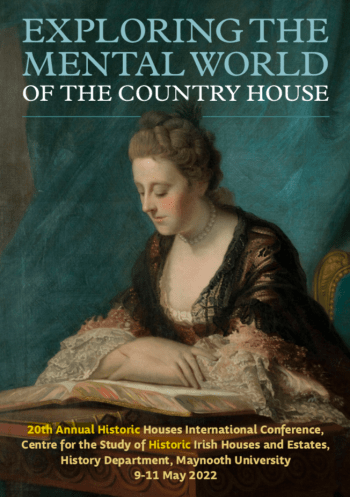 Country houses are masterpieces of material culture, they are triumphs of architecture, fine and decorative art, and landscape design, but they are also about the history and transmission of ideas.
In varying degrees their occupants (above and below stairs, indoors and outdoors) thought, conversed, read, and responded to their milieu through books, newspapers, as well as other media and forms of knowledge. In recent years country house libraries and archives have steadily revealed more evidence for how people in country houses fashioned themselves and their views of the world. In 2022 the Twentieth Annual Historic Houses Conference will examine the intellectual background to the country house. What is the meaning of all those volumes in bookcases, did they do more than just decorate a room? How were they acquired, read, and put to use?
By what means did elite society exchange ideas, absorb new trends, and engage in wider debate, especially when at home in the country? To what degree was this knowledge valued and displayed in terms of stylish library design, and how did houses preserve, or neglect, their books and other records? How did members of a household entertain or better themselves, what was popular to read with whom —men, women and children? The classics, natural history, literature, genealogy, fiction, and other subjects feature in many country house libraries, and very often a battered, plain copy of a publication will reveal more than the most pristine edition in a lavish ornamental binding. In what ways did books furnish minds as well as interiors?
Beyond the demesne walls how has the world of the country house been perceived and understood in fiction, poetry, drama and, more recently, film? How have these treatments shaped a wider understanding of the country house as a cultural and literary phenomenon? Exploring the Mental World of the Country House will examine these and other related questions, and mark the twentieth anniversary of the Centre; the conference is likely to be a mix of real and online proceedings. Papers on any of the above topics relating to country houses in Ireland, the UK, Europe, or further afield will be considered. Abstracts of no more than 400 words should be sent to Professor Terence Dooley and Professor Christopher Ridgway before 19 November 2021 at the following addresses: terence.a.dooley@mu.ie and cridgway@castlehoward.co.uk.
Call for Papers | Grinling Gibbons and the Story of Carving
From ArtHist.net (5 October 2021) . . .
Grinling Gibbons and the Story of Carving
Victoria and Albert Museum, London, 24–25 June 2022
Organized by Jenny Saunt, Kira d’Alburquerque, and Ada de Wit
Proposals due by 10 January 2022
Grinling Gibbons (1648–1721) is the most celebrated carver in British history. His closely observed depictions of full-bodied natural forms, executed in hyperreal detail, captivated audiences of his own time as much as they captivate us today. But how much is really known about this man, his work, and its implications in terms of the way we think about carving now? As part of the year-long Gibbons tercentenary celebrations of 2021/22, this conference explores the story of Gibbons but also investigates broader themes around the subject of carving in a European context from 1600 to 1800.
On day one, an invited panel of speakers will present the latest research on Grinling Gibbons and his work. For the second day, we invite papers that explore all aspects of the processes of production and design in the story of carving in early modern Britain and in terms of international exchanges. Topics of interest are wide ranging and include design, sources, materials, methods, training, tools, techniques, business and workshop structures, branding, professional networks, and nineteenth- and twentieth century engagement with and reinterpretation of the carved work produced in this period. Intersections and interactions are of particular interest. In what ways did the lives and careers of practitioners contemporary to Grinling Gibbons and the careers of his assistants and apprentices relate to each other and how did this impact the work produced? What were the exchanges between carving and other related disciplines of the time, such as ship building, furniture production and frame making? Using examples of early modern practice, how can we expand our understanding of the meaning of design sources and processes, be that through print or other material or social cultures of the time; how did these interplay and how can they be questioned and quantified? How can we develop methodologies to investigate these makers and their understanding of their own working processes, their relationships with materials and tools, and what new insights can be gained from this type of exploration? How did such factors work together to create the type of physical forms that are so recognisable as the product of Gibbons’ world?
Papers should be 20 minutes in length and include a PowerPoint. Please send an abstract of 250–300 words, with name, title, institution, and short bio (100 words max) to grinling.gibbons@vam.ac.uk. The deadline for paper proposals is 10th January 2022. Notification for acceptance will be sent by 7th February 2022.
Call for Papers | The 17th and 18th Centuries at the Accademia

Giovanni Battista Tiepolo, The Scourge of the Serpents (detail), 1732–35, oil on canvas
(Venice: Gallerie dell’Accademia)
◊ ◊ ◊ ◊ ◊
From ArtHist.net and the Accademia:
The Seventeenth and Eighteenth Centuries at the Gallerie dell’Accademia: New Studies
Gallerie dell’Accademia, Venice, 22–23 February 2022
Organized by Giulio Manieri Elia and Michele Nicolaci
Proposals due by 10 December 2021
The inauguration of the new Seicento and Settecento rooms at the Gallerie dell’Accademia represents a fundamental part of the re-installation of the museum’s collections that has finally been completed with the ground floor organized around 13 rooms, with a chronological arc from the seventeenth to the ninenteenth centuries. Among the 62 works now visible to the public—including absolute highlights of the period’s artistic production—many are included in the museum itinerary for the first time, and many have returned to view after significant restoration campaigns. The long gestation of this moment has enabled scrupulous examination of the works, stimulating new research and unexpected discoveries, and a rich dialogue between the museum and both the Italian and international scholarly communities.
The reopening of these spaces, which singularly represent the art of painting over these two centuries, should be considered a cue for new departures, a field of investigation for new research. Plenty of the works remain little known, and many diverse and fascinating themes merit further research: from authorship to dating, from patronage to provenance, from iconographic questions to those linked to the materials and techniques of painting and restoration history. To further this endeavour, the Gallerie will organize a workshop intended as an opportunity to share inquiries and to enrich our knowledge about the museum’s patrimony with the aim of attracting the most innovative and cutting-edge studies on the Seicento and Settecento works in the Gallerie dell’Accademia. The conference will foreground not only artworks hanging in the new rooms 5 and 6, but also the rest of the display, as well as the many works in the museum’s stores and those visible in other institutions in Venice and the Veneto (external stores). It is further hoped that the meeting will constitute a preliminary contribution to complex effort of updating the catalogue raisonné of the collections.
The workshop will be held in the Gallerie dell’Accademia over two days, one dedicated to the Seicento and one to the Settecento, with individual talks lasting 30 minutes. A portion of the conference will address restoration conducted in the museum, providing the opportunity to share conservation discoveries, doubts, and decisions with the workshop participants. The conference will take place in person, with a limited number of places available respecting the rules in place with regards to the containment of the diffusion of Covid 19 (distancing, masks, and other measures required by relevant safety protocols). Plans are also in progress for the transmission of the talks via the YouTube channel of the museum.
Candidates who wish to present should send an abstract of no more than two pages and a brief CV, in Italian or English. Research concentrating on one or more works in the museum will be privileged along with talks that significantly and concretely advance the current state of knowledge, or which offer a novel approach to understanding the works, their original context, creation, or material history. Participants may expect the costs of travel and stay in Venice to be partially or totally covered. Publication of the conference proceedings is foreseen. Proposals should be sent to michele.nicolaci@beniculturali.it by the 10th of December 2021.
Call for Papers | Emerging Scholars Showcase, Fall 2021
From HECAA:
HECAA Emerging Scholars Showcase
Online, 13 November 2021
Proposals due by 3 October 2021
Building on the success of last year’s Emerging Scholars Showcase (7 November, 6 February, and 17 April)—with kudos to Dani Ezor—the Historians of Eighteenth-Century Art and Architecture (HECAA) is pleased to again invite emerging scholars studying the art, architecture, and visual culture of the long eighteenth century around the globe to participate in a virtual showcase. Our hope is to provide a platform for early career scholars to promote their own research, as well as a forum for networking opportunity and ongoing community building.
Each scholar will be given 3–5 minutes to present their work, followed by an open question and answer session. This year’s Emerging Scholars Showcase will be held on Saturday, 13 November 2021, though additional sessions may be added depending on interest. To apply, please fill out this form. Applications are due by Sunday, 3 October, at midnight (EST). Please direct any questions to Daniella Berman, daniella.berman@nyu.edu.
Emerging Scholars do not need to be current HECAA members and may be current graduate students (MAs or PhDs) and those who have received their PhDs in the past five years, so please circulate this call as appropriate. If you are interested in helping to organize the HECAA Emerging Scholars Showcase, please also contact Daniella Berman (the current HECAA graduate student board member at-large).
Call for Papers | ASECS 2022, Baltimore
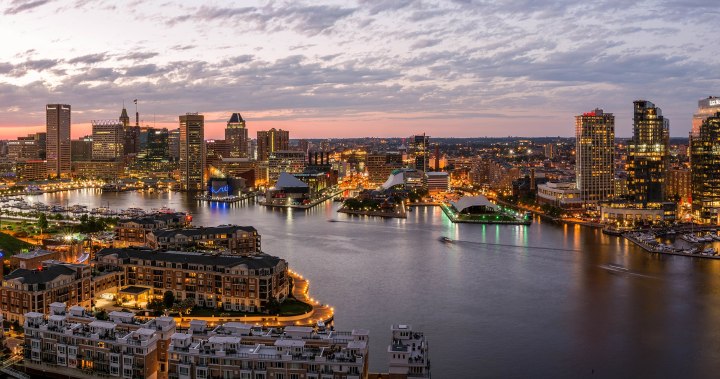
Baltimore’s Inner Harbor
(Photo by Patrick Gillespie, September 2016; Wikimedia Commons)
◊ ◊ ◊ ◊ ◊
Please note that the deadline has been extended to 8 October; you still have time!
2022 American Society for Eighteenth-Century Studies Conference
Hilton Baltimore Inner Harbor, 31 March — 2 April 2022
Proposals due by 8 October 2021 (extended from the original date of 17 September)
Proposals for papers to be presented at the annual meeting of the American Society for Eighteenth-Century Studies, in Baltimore, are now being accepted. Proposals should be sent directly to the session chairs no later than 17 September 2021. Along with our annual business meeting, HECAA will be represented with the Anne Schroder New Scholars Session, chaired by Dipti Khera and Aaron Wile (see #173). A selection of additional sessions that might be relevant for HECAA members is included here. A full list of panels is available as a PDF file here.
Call for Papers | Sequitur (Fall 2021): Aftershock
Sequitur 8.1 (Fall 2021): Aftershock
Submissions and Proposals due by 18 October 2021
The editors of Sequitur, a graduate student journal published by the Department of History of Art & Architecture at Boston University, invite current and recent graduate students to submit content on the theme of Aftershock for our Fall 2021 issue.
For some, this past year and a half was marked by painful experiences. For others, lockdown and physical distancing created opportunities to reevaluate the importance of the social bonds that compose our lives. Since the start of the pandemic, we have experienced history in the making. As we adjust to a ‘new normal’, urgent questions remain about the aftershock of the recent past on our personal and collective experiences. Is the pandemic over; is it yet a thing of the past? How will we and generations to come remember the lost lives, jobs, rituals, and routines?
At this pivotal moment in the fight against the surging Delta variant, and coming on the heels of the tumultuous exit from Afghanistan and the twentieth anniversary of 9/11, we hope to bring together emerging scholarship that considers how art, architecture, and material culture respond to and address the immediate and/or long-term consequences of distressing and traumatic events.
Possible subjects may include, but are not limited to: the after-effects of natural and man-made disasters; social upheavals, economic crises, military conflicts, and unforeseeable events; calamities, and cataclysms; experiences of disorder, trauma, and post-trauma; the fall of civilizations, ruins, decay, and decomposition; structural shifts; monuments, memorials, and forms of commemoration and reparation; pandemics; humanitarian aid and relief efforts; survival and resilience; repairs, recovery, and reconstruction; enduring legacies; rebirth and rejuvenation; reencounters, reconciliations, recomposition of social bonds, and community building; and visions of the future.
We welcome submissions from graduate students in the disciplines of art history, architecture, archaeology, material culture, visual culture, literary studies, queer and gender studies, disability studies, memory studies, and environmental studies, among others, to apply. We encourage submissions that take advantage of the digital format of the journal. Previous issues of Sequitur can be found here.
Founded in 2014, Sequitur is an online biannual scholarly journal dedicated to addressing events, issues, and personalities in art and architectural history. Sequitur engages with and expands current conversations in the field by promoting the perspectives of graduate students from around the world. It seeks to contribute to existing scholarship by focusing on valuable but often overlooked parts of art and architectural history.
We invite full submissions in the following categories:
• Featured essays (1,500 words)
Essays must be submitted in full by the deadline below to be considered for publication. Content should present original material that falls within the stipulated word limit. Please adhere to the formatting guidelines available here.
• Visual and creative essays
We invite M.Arch. or M.F.A. students to showcase a selection of original work. The work must be reproducible in a digital format. Submissions should include .jpegs of up to ten works and must be prefaced by an introduction or artist’s statement of 250 words or less. All images must be captioned and should be at least 500 DPI. We are open to expanding this field to involve various kinds of creative projects.
We invite proposals (200 words max) for the following pieces:
• Exhibition reviews (500 words)
• Exhibitions currently on display or very recently closed are especially sought.
• Book or exhibition catalogue reviews (500 words)
• Reviews of recently published books and catalogues are especially sought.
• Interviews (750 words)
Preference may be given to those who can provide audio or video recordings of the interview. The author must include a full transcript.
• Research spotlights (750 words)
Short summaries of ongoing research written in a more casual format than a formal paper.
When submitting, please remember:
• All submissions and proposals are due by 18 October 2021.
• Direct all materials to sequitur@bu.edu.
• Text must be in the form of a Word document, and images should be sent as .jpeg files. While we welcome as many images as possible, at least one must be very high resolution and large format.
• Please adhere to the formatting guidelines available here.
• Include a recent CV and a brief 50-word bio.
• Include ‘SEQUITUR Fall 2021’ and type of submission/proposal in the subject line, and your name, institution and program, year in program, and contact information in the body of the email.
Authors will be notified of the acceptance of their submission or proposal no later than 22 October 2021, for publication in January 2022. Please note that authors are responsible for obtaining all image copyright releases before publication. If you have any questions, please do not hesitate to contact the Sequitur editors at sequitur@bu.edu.
Call for Papers | AAH 2022, London

Sessions of potential interest for folks working on the eighteenth century (see especially the panel chaired by Emma Barker and Carla Benzan); full offersings are available here:
Association for Art Historians Annual Conference
Goldsmiths, University of London, 6–8 April 2022
Proposals due by 1 November 2021
The Association for Art History’s 2022 Annual Conference will take place in London at the world renowned art college, Goldsmiths. Over the three days of the conference, there will be up to 36 live parallel sessions with 4, 6, or 8 papers delivered in each session. All sessions are open to 25-minute paper proposals. Please email your proposal directly to the convenor, including in your proposal a clear paper title, a short abstract (max 250 words), your name, and email. The deadline for paper proposals is 1 November 2021.
◊ ◊ ◊ ◊ ◊
The Artist’s Friend
Jamin An (University of Arkansas, Fayetteville) and Anne Rana (Independent Art Historian), theartistsfriend2022@gmail.com
Being identified as a great friend of artists, or ‘artist’s friend’, often elevates ancillary art historical figures, past and present. For some collectors, critics, curators, dealers—consider broadly drawn examples like Giorgio Vasari, Alain Locke, Gertrude Stein, Daniel-Henry Kahnweiler, Okwui Enwezor or Geeta Kapur—friendship has represented a deep connection with a particular artist or signaled bonds of loyalty and support with many. Notwithstanding its assumed virtue and frequent invocation, the idea of the ‘artist’s friend’ has escaped meaningful definition.
This panel seeks to undertake a critical analysis of the ‘artist’s friend’, examining case studies that leverage friendship as a conceptual model of relation between artists and non-artists. Our inquiry aims to engage the broad theoretical terrain of friendship: its nature and value, the reciprocal self-knowledge and self-formation it cultivates, and the moral quandaries it raises. We welcome interdisciplinary contributions across geography and chronology, and encourage papers that help us consider such questions as:
• What are defining features of friendship with the artist? How is ‘friend’ distinct from positions such as muse, lover, donor, or patron?
• A friend is said to be ‘another self.’ How might we understand artistic identity or the status of the artist from the standpoint of figures who are considered the ‘artist’s friend’?
• When partiality is an essential feature of friendship, how does friendship enrich or complicate scholarship, curating, or criticism, conventionally predicated on distance and impartiality?
• How do friendship’s ethical and moral commitments intersect with the cultural field’s conditions of production, circulation, and legitimation?
◊ ◊ ◊ ◊ ◊
Critical Perspectives on Disability in Art and Visual Culture
Lynn M. Somers (Independent Scholar), lmsomers@mac.com, @lynn_somers
Critical disability studies over the last thirty years have examined systems of power that shape codes of representation within images, objects, collections, and by extension, prevailing historiographies that define the limits of acceptability among human bodies, or what Tobin Siebers calls the ideology of ability. Advancing a theory of complex embodiment, he writes that disability, as a critical social concept, “enlarges our vision of human variation and difference, and puts forward perspectives that test presuppositions dear to the history of aesthetics” (2010: 3). The materiality of art is invested in affective embodiment, and from the classical period onward, historical narratives are rife with bodies deemed beautiful, perfect, and proportionate to their built environments. Although in the 19th and 20th centuries bodily discourses began shifting toward fragmentation, prostheses, and pain, those representations were labeled degenerate by oppressive political institutions. Interdisciplinary and intersectional disability studies—for example, “crip time” (McRuer, 2018) and “misfitting” (Garland-Thomson, 2011)—posit disability as a cultural minority identity (in opposition to medical models centered on individual pathology). These analytics expand the ways artists and scholars approach embodiment as an elastic human continuum. Two volumes on art history and disability (Routledge, 2016, 2021) offer important global correctives to ideologies of agency that have devalued disparate, contingent, and nonconforming embodied subjectivities. This session welcomes transdisciplinary studies of art in all media that (re)figure disability and theoretical approaches that look to enact radical change, reparation, or reforms to sociopolitical and aesthetic constructions of disability at both historical and contemporary moments.
◊ ◊ ◊ ◊ ◊
Towards an Affective History of Art: Vision, Sensation, Emotion
Emma Barker (Open University), emma.barker@open.ac.uk; and Carla Benzan (Open University), carla.benzan@open.ac.uk
Art-historical considerations of instinctive, non-rational forms of human experience tend in two directions. On the one hand, there are contributions that examine the representation of emotion in works of art, as exemplified by the essay collection, Representing Emotions (ed. Penelope Gouk and Helen Hills, 2005). Following a broadly historicist agenda, such contributions are predicated on the assumption that emotions can only be accessed in mediated form, through representational codes. On the other hand, since the publication of David Freedberg’s The Power of Images (1989), scholars have become increasingly concerned with the intense, even visceral, experiences that works of art can elicit from the beholder. Closely associated with the so-called ‘affective turn’ in the humanities and social sciences, this type of approach asserts the primacy of the material and experiential over cultural frameworks. Attempts to bridge the gap between representation and experience by scholars working in the sub-discipline known as the history of the emotions have as yet made only limited use of visual sources (see, for example, the special issue of Cultural History, 7:2, 2018).
This session seeks to build on these various developments in order to realise the as yet unfulfilled promise of an affective history of art. It aims to bridge the gap identified above by investigating the interaction between works of art and beholders with reference not only to visual strategies and sensory experiences but also to discursive articulations and cultural formations. We especially welcome contributions that analyse such interactions with close reference to historically-specific vocabularies of affective experience in the broad period from around 1400 to 1900, such as the humours, passions, sentiments or emotions. Contributions may seek to examine claims for the compelling power of canonical works or, alternatively, to account for the emotional impact of works that no longer move the beholder as they once did. The central aim is to illuminate the changing role that art and visual culture have played in the understanding of affective experience over time.
◊ ◊ ◊ ◊ ◊
Global Anatomies
Keren Hammerschlag (Australian National University), keren.hammerschlag@anu.edu.au; and Natasha Ruiz-Gómez (University of Essex), natashar@essex.ac.uk
Spanning from Andreas Vesalius’ De humani corporis fabrica in the sixteenth century through to Henry Gray’s Anatomy of the Human Body in the nineteenth, European anatomical illustration has a venerated history that has been documented, studied and made the subject of major exhibitions. A few names dominate the historical record—Leonardo da Vinci, William Hunter, George Stubbs, Frank Netter—all men, all white. In the case of some of the most lavishly illustrated anatomical atlases, only the names of the doctors who directed the production are remembered; the men and women who produced the images are relegated to the footnotes, while the names of those pictured are entirely lost to history. The aim of this panel is to re-evaluate and decentre Western anatomical image-making traditions by bringing them into dialogue with different national, cultural and religious understandings of the inside of the human body. These may include Asian, Latin American and Islamic medical and scientific image-making traditions, among others. By developing accounts of human anatomy and its depiction that are global in outlook and scope, we hope to be able to address the following questions: what does anatomical imagery, broadly conceived, reveal about the people who produced it and about how they thought of particular bodies and body types? Is anatomy universal, local or individual? Is the anatomical body stable or shifting? Areas of inquiry may include but are not limited to anatomy and typology; mobility; geography; power; ideology; colonialism; slavery; race; gender; and (the body’s) borders.










leave a comment