Call for Papers | Making Masculinities: Material Culture and Gender
From ArtHist.net:
Making Masculinities: Material Culture and Gender in the Seventeenth and Eighteenth Centuries
University of Edinburgh, 6 May 2022
Proposals due by 1 March 2022
Research into the intersection of material culture and masculinity has steadily increased as scholars across disciplines choose to use material culture as a conceptual point of departure. The Material and Visual Culture in the Seventeenth and Eighteenth Centuries Research Cluster at the University of Edinburgh aims to provide a space to continue the conversation. The cluster will host a one-day workshop fostering interdisciplinary discussion on the material approaches to historic ideas about gender through material culture. This workshop is spread over a series of formats to diversify how participants may interrogate this material. The day will include several presentations from PhD and Early Career Researchers, a keynote and a workshop for attendees led by Dr Sarah Goldsmith (University of Edinburgh).
To that end, we seek proposals for 10-minute papers that explore how material culture manifest various, competing, and complementary, expressions and definitions of masculinity during the seventeenth and eighteenth centuries. We are particularly interested in the myriad relationships between people and things, interrogating issues of making, consumption, exchange, and agency. We welcome contributions from researchers and museum professionals from fields, including but not limited to Art History, History, Literature, and Anthropology, English Literature, Archaeology.
Please submit a title and abstract of no more than 250 words, with a short biography (max 100 words) to materialcultureresearcheca@ed.ac.uk by the 1 March. Some travel bursaries will be available to assist speaker attendance. Please inquire for further information.
The workshop is kindly supported by ECA and History of Gender and Sexualities Research Group (Edinburgh).
Call for Articles | Spring 2023 Issue of J18: Cities
From Call for Proposals for J18:
Journal18, Issue #15 (Spring 2023) — Cities
Issue edited by Katie Scott and Richard Wittman
Proposals due by 15 March 2022; finished articles will be due by 1 September 2022
Art and architectural histories have traditionally approached the city in terms of the monuments and structures of its built environment and the distribution of its spaces. But the city is also, after all, its people: people who occupied and inhabited buildings, shared spaces and resources, and invested in or were inspired by ideas, labor, and beliefs. How did the city make room for that sharing? How did it inhibit it? Institutional structures—those of religion, politics, the economy, of ‘police’ in the broadest early-modern sense—played an essential part in fostering conditions in which social life occurred. How exactly did that fostering happen in the eighteenth century, and what were its intended and unintended consequences? At the same time, urban dwellers, whether elite or subaltern, continually use, transform, exploit, or otherwise make a city their own; the social forms an essential context for such appropriations. How were the limits and possibilities of social life in the eighteenth-century city defined, regulated, and sustained? In what ways did different constituencies represent those limits and possibilities, and discuss and debate them? How were they made visible, made audible, made legible? And how did different categories of labor shape and support a city’s social life?
We invite proposals that engage with the questions asked above, directly addressing relations between built forms and social bodies. These are some themes that are, we feel, raised by the topic: boundaries (walls, ditches) and the exclusion or protection of the faiths, nations, and trades they helped shape; bridges and the connections they cemented between neighborhoods, markets, spaces of leisure, etc.; infrastructure (roads, water, lighting, refuse collection) and the support it gave to the lived experience of the city; beauty and the collective aspiration to care and conservation, and also to better worlds that it proposed. We welcome contributions that consider actual spaces and communities and also ones that reflect critically on projects, both unrealized and utopian. We are open to essays that take as their objects of study built form, the representation of built form and the city generally, and urban material culture (e.g. guidebooks, street maps, shoes, carriages, walking sticks).
Issue Editors
• Katie Scott, Courtauld Institute of Art
• Richard Wittman, University of California, Santa Barbara
Proposals for issue #15 Cities are now being accepted. The deadline for proposals is 15 March 2022. To submit a proposal, send an abstract (250 words) and brief biography to the following three addresses: editor@journal18.org; katie.scott@courtauld.ac.uk; and rwittman@arthistory.ucsb.edu. Articles should not exceed 6000 words (including footnotes) and will be due by 1 September 2022. For further details on submission and Journal18 house style, see Information for Authors.
Call for Papers | Egypt in Early Modern Antiquarian Imagery
From ArtHist.net, which includes the German version of the CFP:
Egypt in Early-Modern Antiquarian Imagery
Ägypten in der frühneuzeitlichen antiquarischen Bildwelt
Online Workshops on 5 May, 2 June, 7 July 2022
Proposals due by 11 March 2022
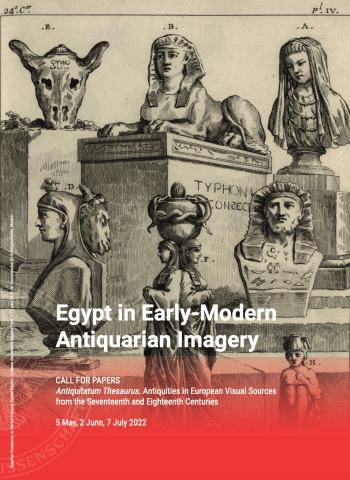 In 2022, Egyptology celebrates important historical events that number among the highlights in the exploration of the culture and civilization of the country by the Nile. In 1822, Jean-François Champollion succeeded in deciphering the hieroglyphics, the hieratic and the demotic scripts, by working primarily with the Rosetta Stone. In 1922, the British archaeologist Howard Carter discovered the tomb of the Pharaoh Tutankhamun in the Valley of the Kings.
The academy research project “Antiquitatum Thesaurus” would like to contribute to the international discourse and, in three half-day digital workshops in the summer semester of 2022 (5 May / 2 June / 7 July), draw attention to some central questions of the early-modern reception of Egypt, which preceded the events mentioned above.
How did contacts with the land of the pharaohs and their culture come about, and what image of it was conveyed? What role did aegyptiaca play in collections of antiquities, cabinets des curiosités or Wunderkammern? How were Egyptian or Egyptianising artefacts visually documented and discussed?
Before Napoleon’s great military expeditions and the subsequent scientific explorations of the country, when the number of travellers to the Levant was still manageable, the perception and understanding of Egypt far from the Nile had to rely primarily on easily portable objects. These had found their way to the other side of the Mediterranean at different times and along different routes. Finally, the study of ancient Greek and Roman authors, who transmitted their own mediated version of history and Egyptian culture, should not be underestimated.
Besides religious motivations, commercial and political activities or the desire to explore that lost or forgotten civilization, discoveries in Europe also stimulated further interest in Nilotic culture. Archaeological finds in Italy, France, Spain, German countries and Britain brought to light artefacts from the Roman imperial period. Through them people assimilated and adapted aspects of Egyptian religion, culture or aesthetics. They were collected together with artefacts from Egypt both as curiositates and as objects of study.
In the course of the early-modern period, a broad spectrum of antiquarian knowledge about Egypt was formed on the basis of these heterogeneous and today often not yet fully tangible foundations, and illustrated by an accompanying world of images.
The project “Antiquitatum Thesaurus” takes on the digital recording and indexing of antiquities in the graphic sources of the 17th and 18th centuries. It has begun this process with the subject area: “Egypt: On the Search of Origins.” Selected, representative illustrated printed works and drawing volumes dedicated to the material legacy of Egypt—or what was considered to be Egyptian—will be analysed. In addition to identifying the illustrated artefacts and architectural works, whether still preserved today or not, the project also aims to describe the methods of recording and conveying the mostly three-dimensional objects on paper, i.e. in a two-dimensional space. Furthermore, digital processing opens up possibilities for recognizing and illustrating spatial, temporal and personal chains within the transmission of knowledge and images across the widely scattered source material.
The subject areas of the three workshops include:
• The protagonists: A consideration of the circulation of artefacts through intermediaries, antiquarians and collectors as well as their reception and representation in drawings and printed works. Particular attention will be paid to how these figures were interconnected between c. 1600 and 1750.
• Multifaceted Egypt: How was the imagery or the idea of Pharaonic Egypt changed or complemented by small-scale artefacts such as amulets, jewellery and funerary objects alongside the familiar monumental evidence such as obelisks or sphinxes?
• The history of reception: What was the basis for the depictions of the many aegyptiaca in the graphic volumes of the time: direct observation or copies based on earlier publications? How exactly did the exchange of drawings and prints, descriptions etc. take place among the members of the European république des lettres?
We plan 20-minute talks in German or English. We kindly ask you to send an abstract relating to the aforementioned topics—alternative proposals are also welcome—of maximum 500 words in German, English, Italian, or French including a short CV to: thesaurus(at)bbaw.de by 11 March 2022. Please indicate the language in which you would like to speak. An answer will be given by 18 March 2022.
Call for Papers | Greek and Gothic Revivals, 1750–1850
From ArtHist.net:
The Greek Revival and the Gothic Revival, 1750–1850
Wrocław, Poland, 13–15 October 2022
Proposals due by 30 March 2022
The University of Wrocław Institute of Art History would like to invite you to participate in a conference to be held 13–15 October 2022. We are accepting proposals for individual papers on all subjects related to various artistic and cultural expressions of the Greek Revival and Gothic Revival styles in Europe and North America. The time frame we wish to focus on is from 1750 to 1850, that is the first, ‘romantic’ phase of the development of both styles, considered in the context of the idea of ‘revivalism’ as a phenomenon that marked art of various epochs, but unique in the precise period indicated, not only because of its size, but also its reference to specific moments in the past. The coexistence and interpenetration of both trends (there were, after all, artists creating their works in both the Greek Revival and Gothic Revival styles) justifies their joint discussion within the framework of an international group of researchers.
Issues we wish to discuss include
• Reasons for the popularity of both phenomena and their nature (so-called Gothicism and, so to speak, the dialectical revitalisation of Greek Antiquity)
• Greek Revival and Gothic Revival monuments as carriers of specific ideas and their role in awakening the historical consciousness of European societies
• Greek Revival and the Gothic Revival: from the Ideal to the Real
• Analysis of specific realisations and trends—monuments that are characteristic, outstanding, but also unknown, forgotten, and located in poorly explored areas, whose analysis will reveal previously unknown aspects of both discussed trends
Proposals that do not directly address the issues identified above are also welcomed.
Individual presentations should be no longer than 20 minutes. The official languages of the conference are English and German. The conference will open with a reception in the evening of Wednesday, 12 October. Over the next three days (Thu–Sat), conference contributors’ papers will be presented.
The call for papers is open until 30 March 2022. Contribution proposals—including your name, institution, presentation title, and a 150-word abstract—should be emailed to agata.kubala@uwr.edu.pl (Greek Revival) and romuald.kaczmarek@uwr.edu.pl (Gothic Revival). The conference fee of €120 (€90 for PhD candidates) includes meals (lunch Thu–Sat and dinner Thu–Fri), conference materials, and a post-conference double-blind, peer-reviewed publication. For updates including detailed information on the conference venue and program, please check this website.
Hope to see you in Wrocław!
Organizing Committee
• Dr hab. Prof. UWr Romuald Kaczmarek (University of Wrocław Institute of Art History)
• Dr hab. Agata Kubala (University of Wrocław Institute of Art History)
• Agata Stasińska, M.A. (University of Wrocław Institute of Art History)
Scientific Committee
• Prof. dr hab. Ewdoksia Papuci-Władyka (Institute of Archaeology at the Jagiellonian University in Krakow)
• Prof. dr. Ruurd B. Halbertsma (National Museum of Antiquities in Leiden, Leiden University)
• Prof. Dr. Klaus Niehr (Universität Osnabrück und Akademie der Wissenschaften zu Göttingen)
• Dr hab. Barbara Arciszewska (University of Warsaw Institute of Art History)
• Dr hab. Jerzy K. Kos (University of Wroclaw Institute of Art History)
Call for Papers | Close Encounters: The Low Countries and Britain

Jacob Jordaens, A Maidservant with a Basket of Fruit, and Two Lovers, detail, 1629–35
(Glasgow: Kelvingrove Art Gallery and Museum)
◊ ◊ ◊ ◊ ◊
From the RKD:
Close Encounters: Cross-Cultural Exchange between the Low Countries and Britain, 1500–1800
RKD – Netherlands Institute for Art History, The Hague, 22 September 2022
Proposals due by 1 March 2022
The risks and challenges of migration are of compelling interest today. Over the last thirty years, research on early modern artists’ migration and on cultural exchange between the Low Countries and Britain has advanced rapidly, and has addressed many themes. The Dutch and Flemish artists’ communities in London, and the careers of individual artists at the English/British and Scottish courts, in particular, have received attention, as has the history of the collecting of Netherlandish art in the UK.

Gerrit van Honthorst, King Charles I, 1628 (London: NPG).
On 22 September 2022, a symposium at the RKD – Netherlands Institute for Art History will mark the launch of the heavily annotated and illustrated digital English language version of Horst Gerson’s chapter on ‘England’ from his Ausbreitung und Nachwirkung der holländischen Malerei des 17. Jahrhunderts of 1942 (The Dispersal and Legacies of Dutch 17th-Century Painting). For historians of Dutch 17th-century painting, in 1942, Gerson’s study of the integration of Dutch art in Britain was largely uncharted territory, although earlier British art historians, including Horace Walpole and C.H. Collins Baker, had been well aware of the involvement of Netherlandish migrants and visitors in art in the British Isles. The launch of the translated and annotated version of Gerson’s text marks the perfect occasion to discuss, contextualize, and rethink his original ideas in the light of present and developing knowledge.
The organizers welcome unpublished contributions on a broad range of areas relating to Dutch and Flemish artists, artisans and art production in Britain. These include: painting, drawing, graphic arts, tapestry, sculpture and architecture, collecting and the art market, as well as the contribution of Dutch and Flemish migrants to many forms of material culture.
Papers will be 20 minutes long, and might address the following themes and questions:
• Fresh approaches to the careers of practitioners from the Low Countries at the English/British and Scottish courts, and in UK urban centres (including monographic studies).
• How did those courts and urban centres function as hubs of cross-cultural exchange between individuals, and of production?
• Less-studied works by Dutch and Flemish artists and artisans who were active in Britain between 1500 and 1800.
• What were the workshop practices and techniques employed by Dutch and Flemish artists and artisans in Britain, and how did these inter-act with local artistic traditions and impact on technical and art literature?
• What were the social networks and professional relationships that linked and supported Netherlandish and British makers, art dealers and collectors?
• What was the market for Dutch and Flemish artistic goods in Britain, and how did it develop over time?
Please submit a preliminary title, abstract (max. 300 words) and a short CV to Angela Jager (jager@rkd.nl) and Rieke van Leeuwen (leeuwen@rkd.nl) before 1 March 2022. Speakers will be notified by 1 April 2022. Selected presentations will be considered for publication.
Close Encounters will be a hybrid symposium to allow for national and international COVID-19 restrictions. Speakers and attendees may choose whether to participate in person or online. For those presenters who decide to come to The Hague, travel and accommodation expenses will be covered (in consultation with the organization).
Academic Committee
Karen Hearn (University College London), Angela Jager (RKD), Sander Karst (University of Amsterdam), Rieke van Leeuwen (RKD), David A.H.B.Taylor (Independent; previously National Trust and National Galleries Scotland) and Joanna Woodall (Courtauld Institute of Art, London)
Call for Papers | Reception of Art in 18th- and 19th-C Mantua
From ArtHist.net:
Opere in Viaggio: Reimpieghi, collezionismo, e nuove committenze a Mantova tra XVIII e XIX secolo
Istituti Santa Paola, Mantua 18-19 May 2022
Organized by Gabriele Barucca, Gigliola Gorio, and Debora Trevisan
Proposals due by 15 January 2022
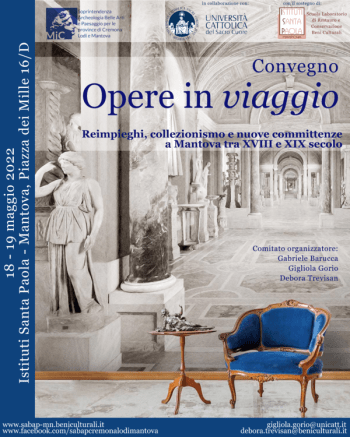 Through the analysis of significant and unpublished case studies, this conference will explore issues and dynamics related to the collecting and reuse of art objects in and around Mantua in the 18th and 19th centuries, during the crucial period between the fall of the Gonzaga and the beginning of Austrian domination. Proposals can be sent by art historians, numismatists, palethnologists, archaeologists, naturalists, and archivists—at any stage of their careers. Submissions should be sent to Gigliola Gorio (gigliola.gorio@unicatt.it) and Debora Trevisan (debora.trevisan@beniculturali.it) by the 15th of January 2022.
Organized by Gabriele Barucca, Gigliola Gorio, and Debora Trevisan, the conference is supported by the Soprintendenza Archeologia Belle Arti e Paesaggio per le province di Cremona, Lodi and Mantova in collaboration with the Catholic University of Milan and with the support of Istituti Santa Paola (Mantua).
More information, in Italian, is available here»
Call for Papers | Art and Friendship

Eustache Le Sueur, Réunion d’amis, ca. 1640, oil on canvas, 136 × 195 cm
(Paris: Musée du Louvre)
◊ ◊ ◊ ◊ ◊
From the Groupe de Recherche en Histoire de l’Art Moderne (GRHAM), where readers will find the French version of the Appel à communication:
Art et amitié aux XVIIe et XVIIIe siècles en Europe
Art and Friendship in 17th- and 18th-Century Europe
Salle Vasari, Institut national d’histoire de l’art (INHA), Paris, 14 June 2022
Organized by GRHAM and Charlotte Rousset
Proposals due by 31 March 2022
Following the pandemic which isolated all of us, magazines such as Courrier international and Philosophie magazine have dedicated their publications to friendship. This workshop intends on discussing this topical notion through the prism of cultural and social history in art. How did 17th– and 18th-century artists live and conceive friendship?
In her recent publication L’Amitié en France aux XVIe et XVIIe siècles: Histoire d’un sentiment[1], Aurélie Prévost reminds us that the term friendship for Modernists entails a large polysemy. It can refer to a feeling of benevolence, erotic love, harmony, or even a filial, marital, charitable, or religious affection. Furetière in his Dictionnaire even applies it to meat, stating “q’u’une viande n’a point d’amitié, pour dire, qu’elle est dure, infipide, ou degouftante”[2] [“A piece of meat is said to lack friendship when it is hard, flavourless or disgusting”].
Friendship is at the origin of many texts and maxims that constitute our cultural heritage today. Descartes, Kant, the Marquise de Sablé, Spinoza, Jean de La Fontaine, and the philosophers of the Enlightenment have all treated the notion of friendship in literature and philosophy. It can be passionate, like the one maintained by La Boétie and Montaigne, immortalized by the quote “Parce que c’était lui, parce que c’était moi” [“Because it was him, because it was me”], or experienced as a betrayal like the one that tore Diderot, Rousseau, Voltaire and D’Alembert when they were writing the Encyclopédie.
What about the art sector? What sort of relationship, whether friendships or rivalries, did 17th– and 18th-century painters, sculptors, architects, engravers, goldsmiths, miniaturists, medalists, and weavers have? What consequences did these have on their contemporary productions? Is it possible to map out united networks of artists through the link of friendship and joint creations?
Many artists made friendship the main subject of their work. Rembrandt van Rijn[3] depicted the story of David and Jonathan from the Book of Samuel in the 17th century. Arnold Houbraken, a Dutch engraver, depicted a personification of friendship[4] at the start of the 18th century. In France, in 1753, Jean-Baptiste Pigalle produced an allegory of friendship to mark the evolution of the relationship between Louis XV and the Marquise de Pompadour and to emphasize that she remained a beloved friend of the king after having been his mistress[5]. The painter François Boucher produced l’École de l’amitié[6] in 1760. One must also question the importance of portraits of friends and the character of these friendships. These can be between a painter and his patrons such as Antoine Watteau and Jean de Julienne[7] or between artists such as Jean-Honoré Fragonard and Marguerite Gérard[8].
How to make visible the feeling of friendship in a visual art piece? Is it possible to ‘read’ the emotions uniting loved ones through the medium of painting, engraving, or sculpting? How do gazes, gestures, and attitudes express this feeling? What visual devices does the artist use to convey this feeling of sincerity, trust, and commitment?
With this in mind, this workshop intends on exploring a wide variety of themes, such as:
• The cultural history of friendship/friendships
• Sociability (on the individual scale)
• Networks (on the collective scale)
• Quarrels and rivalries, even lawsuits created by a deteriorating friendship
• Friendships leading to artistic collaborations
• The representation of friendship in religious iconography
• Portraits of friends or patrons, conversation pieces, genre scenes, and allegories
• Patterns, symbols, gestures, and positions associated with the representation of friendship
• Objects representing friendship
• Letters of artists
• The fringes of friendship: hidden or forbidden love experienced through a friendship displayed in the eyes of all
Abstracts (up to 500 words, either in French or English), presenting a case study or a general discussion, together with a CV, should be sent to asso.grham@gmail.com and charlotte_rousset@hotmail.com by the 31st of March 2022. The workshop is organized by GRHAM and Charlotte Rousset (doctoral candidate at Lille University, laboratory IRHiS).
Notes
[1] Prévost, Aurélie, L’Amitié en France aux XVIe et XVIIe siècles : Histoire d’un sentiment, Louvain-La-Neuve, UCL, Presses Universitaires de Louvain, 2017, p. 17.
[2] Furetière, Antoine, « Amitié », Dictionnaire universel, La Haye et Rotterdam, Arnout & Reinier Leers, 1690.
[3] La Réconciliation de David et d’Absalon ou Les dieux de David et Jonathan, 1642, Huile sur bois, 73 × 62 cm, Saint-Pétersbourg, musée de l’Ermitage.
[4] Arnold Houbraken, Personnification de l’amitié, v. 1710–1715, gravure sur bois, 18 × 9 cm, Amsterdam, Rijksmuseum.
[5] Jean-Baptiste Pigalle, L’Amitié sous les traits de Madame de Pompadour, 1753, marbre, Paris, musée du Louvre.
[6] François Boucher, L’École de l’Amitié, 1760, huile sur toile, 113 × 146 cm, collection particulière.
[7] As illustrated by the work of François de Troy representing a portrait of Jean de Julienne holding a pencil holder and a portrait of his friend Watteau (1722, huile sur toile, 93 × 73 cm, Valenciennes, musée des Beaux-arts).
[8] Marguerite Gérard is portrayed several times by her brother-in-law Jean-Honoré Fragonard. He represents her at least twice (Jean-Honoré Fragonard, Portrait de Marguerite Gérard, v. 1778, dessin, plume, encre et lavis, 18 × 13 cm, Besançon, musée des Beaux-arts et d’Archéologie et Jean-Honoré Fragonard, Portrait de la belle-sœur du peintre, 2ème moitié du XVIIIe siècle, pierre noire, 13 cm de diamètre, Paris, département des Arts graphiques du musée du Louvre).
Selective Bibliography
• Alberti, Alessia, Rovetta, Alessandro, Salsi, Claudio, D’après Michelangelo, Venise, Marsilio, 2015.
• Cazes, Hélène (dir.), Topiques, Études Satoriennes – Topique de l’amitié dans les littératures françaises d’Ancien régime, Victoria, SATOR, 2015, vol. 1.
• Chapman, H. Perry, Jorink, Eric, Lehmann, Ann-Sophie, Ars Amicitiae: The Art of Friendship in the Early Modern Netherlands, Boston, Brill, 2020.
• Chittister, Joan, The Friendship of Women: The Hidden Tradition of the Bible, Saint-Laurent, Bellarmin, 2007.
• Florensky, Pavel, L’Amitié, Paris, Éditions Mimésis, 2018.
• Fripp, Jessica L., Portraiture and Friendship in Enlightenment France, Newark, University of Delaware Press, 2020.
• Goedt, Michel de, L’Amitié divine à l’école de Thérèse d’Avila, Toulouse, Éditions du Carmel, 2012.
• Heacock, Anthony, Jonathan Loved David: Manly Love in the Bible and the Hermeneutic of Sex, Sheffield, Sheffield Phoenix Press, 2011.
• Hoare, Alexandra, Salvator Rosa, Friendship and the Free Artist in Seventeenth-Century Italy, London, Turnhout, Harvey Miller, Brepols, 2018.
• Nardelli, Jean-Fabrice, Classical and Byzantine Monographs – Le motif de la paire d’amis héroïque à prolongements homophiles. Perspectives odysséennes et proche orientales, Amsterdam, Hakkert, 2004, n° 56.
• Olyan, Saul, Friendship in the Hebrew Bible, New Haven, Yale University Press, 2017.
• Petit, Jean-François, Saint Augustin et l’amitié, Paris, Desclée de Brouwer, 2007.
• Prévost, Aurélie, L’Amitié en France aux XVIe et XVIIe siècles : Histoire d’un sentiment, Louvain-La-Neuve, UCL, Presses Universitaires de Louvain, 2017.
• Rievaulx, Aelred de, Briey, Gaëtane de, L’Amitié spirituelle, Paris, Les Éditions du Cerf, 2019.
• Schnackenburg, Bernhard, Jan Lievens: Friend and Rival of the Young Rembrandt, with a Catalogue raisonné of his Early Leiden Work, 1623–1632, Petersberg, Michael Imhof Verlag, 2016.
• Vesely, Patricia, Friendship and Virtue Ethics in the Book of Job, New York, Cambridge University Press, 2019.
• Williams, Hannah, Académie Royale: A History in Portraits, Farnham, Ashgate, 2015.
Laura Macaluso on Benedict Arnold’s House
We’re used to thinking about how the persistence of artifacts and architecture—especially elite forms of material culture—attest to the social and cultural status of individuals long after their deaths. With a growing scholarly appreciation for how the lack of an enduring material record also speaks to historical priorities, many readers will find this essay by Laura Macaluso interesting. And I would draw your attention more generally to Commonplace, edited by Joshua Greenberg; see the ongoing Call for Submissions below. –CH
From Commonplace:
Laura A. Macaluso, “Benedict Arnold’s House: The Making and Unmaking of an American,” Commonplace: The Journal of Early American Life (October 2021).
Arnold’s unceasing efforts to elevate himself in society through marriage and professional work can be viewed through the lens of the houses he bought or built throughout his life.

Benedict Arnold’s Shop Sign (New Haven Museum). ‘Sibi Totique’ (‘For himself and for everyone’).
Historians have examined the many aspects, both positive and negative, of Arnold’s impact on the course of events leading to the establishment of the United States. Yet the largely unanalyzed material culture of his existence—the objects he acquired and the buildings in which he and his family resided—can offer us much more about the contours of his life as he fashioned it, and how others crafted his historical memory. Arnold’s unceasing efforts to elevate himself in society through marriage and professional work can be viewed through the lens of the houses he bought or built throughout his life. This essay looks at the cultural landscape of one of his homes, the New Haven, Connecticut, house he built and resided in from 1769 until wartime. Through an analysis of the choices Arnold made in location, size, and architectural style, I identify how Arnold began to construct his identity not only as a member of the urban merchant class, but also as a gentleman. The building of the home reads as material evidence of his desire to establish his identity and place in society, but equally the abuse and destruction of Arnold’s house is a parallel to the untimely end of a life and career he worked hard to obtain.
The full essay is available here»
◊ ◊ ◊ ◊ ◊
Commonplace: Call for Submissions
Commonplace is now accepting submissions of approximately 2000 words that analyze vast early America before 1900. We seek a diverse range of articles on material and visual culture, critical reviews of books, films, and digital humanities projects, poetic research and fiction, pedagogy, and the historian’s craft. We are especially interested in deep reads of individual objects, images, or documents (including in the collection of the American Antiquarian Society). Submissions should be written in an accessible style and crafted for a wide audience. Inquiries and submissions can be made to commonplacejournal@gmail.com.
About Commonplace:
A bit less formal than a scholarly journal, a bit more scholarly than a popular magazine, Commonplace speaks—and listens—to scholars, museum curators, teachers, hobbyists, and just about anyone interested in American history before 1900. It is for all sorts of people to read about all sorts of things relating to early American life—from architecture to literature, from politics to parlor manners. It’s a place to find insightful analysis of early American history as it is discussed in scholarly literature, as it manifests on the evening news, as it is curated in museums, big and small; as it is performed in documentary and dramatic films and as it shows up in everyday life. . . .
Commonplace originally launched in 2000 as Common-Place: The Journal of Early American Life and has now been reimagined with a cleaner, more accessible interface. Our articles appear on a rolling basis and are arranged by category instead of being organized by issue and volume. . . .
Sponsored by the American Antiquarian Society, founded by editors Jane Kamensky and Jill Lepore, and designed by John McCoy, Common-Place: The Journal of Early American Life is the product of an amazing team of editors and institutions. Over nearly two decades, the journal has been published in partnerships with Florida State University, the University of Oklahoma, the Gilder Lehrman Institute of American History, and the University of Connecticut. Past editors have included Ed Gray; Catherine Kelly; Anna Mae Duane and Walt Woodward. Past contributors and guest editors have included: Joanna Brooks, Robert A. Gross, Gary B. Nash, Megan Kate Nelson, Mary Beth Norton, and Alan Taylor.
In 2019, the Omohundro Institute of Early American History and Culture joined the AAS in a new partnership to redesign and reinvigorate the site.
Call for Papers | The Theatines and Architecture
From ArtHist.net, which includes the Italian and Spanish versions:
‘Circa vestimenta’: i Teatini e l’architettura, XVI–XVIII secolo
The Theatines and Architecture, 16th–18th Centuries
International Conference on the Architectural History of the Order of Clerics Regular Theatines
Sant’Andrea della Valle, Rome, 22–23 March 2022
Proposals due by 7 January 2022
 First among the religious orders born in the climate of the Catholic Reformation and rooted in the sensibility of Devotio moderna, the order of Clerics Regular Theatines was officially founded in 1524 by Gian Pietro Carafa (1476–1559, Pope Paul IV from 1555), Gaetano Thiene (1480–1547), Bonifacio de’ Colli (ϯ 1558), and Paolo Consiglieri (1499–1557). After settling in Venice (from 1527), Naples (from 1538), and finally in Rome (from 1555), between the end of the Council of Trent and the middle of the seventeenth century the order became widespread in Italy, at the same time as it began expanding in Europe and evangelizing in non-Christian territories, mainly in the Caucasus and the East Indies.
In spite of the importance of Theatine houses and places of worship, and the relevance of Theatine patrons and architects, the order has not enjoyed the kind of critical reception enjoyed by other early modern orders, such as the Jesuits, the Barnabites, or the Oratorians. The dispersion of a large part of the order’s documentary heritage and, in particular, the scarcity and unevenness of the drawings and other architectural evidence held in the Theatine general archives at Sant’Andrea della Valle in Rome have certainly been among the reasons that have hindered attempts to produce synthetic studies of Theatine architecture.
In recent years new data and questions have emerged from an increasing amount of research, partly published in the journal of the order, Regnum Dei: Collectanea Theatina, and discussed in specific, limited forums, such as a first international conference dedicated to the Theatine foundations in Sicily (2003) and a study day on the history of the Venetian church and house of San Nicolò da Tolentino and the alterations that have affected it (2017). Today it finally seems possible to think of a scholarly gathering in which to relate some of the many histories regarding the Theatines and architecture.
Starting from the architectural enterprises and evidence associated with the order of Clerics Regular Theatines between the sixteenth and the eighteenth centuries, this conference intends to create an initial framework within which to investigate the urgent issues and historiographic problems facing historians today. Namely:
• the settlement strategies of the Theatines in relation to urban context, to economic choices, and to the process of reuse and appropriation of sites
• the particular role of great promoters, financial backers, and patrons in respect to the expansion of the order and their effects on the development of the order’s sites for churches and houses, with particular reference to sacred space
• the role of Theatine priests as patrons or architects of buildings outside the order
• the circulation and migration of models, techniques, and architectural experts and amateurs among Theatine building sites and/or Theatine commissions
• the dynamics of the ‘center-periphery’ relationship, understood as the relationship between the Roman mother house and the other foundations of the order, through investigation of the genesis and design process of Theatine buildings
• the knowledge, skills, and theoretical and scientific debates regarding architecture in the Theatine context, also considering the books held in Theatine libraries and the publications of the order’s priests
• the effects of the order’s spirituality on the selection of building materials, on architectural and decorative solutions, and on the relation of these to antiquity
• the relationship between tradition and experimentation (typological, architectural and in relation to construction techniques) in Theatine buildings
• the differences and distinctive features in design approach, in functional organization, in management of the building sites, and in the choices of material and manner of construction when comparing the houses for religious, buildings intended for teaching, and those destined for worship
• when and how celebrations, processions and ephemeral apparatuses transformed Theatine sacred space and its relation to the urban context.
The possibility of researching and identifying any unique characteristics of the architecture of the Clerics Regular Theatines—both going back to the problems they faced as the first order founded in the early modern era, and in relation to the production of other orders founded around the same time—certainly invites wider reflection than themes strictly related to architecture. One of the keys to understanding this could be found in the ‘arma apostolica’ that Carafa requested from Clement VII in 1533, ‘tam circa vestimenta quam circa alias cerimonias’, with which the first Theatines, anticipating the difficulties related to evangelizing in distant lands, had the opportunity to flexibly adapt to different, geographically distant cultural realities.
The conference will be hosted by the Generalate of the Theatine order at the church of Sant’Andrea della Valle in Rome and will take place 22–23 March 2022. Given the uncertainty of the evolving public health situation, the organizers plan to hold the event in hybrid format, both in-person and online. The proceedings of the conference will be published in a special issue of the journal Lexicon: Storie e Architettura in Sicilia e nel Mediterraneo, a biannual periodical of studies in architectural history, classified as class A for the assessment sectors 08/C1, D1, E1, E2, F1 of the Italian national agency for the evaluation of universities and research institutes (Anvur). Those interested in participating should send a biography of approximately ten lines and a long abstract of no more than 700 words, accompanied by a reference bibliography of no more than ten items, to convegno.architetturateatina@gmail.com by 7 January 2022. Abstracts will be accepted in Italian, English, French, and Spanish. No registration fees are required. For clarification of any questions, please contact convegno.architetturateatina@gmail.com.
Timeline
1 November 2021 — Call for papers
7 January 2022 — New deadline for submission of biography and long abstracts
15 January 2022 — Notification of acceptance
22–23 March 2022 — Conference
Scientific Committee
Richard Bösel (Universität Wien)
Beatriz Blasco Esquivias (Universidad Complutense de Madrid)
Susan Klaiber (indipendente)
Fulvio Lenzo (Università Iuav di Venezia)
Carmine Mazza, C.R.
Marco Rosario Nobile (Università di Palermo)
Edoardo Piccoli (Politecnico di Torino)
Francesco Repishti (Politecnico di Milano)
Augusto Roca De Amicis (Università La Sapienza, Roma)
Conference Organizers and Editorial Committee
Marco Capponi (Università Iuav di Venezia)
Gaia Nuccio (Università di Palermo)
Organizing Committee
Marco Capponi (Università Iuav di Venezia), Gaia Nuccio (Università di Palermo), Mariana Méndez Gallardo (Universidad Iberoamericana Ciudad de México), Padre Marcelo R. Zubia, C.R., Padre Diego Doldan, C.R.
Call for Articles | Mobility, Art and Religion in the Hispanic World
From the Call for Articles:
Special Issue of Religions (2023), Mobilization of Art and Religion in the Hispanic World: The Intersections of Race, Religion, Gender, and Objects c. 1500–1800
Guest edited by C. Cody Barteet and Alena Robin, with Iraboty Kazi
Proposals due by 30 May 2022; completed manuscripts due by 1 February 2023
In recent years, academic interest in the movement of people, objects, and ideas has risen significantly, driven by the desire to develop a fuller understanding of history and our current globalized world (Beaudry and Paron 2013, Corcoran-Tadd, Hung et. al. 2021). These interests have forced us to reconsider knowledge, art, spatial, religious, and historical formations, prior to, during, and after the colonial era, as we have recognized for several decades now that colonialism was formalized and transgressed by virtually all peoples involved (Hofman and Keehnen 2018). Further, objects, styles, concepts, and other material artifacts traversed oceans and continents (Callligaro, Chiappero et. al. 2019, Hamann 2010, Hyman 2017). We look to consider the intersections of Hispanic cultural traditions with European (whether Jewish, Islamic, Catholic, or Protestant), Indigenous/First Nations, Afro-Latin American/Afro-Caribbean, and Asian-Latin American in a developing global world. By considering the mobility of peoples, objects, themes, and other social constructs throughout the global Spanish territories, we explore the intersection of disparate religious traditions to consider the formation of new cultural knowledges and practices through the appropriation, assimilation, commodification, fetishization, marginalization, and hybridization of objects and practices.
We invite contributors to submit their research in English for consideration for publication in a special issue of the journal Religions. Please note that there is a two-stage submission procedure. We will first collect a title and short abstract (maximum 250 words), 5 keywords, and a short bio (150 words), by 1 May 2022, via email to Dr. Cody Barteet (cbarteet@uwo.ca), Iraboty Kazi (ikazi3@uwo.ca), and Dr. Alena Robin (arobin82@uwo.ca). Before 30 May 2022, we will invite selected abstracts to be submitted as 7000- to 9000-word papers for peer review by 1 February 2023. Journal publication is expected in mid- to late 2023, depending on the revision time needed after peer review. Each article will be published open access on a rolling basis after successfully passing peer review.
C. Cody Barteet
Guest Editor
Associate Professor, Department of Visual Arts, Western University, London, ON N6A 3K7, Canada
Interests: Hispanic American art and architecture; early modern visual culture; race, gender, religious art and architecture
Iraboty Kazi
Guest Editor Assistant
Department of Visual Arts, Western University, London, ON N6A 3K7, Canada
Interests: Spanish American colonial art; New Spain; religious art; heritage protection; Latin American art in Canada
Alena Robin
Guest Editor
Associate Professor, Department of Visual Arts, Western University, London, ON N6A 3K7, Canada
Interests: Spanish American colonial art; New Spain; religious art; heritage protection; Latin American art in Canada
Note (added 4 April 2022) — The posting was revised with a new deadline, extended from May 1 to May 30.










leave a comment