Call for Articles | Black Artists in the Atlantic World, 1500–1900
From the Call for Papers at Arts:
Special Issue of Arts: Black Artists in the Atlantic World, 1500–1900
Guest edited by Paul Niell and Emily Thames
Abstracts due by 31 May 2022, with drafts of completed articles due by 31 March 2023
We are seeking submissions for a special issue of Arts, which will focus on Black Artists in the Atlantic World, ca. 1500–1900. Invoking the modern/colonial racial category of ‘black’ draws critical and much-needed attention to the role of race in the lives and careers of artists of African descent, and others who have had to negotiate being inscribed and socialized into blackness by Atlantic societies. We approach this topic hemispherically, considering both colonial and national socio-political frameworks bordering or shaped by the broader Atlantic arena, including the Americas, Europe, and Africa. In this way, we hope to foster a comparative conversation between scholars working on the various geographic spheres of the Atlantic in order to better understand the transnational and transimperial realities faced by black artists and how they have worked through their respective settings.
This special issue acknowledges and draws inspiration from recent scholarship on artists in the Spanish colonial territories throughout the Americas, such as the essay by Barbara Munday and Aaron Hyman, “Out of the Shadow of Vasari: Towards a New Model of The ‘Artist’ in Colonial Latin America,” Colonial Latin American Review 24.3 (2015): 283-317; the monograph by Susan Verdi-Webster, Lettered Artists and the Language of Empire: Painters and the Profession in Early Colonial Quito (University of Texas Press, 2017); the 2019 Hescah symposium at the University of Florida “Beyond Biography: Artistic Practice & Personhood in Colonial Latin America,” organized by Maya Stanfield-Mazzi; and the special edition of the Colonial Latin American Review, “Visualizing Blackness in Colonial Latin America,” co-edited by Kathryn Santner and Helen Melling, 30.2 (2021). The study of black artists and image makers in the southern Atlantic has been further advanced by the work of scholars, such as Ximena A. Gómez, Agnes Lugo-Ortiz, Linda Rodríguez, and Miguel Valerio. These studies shed light on the methodological challenges as well as the importance of considering the lives, careers, and agencies of Spanish colonial artists in the writing of these regions’ social and cultural histories. Among the salient dimensions addressed by these projects is the role of race in shaping the professional lives of artists. For the northern Atlantic, which is situated later in time than those of the Ibero-Americas and the Caribbean and in contexts informed by Protestant conceptions and practices of the image, relationships between the artist, the art, the viewer, and race have been examined in such works as Kirsten Pai Buick’s Child of the Fire: Mary Edmonia Lewis and the Problem of Art History’s Black and Indian Subject (Duke University Press, 2010), Anna O. Marley’s edited collection of essays Henry Ossawa Tanner: Modern Spirit (University of California Press, 2012), and Jasmine Nichole Cobb, Picture Freedom: Remaking Black Visual Culture in the Early Nineteenth Century (New York University Press, 2015).
Engaging with the subject of black artists in the Atlantic world raises a number of critical questions. How did racial blackness shape the professional worlds negotiated by artists in the Atlantic? How does race impact the ways in which we consider black artists in the Atlantic whose racial classification is not necessarily evident in the formal and stylistic properties of their work? If an artist is of African descent, must their art be a matter of race? What was the relationship between race, blackness, and the creation of the category of ‘artist’ in the Atlantic? What other forms of making and imagery are at stake in this field of inquiry beyond artist and art, as institutionally redefined by academies of art? How has the discourse of race obscured African and African American agency, awareness, and negotiations of imperial/colonial power? How do we address the limits of the historic archive in recovering the stories of such artists? What can be learned by looking across national and imperial boundaries in the Atlantic with respect to the histories of black artists? These questions will be considered and addressed within this special issue.
Dr. Paul Niell
Department of Art History, Florida State University, Tallahassee
Interests: Spanish colonial art; architecture and visual culture; the material culture of the African diaspora with an emphasis on the Caribbean region
Dr. Emily Thames
Department of Art History, Florida State University, Tallahassee
Interests: the visual and material cultures of the colonial Atlantic world; art and empire; art in the age of revolution and nationalism; the history of colonialism; the intersection of art and race; the visual and material cultures of the African diaspora
Call for Papers | Historical Interiors and the Digital
From the Call for Papers (which includes a bibliography). . .
Historical Interiors and the Digital: The Possibilities and Limits of Virtual Reconstructions for Research
Paris and Versailles, 17–18 November 2022
Proposals due by 5 June 2022
The virtual reconstruction of historical interiors—from architecture to wall decoration and furniture to textiles—has been a proven instrument of cultural mediation in recent years, particularly in museums, exhibitions and/or for the study of historical monuments (for instance in archaeology). Questions of spatial proportions and fundamental architectural units are today at the forefront, with emphasis often placed on the possibility of visiting these spaces virtually, either on a 2D screen or with an immersive headset.
However, when it comes to the recreation of the aesthetic characteristics of interiors, which are one of the key issues for their understanding, the possibilities of these new models seem limited. Depending largely on the harmonious interaction of different materials such as woods, metals, and textiles, as well as the structures of their respective surfaces, the nuances of colour or gold, or even the traces of artisanship, the existing solutions in rendering the materiality of an historic interior remain insufficient, both aesthetically and scientifically. The hope to swiftly overcome the excessively sanitized surfaces of digital models, expressed in 2013 (Kohle 2013, p. 166), has not yet come to fruition. Nevertheless, there is more to it than that, as the possibilities of using virtual reconstruction effectively for researching historical interiors—for example, through the virtual insertion of materials that are no longer ethically justifiable or prohibited today—are not fully exploited.
Focusing on the possibilities and limits of virtual reconstructions of historical interiors, of which questions of materiality are only one aspect, this conference highlights the fundamental issues that occupy current research. Firstly, there is the question, not yet completely resolved, of the utility of three-dimensional virtual models—often drawn from the video-game sector—as instruments or even auxiliaries for research in art history. We cannot respond satisfactorily without also exploring the genesis and transformation of the object studied and the representation of one or more states including later modifications. Although research, and in particular archaeology, has already established a tradition of haptic and digital modelling of space, the history of art still seems to be far behind on this front (Messemer 2020). Such a circumspect attitude is off pace with the growing use of three-dimensional models and augmented-reality applications for the transmission of knowledge in museums or in connection with monuments and places of memory (Jeffrey 2021).
Moreover, this disciplinary reservation seems to contradict the often reaffirmed claim of the capacity of digital models to densify scientific reflection beyond the possibilities of language (Pfarr-Harst 2020). Analysis of historical interiors involves confronting architectural structures along with moving objects. However, in the scientific use of three-dimensional models to date, these structures and objects have largely been considered separately. This is why most discourses are interested either in the architectural dimension of spaces or in the objects themselves, considered in isolation. In this context, we would note that the 3D modelling of objects (e.g. pieces of furniture) can give rise to discussions of notions of reproduction and authenticity or, more recently, to questions of cultural appropriation (Jeffrey et al. 2020; Jeffs 2020).
As for the mise-en-scène of social representations and power (Hoppe/De Jonge/Breitling 2018), embodied in the visual and bodily perception of spaces (in their use, particularly ceremonial), this remains insufficiently conveyed by virtual reconstructions, as does the dimension of the use of objects—chairs or desks, for example—as constituting the experience of the room. In addition to the exploration of scenarios of historical utilization in comparison with modern exigencies, the modelling of the acoustic and thermal properties of spaces that were abundantly furnished with textiles (carpets and rugs, curtains, wall hangings, baldachins, and Gobelin tapestries) opens up new research perspectives of the utmost interest. Generally speaking, the absence of those sensory elements integral to the art of interior design constitutes a considerable limitation in the potential benefits of virtual representation.
The international conference—organized jointly by the German Center for Art History Paris (DFK Paris), the Mobilier national, and the Centre de recherche du château de Versailles (CRCV)—will allow for an exchange of information among specialists from the world of museums, historians and historians of art, and experts in digital reconstruction and 3D modelling. It will give occasion to reflect on the stages prior to modelling and virtual restoration, on the creation phase of the tool and dialogues between art historians and technicians, and finally on the future and the public’s reception of such tools. The conference will also enable young researchers to present their own research projects and submit them for discussion in a circle of specialists in the field.
The symposium will take place in Paris, both in person and via videoconference (DUAL MODE), in the conference room of the DFK Paris and the auditorium of the palace of Versailles on November 17 and 18, 2022. Presentations will be limited to 30 minutes. Proposals—in French or English—of around 3,000 characters (including spaces) must include the title of the paper, along with an abstract of its argument, and be accompanied by a short biography (1,200 characters) and the contact details of the candidate. Materials must be received before 5 June 2022, via email to interieursetnumerique@dfk-paris.org. Applicants will receive a response regarding their participation in the conference by 5 July 2022.
Organizing Committee
Muriel Barbier (Mobilier national), Marc Bayard (Mobilier national), Markus A. Castor (DFK Paris), Jörg Ebeling (DFK Paris), Anne Klammt (DFK Paris), Benjamin Ringot (CRCV), Mathieu da Vinha (CRCV)
Call for Papers | CSECS, ECSSS, NEASECS 2022

Jean Siméon Chardin, Attributes of the Sciences, 1731, oil on canvas, oil on canvas, 140 × 220 cm
(Paris: Musée Jacquemart-André)
◊ ◊ ◊ ◊ ◊
From the Call for Papers for the conference. And please note the separate due date for NEASECS soliciting panels (April 8) with paper proposals due by May 6; send to neasecs@gmail.com. Art history panels and papers are encouraged!
Experiencing Modernity; Modernity of Experimentation
Expérience de la modernité; Modernité de l’expérimentation
Canadian Society for Eighteenth Century Studies (CSECS) in collaboration with the Eighteenth-Century Scottish Studies Society (ECSSS) and the Northeast American Society for Eighteenth-Century Studies (NEASECS)
University of Ottawa / Delta Hotel by Marriott, Ottawa City Centre, 26–29 October 2022
CSECS paper proposals due by 15 April 2022 / NEASECS panels due 8 April and papers due 6 May 2022
In the years leading up to the eighteenth century, the Quarrel of the Ancients and the Moderns sparked a passionate debate in which the concept of modernity featured prominently. This was not the first time the concept of the ‘modern’, as a present that contrasted with the remote past, was invoked, but it marks a significant, perhaps defining, development or consolidation of the idea. At issue in the Quarrel was the question of whether or not ancient learning, thought, and literary achievement had been overtaken and superseded by modern thinkers and writers. The Quarrel brought into focus the very idea of modernity itself, of novelty and newness. Was the new century in some fundamental way new and different from previous eras, whether in its socio-political organization; its understanding of nature and the cosmos; its conception of art, literature, and the aesthetic; or its invention of new technologies and material processes? How was the world of the eighteenth century different from what came before it? When and where did this modernity begin? Are we to see this as a heroic narrative of progress, or does it also manifest a dark, destructive dimension that undermined and defeated optimistic visions of the future?
Two features that stand out in this project of self-conceptualization are a sense of historical difference from the past and a drive to record human experience—in dictionaries and encyclopedias—or to measure it by experimentation. Our conference title highlights the interplay between these two terms, for historically, ‘experimentation’ and ‘experience’ are closely related. Indeed, in modern French the word expérience is almost interchangeable with expérimentation, and in English, the earliest meaning of ‘experience’ was an action of putting something to the test (“to make experience of: to make trial of” [OED]). An experience is also an observation of facts or events, and in more recent usage it refers to what a person might subjectively encounter, undergo, live through, and be affected by. We invite conference participants to explore all these facets of the experience of modernity in the eighteenth century.
For explorers, scholars, and creators of the eighteenth century, modernity demanded to be experienced and experimented with, and it came to be defined by a multiplicity of experiments. In the sciences and philosophy, this trend is especially clear, with the development of ‘experimental philosophy’, deriving from Bacon, Newton, and Locke, which made possible the development of new fields of knowledge, new understanding of the grounds of knowledge, and new technologies and practices—in manufacturing, medicine, and military art, for example.
But experimentation in the period is also manifested in field research: that of travelers who set out to meet other cultures, that of correspondents of the academies and learned societies who described the natural world around them, that of inventors and innovators who came to present the fruit of their work to assemblies. Experimentation, here, evolved beyond the collection of ‘curiosities’, to be displayed in cabinets (a matter of spectacle and wonder), to become research, in the sense that we still understand it today, that is to say a deliberate, controlled testing of phenomena in order to bring about predicted effects.
In the fine arts and literature, experimentation took many forms, such as the development of new genres (domestic tragedy, bourgeois drama, prose fiction) and the transformation and mixing of existing ones (georgic, the mock-heroic). Artistic experiments like these were designed to elicit new pleasures and to stimulate new effects in audiences, of moral transformation or aesthetic response. But artists in the period went further: the eighteenth century was also a laboratory of media, as artists endeavoured to exploit the technical discoveries of their time, from the magic lantern to the ocular harpsichord.
We could extend this intellectual and cultural survey almost indefinitely, taking in politics, law, moral inquiry, economics and other nascent social sciences. But modernity was also experienced as difference and alterity: gender, ethnicity, race, and foreignness, for example, figured prominently in the imagining and experience of modernity, as projections of anxieties, fears, and hopes about profound cultural and social change. Financial volatility and novel instruments of credit, for example, were often allegorized as fickle, valetudinarian women, and innovation and novelty were often stigmatized xenophobically as ‘foreign’. Conversely, the inhabitants of Africa and the Americas suffered often calamitous consequences in their encounters with the modernity of an alien culture and alien intruders. This darker side of the experience of modernity will be equally prominent in our exploration of the CSECS 2022 conference theme.
A key dimension of this experience of modernity, for us today, is the ongoing contact between European explorers, empire builders, and colonizers and the indigenous nations who confronted them. The 2021 CSECS conference in Winnipeg mounted an ambitious program of inquiry into the ‘Indigenous Eighteenth Century’, and it is our aim at the Ottawa conference to build on this important work. Thus, the conference organizers particularly invite panels and roundtables that focus on non-European perspectives on the European project of modernity.
Topics related to the conference theme might include, but are not limited to, the following:
• the experimental sciences in dialogue with artistic production
• the idea of innovation in literature and the arts
• experience and the modern novel
• empirical and moral philosophy as sciences of humanity
• enlightenment and the critique of modernity
• travel writing—both real and imagined.
• Lettres persanes (301 years later)
• economic experiments; financial modernity
• conjectural history as experimental or speculative historiography
• constitutional experimentation
• experience of gender; gender and modernity
In keeping with past practice at CSECS conferences, panel and paper proposals on current research unrelated to the conference theme will be equally considered. Deadline for submission of panel proposals: 15 March 2022. Deadline for submission of individual paper proposals: 15 April 2022.
NEASECS soliciting panels are due April 8, with paper proposals due by May 6; please either send to neasecs@gmail.com. Art history panels and papers are encouraged!
All those presenting at the conference must be members in good standing either of CSECS, ECSSS, or NEASECS. Paper proposals should include title, 150-word summary, and brief biographical note indicating the presenter’s name, email, academic status, and institutional affiliation. Panel proposals should include titles and 150-word summaries of both panel and individual papers, and brief biographical notes for all presenters (normally three) and respondents (if any), including names, email addresses, academic statuses, and institutional affiliations. Please send your proposals to csecs-scedhs2022@uottawa.ca. Participants may present papers in English or French and will be invited to submit articles based on their papers in either language to Lumen, the official journal of CSECS, for publication.
◊ ◊ ◊ ◊ ◊
Note (added 20 March) — The original posting did not include the separate due dates for NEASECS submissions.
Call for Papers | Tracing Material Cultures in Early America
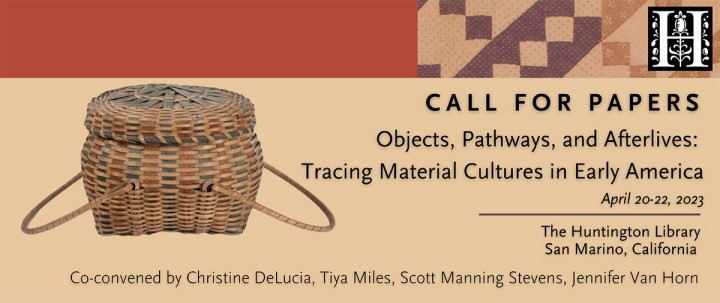
As announced by CAA:
Objects, Pathways, and Afterlives: Tracing Material Cultures in Early America
The Huntington Library, Art Museum, and Botanical Gardens, San Marino, 20–22 April 2023
Organized by Christine DeLucia, Tiya Miles, Scott Manning Stevens, and Jennnifer Van Horn
Proposals due by 15 May 2022
This two-and-a-half-day symposium in April 2023 at the Huntington Library will articulate new pathways forward in American material cultures, broadly defined in terms of subject matter, hemispheric geography, and time period (from roughly 1500 to 1860). We invite holistic thinking about existing fault lines in object study and the generative spaces around issues of power, absence, representation, labor, hybridity, and materiality. Recognizing that ‘early’ America itself has been contested in productive ways, we ask what work ‘early’ American objects can help effect along the lines of contemporary visual sovereignty as well as cultural preservation and knowledge production.
As critical reckonings with the enduring legacies of white supremacy and settler colonialism that shaped early America continue to impact communities today, we seek to create a space for creative learning to investigate: How do we do this work? How do we interpret this work with and for multiple publics? How can we better engage younger community members and college students with materials collected by museums? What through-lines can museums elucidate between historical materials and contemporary Indigenous and African American artists and knowledge keepers?
Symposium participants can engage with the Huntington’s Fielding Collection of Early American Art as a resource and point of departure, but talks do not have to respond directly to works in the collection.
We invite proposals for 20–30 minute papers addressing these themes from people in many fields, including but not limited to African Diaspora, Archaeology, Art History, History, Indigenous Studies, Material Culture, and Museum Studies. Cross-disciplinary and comparative studies are also welcome. To submit, please email abstracts of no more than 200 words, along with a short (2 page) CV, to objectspathwaysafterlives@huntington.org by 15 May 2022.
Travel and accommodations will be provided for speakers arriving from outside the Los Angeles area, and meals will be provided for all. Graduate students outside the Los Angeles area who want to attend the conference are welcome to apply for grants to cover travel and lodging. To be considered, email objectspathwaysafterlives@huntington.org a 300-word statement detailing your research interests and outlining how attending the conference will further your scholarly or career development, along with a short (2-page) CV by 15 May 2022.
Call for Papers | Marine Worlds of the 18th Century

After Jacques Étienne Victor Arago, Vue de Notre-Dame De bon Voyage (Rade de Rio de Janeiro), 1825
(Wikimedia Commons)
◊ ◊ ◊ ◊ ◊
From the Call for Papers:
18th DNS Seminar: The Marine Worlds of the Long Eighteenth Century
Australian Catholic University, Melbourne, 7–9 December 2022
Proposals due by 1 August 2022
The Australian and New Zealand Society for Eighteenth-Century Studies (ANZSECS) and the Australian Catholic University invite you to the 18th David Nichol Smith (DNS) Seminar for Eighteenth-Century Studies.* In 2022, the DNS will be held on 7–9 December at the ACU Fitzroy Campus in Melbourne. It will convene in-person, but will also feature a digital hub hosting a suite of provocations from colleagues around the world. We are delighted to announce that the seminar will include three keynotes: Lynette Russell, ARC Laureate Professor at Monash University; Kevin Dawson, Associate Professor of History at UC Merced; and Miranda Stanyon, ARC DECRA Research Fellow in the School of Culture and Communication at the University of Melbourne.
We welcome proposals that address our theme The Marine Worlds of the Long Eighteenth Century. We seek to explore and understand the experiences, knowledges, and spaces of the sea and undersea from 1650 to 1850. We are particularly keen to highlight and interrogate how the ‘blue humanities,’ and the environmental humanities in general, are in conversation with the study of the eighteenth century across disciplines.
Topics may include
• human-animal relationships in eighteenth-century oceans
• more-than-human oceans
• ideas and practices exploring ocean depths and sea surfaces
• oceanic lives: Indigenous, Black, gendered, plebeian, mercantile, imperial
• queering the eighteenth-century ocean
• feminist, subaltern, or decolonial knowledges of the marine
• seacraft design and representation
• maritime wrecks, disasters, and salvage operations
• reinterpretations of piracy and seaborne conflict
• marine and maritime labours, both free and unfree
• sensing seascapes: sights, sounds, tastes, and smells
• marine genres / oceanic forms
• aquatic sports, leisure, and culture
• relations between eighteenth-century studies and the blue humanities
• marine geographies, or ‘thalassographies,’ in formation, relation, and conflict
• philosophies and practices of sub/marine science
• sea-languages of the long eighteenth century
• submergence, diving, and drowning
• marine worlds of coasts and shores
• objects, things, and oceanic materialisms
• marine memories, testimonies, and archives
We are seeking proposals for panels, workshops, and roundtables (see below). We are happy to help prospective applicants make connections between people in order to form or participate in a session. If this proves impossible, we will of course then accept a 200-word abstract for an individual paper. We are pleased to offer some travel bursaries to postgraduate students or unemployed scholars to assist in the cost of travel to Melbourne. If you would like to be considered for a travel grant, please indicate so in your proposal and include a three-page CV. Please email proposals to dns.xviii@gmail.com by Monday, 1 August 2022.
S E S S I O N V A R I E T I E S
Panel of 90 minutes — 4 × 15-minute papers with a chair. Please submit a proposal with a title that covers your broad topic, the name and email of the main correspondent for the panel, the names of the four speakers, and 4 × 100-word abstracts (one for each prospective paper). You are welcome also to include a chair, or we can arrange one for you.
Panel of 60 minutes — 2 × 15-minute papers with a commentator. Please submit a proposal with a title that covers your broad topic, the name and email of the main correspondent for the panel, the names of the two speakers, and 2 × 100-word abstracts (one for each prospective paper). Please also arrange for a commentator who will reflect for 10 minutes on the paired papers.
Workshop of 60 minutes — This will involve group discussion of 2 × pre-circulated new works-in-progress. Please submit a proposal with a title, the name and email of the main correspondent for the workshop, and the names of the two scholars who will pre-circulate their article/chapter-length drafts for discussion, as well as a 100-word abstract for each. You are welcome also to include a chair-discussant, or we can arrange one for you.
Roundtable of 90 or 60 minutes — This has an open format but must include only short talks by participants that all speak to a central question or issue within the field of eighteenth-century marine studies. Please submit a proposal with a title that signals the key problem, a 200-word abstract for the roundtable, the name and email of the main correspondent/moderator for the roundtable, and the names of all the other participants.
As with previous DNS conferences, we aim to pursue a publication of some work arising from the seminar. We are already in talks with two interested publishers.
Convenors: Kristie Flannery, Kate Fullagar, Killian Quigley
* Inaugurated in 1966 by the National Library of Australia, the DNS is the leading forum for eighteenth-century studies in Australasia. It brings together scholars from across the region and internationally who work on the long eighteenth century in a range of disciplines, including history, literature, Indigenous studies, art and architectural history, philosophy, theology, the history of science, musicology, anthropology, archaeology, and studies of material culture.
Call for Papers | Castrations: Between History and Gender Studies
From the Call for Papers:
Castrations: Entre histoire et études de genre
Université d’Angers, 17–18 November 2022
Organized by Nahema Hanafi and Nathalie Branchu
Proposals due by 31 March 2022
In association with of the ANR JCJC program Les castrats: Expériences de l’altérité au siècle des Lumières ANR-21-CE41-0001
Depuis la seconde moitié du 20e siècle, la castration humaine—qui dans sa définition large concerne une ablation totale ou partielle des organes sexuels et reproducteurs—a fait l’objet de travaux historiques allant des castrations antiques assyriennes ou de la dynastie Chang aux castrations chimiques contemporaines. Des figures singulières ont émergé, comme celle des eunuques ottomans, des castrats italiens ou encore des Skoptzy, témoignant de la grande diversité des pratiques et des motivations, mais aussi de la nature même de la castration opérée.
A la suite de ces premiers travaux—qui ont documenté les dimensions religieuses, politiques, culturelles, socioéconomiques, artistiques, scientifiques ou pénales de la castration—ce colloque invite à penser, dans un temps long allant de l’Antiquité à la période contemporaine, une histoire des castrations renouvelée par les perspectives des études de genre. S’il valorise une appréhension diachronique de ce phénomène, le colloque est ouvert à une pluralité de regards disciplinaires permettant d’analyser la castration comme un phénomène à la fois vécu et représenté. Il s’agit, sans se limiter non plus à une aire socioculturelle spécifique, d’interroger la manière dont la castration questionne les normes de genre des sociétés où elle est pratiquée, participant ainsi à leurs (re)définitions.
Une des approches peut être celle de revisiter les historiographies de la castration concernant la psychanalyse par exemple ou des figures très commentées—telles que l’eunuque oriental—à partir d’une lecture genrée et volontiers intersectionnelle invitant à saisir les rapports de pouvoir en jeu, les dimensions symboliques tout comme les capacités d’action ou de contrainte que la castration présuppose. La castration féminine, finalement marginale dans les productions historiques, mérite également d’être pensée, au même titre que les effets de la castration masculine sur les rapports sociaux de sexe.
Au fil des siècles, la castration a été investie, mobilisée et travaillée par divers champs de connaissances et de pratiques (scientifiques, religieuses, juridiques, artistiques…) dont il s’agira de restituer à la fois la diversité et les points de rencontre. La façon dont la castration change de nom et acquiert ou perd en légitimité en fonction de celles et ceux qui la réalisent ou sur qui elle est réalisée, constitue un angle d’approche particulièrement heuristique.
On s’intéressera donc autant aux castrations humaines qu’à celles qui touchent les autres animaux, mais aussi les végétaux. La manière dont la castration participe à la (re)définition des frontières entre espèces constitue effectivement un questionnement important. Qu’y a-t-il de commun entre la castration du maïs, la stérilisation du chat et l’orchidectomie ou l’ovariectomie pratiquées dans le champ médical ? En quoi ces usages et les représentations associées mobilisent-elles le genre, mais témoignent aussi d’autres rapports sociaux imbriqués ?
On prêtera également une attention particulière aux motivations de la castration et à la place des individus concernés : la castration est-elle subie, attendue, désirée ? Quels effets produit-elle ? Est-elle appréhendée comme une violence, une libération, une transformation du corps et de ses potentialités ? On s’intéressera donc autant aux pouvoirs de contrainte—notamment présents pour la stérilisation forcée des personnes en situation de handicap ou dans les usages génocidaires—qu’aux dynamiques émancipatoires que peuvent receler des pratiques liées à la spiritualité ou à des parcours de transition (chirurgie génitale).
Outre les questionnements larges déployés ci-dessus, les propositions de communication pourront se référer à un ou plusieurs de ces angles d’analyse :
• Usages et justifications : modes de justification ou discours d’opposition à la castration ; controverses et mobilisations ; usages thérapeutiques, juridiques, criminels, religieux et spirituels, politiques, littéraires, psychanalytiques, métaphoriques ; impositions ou émancipations…
• Castration, reproduction et sexualité : normes de genre, masculinités et féminités post-castration ; représentations érotiques ; politiques eugénistes ; pratiques génocidaires ; stérilité ; biopolitiques ; usages et gestion du vivant ; domestication/domination et castration…
• Matérialités : devenir des organes ; rituels et ritualisation ; mises à distance ; traces et mémoire de la castration ; incidences physiques et morales…
• Acteurs et actrices : professionnel·les ou non de la castration(chirurgiens, bourreaux, vétérinaires, barbiers, soignant·es, tortionnaires, auto-castrations…) ; méthodes de castration (symbolique, chirurgicale, chimique…) ; représentations métaphoriques des castratrices et castrateurs et des castré·es…
• Expériences : expériences subjectives de la castration ; trajectoires sociales post- castration ; manières de (se) nommer ; perception de soi et rapports aux normes de genre ; modes de présentation au monde ; stratégies de contournement ou de subversion ; prérogatives sociales ou discriminations…
Les propositions de communication sont attendues pour le 31 mars 2022 à l’adresse suivante : nahema.hanafi@univ-angers.fr. Elles devront comporter une brève notice bio-bibliographie ainsi qu’une présentation de la communication envisagée précisant l’ancrage (pluri)disciplinaire, les enjeux historiographiques, l’approche méthodologique ainsi que les matériaux mobilisés (800 à 1000 mots). A l’issue du colloque, des publications sont envisagées, moins sous la forme d’actes de colloque que de numéros de revue thématiques et/ou d’un ouvrage pensé collectivement. Les retours du comité scientifique auront lieu à la fin du mois d’avril 2022. Le colloque aura lieu les 17 et 18 novembre 2022 à l’Université d’Angers.
Comité scientifique
Jean-Christophe Abramovici, Francesca Arena, Anne Carol, Hervé Guillemain, Nahema Hanafi, Cynthia Kraus, Rafael Mandressi, David Niget, Elodie Serna
Call for Papers | The Horse and the Town and Country House

George Stubbs, Lord Torrington’s Hunt Servants Setting out from Southill, Bedfordshire, ca. 1765–68
(The Bute Collection at Mount Stuart)
◊ ◊ ◊ ◊ ◊
From the Call for Papers:
The Horse and the Town and Country House: Art, Politics and Mobility
Institute of Continuing Education, Madingley Hall, University of Cambridge, 18–19 November 2022
Proposals due by 31 March 2022
Building on the successful 2018 Attingham Trust Study Programme The Horse and the Country House, this conference interrogates the place of the horse in the town and country house. From sporting art and memorabilia, riding dress and horse tack, carriage design and liveries, stables and stable servants, mobility and horseracing, we seek to explore the ways in which the horse was central to the social, cultural, economic, and political functions of the town and country house. We invite proposals for 20-minute papers that engage with any aspect of the topic, especially papers that offer case studies of specific houses, across periods and geographical locations. We are keen for papers that open up new methodological approaches for the study of the horse and the country house, such as from fashion, curatorial, animal, postcolonial, LGBTQ+, and feminist perspectives. We welcome papers from emerging and established scholars highlighting new research, and from those working across a broad range of disciplines.
Suggested topics include the following:
• Sporting art and the domestic interior
• Sporting art and horse and human pedigree
• Horse riding, politics, and sociability
• Horse racing and global networks of trade
• Dress and the materiality of riding
• Equine connoisseurship
• The role of the horse in mobility studies
• Travel between town and country
• Horse-drawn carriage design, significance, and use
• Stable architecture, horse tack, and stable culture
• Interpretation of stables and equine spaces in the country house
Please send a 250-word abstract and 50-word speaker biog. to elizabeth.jamieson@attinghamtrust.org
by 31 March 2022. The successful papers will be selected in April by the academic conference advisory committee comprising Tabitha Barber (Tate Britain), Dr Oliver Cox (TORCH), Christopher Garibaldi (University of Cambridge), Dr Michaela Giebelhausen (Courtauld Institute), Dr Lydia Hamlett (ICE), and Elizabeth Jamieson (Attingham Trust).
Call for Papers | Making Masculinities: Material Culture and Gender
From ArtHist.net:
Making Masculinities: Material Culture and Gender in the Seventeenth and Eighteenth Centuries
University of Edinburgh, 6 May 2022
Proposals due by 1 March 2022
Research into the intersection of material culture and masculinity has steadily increased as scholars across disciplines choose to use material culture as a conceptual point of departure. The Material and Visual Culture in the Seventeenth and Eighteenth Centuries Research Cluster at the University of Edinburgh aims to provide a space to continue the conversation. The cluster will host a one-day workshop fostering interdisciplinary discussion on the material approaches to historic ideas about gender through material culture. This workshop is spread over a series of formats to diversify how participants may interrogate this material. The day will include several presentations from PhD and Early Career Researchers, a keynote and a workshop for attendees led by Dr Sarah Goldsmith (University of Edinburgh).
To that end, we seek proposals for 10-minute papers that explore how material culture manifest various, competing, and complementary, expressions and definitions of masculinity during the seventeenth and eighteenth centuries. We are particularly interested in the myriad relationships between people and things, interrogating issues of making, consumption, exchange, and agency. We welcome contributions from researchers and museum professionals from fields, including but not limited to Art History, History, Literature, and Anthropology, English Literature, Archaeology.
Please submit a title and abstract of no more than 250 words, with a short biography (max 100 words) to materialcultureresearcheca@ed.ac.uk by the 1 March. Some travel bursaries will be available to assist speaker attendance. Please inquire for further information.
The workshop is kindly supported by ECA and History of Gender and Sexualities Research Group (Edinburgh).
Call for Articles | Spring 2023 Issue of J18: Cities
From Call for Proposals for J18:
Journal18, Issue #15 (Spring 2023) — Cities
Issue edited by Katie Scott and Richard Wittman
Proposals due by 15 March 2022; finished articles will be due by 1 September 2022
Art and architectural histories have traditionally approached the city in terms of the monuments and structures of its built environment and the distribution of its spaces. But the city is also, after all, its people: people who occupied and inhabited buildings, shared spaces and resources, and invested in or were inspired by ideas, labor, and beliefs. How did the city make room for that sharing? How did it inhibit it? Institutional structures—those of religion, politics, the economy, of ‘police’ in the broadest early-modern sense—played an essential part in fostering conditions in which social life occurred. How exactly did that fostering happen in the eighteenth century, and what were its intended and unintended consequences? At the same time, urban dwellers, whether elite or subaltern, continually use, transform, exploit, or otherwise make a city their own; the social forms an essential context for such appropriations. How were the limits and possibilities of social life in the eighteenth-century city defined, regulated, and sustained? In what ways did different constituencies represent those limits and possibilities, and discuss and debate them? How were they made visible, made audible, made legible? And how did different categories of labor shape and support a city’s social life?
We invite proposals that engage with the questions asked above, directly addressing relations between built forms and social bodies. These are some themes that are, we feel, raised by the topic: boundaries (walls, ditches) and the exclusion or protection of the faiths, nations, and trades they helped shape; bridges and the connections they cemented between neighborhoods, markets, spaces of leisure, etc.; infrastructure (roads, water, lighting, refuse collection) and the support it gave to the lived experience of the city; beauty and the collective aspiration to care and conservation, and also to better worlds that it proposed. We welcome contributions that consider actual spaces and communities and also ones that reflect critically on projects, both unrealized and utopian. We are open to essays that take as their objects of study built form, the representation of built form and the city generally, and urban material culture (e.g. guidebooks, street maps, shoes, carriages, walking sticks).
Issue Editors
• Katie Scott, Courtauld Institute of Art
• Richard Wittman, University of California, Santa Barbara
Proposals for issue #15 Cities are now being accepted. The deadline for proposals is 15 March 2022. To submit a proposal, send an abstract (250 words) and brief biography to the following three addresses: editor@journal18.org; katie.scott@courtauld.ac.uk; and rwittman@arthistory.ucsb.edu. Articles should not exceed 6000 words (including footnotes) and will be due by 1 September 2022. For further details on submission and Journal18 house style, see Information for Authors.
Call for Papers | Egypt in Early Modern Antiquarian Imagery
From ArtHist.net, which includes the German version of the CFP:
Egypt in Early-Modern Antiquarian Imagery
Ägypten in der frühneuzeitlichen antiquarischen Bildwelt
Online Workshops on 5 May, 2 June, 7 July 2022
Proposals due by 11 March 2022
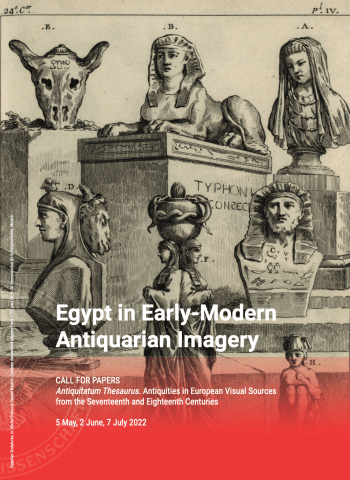 In 2022, Egyptology celebrates important historical events that number among the highlights in the exploration of the culture and civilization of the country by the Nile. In 1822, Jean-François Champollion succeeded in deciphering the hieroglyphics, the hieratic and the demotic scripts, by working primarily with the Rosetta Stone. In 1922, the British archaeologist Howard Carter discovered the tomb of the Pharaoh Tutankhamun in the Valley of the Kings.
The academy research project “Antiquitatum Thesaurus” would like to contribute to the international discourse and, in three half-day digital workshops in the summer semester of 2022 (5 May / 2 June / 7 July), draw attention to some central questions of the early-modern reception of Egypt, which preceded the events mentioned above.
How did contacts with the land of the pharaohs and their culture come about, and what image of it was conveyed? What role did aegyptiaca play in collections of antiquities, cabinets des curiosités or Wunderkammern? How were Egyptian or Egyptianising artefacts visually documented and discussed?
Before Napoleon’s great military expeditions and the subsequent scientific explorations of the country, when the number of travellers to the Levant was still manageable, the perception and understanding of Egypt far from the Nile had to rely primarily on easily portable objects. These had found their way to the other side of the Mediterranean at different times and along different routes. Finally, the study of ancient Greek and Roman authors, who transmitted their own mediated version of history and Egyptian culture, should not be underestimated.
Besides religious motivations, commercial and political activities or the desire to explore that lost or forgotten civilization, discoveries in Europe also stimulated further interest in Nilotic culture. Archaeological finds in Italy, France, Spain, German countries and Britain brought to light artefacts from the Roman imperial period. Through them people assimilated and adapted aspects of Egyptian religion, culture or aesthetics. They were collected together with artefacts from Egypt both as curiositates and as objects of study.
In the course of the early-modern period, a broad spectrum of antiquarian knowledge about Egypt was formed on the basis of these heterogeneous and today often not yet fully tangible foundations, and illustrated by an accompanying world of images.
The project “Antiquitatum Thesaurus” takes on the digital recording and indexing of antiquities in the graphic sources of the 17th and 18th centuries. It has begun this process with the subject area: “Egypt: On the Search of Origins.” Selected, representative illustrated printed works and drawing volumes dedicated to the material legacy of Egypt—or what was considered to be Egyptian—will be analysed. In addition to identifying the illustrated artefacts and architectural works, whether still preserved today or not, the project also aims to describe the methods of recording and conveying the mostly three-dimensional objects on paper, i.e. in a two-dimensional space. Furthermore, digital processing opens up possibilities for recognizing and illustrating spatial, temporal and personal chains within the transmission of knowledge and images across the widely scattered source material.
The subject areas of the three workshops include:
• The protagonists: A consideration of the circulation of artefacts through intermediaries, antiquarians and collectors as well as their reception and representation in drawings and printed works. Particular attention will be paid to how these figures were interconnected between c. 1600 and 1750.
• Multifaceted Egypt: How was the imagery or the idea of Pharaonic Egypt changed or complemented by small-scale artefacts such as amulets, jewellery and funerary objects alongside the familiar monumental evidence such as obelisks or sphinxes?
• The history of reception: What was the basis for the depictions of the many aegyptiaca in the graphic volumes of the time: direct observation or copies based on earlier publications? How exactly did the exchange of drawings and prints, descriptions etc. take place among the members of the European république des lettres?
We plan 20-minute talks in German or English. We kindly ask you to send an abstract relating to the aforementioned topics—alternative proposals are also welcome—of maximum 500 words in German, English, Italian, or French including a short CV to: thesaurus(at)bbaw.de by 11 March 2022. Please indicate the language in which you would like to speak. An answer will be given by 18 March 2022.










leave a comment