Call for Articles | William Hogarth and Cinema

Paul Sandby, Satire with Hogarth as a Magic Lantern Projecting a Parody of his ‘Paul before Felix’, 1753, etching
(London: British Museum, Cc,3.12)
◊ ◊ ◊ ◊ ◊
From the Call for Papers:
William Hogarth and Cinema
Special issue of Ecrans (Spring 2024), edited by Marie Gueden and Pierre Von-Ow
Abstracts due by 5 September 2022; drafts due by 30 March 2023
According to Sergei Eisenstein, “Diderot talked about cinema.” It could likewise be suggested that the eighteenth-century artist William Hogarth (1697–1764) inaugurated cinematic discourse. Through his visual and theoretical work, Hogarth offers a crucial contribution to the narrative and aesthetic reflections that predate—and somehow anticipate—the invention of cinema. Eisenstein did indeed comment upon and commend Hogarth’s visual productions (praising in particular his stage-like compositions and visual narratives articulated in sequences of images). The Russian filmmaker admired his English predecessor’s artistic theory, preoccupied with the movement of bodies and gazes: Eisenstein appropriated the idea of a “line of beauty” developed in Hogarth’s The Analysis of Beauty in his directing and editing. Yet, the filmic potentialities of Hogarth’s work and ideas still await extended critical and scholarly attention. The artist’s name appears sporadically in film studies that mention his influence for set designs—especially in Hollywood where Fritz Lang, Mark Robson, and Stanley Kubrick, among others, drew from Hogarth’s works to stage their historical films—and on the legacy of his artistic writings in film theory and criticism. The abundant art historical literature devoted to Hogarth, however, rarely evokes the artist’s cinematographic legacy. A special issue of the peer-reviewed journal Ecrans (No. 20, Spring 2024), to be published in French and English, seeks to explore the largely understudied connections between William Hogarth and global and expanded cinema.
We invite papers on topics that may include (but are not limited to):
• Pre-cinema, with particular emphasis on magic lanterns and early cinema, for example, filmed tableaux vivants
• William Hogarth in Hollywood, especially in the studios’ archives
• The temporality of images and sequencing of visual narratives
• Graphic novels, illustrated journals, and cartoons
• Adaptations of literary ‘Progresses’ between prints, paintings, theatre, performance, film, TV series, etc.
• Case studies from global cinema, including art documentaries
• Experimental cinema, particularly the challenging of narrative linearity
• The legacy of Hogarth’s satirical work in comedy, including productions featuring Hogarth as a character of fiction
• The legacy of Hogarth’s artistic theory and his “line of beauty” in film theory (for example through various visual shorthand systems) and criticism
• Marxist, feminist, and post-colonial currents in the reception of Hogarth’s work
Please submit a proposal by 5 September 2022 in English or French (up to 400 words), as well as a short bio, to the guest editors of this special issue: Marie Gueden (marie.gueden@univ-lyon2.fr) and Pierre Von-Ow (pierre.von-ow@yale.edu). Final papers should not exceed 8000 words. First drafts expected on 30 March 2023 for publication in April 2024. Feel free to contact us if any questions should arise before submitting your proposal. More information about Ecrans is available here.
Call for Papers | Fashioning Masculinities: The Art of Menswear
From ArtHist.net:
Fashioning Masculinities: The Art of Menswear
Victoria and Albert Museum, London, 13–14 October 2022
Proposals due by 19 June 2022
The exhibition Fashioning Masculinities: The Art of Menswear (V&A, 19 March — 6 November 2022) serves as a catalyst for a two-day symposium exploring how masculinity has been fashioned and refashioned from Renaissance Europe to the global contemporary.
The symposium—organised by the V&A Research Institute in collaboration with the Centre for Fashion Curation and the Masculinities Research Hub at London College of Fashion, University of the Arts London— invites scholars, curators, and practitioners from the fields of fashion, art history, performance, material culture, and gender studies to propose papers that respond to the themes and key concepts addressed in the exhibition. We welcome proposals from researchers at all stages of their career and practitioners engaging with the themes expressed in the call. Proposals comprising a 250-word abstract and 150-word biography should be sent to m.franceschini@vam.ac.uk by 19th June 2022.
Call for Papers | Early Modern Women on Politics and Ethics
From ArtHist.net:
Early Modern Women on Politics and Ethics
University of Gothenburg, Sweden, 5–7 October 2023
Proposal due by 1 February 2023
In Nicomachean Ethics and Politics, Aristotle conceived ethics and politics to be both interrelated and exclusively male endeavors. This notion continued to be influential in the early modern period (c. 1500–1800). Yet in recent decades, feminist scholarship has showed that throughout the early modern world numerous women nonetheless discussed, developed, and challenged politics and ethics in profound and often surprising ways.
The conference Early Modern Women on Politics and Ethics is organized by the Early Modern Seminar and the research network Philosophy in Other Words, at the University of Gothenburg, Sweden. It is dedicated to early modern women’s engagement with politics and ethics as philosophers, authors, critics, translators, editors, artists, patrons, salonnières, pamphleteers, political agents, letter writers, etcetera. Multidisciplinary in scope, the conference will bring together scholars working in various scientific fields. We especially welcome contributions that concern underexplored geographical contexts, languages, and traditions.
Suggested topics include, but are not limited to
• Marginalized voices in politics and ethics
• Genres of political and ethical writing
• Representations of political and moral authority
• Subversive political and ethical thought
• Global perspectives on politics and ethics
• Public and private agency
• Material aspects of politics and ethics
• Reception and circulation of political and ethical thought
• Ethics and politics of sexuality
• Politics and ethics in religious contexts
Confirmed Keynotes
• Unn Falkeid, University of Oslo
• Carin Franzén, Stockholm University
• Dena Goodman, University of Michigan
• Marie-Frédérique Pellegrin, Jean Moulin Lyon 3 University
• Melissa E. Sanchez, University of Pennsylvania
To submit, please send a 300-word proposal for a 20-minute paper and a brief biographical note to earlymodern@lir.gu.se by 1 February 2023. Notice of acceptance will be given by 1 March 2023.
Organizing Committee
Maria Johansen, Cecilia Rosengren, Matilda Amundsen Bergström, Alexandra Herlitz, Philip Lavender
Call for Articles | Thresholds 51: Heat
From Thresholds:
Thresholds 51: Heat
Edited by Hampton Smith and Zachariah DeGiulio
Submissions are due by 1 June 2022
 Thresholds is the annual peer-reviewed journal produced by the MIT Department of Architecture, held in over 150 university art & architecture libraries around the world. Content features leading scholars and practitioners from the fields of architecture, art, and culture.
Heat is elusive: always on the move, always fugitive. Though we have many signs of its presence—sweating, ‘hot’ and ‘cool’ media, sitting under the shade, catching fire—heat itself largely evades conventional forms of representation. As the transference of energy from one system to another, heat radiates and penetrates. Immanent and intense, heat binds and nourishes as much as it reshapes or destroys. While helping us navigate the material world as tool, medium, and affect, heat forces us to come to terms with the fragility of the systems in which we take part. And though temperature is regularly mapped across graphs and thermometers, the feeling of heat is often so localized and so personal that it evades historic perception altogether. Even if we know things are hotter now than they were yesterday, where is heat within art and architecture practice?
Thresholds 51: Heat takes enthalpy—the thermodynamic property that comprises heat, pressure, and volume to effect chemical state change—as its guiding principle. We seek scholarly writing, artistic interventions, and criticism from art, architecture, and related fields to apply pressure within the volume to effect disciplinary state change. We aim to discover the ways art and architecture have historically navigated, wielded, and avoided heat.
Courtyard buildings across the Islamic world produce thermal delight; Mande blacksmiths carefully wield heat to make iron tools for repairing and nourishing communities; museum conservators curate temperature-controlled environments for artworks; Yurok practices of fire stewardship regulate natural rhythms of growth and decay. And though thermodynamic flux underlies such practices of making and maintenance, heat just as frequently effaces or prevents knowledge production—think of the conflagration of the University of Cape Town’s special collections or mold consuming boxes of archival material.
Recognizing that heat has never been evenly felt, from the violently racialized fictions of the ‘torrid zone’ to the lack of adequate shade in urban communities, we are particularly invested in alternative architectural or aesthetic mobilizations of heat—in the contestation of thermal violence, in the activation of ritual, or in the warmth of community, desire, and lust. A critical account of heat within art and architecture must attend to its use as a medium and structure of violence, while nevertheless exploring how ‘feeling the heat’ productively links scales of being, practices, and types of labor.
Please send all submissions to the editors via email at thresh@mit.edu with the subject heading THAT’S HOT. Essay submissions should be in English, approximately 3000 words, and formatted in accordance with the Chicago Manual of Style. Submission should include a brief cover letter, contact information, and bio of 50–75 words for each author. Text should be submitted in MS Word. Images should be submitted at 72 dpi as uncompressed TIFF files. Other creative proposals, including, but certainly not limited to, performances, poetry, and film are not limited in size or medium. All scholarly submissions are subject to peer review.
Call for Papers | Shipwrecks in Art, History, and Archaeology
From ArtHist.net:
Resurfacing: Shipwrecks in Art, History, and Archaeology
The Warburg Institute, The Royal Museums Greenwich, London, 11–12 November 2022
Proposals due by 27 May 2022
Organized by Caspar Pearson, Johannes von Müller, Andrew Choong Han Lin, and Imogen Tedbury
Every sea voyage entails the possibility of disaster. This makes the motif of the shipwreck a highly significant symbol, to which its popularity as an artistic subject in the early modern period attests. Today, the potential symbolism of a shipwreck and its contents remains key to marine archaeology. Since Plato, the ship can act as a metaphor for a state and consequently a state can also invest itself into its ships—and its shipwrecks. Examples like the Mary Rose (1545) or the Titanic (1912) demonstrate how these structures can, in the public imagination, become era-defining symbols of certain technological or social achievements. Archaeology can reveal wondrous relics of a wreck’s active life, a snapshot of the past frozen in the moment of the vessel’s abrupt end.
The shipwreck, already a versatile metaphor, can therefore also serve as a figure for history itself. In his architectural treatise, Alberti, who dabbled in nautical archaeology when he attempted to raise an ancient ship from the bed Lake Nemi, discusses Vitruvius as one of the few survivors of a shipwrecked antiquity. In turn, Winckelmann likens the ruins of classical artworks to the fragments of a ship that can never be seen in its entirety. In these two key moments in the history of art history, the figure of the ship signifies the suspension of time, and the shipwreck, in consequence, marks the end of an era. Perhaps it is for this reason that Jacob Burckhardt would eventually conceive of the scholar drifting upon vast seas of past and present turmoil.
As the horizons of art history have expanded beyond their former Eurocentric focus, increasing interest in processes of exchange, trade and migration have also led to the discovery of sunken treasures that are now claimed as objects of study. In this context, the shipwreck may eventually reveal itself as a guiding principle for art history written on the fragmented grounds of surviving data. This conviction, however, demands to take into account the systemic suppression of marginalised histories, gradually resurfacing and challenging scholars to review their standpoint.
Considerations like these spark a variety of questions. What meaning does the figure of the shipwreck hold for art history, archaeology and related disciplines? Are the vessels lost at sea merely shattered cabinets of forgotten wonders that are now resurfacing? Or does the interest in them which art historians and archaeologists share with maritime historians, literary scholars and artists hold the potential to recalibrate an understanding of the knowledge produced in confrontation with material objects of both past and diverse aesthetics? And how do questions such as these resonate in a moment in which the dangers of the voyage by sea are very real and not metaphorical at all for hundreds of thousands who desperately try to cross the bodies of water separating the Global South from the Global North?
This two-day conference, held on 11 and 12 November 2022 in London at the Warburg Institute and the Royal Museums Greenwich, invites scholars from a variety of fields—art history, archaeology, history of ideas, literary studies, and others—in order to discuss the following topics and more:
a) material and epistemic cultures of shipwrecks
b) the shipwreck as a subject in the arts of the past and the present alike
c) the shipwreck as a metaphor as which it runs through histories of both literature and scholarship
d) the shipwreck as a potential paradigm for an expansion of subject areas in art history, archaeology and related fields.
Please send a proposal of 300 words max. together with a short CV to caspar.pearson@warburg.sas.ac.uk by 27 May 2022.
Organisers
Dr Caspar Pearson (The Warburg Institute), Dr Johannes von Müller (Christian-Albrechts-Universität Kiel), Andrew Choong Han Lin, and Dr Imogen Tedbury (The Royal Museums Greenwich)
Call for Papers | The Science of Taste in the 18th Century
From Fabula.org (which also includes the accompanying bibliography) . . .
La Science du Goût au XVIIIe Siècle
Special issue of Revue Internationale d’étude du dix-huitième siècle (RIEDS), edited by Guilhem Armand and Emmanuelle Sempère
Proposals due by 1 June 2022; completed essays due by 1 November 2022
« Ce sens, ce don de discerner nos aliments, a produit dans toutes les langues connues, la métaphore qui exprime par le mot goût, le sentiment des beautés et des défauts dans tous les arts »
–Voltaire, « Goût (Gramm. Litterat. & Philos.) », Encyclopédie, vol. VII (1757).
« Une espèce de toucher plus fin, plus subtil »
–Jaucourt, « Goût (Physiolog.) », Ibid.
Ce siècle, qui est celui de l’Encyclopédie, qui, en quelque sorte, s’ouvre avec l’ennoblissement de la science par Fontenelle qui parvient dans le même temps à en faire un objet de plaisir, et se clôt avec La Physiologie du goût, n’est-il pas celui où tente de s’élaborer une véritable science du goût ?
Le 18e siècle – ou, plus largement, le grand âge classique – est en effet la grande période de théorisation du goût, mais la labilité du terme rend en même temps la notion rétive à toute tentative de définition stricte. Pourquoi désigner de l’un des cinq sens ce qui flatte l’oreille (un air), charme la vue (un tableau), plaît à l’esprit ou au cœur ? Pourquoi même désigner d’un sens corporel ce qui stimule l’esprit ou heurte les règles sociales ? Enfin, pourquoi parmi ces cinq sens choisir l’un des moins « nobles », et peut-être le moins attendu (et non pas l’odorat, l’expression « avoir le nez fin » étant attestée depuis au moins 1694) ? Car il convient de noter que les choses de la table et tout ce qui s’y rapporte relèvent du péché de gourmandise dont, rappellent médecins et théologiens de l’époque, on est puni par l’indisposition ou la maladie. Or, il n’est peut-être pas indifférent que cette association entre un sens et un jugement se cristallise à une époque où la gourmandise commence à être réhabilitée, où la gastronomie naît et acquiert progressivement ses lettres de noblesse, tandis que les belles lettres deviennent littérature. Au même moment, un domaine du savoir se dégage au croisement des disciplines artistiques et de la philosophie : l’esthétique. Le goût, ce serait donc ce terme qui permet d’évoquer à la fois une sensation, une émotion et un jugement, une intuition et une théorie.
Durant cette même période, ce que l’on appelle le goût français se répand dans toute l’Europe et même au-delà, pour devenir durablement synonyme du bon goût. La notion revient sans cesse, pour définir une convenance sociale dans les apparences, caractériser une posture, un langage, une réussite ou un échec littéraire, théâtral, artistique, mais aussi tout simplement pour désigner la saveur d’un mets. Le goût cristallise aussi des enjeux politiques et entretient des liens forts avec les notions d’esprit des nations et de génie : c’est peut-être ce qui explique l’intérêt grandissant des Lumières pour ce concept difficile, cousin du je-ne-sais-quoi, et la multiplication des tentatives de définition qu’il suscite, voire des querelles, au moment même où s’élabore la science esthétique, où le mot et l’idée d’original changent de statut, où la notion d’expérience humaine s’individualise. La question du goût se pose de façon d’autant plus intéressante que la littérature fait une place de plus en plus grande à une vie psychique clairement ancrée dans la vie physique. Cette science du goût qui s’élabore se situe ainsi au cœur du partage des savoirs qui caractérise le 18e siècle : au confluent de différents domaines, elle s’en enrichit, non sans éviter le risque d’une certaine confusion.
La question du goût au 18e siècle a fait principalement l’objet de deux types d’approche, résonnant avec l’analogie étudiée dans l’article du même nom dans l’Encyclopédie de Diderot et D’Alembert : le goût comme sens physique, renvoyant à la gourmandise, et le goût en lien avec l’esthétique au moment où cette science émerge. Les travaux de Jean-Claude Bonnet – du numéro 15 de DHS à son ouvrage La Gourmandise et la faim, 2015 – ainsi que ceux de Béatrice Fink, et d’historiens comme Philippe Meyzie (Lumières n° 11 « La Gourmandise entre péché et plaisir ») ont enrichi et affiné notre connaissance de la réhabilitation du péché de gourmandise, de la transformation des arts culinaires en ce qui s’appellera bientôt la gastronomie (1801), des débats techniques, médicaux et philosophiques. Si quelques travaux comme ceux de Frédéric Charbonneau (L’École de la gourmandise, 2008) font le lien entre esthétique – et en particulier littérature – et gourmandise, les deux domaines restent le plus souvent distincts. Cependant, les positions et postures des auteurs du 18e siècle en matière de morale et d’esthétique sont de plus en plus interrogées aujourd’hui sous l’angle d’une sensibilité concrète, voire d’une physiologie. Depuis les travaux d’Alain Corbin, les « cultures sensibles » sont devenues un objet historique et plus généralement l’anthropologie sensorielle très active outre-Atlantique depuis les travaux de Howes et de Classen trouve un assez large écho dans l’ensemble des sciences humaines. Ces approches sont d’autant plus pertinentes pour le goût qu’il engage une sensorialité dite « basse » en dépit des opérations de symbolisation dont il fait l’objet – l’homologie avec le jugement de valeur en est une. Force est en effet de constater que si le goût participe, tout comme la vue, des deux ordres de la sensibilité que constituent la morale et la sensation, il conduit bien davantage, ou plus directement, dans les ressacs de la sensation et de ses ressorts physiologiques. Serait-ce à dire que le « goût » le plus « sublime » relèverait de ce qu’il y a de plus matériel en nous[1] ? On pourrait en prendre pour preuve les coups de boutoir dont le Neveu attaque l’édifice du bon goût et qui bouleversent l’ordre moral et esthétique du Philosophe de la Satire seconde. Lequel confesse une forme de dégoût : « Je commençais à supporter avec peine la présence d’un homme qui discutait une action horrible, un exécrable forfait, comme un connaisseur en peinture ou en poésie examine les beautés d’un ouvrage de goût[2] ». Celui qui mange mal (ou peu, ou trop) et celui qui mange bien (à satiété, en bonne compagnie, avec mesure et choix) dessinent ainsi les contours de goûts concurrents, qui questionnent et mettent à mal les idéaux de sociabilité et d’universalité.
Le goût s’envisage avec profit par son envers, ou son dessous, qu’il s’agisse du “mauvais goût” ou du “dégoût”. Le premier a été envisagé par Jennifer Tsien relativement à l’esthétique du 18ème siècle (Le Mauvais goût des autres, 2017) et par Carine Barbafieri et Jean-Christophe Abramovici sous un angle résolument transversal (L’Invention du mauvais goût à l’âge classique, 2013). Le second a fait l’objet d’une journée d’étude en mai 2019 à l’Université d’Aix Marseille (« Le Dégoût : vécu, perception, représentations et histoire »).
C’est à la fois dans la lignée de ces travaux récents ou plus anciens, et dans une perspective renouvelée, que se situe cet appel. La richesse et la diversification des travaux sur le goût dans ces dernières décennies montrent à quel point les enjeux du goût débordent les questions purement esthétiques ou idéologiques. Cet appel à communication voudrait donc envisager la catégorie du goût non plus seulement dans ses fonctions normatives ou axiologiques, ou dans ses dimensions sociologiques ou esthétiques, mais aussi en tant que catégorie épistémique et scientifique. Il s’agira d’interroger la notion de “goût” au 18e dans le champ des savoirs, pour mieux comprendre les enjeux heuristiques et méthodologiques que les philosophes, écrivains, artistes, savants et amateurs ont voulu lui prêter.
Ce dossier de RIEDS s’intéressera donc au goût sous toutes les formes et dans tous les sens que lui donne le XVIIIe siècle, mais en mettant en particulier l’accent sur le lien entre les deux termes de la métaphore, les deux sens du goût, et en postulant que ce lien n’est pas seulement de l’ordre de l’histoire esthétique ou des mentalités. La labilité des notions de bon et de mauvais goût, l’empirisme qui préside au choix du terme goût pour parler de préférence esthétique et, parallèlement, l’ambiguïté qui caractérise la gastronomie encore naissante et pas encore ainsi nommée doivent avoir partie liée. C’est pourquoi nous envisageons l’angle de la science du goût, qui permet de s’intéresser au lien qu’opère cette notion entre l’intuitif et le rationnel : le goût apparaît en effet comme un point de jonction important entre une appréhension concrète – induite par le sens premier – et une signification plus abstraite, en quelque sorte à l’image de ce lien permanent entre arts et théories, fiction et savoir, qui est au cœur des écrits des Lumières. Le goût, devenu objet d’un discours savant, cristallise en effet les différends philosophiques de toute farine. Prise entre les feux du rationalisme et de la subjectivité, de la physiologie et de la morale, la science du goût ne risque-t-elle pas la contradiction ? Et ne cristalliserait-elle pas ainsi une « révolution morale » (au sens de K.A. Appiah[3]) ?
Si Kant ou Burke ont tenté de revisiter l’idée que l’esthétique pourrait se passer d’un rapport direct et sensitif, voire sensuel, aux objets, n’est-ce pas qu’il y avait bien, chez tant d’autres théoriciens, notamment les Encyclopédistes (Diderot et Jaucourt, en particulier), en partant de la physiologie, un matérialisme sourd travaillant cet ennoblissement du sens ? Mais le point de départ physiologiste n’est pas nécessairement matérialiste et peut abonder d’autres théories, comme celles du médecin et écrivain Tiphaigne de La Roche, qui tenta une solution hybride (sinon incertaine, voire confuse) de matérialisme spiritualiste.
En forçant le trait, un hiatus se dessine entre une conception subjectiviste du goût, sur lequel elle fait peser un risque d’obscurité, d’illégitimité, de solipsisme, et une conception sensitive et physiologique qui voudrait gommer la labilité du jugement de goût dans une perspective positive et scientifique. À cette aune doublement complexe, les goûts et les dégoûts des savants, des artistes et des écrivains de la période, ne nous parlent plus seulement de leur sensibilité, mais peuvent informer une histoire émotionnelle des mentalités, qui pourra s’appuyer sur les travaux de Françoise Waquet[4]. Aussi, l’examen de l’hypothèse d’une science du goût en construction au fil du siècle pourra-t-il se doubler d’une réflexion sur le savoir que nous construisons nous-mêmes sur le goût que les hommes et les femmes des Lumières ont manifesté, sans le théoriser, mais en l’expérimentant sans relâche et de multiples façons, pour une science mêlée, dont on rappellera qu’elle ne s’inféode pas à l’objectivité moderne.
Les contributions (en histoire des idées, histoire et théories de l’art, littérature, histoire culturelle) pourront aborder les axes suivants :
Les savoirs sur le goût: la critique a déjà défriché toute cette littérature autour de la gourmandise et du goût au sens physiologique, ainsi que les nombreux textes théoriques tels que les préfaces de manuels culinaires (J.-C. Bonnet, B. Fink), les ouvrages de médecine, les traités savants sur l’agronomie (on pense évidemment à Parmentier), et les correspondances d’auteurs qui révèlent goûts et dégoûts, excès et régimes. Si on prolonge l’enquête, ces textes peuvent-ils se lire comme le lieu où se pense le passage du sens matériel à sa symbolisation, où s’interroge le lien entre la perception subjective du goût et le défi théorique tendant à une forme d’universalisme ? Que nous disent, par exemple, les plaisirs d’Émilie du Châtelet ou les raffinements libertins du rapport entre l’individuel et le politique ?
Matérialité du goût et sensualisme. Comment s’articulent les théories du goût (dans tous les sens) et le sensualisme des Lumières ? Qu’impliquent les bouleversements épistémiques touchant la sensation sur la définition du jugement de goût ? Le goût peut-il relever de la pure matière ? Un savoir abstrait peut-il se passer d’un rapport direct, sensitif, voire sensuel aux objets ? Du côté de l’esthétique, il s’agira de s’intéresser à ce glissement du je-ne-sais-quoi à l’originalité, à ce moment où le goût déborde les règles de la Technè. On pourra s’intéresser aux arts d’agrément, aux querelles esthétiques, à la question de la permanence ou de l’universalité du grand goût par rapport aux théories relativistes, ainsi qu’aux questionnements sur la postérité.
Les goûteurs et les dégoûtants : sociologie et anthropologie du goût. À cette époque où se redéfinit le sublime, où l’association du beau et du bien se trouve remise en question, où les frontières du bon et du mauvais goût semblent mouvantes, c’est aussi fondamentalement le rapport du goût à la morale qui se trouve questionné, dans un siècle qui désire certes détacher la science et la philosophie d’un certain nombre de préoccupations théologiques, mais pour y fonder une éthique. Comment redéfinir le goût dans la perspective éthique des Lumières, qui s’affronte aux valeurs humanistes, aux aspirations de l’individualité et de l’harmonie sociale, à l’idée du génie des nations, aux acquis du relativisme et de l’universalisme ?
Modalités de soumission
Les propositions d’article sont à envoyer avant le 1er juin 2022, sous la forme d’un résumé ne dépassant pas 500 mots, en français ou en anglais, accompagné d’une brève notice bio-bibliographique, aux deux adresses suivantes : guilhem.armand@univ-reunion.fr et sempere@unistra.fr. Après accord du comité scientifique, les propositions retenues seront attendues pour le 1er novembre 2022. Les articles feront entre 30.000 et 45.000 caractères espaces comprises et pourront conformément aux normes de la revue être rédigés en français ou en anglais ; ils seront accompagnés d’un résumé en 500 caractères maximum, espaces comprises, et d’une biobibliographie des auteurs en 300 caractères espaces comprises.
Call for Papers | Images & Institutions, Early Modern Scientific Societies
From ArtHist.net:
Images and Institutions: The Visual Culture of Early Modern Scientific Societies
Accademia dei Lincei, Royal Netherlands Institute in Rome (KNIR), and the Bibliotheca Hertziana – Max Planck Institute for Art History, Rome, 14–16 September 2022
Organized by Katherine Reinhart and Matthijs Jonker
Proposals due by 15 May 2022
One of the most important developments in early modern science was the foundation of institutions for collaborative research and the publication of knowledge, such as the Accademia dei Lincei in Rome (1603), the Accademia del Cimento in Florence (1657), the Royal Society in London (1660), the Académie Royale des Sciences in Paris (1666), and the Scientific Academy of St Petersburg (1725). The communication of knowledge was integral to early modern processes of knowledge production in these new sites of collaborative science. Within these institutions, knowledge was not only acquired and disseminated orally and textually, but also visually. From drawings which circulated in society meetings to the printed plates in their published books, images across all media were vital to the developing practices of early modern science.
A growing body of scholarship has convincingly shown the importance of images and image-making practices to early modern knowledge production. Scholars have shown, for instance, that early modern botanists, zoologists, and physicians used drawings and prints as visual narratives to prove an argument or the existence of a species, as substitutes for the objects described, as mnemonic aids, or as tools themselves (Dackerman, Daston, Kusukawa). Research has also been done showing the important relationships between artists, natural philosophers and their collections (Baldriga, Egmond, Tongiorgi Tomasi). However, these studies have focused on single institutions or individual practitioners, and we still lack a comprehensive and comparative understanding of the relationships between visual culture and the developing practices of collaborative science.
Therefore, this project, Images and Institutions, seeks to fill that gap by bringing together an international team of historians of art and science for a three-day symposium in Rome to gain a larger picture of these relationships. Within these early institutions, images functioned in diverse ways: they communicated new ideas, recorded new phenomena, demonstrated new instruments, and stood in for missing specimens. They expressed theories, clarified arguments, organized concepts, and persuaded colleagues. Some images were created from nature or ad vivum, while others portrayed scientific ideas allegorically. In bringing together an interdisciplinary group of scholars, this symposium will reevaluate the functions of images and image-making practices that were integral to the advancement of early modern science within its formative institutions. The symposium contributes to widening disciplinary boundaries by bringing scholars from different fields into conversation and by having a wide geographical perspective.
We are interested in how images and image-making practices contributed to the collective and collaborative production and dissemination of knowledge in scientific institutions from the 16th until the 18th century. Central questions for this symposium include: What common visual practices were shared among these institutions, and importantly, where did they diverge? How did differing national artistic contexts impact the visual culture of scientific institutions? And how did these relationships shift over time with new enlightenment societies founded in the 18th century? By comparing these institutions, this symposium will explore the ways in which images and image-making practices were integral to the advancement of early modern collaborative science.
The symposium will consist of 30-minute papers, which will be the basis for a published edited volume. The symposium will take place on 14–16 September 2022 in Rome, and some travel and lodging assistance is available. Scholars of art history, visual studies, and history of science and knowledge from all career phases are encouraged to apply. We welcome abstracts which explore visual strategies in early modern collaborative science, particularly in the context of Spain, Germany, Eastern Europe, as well as non-European regions.
To apply, please send an abstract of no more than 300 words, accompanied by a brief (2-page) CV to secretary@knir.it with the subject line: ‘Images and Institutions’. The deadline for abstracts is 15 May 2022. Applicants will be notified in early June. For queries, please contact Katherine Reinhart (kmreinhart@wisc.edu) or Matthijs Jonker (m.jonker@knir.it).
Scientific Committee
Irene Baldriga (Sapienza, Università di Roma), Sietske Fransen (Bibliotheca Hertziana), Matthijs Jonker (KNIR), and Katherine Reinhart (University of Wisconsin-Madison)
This symposium is made possible with support from the Royal Netherlands Institute in Rome (KNIR), Bibliotheca Hertziana, Max Planck Institute for Art History in Rome, the Accademia dei Lincei (IT), the Association for Art History (UK), the Society for Renaissance Studies (UK), and The Huizinga Institute RNW History and Philosophy of Science (NL).
Call for Papers | The Cultural Ramifications of Water, 1650–1850
From the Call for Papers:
The Cultural Ramifications of Water in Early Modern Texts and Images, 1650–1850
A special issue of 1650–1850: Ideas, Aesthetics, and Inquiries in the Early Modern Era
Edited by Leigh G. Dillard and Christina Ionescu
Proposals due by 15 May 2022
This special issue offers a fresh, wide-ranging perspective on the agency of water in relation to knowledge, innovation, and individual or collective identity by investigating parallel and interconnected visual and/or textual representations of this fundamental element in the early modern period. We currently seek two more contributions to complete this issue that evolved from a series of panels at the 2021 virtual conference of the International Association of Word and Image Studies.
A number of bestselling novels of the early modern period include key episodes in which water—whether in the form of oceans, seas, ponds, lakes, torrents, springs, rivulets, falls, wells, or fountains—plays a crucial symbolic role, variously expressing the passions embodied by ‘nature’ or more cultivated versions of this dangerous element. Charged with significance and symbolism, these representations of water are sometimes used as a backdrop or setting to the main action, but at other times, they represent an active agent in the human dramas that unfold when characters interact with this element in its materiality and that interaction unexpectedly alters the course of their lives in consequential ways. The results are often deeply poignant—drowning, shipwreck, trauma, flooding, etc.—but they can also be positively transformative—self-discovery, spiritual healing, physical nourishment, even fulfilment, etc. Within fictional realms, water acts, moreover, as a marker of identity and place in literary cartographies, triggers vital memories and meanings, surreptitiously encodes libertine thoughts, and simultaneously separates and unifies peoples, countries, and continents. In early modern literary illustration, water is equally omnipresent, and its representation is endowed with a degree of complexity that invites a closer look from an interdisciplinary perspective.
As humans grappled with mechanisation and modernisation in the Age of the Industrial Revolution, water emerged from the background to become a key element in scientific and technical illustration. Technological innovations relying on the use of water, such as the stationary steam engine and the spinning frame, were prominently displayed and meticulously explained in encyclopedias, periodicals, and specialised treatises. Through empirical observation, both professional and amateur scientists lavished attention on natural phenomena such as geysers, waterfalls, and stalagmites and stalactites, often documenting their findings not only by conventional textual means but also inventive pictorial ones. At a time when the lack of water facilitated the spread of death and disease in overcrowded cities such as Hogarth’s London, bathing in thermal pools or exposure to seawater, which were strongly advocated in medical literature, were perceived by the wealthy as beneficial to health and healing. Prints depicting the age-old cult of water, watering-places, and structures designed to contain or manipulate the flow of water proliferated throughout Europe.
For this special issue of 1650–1850: Ideas, Aesthetics, and Inquiries in the Early Modern Era, we invite proposals engaging with texts and images that shed light on the cultural ramifications of water during this important timeframe. In particular, we are interested in the way in which images visually interpret and subtly challenge the sophisticated textual dynamics between nature and culture or investigate the multiple configurations of water. Examples of verbal and visual engagements with water and its materiality during this transformative historical period may be selected from a diverse range of fields, including angling, architecture, art, botany, garden design, geology, horticulture, hydraulics, literature, natural history, medicine, and print culture. Papers addressing word and image interaction through the following topics are particularly welcome: architecture and landscape designs as a nexus of space, place, identity, and water; connections through water between humans and the environment; and water as a healing agent, source of life, and force of nature. Proposals that engage with the topic diachronically and transnationally would enhance this special issue. Please send proposal to Leigh G. Dillard (leigh.dillard@ung.edu) and Christina Ionescu (cionescu@mta.ca) by May 15, 2022.
Call for Papers | Slave Dwelling Project Conference
Overlapping with The Stono Legacy Project, a month-long commemoration of the 1739 Stono Rebellion, this year’s Slave Dwelling Project Conference will take place in a hybrid format, with in-person activities in and around Charleston as well as live-streamed virtual events. From the Call for Papers:
The 1739 Stono Rebellion and the Atlantic World
Seventh National Slave Dwelling Project Conference
College of Charleston, 8–10 September 2022
Proposals due by 1 May 2022
 The Stono Rebellion, a transformative event in the history of enslavement in the Americas, tells a powerful story of resistance and resilience. In September 1739, against near-impossible odds, a group of enslaved South Carolinians south of Charleston armed themselves and set out to make their way to freedom in Spanish Florida. As they marched through the countryside, they were confronted by an armed white militia and engaged in bloody combat. Many of the rebels were murdered; others faced execution after the fighting or were re-enslaved. Only a handful survived into freedom. In its immediate aftermath, the 1739 Stono Rebellion led to restrictive slave codes in South Carolina, which quickly spread throughout the American South. At the same time, word of the courageous rebellion spread throughout the Atlantic world, inspiring multiple acts of defiance.
This early-American story of rebellion, resistance, and resilience powerfully impacted the 18th- and 19th-century Atlantic world, and continues to wield power today as we seek to unearth the full story of African American resistance to enslavement, and to celebrate the extraordinary legacy of African American resilience. The 2022 Slave Dwelling Project Conference: The Stono Rebellion and the Atlantic World seeks to examine not only the 1739 rebellion but also its remarkable legacy—one that continues to resonate throughout the world today in the ongoing fight for racial justice.
The conference will take place 8–10 September 2022, at the College of Charleston in Charleston, South Carolina. Concurrent with The Stono Legacy Project, a month-long commemoration of the 1739 Stono Rebellion, this 7th national SDP conference will employ a hybrid format, with in-person activities in and around Charleston as well as a number of live-streamed virtual events.
Conference organizers welcome proposals for both 60-minute and 90-minute sessions on the Stono Rebellion itself as well as other important rebellions by enslaved Africans throughout the Atlantic World. We are also seeking sessions on the subsequent legacy of these events—up to and including the present day. We welcome both scholarly presentations, panels, and round-tables as well as sessions on historic sites and interpretation, and cultural offerings. Proposals will be accepted between 15 March 15 and 1 May 2022. Questions should be directed to the Slave Dwelling Project at slavedwellingproject@gmail.com.
Key partners in the 2022 Slave Dwelling Project Conference are the Carolina Lowcountry and Atlantic World (CLAW) Program at the College of Charleston, the National Underground Railroad Network to Freedom Program, and the Slave Dwelling Project. Major funding for the conference has been generously provided by the 1772 Foundation.
Developed by a collective of cultural organizations, the Stono Legacy Project includes a month-long series of public programming surrounding South Carolina’s Stono Rebellion, its impact on antislavery and Civil Rights activism, and its contemporary relevance. Key partners in the Project are the Carolina Lowcountry and Atlantic World (CLAW) Program at the College of Charleston; the Caw Caw Interpretive Center in Ravenel, SC; Charleston County Parks; the Fort Mose Historical Society in St. Augustine, FL; the Gullah Geechee Cultural Heritage Corridor; the International African American Museum in Charleston, SC; the National Underground Railroad Network to Freedom Program; the Slave Dwelling Project; and historians Jane Landers of Vanderbilt University and Peter H. Wood, professor emeritus of Duke University.
◊ ◊ ◊ ◊ ◊
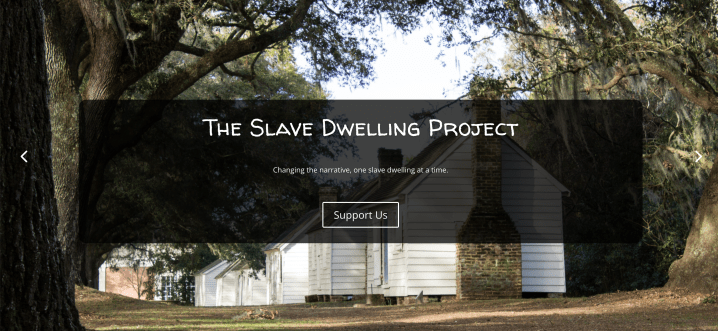
The Slave Dwelling Project envisions a future in which the hearts and minds of Americans acknowledge a more truthful and inclusive narrative of the history of the nation that honors the contributions of all our people, is embedded and preserved in the buildings and artifacts of people of African heritage, and inspires all Americans to acknowledge their Ancestors.
Mission
1 Raise awareness and organize resources to preserve, interpret, maintain and sustain extant slave dwellings and other structures significant to the stories of the enslaved Ancestors.
2 Bring together scholars and practitioners, preservationists, students and educators, writers, artists, legislators, organizations and businesses with the general public to:
• Change the narrative of American history and address the legacies of slavery,
• Preserve and sustain slave dwellings,
• Promote education about slavery and the contributions of African Americans,
• Engage in conversation about all these matters.
3 Support and encourage individuals and organizations to preserve and mark sites related to the institution of slavery and the legacy of slavery.
4 Educate ourselves and others about the intertwined history of Americans of African and European origins, from the country’s founding to the present, to help us rewrite the narrative of history, preserve slave dwellings, and have dialogue about the legacies of slavery.
5 Engage people in honest conversations about slavery, race, racism and racial equity in search of improved racial relations.
What We Do: The Slave Dwelling Project . . .
• Gives talks and presentations.
• Organizes and conducts overnight stays at sites associated with slavery.
• Presents living history programs, “Inalienable Rights: Living History through the Eyes of the Enslaved.”
• Holds a major conference annually and at least one mini-conference each year.
• Provides consultation and networking support for those interested in preserving an extant slave dwelling.
Call for Papers | The Longue Durée of Cultural Heritage
From ArtHist.net:
The Longue Durée of Cultural Heritage: Curation of the Past from Antiquity to the Present Day
Norwegian Institute in Rome, 5–7 December 2022
Proposals due by 15 May 2022
An interdisciplinary conference at the Norwegian Institute in Rome (University of Oslo), in collaboration with the Heritage Experience Initiative (HEI), University of Oslo.
Across the world, there is a burgeoning interest in cultural heritage, among academics and professionals, as well as in politics. While heritage is typically thought of as a modern concept with origins in the late-eighteenth and nineteenth centuries, there is ample proof that pre-modern societies curated their pasts in highly comparable ways. Starting from the understanding of cultural heritage as a process, we recognize certain practices regarding the management of spaces, monuments, and objects in pre- and early modern societies as congruent to types of activity commonly placed within the heritage rubric. By adopting a long-term approach to the subject, this conference aims to create opportunities for new lines of research across disciplines. This includes examining historical examples to contextualize, interrogate, and deepen our understanding of modern approaches to heritage. Moreover, developments in contemporary heritage theory and practice can provide a fresh and productive framework for examining and categorizing processes in the past. By bringing together scholars working on issues of heritage in the present day with those studying similar ideas in more remote, historical contexts, this interdisciplinary conference aims to foster a dialogue which can enrich analyses of heritage practices in the past and in the present day.
We invite contributions from scholars with a contemporary and/or historical focus (in particular, we welcome research on pre-modern periods). Relevant themes include (but are not restricted to):
• Methodologies of heritage
• Case studies of pre-modern heritage curation/preservation
• Authenticity
• Destruction and iconoclasm
• Ruins and reconstructions
• Commodification
• Preservation as deconsecration
• Restoration
• Are texts intangible heritage? Textual heritage(s) and their material dimensions: epigraphy, archives, corpora, etc.
• Images/representations of heritage processes
Please submit a paper proposal of no more than 250 words and a short CV (half page) to k.b.aavitsland@roma.uio.no by 15 May 2022. Scholars without funding from their home institutions may apply for travel grants to the same address.
Confirmed invited speakers include Thora Petursdottir (HEI/University of Oslo), David C. Harvey (Aarhus University), Birgit Meyer (University of Utrecht), Chiara Mannoni (Ca’ Foscari University of Venice), Lars Boje Mortensen (University of Southern Denmark), Anne Eriksen (University of Oslo), Arnold Witte (University of Amsterdam), and Christopher Whitehead (Newcastle University).










leave a comment